Analysis of Management Issues in Hospitality and Tourism (HAT203)
VerifiedAdded on 2023/06/09
|6
|1265
|196
Report
AI Summary
This report analyzes the key management issues in the hospitality and tourism industry, as required for the HAT203 course. The report is structured into four main contexts: operational, human resources, financial, and product/markets. In the operational context, it highlights challenges such as quality management and complex data management, especially in multi-property hotels and during peak seasons. The human resource context focuses on issues like high employee turnover and low staff morale. The financial context addresses problems such as decreased sales in the off-season and capital shortages. Finally, the product or markets context discusses failures in service delivery and inadequate marketing efforts. The report provides a comprehensive overview of current challenges and trends, supported by scholarly publications and references.
1
Hospitality and Tourism Management
Paraphrase This Document
Need a fresh take? Get an instant paraphrase of this document with our AI Paraphraser

HOSPITALITY AND TOURISM 2
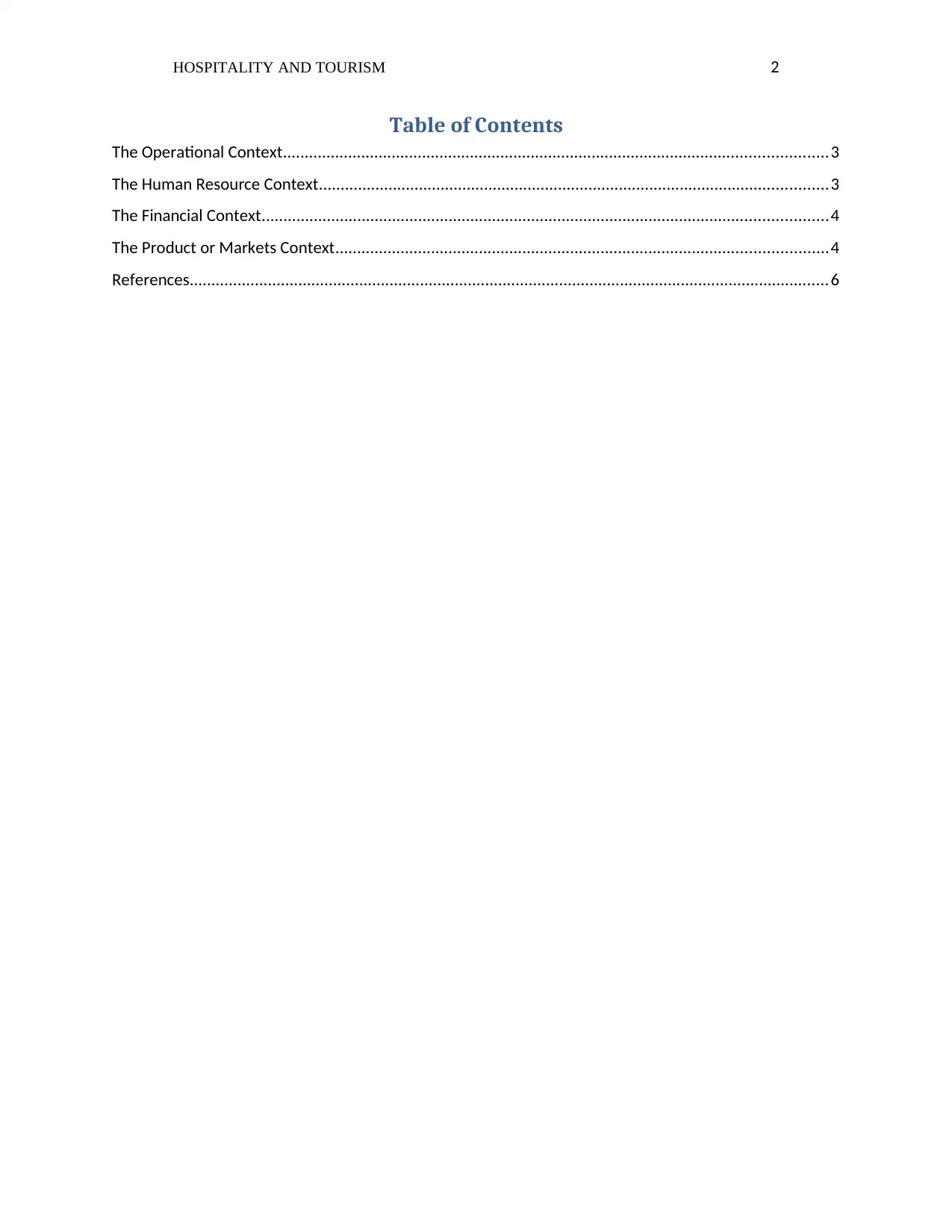
Table of Contents
The Operational Context.............................................................................................................................3
The Human Resource Context.....................................................................................................................3
The Financial Context..................................................................................................................................4
The Product or Markets Context.................................................................................................................4
References...................................................................................................................................................6
Table of Contents
The Operational Context.............................................................................................................................3
The Human Resource Context.....................................................................................................................3
The Financial Context..................................................................................................................................4
The Product or Markets Context.................................................................................................................4
References...................................................................................................................................................6

HOSPITALITY AND TOURISM 3
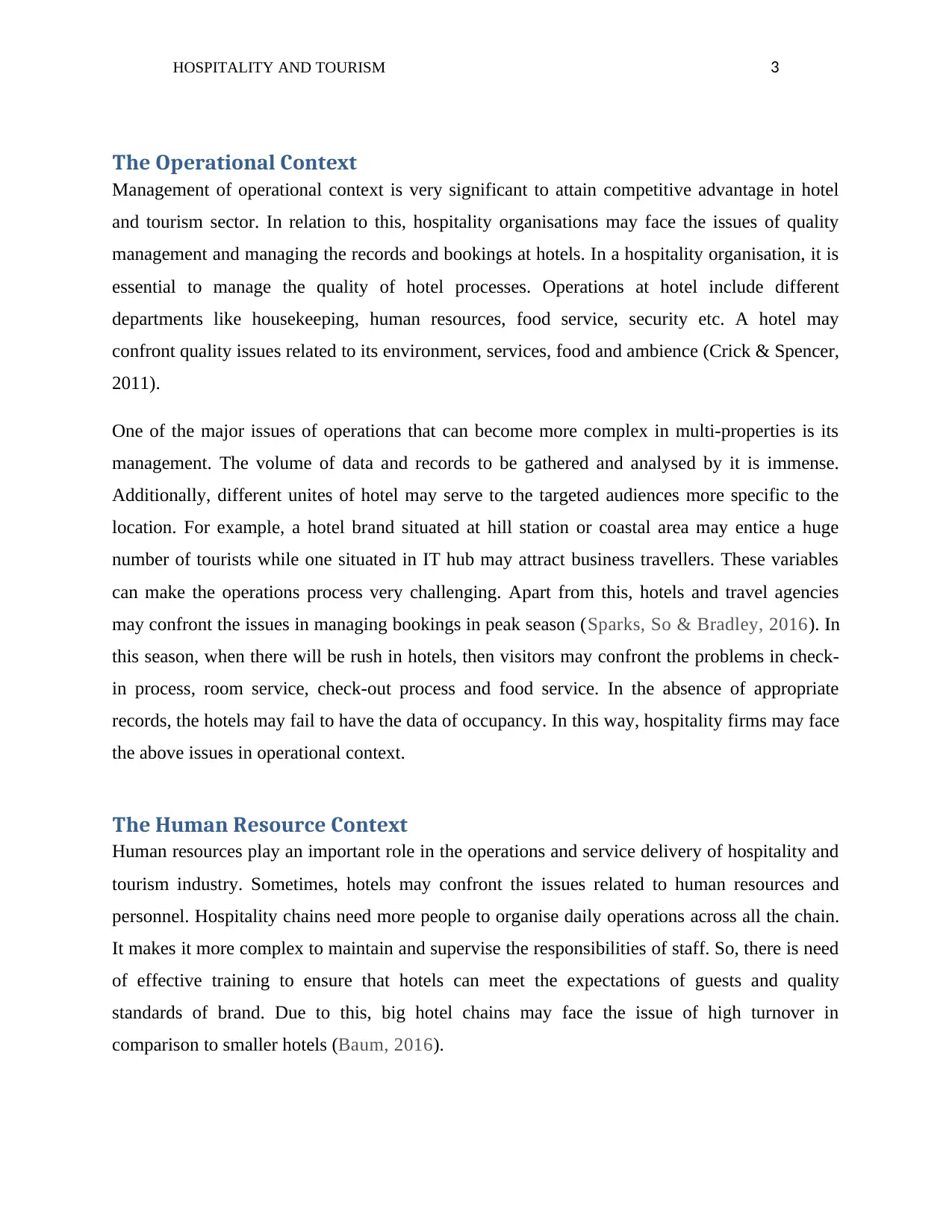
The Operational Context
Management of operational context is very significant to attain competitive advantage in hotel
and tourism sector. In relation to this, hospitality organisations may face the issues of quality
management and managing the records and bookings at hotels. In a hospitality organisation, it is
essential to manage the quality of hotel processes. Operations at hotel include different
departments like housekeeping, human resources, food service, security etc. A hotel may
confront quality issues related to its environment, services, food and ambience (Crick & Spencer,
2011).
One of the major issues of operations that can become more complex in multi-properties is its
management. The volume of data and records to be gathered and analysed by it is immense.
Additionally, different unites of hotel may serve to the targeted audiences more specific to the
location. For example, a hotel brand situated at hill station or coastal area may entice a huge
number of tourists while one situated in IT hub may attract business travellers. These variables
can make the operations process very challenging. Apart from this, hotels and travel agencies
may confront the issues in managing bookings in peak season (Sparks, So & Bradley, 2016). In
this season, when there will be rush in hotels, then visitors may confront the problems in check-
in process, room service, check-out process and food service. In the absence of appropriate
records, the hotels may fail to have the data of occupancy. In this way, hospitality firms may face
the above issues in operational context.
The Human Resource Context
Human resources play an important role in the operations and service delivery of hospitality and
tourism industry. Sometimes, hotels may confront the issues related to human resources and
personnel. Hospitality chains need more people to organise daily operations across all the chain.
It makes it more complex to maintain and supervise the responsibilities of staff. So, there is need
of effective training to ensure that hotels can meet the expectations of guests and quality
standards of brand. Due to this, big hotel chains may face the issue of high turnover in
comparison to smaller hotels (Baum, 2016).
The Operational Context
Management of operational context is very significant to attain competitive advantage in hotel
and tourism sector. In relation to this, hospitality organisations may face the issues of quality
management and managing the records and bookings at hotels. In a hospitality organisation, it is
essential to manage the quality of hotel processes. Operations at hotel include different
departments like housekeeping, human resources, food service, security etc. A hotel may
confront quality issues related to its environment, services, food and ambience (Crick & Spencer,
2011).
One of the major issues of operations that can become more complex in multi-properties is its
management. The volume of data and records to be gathered and analysed by it is immense.
Additionally, different unites of hotel may serve to the targeted audiences more specific to the
location. For example, a hotel brand situated at hill station or coastal area may entice a huge
number of tourists while one situated in IT hub may attract business travellers. These variables
can make the operations process very challenging. Apart from this, hotels and travel agencies
may confront the issues in managing bookings in peak season (Sparks, So & Bradley, 2016). In
this season, when there will be rush in hotels, then visitors may confront the problems in check-
in process, room service, check-out process and food service. In the absence of appropriate
records, the hotels may fail to have the data of occupancy. In this way, hospitality firms may face
the above issues in operational context.
The Human Resource Context
Human resources play an important role in the operations and service delivery of hospitality and
tourism industry. Sometimes, hotels may confront the issues related to human resources and
personnel. Hospitality chains need more people to organise daily operations across all the chain.
It makes it more complex to maintain and supervise the responsibilities of staff. So, there is need
of effective training to ensure that hotels can meet the expectations of guests and quality
standards of brand. Due to this, big hotel chains may face the issue of high turnover in
comparison to smaller hotels (Baum, 2016).
⊘ This is a preview!⊘
Do you want full access?
Subscribe today to unlock all pages.

Trusted by 1+ million students worldwide

HOSPITALITY AND TOURISM 4
Additionally, this industry can confront the issue of lower morale of staff that can impact the
delivery of service to guests. Staff morale is a critical factor because it directs the hospitality
organisations to be more successful and competitive. In the off season, sometimes human
resources feel demoralized when there is low level of occupancy. It has adverse impact on the
service delivery to final guests. Sometimes, staff feels demotivated when they are not satisfied
with their salaries. Hotel Career Expo is the biggest example of hospitality organisation that is
confronting the issues employee turnover and lower staff morale (Clarke, 2016).
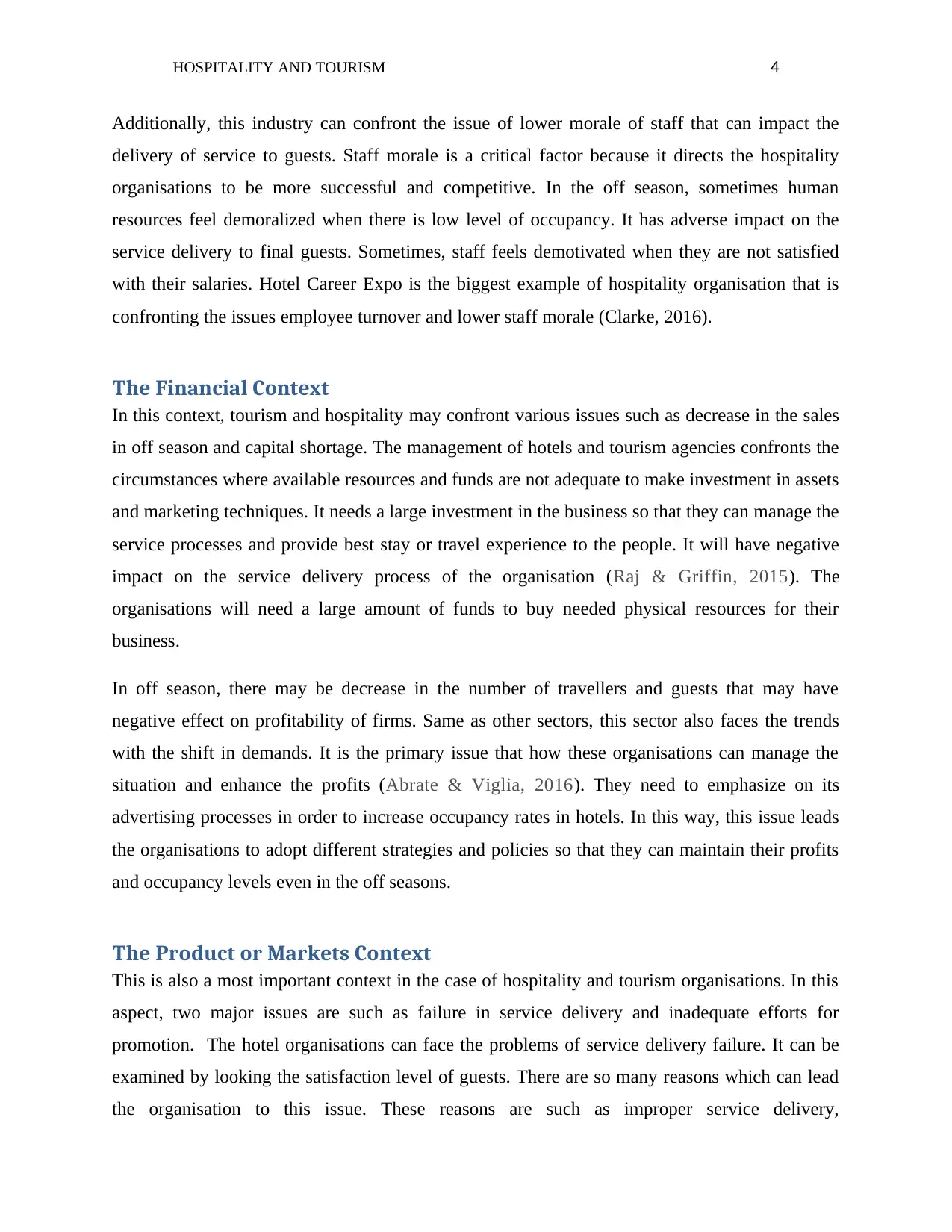
The Financial Context
In this context, tourism and hospitality may confront various issues such as decrease in the sales
in off season and capital shortage. The management of hotels and tourism agencies confronts the
circumstances where available resources and funds are not adequate to make investment in assets
and marketing techniques. It needs a large investment in the business so that they can manage the
service processes and provide best stay or travel experience to the people. It will have negative
impact on the service delivery process of the organisation (Raj & Griffin, 2015). The
organisations will need a large amount of funds to buy needed physical resources for their
business.
In off season, there may be decrease in the number of travellers and guests that may have
negative effect on profitability of firms. Same as other sectors, this sector also faces the trends
with the shift in demands. It is the primary issue that how these organisations can manage the
situation and enhance the profits (Abrate & Viglia, 2016). They need to emphasize on its
advertising processes in order to increase occupancy rates in hotels. In this way, this issue leads
the organisations to adopt different strategies and policies so that they can maintain their profits
and occupancy levels even in the off seasons.
The Product or Markets Context
This is also a most important context in the case of hospitality and tourism organisations. In this
aspect, two major issues are such as failure in service delivery and inadequate efforts for
promotion. The hotel organisations can face the problems of service delivery failure. It can be
examined by looking the satisfaction level of guests. There are so many reasons which can lead
the organisation to this issue. These reasons are such as improper service delivery,
Additionally, this industry can confront the issue of lower morale of staff that can impact the
delivery of service to guests. Staff morale is a critical factor because it directs the hospitality
organisations to be more successful and competitive. In the off season, sometimes human
resources feel demoralized when there is low level of occupancy. It has adverse impact on the
service delivery to final guests. Sometimes, staff feels demotivated when they are not satisfied
with their salaries. Hotel Career Expo is the biggest example of hospitality organisation that is
confronting the issues employee turnover and lower staff morale (Clarke, 2016).
The Financial Context
In this context, tourism and hospitality may confront various issues such as decrease in the sales
in off season and capital shortage. The management of hotels and tourism agencies confronts the
circumstances where available resources and funds are not adequate to make investment in assets
and marketing techniques. It needs a large investment in the business so that they can manage the
service processes and provide best stay or travel experience to the people. It will have negative
impact on the service delivery process of the organisation (Raj & Griffin, 2015). The
organisations will need a large amount of funds to buy needed physical resources for their
business.
In off season, there may be decrease in the number of travellers and guests that may have
negative effect on profitability of firms. Same as other sectors, this sector also faces the trends
with the shift in demands. It is the primary issue that how these organisations can manage the
situation and enhance the profits (Abrate & Viglia, 2016). They need to emphasize on its
advertising processes in order to increase occupancy rates in hotels. In this way, this issue leads
the organisations to adopt different strategies and policies so that they can maintain their profits
and occupancy levels even in the off seasons.
The Product or Markets Context
This is also a most important context in the case of hospitality and tourism organisations. In this
aspect, two major issues are such as failure in service delivery and inadequate efforts for
promotion. The hotel organisations can face the problems of service delivery failure. It can be
examined by looking the satisfaction level of guests. There are so many reasons which can lead
the organisation to this issue. These reasons are such as improper service delivery,
Paraphrase This Document
Need a fresh take? Get an instant paraphrase of this document with our AI Paraphraser

HOSPITALITY AND TOURISM 5
communication issues, employee dissatisfaction, ignorance of guest feedback etc. These reasons
can decrease the satisfaction level of customers and have negative effect on customers’ repeat
intention (Ho, 2017).
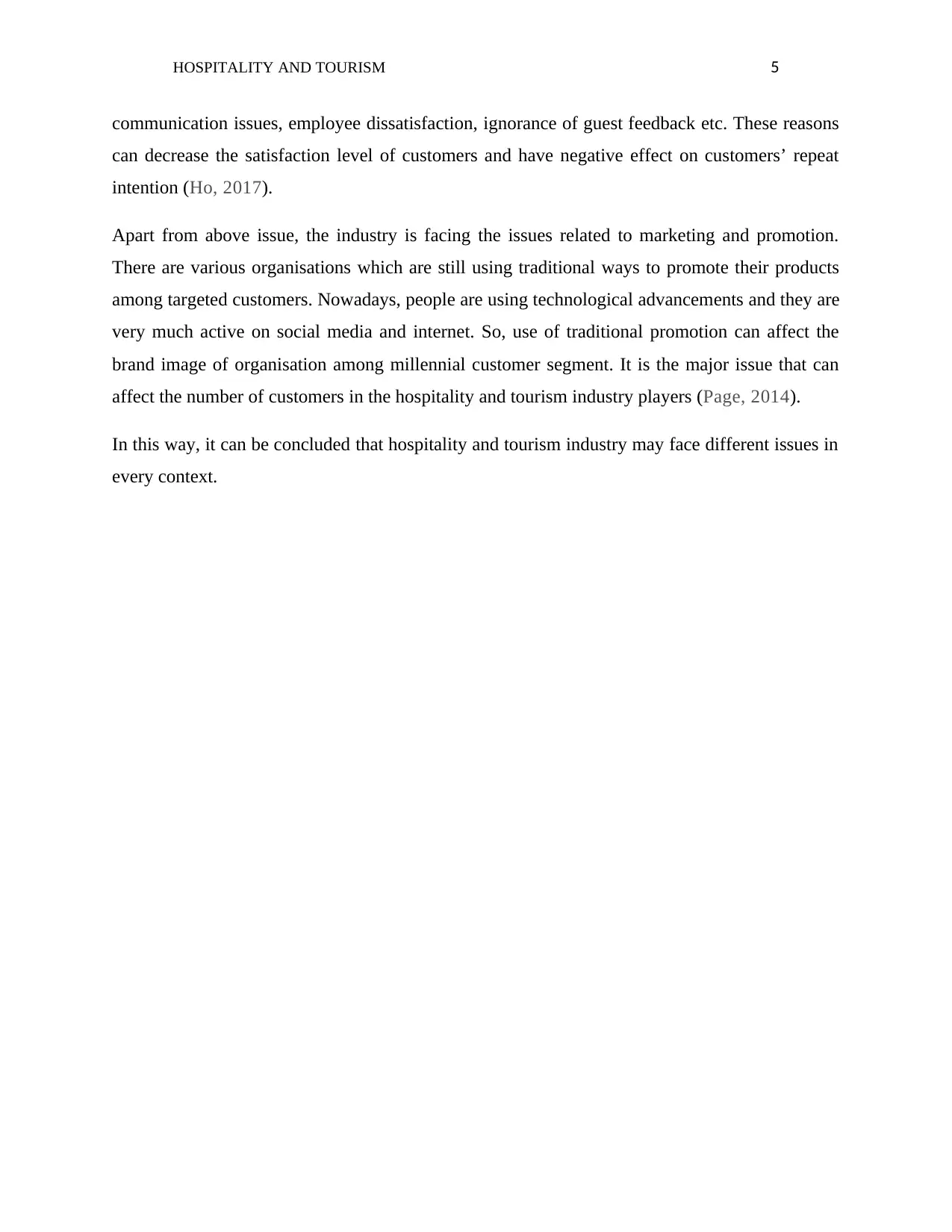
Apart from above issue, the industry is facing the issues related to marketing and promotion.
There are various organisations which are still using traditional ways to promote their products
among targeted customers. Nowadays, people are using technological advancements and they are
very much active on social media and internet. So, use of traditional promotion can affect the
brand image of organisation among millennial customer segment. It is the major issue that can
affect the number of customers in the hospitality and tourism industry players (Page, 2014).
In this way, it can be concluded that hospitality and tourism industry may face different issues in
every context.
communication issues, employee dissatisfaction, ignorance of guest feedback etc. These reasons
can decrease the satisfaction level of customers and have negative effect on customers’ repeat
intention (Ho, 2017).
Apart from above issue, the industry is facing the issues related to marketing and promotion.
There are various organisations which are still using traditional ways to promote their products
among targeted customers. Nowadays, people are using technological advancements and they are
very much active on social media and internet. So, use of traditional promotion can affect the
brand image of organisation among millennial customer segment. It is the major issue that can
affect the number of customers in the hospitality and tourism industry players (Page, 2014).
In this way, it can be concluded that hospitality and tourism industry may face different issues in
every context.

HOSPITALITY AND TOURISM 6
References
Abrate, G. & Viglia, G., 2016, Strategic and tactical price decisions in hotel revenue
management. Tourism Management, 55, pp.123-132.
Baum, T., 2016, Human resource issues in international tourism. Netherlands: Elsevier.
Clarke, R., 2016, Time to address key issues facing the Australian hotel industry: attracting and
growing quality staff, Viewed 12 August 2018 <https://www.accomnews.com.au/2016/05/time-
to-address-a-key-issues-facing-the-australian-hotel-industry-attracting-and-growing-quality-
staff/>
Crick, A.P. & Spencer, A., 2011, Hospitality quality: new directions and new challenges,
International Journal of Contemporary Hospitality Management, 23 (4) pp. 463-478.
Ho, V., 2017, Giving offense and making amends: How hotel management attempts to
manage rapport with dissatisfied customers. Journal of Pragmatics, 109, pp.1-11.
Page, S. J., 2014, Tourism management. UK: Routledge.
Raj, R. & Griffin, K.A., 2015, Religious tourism and pilgrimage management: An
international perspective. US: Cabi.
Sparks, B.A., So, K.K.F. & Bradley, G.L., 2016, Responding to negative online reviews:
The effects of hotel responses on customer inferences of trust and concern. Tourism
Management, 53, pp.74-85.
References
Abrate, G. & Viglia, G., 2016, Strategic and tactical price decisions in hotel revenue
management. Tourism Management, 55, pp.123-132.
Baum, T., 2016, Human resource issues in international tourism. Netherlands: Elsevier.
Clarke, R., 2016, Time to address key issues facing the Australian hotel industry: attracting and
growing quality staff, Viewed 12 August 2018 <https://www.accomnews.com.au/2016/05/time-
to-address-a-key-issues-facing-the-australian-hotel-industry-attracting-and-growing-quality-
staff/>
Crick, A.P. & Spencer, A., 2011, Hospitality quality: new directions and new challenges,
International Journal of Contemporary Hospitality Management, 23 (4) pp. 463-478.
Ho, V., 2017, Giving offense and making amends: How hotel management attempts to
manage rapport with dissatisfied customers. Journal of Pragmatics, 109, pp.1-11.
Page, S. J., 2014, Tourism management. UK: Routledge.
Raj, R. & Griffin, K.A., 2015, Religious tourism and pilgrimage management: An
international perspective. US: Cabi.
Sparks, B.A., So, K.K.F. & Bradley, G.L., 2016, Responding to negative online reviews:
The effects of hotel responses on customer inferences of trust and concern. Tourism
Management, 53, pp.74-85.
⊘ This is a preview!⊘
Do you want full access?
Subscribe today to unlock all pages.

Trusted by 1+ million students worldwide
1 out of 6
Related Documents
Your All-in-One AI-Powered Toolkit for Academic Success.
+13062052269
info@desklib.com
Available 24*7 on WhatsApp / Email
Unlock your academic potential
Copyright © 2020–2025 A2Z Services. All Rights Reserved. Developed and managed by ZUCOL.


![Rooms Division Operations Management - [University Name] Report](/_next/image/?url=https%3A%2F%2Fdesklib.com%2Fmedia%2Fimages%2Fil%2F4fe85cf5ecbe43baaa11c66b247a13db.jpg&w=256&q=75)