A Report on Investment Appraisal Techniques and Valuation Methods
VerifiedAdded on 2023/06/18
|16
|4329
|428
Report
AI Summary
This report provides a comprehensive analysis of financial management techniques, focusing on investment appraisal and valuation methods. It begins by evaluating the economic feasibility of Super Tasty Soup (STS) Limited using methods like Payback Period, Accounting Rate of Return (ARR), Net Present Value (NPV), and Internal Rate of Return (IRR), discussing their pros and cons. The report then assesses the effects of repurchasing equity capital and paying cash dividends on the company. Furthermore, it delves into valuation methods such as the price-earnings ratio, discounted cash flow (DCF), and dividend valuation method, highlighting associated problems with each technique. The analysis includes detailed calculations and recommendations for improving financial decision-making within an organization, offering a thorough understanding of investment and valuation strategies. Desklib provides this document as a valuable resource for students, alongside a wealth of other solved assignments and past papers.

FINANCIAL
MANAGEMENT
MANAGEMENT

Paraphrase This Document
Need a fresh take? Get an instant paraphrase of this document with our AI Paraphraser
TABLE OF CONTENT
INTRODUCTION...........................................................................................................................3
MAIN BODY...................................................................................................................................3
Question 2........................................................................................................................................3
Recommending economic feasibility...........................................................................................3
Evaluating effects of the proposal on the company.....................................................................6
Pros and cons of the differing investment appraisal techniques..................................................7
Question 3........................................................................................................................................9
Valuation with the help of price earning ratio.............................................................................9
Discounted cash flow method calculation for dragon plc..........................................................10
Value assessment through dividend valuation method..............................................................11
Associated problem with the different types of valuation techniques.......................................12
CONCLUSION..............................................................................................................................14
REFERENCES..............................................................................................................................15
INTRODUCTION...........................................................................................................................3
MAIN BODY...................................................................................................................................3
Question 2........................................................................................................................................3
Recommending economic feasibility...........................................................................................3
Evaluating effects of the proposal on the company.....................................................................6
Pros and cons of the differing investment appraisal techniques..................................................7
Question 3........................................................................................................................................9
Valuation with the help of price earning ratio.............................................................................9
Discounted cash flow method calculation for dragon plc..........................................................10
Value assessment through dividend valuation method..............................................................11
Associated problem with the different types of valuation techniques.......................................12
CONCLUSION..............................................................................................................................14
REFERENCES..............................................................................................................................15
INTRODUCTION
Financial management means planning, organising and controlling the finances of the
company. It have major role in fiscal policy and on the financial assets of the company it apply
management principles. It deals with the investment for the business so that effective decision
making can be done. Finance related work is completed by accounting department of the
organisation. This report will calculate investment appraisal techniques along with its advantages
and limitations. Further it will also calculate valuation methods like price earning ratio, dividend
valuation and discounted cash flow method. Its will also discuss problems with the valuation
method.
MAIN BODY
Question 2
Recommending economic feasibility
This organization known as Super Tasty Soup (STS) Limited which is a fast food
company can be recommended with the following investment appraisal techniques in order to
improve its economic feasibility,
Payback period :
As the result of the calculation of the pay back period the result of which has been
amounted to a total of 3.08 years. It can be said as the total amount of time which the
Financial management means planning, organising and controlling the finances of the
company. It have major role in fiscal policy and on the financial assets of the company it apply
management principles. It deals with the investment for the business so that effective decision
making can be done. Finance related work is completed by accounting department of the
organisation. This report will calculate investment appraisal techniques along with its advantages
and limitations. Further it will also calculate valuation methods like price earning ratio, dividend
valuation and discounted cash flow method. Its will also discuss problems with the valuation
method.
MAIN BODY
Question 2
Recommending economic feasibility
This organization known as Super Tasty Soup (STS) Limited which is a fast food
company can be recommended with the following investment appraisal techniques in order to
improve its economic feasibility,
Payback period :
As the result of the calculation of the pay back period the result of which has been
amounted to a total of 3.08 years. It can be said as the total amount of time which the
⊘ This is a preview!⊘
Do you want full access?
Subscribe today to unlock all pages.

Trusted by 1+ million students worldwide
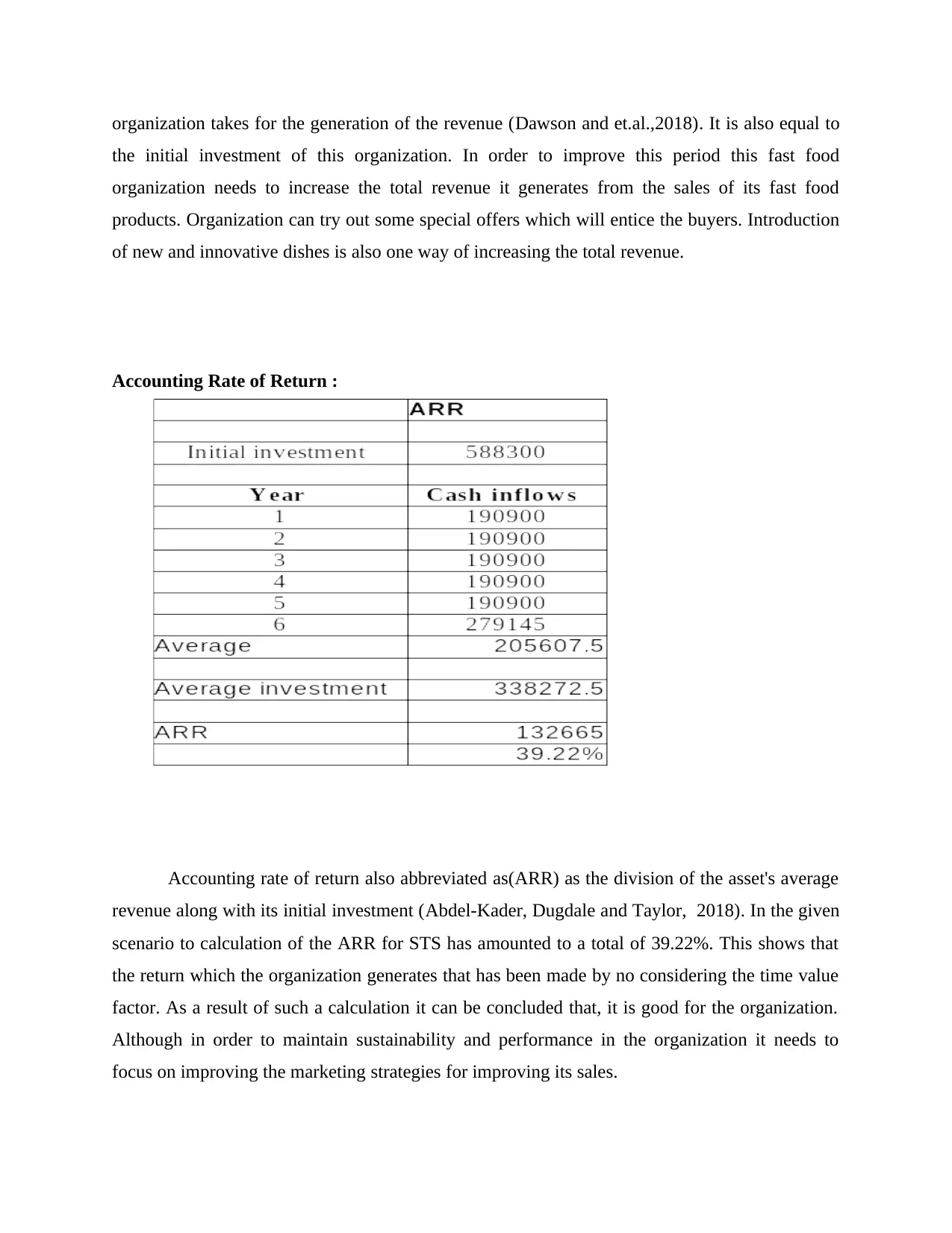
organization takes for the generation of the revenue (Dawson and et.al.,2018). It is also equal to
the initial investment of this organization. In order to improve this period this fast food
organization needs to increase the total revenue it generates from the sales of its fast food
products. Organization can try out some special offers which will entice the buyers. Introduction
of new and innovative dishes is also one way of increasing the total revenue.
Accounting Rate of Return :
Accounting rate of return also abbreviated as(ARR) as the division of the asset's average
revenue along with its initial investment (Abdel-Kader, Dugdale and Taylor, 2018). In the given
scenario to calculation of the ARR for STS has amounted to a total of 39.22%. This shows that
the return which the organization generates that has been made by no considering the time value
factor. As a result of such a calculation it can be concluded that, it is good for the organization.
Although in order to maintain sustainability and performance in the organization it needs to
focus on improving the marketing strategies for improving its sales.
the initial investment of this organization. In order to improve this period this fast food
organization needs to increase the total revenue it generates from the sales of its fast food
products. Organization can try out some special offers which will entice the buyers. Introduction
of new and innovative dishes is also one way of increasing the total revenue.
Accounting Rate of Return :
Accounting rate of return also abbreviated as(ARR) as the division of the asset's average
revenue along with its initial investment (Abdel-Kader, Dugdale and Taylor, 2018). In the given
scenario to calculation of the ARR for STS has amounted to a total of 39.22%. This shows that
the return which the organization generates that has been made by no considering the time value
factor. As a result of such a calculation it can be concluded that, it is good for the organization.
Although in order to maintain sustainability and performance in the organization it needs to
focus on improving the marketing strategies for improving its sales.
Paraphrase This Document
Need a fresh take? Get an instant paraphrase of this document with our AI Paraphraser
NPV :
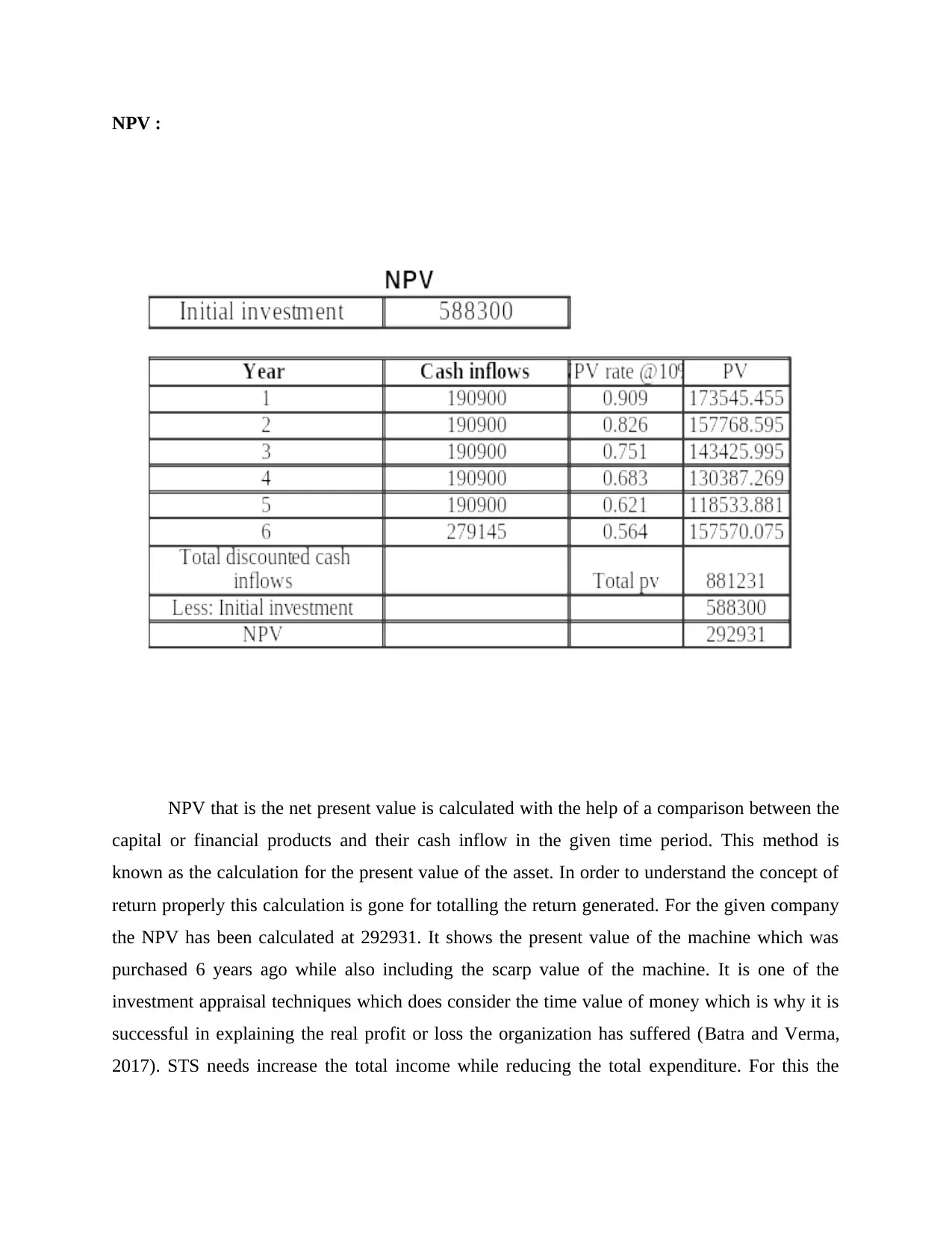
NPV that is the net present value is calculated with the help of a comparison between the
capital or financial products and their cash inflow in the given time period. This method is
known as the calculation for the present value of the asset. In order to understand the concept of
return properly this calculation is gone for totalling the return generated. For the given company
the NPV has been calculated at 292931. It shows the present value of the machine which was
purchased 6 years ago while also including the scarp value of the machine. It is one of the
investment appraisal techniques which does consider the time value of money which is why it is
successful in explaining the real profit or loss the organization has suffered (Batra and Verma,
2017). STS needs increase the total income while reducing the total expenditure. For this the
NPV that is the net present value is calculated with the help of a comparison between the
capital or financial products and their cash inflow in the given time period. This method is
known as the calculation for the present value of the asset. In order to understand the concept of
return properly this calculation is gone for totalling the return generated. For the given company
the NPV has been calculated at 292931. It shows the present value of the machine which was
purchased 6 years ago while also including the scarp value of the machine. It is one of the
investment appraisal techniques which does consider the time value of money which is why it is
successful in explaining the real profit or loss the organization has suffered (Batra and Verma,
2017). STS needs increase the total income while reducing the total expenditure. For this the
organization can try to improve the efficiency of the resources which helps in the generation of
revenue.
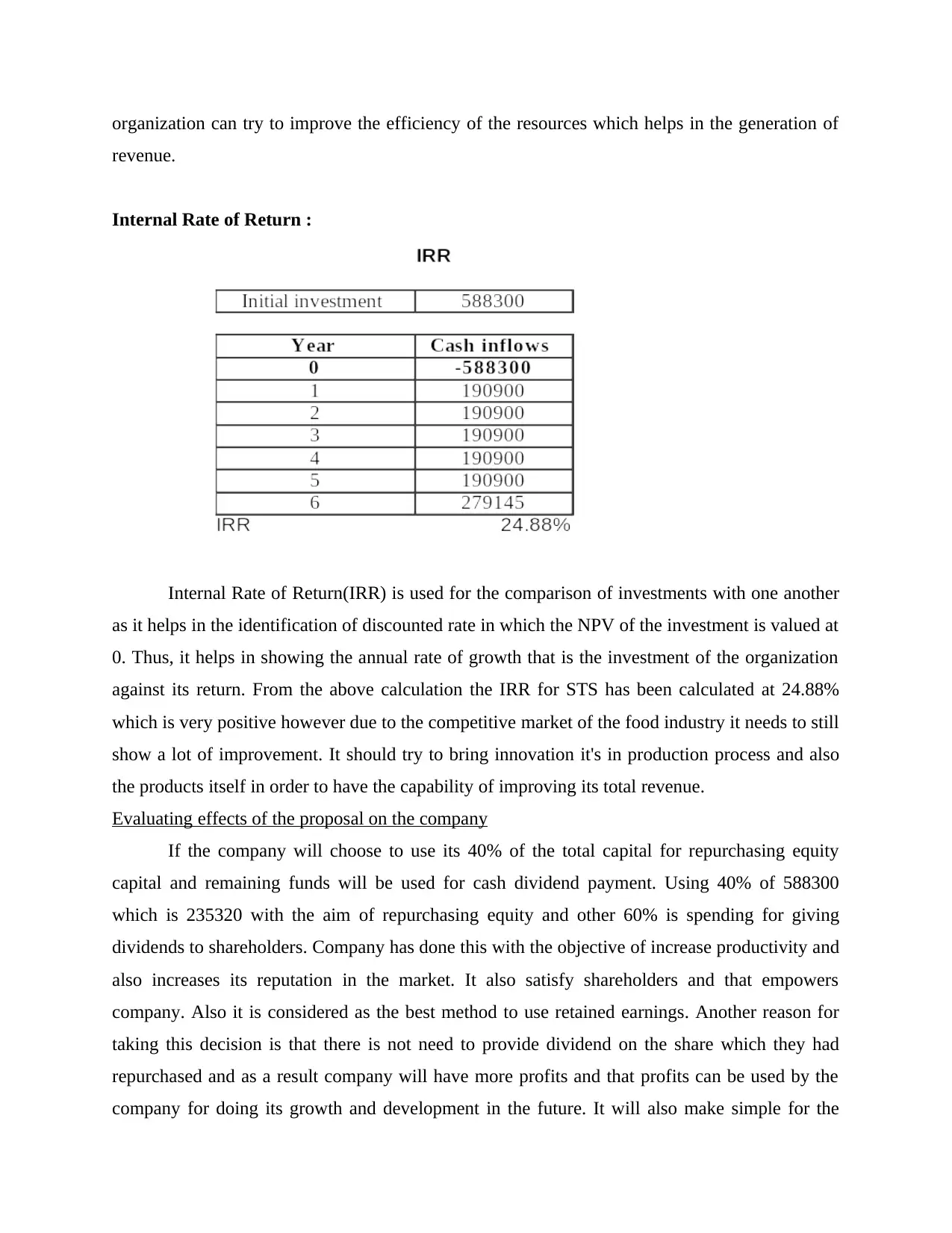
Internal Rate of Return :
Internal Rate of Return(IRR) is used for the comparison of investments with one another
as it helps in the identification of discounted rate in which the NPV of the investment is valued at
0. Thus, it helps in showing the annual rate of growth that is the investment of the organization
against its return. From the above calculation the IRR for STS has been calculated at 24.88%
which is very positive however due to the competitive market of the food industry it needs to still
show a lot of improvement. It should try to bring innovation it's in production process and also
the products itself in order to have the capability of improving its total revenue.
Evaluating effects of the proposal on the company
If the company will choose to use its 40% of the total capital for repurchasing equity
capital and remaining funds will be used for cash dividend payment. Using 40% of 588300
which is 235320 with the aim of repurchasing equity and other 60% is spending for giving
dividends to shareholders. Company has done this with the objective of increase productivity and
also increases its reputation in the market. It also satisfy shareholders and that empowers
company. Also it is considered as the best method to use retained earnings. Another reason for
taking this decision is that there is not need to provide dividend on the share which they had
repurchased and as a result company will have more profits and that profits can be used by the
company for doing its growth and development in the future. It will also make simple for the
revenue.
Internal Rate of Return :
Internal Rate of Return(IRR) is used for the comparison of investments with one another
as it helps in the identification of discounted rate in which the NPV of the investment is valued at
0. Thus, it helps in showing the annual rate of growth that is the investment of the organization
against its return. From the above calculation the IRR for STS has been calculated at 24.88%
which is very positive however due to the competitive market of the food industry it needs to still
show a lot of improvement. It should try to bring innovation it's in production process and also
the products itself in order to have the capability of improving its total revenue.
Evaluating effects of the proposal on the company
If the company will choose to use its 40% of the total capital for repurchasing equity
capital and remaining funds will be used for cash dividend payment. Using 40% of 588300
which is 235320 with the aim of repurchasing equity and other 60% is spending for giving
dividends to shareholders. Company has done this with the objective of increase productivity and
also increases its reputation in the market. It also satisfy shareholders and that empowers
company. Also it is considered as the best method to use retained earnings. Another reason for
taking this decision is that there is not need to provide dividend on the share which they had
repurchased and as a result company will have more profits and that profits can be used by the
company for doing its growth and development in the future. It will also make simple for the
⊘ This is a preview!⊘
Do you want full access?
Subscribe today to unlock all pages.
Trusted by 1+ million students worldwide
company to give profits to the investors effectively (Woodhead and Berawi, 2020). By giving
profit at high rate will improvise the image of the company in front of investors.
Pros and cons of the differing investment appraisal techniques.
Payback period:
Payback method is helpful in getting payback period for an investment. Payback period
is referred as the time which is taken by the cash flows of income from the specific project in
order to cover the initial investment.
Benefits:
This method can be understand easily because it is very simple. As this method require less
inputs and to do its calculation is also easy when compared with other capital budgeting method.
As it is easy to calculate so managers can fast calculate it and can take quick decisions (Bader,
Al-Nawaiseh and Nawaiseh, 2018). This provide important information which no other capital
budgeting method provides. Generally the project which have shorter payback period can be seen
with low risk. These kinds of information is necessary for small businesses who are having
limited resources. In order to invest in other opportunities, small business have to recover its
costs. This method is also helpful in such industries which has to face quick technological
changes.
Limitations:
This can be consider as the main disadvantage of this method that it does not consider time value
of money and it is one of the important business concept. According to time value of money, the
money which is received early is having more worth than the money which will going to come in
the future because they have capacity to get extra return if it is again invested. Another limitation
is payback method take the cash flows only till the time when the recovery of initial investment
is done.
Accounting rate of return:
This method is the manner through which profits can be compared which is made via
investment for the amount which is required to invest (Wijnen and et.al., 2020). The ARR
method is generally calculated in the form of average annual profit which is expected by investor
from the investment project. This method is used to find out the worth of investment.
Benefits:
profit at high rate will improvise the image of the company in front of investors.
Pros and cons of the differing investment appraisal techniques.
Payback period:
Payback method is helpful in getting payback period for an investment. Payback period
is referred as the time which is taken by the cash flows of income from the specific project in
order to cover the initial investment.
Benefits:
This method can be understand easily because it is very simple. As this method require less
inputs and to do its calculation is also easy when compared with other capital budgeting method.
As it is easy to calculate so managers can fast calculate it and can take quick decisions (Bader,
Al-Nawaiseh and Nawaiseh, 2018). This provide important information which no other capital
budgeting method provides. Generally the project which have shorter payback period can be seen
with low risk. These kinds of information is necessary for small businesses who are having
limited resources. In order to invest in other opportunities, small business have to recover its
costs. This method is also helpful in such industries which has to face quick technological
changes.
Limitations:
This can be consider as the main disadvantage of this method that it does not consider time value
of money and it is one of the important business concept. According to time value of money, the
money which is received early is having more worth than the money which will going to come in
the future because they have capacity to get extra return if it is again invested. Another limitation
is payback method take the cash flows only till the time when the recovery of initial investment
is done.
Accounting rate of return:
This method is the manner through which profits can be compared which is made via
investment for the amount which is required to invest (Wijnen and et.al., 2020). The ARR
method is generally calculated in the form of average annual profit which is expected by investor
from the investment project. This method is used to find out the worth of investment.
Benefits:
Paraphrase This Document
Need a fresh take? Get an instant paraphrase of this document with our AI Paraphraser
This is one of the simpler technique and also used by many organisations or individuals when
they has to compare capital projects which is easy to understand. ARR of various projects can be
easily gets calculated. For specific capital project, decisions can be easily made. As project
which have high ARR is chosen and project which have less ARR is eliminated. With the help of
ARR method projects profitability can be easily measured and that gives benefits to owners and
shareholders.
Limitations:
The major limitation is it does not consider time value of money. So it is not the good method to
compare capital projects. ARR is calculated on the basis of project which is earned through
investing in the project. It completely ignore important factor of business which is cash flows.
Net present value:
NPV is called as the discounted cash flow technique which is utilized in capital budgeting so to
check the viability of the investment. NPV is the difference of present value of cash inflows and
current value of cash outflows.
Benefits:
The major advantage is that it takes into consideration the time value of money. As dollar rate
which is toady will definitely more on tomorrow. This method also helps in the decision making
process. It helps in evaluating projects and along with helps to know that the investment will
make profits or incur loss (Advantages and Disadvantages of NPV., 2021).
Limitations:
There is no proper guidelines regarding how to calculate required rate of return. As the NPV is
calculated after discounting the future cash flows with present value with the help of required
rate of return. So there is not particular guidelines for the rate. When the project are of different
sizes than it cannot get compared through this technique. As NPV provides figures and not the
percentage. So that is why NPV of big projects will be higher than the small size projects. NPV
only considers cash inflows and outflows of the specific project while completely ignoring sunk
costs, preliminary costs or any hidden costs (Warren and Seal, 2018).
Internal rate of return:
This rate of return is used to measure or comparing the profitability level of various investments
in capital budgeting. It is also called as economic rate of return. This method is used to check the
desirability of the projects.
they has to compare capital projects which is easy to understand. ARR of various projects can be
easily gets calculated. For specific capital project, decisions can be easily made. As project
which have high ARR is chosen and project which have less ARR is eliminated. With the help of
ARR method projects profitability can be easily measured and that gives benefits to owners and
shareholders.
Limitations:
The major limitation is it does not consider time value of money. So it is not the good method to
compare capital projects. ARR is calculated on the basis of project which is earned through
investing in the project. It completely ignore important factor of business which is cash flows.
Net present value:
NPV is called as the discounted cash flow technique which is utilized in capital budgeting so to
check the viability of the investment. NPV is the difference of present value of cash inflows and
current value of cash outflows.
Benefits:
The major advantage is that it takes into consideration the time value of money. As dollar rate
which is toady will definitely more on tomorrow. This method also helps in the decision making
process. It helps in evaluating projects and along with helps to know that the investment will
make profits or incur loss (Advantages and Disadvantages of NPV., 2021).
Limitations:
There is no proper guidelines regarding how to calculate required rate of return. As the NPV is
calculated after discounting the future cash flows with present value with the help of required
rate of return. So there is not particular guidelines for the rate. When the project are of different
sizes than it cannot get compared through this technique. As NPV provides figures and not the
percentage. So that is why NPV of big projects will be higher than the small size projects. NPV
only considers cash inflows and outflows of the specific project while completely ignoring sunk
costs, preliminary costs or any hidden costs (Warren and Seal, 2018).
Internal rate of return:
This rate of return is used to measure or comparing the profitability level of various investments
in capital budgeting. It is also called as economic rate of return. This method is used to check the
desirability of the projects.
Benefits:
While evaluating the project this technique considers time value of money. Whereas payback
period does have this feature. Its interpretation is simple after the calculation of IRR. In case of
IRR if the cost of capital is more than only project should accept otherwise it should be rejected.
This will make work of the managers easy.
Limitations:
It completely ignores economies of scale and does not consider actual dollar value of benefits.
When projects are analysed with IRR technique. It is estimated that positive future cash flows
will going to reinvested at IRR (Li and Trutnevyte, 2017). In case the project is having lower
IRR than reinvestment will be done at less rate of return and if projects gets high IRR than
reinvestment will be done at high rate of return. This is the not valid situation. It cannot calculate
different terms of projects.
Question 3
Valuation with the help of price earning ratio
In the method of price earning ration the determination of the price is very important and
can be done by the utilization of the price of another similar company from the same industry. It
is calculated by the division of the market price per share (MPS) with the (EPS) earning price per
share. With the help of this method the investors pertaining into the investment of the company
is understood. Those companies which develops a higher earning prospect is generally the one
which have the greater P/E ratio (Aulia, 2018). It occurs due to the reason which signifies that
the company which is in the position of paying an even high return. For dragon plc this method
will be very useful as it will make comparison between two different similar companies.
Computation and valuation of the organization utilizing price earnings ratio
Particulars Formula Amount (in
£m)
Distributable earnings 42.4
Market price per share
(MPS) 4.15
While evaluating the project this technique considers time value of money. Whereas payback
period does have this feature. Its interpretation is simple after the calculation of IRR. In case of
IRR if the cost of capital is more than only project should accept otherwise it should be rejected.
This will make work of the managers easy.
Limitations:
It completely ignores economies of scale and does not consider actual dollar value of benefits.
When projects are analysed with IRR technique. It is estimated that positive future cash flows
will going to reinvested at IRR (Li and Trutnevyte, 2017). In case the project is having lower
IRR than reinvestment will be done at less rate of return and if projects gets high IRR than
reinvestment will be done at high rate of return. This is the not valid situation. It cannot calculate
different terms of projects.
Question 3
Valuation with the help of price earning ratio
In the method of price earning ration the determination of the price is very important and
can be done by the utilization of the price of another similar company from the same industry. It
is calculated by the division of the market price per share (MPS) with the (EPS) earning price per
share. With the help of this method the investors pertaining into the investment of the company
is understood. Those companies which develops a higher earning prospect is generally the one
which have the greater P/E ratio (Aulia, 2018). It occurs due to the reason which signifies that
the company which is in the position of paying an even high return. For dragon plc this method
will be very useful as it will make comparison between two different similar companies.
Computation and valuation of the organization utilizing price earnings ratio
Particulars Formula Amount (in
£m)
Distributable earnings 42.4
Market price per share
(MPS) 4.15
⊘ This is a preview!⊘
Do you want full access?
Subscribe today to unlock all pages.
Trusted by 1+ million students worldwide
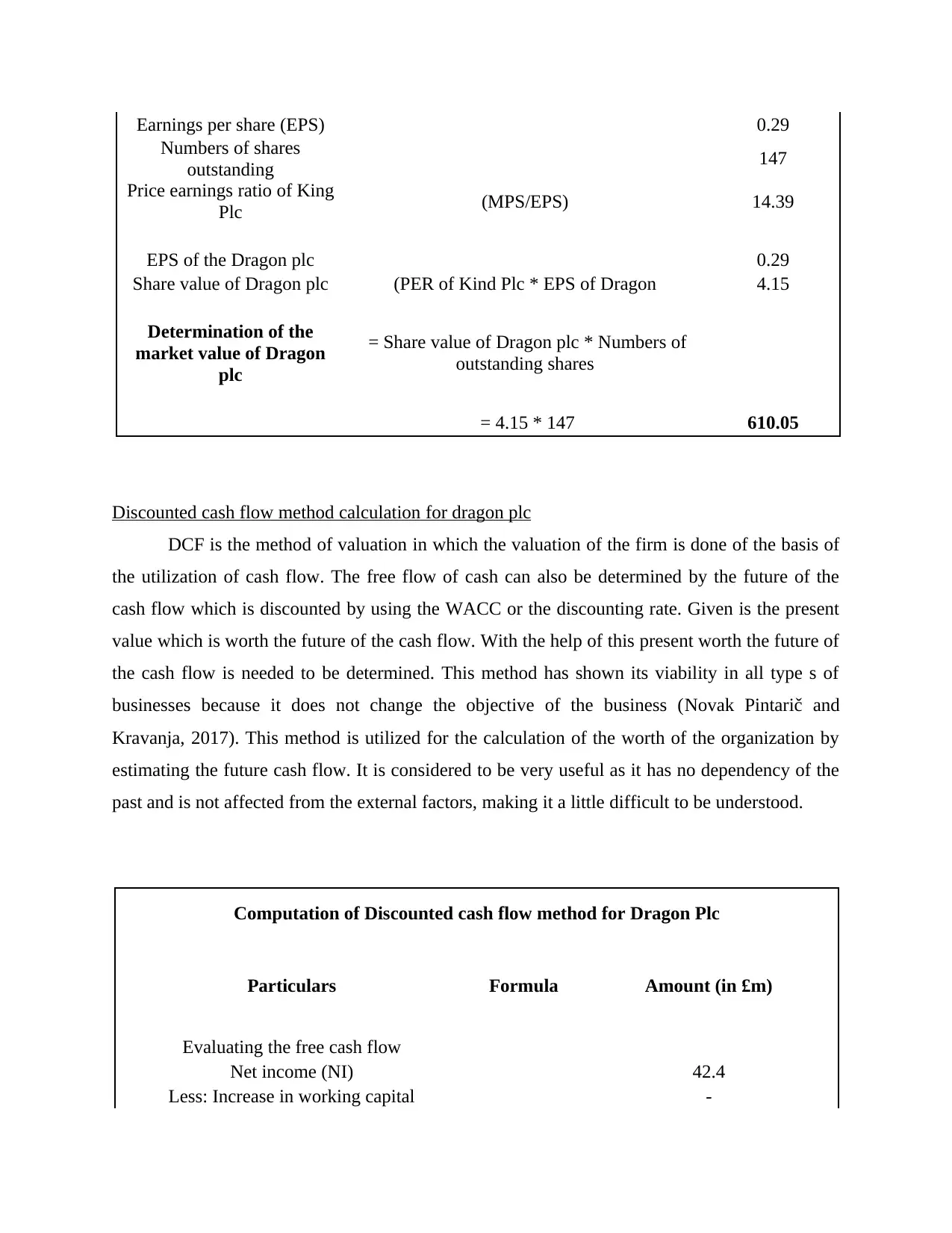
Earnings per share (EPS) 0.29
Numbers of shares
outstanding 147
Price earnings ratio of King
Plc (MPS/EPS) 14.39
EPS of the Dragon plc 0.29
Share value of Dragon plc (PER of Kind Plc * EPS of Dragon 4.15
Determination of the
market value of Dragon
plc
= Share value of Dragon plc * Numbers of
outstanding shares
= 4.15 * 147 610.05
Discounted cash flow method calculation for dragon plc
DCF is the method of valuation in which the valuation of the firm is done of the basis of
the utilization of cash flow. The free flow of cash can also be determined by the future of the
cash flow which is discounted by using the WACC or the discounting rate. Given is the present
value which is worth the future of the cash flow. With the help of this present worth the future of
the cash flow is needed to be determined. This method has shown its viability in all type s of
businesses because it does not change the objective of the business (Novak Pintarič and
Kravanja, 2017). This method is utilized for the calculation of the worth of the organization by
estimating the future cash flow. It is considered to be very useful as it has no dependency of the
past and is not affected from the external factors, making it a little difficult to be understood.
Computation of Discounted cash flow method for Dragon Plc
Particulars Formula Amount (in £m)
Evaluating the free cash flow
Net income (NI) 42.4
Less: Increase in working capital -
Numbers of shares
outstanding 147
Price earnings ratio of King
Plc (MPS/EPS) 14.39
EPS of the Dragon plc 0.29
Share value of Dragon plc (PER of Kind Plc * EPS of Dragon 4.15
Determination of the
market value of Dragon
plc
= Share value of Dragon plc * Numbers of
outstanding shares
= 4.15 * 147 610.05
Discounted cash flow method calculation for dragon plc
DCF is the method of valuation in which the valuation of the firm is done of the basis of
the utilization of cash flow. The free flow of cash can also be determined by the future of the
cash flow which is discounted by using the WACC or the discounting rate. Given is the present
value which is worth the future of the cash flow. With the help of this present worth the future of
the cash flow is needed to be determined. This method has shown its viability in all type s of
businesses because it does not change the objective of the business (Novak Pintarič and
Kravanja, 2017). This method is utilized for the calculation of the worth of the organization by
estimating the future cash flow. It is considered to be very useful as it has no dependency of the
past and is not affected from the external factors, making it a little difficult to be understood.
Computation of Discounted cash flow method for Dragon Plc
Particulars Formula Amount (in £m)
Evaluating the free cash flow
Net income (NI) 42.4
Less: Increase in working capital -
Paraphrase This Document
Need a fresh take? Get an instant paraphrase of this document with our AI Paraphraser
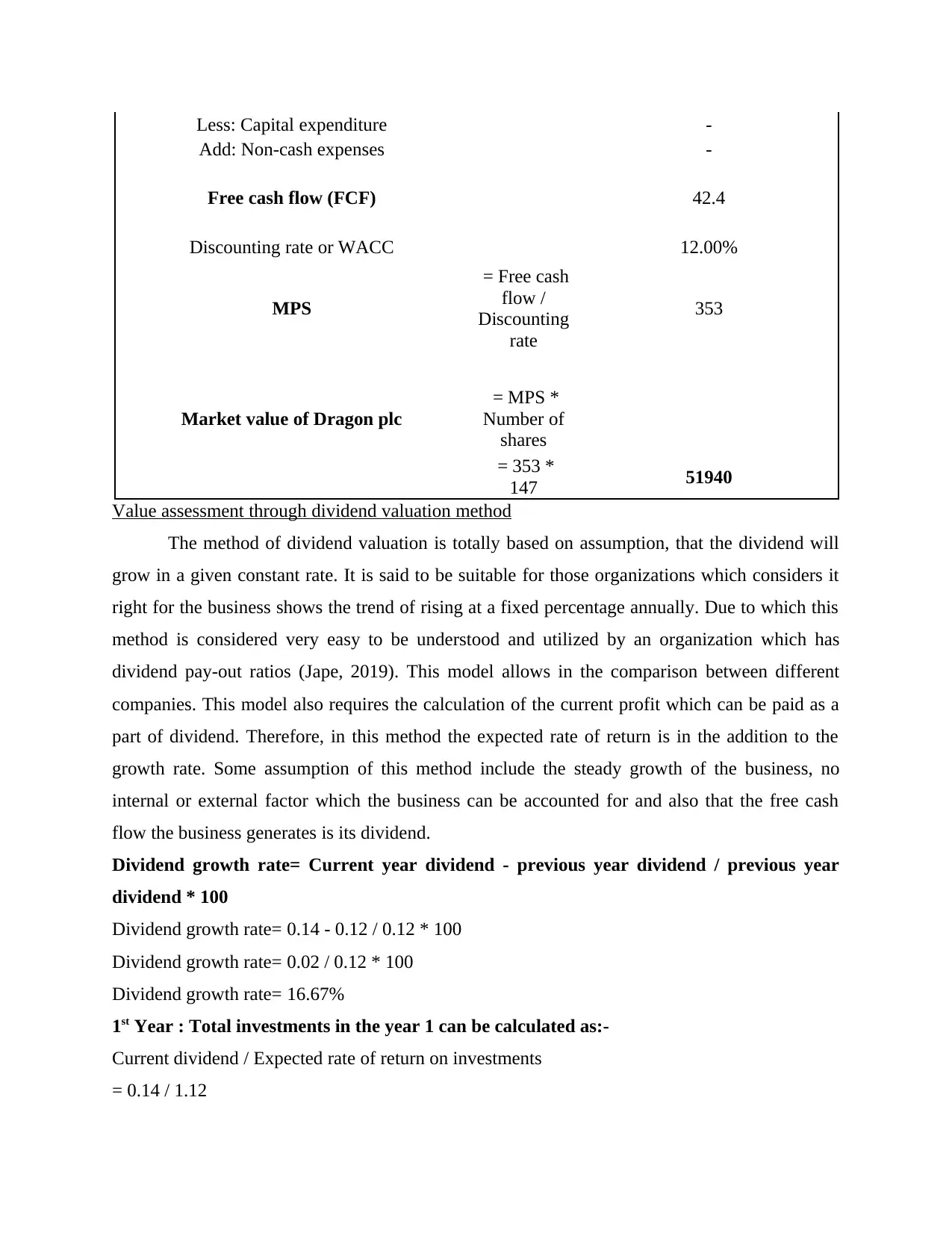
Less: Capital expenditure -
Add: Non-cash expenses -
Free cash flow (FCF) 42.4
Discounting rate or WACC 12.00%
MPS
= Free cash
flow /
Discounting
rate
353
Market value of Dragon plc
= MPS *
Number of
shares
= 353 *
147 51940
Value assessment through dividend valuation method
The method of dividend valuation is totally based on assumption, that the dividend will
grow in a given constant rate. It is said to be suitable for those organizations which considers it
right for the business shows the trend of rising at a fixed percentage annually. Due to which this
method is considered very easy to be understood and utilized by an organization which has
dividend pay-out ratios (Jape, 2019). This model allows in the comparison between different
companies. This model also requires the calculation of the current profit which can be paid as a
part of dividend. Therefore, in this method the expected rate of return is in the addition to the
growth rate. Some assumption of this method include the steady growth of the business, no
internal or external factor which the business can be accounted for and also that the free cash
flow the business generates is its dividend.
Dividend growth rate= Current year dividend - previous year dividend / previous year
dividend * 100
Dividend growth rate= 0.14 - 0.12 / 0.12 * 100
Dividend growth rate= 0.02 / 0.12 * 100
Dividend growth rate= 16.67%
1st Year : Total investments in the year 1 can be calculated as:-
Current dividend / Expected rate of return on investments
= 0.14 / 1.12
Add: Non-cash expenses -
Free cash flow (FCF) 42.4
Discounting rate or WACC 12.00%
MPS
= Free cash
flow /
Discounting
rate
353
Market value of Dragon plc
= MPS *
Number of
shares
= 353 *
147 51940
Value assessment through dividend valuation method
The method of dividend valuation is totally based on assumption, that the dividend will
grow in a given constant rate. It is said to be suitable for those organizations which considers it
right for the business shows the trend of rising at a fixed percentage annually. Due to which this
method is considered very easy to be understood and utilized by an organization which has
dividend pay-out ratios (Jape, 2019). This model allows in the comparison between different
companies. This model also requires the calculation of the current profit which can be paid as a
part of dividend. Therefore, in this method the expected rate of return is in the addition to the
growth rate. Some assumption of this method include the steady growth of the business, no
internal or external factor which the business can be accounted for and also that the free cash
flow the business generates is its dividend.
Dividend growth rate= Current year dividend - previous year dividend / previous year
dividend * 100
Dividend growth rate= 0.14 - 0.12 / 0.12 * 100
Dividend growth rate= 0.02 / 0.12 * 100
Dividend growth rate= 16.67%
1st Year : Total investments in the year 1 can be calculated as:-
Current dividend / Expected rate of return on investments
= 0.14 / 1.12
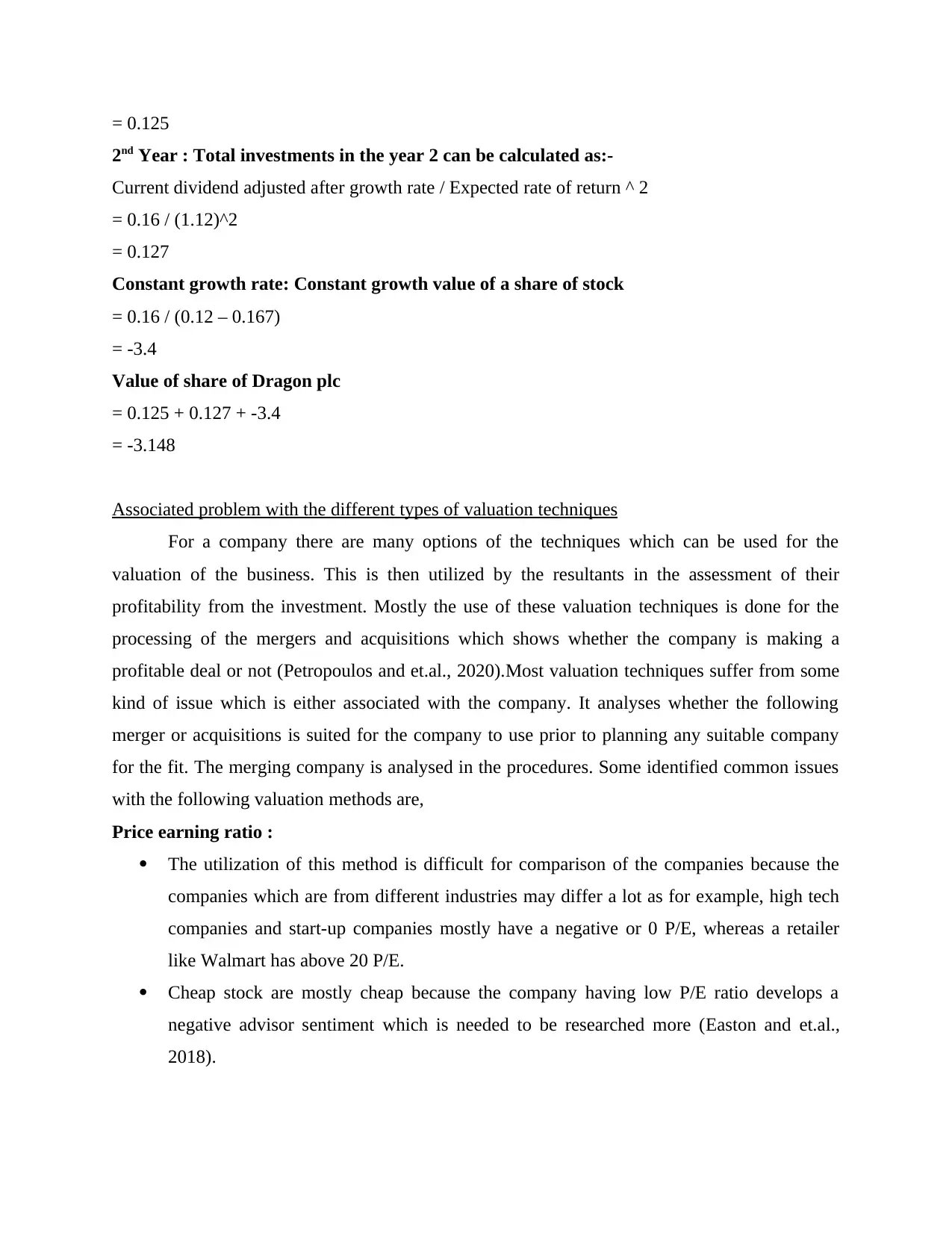
= 0.125
2nd Year : Total investments in the year 2 can be calculated as:-
Current dividend adjusted after growth rate / Expected rate of return ^ 2
= 0.16 / (1.12)^2
= 0.127
Constant growth rate: Constant growth value of a share of stock
= 0.16 / (0.12 – 0.167)
= -3.4
Value of share of Dragon plc
= 0.125 + 0.127 + -3.4
= -3.148
Associated problem with the different types of valuation techniques
For a company there are many options of the techniques which can be used for the
valuation of the business. This is then utilized by the resultants in the assessment of their
profitability from the investment. Mostly the use of these valuation techniques is done for the
processing of the mergers and acquisitions which shows whether the company is making a
profitable deal or not (Petropoulos and et.al., 2020).Most valuation techniques suffer from some
kind of issue which is either associated with the company. It analyses whether the following
merger or acquisitions is suited for the company to use prior to planning any suitable company
for the fit. The merging company is analysed in the procedures. Some identified common issues
with the following valuation methods are,
Price earning ratio :
The utilization of this method is difficult for comparison of the companies because the
companies which are from different industries may differ a lot as for example, high tech
companies and start-up companies mostly have a negative or 0 P/E, whereas a retailer
like Walmart has above 20 P/E.
Cheap stock are mostly cheap because the company having low P/E ratio develops a
negative advisor sentiment which is needed to be researched more (Easton and et.al.,
2018).
2nd Year : Total investments in the year 2 can be calculated as:-
Current dividend adjusted after growth rate / Expected rate of return ^ 2
= 0.16 / (1.12)^2
= 0.127
Constant growth rate: Constant growth value of a share of stock
= 0.16 / (0.12 – 0.167)
= -3.4
Value of share of Dragon plc
= 0.125 + 0.127 + -3.4
= -3.148
Associated problem with the different types of valuation techniques
For a company there are many options of the techniques which can be used for the
valuation of the business. This is then utilized by the resultants in the assessment of their
profitability from the investment. Mostly the use of these valuation techniques is done for the
processing of the mergers and acquisitions which shows whether the company is making a
profitable deal or not (Petropoulos and et.al., 2020).Most valuation techniques suffer from some
kind of issue which is either associated with the company. It analyses whether the following
merger or acquisitions is suited for the company to use prior to planning any suitable company
for the fit. The merging company is analysed in the procedures. Some identified common issues
with the following valuation methods are,
Price earning ratio :
The utilization of this method is difficult for comparison of the companies because the
companies which are from different industries may differ a lot as for example, high tech
companies and start-up companies mostly have a negative or 0 P/E, whereas a retailer
like Walmart has above 20 P/E.
Cheap stock are mostly cheap because the company having low P/E ratio develops a
negative advisor sentiment which is needed to be researched more (Easton and et.al.,
2018).
⊘ This is a preview!⊘
Do you want full access?
Subscribe today to unlock all pages.
Trusted by 1+ million students worldwide

1 out of 16


Related Documents


Your All-in-One AI-Powered Toolkit for Academic Success.
+13062052269
info@desklib.com
Available 24*7 on WhatsApp / Email
![[object Object]](/_next/static/media/star-bottom.7253800d.svg)
Unlock your academic potential
Copyright © 2020–2026 A2Z Services. All Rights Reserved. Developed and managed by ZUCOL.