Investment Proposal for New Product Line: Financial Evaluation
VerifiedAdded on 2019/10/12
|14
|3378
|203
Report
AI Summary
This report presents an investment proposal for a new product line, employing the net present value (NPV) discounting technique and the payback period method for financial evaluation. The proposal outlines a six-year plan, detailing cash flows, including purchases, wages, advertising, and income. The analysis calculates the NPV, which is positive at 73,202, and a payback period of approximately three years, suggesting the project's financial viability. The report highlights the importance of investment proposals in attracting investors and providing financial insights. It also discusses the advantages of NPV in considering the time value of money and the limitations of the payback period, such as not accounting for the time value of money and other critical factors. The application of these methods in project selection and their criticisms are also addressed, providing a comprehensive financial perspective on the investment decision-making process. The report concludes that the project is acceptable based on the positive financial outcomes.

Investment Proposal
Student Name:
Course work:
University:
Student Name:
Course work:
University:

Paraphrase This Document
Need a fresh take? Get an instant paraphrase of this document with our AI Paraphraser
Table of Contents
Executive Summary.........................................................................................................................2
Introduction......................................................................................................................................3
Importance of Investment proposal.................................................................................................3
Discounting cash flow technique.....................................................................................................4
Traditional cash flow technique.......................................................................................................5
Proposed Investment proposal.........................................................................................................5
Application for the determination of cash flow...............................................................................6
Criticism of the methods..................................................................................................................7
Logical aspect of Decision making..................................................................................................7
Conclusion.......................................................................................................................................8
References........................................................................................................................................9
Appendix........................................................................................................................................10
Executive Summary.........................................................................................................................2
Introduction......................................................................................................................................3
Importance of Investment proposal.................................................................................................3
Discounting cash flow technique.....................................................................................................4
Traditional cash flow technique.......................................................................................................5
Proposed Investment proposal.........................................................................................................5
Application for the determination of cash flow...............................................................................6
Criticism of the methods..................................................................................................................7
Logical aspect of Decision making..................................................................................................7
Conclusion.......................................................................................................................................8
References........................................................................................................................................9
Appendix........................................................................................................................................10
Executive Summary
The investment proposal is a very important document of the company because it creates the first
impression on the investors which helps them to proceed towards the next investment process.
The investment proposal includes two sections, namely, descriptive information and financial
information. The net present value discounting technique and pay-back period traditional
technique is used by the company for preparing the investment proposal for six years. The net
present value technique is used for taking the decision regarding the investment in the project.
The pay-back period is used to determine the duration require to recover the initial cash flow of
investment in the project. The net present cash flow does not consider the opportunity cost which
is very necessary to choose the project. The pay-back period does not consider the time value of
money, risk, and other important factors to evaluate the project. The net present value of the
company is positive and the pay-back period is positive which shows the new product investment
proposal must be accepted.
The investment proposal is a very important document of the company because it creates the first
impression on the investors which helps them to proceed towards the next investment process.
The investment proposal includes two sections, namely, descriptive information and financial
information. The net present value discounting technique and pay-back period traditional
technique is used by the company for preparing the investment proposal for six years. The net
present value technique is used for taking the decision regarding the investment in the project.
The pay-back period is used to determine the duration require to recover the initial cash flow of
investment in the project. The net present cash flow does not consider the opportunity cost which
is very necessary to choose the project. The pay-back period does not consider the time value of
money, risk, and other important factors to evaluate the project. The net present value of the
company is positive and the pay-back period is positive which shows the new product investment
proposal must be accepted.
⊘ This is a preview!⊘
Do you want full access?
Subscribe today to unlock all pages.

Trusted by 1+ million students worldwide
Introduction
In this present paper, we will discuss the measures to improve the shareholder's wealth of
international listed company within the textbook publishing industry. In this paper, investment
proposal for six years has been made for the product line using Net present value discounted
technique and payback period traditional technique.
Investment proposal is defined as the document which is prepared by the sponsor for a new
investment project in an existing firm. The aim of investment proposal is to motivate the
potential investors to enter into the mutual benefit business relationship by entering into the
investment proposal. The information in the proposal helps the investors to understand the value
of the firm and enables them to understand the reward associated with investment in the project.
The proposal is prepared as a generic document which is intended to reach the wide range of
investors. The main aim of investment proposal is to attract the investors to invest in the
particular project by showing them the benefits of investment. The net present value discounting
technique and pay-back period traditional technique is used by the company for preparing the
investment proposal for the new product line of the company.
Importance of Investment proposal
The investment proposal is a very important to document for the company. It is used by the
company attract the investors for investing in the project. The information included in the
proposal helps to provide the screenshot of company’s financial position. It also shows the
benefits of entering into the proposal. The scope of the project is to provide key sections which
provide the relevant information to the investors. The proposal starts with the nature of the
investment opportunity which includes history and background of the company’s investments.
The proposal addresses the structure of the investment with the duration and returns on
investment (Bierman et al., 2012). The originator of the proposal needs to consider the relevant
information which is required by the investor's such returns of investment, the growth of
investment, and others. The investment proposal allows the investors to concentrate the
investment decision which is a very crucial decision for an investor because it includes the
commitment of huge amount of funds. The information includes competition analysis, market
In this present paper, we will discuss the measures to improve the shareholder's wealth of
international listed company within the textbook publishing industry. In this paper, investment
proposal for six years has been made for the product line using Net present value discounted
technique and payback period traditional technique.
Investment proposal is defined as the document which is prepared by the sponsor for a new
investment project in an existing firm. The aim of investment proposal is to motivate the
potential investors to enter into the mutual benefit business relationship by entering into the
investment proposal. The information in the proposal helps the investors to understand the value
of the firm and enables them to understand the reward associated with investment in the project.
The proposal is prepared as a generic document which is intended to reach the wide range of
investors. The main aim of investment proposal is to attract the investors to invest in the
particular project by showing them the benefits of investment. The net present value discounting
technique and pay-back period traditional technique is used by the company for preparing the
investment proposal for the new product line of the company.
Importance of Investment proposal
The investment proposal is a very important to document for the company. It is used by the
company attract the investors for investing in the project. The information included in the
proposal helps to provide the screenshot of company’s financial position. It also shows the
benefits of entering into the proposal. The scope of the project is to provide key sections which
provide the relevant information to the investors. The proposal starts with the nature of the
investment opportunity which includes history and background of the company’s investments.
The proposal addresses the structure of the investment with the duration and returns on
investment (Bierman et al., 2012). The originator of the proposal needs to consider the relevant
information which is required by the investor's such returns of investment, the growth of
investment, and others. The investment proposal allows the investors to concentrate the
investment decision which is a very crucial decision for an investor because it includes the
commitment of huge amount of funds. The information includes competition analysis, market
Paraphrase This Document
Need a fresh take? Get an instant paraphrase of this document with our AI Paraphraser
strategy, traction and others. The investment proposal is very necessary because it is used to raise
the funds for the investment in the particular project. The funds include equity, debts, and trade
funds. The collateral needs to support the application for the funding of the project. The proposal
must grab the attention of the investors and it must create the first impression on the investors so
that they can precede the funding application to the next application. The small section of the
proposal makes the next phase of the investment process. The proposal consists of two sections,
namely, descriptive section and financial information section. The descriptive section includes
the history of the company, details of the product and services, management team, details of the
investor sector, advantages of investment in the project and others. The financial information
section includes historical and current trading position of the company. The broad headings of
investment proposal include executive summary, history of the company, details of the product
and services, details of the target market, profiles of the company’s directors, founders and
others, SWOT analysis, relevant information for investors, regulations, and exit strategy
(Pompian et al., 2012).
Discounting cash flow technique
The discounting cash flow technique provides the most objective basis for evaluating and
choosing the investment project. It enables one to isolate the difference in the period of time of
cash flows for various projects by discounting the cash flows to the present values. The
discounting technique takes into account the magnitude and duration of the expected cash flows
in each period of the life of the project. The net present value is the discounting technique which
is used by the company for taking the decision to accept or reject the project. It is calculated by
deducting the present cash inflow from the present cash outflow of the project (Leyman et al.,
2016. The cash flow is discounted at the desired rate of return which is equal to the cost of
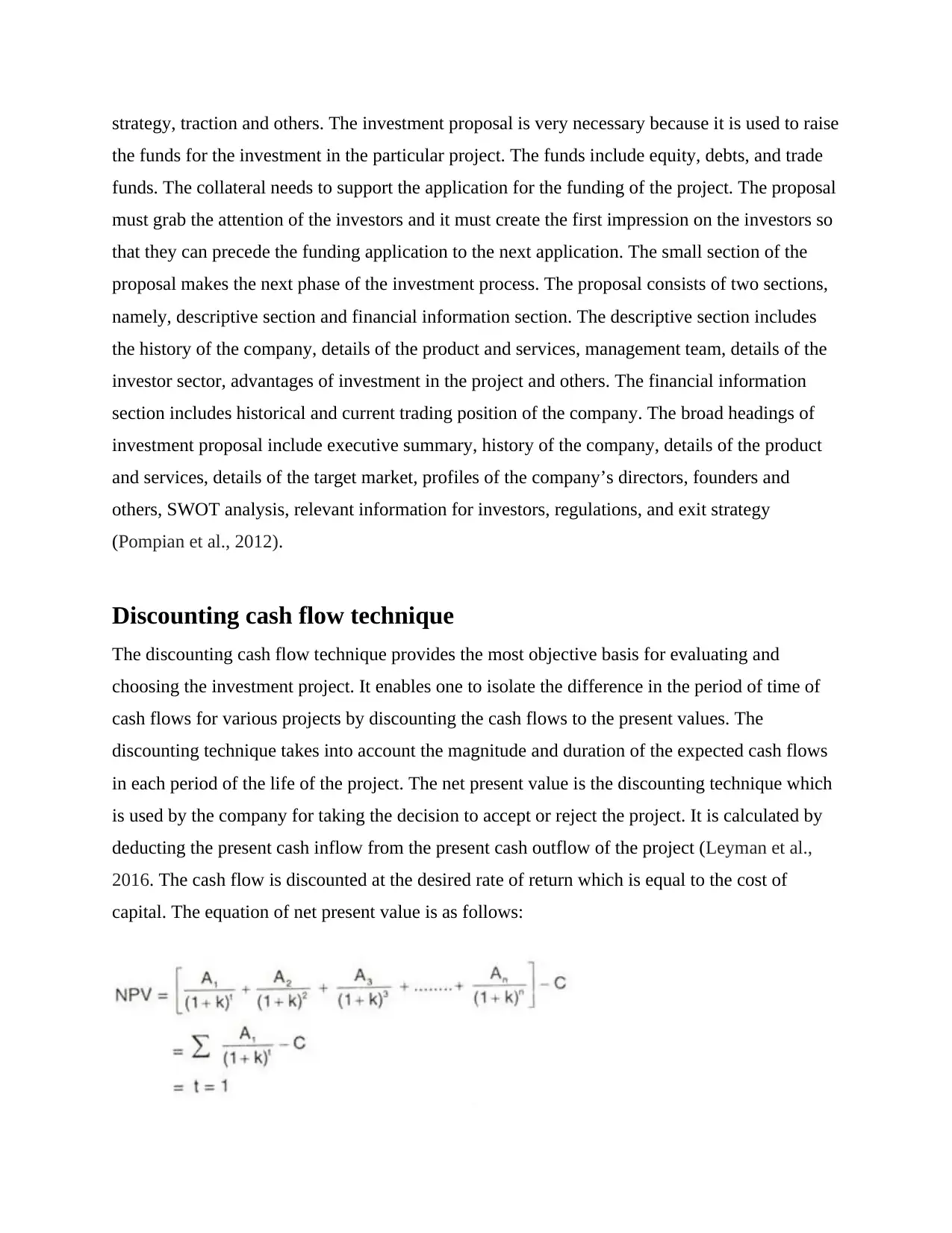
capital. The equation of net present value is as follows:
the funds for the investment in the particular project. The funds include equity, debts, and trade
funds. The collateral needs to support the application for the funding of the project. The proposal
must grab the attention of the investors and it must create the first impression on the investors so
that they can precede the funding application to the next application. The small section of the
proposal makes the next phase of the investment process. The proposal consists of two sections,
namely, descriptive section and financial information section. The descriptive section includes
the history of the company, details of the product and services, management team, details of the
investor sector, advantages of investment in the project and others. The financial information
section includes historical and current trading position of the company. The broad headings of
investment proposal include executive summary, history of the company, details of the product
and services, details of the target market, profiles of the company’s directors, founders and
others, SWOT analysis, relevant information for investors, regulations, and exit strategy
(Pompian et al., 2012).
Discounting cash flow technique
The discounting cash flow technique provides the most objective basis for evaluating and
choosing the investment project. It enables one to isolate the difference in the period of time of
cash flows for various projects by discounting the cash flows to the present values. The
discounting technique takes into account the magnitude and duration of the expected cash flows
in each period of the life of the project. The net present value is the discounting technique which
is used by the company for taking the decision to accept or reject the project. It is calculated by
deducting the present cash inflow from the present cash outflow of the project (Leyman et al.,
2016. The cash flow is discounted at the desired rate of return which is equal to the cost of
capital. The equation of net present value is as follows:
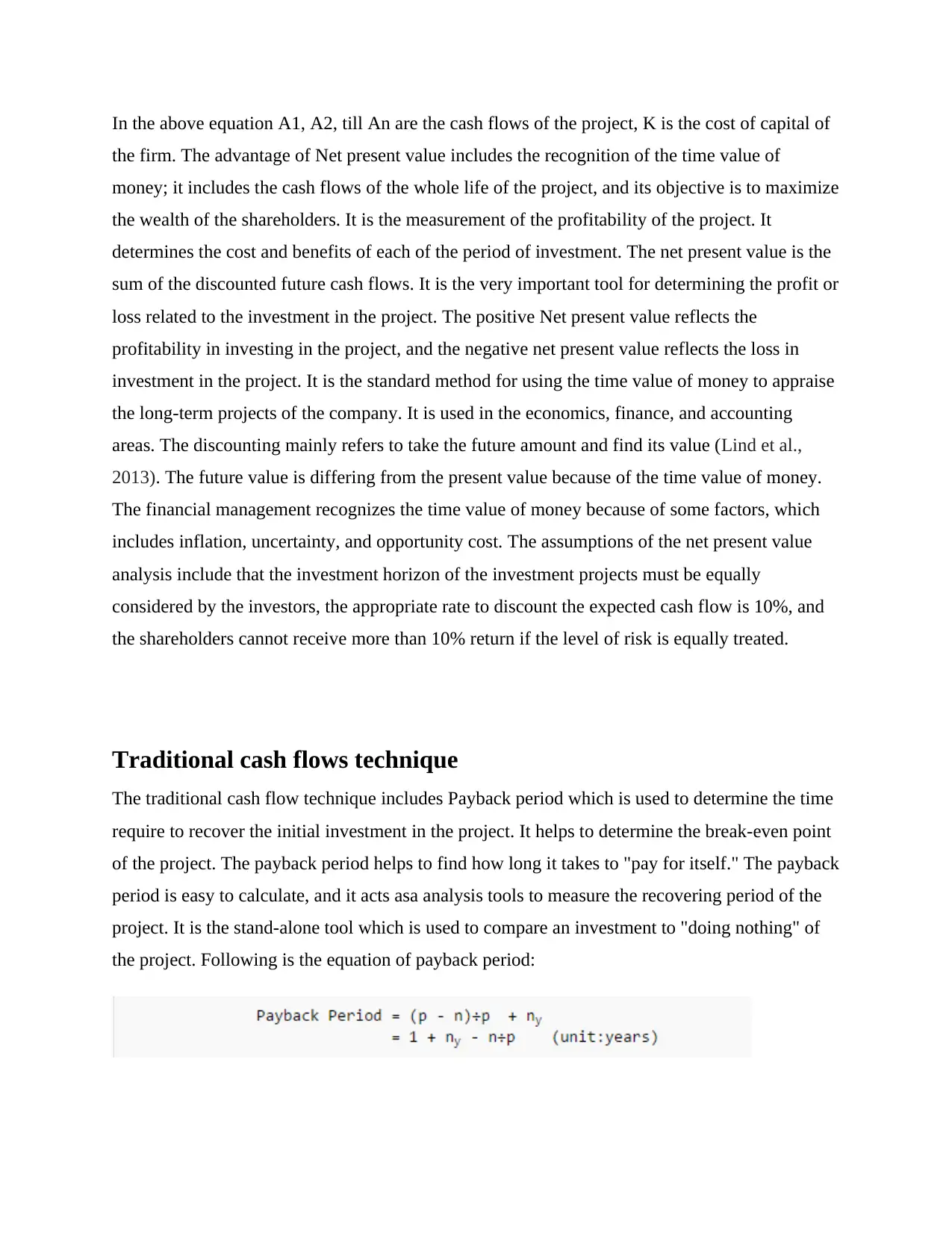
In the above equation A1, A2, till An are the cash flows of the project, K is the cost of capital of
the firm. The advantage of Net present value includes the recognition of the time value of
money; it includes the cash flows of the whole life of the project, and its objective is to maximize
the wealth of the shareholders. It is the measurement of the profitability of the project. It
determines the cost and benefits of each of the period of investment. The net present value is the
sum of the discounted future cash flows. It is the very important tool for determining the profit or
loss related to the investment in the project. The positive Net present value reflects the
profitability in investing in the project, and the negative net present value reflects the loss in
investment in the project. It is the standard method for using the time value of money to appraise
the long-term projects of the company. It is used in the economics, finance, and accounting
areas. The discounting mainly refers to take the future amount and find its value (Lind et al.,
2013). The future value is differing from the present value because of the time value of money.
The financial management recognizes the time value of money because of some factors, which
includes inflation, uncertainty, and opportunity cost. The assumptions of the net present value
analysis include that the investment horizon of the investment projects must be equally
considered by the investors, the appropriate rate to discount the expected cash flow is 10%, and
the shareholders cannot receive more than 10% return if the level of risk is equally treated.
Traditional cash flows technique
The traditional cash flow technique includes Payback period which is used to determine the time
require to recover the initial investment in the project. It helps to determine the break-even point
of the project. The payback period helps to find how long it takes to "pay for itself." The payback
period is easy to calculate, and it acts asa analysis tools to measure the recovering period of the
project. It is the stand-alone tool which is used to compare an investment to "doing nothing" of
the project. Following is the equation of payback period:
the firm. The advantage of Net present value includes the recognition of the time value of
money; it includes the cash flows of the whole life of the project, and its objective is to maximize
the wealth of the shareholders. It is the measurement of the profitability of the project. It
determines the cost and benefits of each of the period of investment. The net present value is the
sum of the discounted future cash flows. It is the very important tool for determining the profit or
loss related to the investment in the project. The positive Net present value reflects the
profitability in investing in the project, and the negative net present value reflects the loss in
investment in the project. It is the standard method for using the time value of money to appraise
the long-term projects of the company. It is used in the economics, finance, and accounting
areas. The discounting mainly refers to take the future amount and find its value (Lind et al.,
2013). The future value is differing from the present value because of the time value of money.
The financial management recognizes the time value of money because of some factors, which
includes inflation, uncertainty, and opportunity cost. The assumptions of the net present value
analysis include that the investment horizon of the investment projects must be equally
considered by the investors, the appropriate rate to discount the expected cash flow is 10%, and
the shareholders cannot receive more than 10% return if the level of risk is equally treated.
Traditional cash flows technique
The traditional cash flow technique includes Payback period which is used to determine the time
require to recover the initial investment in the project. It helps to determine the break-even point
of the project. The payback period helps to find how long it takes to "pay for itself." The payback
period is easy to calculate, and it acts asa analysis tools to measure the recovering period of the
project. It is the stand-alone tool which is used to compare an investment to "doing nothing" of
the project. Following is the equation of payback period:
⊘ This is a preview!⊘
Do you want full access?
Subscribe today to unlock all pages.
Trusted by 1+ million students worldwide
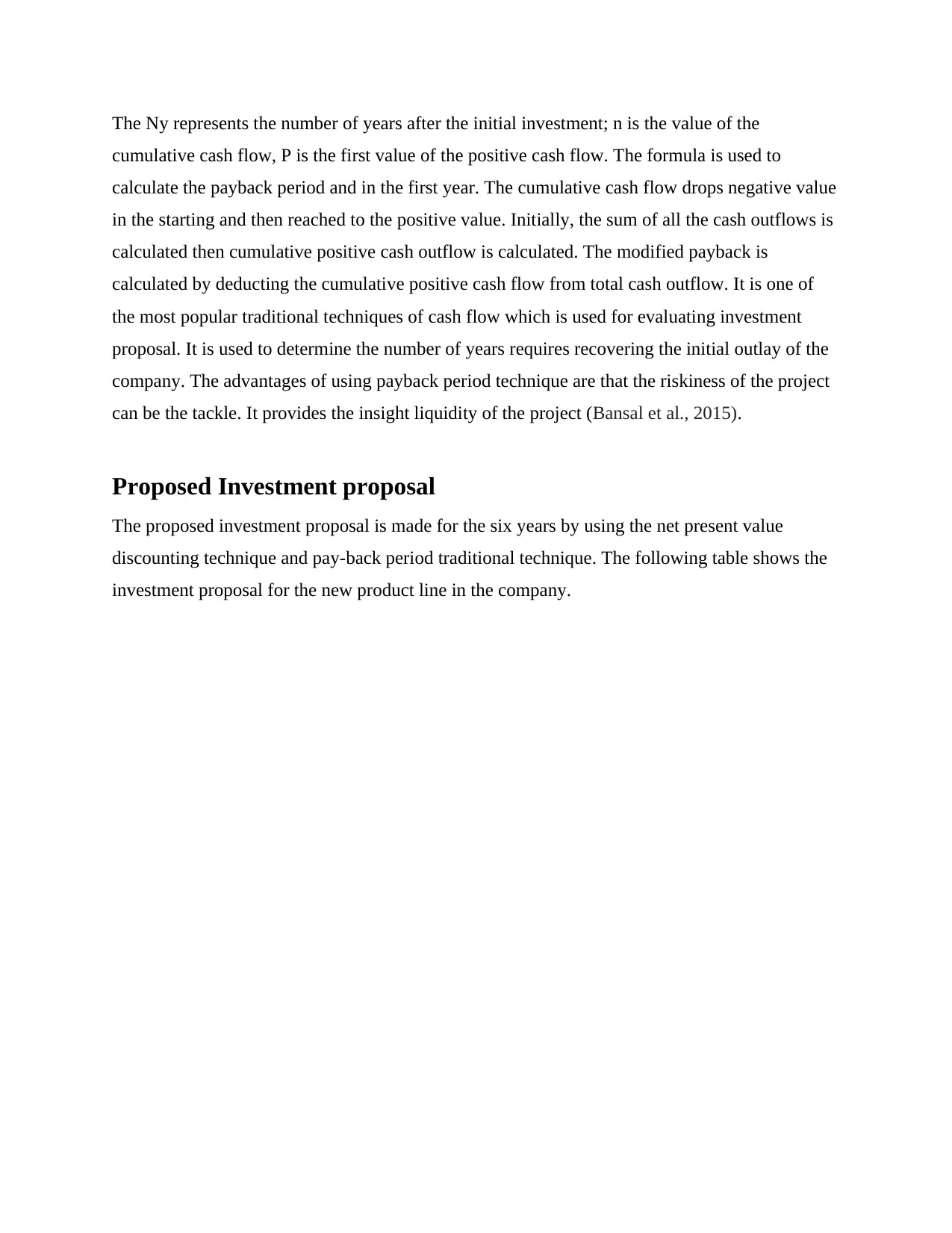
The Ny represents the number of years after the initial investment; n is the value of the
cumulative cash flow, P is the first value of the positive cash flow. The formula is used to
calculate the payback period and in the first year. The cumulative cash flow drops negative value
in the starting and then reached to the positive value. Initially, the sum of all the cash outflows is
calculated then cumulative positive cash outflow is calculated. The modified payback is
calculated by deducting the cumulative positive cash flow from total cash outflow. It is one of
the most popular traditional techniques of cash flow which is used for evaluating investment
proposal. It is used to determine the number of years requires recovering the initial outlay of the
company. The advantages of using payback period technique are that the riskiness of the project
can be the tackle. It provides the insight liquidity of the project (Bansal et al., 2015).
Proposed Investment proposal
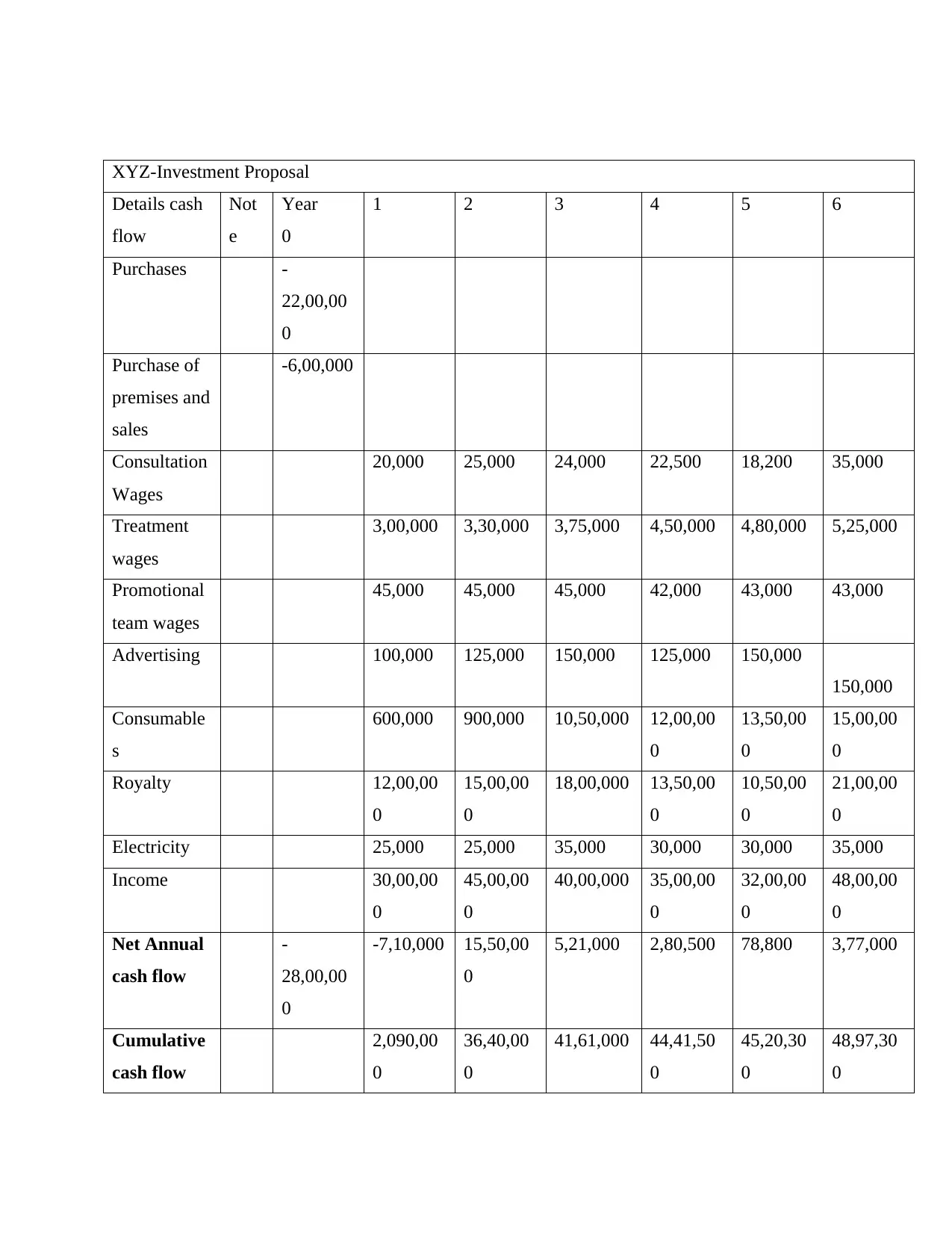
The proposed investment proposal is made for the six years by using the net present value
discounting technique and pay-back period traditional technique. The following table shows the
investment proposal for the new product line in the company.
cumulative cash flow, P is the first value of the positive cash flow. The formula is used to
calculate the payback period and in the first year. The cumulative cash flow drops negative value
in the starting and then reached to the positive value. Initially, the sum of all the cash outflows is
calculated then cumulative positive cash outflow is calculated. The modified payback is
calculated by deducting the cumulative positive cash flow from total cash outflow. It is one of
the most popular traditional techniques of cash flow which is used for evaluating investment
proposal. It is used to determine the number of years requires recovering the initial outlay of the
company. The advantages of using payback period technique are that the riskiness of the project
can be the tackle. It provides the insight liquidity of the project (Bansal et al., 2015).
Proposed Investment proposal
The proposed investment proposal is made for the six years by using the net present value
discounting technique and pay-back period traditional technique. The following table shows the
investment proposal for the new product line in the company.
Paraphrase This Document
Need a fresh take? Get an instant paraphrase of this document with our AI Paraphraser
XYZ-Investment Proposal
Details cash
flow
Not
e
Year
0
1 2 3 4 5 6
Purchases -
22,00,00
0
Purchase of
premises and
sales
-6,00,000
Consultation
Wages
20,000 25,000 24,000 22,500 18,200 35,000
Treatment
wages
3,00,000 3,30,000 3,75,000 4,50,000 4,80,000 5,25,000
Promotional
team wages
45,000 45,000 45,000 42,000 43,000 43,000
Advertising 100,000 125,000 150,000 125,000 150,000
150,000
Consumable
s
600,000 900,000 10,50,000 12,00,00
0
13,50,00
0
15,00,00
0
Royalty 12,00,00
0
15,00,00
0
18,00,000 13,50,00
0
10,50,00
0
21,00,00
0
Electricity 25,000 25,000 35,000 30,000 30,000 35,000
Income 30,00,00
0
45,00,00
0
40,00,000 35,00,00
0
32,00,00
0
48,00,00
0
Net Annual
cash flow
-
28,00,00
0
-7,10,000 15,50,00
0
5,21,000 2,80,500 78,800 3,77,000
Cumulative
cash flow
2,090,00
0
36,40,00
0
41,61,000 44,41,50
0
45,20,30
0
48,97,30
0
Details cash
flow
Not
e
Year
0
1 2 3 4 5 6
Purchases -
22,00,00
0
Purchase of
premises and
sales
-6,00,000
Consultation
Wages
20,000 25,000 24,000 22,500 18,200 35,000
Treatment
wages
3,00,000 3,30,000 3,75,000 4,50,000 4,80,000 5,25,000
Promotional
team wages
45,000 45,000 45,000 42,000 43,000 43,000
Advertising 100,000 125,000 150,000 125,000 150,000
150,000
Consumable
s
600,000 900,000 10,50,000 12,00,00
0
13,50,00
0
15,00,00
0
Royalty 12,00,00
0
15,00,00
0
18,00,000 13,50,00
0
10,50,00
0
21,00,00
0
Electricity 25,000 25,000 35,000 30,000 30,000 35,000
Income 30,00,00
0
45,00,00
0
40,00,000 35,00,00
0
32,00,00
0
48,00,00
0
Net Annual
cash flow
-
28,00,00
0
-7,10,000 15,50,00
0
5,21,000 2,80,500 78,800 3,77,000
Cumulative
cash flow
2,090,00
0
36,40,00
0
41,61,000 44,41,50
0
45,20,30
0
48,97,30
0
Pay back
period
Year 3
Discount
rate
1 0.9091 0.8264 0.7513 0.683 0.621 0.564
Present
value
Net present
value
-
28,00,00
0
6,45,461 12,80,92
0
3,91,427.
3
191581.5 4,843.2 2,12,628
73202
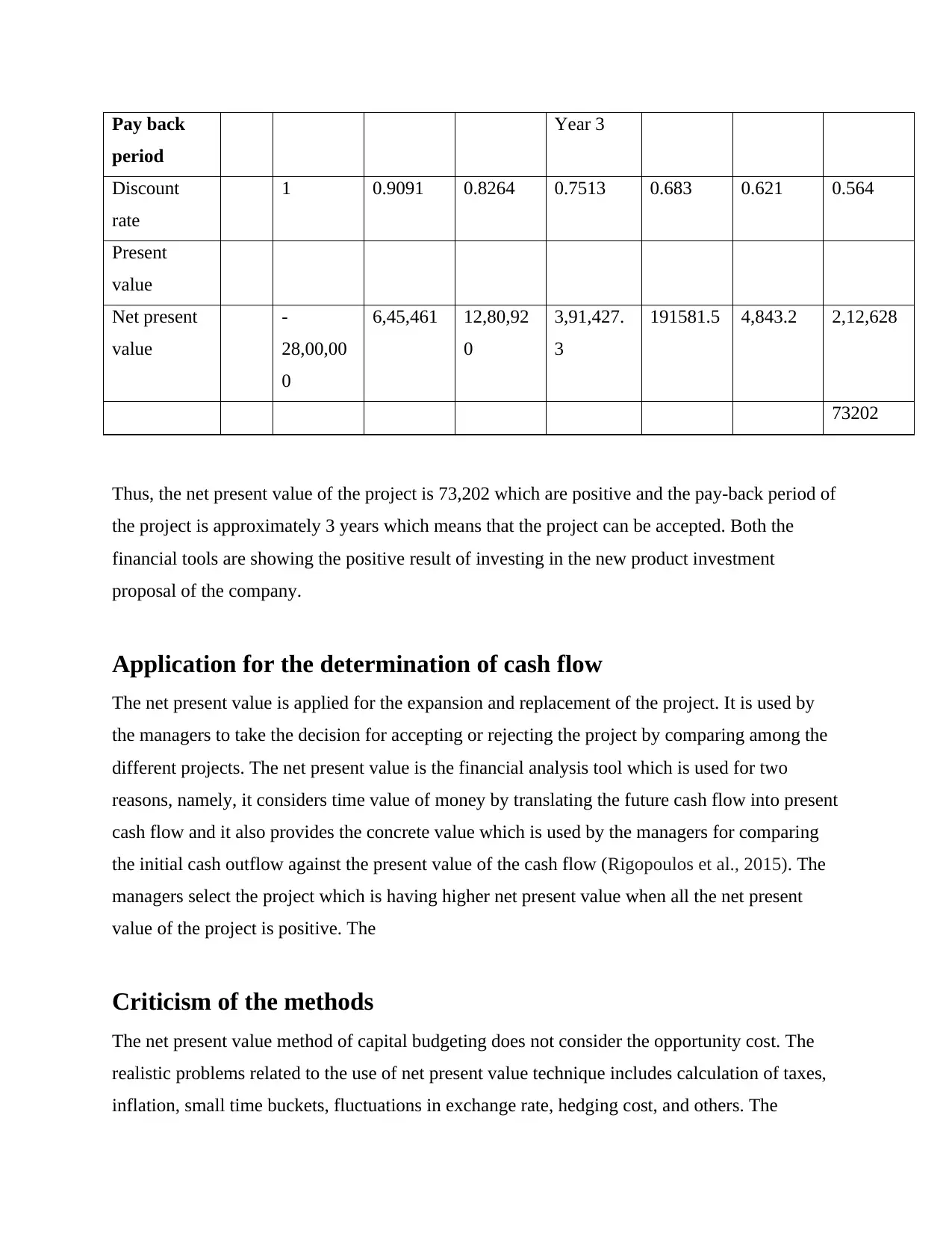
Thus, the net present value of the project is 73,202 which are positive and the pay-back period of
the project is approximately 3 years which means that the project can be accepted. Both the
financial tools are showing the positive result of investing in the new product investment
proposal of the company.
Application for the determination of cash flow
The net present value is applied for the expansion and replacement of the project. It is used by
the managers to take the decision for accepting or rejecting the project by comparing among the
different projects. The net present value is the financial analysis tool which is used for two
reasons, namely, it considers time value of money by translating the future cash flow into present
cash flow and it also provides the concrete value which is used by the managers for comparing
the initial cash outflow against the present value of the cash flow (Rigopoulos et al., 2015). The
managers select the project which is having higher net present value when all the net present
value of the project is positive. The
Criticism of the methods
The net present value method of capital budgeting does not consider the opportunity cost. The
realistic problems related to the use of net present value technique includes calculation of taxes,
inflation, small time buckets, fluctuations in exchange rate, hedging cost, and others. The
period
Year 3
Discount
rate
1 0.9091 0.8264 0.7513 0.683 0.621 0.564
Present
value
Net present
value
-
28,00,00
0
6,45,461 12,80,92
0
3,91,427.
3
191581.5 4,843.2 2,12,628
73202
Thus, the net present value of the project is 73,202 which are positive and the pay-back period of
the project is approximately 3 years which means that the project can be accepted. Both the
financial tools are showing the positive result of investing in the new product investment
proposal of the company.
Application for the determination of cash flow
The net present value is applied for the expansion and replacement of the project. It is used by
the managers to take the decision for accepting or rejecting the project by comparing among the
different projects. The net present value is the financial analysis tool which is used for two
reasons, namely, it considers time value of money by translating the future cash flow into present
cash flow and it also provides the concrete value which is used by the managers for comparing
the initial cash outflow against the present value of the cash flow (Rigopoulos et al., 2015). The
managers select the project which is having higher net present value when all the net present
value of the project is positive. The
Criticism of the methods
The net present value method of capital budgeting does not consider the opportunity cost. The
realistic problems related to the use of net present value technique includes calculation of taxes,
inflation, small time buckets, fluctuations in exchange rate, hedging cost, and others. The
⊘ This is a preview!⊘
Do you want full access?
Subscribe today to unlock all pages.
Trusted by 1+ million students worldwide
payback period method has serious limitations because it does not take into account the time
value of money, financing, risk and other important factors which need to be considered. It does
not consider any comparison of the projects. It is also not considered the cash inflow of the
project, the profitability of the project and it also fails to define the cash inflows of the project
(Pasqual et al., 2013).
Logical aspect of Decision making
The net present value indicates the value added by the project in the company. The positive Rt of
the project shows the positive cash inflow of the company and if it is negatives then the status of
discounted cash outflow within the time t. The projects having positive NPV could be accepted.
According to the financial theories, the company should compare the two mutually exclusive
projects, and the one with higher net present value should be selected (Kogan et al., 2014). The
present value indicates that the earnings of the projects are more than the anticipated cost of the
project. The concept of net present value is based on the rule of net present value. According to
the rule of net present value if the net present value is more than one then the project can be
accepted, if the net present value of the project is less than one then the project must be rejected
and if the net present value of the project is zero it means there is neither a loss nor a profit so the
company can accept the project or reject the project. The logical aspect of payback period
includes that if the initial outlay cost of the project is covered in the shorter period then the
company can accept the project, but if the project takes a long time to cover the initial outlay cost
then the company may not accept the project. The very crucial decision investment of funds is a
very crucial decision for the investors because it requires the commitment of huge funds. The net
present value discounting techniques acts as analytical tools which help in taking the decision
regarding the acceptance of the project (Clemen et al., 2013).
Conclusion
The investment proposal plays an important role in raise the capital for the investment projects of
the company. The proposal includes the information which is relevant for the investors and
consumers. The aim of the proposal is to attract the investors by showing the benefits of
value of money, financing, risk and other important factors which need to be considered. It does
not consider any comparison of the projects. It is also not considered the cash inflow of the
project, the profitability of the project and it also fails to define the cash inflows of the project
(Pasqual et al., 2013).
Logical aspect of Decision making
The net present value indicates the value added by the project in the company. The positive Rt of
the project shows the positive cash inflow of the company and if it is negatives then the status of
discounted cash outflow within the time t. The projects having positive NPV could be accepted.
According to the financial theories, the company should compare the two mutually exclusive
projects, and the one with higher net present value should be selected (Kogan et al., 2014). The
present value indicates that the earnings of the projects are more than the anticipated cost of the
project. The concept of net present value is based on the rule of net present value. According to
the rule of net present value if the net present value is more than one then the project can be
accepted, if the net present value of the project is less than one then the project must be rejected
and if the net present value of the project is zero it means there is neither a loss nor a profit so the
company can accept the project or reject the project. The logical aspect of payback period
includes that if the initial outlay cost of the project is covered in the shorter period then the
company can accept the project, but if the project takes a long time to cover the initial outlay cost
then the company may not accept the project. The very crucial decision investment of funds is a
very crucial decision for the investors because it requires the commitment of huge funds. The net
present value discounting techniques acts as analytical tools which help in taking the decision
regarding the acceptance of the project (Clemen et al., 2013).
Conclusion
The investment proposal plays an important role in raise the capital for the investment projects of
the company. The proposal includes the information which is relevant for the investors and
consumers. The aim of the proposal is to attract the investors by showing the benefits of
Paraphrase This Document
Need a fresh take? Get an instant paraphrase of this document with our AI Paraphraser
investment in the particular project. The investment project includes two sections, namely,
descriptive information and financial information. The descriptive information includes history
and the background information about the company. The financial information includes the rate
of return, growth of investment, and other financial aspects of the investment in the project. It
allows the investors to concrete the investment decision which is the very crucial decision
because it involves the commitment of huge funds. The objective of discounting cash flow
technique is to evaluate and assess the project. The net present value technique is used evaluating
the project and preparation of investment proposal for the six years. The net present value is
applicable in economics, finance and accounts. It is used by the managers for taking the decision
regarding the acceptance or rejection of the project. The net present value rule explains the
criteria for accepting and rejecting the project. It the net present value is positive then the project
can be accepted, if the net present value is negative, then the project must be rejected, and if the
net present value is zero, then it is to the investor that he may accept or reject the project. The
traditional technique pay-back period is used for preparing the investment proposal for the six
years. The investment proposal is made for the new product line in the company. The net present
value does not include the opportunity cost which is very necessary for the selecting the project
for the company. The pay-back period does not include the profitability of the company, time
value of money, risk and other important factors which are very necessary for evaluating the
project. The logical aspect of using net present value method is according to the rule of net
present value which is used by the managers for taking a decision regarding the selection of the
project. According to the financial analysis, the net present value of the project is positive which
means then the project can be accepted and the pay-back period of the company is three years
which manes the initial cash outlay of the company will be covered in the first three years of the
investment. It shows that the project must be accepted.
descriptive information and financial information. The descriptive information includes history
and the background information about the company. The financial information includes the rate
of return, growth of investment, and other financial aspects of the investment in the project. It
allows the investors to concrete the investment decision which is the very crucial decision
because it involves the commitment of huge funds. The objective of discounting cash flow
technique is to evaluate and assess the project. The net present value technique is used evaluating
the project and preparation of investment proposal for the six years. The net present value is
applicable in economics, finance and accounts. It is used by the managers for taking the decision
regarding the acceptance or rejection of the project. The net present value rule explains the
criteria for accepting and rejecting the project. It the net present value is positive then the project
can be accepted, if the net present value is negative, then the project must be rejected, and if the
net present value is zero, then it is to the investor that he may accept or reject the project. The
traditional technique pay-back period is used for preparing the investment proposal for the six
years. The investment proposal is made for the new product line in the company. The net present
value does not include the opportunity cost which is very necessary for the selecting the project
for the company. The pay-back period does not include the profitability of the company, time
value of money, risk and other important factors which are very necessary for evaluating the
project. The logical aspect of using net present value method is according to the rule of net
present value which is used by the managers for taking a decision regarding the selection of the
project. According to the financial analysis, the net present value of the project is positive which
means then the project can be accepted and the pay-back period of the company is three years
which manes the initial cash outlay of the company will be covered in the first three years of the
investment. It shows that the project must be accepted.
References
Lyman, P. and Vanhoucke, M., 2016. Capital-and resource-constrained project scheduling with
net present value optimization. European Journal of Operational Research.
Lind, R.C., Arrow, K.J., Corey, G.R., Dasgupta, P., Sen, A.K., Stauffer, T., Stiglitz, J.E. and
Stockfisch, J.A., 2013. Discounting for time and risk in energy policy (Vol. 3). Routledge.
Bierman Jr, H. and Smidt, S., 2012. The capital budgeting decision: economic analysis of
investment projects. Routledge.
Kogan, A. (2014). The Criticism of Net Present Value and Equivalent Annual Cost. Journal of
Advanced Research in Law and Economics, 5(1 (9)), 15.
Rigopoulos, G., 2015. A review on Real Options utilization in Capital Budgeting
practice. International Journal of Information, Business and Management, 7(2), p.1.
Clemen, R.T. and Reilly, T., 2013. Making hard decisions with DecisionTools. Cengage
Learning.
Bansal, P. and Sharma, G., 2015, January. Making Social Issues Count: How Businesses Make
Responsible Strategic Decisions. In Academy of Management Proceedings (Vol. 2015, No. 1, p.
16173). Academy of Management.
Pasqual, J., Padilla, E. and Jadotte, E., 2013. Technical note: equivalence of different
profitability criteria with the net present value. International Journal of Production
Economics, 142(1), pp.205-210.
Pompian, M., 2012. Behavioral finance and investor types. Private Wealth Management Feature
Articles, 2012(1), pp.1-3.
Lyman, P. and Vanhoucke, M., 2016. Capital-and resource-constrained project scheduling with
net present value optimization. European Journal of Operational Research.
Lind, R.C., Arrow, K.J., Corey, G.R., Dasgupta, P., Sen, A.K., Stauffer, T., Stiglitz, J.E. and
Stockfisch, J.A., 2013. Discounting for time and risk in energy policy (Vol. 3). Routledge.
Bierman Jr, H. and Smidt, S., 2012. The capital budgeting decision: economic analysis of
investment projects. Routledge.
Kogan, A. (2014). The Criticism of Net Present Value and Equivalent Annual Cost. Journal of
Advanced Research in Law and Economics, 5(1 (9)), 15.
Rigopoulos, G., 2015. A review on Real Options utilization in Capital Budgeting
practice. International Journal of Information, Business and Management, 7(2), p.1.
Clemen, R.T. and Reilly, T., 2013. Making hard decisions with DecisionTools. Cengage
Learning.
Bansal, P. and Sharma, G., 2015, January. Making Social Issues Count: How Businesses Make
Responsible Strategic Decisions. In Academy of Management Proceedings (Vol. 2015, No. 1, p.
16173). Academy of Management.
Pasqual, J., Padilla, E. and Jadotte, E., 2013. Technical note: equivalence of different
profitability criteria with the net present value. International Journal of Production
Economics, 142(1), pp.205-210.
Pompian, M., 2012. Behavioral finance and investor types. Private Wealth Management Feature
Articles, 2012(1), pp.1-3.
⊘ This is a preview!⊘
Do you want full access?
Subscribe today to unlock all pages.
Trusted by 1+ million students worldwide

1 out of 14


Related Documents


Your All-in-One AI-Powered Toolkit for Academic Success.
+13062052269
info@desklib.com
Available 24*7 on WhatsApp / Email
![[object Object]](/_next/static/media/star-bottom.7253800d.svg)
Unlock your academic potential
Copyright © 2020–2026 A2Z Services. All Rights Reserved. Developed and managed by ZUCOL.