University Project Proposal: Internet of Robotic Things
VerifiedAdded on 2021/04/24
|15
|2638
|311
Project
AI Summary
This project proposal explores the application of the Internet of Robotic Things (IoRT) in the manufacturing industry. It addresses the challenges of skilled labor shortages and proposes IoRT as a solution to increase productivity and market share. The proposal includes a detailed rationale, research questions, a conceptual framework, and a methodology utilizing qualitative research and the Rapid Application Development (RAD) system development method. It covers data collection techniques, ethical considerations, and compliance requirements. The project plan outlines deliverables, a work breakdown structure, risk analysis, and a Gantt chart for a 275-day project duration. The proposal concludes with recommendations for implementation and references relevant literature. The project aims to demonstrate how IoRT can provide cost-effective solutions and competitive advantages for the manufacturing sector.

Running head: Emerging Technology Topic: Internet of Robotic Things
Project Proposal: “Emerging Technology Topic: Internet of Robotic Things”
Name of Student
Name of University
Project Proposal: “Emerging Technology Topic: Internet of Robotic Things”
Name of Student
Name of University

Paraphrase This Document
Need a fresh take? Get an instant paraphrase of this document with our AI Paraphraser
Emerging Technology Topic: Internet of Robotic Things
Table of Contents
Rationale........................................................................................................................................................................................................................................ 3
a. Problem Domain................................................................................................................................................................................................................ 3
a. Purpose and justification.................................................................................................................................................................................................... 3
2. Research questions.................................................................................................................................................................................................................... 4
3. Conceptual framework............................................................................................................................................................................................................... 4
4. Methodology.............................................................................................................................................................................................................................. 5
a. Research and System Development Methodologies...............................................................................................................................................................5
b. Data Collection...................................................................................................................................................................................................................... 6
c. Ethical Issues......................................................................................................................................................................................................................... 7
d. Compliance Requirements..................................................................................................................................................................................................... 8
e. Data Analysis......................................................................................................................................................................................................................... 8
5. Project Plan................................................................................................................................................................................................................................ 9
a. Deliverables........................................................................................................................................................................................................................... 9
b. Project Plan............................................................................................................................................................................................................................ 9
c. Work Breakdown Structure.................................................................................................................................................................................................. 12
d. Risk Analysis....................................................................................................................................................................................................................... 13
e. Duration............................................................................................................................................................................................................................... 13
f. Gantt Chart........................................................................................................................................................................................................................... 14
6. References............................................................................................................................................................................................................................... 15
Table of Contents
Rationale........................................................................................................................................................................................................................................ 3
a. Problem Domain................................................................................................................................................................................................................ 3
a. Purpose and justification.................................................................................................................................................................................................... 3
2. Research questions.................................................................................................................................................................................................................... 4
3. Conceptual framework............................................................................................................................................................................................................... 4
4. Methodology.............................................................................................................................................................................................................................. 5
a. Research and System Development Methodologies...............................................................................................................................................................5
b. Data Collection...................................................................................................................................................................................................................... 6
c. Ethical Issues......................................................................................................................................................................................................................... 7
d. Compliance Requirements..................................................................................................................................................................................................... 8
e. Data Analysis......................................................................................................................................................................................................................... 8
5. Project Plan................................................................................................................................................................................................................................ 9
a. Deliverables........................................................................................................................................................................................................................... 9
b. Project Plan............................................................................................................................................................................................................................ 9
c. Work Breakdown Structure.................................................................................................................................................................................................. 12
d. Risk Analysis....................................................................................................................................................................................................................... 13
e. Duration............................................................................................................................................................................................................................... 13
f. Gantt Chart........................................................................................................................................................................................................................... 14
6. References............................................................................................................................................................................................................................... 15
Emerging Technology Topic: Internet of Robotic Things
Rationale
a. Problem Domain
In recent times the manufacturing industry is suffering due to shortage of skilled workers. The author has found that the skilled
professionals are aging and retiring, that is why the manufacturing sectors are searching for the solution by which they can retain their top
position in the market and can fulfil demand of the customers (Simoens et al., 2016). The manufacturing sectors are opting for the Internet-
enabled robots. Internet of Robotic Things allows robots to communicate with each other over the internet. The robots by working together can
eliminate the skills gap and can help the manufacturing sectors to prosper.
a. Purpose and justification
The purpose of this project is to provide the manufacturing industry a solution by which they can increase their productivity and market
share. The robots will give them the cost-effective solution and the competitive advantage following which they can prosper in future. Also the
manufacturing sectors can be able to reduce of risks which emerge due to lack of skilled labourers (Razafimandimby, Loscri & Vegni, 2016).
The paper will demonstrate various advantages that can be acquired due to the adaptation of IoRT in the manufacturing industry.
The robots communicate with each other over the internet and will assist to handle the difficult tasks with ease which is not even possible for
human beings even if they work as a team. The manufacturing industry mainly uses those robots to perform pick and place operations.
Rationale
a. Problem Domain
In recent times the manufacturing industry is suffering due to shortage of skilled workers. The author has found that the skilled
professionals are aging and retiring, that is why the manufacturing sectors are searching for the solution by which they can retain their top
position in the market and can fulfil demand of the customers (Simoens et al., 2016). The manufacturing sectors are opting for the Internet-
enabled robots. Internet of Robotic Things allows robots to communicate with each other over the internet. The robots by working together can
eliminate the skills gap and can help the manufacturing sectors to prosper.
a. Purpose and justification
The purpose of this project is to provide the manufacturing industry a solution by which they can increase their productivity and market
share. The robots will give them the cost-effective solution and the competitive advantage following which they can prosper in future. Also the
manufacturing sectors can be able to reduce of risks which emerge due to lack of skilled labourers (Razafimandimby, Loscri & Vegni, 2016).
The paper will demonstrate various advantages that can be acquired due to the adaptation of IoRT in the manufacturing industry.
The robots communicate with each other over the internet and will assist to handle the difficult tasks with ease which is not even possible for
human beings even if they work as a team. The manufacturing industry mainly uses those robots to perform pick and place operations.
⊘ This is a preview!⊘
Do you want full access?
Subscribe today to unlock all pages.

Trusted by 1+ million students worldwide
Emerging Technology Topic: Internet of Robotic Things
2. Research questions
What is the main reason behind for not meeting the quality demand?
What are the issues occurring due to shortage of skilled labourers?
Does IoRT devices are capable enough to meet the needs of the manufacturing sectors?
What will be the probable budget for implementing all these smart devices?
3. Conceptual framework
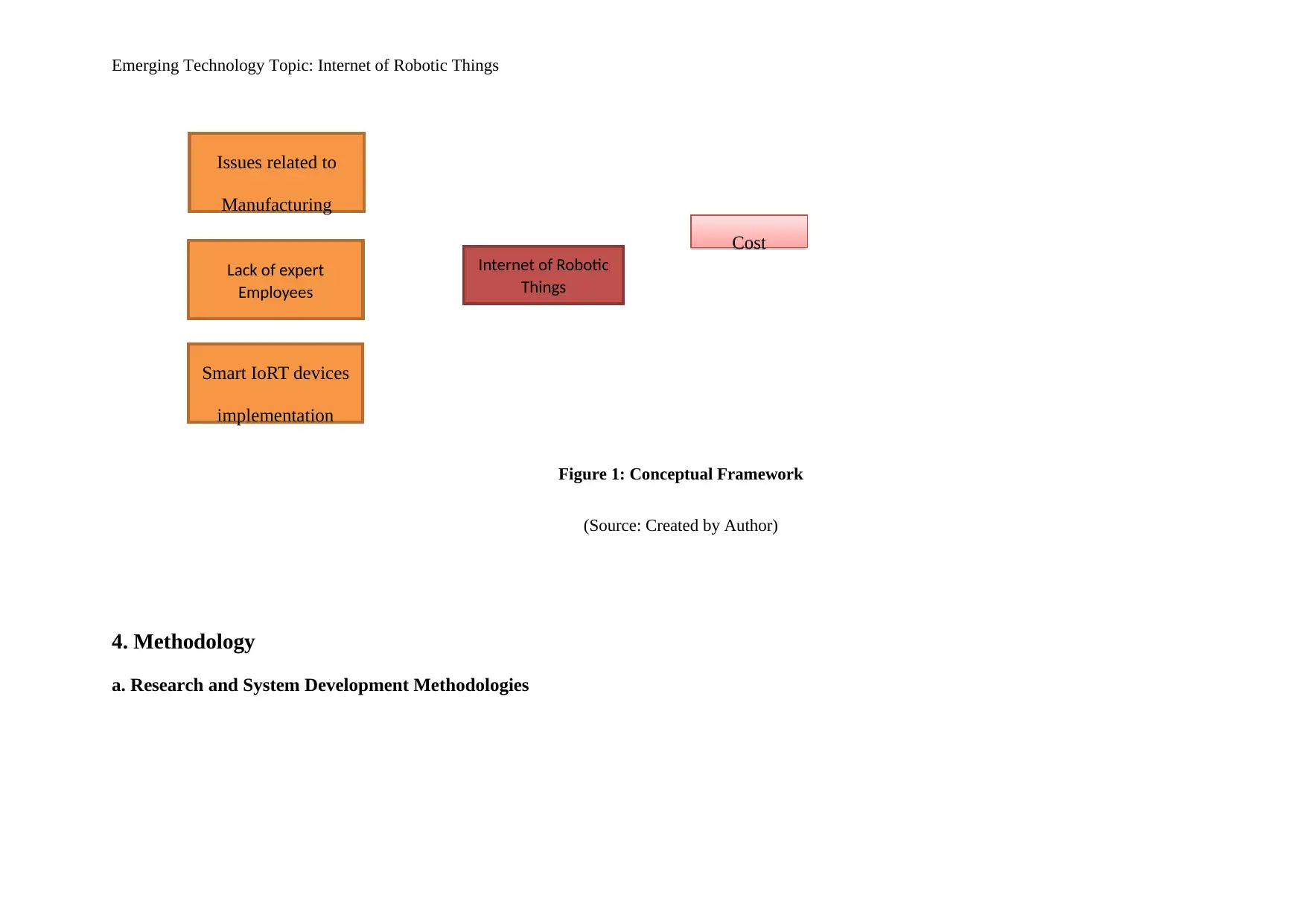
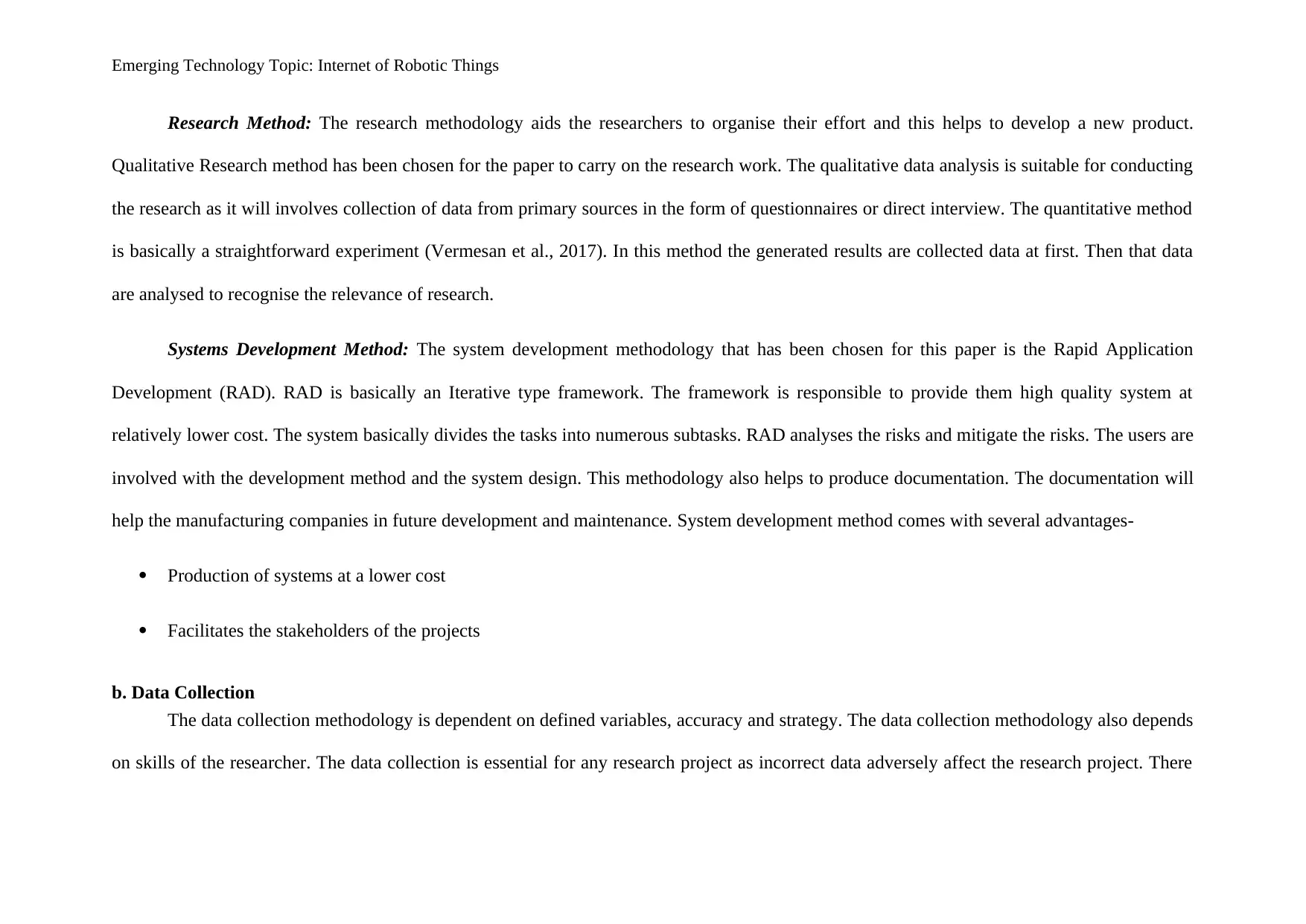
The conceptual framework explains several questions which help to conduct the research. The figure 1 has illustrated the major issues
which the manufacturing companies are facing. The manufacturing sectors are opting for implementing the smart IoRT devices. They hope that
all these robots will give them several benefits. The robots are generally fast and efficient compared to the humans. The humans can give wrong
output. However, the robots give fast and efficient results (Ray, 2016). The robots require little maintenance and they can serve for long. The
robots are cost-effective. Figure 1 shows the issues associated with the project. The cost also depends on the robots.
2. Research questions
What is the main reason behind for not meeting the quality demand?
What are the issues occurring due to shortage of skilled labourers?
Does IoRT devices are capable enough to meet the needs of the manufacturing sectors?
What will be the probable budget for implementing all these smart devices?
3. Conceptual framework
The conceptual framework explains several questions which help to conduct the research. The figure 1 has illustrated the major issues
which the manufacturing companies are facing. The manufacturing sectors are opting for implementing the smart IoRT devices. They hope that
all these robots will give them several benefits. The robots are generally fast and efficient compared to the humans. The humans can give wrong
output. However, the robots give fast and efficient results (Ray, 2016). The robots require little maintenance and they can serve for long. The
robots are cost-effective. Figure 1 shows the issues associated with the project. The cost also depends on the robots.
Paraphrase This Document
Need a fresh take? Get an instant paraphrase of this document with our AI Paraphraser
Emerging Technology Topic: Internet of Robotic Things
Figure 1: Conceptual Framework
(Source: Created by Author)
4. Methodology
a. Research and System Development Methodologies
Lack of expert
Employees
Issues related to
Manufacturing
Smart IoRT devices
implementation
Internet of Robotic
Things
Cost
Figure 1: Conceptual Framework
(Source: Created by Author)
4. Methodology
a. Research and System Development Methodologies
Lack of expert
Employees
Issues related to
Manufacturing
Smart IoRT devices
implementation
Internet of Robotic
Things
Cost
Emerging Technology Topic: Internet of Robotic Things
Research Method: The research methodology aids the researchers to organise their effort and this helps to develop a new product.
Qualitative Research method has been chosen for the paper to carry on the research work. The qualitative data analysis is suitable for conducting
the research as it will involves collection of data from primary sources in the form of questionnaires or direct interview. The quantitative method
is basically a straightforward experiment (Vermesan et al., 2017). In this method the generated results are collected data at first. Then that data
are analysed to recognise the relevance of research.
Systems Development Method: The system development methodology that has been chosen for this paper is the Rapid Application
Development (RAD). RAD is basically an Iterative type framework. The framework is responsible to provide them high quality system at
relatively lower cost. The system basically divides the tasks into numerous subtasks. RAD analyses the risks and mitigate the risks. The users are
involved with the development method and the system design. This methodology also helps to produce documentation. The documentation will
help the manufacturing companies in future development and maintenance. System development method comes with several advantages-
Production of systems at a lower cost
Facilitates the stakeholders of the projects
b. Data Collection
The data collection methodology is dependent on defined variables, accuracy and strategy. The data collection methodology also depends
on skills of the researcher. The data collection is essential for any research project as incorrect data adversely affect the research project. There
Research Method: The research methodology aids the researchers to organise their effort and this helps to develop a new product.
Qualitative Research method has been chosen for the paper to carry on the research work. The qualitative data analysis is suitable for conducting
the research as it will involves collection of data from primary sources in the form of questionnaires or direct interview. The quantitative method
is basically a straightforward experiment (Vermesan et al., 2017). In this method the generated results are collected data at first. Then that data
are analysed to recognise the relevance of research.
Systems Development Method: The system development methodology that has been chosen for this paper is the Rapid Application
Development (RAD). RAD is basically an Iterative type framework. The framework is responsible to provide them high quality system at
relatively lower cost. The system basically divides the tasks into numerous subtasks. RAD analyses the risks and mitigate the risks. The users are
involved with the development method and the system design. This methodology also helps to produce documentation. The documentation will
help the manufacturing companies in future development and maintenance. System development method comes with several advantages-
Production of systems at a lower cost
Facilitates the stakeholders of the projects
b. Data Collection
The data collection methodology is dependent on defined variables, accuracy and strategy. The data collection methodology also depends
on skills of the researcher. The data collection is essential for any research project as incorrect data adversely affect the research project. There
⊘ This is a preview!⊘
Do you want full access?
Subscribe today to unlock all pages.
Trusted by 1+ million students worldwide
Emerging Technology Topic: Internet of Robotic Things
are various types of data collection methods. The Quantitative research methodology is being chosen for the project. It comprises of surveys,
interviews, questionnaires, documents as well as records. The surveys and the questionnaires will help to determine the issues that erupt due to
the several reasons like lack of skilled labourers (Wan et al., 2017). The researchers can get to know the expenses for the project. The
documentation will help to showcase the expenses required by the manufacturing sectors for adopting the smart devices.
c. Ethical Issues
The primary issue that is involved with the research is the privacy of the participants. There are several issues that must be considered
while conducting the research and they are-
Anonymity of Respondents- The manufacturing companies must secure the confidential data of the respondents. The personal
information must not be disclosed at any cost otherwise data breach can lead can harm the organisation.
Research Misconduct- The respondents provide the data and the data collected must be solely for the research purposes. The sensitive
information must not be disclosed at any cost (Al-Fuqaha et al., 2015).
Conflicts of interest- The respondents participating can have different opinions on a definite issue. The researcher should not take into
account anyone’s response to manipulate others’ opinions.
are various types of data collection methods. The Quantitative research methodology is being chosen for the project. It comprises of surveys,
interviews, questionnaires, documents as well as records. The surveys and the questionnaires will help to determine the issues that erupt due to
the several reasons like lack of skilled labourers (Wan et al., 2017). The researchers can get to know the expenses for the project. The
documentation will help to showcase the expenses required by the manufacturing sectors for adopting the smart devices.
c. Ethical Issues
The primary issue that is involved with the research is the privacy of the participants. There are several issues that must be considered
while conducting the research and they are-
Anonymity of Respondents- The manufacturing companies must secure the confidential data of the respondents. The personal
information must not be disclosed at any cost otherwise data breach can lead can harm the organisation.
Research Misconduct- The respondents provide the data and the data collected must be solely for the research purposes. The sensitive
information must not be disclosed at any cost (Al-Fuqaha et al., 2015).
Conflicts of interest- The respondents participating can have different opinions on a definite issue. The researcher should not take into
account anyone’s response to manipulate others’ opinions.
Paraphrase This Document
Need a fresh take? Get an instant paraphrase of this document with our AI Paraphraser
Emerging Technology Topic: Internet of Robotic Things
d. Compliance Requirements
The robots development must meet the standards of a particular industry. The compliance aims towards the human safety as well as
process development.
Active Compliance: The active compliance is generally set by the users (Benardos & Vosniakos, 2017). The active compliance varies
from applications to applications. It is setup with the assistance of the software programming of several components and internet of things.
Passive Compliance: The passive compliance is implemented at the time of the robotic cell development and interconnecting those
robots over the Internet. The passive compliance always stay active in the background to meet the embedded safety role.
e. Data Analysis
Sampling technique: Random sampling is used to create a list of responses. The list of responses is acquired from several respondents.
About 80 employees and about 20 managers from several manufacturing industry are considered as respondents. The data will be collected from
them in the form of questionnaires and surveys (Kshetri, 2017).
Data Analysis Technique: Quantitative research will be carried out for this research. The data analysis will be carried out with the help
of the SPSS software. SPSS software will provide the researcher with accurate data so that they can carry out the research on the research topic.
d. Compliance Requirements
The robots development must meet the standards of a particular industry. The compliance aims towards the human safety as well as
process development.
Active Compliance: The active compliance is generally set by the users (Benardos & Vosniakos, 2017). The active compliance varies
from applications to applications. It is setup with the assistance of the software programming of several components and internet of things.
Passive Compliance: The passive compliance is implemented at the time of the robotic cell development and interconnecting those
robots over the Internet. The passive compliance always stay active in the background to meet the embedded safety role.
e. Data Analysis
Sampling technique: Random sampling is used to create a list of responses. The list of responses is acquired from several respondents.
About 80 employees and about 20 managers from several manufacturing industry are considered as respondents. The data will be collected from
them in the form of questionnaires and surveys (Kshetri, 2017).
Data Analysis Technique: Quantitative research will be carried out for this research. The data analysis will be carried out with the help
of the SPSS software. SPSS software will provide the researcher with accurate data so that they can carry out the research on the research topic.
Emerging Technology Topic: Internet of Robotic Things
5. Project Plan
a. Deliverables
Conclusion: The internet-based robots are still in development phase and it will take time to develop fully so that the manufacturing
industry can use it to a maximum extent. These internet-based robots can be able to save time and money, so they are economically feasible.
They can work fast and efficiently so the manufacturing industries can increase their productivity by implementing these internet-based robots.
Recommendations: the introduction of this research needs an extensive research and the robots must be developed in such a way that it
fulfils the needs of industry standards.
b. Project Plan
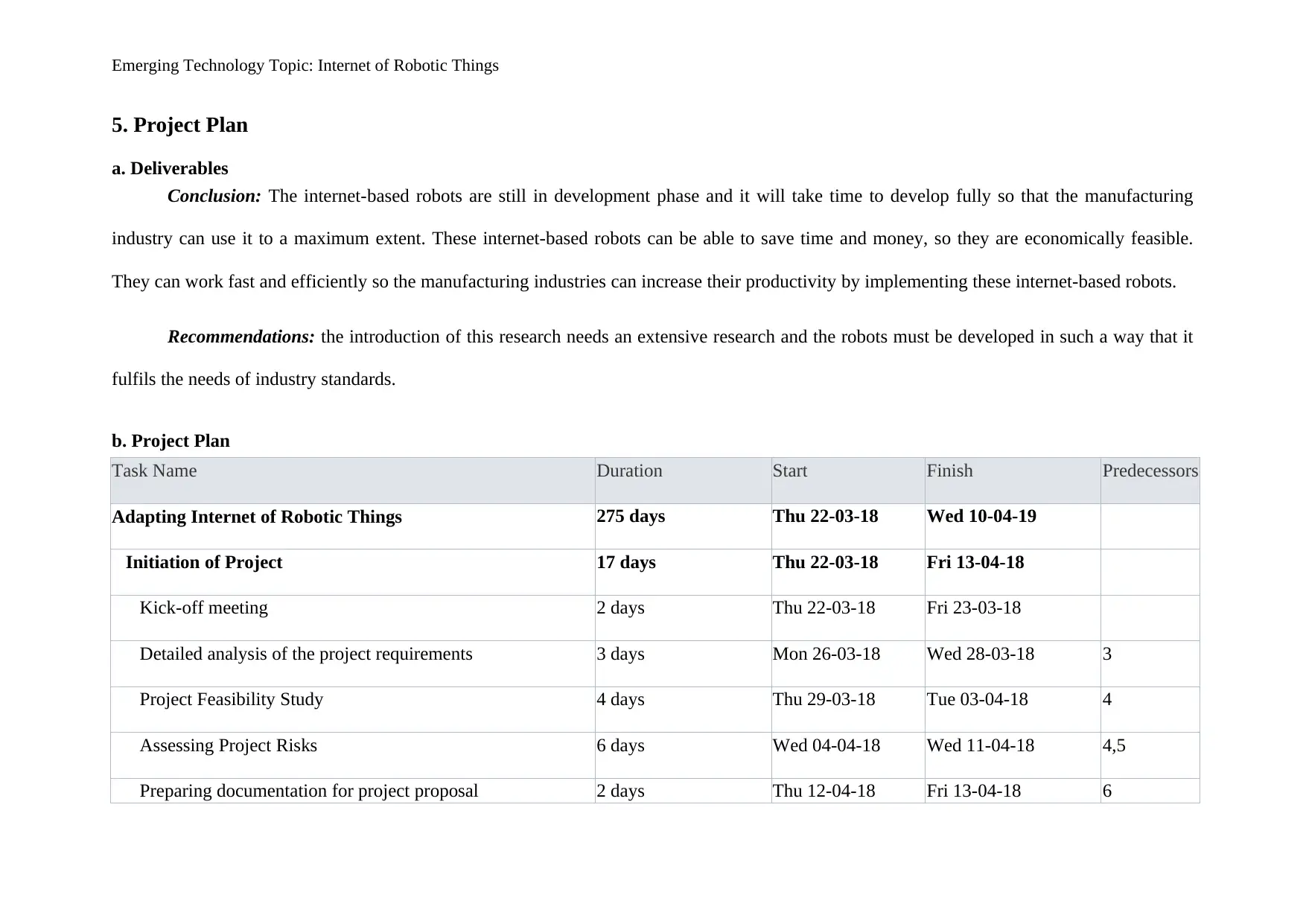
Task Name Duration Start Finish Predecessors
Adapting Internet of Robotic Things 275 days Thu 22-03-18 Wed 10-04-19
Initiation of Project 17 days Thu 22-03-18 Fri 13-04-18
Kick-off meeting 2 days Thu 22-03-18 Fri 23-03-18
Detailed analysis of the project requirements 3 days Mon 26-03-18 Wed 28-03-18 3
Project Feasibility Study 4 days Thu 29-03-18 Tue 03-04-18 4
Assessing Project Risks 6 days Wed 04-04-18 Wed 11-04-18 4,5
Preparing documentation for project proposal 2 days Thu 12-04-18 Fri 13-04-18 6
5. Project Plan
a. Deliverables
Conclusion: The internet-based robots are still in development phase and it will take time to develop fully so that the manufacturing
industry can use it to a maximum extent. These internet-based robots can be able to save time and money, so they are economically feasible.
They can work fast and efficiently so the manufacturing industries can increase their productivity by implementing these internet-based robots.
Recommendations: the introduction of this research needs an extensive research and the robots must be developed in such a way that it
fulfils the needs of industry standards.
b. Project Plan
Task Name Duration Start Finish Predecessors
Adapting Internet of Robotic Things 275 days Thu 22-03-18 Wed 10-04-19
Initiation of Project 17 days Thu 22-03-18 Fri 13-04-18
Kick-off meeting 2 days Thu 22-03-18 Fri 23-03-18
Detailed analysis of the project requirements 3 days Mon 26-03-18 Wed 28-03-18 3
Project Feasibility Study 4 days Thu 29-03-18 Tue 03-04-18 4
Assessing Project Risks 6 days Wed 04-04-18 Wed 11-04-18 4,5
Preparing documentation for project proposal 2 days Thu 12-04-18 Fri 13-04-18 6
⊘ This is a preview!⊘
Do you want full access?
Subscribe today to unlock all pages.
Trusted by 1+ million students worldwide
Emerging Technology Topic: Internet of Robotic Things
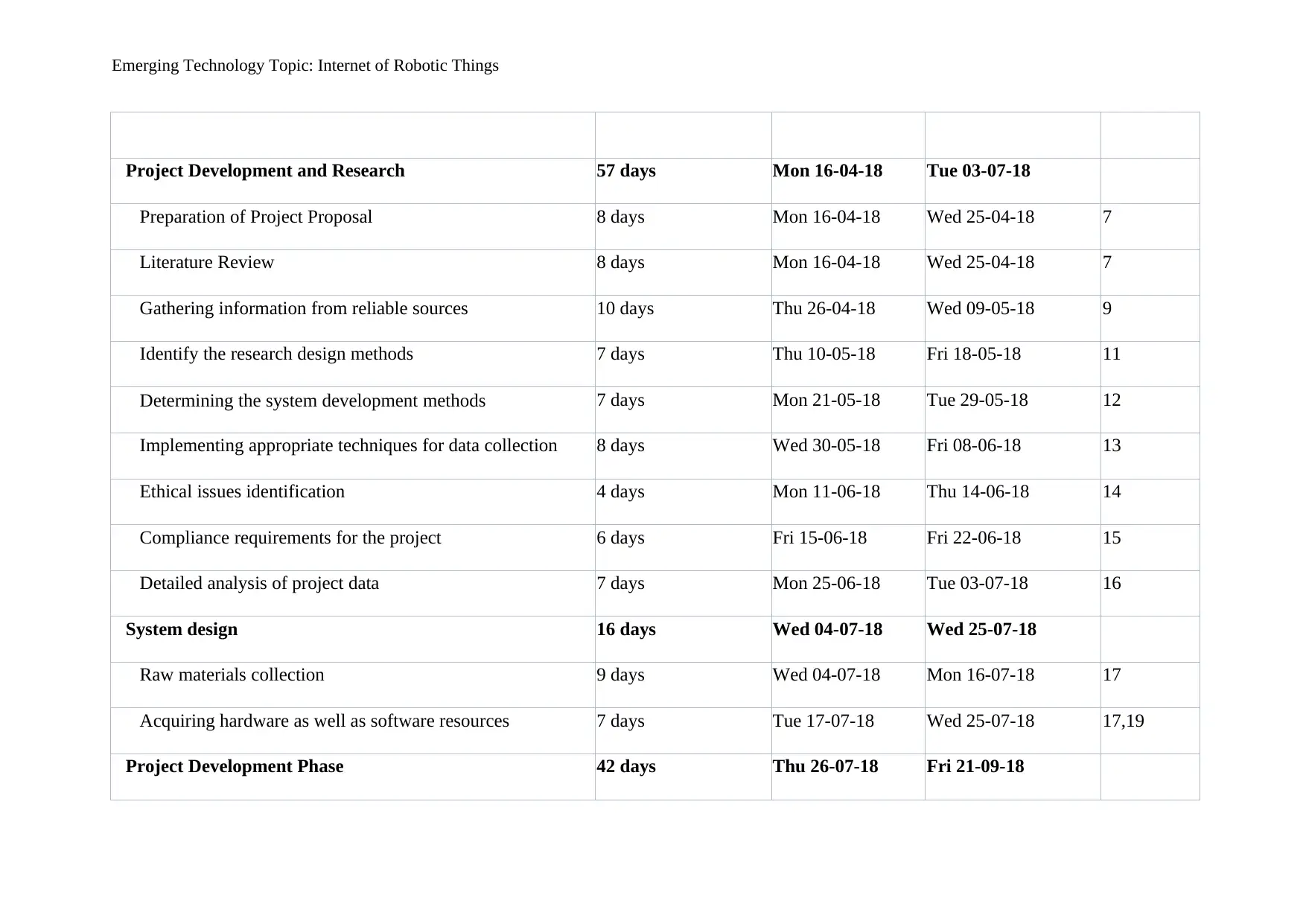
Project Development and Research 57 days Mon 16-04-18 Tue 03-07-18
Preparation of Project Proposal 8 days Mon 16-04-18 Wed 25-04-18 7
Literature Review 8 days Mon 16-04-18 Wed 25-04-18 7
Gathering information from reliable sources 10 days Thu 26-04-18 Wed 09-05-18 9
Identify the research design methods 7 days Thu 10-05-18 Fri 18-05-18 11
Determining the system development methods 7 days Mon 21-05-18 Tue 29-05-18 12
Implementing appropriate techniques for data collection 8 days Wed 30-05-18 Fri 08-06-18 13
Ethical issues identification 4 days Mon 11-06-18 Thu 14-06-18 14
Compliance requirements for the project 6 days Fri 15-06-18 Fri 22-06-18 15
Detailed analysis of project data 7 days Mon 25-06-18 Tue 03-07-18 16
System design 16 days Wed 04-07-18 Wed 25-07-18
Raw materials collection 9 days Wed 04-07-18 Mon 16-07-18 17
Acquiring hardware as well as software resources 7 days Tue 17-07-18 Wed 25-07-18 17,19
Project Development Phase 42 days Thu 26-07-18 Fri 21-09-18
Project Development and Research 57 days Mon 16-04-18 Tue 03-07-18
Preparation of Project Proposal 8 days Mon 16-04-18 Wed 25-04-18 7
Literature Review 8 days Mon 16-04-18 Wed 25-04-18 7
Gathering information from reliable sources 10 days Thu 26-04-18 Wed 09-05-18 9
Identify the research design methods 7 days Thu 10-05-18 Fri 18-05-18 11
Determining the system development methods 7 days Mon 21-05-18 Tue 29-05-18 12
Implementing appropriate techniques for data collection 8 days Wed 30-05-18 Fri 08-06-18 13
Ethical issues identification 4 days Mon 11-06-18 Thu 14-06-18 14
Compliance requirements for the project 6 days Fri 15-06-18 Fri 22-06-18 15
Detailed analysis of project data 7 days Mon 25-06-18 Tue 03-07-18 16
System design 16 days Wed 04-07-18 Wed 25-07-18
Raw materials collection 9 days Wed 04-07-18 Mon 16-07-18 17
Acquiring hardware as well as software resources 7 days Tue 17-07-18 Wed 25-07-18 17,19
Project Development Phase 42 days Thu 26-07-18 Fri 21-09-18
Paraphrase This Document
Need a fresh take? Get an instant paraphrase of this document with our AI Paraphraser
Emerging Technology Topic: Internet of Robotic Things
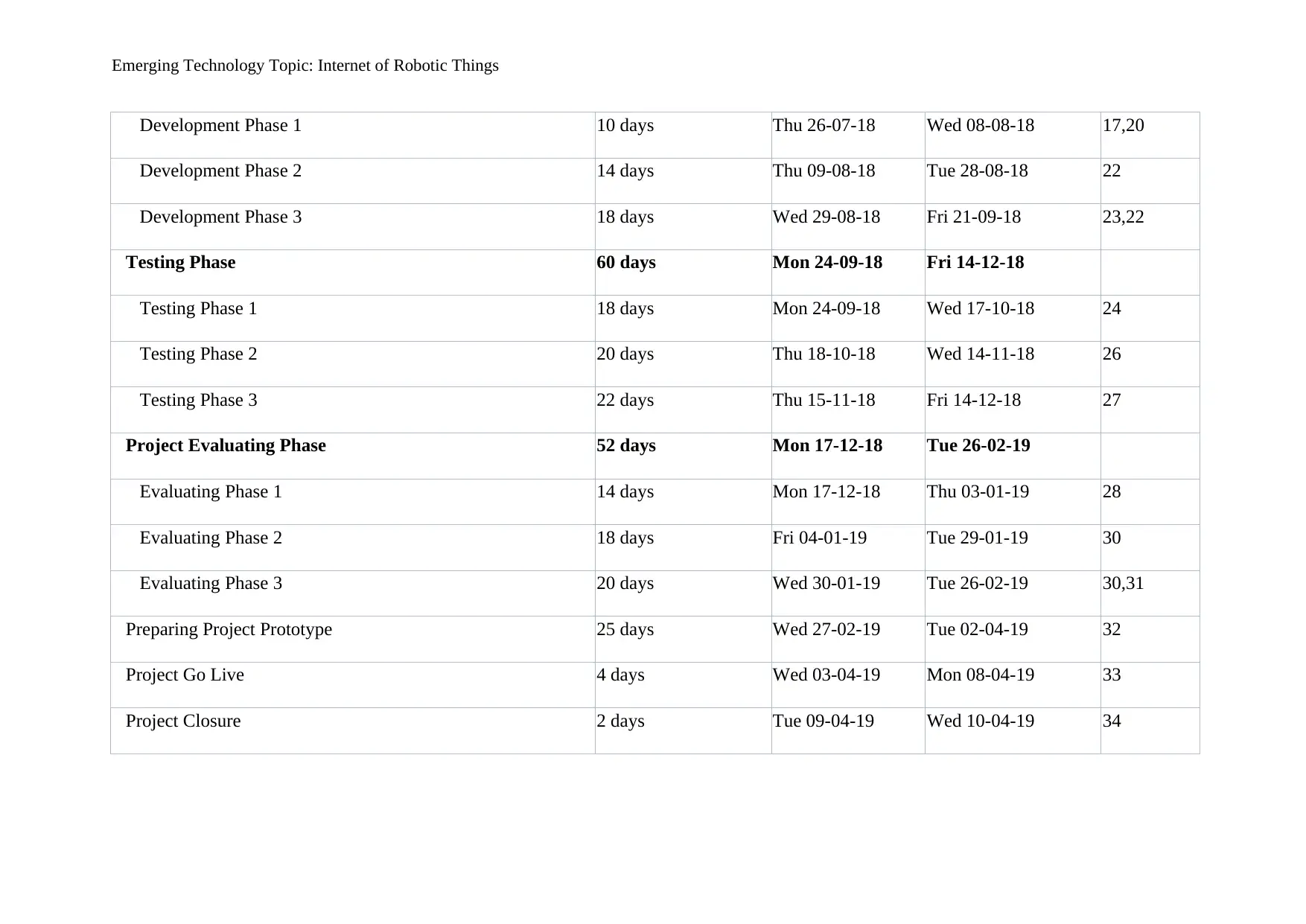
Development Phase 1 10 days Thu 26-07-18 Wed 08-08-18 17,20
Development Phase 2 14 days Thu 09-08-18 Tue 28-08-18 22
Development Phase 3 18 days Wed 29-08-18 Fri 21-09-18 23,22
Testing Phase 60 days Mon 24-09-18 Fri 14-12-18
Testing Phase 1 18 days Mon 24-09-18 Wed 17-10-18 24
Testing Phase 2 20 days Thu 18-10-18 Wed 14-11-18 26
Testing Phase 3 22 days Thu 15-11-18 Fri 14-12-18 27
Project Evaluating Phase 52 days Mon 17-12-18 Tue 26-02-19
Evaluating Phase 1 14 days Mon 17-12-18 Thu 03-01-19 28
Evaluating Phase 2 18 days Fri 04-01-19 Tue 29-01-19 30
Evaluating Phase 3 20 days Wed 30-01-19 Tue 26-02-19 30,31
Preparing Project Prototype 25 days Wed 27-02-19 Tue 02-04-19 32
Project Go Live 4 days Wed 03-04-19 Mon 08-04-19 33
Project Closure 2 days Tue 09-04-19 Wed 10-04-19 34
Development Phase 1 10 days Thu 26-07-18 Wed 08-08-18 17,20
Development Phase 2 14 days Thu 09-08-18 Tue 28-08-18 22
Development Phase 3 18 days Wed 29-08-18 Fri 21-09-18 23,22
Testing Phase 60 days Mon 24-09-18 Fri 14-12-18
Testing Phase 1 18 days Mon 24-09-18 Wed 17-10-18 24
Testing Phase 2 20 days Thu 18-10-18 Wed 14-11-18 26
Testing Phase 3 22 days Thu 15-11-18 Fri 14-12-18 27
Project Evaluating Phase 52 days Mon 17-12-18 Tue 26-02-19
Evaluating Phase 1 14 days Mon 17-12-18 Thu 03-01-19 28
Evaluating Phase 2 18 days Fri 04-01-19 Tue 29-01-19 30
Evaluating Phase 3 20 days Wed 30-01-19 Tue 26-02-19 30,31
Preparing Project Prototype 25 days Wed 27-02-19 Tue 02-04-19 32
Project Go Live 4 days Wed 03-04-19 Mon 08-04-19 33
Project Closure 2 days Tue 09-04-19 Wed 10-04-19 34
Emerging Technology Topic: Internet of Robotic Things
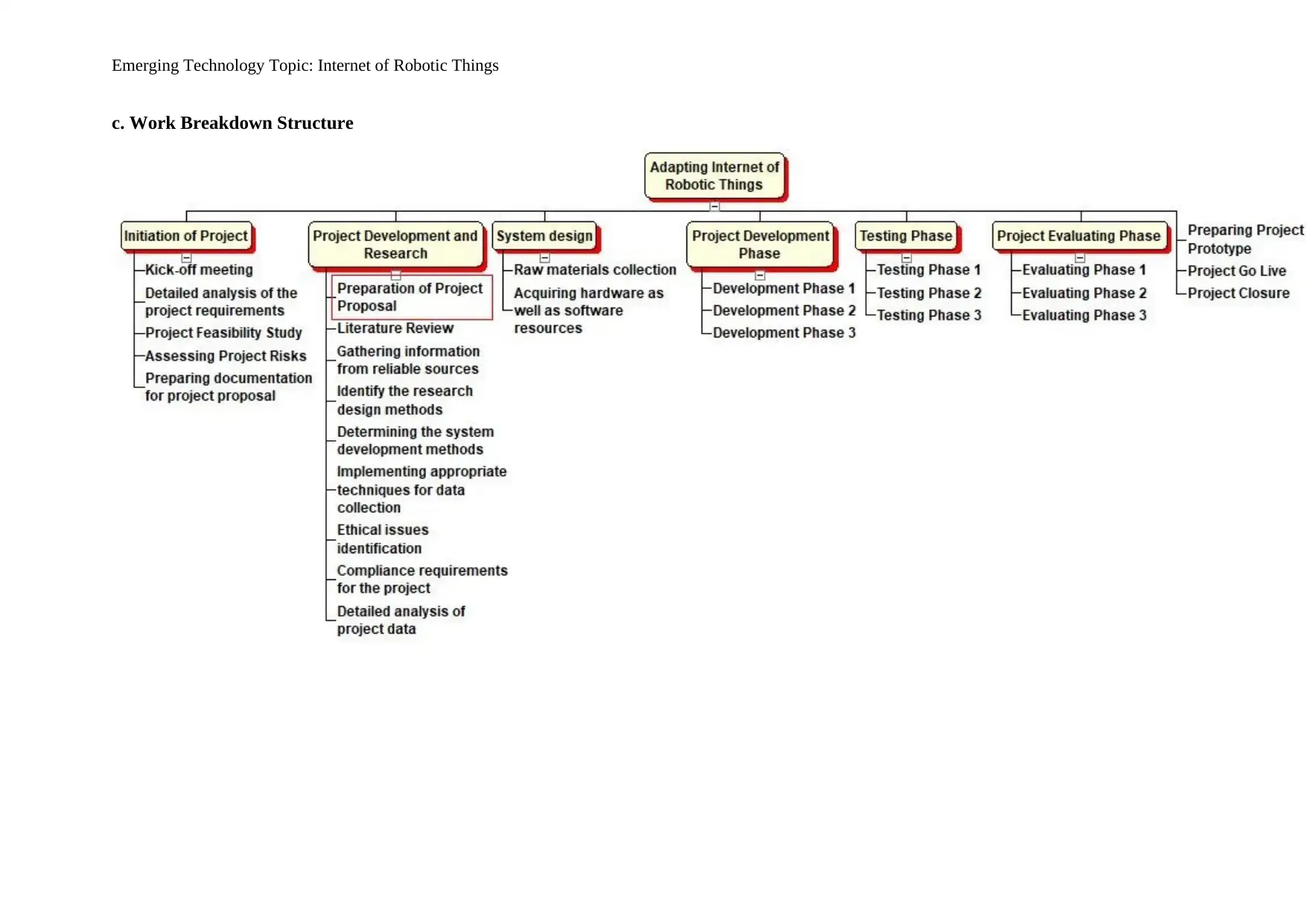
c. Work Breakdown Structure
c. Work Breakdown Structure
⊘ This is a preview!⊘
Do you want full access?
Subscribe today to unlock all pages.
Trusted by 1+ million students worldwide

1 out of 15


Related Documents


Your All-in-One AI-Powered Toolkit for Academic Success.
+13062052269
info@desklib.com
Available 24*7 on WhatsApp / Email
![[object Object]](/_next/static/media/star-bottom.7253800d.svg)
Unlock your academic potential
Copyright © 2020–2026 A2Z Services. All Rights Reserved. Developed and managed by ZUCOL.