IoT in Education: Applications, Challenges, and Future Trends Report
VerifiedAdded on 2020/03/28
|43
|10248
|369
Report
AI Summary
This research report explores the integration of the Internet of Things (IoT) in education, examining its potential to transform learning environments. It highlights the benefits, such as improved campus management, resource tracking, and enhanced access to educational information. The report discusses applications like smart classrooms, student tracking, and the use of wearable devices. It also addresses challenges, including data security, privacy, and the need for innovative teaching methods. The study outlines a proposed cloud framework for student interaction with physical objects and provides a timeline for research implementation. The report further analyzes the current trends and future expectations of IoT in education, offering insights into how it can solve existing problems in higher education and improve the overall learning experience. The report includes literature review, methodology, research plan and timeline, findings, and discussion sections.
Running head: IoT IN EDUCATION
Internet of Things (IoT) in Education
<Student Name>
<Student Number>
A report submitted for
Master Project 1
in partial fulfilment of the requirements for the degree of
<For example, Master of Engineering>
Supervisor: <XXX>
School of Computing, Engineering and Mathematics
<Month Year>
Internet of Things (IoT) in Education
<Student Name>
<Student Number>
A report submitted for
Master Project 1
in partial fulfilment of the requirements for the degree of
<For example, Master of Engineering>
Supervisor: <XXX>
School of Computing, Engineering and Mathematics
<Month Year>

Paraphrase This Document
Need a fresh take? Get an instant paraphrase of this document with our AI Paraphraser
iIoT IN EDUCATION
ABSTRACT
The research report is based on IoT into education. IoT into Education permits the
schools to develop their school campus, education system, keep track of the education
resources and enhancement of access to the educational information. The benefits of IoT
in schools are tracking of school buses, monitoring of security system, attendance,
student ID cards and others. It helps to uphold simplicity into the education processes and
maintain a quality into services. IoT education system can recognize the problem areas
where the students tend to create mistakes by evaluating the study records of the students.
When the teachers provide the teaching documents in the internet, the students can access
the data from their classroom and home both. Personal data are required to treat
differentially; therefore the privacy of individual is also respected. Security ensures for
data integrity and therefore there should be safeguard of data transmission as it travels
from decentralized location throughout devices across the internal networks and from the
cloud. Some of the identified problems and issues exist into higher education are
overcrowded school, lack of innovation from the teachers, lack of involvement from the
parents and technology becomes synonymous with the entertainment. The concept of
service and deployment model is discussed to provide an overview of the proposed
adoption of cloud framework which allows the students to interact of physical objects in
surroundings.
ABSTRACT
The research report is based on IoT into education. IoT into Education permits the
schools to develop their school campus, education system, keep track of the education
resources and enhancement of access to the educational information. The benefits of IoT
in schools are tracking of school buses, monitoring of security system, attendance,
student ID cards and others. It helps to uphold simplicity into the education processes and
maintain a quality into services. IoT education system can recognize the problem areas
where the students tend to create mistakes by evaluating the study records of the students.
When the teachers provide the teaching documents in the internet, the students can access
the data from their classroom and home both. Personal data are required to treat
differentially; therefore the privacy of individual is also respected. Security ensures for
data integrity and therefore there should be safeguard of data transmission as it travels
from decentralized location throughout devices across the internal networks and from the
cloud. Some of the identified problems and issues exist into higher education are
overcrowded school, lack of innovation from the teachers, lack of involvement from the
parents and technology becomes synonymous with the entertainment. The concept of
service and deployment model is discussed to provide an overview of the proposed
adoption of cloud framework which allows the students to interact of physical objects in
surroundings.
iiIoT IN EDUCATION
ACKNOWLEDGMENTS
Conducting this research has been one of the most enriching experiences of my life. The
contribution of this research to enhance my knowledge base and analytical skill has been
paramount. It gave me the opportunity to face challenges in the process and overcome
them. This would not have been possible without the valuable guidance of my professors,
peers and all the people who have contributed to this enriching experience. I would like
to take this opportunity to thank my supervisor ----------------------- for the constant
guidance and support provided to me during the process of this research. It would not be
justified if I did not thank my academic guides for their important and valuable assistance
and encouragement throughout the research process. I would also like to thank my friends
who had provided me with help and encouragement for collecting data and valuable
resources. Finally, I would like to thank the students who have participated in the
research survey and provided with valuable inputs into the subject. The support of all
these people has been inspiring and enlightening throughout the process of research in the
subject.
Yours Sincerely,
ACKNOWLEDGMENTS
Conducting this research has been one of the most enriching experiences of my life. The
contribution of this research to enhance my knowledge base and analytical skill has been
paramount. It gave me the opportunity to face challenges in the process and overcome
them. This would not have been possible without the valuable guidance of my professors,
peers and all the people who have contributed to this enriching experience. I would like
to take this opportunity to thank my supervisor ----------------------- for the constant
guidance and support provided to me during the process of this research. It would not be
justified if I did not thank my academic guides for their important and valuable assistance
and encouragement throughout the research process. I would also like to thank my friends
who had provided me with help and encouragement for collecting data and valuable
resources. Finally, I would like to thank the students who have participated in the
research survey and provided with valuable inputs into the subject. The support of all
these people has been inspiring and enlightening throughout the process of research in the
subject.
Yours Sincerely,
⊘ This is a preview!⊘
Do you want full access?
Subscribe today to unlock all pages.

Trusted by 1+ million students worldwide
iiiIoT IN EDUCATION
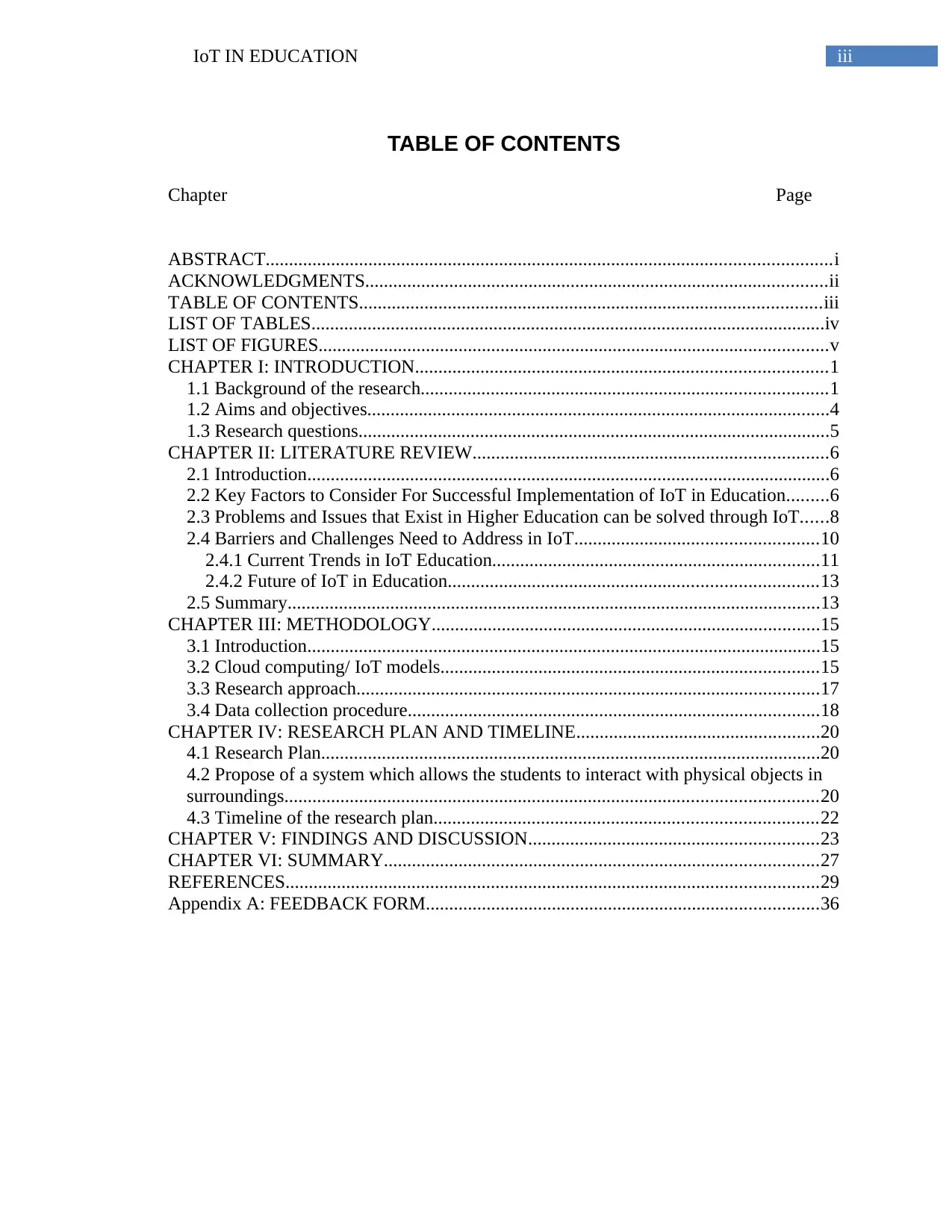
TABLE OF CONTENTS
Chapter Page
ABSTRACT.........................................................................................................................i
ACKNOWLEDGMENTS...................................................................................................ii
TABLE OF CONTENTS...................................................................................................iii
LIST OF TABLES..............................................................................................................iv
LIST OF FIGURES.............................................................................................................v
CHAPTER I: INTRODUCTION........................................................................................1
1.1 Background of the research.......................................................................................1
1.2 Aims and objectives...................................................................................................4
1.3 Research questions.....................................................................................................5
CHAPTER II: LITERATURE REVIEW............................................................................6
2.1 Introduction................................................................................................................6
2.2 Key Factors to Consider For Successful Implementation of IoT in Education.........6
2.3 Problems and Issues that Exist in Higher Education can be solved through IoT......8
2.4 Barriers and Challenges Need to Address in IoT....................................................10
2.4.1 Current Trends in IoT Education......................................................................11
2.4.2 Future of IoT in Education...............................................................................13
2.5 Summary..................................................................................................................13
CHAPTER III: METHODOLOGY...................................................................................15
3.1 Introduction..............................................................................................................15
3.2 Cloud computing/ IoT models.................................................................................15
3.3 Research approach...................................................................................................17
3.4 Data collection procedure........................................................................................18
CHAPTER IV: RESEARCH PLAN AND TIMELINE....................................................20
4.1 Research Plan...........................................................................................................20
4.2 Propose of a system which allows the students to interact with physical objects in
surroundings..................................................................................................................20
4.3 Timeline of the research plan..................................................................................22
CHAPTER V: FINDINGS AND DISCUSSION..............................................................23
CHAPTER VI: SUMMARY.............................................................................................27
REFERENCES..................................................................................................................29
Appendix A: FEEDBACK FORM....................................................................................36
TABLE OF CONTENTS
Chapter Page
ABSTRACT.........................................................................................................................i
ACKNOWLEDGMENTS...................................................................................................ii
TABLE OF CONTENTS...................................................................................................iii
LIST OF TABLES..............................................................................................................iv
LIST OF FIGURES.............................................................................................................v
CHAPTER I: INTRODUCTION........................................................................................1
1.1 Background of the research.......................................................................................1
1.2 Aims and objectives...................................................................................................4
1.3 Research questions.....................................................................................................5
CHAPTER II: LITERATURE REVIEW............................................................................6
2.1 Introduction................................................................................................................6
2.2 Key Factors to Consider For Successful Implementation of IoT in Education.........6
2.3 Problems and Issues that Exist in Higher Education can be solved through IoT......8
2.4 Barriers and Challenges Need to Address in IoT....................................................10
2.4.1 Current Trends in IoT Education......................................................................11
2.4.2 Future of IoT in Education...............................................................................13
2.5 Summary..................................................................................................................13
CHAPTER III: METHODOLOGY...................................................................................15
3.1 Introduction..............................................................................................................15
3.2 Cloud computing/ IoT models.................................................................................15
3.3 Research approach...................................................................................................17
3.4 Data collection procedure........................................................................................18
CHAPTER IV: RESEARCH PLAN AND TIMELINE....................................................20
4.1 Research Plan...........................................................................................................20
4.2 Propose of a system which allows the students to interact with physical objects in
surroundings..................................................................................................................20
4.3 Timeline of the research plan..................................................................................22
CHAPTER V: FINDINGS AND DISCUSSION..............................................................23
CHAPTER VI: SUMMARY.............................................................................................27
REFERENCES..................................................................................................................29
Appendix A: FEEDBACK FORM....................................................................................36
Paraphrase This Document
Need a fresh take? Get an instant paraphrase of this document with our AI Paraphraser
ivIoT IN EDUCATION
LIST OF TABLES
Table 1: Activities into the research study........................................................................20
Table 2: Timeline of research plan....................................................................................22
LIST OF TABLES
Table 1: Activities into the research study........................................................................20
Table 2: Timeline of research plan....................................................................................22
vIoT IN EDUCATION
LIST OF FIGURES
Figure 1.1: IoT Network......................................................................................................2
Figure 2.1: Current trends in IoT Education......................................................................12
Figure 3.1: Service and Deployment Model......................................................................16
LIST OF FIGURES
Figure 1.1: IoT Network......................................................................................................2
Figure 2.1: Current trends in IoT Education......................................................................12
Figure 3.1: Service and Deployment Model......................................................................16
⊘ This is a preview!⊘
Do you want full access?
Subscribe today to unlock all pages.
Trusted by 1+ million students worldwide
1IoT IN EDUCATION
CHAPTER I: INTRODUCTION
1.1 Background of the research
Internet of Things (IoT) is a connection of devices such as computers as well as
smartphones with the internet which is a process to transform various areas of everyday
life of people. Rapid computer plus development of communication technologies
influenced the education processes in current decades. Education is one of the most
important applications of IoT, which is discussed in this particular paper. Nie (2013)
stated that as IoT is used in the schools, therefore e-learning becomes a general practice
within the school system. Due to the rise of the mobile technologies and also IoT, it
permits the schools to develop their school campus, education system, tracking of the
resources of education and enhancement for accessing towards the educational
information (Augur, 2015). The education professionals are used of advanced technology
in order to generate of smart lessons plan. Hurst et al., (2017) argued that within the
college, students are moved from the paper books towards the use of tablets as well as
laptops. They get required education-related information at the fingerprints.
Mavroudi et al., (2017) mentioned that IoT education system provides a good
quality of online courses to the students who are accessible from anyplace and anytime.
Out of the classroom, the universities are used of connected devices to supervise the
students, teaching staffs, educational resources and equipment at a lesser operating cost
(Ahlmeyer & Chircu, 2016). The benefits of IoT in schools are tracking of school buses,
monitoring of security system, attendance, student ID cards and others. Automatic
tracking of attendance is done with the use of radio frequency identification, which is an
1
CHAPTER I: INTRODUCTION
1.1 Background of the research
Internet of Things (IoT) is a connection of devices such as computers as well as
smartphones with the internet which is a process to transform various areas of everyday
life of people. Rapid computer plus development of communication technologies
influenced the education processes in current decades. Education is one of the most
important applications of IoT, which is discussed in this particular paper. Nie (2013)
stated that as IoT is used in the schools, therefore e-learning becomes a general practice
within the school system. Due to the rise of the mobile technologies and also IoT, it
permits the schools to develop their school campus, education system, tracking of the
resources of education and enhancement for accessing towards the educational
information (Augur, 2015). The education professionals are used of advanced technology
in order to generate of smart lessons plan. Hurst et al., (2017) argued that within the
college, students are moved from the paper books towards the use of tablets as well as
laptops. They get required education-related information at the fingerprints.
Mavroudi et al., (2017) mentioned that IoT education system provides a good
quality of online courses to the students who are accessible from anyplace and anytime.
Out of the classroom, the universities are used of connected devices to supervise the
students, teaching staffs, educational resources and equipment at a lesser operating cost
(Ahlmeyer & Chircu, 2016). The benefits of IoT in schools are tracking of school buses,
monitoring of security system, attendance, student ID cards and others. Automatic
tracking of attendance is done with the use of radio frequency identification, which is an
1
Paraphrase This Document
Need a fresh take? Get an instant paraphrase of this document with our AI Paraphraser
2IoT IN EDUCATION
application at the K-12 level. RFID chip is stored information on student's ID card, and
then it used to track it (Cha & Kang, 2015). Students can able to track the connected
buses and then change its schedule that prevents from spending needless time in
educational areas. Wearable IoT devices like watches, virtual reality headset and others
are finding a way into the classroom (Harris, 2016). Muse is a headband that informs the
brain activities to the mobile application that assist the teachers in observing the
engagement of student and used to follow the learning styles. In this way, IoT devices
help both students and teachers to produce more within less time and optimisation of
workflows.
2
application at the K-12 level. RFID chip is stored information on student's ID card, and
then it used to track it (Cha & Kang, 2015). Students can able to track the connected
buses and then change its schedule that prevents from spending needless time in
educational areas. Wearable IoT devices like watches, virtual reality headset and others
are finding a way into the classroom (Harris, 2016). Muse is a headband that informs the
brain activities to the mobile application that assist the teachers in observing the
engagement of student and used to follow the learning styles. In this way, IoT devices
help both students and teachers to produce more within less time and optimisation of
workflows.
2
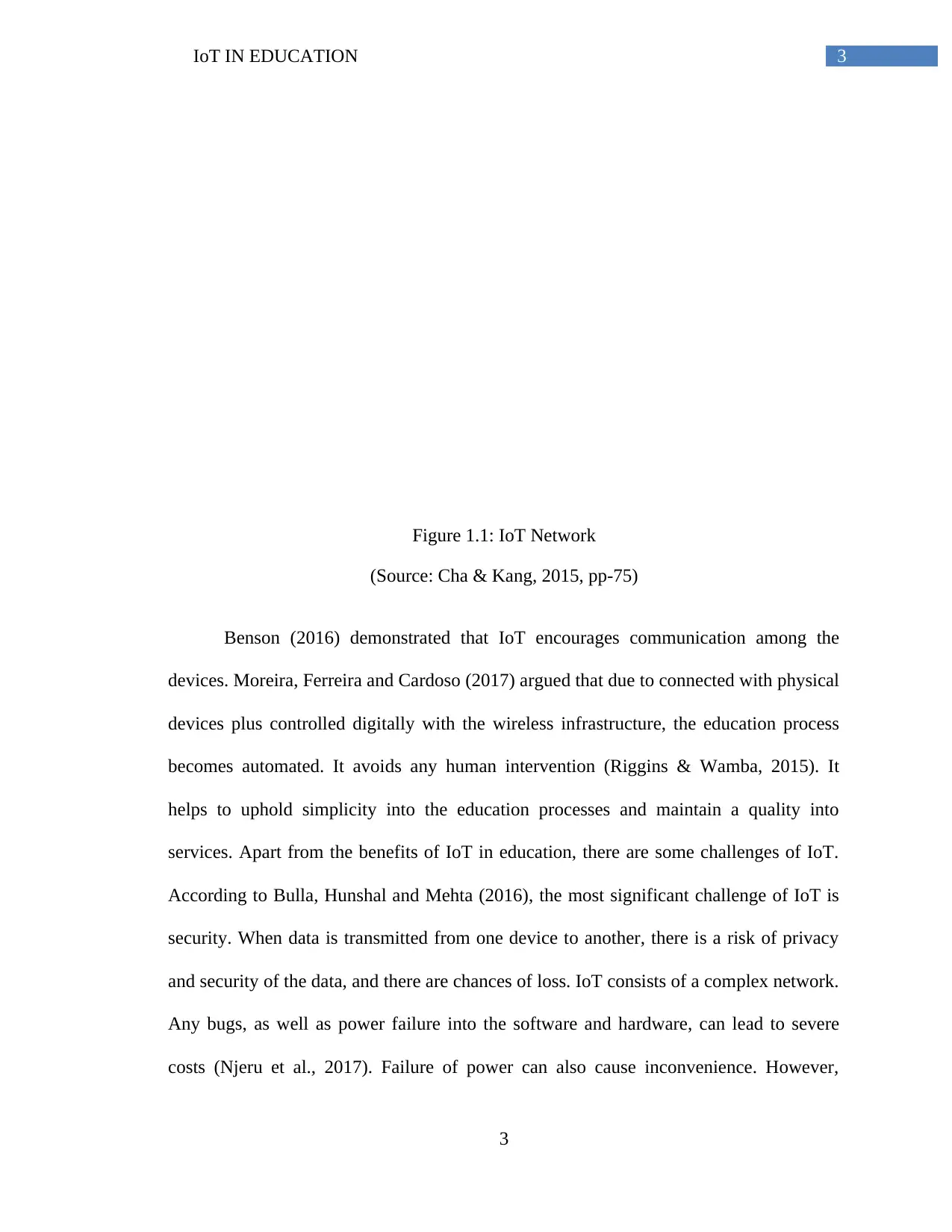
3IoT IN EDUCATION
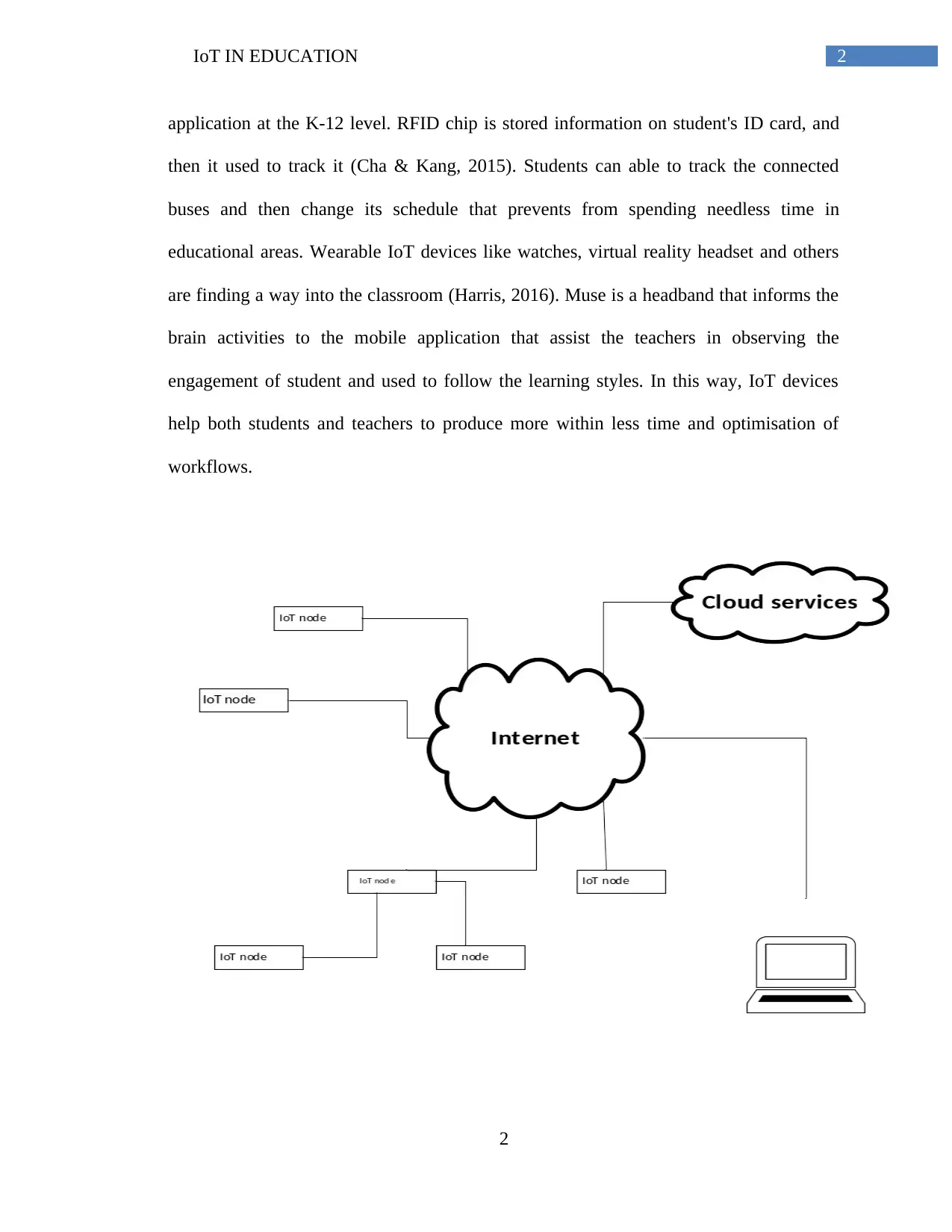
Figure 1.1: IoT Network
(Source: Cha & Kang, 2015, pp-75)
Benson (2016) demonstrated that IoT encourages communication among the
devices. Moreira, Ferreira and Cardoso (2017) argued that due to connected with physical
devices plus controlled digitally with the wireless infrastructure, the education process
becomes automated. It avoids any human intervention (Riggins & Wamba, 2015). It
helps to uphold simplicity into the education processes and maintain a quality into
services. Apart from the benefits of IoT in education, there are some challenges of IoT.
According to Bulla, Hunshal and Mehta (2016), the most significant challenge of IoT is
security. When data is transmitted from one device to another, there is a risk of privacy
and security of the data, and there are chances of loss. IoT consists of a complex network.
Any bugs, as well as power failure into the software and hardware, can lead to severe
costs (Njeru et al., 2017). Failure of power can also cause inconvenience. However,
3
Figure 1.1: IoT Network
(Source: Cha & Kang, 2015, pp-75)
Benson (2016) demonstrated that IoT encourages communication among the
devices. Moreira, Ferreira and Cardoso (2017) argued that due to connected with physical
devices plus controlled digitally with the wireless infrastructure, the education process
becomes automated. It avoids any human intervention (Riggins & Wamba, 2015). It
helps to uphold simplicity into the education processes and maintain a quality into
services. Apart from the benefits of IoT in education, there are some challenges of IoT.
According to Bulla, Hunshal and Mehta (2016), the most significant challenge of IoT is
security. When data is transmitted from one device to another, there is a risk of privacy
and security of the data, and there are chances of loss. IoT consists of a complex network.
Any bugs, as well as power failure into the software and hardware, can lead to severe
costs (Njeru et al., 2017). Failure of power can also cause inconvenience. However,
3
⊘ This is a preview!⊘
Do you want full access?
Subscribe today to unlock all pages.
Trusted by 1+ million students worldwide
4IoT IN EDUCATION
despite its challenges, IoT has the potential to make the education system more relevant
to engagement of learners.
Namiot, Sneps-Sneppe and Daradkeh (2017) pointed out that IoT is the next step
towards the evolution of the smart objects (between physical objects plus digital
information about the object). IoT creates an education system which would empower the
new generation of digital people those would understand the IoT technologies. Kane et
al., (2013) demonstrated that higher education system ensures that the next generation
engineers can understand the process to design as well as build of a technological system
which can reflect expectations of participation. The challenge is to develop new forms of
scalable education that should contain a larger number of students, attract probable
students and distribute of a modern curriculum which replicates changes into the
computer technology. Lakshminarayanan and McBrideb (2015) concluded that IoT
provides solutions to those challenges in the system. The main users of the system are
students, teachers, examination branch, admission branch and administrative staffs. IoT
education system can recognize the problem areas where the students tend to create
mistakes by evaluating the study records of the students. When the teachers provide the
teaching documents on the internet, the students can access the data from their classroom
and home both. Atzori, Iera and Morabito (2015) stated that use of cloud computing
system reduces the operational cost as servers as well as learning materials are shared
with other colleges.
4
despite its challenges, IoT has the potential to make the education system more relevant
to engagement of learners.
Namiot, Sneps-Sneppe and Daradkeh (2017) pointed out that IoT is the next step
towards the evolution of the smart objects (between physical objects plus digital
information about the object). IoT creates an education system which would empower the
new generation of digital people those would understand the IoT technologies. Kane et
al., (2013) demonstrated that higher education system ensures that the next generation
engineers can understand the process to design as well as build of a technological system
which can reflect expectations of participation. The challenge is to develop new forms of
scalable education that should contain a larger number of students, attract probable
students and distribute of a modern curriculum which replicates changes into the
computer technology. Lakshminarayanan and McBrideb (2015) concluded that IoT
provides solutions to those challenges in the system. The main users of the system are
students, teachers, examination branch, admission branch and administrative staffs. IoT
education system can recognize the problem areas where the students tend to create
mistakes by evaluating the study records of the students. When the teachers provide the
teaching documents on the internet, the students can access the data from their classroom
and home both. Atzori, Iera and Morabito (2015) stated that use of cloud computing
system reduces the operational cost as servers as well as learning materials are shared
with other colleges.
4
Paraphrase This Document
Need a fresh take? Get an instant paraphrase of this document with our AI Paraphraser
5IoT IN EDUCATION
1.2 Aims and objectives
The main purpose of this study to analyse the use of IoT in education to change the
way people learn. This study aims to identify a variety of applications related to IoT
within education and conclude the suggestions for interference. IoT is a fast expanding
space for the researchers, students as well as teaching professionals. Following are the
objectives of this particular research study:
To find out the impacts of IoT into education
To find out the factors to be considered for implementation of IoT in education
To identify the advantages and disadvantages of IoI in education
To propose solutions for solving problems and issues that exist in higher
education through IoT
To find out the barriers and challenges require addressing in IoT
To identify the current trends into IoT with its future expectation
1.3 Research questions
Following are the research questions:
1. What is IoT in education and its impact?
2. What are the key factors to consider for successful implementation of IoT in
education?
5
1.2 Aims and objectives
The main purpose of this study to analyse the use of IoT in education to change the
way people learn. This study aims to identify a variety of applications related to IoT
within education and conclude the suggestions for interference. IoT is a fast expanding
space for the researchers, students as well as teaching professionals. Following are the
objectives of this particular research study:
To find out the impacts of IoT into education
To find out the factors to be considered for implementation of IoT in education
To identify the advantages and disadvantages of IoI in education
To propose solutions for solving problems and issues that exist in higher
education through IoT
To find out the barriers and challenges require addressing in IoT
To identify the current trends into IoT with its future expectation
1.3 Research questions
Following are the research questions:
1. What is IoT in education and its impact?
2. What are the key factors to consider for successful implementation of IoT in
education?
5
6IoT IN EDUCATION
3. What are advantages and disadvantages of IoT in education?
4. How problems and issues that exist in higher education can be solved through
IoT?
5. What barriers and challenges those need to be addressed in IoT and what are the
current trends in IoT education and what to expect in near future?
6
3. What are advantages and disadvantages of IoT in education?
4. How problems and issues that exist in higher education can be solved through
IoT?
5. What barriers and challenges those need to be addressed in IoT and what are the
current trends in IoT education and what to expect in near future?
6
⊘ This is a preview!⊘
Do you want full access?
Subscribe today to unlock all pages.
Trusted by 1+ million students worldwide

1 out of 43


Related Documents


Your All-in-One AI-Powered Toolkit for Academic Success.
+13062052269
info@desklib.com
Available 24*7 on WhatsApp / Email
![[object Object]](/_next/static/media/star-bottom.7253800d.svg)
Unlock your academic potential
Copyright © 2020–2026 A2Z Services. All Rights Reserved. Developed and managed by ZUCOL.