Analysis of Wireless Communication Protocols in Internet of Things

Verified

Added on  2023/06/11

|8
|1627
|425
Report
AI Summary
This report provides a comprehensive overview of wireless communication protocols in the context of Internet of Things (IoT) networks. It begins by introducing the role of IoT in improving quality of life and reducing operational costs, highlighting the challenges and opportunities in the IoT ecosystem. The report then delves into the key features of an IoT gateway, emphasizing communication support from network-to-network and security considerations, including data confidentiality and node authentication. Furthermore, it examines various wireless communication technologies such as IEEE 802.16 (WiMAX), IEEE 802.15.4, IETF 6LoWPAN, and ZigBee, discussing their roles in connecting smart things. The report concludes by emphasizing the importance of a well-designed IoT network architecture for seamless operation of devices and services, noting that novel techniques in connection management, network management, privacy, and grouping are crucial for the success of IoT networks. It also acknowledges the transformative impact of IoT on daily life, making it simpler and more comfortable.

Document Page
Running head: WIRELESS COMMUNICATION PROTOCOLS
WIRELESS COMMUNICATION PROTOCOL
Name of the Student
Name of the University
Author Note
tabler-icon-diamond-filled.svg

Paraphrase This Document

Need a fresh take? Get an instant paraphrase of this document with our AI Paraphraser
Document Page
1WIRELESS COMMUNICATION PROTOCOLS
Table of Contents
Introduction................................................................................................................................2
IoT Gateway...............................................................................................................................2
Wireless Communication...........................................................................................................4
Conclusion..................................................................................................................................6
Bibliography...............................................................................................................................7
Document Page
2WIRELESS COMMUNICATION PROTOCOLS
Introduction
The emerging technology of IoT is driven by human being for the applications that
can improve the quality of life of the people meanwhile it safe the public authorities or
companies’ operation cost. Different domain of IoT such as transportation, environment,
health, energy is the related application that are use every day for strong interconnection of
things. There are new challenges in the IoT ecosystem which keep the academics and
industrial researchers busy. Interconnection of technological devices enable the IoT
ecosystem. The IoT concept is simple and has unlimited capabilities. The concept is based on
network interface that is embedded into the objects and users get various services for
communications. Before IoT user could get the data from service provider only. The sensors
get directly access by the users and the actuators get the commands. The infrastructure of IoT
is well-designed to manage the services. Although some limitations are there in the current
development and research plan through which a complete IoT environment will be created.
IoT Gateway
The future of IoT network is IoT gateway. This section will give the key features for
the IoT gateway.
Communication Support from Network-to-Network: The node attributes affiliated to manage
the information of the IoT environment would be a crucial part to manage. There are contents
that need to hold for identification and has a network status. It utilizes the content-distributed
network (CDN) or information-centric network (ICN) that is group by the network
management object. Moreover, such information is shared to the neighbour network
management object or content management server which conduct content-based routing or
context-based multi-connection. It is very important to share non-real-time data from one
network to another network were no end-to-end connection are configured across more than
Document Page
3WIRELESS COMMUNICATION PROTOCOLS
two networks. The information of the network could be share through a good management
network that can be directly connected to core network were other network management
objects could also be shared. Apart from this a newly constructed network connection shares
information that could share and cause an overhead problem were a throughput being
degraded at the core network. It is very necessary to solve the problem of the network that
reconfigure the new network and transmit data by using some technique. Above all, it is
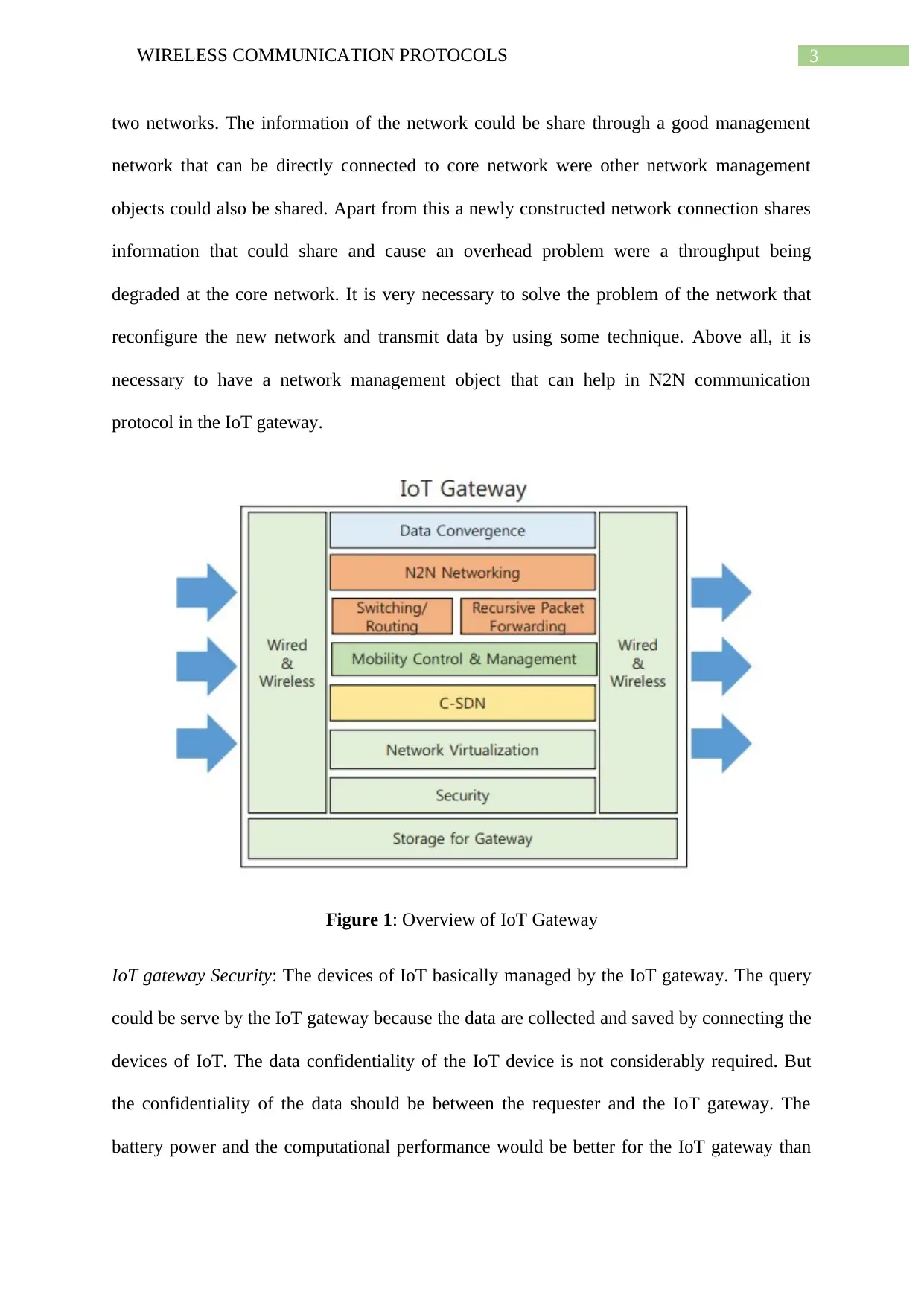
necessary to have a network management object that can help in N2N communication
protocol in the IoT gateway.
Figure 1: Overview of IoT Gateway
IoT gateway Security: The devices of IoT basically managed by the IoT gateway. The query
could be serve by the IoT gateway because the data are collected and saved by connecting the
devices of IoT. The data confidentiality of the IoT device is not considerably required. But
the confidentiality of the data should be between the requester and the IoT gateway. The
battery power and the computational performance would be better for the IoT gateway than
tabler-icon-diamond-filled.svg

Paraphrase This Document

Need a fresh take? Get an instant paraphrase of this document with our AI Paraphraser
Document Page
4WIRELESS COMMUNICATION PROTOCOLS
the devices of IoT which makes possible the security algorithm. Furthermore, in wireless
communication eavesdropping is possible for IoT devices and IoT gateway through a
communication medium. The devices of IoT is based on the battery. Thus, adopting a
security algorithm is an overhead and distinguishes a data for adaptive encryption scheme or
having a security algorithm with light weight which could protect the data of IoT. In the IoT
gateway security the important issue is the registration of the node and authentication. It
should owe to node mobility that can guarantee the device connectivity. The type could be a
guest or master or any other. Instantly, guest node could be a foreigner for a group that has
some limitation in communication. All nodes could be managing through the master node in
a group and the group could be control by the network that are out of the home network.
Therefore, the user’s thing could be managing finally by the member node were the network
could be utilized. Various devices are supported by the authentication of the flexible node
and have gateway connection.
Wireless Communication
IoT has been able to overcome the existing challenges that are technological
reliability, resilience and interoperability. In this section a short overview has been provided
that is important for the wireless communication technologies were essential roles are being
played potentially to connect the IoT with smart things. There are no communication
technologies being describe in this section which are currently under development or may
have some future environment that might draft the status which are discussed below.
IEEE 802.16 and WiMAX: The forum of WiMAX that is the Worldwide Interoperability for
Microwave Access is a non-profit organization having an industry-led which certifies and
promotes the interoperability and compatibility products of the wireless broadband which is
completely based on the Standard of IEEE 802.16. The technology has a wireless broadband
Document Page
5WIRELESS COMMUNICATION PROTOCOLS
access design to support 1 Gbit/s. The IEEE 802.16p enhance the machine-to-machine
applications. There has been an appropriate modification which can easily enhance the
Medium Access Control (MAC) with Orthogonal Frequency Division Multiple Access
(OFDMA) thus making the communication devices to consume low power. The IEE 802.16p
has an area with typical application for the purpose of observation and control.
IEEE 802.15.4: The media access control layer and the physical layer has a standard to define
the IEEE 802.15.4 with a wireless networks having personal area. There is a selection of
channel for the typical physical layer that can manage a signal. The frequencies could be
assigned specifically for communication. Above the physical layer, the properties of MAC
layer could easily define the IEE 802.15.4 like the node associations and time slot
coordination. Some of the standard IEEE 802.15.4 are ZigBee, 6LoWPAN and
WirelessHART. It supports peer-to-peer with star topologies.
IETF 6LoWPAN: The adaption layer of 6LoWPAN is the most important component as it is
the standard protocol for data transmission that are based on IP which has low power wireless
personal area networks which is located on the OSI network layer Protocol which is typically
responsible for fragmentation, de-fragmentation and header compression of the routing as
well as packets. In network that support mesh routing which are capable of routing
6LoWPAN with nodes mobility. The IPv6 protocol has been established by 6LoWPAN
which is based on communication of the devices that are resource constrained above the
IEEE 802.15.4.
ZigBee: The standard of ZigBee has been developed for communication that are of short
range with a wireless network which is established with IEEE 802.15.4. In the OSI model the
stack of ZigBee spans from the layer of network to the layer of application which include the
basic model of security.
Document Page
6WIRELESS COMMUNICATION PROTOCOLS
Conclusion
From the survey being done above, it has been concluded that the research of the
current IoT were classified based on the layers of platform, service, device and network.
Throughout the paper, the focus was mainly given to the network layer and this will help in
realizing the environment of IoT. A survey was done on the IoT network in which it has
presented insights for the future. The IoT network success is completely based on the novel
architecture. The devices and services of IoT will not operate seamlessly if the IoT network
architecture is not well-designed and it will not provide services that are necessary for the
users. There were some techniques being introduced to the novel architecture which are
predictable like the connection management, network management of IoT, privacy and
grouping. In our daily life IoT brings a technological changes and helps in making the life
simpler and comfortable.
tabler-icon-diamond-filled.svg

Paraphrase This Document

Need a fresh take? Get an instant paraphrase of this document with our AI Paraphraser
Document Page
7WIRELESS COMMUNICATION PROTOCOLS
Bibliography
[1] Centenaro, M., Vangelista, L., Zanella, A. and Zorzi, M. Long-range communications in
unlicensed bands: The rising stars in the IoT and smart city scenarios. IEEE Wireless
Communications, 23(5), pp.60-67, (2016).
[2] Luong, N.C., Hoang, D.T., Wang, P., Niyato, D., Kim, D.I. and Han, Z. Data collection
and wireless communication in Internet of Things (IoT) using economic analysis and pricing
models: A survey. IEEE Communications Surveys & Tutorials, 18(4), pp.2546-2590, (2016).
[3] Al-Fuqaha, A., Guizani, M., Mohammadi, M., Aledhari, M. and Ayyash, M. Internet of
things: A survey on enabling technologies, protocols, and applications. IEEE
Communications Surveys & Tutorials, 17(4), pp.2347-2376, (2015).
[4] Granjal, J., Monteiro, E. and Silva, J.S. Security for the internet of things: a survey of
existing protocols and open research issues. IEEE Communications Surveys &
Tutorials, 17(3), pp.1294-1312, (2015).
chevron_up_icon
1 out of 8
circle_padding
hide_on_mobile
zoom_out_icon
[object Object]