IPENZ KA02: Mechanical Engineering Knowledge Profile Assessment
VerifiedAdded on 2022/08/12
|19
|4467
|13
Report
AI Summary
This report presents a comprehensive analysis of the IPENZ KA02 Knowledge Profile for Mechanical Engineering, addressing key elements such as the application of natural sciences, mathematical knowledge, engineering fundamentals, specialist knowledge for solving complex problems, design methods, engineering practice, and the role of engineering in society. The report explores how mechanical engineers utilize these elements in their work, from design and manufacturing to problem-solving and project management. It emphasizes the importance of formal study, job learning, and the application of various tools and technologies, including software like CAD and FEA. The report also highlights the significance of communication, teamwork, and economic decision-making in engineering practice, and the broader impact of engineers on society. The document provides insights into the core competencies and skills necessary for success in the field, as well as the essential role of engineers in connecting and improving society through infrastructure and innovation.

IPENZ 1
IPENZ
Name of Student
Institution
Date
IPENZ
Name of Student
Institution
Date

Paraphrase This Document
Need a fresh take? Get an instant paraphrase of this document with our AI Paraphraser
IPENZ 2
SECTION TWO – KNOWLEDGE PROFILE
Element one: Application of knowledge from one or more of the natural sciences
Mechanical Engineering
Majorly, a mechanical engineer is mostly concerned with the manufacture, design as well
as maintenance of mechanical systems across a range of industries. As they perfom the named
functions, they apply various theories and principles such as thermodynamics, pneumatics
hydraulics, among others (Belegundu and Chandrupatla, 2019). On the other hand, natural
science relates to the description, understanding and the prediction of natural phenomena with
regards to the empirical data obtained during the experimentation and observation (Ahmad et al.,
2015). There are a number of natural sciences related to mechanical engineering which has a
significant contribution in the field. Some of these include computer and information sciences,
mathematics, physics, hydrology, calculus-based physics, and chemistry (Budynas and Nisbett,
2020).
Development through formal study
Mechanical engineering is developed formal through enrolling in a bachelor’s degree
program which is accredited. Thereafter, one advances to graduate studies as well as work
experience under the supervision of senior and a well-accomplished engineer. Upon beginning a
new project, the mechanical engineer will basically rely on their hands-on skills, physical
intuition, as well as personal judgement which is gained through the past technical experiences
(Deb, 2012) (Chen et al., 2013). In the process, they make a number of questions such as how
will this work? In case one is not aware of how to develop a particular formulation or solve a
task, an engineer will conduct further research such from the already published articles i.e. From
SECTION TWO – KNOWLEDGE PROFILE
Element one: Application of knowledge from one or more of the natural sciences
Mechanical Engineering
Majorly, a mechanical engineer is mostly concerned with the manufacture, design as well
as maintenance of mechanical systems across a range of industries. As they perfom the named
functions, they apply various theories and principles such as thermodynamics, pneumatics
hydraulics, among others (Belegundu and Chandrupatla, 2019). On the other hand, natural
science relates to the description, understanding and the prediction of natural phenomena with
regards to the empirical data obtained during the experimentation and observation (Ahmad et al.,
2015). There are a number of natural sciences related to mechanical engineering which has a
significant contribution in the field. Some of these include computer and information sciences,
mathematics, physics, hydrology, calculus-based physics, and chemistry (Budynas and Nisbett,
2020).
Development through formal study
Mechanical engineering is developed formal through enrolling in a bachelor’s degree
program which is accredited. Thereafter, one advances to graduate studies as well as work
experience under the supervision of senior and a well-accomplished engineer. Upon beginning a
new project, the mechanical engineer will basically rely on their hands-on skills, physical
intuition, as well as personal judgement which is gained through the past technical experiences
(Deb, 2012) (Chen et al., 2013). In the process, they make a number of questions such as how
will this work? In case one is not aware of how to develop a particular formulation or solve a
task, an engineer will conduct further research such from the already published articles i.e. From
IPENZ 3
cite seer and google scholar, patents, product compositions and c0onference papers. In summary,
the mechanical engineer is a lifelong endeavour which is developed over time (Chiang et al.,
2014).
Development through job learning
In order to develop one's career as a mechanical engineer, one needs to begin gaining
experience at an early stage. Most of the employers out there value experience more than any
other aspect. For instance; star undertaking the internships as early as the first year of study,
undertaking part-time tasks, volunteering, in addition to shadowing professionals (Huang and
Yan, 2013). This will greatly add to your insight into becoming a better mechanical engineer.
Besides, one needs to develop some qualities and skills such as math skills, listening skills, and
problem-solving skills in order to be an apt engineer (Gausemeier et al., 2014).
Element Two: Mathematical knowledge relevant to mechanical engineering
Applied mathematics or basically mathematics is an integral component of every
engineering field. There are a number of applications in the mechanical engineering field which
necessitate for the use of mathematics. The mathematics skills are essential as they will assist the
mechanical engineer in designing, developing as well as maintaining the various mechanical
tools and equipment (Letcher et al., 2015). Often, mechanical engineers combine problem-
solving abilities and analytical problems with mathematics to design new machines. For
instance; an engineer might be in need of designing a new chassis for the auto industry (Hwang
et al., 2013).
The process involved in the design includes analysis of the current parts, use of maths in
the creativity to design the appropriate fits, awareness of the desired performance standards and
goals, as well as the use of creativity. Some of the relevant mathematical areas essential in
cite seer and google scholar, patents, product compositions and c0onference papers. In summary,
the mechanical engineer is a lifelong endeavour which is developed over time (Chiang et al.,
2014).
Development through job learning
In order to develop one's career as a mechanical engineer, one needs to begin gaining
experience at an early stage. Most of the employers out there value experience more than any
other aspect. For instance; star undertaking the internships as early as the first year of study,
undertaking part-time tasks, volunteering, in addition to shadowing professionals (Huang and
Yan, 2013). This will greatly add to your insight into becoming a better mechanical engineer.
Besides, one needs to develop some qualities and skills such as math skills, listening skills, and
problem-solving skills in order to be an apt engineer (Gausemeier et al., 2014).
Element Two: Mathematical knowledge relevant to mechanical engineering
Applied mathematics or basically mathematics is an integral component of every
engineering field. There are a number of applications in the mechanical engineering field which
necessitate for the use of mathematics. The mathematics skills are essential as they will assist the
mechanical engineer in designing, developing as well as maintaining the various mechanical
tools and equipment (Letcher et al., 2015). Often, mechanical engineers combine problem-
solving abilities and analytical problems with mathematics to design new machines. For
instance; an engineer might be in need of designing a new chassis for the auto industry (Hwang
et al., 2013).
The process involved in the design includes analysis of the current parts, use of maths in
the creativity to design the appropriate fits, awareness of the desired performance standards and
goals, as well as the use of creativity. Some of the relevant mathematical areas essential in
⊘ This is a preview!⊘
Do you want full access?
Subscribe today to unlock all pages.

Trusted by 1+ million students worldwide
IPENZ 4
mechanical engineering include trigonometry, college algebra, differential equations, calculus I,
calculus ii, statistics, geometry, and linear algebra (Manzhirov, 2014).
Development through formal study
Mathematics in mechanical engineering is developed through design and development of
tools, equipment and machinery. It majorly entails analysis of the performance standards and
current parts, and application of the creativity to generate the desired outcome. Taking calculus,
as the first instance; all areas of thermodynamics and fluid mechanics apply calculus (Haik et al.,
2018). Additionally, vibrational mechanics apply calculus in the determination of acceleration
and velocity of the vibrating object. Trigonometry: trigonometry is applied widely in the
determination of large distances which otherwise cannot be determined through physical
methods such as muse of measuring devices and instruments (Olusegun et al., 2012).
Differential equations: this is applied basically on areas such as fluid dynamics, heat
transfer and mechanical vibrations. Statists, and probability: statics is applied in the analysis of
tolerance, as well as testing of components prior to their failure.
On-job learning of mathematics in mechanical engineering
There are a number of things which one can undertake in order to develop their
mathematical knowledge in mechanical engineering. Some of these include undertaking
problems involving autocad, computer-aided design, Microsoft office suite experience,
automated model programming, understanding flow charts and documentation, as well as
utilisation of software to design various concepts up to the set standards (Rashad et al., 2014).
mechanical engineering include trigonometry, college algebra, differential equations, calculus I,
calculus ii, statistics, geometry, and linear algebra (Manzhirov, 2014).
Development through formal study
Mathematics in mechanical engineering is developed through design and development of
tools, equipment and machinery. It majorly entails analysis of the performance standards and
current parts, and application of the creativity to generate the desired outcome. Taking calculus,
as the first instance; all areas of thermodynamics and fluid mechanics apply calculus (Haik et al.,
2018). Additionally, vibrational mechanics apply calculus in the determination of acceleration
and velocity of the vibrating object. Trigonometry: trigonometry is applied widely in the
determination of large distances which otherwise cannot be determined through physical
methods such as muse of measuring devices and instruments (Olusegun et al., 2012).
Differential equations: this is applied basically on areas such as fluid dynamics, heat
transfer and mechanical vibrations. Statists, and probability: statics is applied in the analysis of
tolerance, as well as testing of components prior to their failure.
On-job learning of mathematics in mechanical engineering
There are a number of things which one can undertake in order to develop their
mathematical knowledge in mechanical engineering. Some of these include undertaking
problems involving autocad, computer-aided design, Microsoft office suite experience,
automated model programming, understanding flow charts and documentation, as well as
utilisation of software to design various concepts up to the set standards (Rashad et al., 2014).
Paraphrase This Document
Need a fresh take? Get an instant paraphrase of this document with our AI Paraphraser
IPENZ 5
Element Three: Application of knowledge of engineering fundamentals
The section below describes the core areas of engineering fundamentals knowledge
Fluid mechanics- fluid mechanics is a branch of classical physics which deals with
the response of fluid to the forces which are exerted upon them. Often, it is regarded
as an experimental subject that makes use of formulae that relies on the experimental
results (Shuqing et al., 2013).
Statics and dynamics, - taking a Newtonian point of view, static problems represents
a unique case of dynamic problems in the right-hand side which is equated to zero.
For instance, there is always no change in motion, an ideal case is zero acceleration.
Dynamics, on the other hand, is the study of forces which are in motion. Its
concentration is on the effect produced by the forces which act on objects in motion
(Hubka and Eder, 2012).
Electric circuits- an electric circuit is a path used for the transmission of electric
current. It thus comprises of a device which generates energy to the charged particles
for instance; a generator, battery, electric motors among others.
Solid mechanics,- this is a continuum mechanics branch which majorly concentrates
on the behaviour of solid materials, particularly the deformation as well as a motion
upon the application of temperature, force as well as internal and external agents
(Stolarski et al., 2018).
Thermodynamics,- thermodynamics is a branch of physics which concentrates on
temperature and heat, as well their relation to work, energy and radiation. The various
behavioural quantities are governed by thermodynamic laws.
Element Three: Application of knowledge of engineering fundamentals
The section below describes the core areas of engineering fundamentals knowledge
Fluid mechanics- fluid mechanics is a branch of classical physics which deals with
the response of fluid to the forces which are exerted upon them. Often, it is regarded
as an experimental subject that makes use of formulae that relies on the experimental
results (Shuqing et al., 2013).
Statics and dynamics, - taking a Newtonian point of view, static problems represents
a unique case of dynamic problems in the right-hand side which is equated to zero.
For instance, there is always no change in motion, an ideal case is zero acceleration.
Dynamics, on the other hand, is the study of forces which are in motion. Its
concentration is on the effect produced by the forces which act on objects in motion
(Hubka and Eder, 2012).
Electric circuits- an electric circuit is a path used for the transmission of electric
current. It thus comprises of a device which generates energy to the charged particles
for instance; a generator, battery, electric motors among others.
Solid mechanics,- this is a continuum mechanics branch which majorly concentrates
on the behaviour of solid materials, particularly the deformation as well as a motion
upon the application of temperature, force as well as internal and external agents
(Stolarski et al., 2018).
Thermodynamics,- thermodynamics is a branch of physics which concentrates on
temperature and heat, as well their relation to work, energy and radiation. The various
behavioural quantities are governed by thermodynamic laws.
IPENZ 6
Heat transfer,- this is a branch of thermal engineering that concentrates on use,
generation, exchange and conversion of thermal energy between physical items. It
can be grouped into a number of mechanism including thermal convection, thermal
conduction and thermal radiation.
Mass transfer- it is defined as the net movement of mass from one destination to
another, which is usually a phase, stream or component. It takes place in a number of
prices such as precipitation, evaporation, membrane filtration among others.
Properties of material – the property of a material is a property which basically does
not rely on the amount of the material. It can be a function of the independent
variable(s) or a constant (Timerbaev et al., 2017).
Element Four: Application of specialist engineering knowledge to solve complex problems
One area which has offered a great insight into the mechanical engineering field is
software engineering. Software engineering is an emerging field. Software engineering has
enabled the analysis of a number of functions in the mechanical engineering field through the use
of multiple software packages. However, the knowledge required for any software relies on the
specific role of the engineer. For instance, some of the software packages which have been
utilized over the past been applicable includes
Mathcad- Mathcad is one of the packages which is essential to every engineer,
and primarily, it allows an engineer to perform mathematical functions as well as adding
images within his work (Hubka, 2015).
Computer-Aided Design (CAD) Software- this package basically allows the engineers to
perform various designs, and majorly those which focuses on 3-dimensional models. This
Heat transfer,- this is a branch of thermal engineering that concentrates on use,
generation, exchange and conversion of thermal energy between physical items. It
can be grouped into a number of mechanism including thermal convection, thermal
conduction and thermal radiation.
Mass transfer- it is defined as the net movement of mass from one destination to
another, which is usually a phase, stream or component. It takes place in a number of
prices such as precipitation, evaporation, membrane filtration among others.
Properties of material – the property of a material is a property which basically does
not rely on the amount of the material. It can be a function of the independent
variable(s) or a constant (Timerbaev et al., 2017).
Element Four: Application of specialist engineering knowledge to solve complex problems
One area which has offered a great insight into the mechanical engineering field is
software engineering. Software engineering is an emerging field. Software engineering has
enabled the analysis of a number of functions in the mechanical engineering field through the use
of multiple software packages. However, the knowledge required for any software relies on the
specific role of the engineer. For instance, some of the software packages which have been
utilized over the past been applicable includes
Mathcad- Mathcad is one of the packages which is essential to every engineer,
and primarily, it allows an engineer to perform mathematical functions as well as adding
images within his work (Hubka, 2015).
Computer-Aided Design (CAD) Software- this package basically allows the engineers to
perform various designs, and majorly those which focuses on 3-dimensional models. This
⊘ This is a preview!⊘
Do you want full access?
Subscribe today to unlock all pages.
Trusted by 1+ million students worldwide
IPENZ 7
package has direct integration with the finite element analysis thereby enabling for easy
design and analysis.
Finite Element Analysis (FEA) Software- fea basically is helpful for the main engineer
who is interested in performing structural analysis. Some of the common examples
include Nastran and Ansys.
MATLAB- this is a programming language for the mechanical engineers. It basically is
used for the solving of complex numerical analysis which supersedes the simple maths.
Other programming languages which are as well helpful to the mechanical engineering
field includes python, java, and c++ among others.
Element Five: Application of Knowledge of Design Methods To Solve Complex Problems
An industrial society calls for precision machines in order to attain the desired objectives
of the designated task. A design generally, is a mixture of creative thought and analysis. The
good design relies on properly designed details as well as excellent concepts. Thus, to come up
with an excellent design, the mechanical design engineers need to be more creative in their
surrounding environment (Kelly, 2012). However, the end product of the design needs to be
simple.
As per the various theories of contemporary learning, problem solving forms the pinnacle
of practice. Some of the contemporary approaches include open –ended learning, problem based
learning, goal based scenarios as well as goal-based learning. These concepts offers the
engineering with instructional strategies that include coaching, simulation, modeling, and
scaffolding as well as authentic cases. The instructional strategies provides support to the
outcomes of problem solving scenarios, however, with superficial analysis.
Element six: Application of knowledge of key elements of engineering practice:
package has direct integration with the finite element analysis thereby enabling for easy
design and analysis.
Finite Element Analysis (FEA) Software- fea basically is helpful for the main engineer
who is interested in performing structural analysis. Some of the common examples
include Nastran and Ansys.
MATLAB- this is a programming language for the mechanical engineers. It basically is
used for the solving of complex numerical analysis which supersedes the simple maths.
Other programming languages which are as well helpful to the mechanical engineering
field includes python, java, and c++ among others.
Element Five: Application of Knowledge of Design Methods To Solve Complex Problems
An industrial society calls for precision machines in order to attain the desired objectives
of the designated task. A design generally, is a mixture of creative thought and analysis. The
good design relies on properly designed details as well as excellent concepts. Thus, to come up
with an excellent design, the mechanical design engineers need to be more creative in their
surrounding environment (Kelly, 2012). However, the end product of the design needs to be
simple.
As per the various theories of contemporary learning, problem solving forms the pinnacle
of practice. Some of the contemporary approaches include open –ended learning, problem based
learning, goal based scenarios as well as goal-based learning. These concepts offers the
engineering with instructional strategies that include coaching, simulation, modeling, and
scaffolding as well as authentic cases. The instructional strategies provides support to the
outcomes of problem solving scenarios, however, with superficial analysis.
Element six: Application of knowledge of key elements of engineering practice:
Paraphrase This Document
Need a fresh take? Get an instant paraphrase of this document with our AI Paraphraser
IPENZ 8
Tools and technologies---
The mechanical engineers utilise a variety of tools and equipment in order to come up
with different designs. These tools can be used for drawing, investigation as well as analysis. It is
the duty of the mechanical engineers to utilise these tools with great precision both on the indoor
and outdoor activities. The selection of the appropriate tools to be used in mechanical
engineering projects needs to be effectively selected based on the nature and kind of task to be
executed. By extension, when working with the engineering tools and technologies, the
appropriate methodology needs to be taken into consideration so as to prevent any harm from
occurring. Some of the tools and technologies which are currently used in the mechanical
engineering field today includes ansys, autocad, Pro/engineer, fluent, hypermesh, solidwirks and
uniraphics among others.
Communication
Effective communication is key towards ensuring that an engineering project is
undertaken effectively. While preparing a correspondence, it is essential to consider the various
aspects of effective communication, whereby the facts are narrated as they are and in a precise
manner. Further, the documentation of facts should be done in oral, as well as accompanied with
visual materials.
Engineering management principles and economic decision making:
It is important to apply the suitable techniques to monitor project costs and schedules.
There exists a number of tools which helps in predicting better financial decisions for the sake of
the success of the project. Some of these tools include cash flow diagram, the sum of the year
digits methods, the internal rate of return, sensitivity analysis, spider diagram, breakeven
analysis, breakeven chart as well as declining balance with switch over to the straight line. It is
Tools and technologies---
The mechanical engineers utilise a variety of tools and equipment in order to come up
with different designs. These tools can be used for drawing, investigation as well as analysis. It is
the duty of the mechanical engineers to utilise these tools with great precision both on the indoor
and outdoor activities. The selection of the appropriate tools to be used in mechanical
engineering projects needs to be effectively selected based on the nature and kind of task to be
executed. By extension, when working with the engineering tools and technologies, the
appropriate methodology needs to be taken into consideration so as to prevent any harm from
occurring. Some of the tools and technologies which are currently used in the mechanical
engineering field today includes ansys, autocad, Pro/engineer, fluent, hypermesh, solidwirks and
uniraphics among others.
Communication
Effective communication is key towards ensuring that an engineering project is
undertaken effectively. While preparing a correspondence, it is essential to consider the various
aspects of effective communication, whereby the facts are narrated as they are and in a precise
manner. Further, the documentation of facts should be done in oral, as well as accompanied with
visual materials.
Engineering management principles and economic decision making:
It is important to apply the suitable techniques to monitor project costs and schedules.
There exists a number of tools which helps in predicting better financial decisions for the sake of
the success of the project. Some of these tools include cash flow diagram, the sum of the year
digits methods, the internal rate of return, sensitivity analysis, spider diagram, breakeven
analysis, breakeven chart as well as declining balance with switch over to the straight line. It is
IPENZ 9
thus essential to select the appropriate financial tool for the assessment of the project (Sinnott,
2014).
Teamwork-
It is important to operate as an effective team member or leader of a multidisciplinary
team. Some of the essential elements to achieving this includes a shared vision and a shared
responsibility for one another (2) a definite role in the project. (3) Mutual assistance and high
degrees of cooperation (5) the organization supports innovation and creativity
Element Seven: Role of Engineering In Society
A professional engineer has a great role in the society. Fundamentally, the engineers
facilitates the functioning of the modern society. There are many ways, and focusing on three
areas, the first role of the engineer’s tis to connect the society through infrastructure. For
instance, for an efficient economic network, an effective infrastructure is required not only for
the sustenance but also for the well-being of the society. In addition, as the society have the
capability of navigating from one place to the other, they manage to save time and ensure that
their activities are running smoothly, via the infrastructure influenced by the engineers (Towler
and Sinnott, 2012).
Additionally, engineers affect the society through communication. Without
communication. It is hardly possible to unite a society in many ways, but by creating the
networks system, it becomes a non-issue. Engineers also have a great role in protecting the
society through the design iof structures with high tensile strengths to prevent any external forces
from causing harm.
Hence, The conduct of an engineer towards other engineers, clients, employees as well as
the public needs trio be such that it follows the code of ethics and does not violate or override on
thus essential to select the appropriate financial tool for the assessment of the project (Sinnott,
2014).
Teamwork-
It is important to operate as an effective team member or leader of a multidisciplinary
team. Some of the essential elements to achieving this includes a shared vision and a shared
responsibility for one another (2) a definite role in the project. (3) Mutual assistance and high
degrees of cooperation (5) the organization supports innovation and creativity
Element Seven: Role of Engineering In Society
A professional engineer has a great role in the society. Fundamentally, the engineers
facilitates the functioning of the modern society. There are many ways, and focusing on three
areas, the first role of the engineer’s tis to connect the society through infrastructure. For
instance, for an efficient economic network, an effective infrastructure is required not only for
the sustenance but also for the well-being of the society. In addition, as the society have the
capability of navigating from one place to the other, they manage to save time and ensure that
their activities are running smoothly, via the infrastructure influenced by the engineers (Towler
and Sinnott, 2012).
Additionally, engineers affect the society through communication. Without
communication. It is hardly possible to unite a society in many ways, but by creating the
networks system, it becomes a non-issue. Engineers also have a great role in protecting the
society through the design iof structures with high tensile strengths to prevent any external forces
from causing harm.
Hence, The conduct of an engineer towards other engineers, clients, employees as well as
the public needs trio be such that it follows the code of ethics and does not violate or override on
⊘ This is a preview!⊘
Do you want full access?
Subscribe today to unlock all pages.
Trusted by 1+ million students worldwide
IPENZ 10
others rights. Thus, professional ethics needs to be followed by all engineers, be it in making
ethical decisions, undertaking experimental procedures, as well as executing real-time projects.
Further, they need to equip themselves with adequate risk arrangement used to assess the
authenticity of information (Towler and Sinnott, 2012) .
Element Eight: Engagement with Selected Knowledge In The Research Literature Of The
Discipline
As a professional mechanical engineer, one needs to be updated with the latest
information in the field. This entails the various changes in codes of ethics as well as other areas
of professionalism. There is a rapid evolution of technology and science, thus mechanical
engineer is required to keep advancing their knowledge in the specified area of expertise. Some
of the ways through which one can advance their research knowledge are through making good
geek friends and read anything to everything related to engineering (Waldron and Waldron,
2013).
One also need to keep exploring more so in the areas of interests, and Whenever you
come across any word relating to technology or of your interest, make a note in your Google
keep and do the home work. There are also specific pages on LinkedIn, which have good
discussions over recent advancement and by keeping in touch, it becomes healthy profession-
wise. There is also the aspect of knowledge sharing- share whatever you read, spread and share
your views, you will get back more than you think.
Notwithstanding, be a good and patient listener and bookmark certain pages which you
think you need to know more and visit those pages in your free time. In summary, attending
scientific conferences, doing unrelenting research through official journal cites such as google
others rights. Thus, professional ethics needs to be followed by all engineers, be it in making
ethical decisions, undertaking experimental procedures, as well as executing real-time projects.
Further, they need to equip themselves with adequate risk arrangement used to assess the
authenticity of information (Towler and Sinnott, 2012) .
Element Eight: Engagement with Selected Knowledge In The Research Literature Of The
Discipline
As a professional mechanical engineer, one needs to be updated with the latest
information in the field. This entails the various changes in codes of ethics as well as other areas
of professionalism. There is a rapid evolution of technology and science, thus mechanical
engineer is required to keep advancing their knowledge in the specified area of expertise. Some
of the ways through which one can advance their research knowledge are through making good
geek friends and read anything to everything related to engineering (Waldron and Waldron,
2013).
One also need to keep exploring more so in the areas of interests, and Whenever you
come across any word relating to technology or of your interest, make a note in your Google
keep and do the home work. There are also specific pages on LinkedIn, which have good
discussions over recent advancement and by keeping in touch, it becomes healthy profession-
wise. There is also the aspect of knowledge sharing- share whatever you read, spread and share
your views, you will get back more than you think.
Notwithstanding, be a good and patient listener and bookmark certain pages which you
think you need to know more and visit those pages in your free time. In summary, attending
scientific conferences, doing unrelenting research through official journal cites such as google
Paraphrase This Document
Need a fresh take? Get an instant paraphrase of this document with our AI Paraphraser

IPENZ 11
scholar, as well as constant review of research articles pertaining to a project component
typically encountered in a specific area of engineering design (Waldron and Waldron, 2013).
scholar, as well as constant review of research articles pertaining to a project component
typically encountered in a specific area of engineering design (Waldron and Waldron, 2013).
IPENZ 12
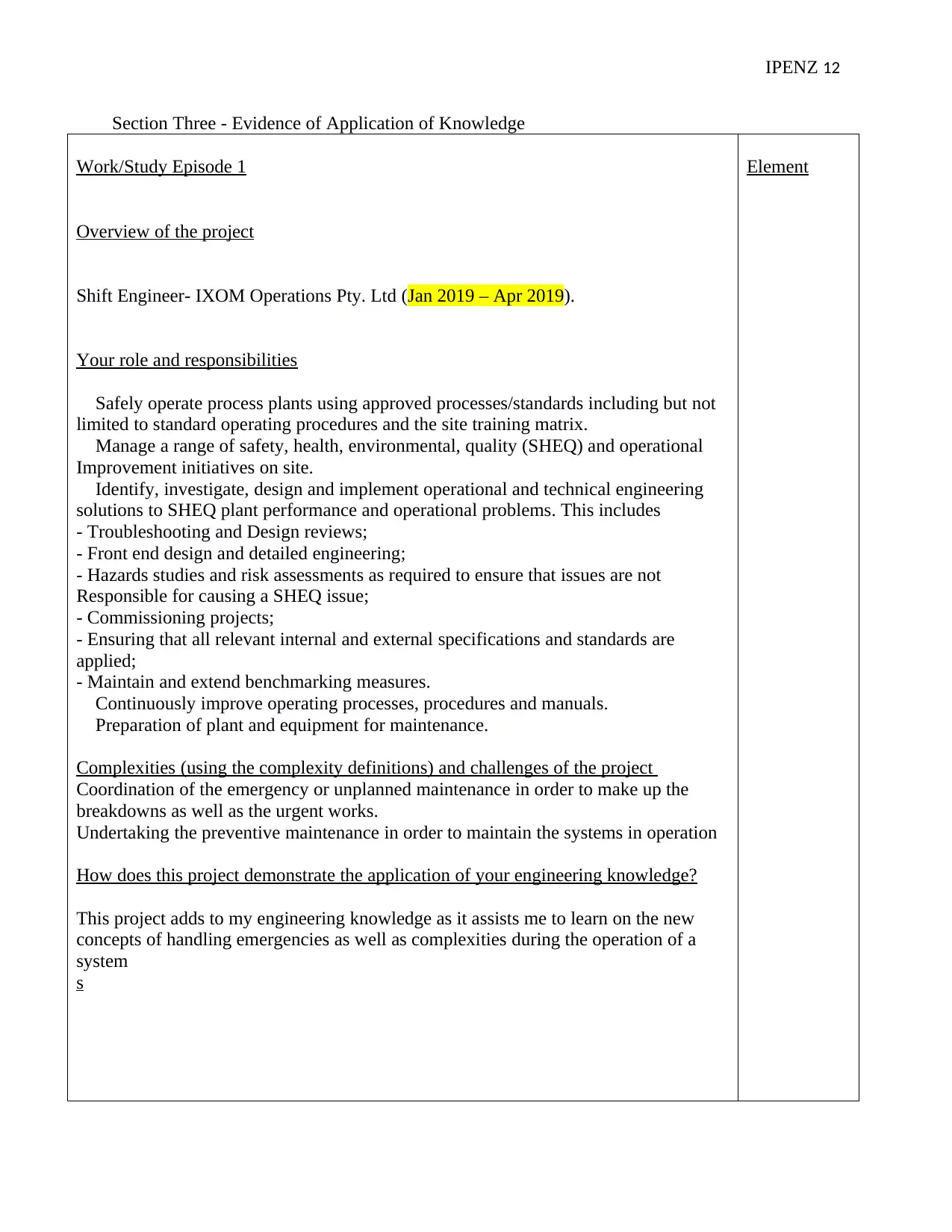
Section Three - Evidence of Application of Knowledge
Work/Study Episode 1
Overview of the project
Shift Engineer- IXOM Operations Pty. Ltd (Jan 2019 – Apr 2019).
Your role and responsibilities
Safely operate process plants using approved processes/standards including but not
limited to standard operating procedures and the site training matrix.
Manage a range of safety, health, environmental, quality (SHEQ) and operational
Improvement initiatives on site.
Identify, investigate, design and implement operational and technical engineering
solutions to SHEQ plant performance and operational problems. This includes
- Troubleshooting and Design reviews;
- Front end design and detailed engineering;
- Hazards studies and risk assessments as required to ensure that issues are not
Responsible for causing a SHEQ issue;
- Commissioning projects;
- Ensuring that all relevant internal and external specifications and standards are
applied;
- Maintain and extend benchmarking measures.
Continuously improve operating processes, procedures and manuals.
Preparation of plant and equipment for maintenance.
Complexities (using the complexity definitions) and challenges of the project
Coordination of the emergency or unplanned maintenance in order to make up the
breakdowns as well as the urgent works.
Undertaking the preventive maintenance in order to maintain the systems in operation
How does this project demonstrate the application of your engineering knowledge?
This project adds to my engineering knowledge as it assists me to learn on the new
concepts of handling emergencies as well as complexities during the operation of a
system
s
Element
Section Three - Evidence of Application of Knowledge
Work/Study Episode 1
Overview of the project
Shift Engineer- IXOM Operations Pty. Ltd (Jan 2019 – Apr 2019).
Your role and responsibilities
Safely operate process plants using approved processes/standards including but not
limited to standard operating procedures and the site training matrix.
Manage a range of safety, health, environmental, quality (SHEQ) and operational
Improvement initiatives on site.
Identify, investigate, design and implement operational and technical engineering
solutions to SHEQ plant performance and operational problems. This includes
- Troubleshooting and Design reviews;
- Front end design and detailed engineering;
- Hazards studies and risk assessments as required to ensure that issues are not
Responsible for causing a SHEQ issue;
- Commissioning projects;
- Ensuring that all relevant internal and external specifications and standards are
applied;
- Maintain and extend benchmarking measures.
Continuously improve operating processes, procedures and manuals.
Preparation of plant and equipment for maintenance.
Complexities (using the complexity definitions) and challenges of the project
Coordination of the emergency or unplanned maintenance in order to make up the
breakdowns as well as the urgent works.
Undertaking the preventive maintenance in order to maintain the systems in operation
How does this project demonstrate the application of your engineering knowledge?
This project adds to my engineering knowledge as it assists me to learn on the new
concepts of handling emergencies as well as complexities during the operation of a
system
s
Element
⊘ This is a preview!⊘
Do you want full access?
Subscribe today to unlock all pages.
Trusted by 1+ million students worldwide

1 out of 19


Related Documents


Your All-in-One AI-Powered Toolkit for Academic Success.
+13062052269
info@desklib.com
Available 24*7 on WhatsApp / Email
![[object Object]](/_next/static/media/star-bottom.7253800d.svg)
Unlock your academic potential
Copyright © 2020–2026 A2Z Services. All Rights Reserved. Developed and managed by ZUCOL.