University Assignment: Apple iPhone's Approach to Security and Privacy

Verified

Added on  2023/06/03

|4
|623
|462
Case Study
AI Summary
This case study examines Apple's approach to balancing user experience, convenience, and security in its iPhones, particularly in the context of the San Bernardino Massacre and the FBI's request for user data. The study highlights Apple's efforts to protect user privacy, even when faced with governmental demands. It analyzes the company's use of Secure Enclave and its stance on not compromising user data. The assignment explores the ethical and business implications of Apple's decisions, emphasizing the importance of customer loyalty and responsible data handling. The case study references legal and ethical considerations, demonstrating Apple's commitment to user privacy while navigating complex situations. The provided references support the analysis, offering insights into the ongoing debate about data security and user rights.
Document Page
Running head: APPLE IPHONE AND ITS SECRECY
Apple iPhone and its secrecy
Name of the Student
Name of the University
Author Note
tabler-icon-diamond-filled.svg

Paraphrase This Document

Need a fresh take? Get an instant paraphrase of this document with our AI Paraphraser
Document Page
1APPLE IPHONE AND ITS SECRECY
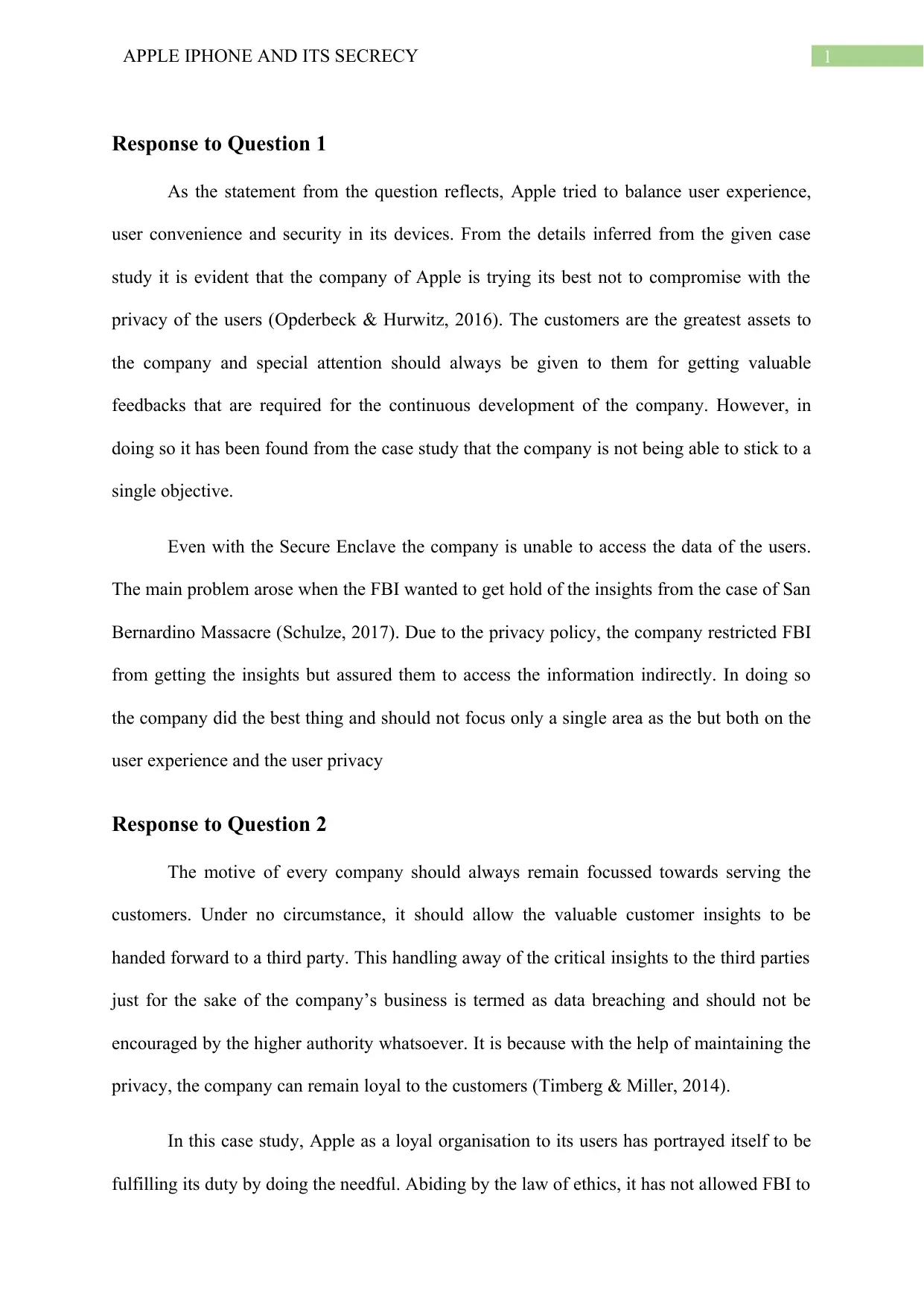
Response to Question 1
As the statement from the question reflects, Apple tried to balance user experience,
user convenience and security in its devices. From the details inferred from the given case
study it is evident that the company of Apple is trying its best not to compromise with the
privacy of the users (Opderbeck & Hurwitz, 2016). The customers are the greatest assets to
the company and special attention should always be given to them for getting valuable
feedbacks that are required for the continuous development of the company. However, in
doing so it has been found from the case study that the company is not being able to stick to a
single objective.
Even with the Secure Enclave the company is unable to access the data of the users.
The main problem arose when the FBI wanted to get hold of the insights from the case of San
Bernardino Massacre (Schulze, 2017). Due to the privacy policy, the company restricted FBI
from getting the insights but assured them to access the information indirectly. In doing so
the company did the best thing and should not focus only a single area as the but both on the
user experience and the user privacy
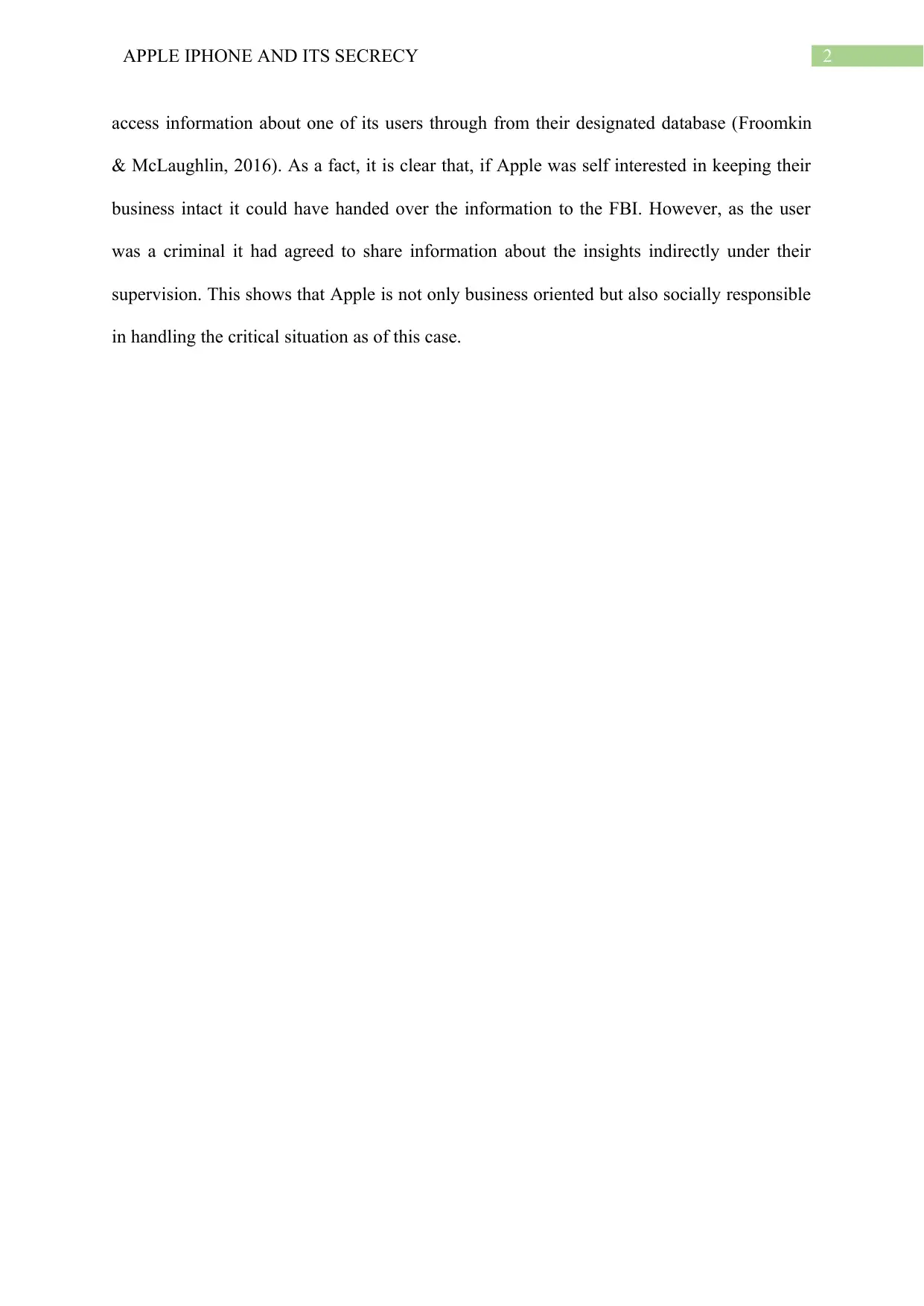
Response to Question 2
The motive of every company should always remain focussed towards serving the
customers. Under no circumstance, it should allow the valuable customer insights to be
handed forward to a third party. This handling away of the critical insights to the third parties
just for the sake of the company’s business is termed as data breaching and should not be
encouraged by the higher authority whatsoever. It is because with the help of maintaining the
privacy, the company can remain loyal to the customers (Timberg & Miller, 2014).
In this case study, Apple as a loyal organisation to its users has portrayed itself to be
fulfilling its duty by doing the needful. Abiding by the law of ethics, it has not allowed FBI to
Document Page
2APPLE IPHONE AND ITS SECRECY
access information about one of its users through from their designated database (Froomkin
& McLaughlin, 2016). As a fact, it is clear that, if Apple was self interested in keeping their
business intact it could have handed over the information to the FBI. However, as the user
was a criminal it had agreed to share information about the insights indirectly under their
supervision. This shows that Apple is not only business oriented but also socially responsible
in handling the critical situation as of this case.
Document Page
3APPLE IPHONE AND ITS SECRECY
References
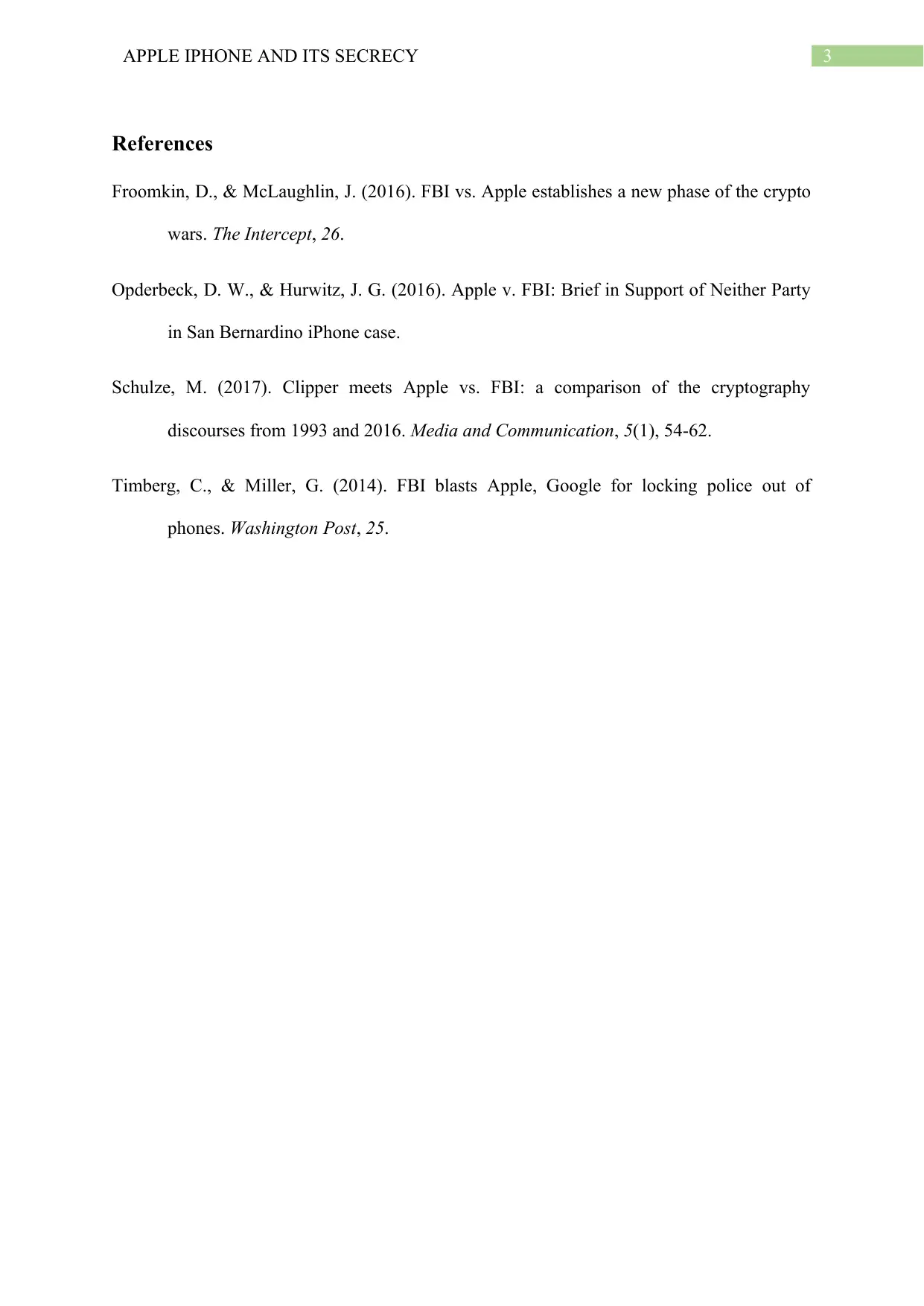
Froomkin, D., & McLaughlin, J. (2016). FBI vs. Apple establishes a new phase of the crypto
wars. The Intercept, 26.
Opderbeck, D. W., & Hurwitz, J. G. (2016). Apple v. FBI: Brief in Support of Neither Party
in San Bernardino iPhone case.
Schulze, M. (2017). Clipper meets Apple vs. FBI: a comparison of the cryptography
discourses from 1993 and 2016. Media and Communication, 5(1), 54-62.
Timberg, C., & Miller, G. (2014). FBI blasts Apple, Google for locking police out of
phones. Washington Post, 25.
chevron_up_icon
1 out of 4
circle_padding
hide_on_mobile
zoom_out_icon
[object Object]