IRB: Ethical Standards and Case Analysis in Research Studies

Verified

Added on  2022/08/17

|4
|508
|16
Report
AI Summary
This report delves into the role of the Institutional Review Board (IRB) in safeguarding the rights and welfare of human subjects involved in research. It highlights the importance of IRB approval, emphasizing the reduction of risks, equitable subject selection, informed consent, and the maintenance of data privacy. The report references the ethical guidelines and the need to disclose financial and personal relationships to avoid conflict of interest. The report provides case studies of unethical trials, such as the Letrozole trials in India and the VGV-1 trials in China, to illustrate the consequences of failing to obtain informed consent or inform subjects about potential risks. The conclusion emphasizes the ethical imperative to protect human subjects and prevent research misconduct.

Document Page
Running head: THE IRB 1
The IRB
Name
Institution
tabler-icon-diamond-filled.svg

Paraphrase This Document

Need a fresh take? Get an instant paraphrase of this document with our AI Paraphraser
Document Page
THE IRB 2
The IRB
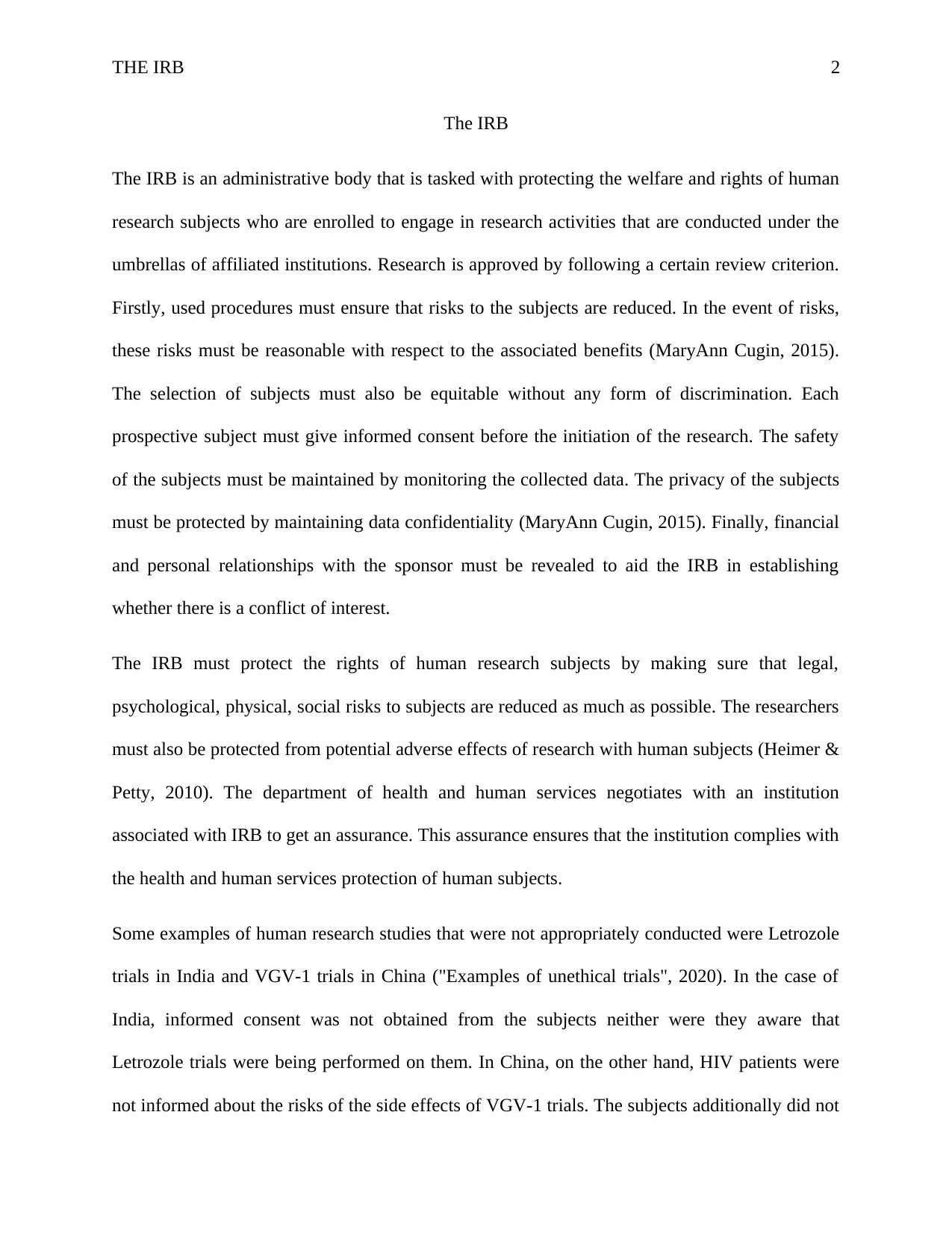
The IRB is an administrative body that is tasked with protecting the welfare and rights of human
research subjects who are enrolled to engage in research activities that are conducted under the
umbrellas of affiliated institutions. Research is approved by following a certain review criterion.
Firstly, used procedures must ensure that risks to the subjects are reduced. In the event of risks,
these risks must be reasonable with respect to the associated benefits (MaryAnn Cugin, 2015).
The selection of subjects must also be equitable without any form of discrimination. Each
prospective subject must give informed consent before the initiation of the research. The safety
of the subjects must be maintained by monitoring the collected data. The privacy of the subjects
must be protected by maintaining data confidentiality (MaryAnn Cugin, 2015). Finally, financial
and personal relationships with the sponsor must be revealed to aid the IRB in establishing
whether there is a conflict of interest.
The IRB must protect the rights of human research subjects by making sure that legal,
psychological, physical, social risks to subjects are reduced as much as possible. The researchers
must also be protected from potential adverse effects of research with human subjects (Heimer &
Petty, 2010). The department of health and human services negotiates with an institution
associated with IRB to get an assurance. This assurance ensures that the institution complies with
the health and human services protection of human subjects.
Some examples of human research studies that were not appropriately conducted were Letrozole
trials in India and VGV-1 trials in China ("Examples of unethical trials", 2020). In the case of
India, informed consent was not obtained from the subjects neither were they aware that
Letrozole trials were being performed on them. In China, on the other hand, HIV patients were
not informed about the risks of the side effects of VGV-1 trials. The subjects additionally did not
Document Page
THE IRB 3
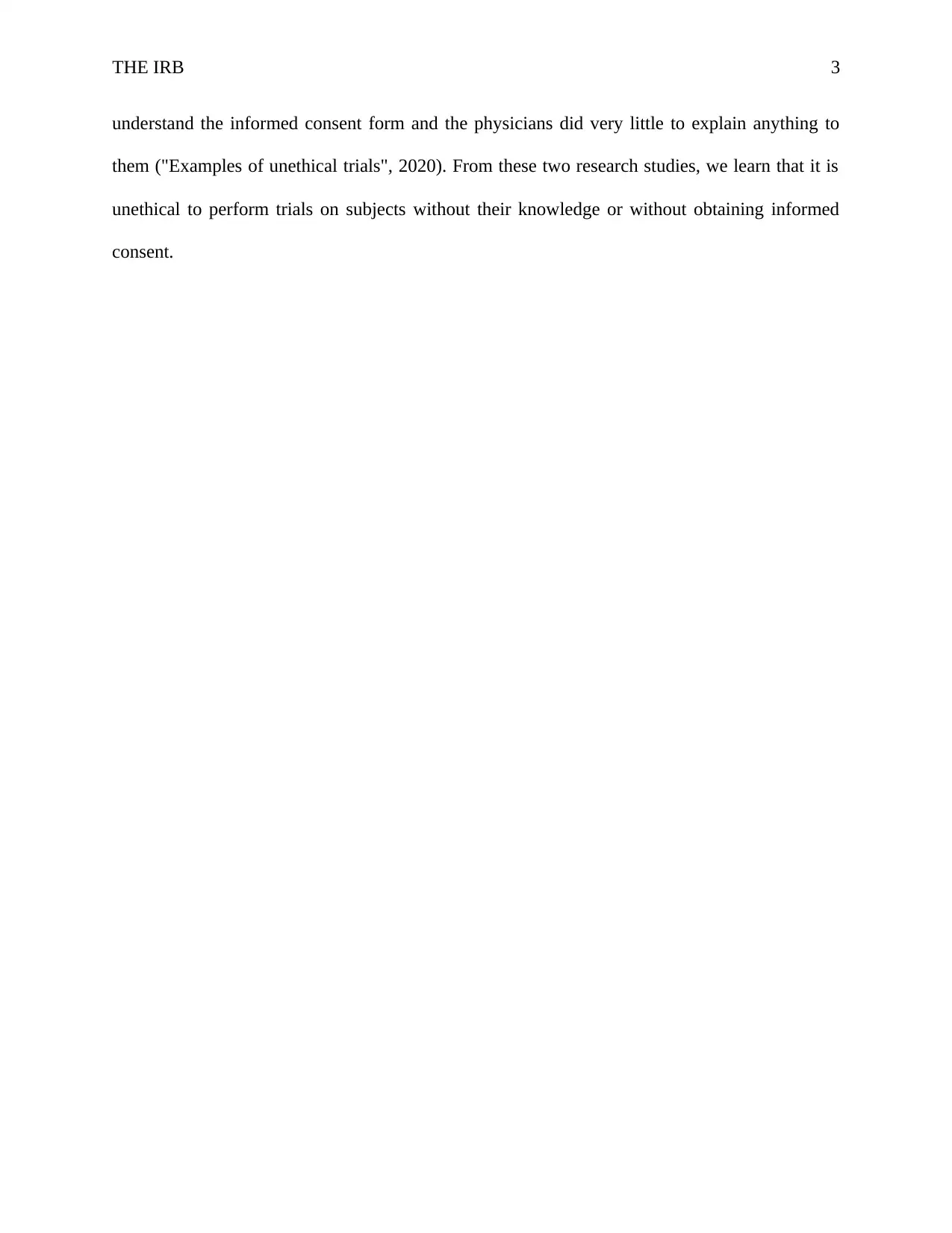
understand the informed consent form and the physicians did very little to explain anything to
them ("Examples of unethical trials", 2020). From these two research studies, we learn that it is
unethical to perform trials on subjects without their knowledge or without obtaining informed
consent.
Document Page
THE IRB 4
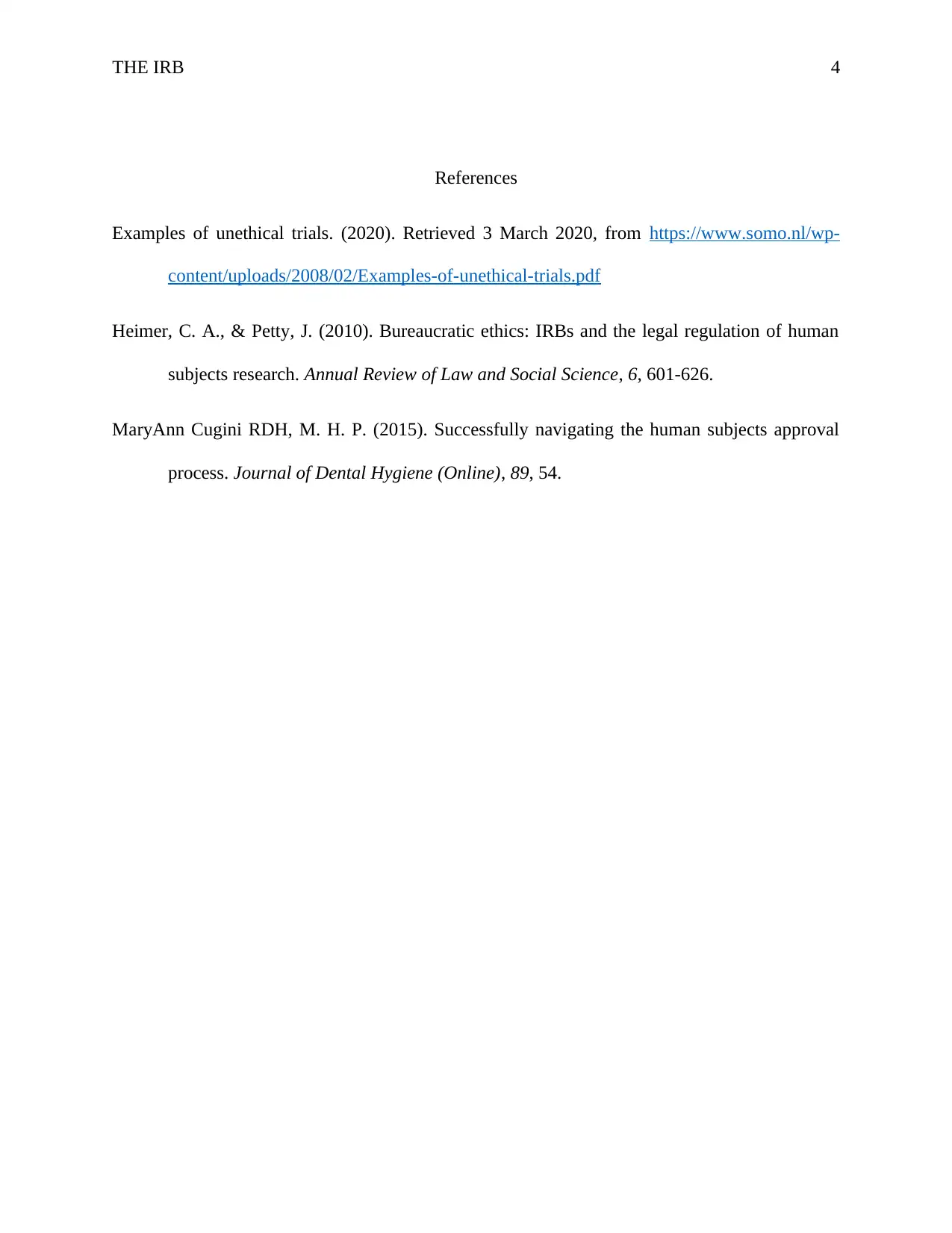
References
Examples of unethical trials. (2020). Retrieved 3 March 2020, from https://www.somo.nl/wp-
content/uploads/2008/02/Examples-of-unethical-trials.pdf
Heimer, C. A., & Petty, J. (2010). Bureaucratic ethics: IRBs and the legal regulation of human
subjects research. Annual Review of Law and Social Science, 6, 601-626.
MaryAnn Cugini RDH, M. H. P. (2015). Successfully navigating the human subjects approval
process. Journal of Dental Hygiene (Online), 89, 54.
chevron_up_icon
1 out of 4
circle_padding
hide_on_mobile
zoom_out_icon
[object Object]