Assessing Ireland's Prison Rehab Programs' Effectiveness
VerifiedAdded on 2020/05/16
|12
|3128
|63
AI Summary
The analysis examines Ireland's prison rehabilitation programs, highlighting their objectives to reduce recidivism and enhance public safety. While some progress has been made, there remain significant challenges such as high reoffending rates and inconsistent implementation of treatment strategies like cognitive behavioral therapy. The assignment explores various facets including the effectiveness of therapeutic communities, drug treatment outcomes, and vocational training initiatives. It also assesses cost-benefit analyses that suggest potential long-term savings for the criminal justice system through these rehabilitation efforts. By comparing Ireland's approach to international best practices, this study provides recommendations for strengthening these programs to achieve better public safety and economic outcomes.
Running head: EFFECTIVENESS OF REHABILITATION OF PRISONERS INTO IRISH
SOCIETY
EFFECTIVENESS OF REHABILITATION OF PRISONERS INTO IRISH SOCIETY
Name of the Student
Name of the University
Author’s Note
SOCIETY
EFFECTIVENESS OF REHABILITATION OF PRISONERS INTO IRISH SOCIETY
Name of the Student
Name of the University
Author’s Note

Paraphrase This Document
Need a fresh take? Get an instant paraphrase of this document with our AI Paraphraser
1EFFECTIVENESS OF REHABILITATION OF PRISONERS INTO IRISH SOCIETY
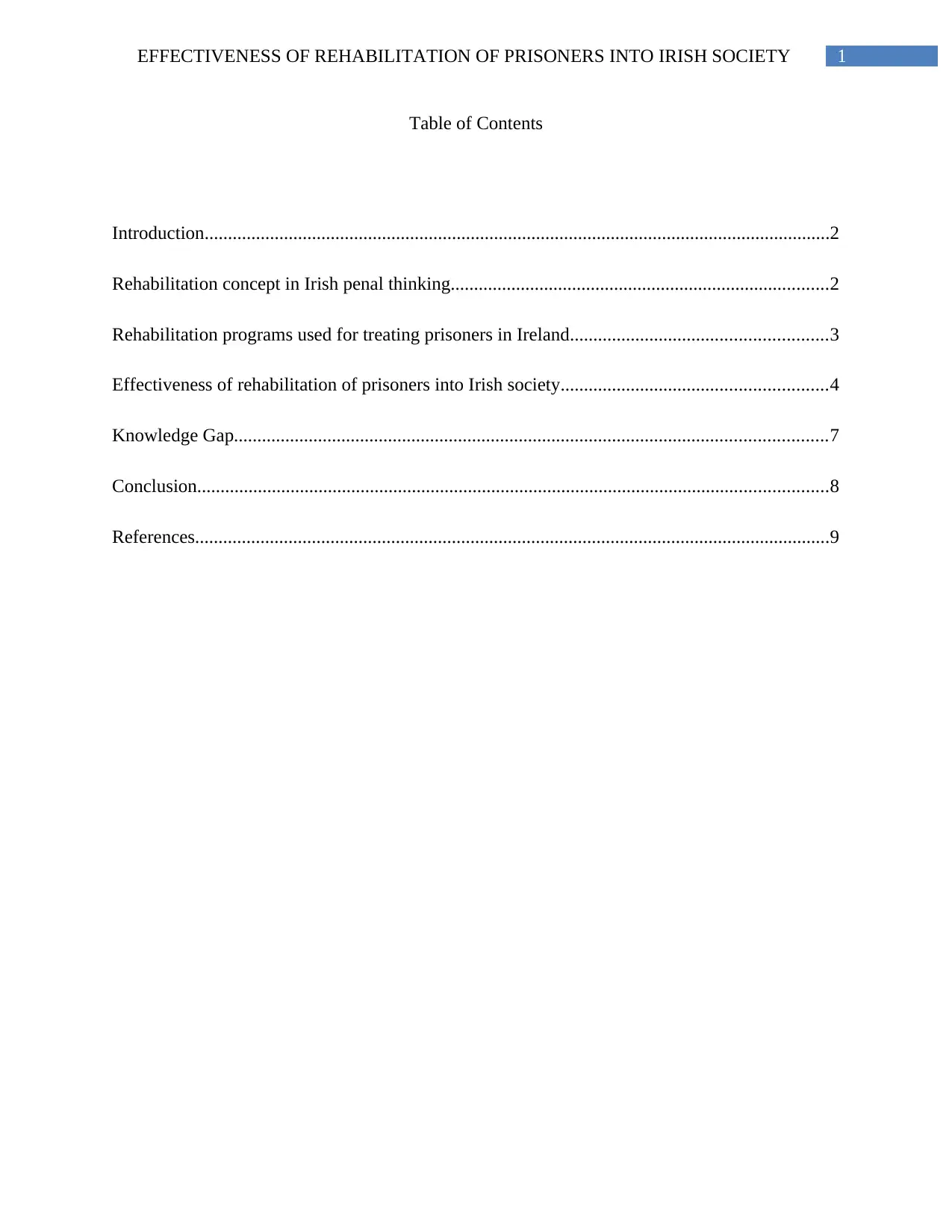
Table of Contents
Introduction......................................................................................................................................2
Rehabilitation concept in Irish penal thinking.................................................................................2
Rehabilitation programs used for treating prisoners in Ireland.......................................................3
Effectiveness of rehabilitation of prisoners into Irish society.........................................................4
Knowledge Gap...............................................................................................................................7
Conclusion.......................................................................................................................................8
References........................................................................................................................................9
Table of Contents
Introduction......................................................................................................................................2
Rehabilitation concept in Irish penal thinking.................................................................................2
Rehabilitation programs used for treating prisoners in Ireland.......................................................3
Effectiveness of rehabilitation of prisoners into Irish society.........................................................4
Knowledge Gap...............................................................................................................................7
Conclusion.......................................................................................................................................8
References........................................................................................................................................9
2EFFECTIVENESS OF REHABILITATION OF PRISONERS INTO IRISH SOCIETY
LITERATURE REVIEW
Introduction
This chapter focuses on the literature review, both theoretical as well as conceptual
framework of the research study. This research also reveals the gap of knowledge from
previously done review about the present research topic that aligns with effectiveness of
rehabilitation of prisoners into Irish society.
Rehabilitation concept in Irish penal thinking
Rehabilitation refers to the process of facilitating inmates those who are presently in
prisons serving their sentences for returning them to normal life through provisions of training.
The target of rehabilitation programs of the prisoners is to change them from doing any kind of
crimes and also assists them to live in normal life (Behan, 2012). Rehabilitation has been
considered as one of the vital functions of the prison system. For realizing this target, the
prisoners of this nation mainly receives counseling, guidance and training. The extent of
rehabilitation attained in the prison mainly determines the prisoner’s adjustment in the Irish
society after release.
Ireland took different pathway to its neighbor in context to this prison policy as well as
rehabilitation. Behan & Bates-Gaston (2015) opines that “Penal welfarism” indicates the concept
in which rehabilitation has been embedded and mainly considers to include correctionalism. This
concept generally includes specific penal practices that includes- attempting to divert individuals
from prison through use of probation as well as fines. It has opined by Rogan (2013) that, the
Irish prison took new position within the changed structure within the complex of penal- welfare.
LITERATURE REVIEW
Introduction
This chapter focuses on the literature review, both theoretical as well as conceptual
framework of the research study. This research also reveals the gap of knowledge from
previously done review about the present research topic that aligns with effectiveness of
rehabilitation of prisoners into Irish society.
Rehabilitation concept in Irish penal thinking
Rehabilitation refers to the process of facilitating inmates those who are presently in
prisons serving their sentences for returning them to normal life through provisions of training.
The target of rehabilitation programs of the prisoners is to change them from doing any kind of
crimes and also assists them to live in normal life (Behan, 2012). Rehabilitation has been
considered as one of the vital functions of the prison system. For realizing this target, the
prisoners of this nation mainly receives counseling, guidance and training. The extent of
rehabilitation attained in the prison mainly determines the prisoner’s adjustment in the Irish
society after release.
Ireland took different pathway to its neighbor in context to this prison policy as well as
rehabilitation. Behan & Bates-Gaston (2015) opines that “Penal welfarism” indicates the concept
in which rehabilitation has been embedded and mainly considers to include correctionalism. This
concept generally includes specific penal practices that includes- attempting to divert individuals
from prison through use of probation as well as fines. It has opined by Rogan (2013) that, the
Irish prison took new position within the changed structure within the complex of penal- welfare.
⊘ This is a preview!⊘
Do you want full access?
Subscribe today to unlock all pages.

Trusted by 1+ million students worldwide
3EFFECTIVENESS OF REHABILITATION OF PRISONERS INTO IRISH SOCIETY
Several new sanctions were introduced as the alternatives to imprisonment and to eliminate
offender from prison setting. In addition, declining reoffending behaviour as well as dependence
on prison are the main objective of this penal system (Carr & Maruna, 2012). Thus, in order to
pursue these aims they apply appropriate law as well as practice in penal policy area.
Rehabilitation programs used for treating prisoners in Ireland
The prisoners of this nation are generally provided with huge range of the rehabilitation
programs that includes- education, psychiatric counseling, welfare as well as spiritual services,
vocational training, healthcare services etc. All the prisoners are basically interviewed by each
prison’s governor and are also informed of services available in prison (Cooney, 2012). In the
Irish Prison system, Dr Kevin Warner was the coordinator of Education for more than 30 years
until 2009. Harding (2014) found out that one of the top priorities for the Irish Prison Service
(IPS) is to help the prisoners with reading as well as writing issues and also provide with the
mentoring programs. It has been stated by Silke (2014) that, the programs are implemented for
taking into account prisoners population diversity as well as complex prison life nature. The
programs are widely categorized as follows-
Providing basic education- this involves numeracy, English and other communicative
languages
Technology- They provides training in technology that includes information technology,
metalwork, computer design etc
Life skills- This involves personal development, addiction studies, interpersonal skills etc
Healthy life- It notably involves recreational activities, physical as health education etc.
Several new sanctions were introduced as the alternatives to imprisonment and to eliminate
offender from prison setting. In addition, declining reoffending behaviour as well as dependence
on prison are the main objective of this penal system (Carr & Maruna, 2012). Thus, in order to
pursue these aims they apply appropriate law as well as practice in penal policy area.
Rehabilitation programs used for treating prisoners in Ireland
The prisoners of this nation are generally provided with huge range of the rehabilitation
programs that includes- education, psychiatric counseling, welfare as well as spiritual services,
vocational training, healthcare services etc. All the prisoners are basically interviewed by each
prison’s governor and are also informed of services available in prison (Cooney, 2012). In the
Irish Prison system, Dr Kevin Warner was the coordinator of Education for more than 30 years
until 2009. Harding (2014) found out that one of the top priorities for the Irish Prison Service
(IPS) is to help the prisoners with reading as well as writing issues and also provide with the
mentoring programs. It has been stated by Silke (2014) that, the programs are implemented for
taking into account prisoners population diversity as well as complex prison life nature. The
programs are widely categorized as follows-
Providing basic education- this involves numeracy, English and other communicative
languages
Technology- They provides training in technology that includes information technology,
metalwork, computer design etc
Life skills- This involves personal development, addiction studies, interpersonal skills etc
Healthy life- It notably involves recreational activities, physical as health education etc.
Paraphrase This Document
Need a fresh take? Get an instant paraphrase of this document with our AI Paraphraser
4EFFECTIVENESS OF REHABILITATION OF PRISONERS INTO IRISH SOCIETY
These training activities also provide opportunities for the prisoners as it helps them in
acquiring practical skills. This in turn aids them in securing employment on their release. The
IPS also places emphasis on vocational training program for their prisoners (Visher & Travis,
2012). The training workshop that operates within the prison includes- computers, construction,
printing, craft etc. Additionally, vital services for Trish prisons are also provided through this
work training. There are nearly 126 workshops across prison, the training area also authorized
allocation of staffing of approximately 378,
In fact, the IPS as well as Probation Service co- manages early release scheme termed as
“ The Community Return Program”. It was commenced during the year 2011 and at present it
has been operational in every nation. This program is usually supported by resource reallocation
and the personnel from within these services (Duwe & Johnson, 2013). It usually targets those
prisoners who are well- behaved and serving sentences between 1 to 8 years of imprisonment
and are making real efforts for desisting from reoffending. Moreover, the prisoners who are
serving imprisonment for less than 1 year becomes ineligible for this program and instead is
taken into account for release under the Irish Society Support Scheme. In addition, the prisoners
who are serving sentences for more than 8 years usually lies within the process of Parole Board.
Effectiveness of rehabilitation of prisoners into Irish society
The IPS is mainly committed to administer custodial sentences through certain method which
encourages as well as supports the prisoners for living purposeful lives and law abiding as valued
citizens of the Irish society. Few core values of this IPS includes- identifying its obligation for
serving their society by giving respect to human dignity, appropriate conditions as well as
services to their well-being, personal development and making commitment for reducing
These training activities also provide opportunities for the prisoners as it helps them in
acquiring practical skills. This in turn aids them in securing employment on their release. The
IPS also places emphasis on vocational training program for their prisoners (Visher & Travis,
2012). The training workshop that operates within the prison includes- computers, construction,
printing, craft etc. Additionally, vital services for Trish prisons are also provided through this
work training. There are nearly 126 workshops across prison, the training area also authorized
allocation of staffing of approximately 378,
In fact, the IPS as well as Probation Service co- manages early release scheme termed as
“ The Community Return Program”. It was commenced during the year 2011 and at present it
has been operational in every nation. This program is usually supported by resource reallocation
and the personnel from within these services (Duwe & Johnson, 2013). It usually targets those
prisoners who are well- behaved and serving sentences between 1 to 8 years of imprisonment
and are making real efforts for desisting from reoffending. Moreover, the prisoners who are
serving imprisonment for less than 1 year becomes ineligible for this program and instead is
taken into account for release under the Irish Society Support Scheme. In addition, the prisoners
who are serving sentences for more than 8 years usually lies within the process of Parole Board.
Effectiveness of rehabilitation of prisoners into Irish society
The IPS is mainly committed to administer custodial sentences through certain method which
encourages as well as supports the prisoners for living purposeful lives and law abiding as valued
citizens of the Irish society. Few core values of this IPS includes- identifying its obligation for
serving their society by giving respect to human dignity, appropriate conditions as well as
services to their well-being, personal development and making commitment for reducing
5EFFECTIVENESS OF REHABILITATION OF PRISONERS INTO IRISH SOCIETY
detrimental impact of imprisonment. For achieving this objective, the IPS as well as the
Probation service involves multi-agency approaches that involves significant resources dedicated
to rehabilitation and offender management from pre to post imprisonment for reducing re-
offending as well as improving results of prisoners. Craig, Gannon & Dixon (2013) opines that,
the aim of the IPS is that all the prisoner’s release from the prisons and detention places are
usually planned release for ensuring effective offender’s transition from prison to Irish society, in
conformity with legal and statutory provisions.
The IPS works with IASIO (Irish Association for the Social Integration of Offenders) for
providing operational services that includes- “The Gate Service” and “The Resettlement
Service”. The GATE (Gaining Access to Training and Employment) service refers to the
vocational service, which provides guidance counseling as well as placement supports to the
prisoners. This service helps the prisoners of this nation to secure their place in different types of
jobs post- release (Craig, Gannon & Dixon, 2015). In addition, the resettlement service provided
by IPS refers to the basic requirements support service for the prisoners with near about 18
months left for serving. As this resettlement program offers one-to–one support from prison to
Irish society, this helps the prisoners in accessing housing as well as welfare supports post their
release from the prison. In the year 2016, the IPS also integrated the new platform for central
information on the PIMS (Prisoner Information Management System) in which both ISM
members as well as coordinators of multi-disciplinary team records wide range of data in context
to sentence management for the prisoners as well as raise concerns on post- release. Lambi &
Randell (2013) opines that, this centralized information resource helps in assisting services that
are prison based for improving conversion from custody to Irish society for the offenders. This in
turn declines risk to persons as well as risk of reoffending after their release.
detrimental impact of imprisonment. For achieving this objective, the IPS as well as the
Probation service involves multi-agency approaches that involves significant resources dedicated
to rehabilitation and offender management from pre to post imprisonment for reducing re-
offending as well as improving results of prisoners. Craig, Gannon & Dixon (2013) opines that,
the aim of the IPS is that all the prisoner’s release from the prisons and detention places are
usually planned release for ensuring effective offender’s transition from prison to Irish society, in
conformity with legal and statutory provisions.
The IPS works with IASIO (Irish Association for the Social Integration of Offenders) for
providing operational services that includes- “The Gate Service” and “The Resettlement
Service”. The GATE (Gaining Access to Training and Employment) service refers to the
vocational service, which provides guidance counseling as well as placement supports to the
prisoners. This service helps the prisoners of this nation to secure their place in different types of
jobs post- release (Craig, Gannon & Dixon, 2015). In addition, the resettlement service provided
by IPS refers to the basic requirements support service for the prisoners with near about 18
months left for serving. As this resettlement program offers one-to–one support from prison to
Irish society, this helps the prisoners in accessing housing as well as welfare supports post their
release from the prison. In the year 2016, the IPS also integrated the new platform for central
information on the PIMS (Prisoner Information Management System) in which both ISM
members as well as coordinators of multi-disciplinary team records wide range of data in context
to sentence management for the prisoners as well as raise concerns on post- release. Lambi &
Randell (2013) opines that, this centralized information resource helps in assisting services that
are prison based for improving conversion from custody to Irish society for the offenders. This in
turn declines risk to persons as well as risk of reoffending after their release.
⊘ This is a preview!⊘
Do you want full access?
Subscribe today to unlock all pages.
Trusted by 1+ million students worldwide
6EFFECTIVENESS OF REHABILITATION OF PRISONERS INTO IRISH SOCIETY
The IPS has implemented Drug Treatment policy in order to provide best standard of
prisoners care with addiction problem. From the present strategic assessment of the Irish Penal
policy (2014), it has been seen that treatment of drug usually doesn’t work without the
willingness of the individual’s cooperation. According to Hannon, Kelleher & Friel, (2017), the
drug treatment in this nation’s prison mainly involves- counseling, rehabilitation, education
programs and medical detoxification. Lambie & Randell (2013) opines that this policy also helps
in reducing drug demand in Irish prison. The demand is generally reduced in three methods-
Identify as well as engage with the drug users
Developing treatment options
The rehabilitation as well as reintegration of the offenders results in desistance from crime,
which helped in making Ireland safer place to live in. It has been stated by Visher & Travis
(2012) that, the Irish Penal Reform Trust ( IPRT) believes that proper strategy as well as
preparation for support of post- release plays vital role in successful prisoners return to the Irish
society and families. They also believe that this support is also vital in successful reintegration.
This in turn provides the prisoners with huge employment opportunities as well as with proper
services in Irish society (Zarkin et al., 2012). This rehabilitation programs has been effective to
deal with the issues regarding overcrowding, violence within Irish prison system and drug abuse.
Few evidences reflect that prisoners of this nation were not appropriately rehabilitated. For
example, some of the prisoners in Cloverhill have said that being imprisoned for over few years
generally changed their life as it facilitated them in sorting out several problems in their life and
also helped them to become more focus on their aim in life. But this actually did not occur
outside the prison owing to some faults in the Irish society.
The IPS has implemented Drug Treatment policy in order to provide best standard of
prisoners care with addiction problem. From the present strategic assessment of the Irish Penal
policy (2014), it has been seen that treatment of drug usually doesn’t work without the
willingness of the individual’s cooperation. According to Hannon, Kelleher & Friel, (2017), the
drug treatment in this nation’s prison mainly involves- counseling, rehabilitation, education
programs and medical detoxification. Lambie & Randell (2013) opines that this policy also helps
in reducing drug demand in Irish prison. The demand is generally reduced in three methods-
Identify as well as engage with the drug users
Developing treatment options
The rehabilitation as well as reintegration of the offenders results in desistance from crime,
which helped in making Ireland safer place to live in. It has been stated by Visher & Travis
(2012) that, the Irish Penal Reform Trust ( IPRT) believes that proper strategy as well as
preparation for support of post- release plays vital role in successful prisoners return to the Irish
society and families. They also believe that this support is also vital in successful reintegration.
This in turn provides the prisoners with huge employment opportunities as well as with proper
services in Irish society (Zarkin et al., 2012). This rehabilitation programs has been effective to
deal with the issues regarding overcrowding, violence within Irish prison system and drug abuse.
Few evidences reflect that prisoners of this nation were not appropriately rehabilitated. For
example, some of the prisoners in Cloverhill have said that being imprisoned for over few years
generally changed their life as it facilitated them in sorting out several problems in their life and
also helped them to become more focus on their aim in life. But this actually did not occur
outside the prison owing to some faults in the Irish society.
Paraphrase This Document
Need a fresh take? Get an instant paraphrase of this document with our AI Paraphraser
7EFFECTIVENESS OF REHABILITATION OF PRISONERS INTO IRISH SOCIETY
The Norwegian rehabilitation approach towards their prisoners has been highly effective.
This means only 20% of the prisoners have been reconvicted within last two years, which
highlighted half that of the US rate. Norwegian import model denotes the vital reintegration
services are usually delivered to prison through the municipal as well as local service providers.
The prisons of this nation do not include staff delivering educational, library and medical
services (Latessa & Smith, 2015). These are generally imported from their community. Some of
the advantages of this model include-
Better continuity in service deliverance helps the offender to set up contact while staying
in prison
Involvement from their community along with prison system. This however leads to
better cross connections as well as improvement of their prisons image.
These services are basically financed by some other institutions
Recent evidence also reflects that the prison system in this nation has led to huge success as it
helps in keeping the rates of re-offending low. The main aim of Norway prisons is to implement
effective rehabilitation of the prisoners. Moreover, access to vocational courses also provides the
prisoners skills for employment. They even start to work outside for about 18 months before
their release. In addition, cognitive behavioral treatment as well as counseling services also helps
in improving mental health of the prisoners of this country.
Knowledge Gap
This section of the literature review reflects that not many studies have on the present
research topic that aligns with the effectiveness of rehabilitation of prisoners in the Irish society.
The study mainly focused on the concept of rehabilitation in the Irish penal thinking. In addition,
The Norwegian rehabilitation approach towards their prisoners has been highly effective.
This means only 20% of the prisoners have been reconvicted within last two years, which
highlighted half that of the US rate. Norwegian import model denotes the vital reintegration
services are usually delivered to prison through the municipal as well as local service providers.
The prisons of this nation do not include staff delivering educational, library and medical
services (Latessa & Smith, 2015). These are generally imported from their community. Some of
the advantages of this model include-
Better continuity in service deliverance helps the offender to set up contact while staying
in prison
Involvement from their community along with prison system. This however leads to
better cross connections as well as improvement of their prisons image.
These services are basically financed by some other institutions
Recent evidence also reflects that the prison system in this nation has led to huge success as it
helps in keeping the rates of re-offending low. The main aim of Norway prisons is to implement
effective rehabilitation of the prisoners. Moreover, access to vocational courses also provides the
prisoners skills for employment. They even start to work outside for about 18 months before
their release. In addition, cognitive behavioral treatment as well as counseling services also helps
in improving mental health of the prisoners of this country.
Knowledge Gap
This section of the literature review reflects that not many studies have on the present
research topic that aligns with the effectiveness of rehabilitation of prisoners in the Irish society.
The study mainly focused on the concept of rehabilitation in the Irish penal thinking. In addition,
8EFFECTIVENESS OF REHABILITATION OF PRISONERS INTO IRISH SOCIETY
the rehabilitation programs that have been used for treating prisoners in this nation are also
analyzed in this study. The factors influencing the performance of the rehabilitation programs
into this Irish society has not been highlighted in this study. Moreover, the motivation of the
rehabilitators provided by the IPS is not reflected in this study.
Conclusion
From the above essay, it can be concluded that effective rehabilitation is vital to
reintegrating into the Irish society after the prisoners release from prison. The Penal Reform
Trust of the Irish society has changed the system of prison while further reforming it to cost–
effective. In addition, adoption of the rehabilitation approach helped in improving the life of the
prisoners. The effectiveness of these rehabilitation programs adopted by the IPS has high
influence on recidivism of the inmates. Owing to this, when the rehabilitation programs become
inadequate, the recidivism rate of prisoners of this country goes high. But in case if it becomes
adequate, the recidivism rate becomes minimal. There are several issues in the Irish prison
system that includes- police brutality, overcrowding, prisoner’s treatment, rehabilitation etc. In
addition, the government of this nation also plays vital role in properly running this nation’s
prison system. Furthermore, effective rehabilitation program implemented by IPS also helped in
decreasing the re conviction incidences of this nation’s prisoners after the release. In fact, this
rehabilitation program also influences their finances or allocation of budget. However, it is
recommended that advancement of technology must be used in proper way in order to enhance
the effectiveness of rehabilitation programs as well as decrease the recidivism incidences.
the rehabilitation programs that have been used for treating prisoners in this nation are also
analyzed in this study. The factors influencing the performance of the rehabilitation programs
into this Irish society has not been highlighted in this study. Moreover, the motivation of the
rehabilitators provided by the IPS is not reflected in this study.
Conclusion
From the above essay, it can be concluded that effective rehabilitation is vital to
reintegrating into the Irish society after the prisoners release from prison. The Penal Reform
Trust of the Irish society has changed the system of prison while further reforming it to cost–
effective. In addition, adoption of the rehabilitation approach helped in improving the life of the
prisoners. The effectiveness of these rehabilitation programs adopted by the IPS has high
influence on recidivism of the inmates. Owing to this, when the rehabilitation programs become
inadequate, the recidivism rate of prisoners of this country goes high. But in case if it becomes
adequate, the recidivism rate becomes minimal. There are several issues in the Irish prison
system that includes- police brutality, overcrowding, prisoner’s treatment, rehabilitation etc. In
addition, the government of this nation also plays vital role in properly running this nation’s
prison system. Furthermore, effective rehabilitation program implemented by IPS also helped in
decreasing the re conviction incidences of this nation’s prisoners after the release. In fact, this
rehabilitation program also influences their finances or allocation of budget. However, it is
recommended that advancement of technology must be used in proper way in order to enhance
the effectiveness of rehabilitation programs as well as decrease the recidivism incidences.
⊘ This is a preview!⊘
Do you want full access?
Subscribe today to unlock all pages.
Trusted by 1+ million students worldwide
9EFFECTIVENESS OF REHABILITATION OF PRISONERS INTO IRISH SOCIETY
References
Behan, C. (2014). Learning to escape: Prison education, rehabilitation and the potential for
transformation. Journal of Prison Education and Reentry, 1(1), 20-31.
Behan, C., & Bates-Gaston, J. (2015). Prison education and rehabilitation. The Routledge
Handbook of Irish Criminology, 356.
Carr, N., & Maruna, S. (2012). Legitimacy through neutrality: probation and conflict in Northern
Ireland. The Howard Journal of Crime and Justice, 51(5), 474-487.
Cooney, T. M. (2012). Reducing recidivism through entrepreneurship programmes in
prisons. The International Journal of Entrepreneurship and Innovation, 13(2), 125-133.
Costelloe, A., & Warner, K. (2014). Prison education across Europe: policy, practice,
politics. London Review of Education, 12(2), 175-183.
Craig, L. A., Gannon, T. A., & Dixon, L. (Eds.). (2013). What works in offender rehabilitation:
An evidence-based approach to assessment and treatment. John Wiley & Sons.
Cullen, F. T., & Gilbert, K. E. (2013). Reaffirming rehabilitation. Routledge.
Day, A., Casey, S., Vess, J., & Huisy, G. (2012). Assessing the therapeutic climate of
prisons. Criminal justice and behavior, 39(2), 156-168.
Duwe, G., & Johnson, B. R. (2013). Estimating the benefits of a faith-based correctional
program. International Journal of Criminology and Sociology, 2, 227-239.
References
Behan, C. (2014). Learning to escape: Prison education, rehabilitation and the potential for
transformation. Journal of Prison Education and Reentry, 1(1), 20-31.
Behan, C., & Bates-Gaston, J. (2015). Prison education and rehabilitation. The Routledge
Handbook of Irish Criminology, 356.
Carr, N., & Maruna, S. (2012). Legitimacy through neutrality: probation and conflict in Northern
Ireland. The Howard Journal of Crime and Justice, 51(5), 474-487.
Cooney, T. M. (2012). Reducing recidivism through entrepreneurship programmes in
prisons. The International Journal of Entrepreneurship and Innovation, 13(2), 125-133.
Costelloe, A., & Warner, K. (2014). Prison education across Europe: policy, practice,
politics. London Review of Education, 12(2), 175-183.
Craig, L. A., Gannon, T. A., & Dixon, L. (Eds.). (2013). What works in offender rehabilitation:
An evidence-based approach to assessment and treatment. John Wiley & Sons.
Cullen, F. T., & Gilbert, K. E. (2013). Reaffirming rehabilitation. Routledge.
Day, A., Casey, S., Vess, J., & Huisy, G. (2012). Assessing the therapeutic climate of
prisons. Criminal justice and behavior, 39(2), 156-168.
Duwe, G., & Johnson, B. R. (2013). Estimating the benefits of a faith-based correctional
program. International Journal of Criminology and Sociology, 2, 227-239.
Paraphrase This Document
Need a fresh take? Get an instant paraphrase of this document with our AI Paraphraser
10EFFECTIVENESS OF REHABILITATION OF PRISONERS INTO IRISH SOCIETY
Gallant, D., Sherry, E., & Nicholson, M. (2015). Recreation or rehabilitation? Managing sport
for development programs with prison populations. Sport management review, 18(1), 45-
56.
Hannon, F., Kelleher, C., & Friel, S. (2017). General healthcare study of the Irish prison
population. People. Zarkin, G. A., Cowell, A. J., Hicks, K. A., Mills, M. J., Belenko, S.,
Dunlap, L. J., ... & Keyes, V. (2012). Benefits and costs of substance abuse treatment
programs for state prison inmates: Results from a lifetime simulation model. Health
economics, 21(6), 633-652.
Harding, R. (2014). Rehabilitation and prison social climate: do ‘What Works’ rehabilitation
programs work better in prisons that have a positive social climate?. Australian & New
Zealand Journal of Criminology, 47(2), 163-175.
Hedrich, D., Alves, P., Farrell, M., Stöver, H., Møller, L., & Mayet, S. (2012). The effectiveness
of opioid maintenance treatment in prison settings: a systematic
review. Addiction, 107(3), 501-517.
Lambie, I., & Randell, I. (2013). The impact of incarceration on juvenile offenders. Clinical
Psychology Review, 33(3), 448-459.
Latessa, E. J., & Smith, P. (2015). Corrections in the Community. Routledge.
MacNamara, C., & Mannix-McNamara, P. (2014). Placing the promotion of health and well
being on the Irish prison agenda-the complexity of health promotion in Irish prisons. Irish
Journal of Applied Social Studies, 14(1), 6.
Maruna, S. (2017). Desistance as a Social Movement1. Irish Probation Journal, 14.
Gallant, D., Sherry, E., & Nicholson, M. (2015). Recreation or rehabilitation? Managing sport
for development programs with prison populations. Sport management review, 18(1), 45-
56.
Hannon, F., Kelleher, C., & Friel, S. (2017). General healthcare study of the Irish prison
population. People. Zarkin, G. A., Cowell, A. J., Hicks, K. A., Mills, M. J., Belenko, S.,
Dunlap, L. J., ... & Keyes, V. (2012). Benefits and costs of substance abuse treatment
programs for state prison inmates: Results from a lifetime simulation model. Health
economics, 21(6), 633-652.
Harding, R. (2014). Rehabilitation and prison social climate: do ‘What Works’ rehabilitation
programs work better in prisons that have a positive social climate?. Australian & New
Zealand Journal of Criminology, 47(2), 163-175.
Hedrich, D., Alves, P., Farrell, M., Stöver, H., Møller, L., & Mayet, S. (2012). The effectiveness
of opioid maintenance treatment in prison settings: a systematic
review. Addiction, 107(3), 501-517.
Lambie, I., & Randell, I. (2013). The impact of incarceration on juvenile offenders. Clinical
Psychology Review, 33(3), 448-459.
Latessa, E. J., & Smith, P. (2015). Corrections in the Community. Routledge.
MacNamara, C., & Mannix-McNamara, P. (2014). Placing the promotion of health and well
being on the Irish prison agenda-the complexity of health promotion in Irish prisons. Irish
Journal of Applied Social Studies, 14(1), 6.
Maruna, S. (2017). Desistance as a Social Movement1. Irish Probation Journal, 14.
11EFFECTIVENESS OF REHABILITATION OF PRISONERS INTO IRISH SOCIETY
Polaschek, D. L. (2012). An appraisal of the risk–need–responsivity (RNR) model of offender
rehabilitation and its application in correctional treatment. Legal and criminological
Psychology, 17(1), 1-17.
Redondo Illescas, S., & Frerich, N. (2014). Crime and justice reinvestment in Europe:
Possibilities and challenges. Victims & Offenders, 9(1), 13-49.
Rogan, M. (2013). The Irish penal system: Pragmatism, neglect and the effects of austerity.
In Punishment in Europe(pp. 86-110). Palgrave Macmillan, London.
Scraton, P. (2015). Prisons and imprisonment in Northern Ireland. Criminal Justice in
Transition: The Northern Ireland Context, 185-208.
Silke, A. (Ed.). (2014). Prisons, terrorism and extremism: Critical issues in management,
radicalisation and reform. Routledge.
Visher, C. A., & Travis, J. (2012). The characteristics of prisoners returning home and effective
reentry programs and policies. In The Oxford handbook of sentencing and corrections.
Polaschek, D. L. (2012). An appraisal of the risk–need–responsivity (RNR) model of offender
rehabilitation and its application in correctional treatment. Legal and criminological
Psychology, 17(1), 1-17.
Redondo Illescas, S., & Frerich, N. (2014). Crime and justice reinvestment in Europe:
Possibilities and challenges. Victims & Offenders, 9(1), 13-49.
Rogan, M. (2013). The Irish penal system: Pragmatism, neglect and the effects of austerity.
In Punishment in Europe(pp. 86-110). Palgrave Macmillan, London.
Scraton, P. (2015). Prisons and imprisonment in Northern Ireland. Criminal Justice in
Transition: The Northern Ireland Context, 185-208.
Silke, A. (Ed.). (2014). Prisons, terrorism and extremism: Critical issues in management,
radicalisation and reform. Routledge.
Visher, C. A., & Travis, J. (2012). The characteristics of prisoners returning home and effective
reentry programs and policies. In The Oxford handbook of sentencing and corrections.
⊘ This is a preview!⊘
Do you want full access?
Subscribe today to unlock all pages.
Trusted by 1+ million students worldwide

1 out of 12


Your All-in-One AI-Powered Toolkit for Academic Success.
+13062052269
info@desklib.com
Available 24*7 on WhatsApp / Email
![[object Object]](/_next/static/media/star-bottom.7253800d.svg)
Unlock your academic potential
Copyright © 2020–2026 A2Z Services. All Rights Reserved. Developed and managed by ZUCOL.