Taxation in Ireland: Residency Rules, Rental Income and VAT Treatment
VerifiedAdded on 2023/06/10
|20
|3969
|334
Report
AI Summary
This report provides a detailed analysis of the Irish taxation system, focusing on key aspects such as tax residency rules, the impact of residency on income tax, and the tax compliance implications of having an Irish rental source of income. It covers the determination of tax residency for individuals like Austin, considering factors such as the number of days spent in Ireland and the concept of ordinary residence and domicile. The report also discusses allowable expenses that can be deducted from gross rents, commencement rules for businesses, and the calculation of adjusted profits and capital allowances. Furthermore, it addresses VAT treatment, including the two-thirds rule, composite supply, and multiple supply scenarios. The analysis includes specific examples and references to relevant Irish tax laws and regulations, providing a comprehensive overview of the tax landscape in Ireland. Desklib provides students with access to this report and other solved assignments.
Ireland Taxation System
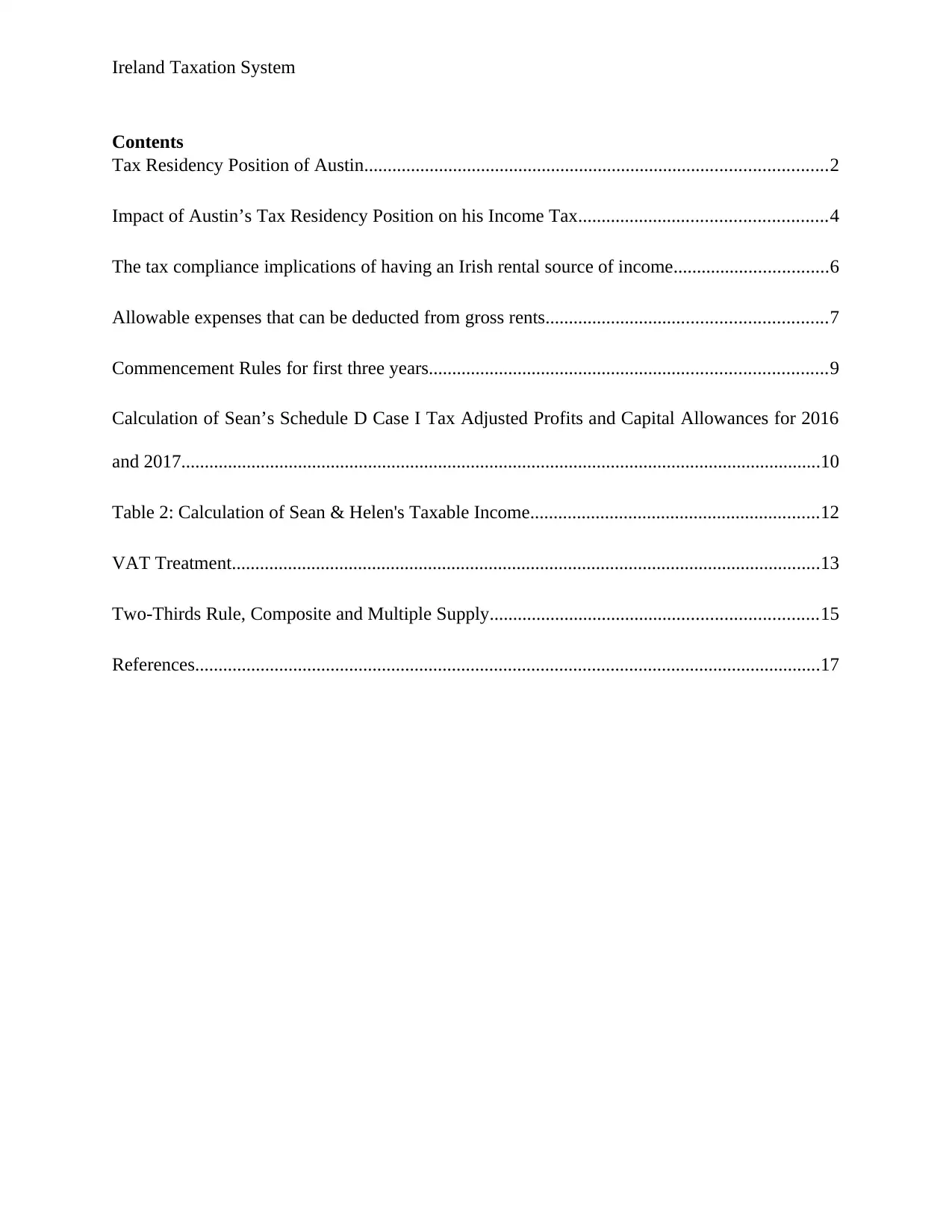
Contents
Tax Residency Position of Austin...................................................................................................2
Impact of Austin’s Tax Residency Position on his Income Tax.....................................................4
The tax compliance implications of having an Irish rental source of income.................................6
Allowable expenses that can be deducted from gross rents............................................................7
Commencement Rules for first three years.....................................................................................9
Calculation of Sean’s Schedule D Case I Tax Adjusted Profits and Capital Allowances for 2016
and 2017.........................................................................................................................................10
Table 2: Calculation of Sean & Helen's Taxable Income..............................................................12
VAT Treatment..............................................................................................................................13
Two-Thirds Rule, Composite and Multiple Supply......................................................................15
References......................................................................................................................................17
Contents
Tax Residency Position of Austin...................................................................................................2
Impact of Austin’s Tax Residency Position on his Income Tax.....................................................4
The tax compliance implications of having an Irish rental source of income.................................6
Allowable expenses that can be deducted from gross rents............................................................7
Commencement Rules for first three years.....................................................................................9
Calculation of Sean’s Schedule D Case I Tax Adjusted Profits and Capital Allowances for 2016
and 2017.........................................................................................................................................10
Table 2: Calculation of Sean & Helen's Taxable Income..............................................................12
VAT Treatment..............................................................................................................................13
Two-Thirds Rule, Composite and Multiple Supply......................................................................15
References......................................................................................................................................17

Paraphrase This Document
Need a fresh take? Get an instant paraphrase of this document with our AI Paraphraser
Ireland Taxation System
Tax Residency Position of Austin
For the year 2016 to 2019
Tax Residency of an individual in Ireland depends upon the days the individual was residing
in state during taxation year. Tax year means period from January 1 to December 31. A person is
said to be resident if he is present in Ireland for total of:
More than or equal to 183 days in a year
More than or equal to 280 days in a year together with the previous tax year, provided
there must be a minimum of 30 days in each year (Citizensinformation.ie, 2018)
As per the case law provided Austin was an Irish domicile but due to unforeseen
circumstances he had to leave Ireland and move to Australia for employment. He moved to
Australia on 1st July 2016. For deciding the tax implications, we will have to first perform
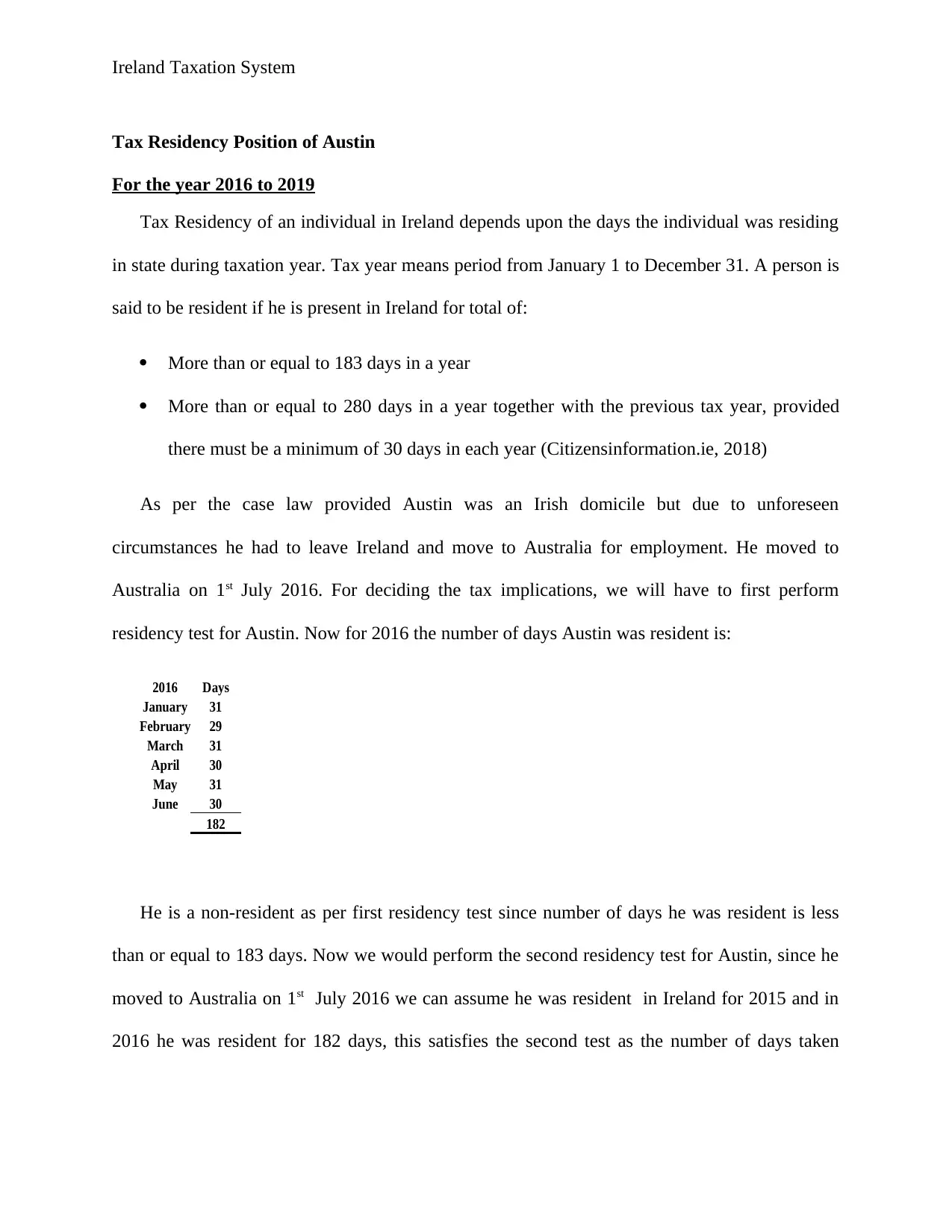
residency test for Austin. Now for 2016 the number of days Austin was resident is:
2016 Days
January 31
February 29
March 31
April 30
May 31
June 30
182
He is a non-resident as per first residency test since number of days he was resident is less
than or equal to 183 days. Now we would perform the second residency test for Austin, since he
moved to Australia on 1st July 2016 we can assume he was resident in Ireland for 2015 and in
2016 he was resident for 182 days, this satisfies the second test as the number of days taken
Tax Residency Position of Austin
For the year 2016 to 2019
Tax Residency of an individual in Ireland depends upon the days the individual was residing
in state during taxation year. Tax year means period from January 1 to December 31. A person is
said to be resident if he is present in Ireland for total of:
More than or equal to 183 days in a year
More than or equal to 280 days in a year together with the previous tax year, provided
there must be a minimum of 30 days in each year (Citizensinformation.ie, 2018)
As per the case law provided Austin was an Irish domicile but due to unforeseen
circumstances he had to leave Ireland and move to Australia for employment. He moved to
Australia on 1st July 2016. For deciding the tax implications, we will have to first perform
residency test for Austin. Now for 2016 the number of days Austin was resident is:
2016 Days
January 31
February 29
March 31
April 30
May 31
June 30
182
He is a non-resident as per first residency test since number of days he was resident is less
than or equal to 183 days. Now we would perform the second residency test for Austin, since he
moved to Australia on 1st July 2016 we can assume he was resident in Ireland for 2015 and in
2016 he was resident for 182 days, this satisfies the second test as the number of days taken
Ireland Taxation System
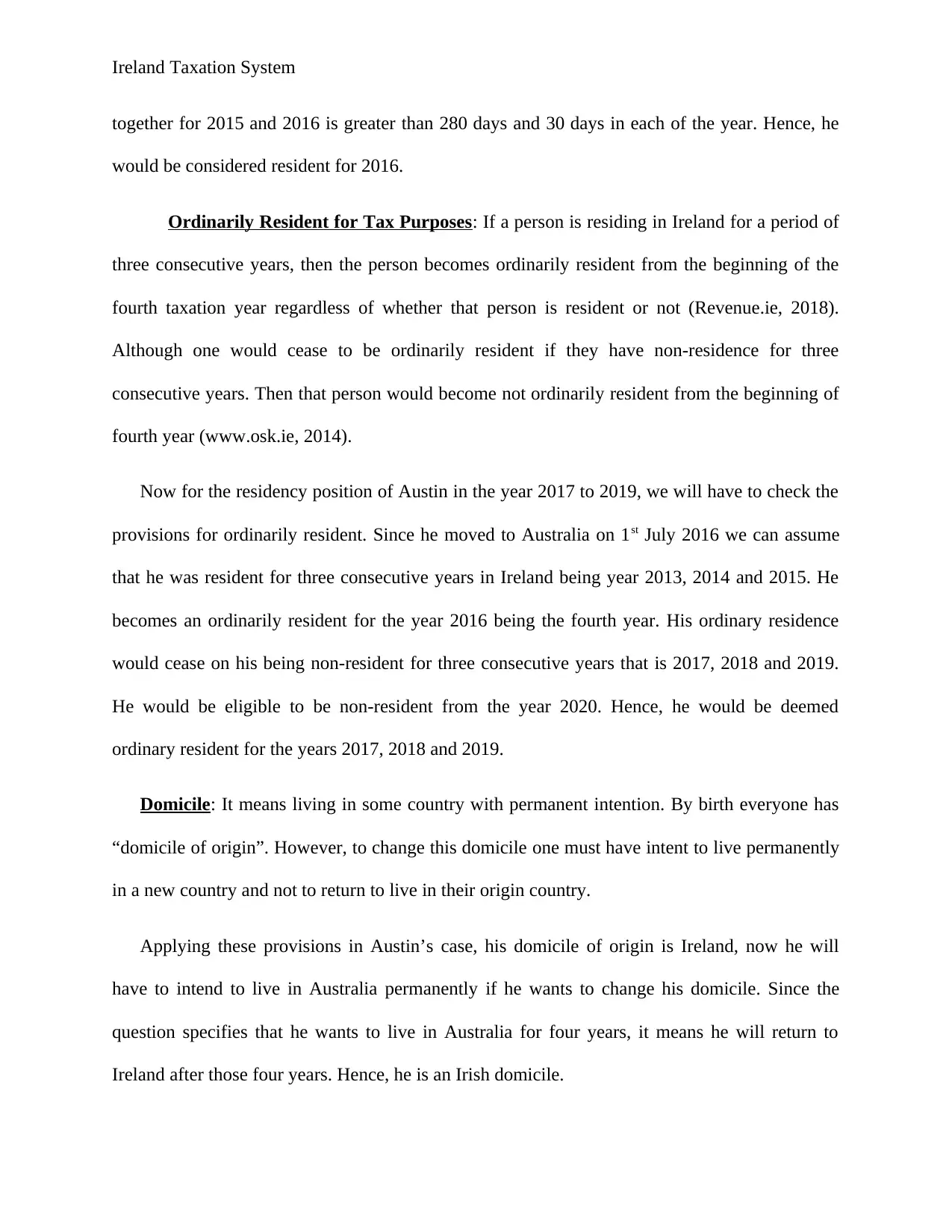
together for 2015 and 2016 is greater than 280 days and 30 days in each of the year. Hence, he
would be considered resident for 2016.
Ordinarily Resident for Tax Purposes: If a person is residing in Ireland for a period of
three consecutive years, then the person becomes ordinarily resident from the beginning of the
fourth taxation year regardless of whether that person is resident or not (Revenue.ie, 2018).
Although one would cease to be ordinarily resident if they have non-residence for three
consecutive years. Then that person would become not ordinarily resident from the beginning of
fourth year (www.osk.ie, 2014).
Now for the residency position of Austin in the year 2017 to 2019, we will have to check the
provisions for ordinarily resident. Since he moved to Australia on 1st July 2016 we can assume
that he was resident for three consecutive years in Ireland being year 2013, 2014 and 2015. He
becomes an ordinarily resident for the year 2016 being the fourth year. His ordinary residence
would cease on his being non-resident for three consecutive years that is 2017, 2018 and 2019.
He would be eligible to be non-resident from the year 2020. Hence, he would be deemed
ordinary resident for the years 2017, 2018 and 2019.
Domicile: It means living in some country with permanent intention. By birth everyone has
“domicile of origin”. However, to change this domicile one must have intent to live permanently
in a new country and not to return to live in their origin country.
Applying these provisions in Austin’s case, his domicile of origin is Ireland, now he will
have to intend to live in Australia permanently if he wants to change his domicile. Since the
question specifies that he wants to live in Australia for four years, it means he will return to
Ireland after those four years. Hence, he is an Irish domicile.
together for 2015 and 2016 is greater than 280 days and 30 days in each of the year. Hence, he
would be considered resident for 2016.
Ordinarily Resident for Tax Purposes: If a person is residing in Ireland for a period of
three consecutive years, then the person becomes ordinarily resident from the beginning of the
fourth taxation year regardless of whether that person is resident or not (Revenue.ie, 2018).
Although one would cease to be ordinarily resident if they have non-residence for three
consecutive years. Then that person would become not ordinarily resident from the beginning of
fourth year (www.osk.ie, 2014).
Now for the residency position of Austin in the year 2017 to 2019, we will have to check the
provisions for ordinarily resident. Since he moved to Australia on 1st July 2016 we can assume
that he was resident for three consecutive years in Ireland being year 2013, 2014 and 2015. He
becomes an ordinarily resident for the year 2016 being the fourth year. His ordinary residence
would cease on his being non-resident for three consecutive years that is 2017, 2018 and 2019.
He would be eligible to be non-resident from the year 2020. Hence, he would be deemed
ordinary resident for the years 2017, 2018 and 2019.
Domicile: It means living in some country with permanent intention. By birth everyone has
“domicile of origin”. However, to change this domicile one must have intent to live permanently
in a new country and not to return to live in their origin country.
Applying these provisions in Austin’s case, his domicile of origin is Ireland, now he will
have to intend to live in Australia permanently if he wants to change his domicile. Since the
question specifies that he wants to live in Australia for four years, it means he will return to
Ireland after those four years. Hence, he is an Irish domicile.
⊘ This is a preview!⊘
Do you want full access?
Subscribe today to unlock all pages.

Trusted by 1+ million students worldwide
Ireland Taxation System
Impact of Austin’s Tax Residency Position on his Income Tax
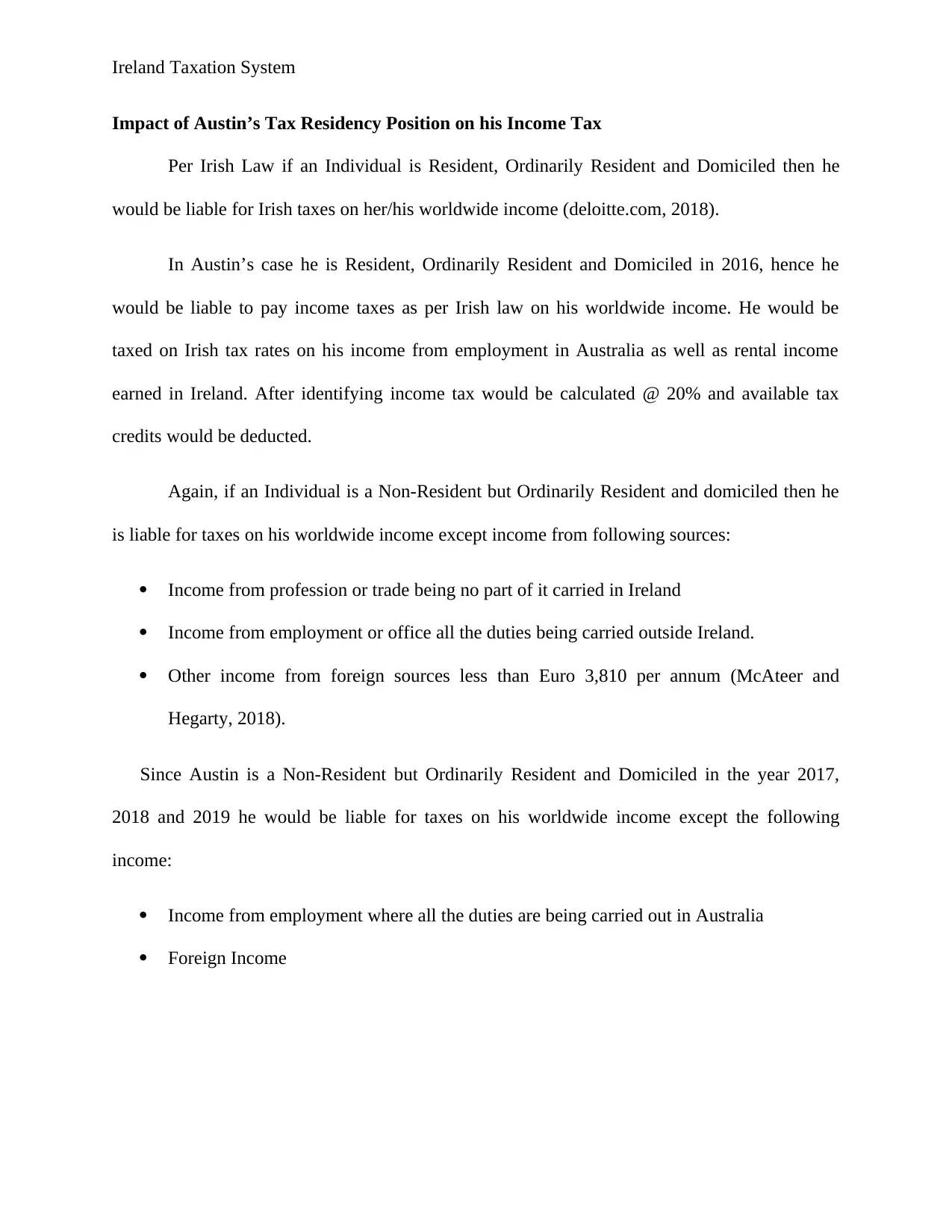
Per Irish Law if an Individual is Resident, Ordinarily Resident and Domiciled then he
would be liable for Irish taxes on her/his worldwide income (deloitte.com, 2018).
In Austin’s case he is Resident, Ordinarily Resident and Domiciled in 2016, hence he
would be liable to pay income taxes as per Irish law on his worldwide income. He would be
taxed on Irish tax rates on his income from employment in Australia as well as rental income
earned in Ireland. After identifying income tax would be calculated @ 20% and available tax
credits would be deducted.
Again, if an Individual is a Non-Resident but Ordinarily Resident and domiciled then he
is liable for taxes on his worldwide income except income from following sources:
Income from profession or trade being no part of it carried in Ireland
Income from employment or office all the duties being carried outside Ireland.
Other income from foreign sources less than Euro 3,810 per annum (McAteer and
Hegarty, 2018).
Since Austin is a Non-Resident but Ordinarily Resident and Domiciled in the year 2017,
2018 and 2019 he would be liable for taxes on his worldwide income except the following
income:
Income from employment where all the duties are being carried out in Australia
Foreign Income
Impact of Austin’s Tax Residency Position on his Income Tax
Per Irish Law if an Individual is Resident, Ordinarily Resident and Domiciled then he
would be liable for Irish taxes on her/his worldwide income (deloitte.com, 2018).
In Austin’s case he is Resident, Ordinarily Resident and Domiciled in 2016, hence he
would be liable to pay income taxes as per Irish law on his worldwide income. He would be
taxed on Irish tax rates on his income from employment in Australia as well as rental income
earned in Ireland. After identifying income tax would be calculated @ 20% and available tax
credits would be deducted.
Again, if an Individual is a Non-Resident but Ordinarily Resident and domiciled then he
is liable for taxes on his worldwide income except income from following sources:
Income from profession or trade being no part of it carried in Ireland
Income from employment or office all the duties being carried outside Ireland.
Other income from foreign sources less than Euro 3,810 per annum (McAteer and
Hegarty, 2018).
Since Austin is a Non-Resident but Ordinarily Resident and Domiciled in the year 2017,
2018 and 2019 he would be liable for taxes on his worldwide income except the following
income:
Income from employment where all the duties are being carried out in Australia
Foreign Income
Paraphrase This Document
Need a fresh take? Get an instant paraphrase of this document with our AI Paraphraser
Ireland Taxation System
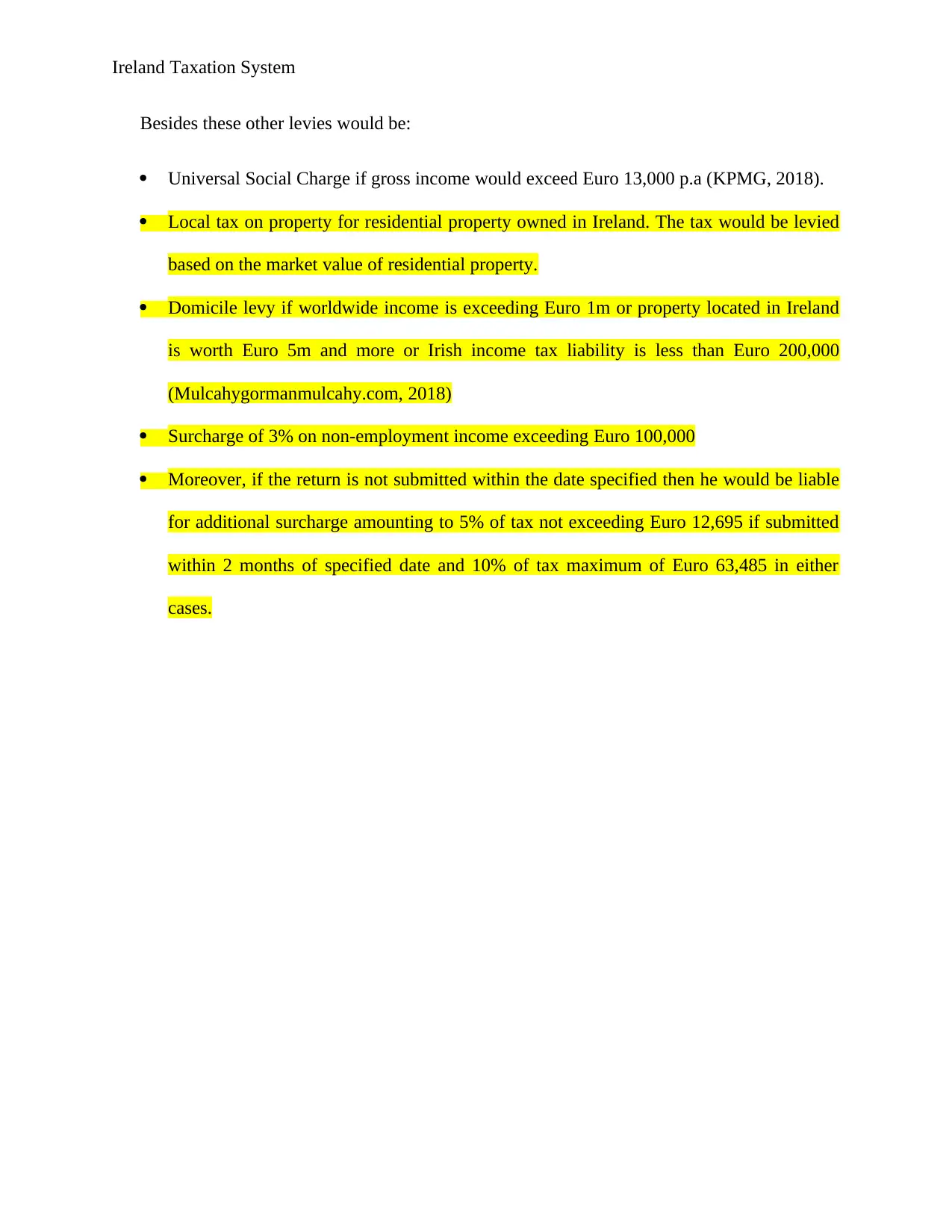
Besides these other levies would be:
Universal Social Charge if gross income would exceed Euro 13,000 p.a (KPMG, 2018).
Local tax on property for residential property owned in Ireland. The tax would be levied
based on the market value of residential property.
Domicile levy if worldwide income is exceeding Euro 1m or property located in Ireland
is worth Euro 5m and more or Irish income tax liability is less than Euro 200,000
(Mulcahygormanmulcahy.com, 2018)
Surcharge of 3% on non-employment income exceeding Euro 100,000
Moreover, if the return is not submitted within the date specified then he would be liable
for additional surcharge amounting to 5% of tax not exceeding Euro 12,695 if submitted
within 2 months of specified date and 10% of tax maximum of Euro 63,485 in either
cases.
Besides these other levies would be:
Universal Social Charge if gross income would exceed Euro 13,000 p.a (KPMG, 2018).
Local tax on property for residential property owned in Ireland. The tax would be levied
based on the market value of residential property.
Domicile levy if worldwide income is exceeding Euro 1m or property located in Ireland
is worth Euro 5m and more or Irish income tax liability is less than Euro 200,000
(Mulcahygormanmulcahy.com, 2018)
Surcharge of 3% on non-employment income exceeding Euro 100,000
Moreover, if the return is not submitted within the date specified then he would be liable
for additional surcharge amounting to 5% of tax not exceeding Euro 12,695 if submitted
within 2 months of specified date and 10% of tax maximum of Euro 63,485 in either
cases.
Ireland Taxation System
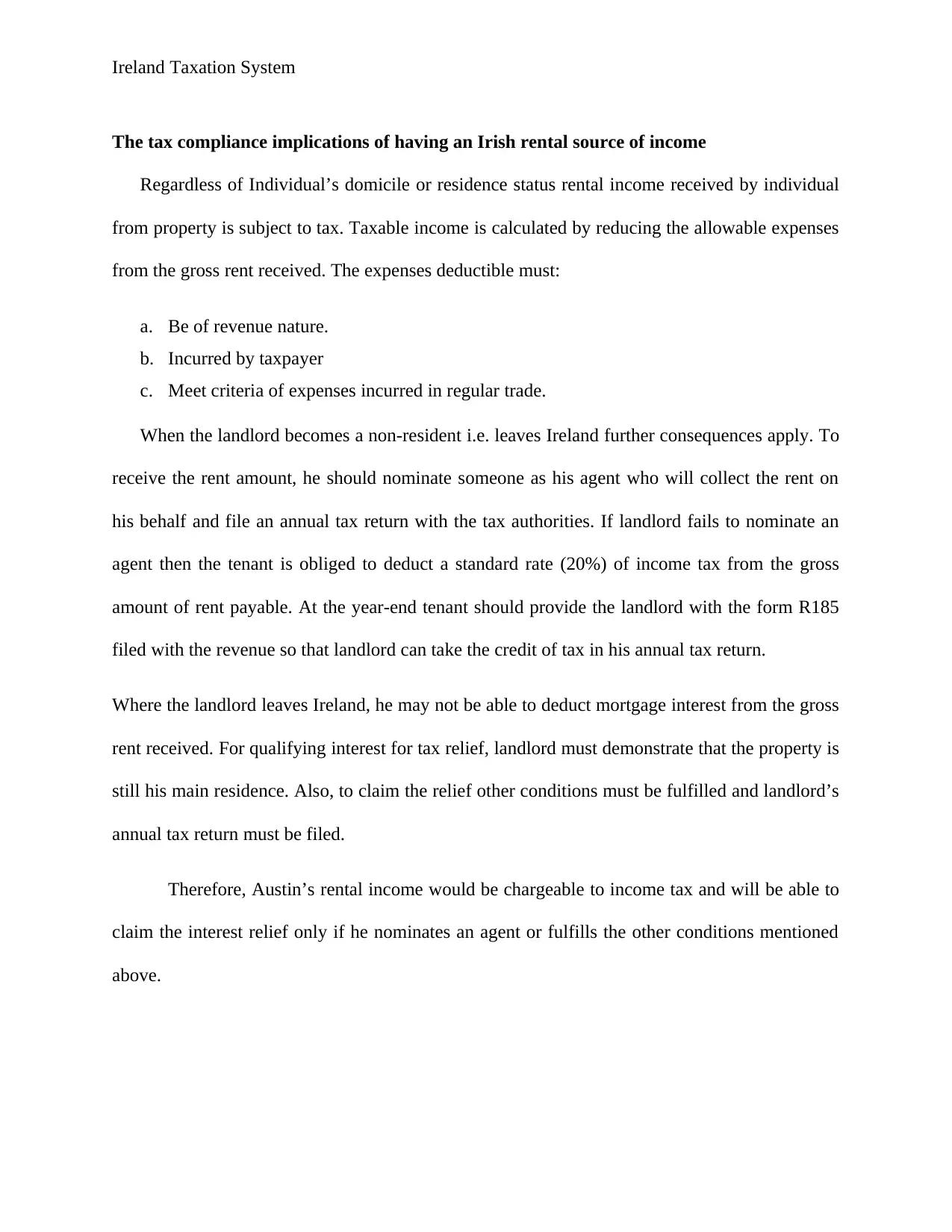
The tax compliance implications of having an Irish rental source of income
Regardless of Individual’s domicile or residence status rental income received by individual
from property is subject to tax. Taxable income is calculated by reducing the allowable expenses
from the gross rent received. The expenses deductible must:
a. Be of revenue nature.
b. Incurred by taxpayer
c. Meet criteria of expenses incurred in regular trade.
When the landlord becomes a non-resident i.e. leaves Ireland further consequences apply. To
receive the rent amount, he should nominate someone as his agent who will collect the rent on
his behalf and file an annual tax return with the tax authorities. If landlord fails to nominate an
agent then the tenant is obliged to deduct a standard rate (20%) of income tax from the gross
amount of rent payable. At the year-end tenant should provide the landlord with the form R185
filed with the revenue so that landlord can take the credit of tax in his annual tax return.
Where the landlord leaves Ireland, he may not be able to deduct mortgage interest from the gross
rent received. For qualifying interest for tax relief, landlord must demonstrate that the property is
still his main residence. Also, to claim the relief other conditions must be fulfilled and landlord’s
annual tax return must be filed.
Therefore, Austin’s rental income would be chargeable to income tax and will be able to
claim the interest relief only if he nominates an agent or fulfills the other conditions mentioned
above.
The tax compliance implications of having an Irish rental source of income
Regardless of Individual’s domicile or residence status rental income received by individual
from property is subject to tax. Taxable income is calculated by reducing the allowable expenses
from the gross rent received. The expenses deductible must:
a. Be of revenue nature.
b. Incurred by taxpayer
c. Meet criteria of expenses incurred in regular trade.
When the landlord becomes a non-resident i.e. leaves Ireland further consequences apply. To
receive the rent amount, he should nominate someone as his agent who will collect the rent on
his behalf and file an annual tax return with the tax authorities. If landlord fails to nominate an
agent then the tenant is obliged to deduct a standard rate (20%) of income tax from the gross
amount of rent payable. At the year-end tenant should provide the landlord with the form R185
filed with the revenue so that landlord can take the credit of tax in his annual tax return.
Where the landlord leaves Ireland, he may not be able to deduct mortgage interest from the gross
rent received. For qualifying interest for tax relief, landlord must demonstrate that the property is
still his main residence. Also, to claim the relief other conditions must be fulfilled and landlord’s
annual tax return must be filed.
Therefore, Austin’s rental income would be chargeable to income tax and will be able to
claim the interest relief only if he nominates an agent or fulfills the other conditions mentioned
above.
⊘ This is a preview!⊘
Do you want full access?
Subscribe today to unlock all pages.
Trusted by 1+ million students worldwide
Ireland Taxation System
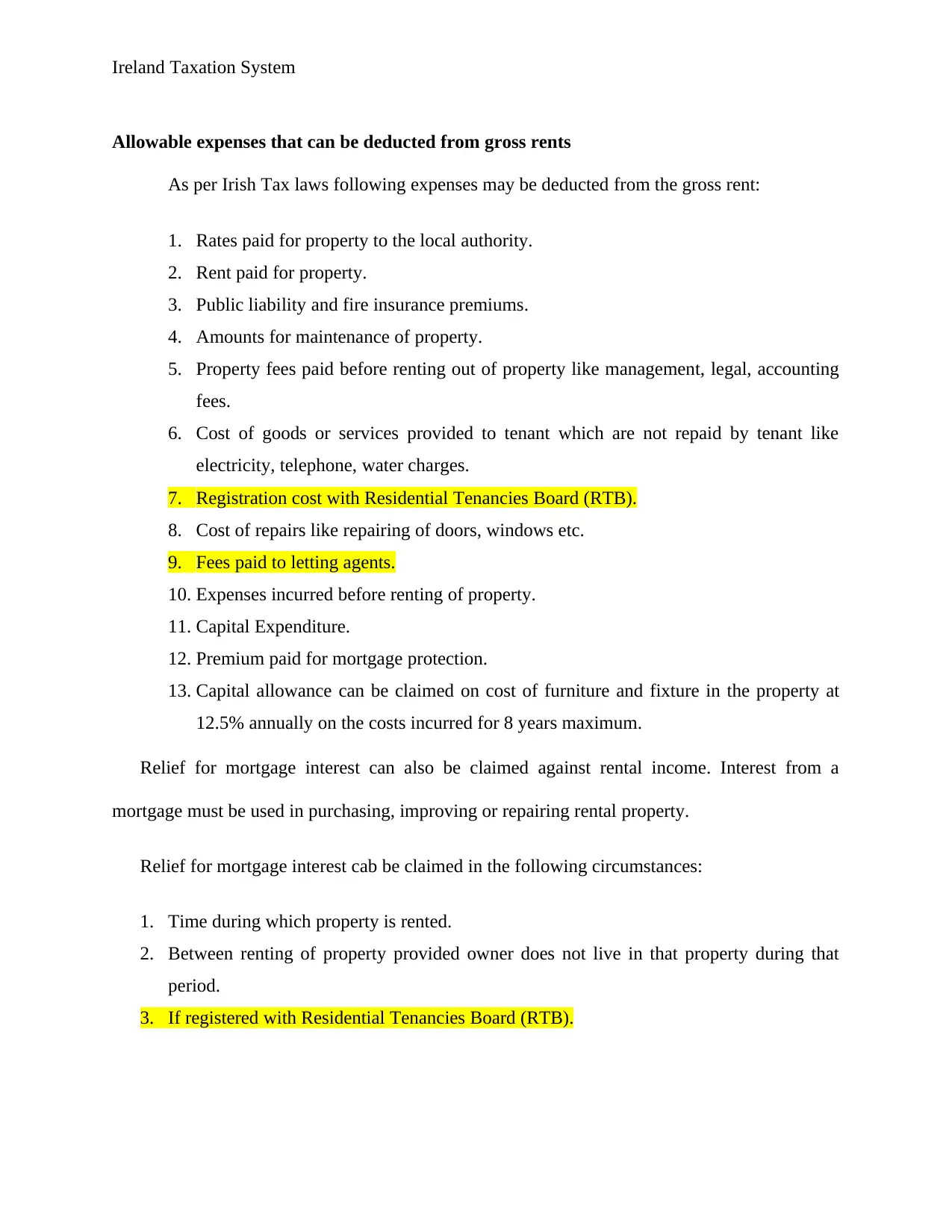
Allowable expenses that can be deducted from gross rents
As per Irish Tax laws following expenses may be deducted from the gross rent:
1. Rates paid for property to the local authority.
2. Rent paid for property.
3. Public liability and fire insurance premiums.
4. Amounts for maintenance of property.
5. Property fees paid before renting out of property like management, legal, accounting
fees.
6. Cost of goods or services provided to tenant which are not repaid by tenant like
electricity, telephone, water charges.
7. Registration cost with Residential Tenancies Board (RTB).
8. Cost of repairs like repairing of doors, windows etc.
9. Fees paid to letting agents.
10. Expenses incurred before renting of property.
11. Capital Expenditure.
12. Premium paid for mortgage protection.
13. Capital allowance can be claimed on cost of furniture and fixture in the property at
12.5% annually on the costs incurred for 8 years maximum.
Relief for mortgage interest can also be claimed against rental income. Interest from a
mortgage must be used in purchasing, improving or repairing rental property.
Relief for mortgage interest cab be claimed in the following circumstances:
1. Time during which property is rented.
2. Between renting of property provided owner does not live in that property during that
period.
3. If registered with Residential Tenancies Board (RTB).
Allowable expenses that can be deducted from gross rents
As per Irish Tax laws following expenses may be deducted from the gross rent:
1. Rates paid for property to the local authority.
2. Rent paid for property.
3. Public liability and fire insurance premiums.
4. Amounts for maintenance of property.
5. Property fees paid before renting out of property like management, legal, accounting
fees.
6. Cost of goods or services provided to tenant which are not repaid by tenant like
electricity, telephone, water charges.
7. Registration cost with Residential Tenancies Board (RTB).
8. Cost of repairs like repairing of doors, windows etc.
9. Fees paid to letting agents.
10. Expenses incurred before renting of property.
11. Capital Expenditure.
12. Premium paid for mortgage protection.
13. Capital allowance can be claimed on cost of furniture and fixture in the property at
12.5% annually on the costs incurred for 8 years maximum.
Relief for mortgage interest can also be claimed against rental income. Interest from a
mortgage must be used in purchasing, improving or repairing rental property.
Relief for mortgage interest cab be claimed in the following circumstances:
1. Time during which property is rented.
2. Between renting of property provided owner does not live in that property during that
period.
3. If registered with Residential Tenancies Board (RTB).
Paraphrase This Document
Need a fresh take? Get an instant paraphrase of this document with our AI Paraphraser
Ireland Taxation System
Mortgage interest cannot be claimed between the time property is bought till the time
property is first let out.
From January 2018, January 2017 and earlier years 85%, 80% and 75% respectively
deduction can be claimed of mortgage interest paid on rental property. (Revenue.ie, 2018)
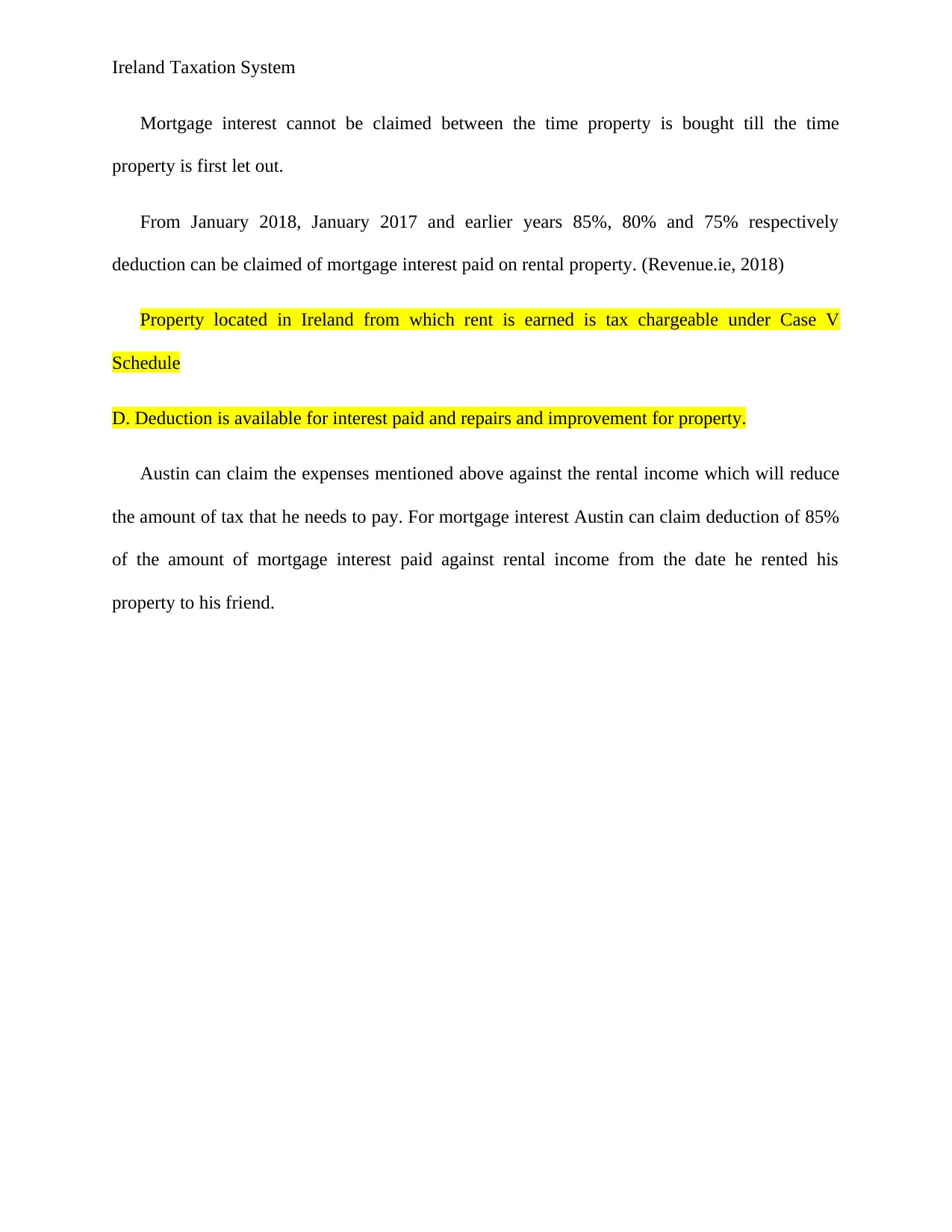
Property located in Ireland from which rent is earned is tax chargeable under Case V
Schedule
D. Deduction is available for interest paid and repairs and improvement for property.
Austin can claim the expenses mentioned above against the rental income which will reduce
the amount of tax that he needs to pay. For mortgage interest Austin can claim deduction of 85%
of the amount of mortgage interest paid against rental income from the date he rented his
property to his friend.
Mortgage interest cannot be claimed between the time property is bought till the time
property is first let out.
From January 2018, January 2017 and earlier years 85%, 80% and 75% respectively
deduction can be claimed of mortgage interest paid on rental property. (Revenue.ie, 2018)
Property located in Ireland from which rent is earned is tax chargeable under Case V
Schedule
D. Deduction is available for interest paid and repairs and improvement for property.
Austin can claim the expenses mentioned above against the rental income which will reduce
the amount of tax that he needs to pay. For mortgage interest Austin can claim deduction of 85%
of the amount of mortgage interest paid against rental income from the date he rented his
property to his friend.
Ireland Taxation System
Commencement Rules for first three years
First Year: In case of commencement of profession or trade, assessment for first year is
founded on profit or gains which arise from commencement date to following December 31st.
Second Year: 1. where in second year of tax accounting period of 12 month is ending
being the only ending accounting period for the year, then profits assessable would be 12 months
profits.
2. if in second year of tax there is only one accounting period and that is lesser than 12 months,
profits assessable would be 12 months period that ends in accounting date provided that the date
is minimum 12 months after commencing.
3. if there are more than two or two accounting periods then profits assessable would be 12
months profits ending on latest of those dates
4. in other cases profits for year ending December 31.
Third year: 1. Profits for 12 months accounting period ending in the tax year
Commencement Rules for first three years
First Year: In case of commencement of profession or trade, assessment for first year is
founded on profit or gains which arise from commencement date to following December 31st.
Second Year: 1. where in second year of tax accounting period of 12 month is ending
being the only ending accounting period for the year, then profits assessable would be 12 months
profits.
2. if in second year of tax there is only one accounting period and that is lesser than 12 months,
profits assessable would be 12 months period that ends in accounting date provided that the date
is minimum 12 months after commencing.
3. if there are more than two or two accounting periods then profits assessable would be 12
months profits ending on latest of those dates
4. in other cases profits for year ending December 31.
Third year: 1. Profits for 12 months accounting period ending in the tax year
⊘ This is a preview!⊘
Do you want full access?
Subscribe today to unlock all pages.
Trusted by 1+ million students worldwide
Ireland Taxation System
Calculation of Sean’s Schedule D Case I Tax Adjusted Profits and Capital Allowances for
2016 and 2017
Business Income is chargeable to tax under heading of Schedule D and Case I charges tax
on profit of a trade. Deduction is allowed for legitimate business expenditures being:
Trademark
Knowhow
Expenses of Pre-Trading
Pre-Commencement cost of training staff
Establishing cost of approved employee share options scheme
Double deduction for wages that are paid to previously unemployed person
Deduction is not allowed for following:
Private and Capital Expenses
Entertainment Expenses
Calculation of Sean’s Schedule D Case I Tax Adjusted Profits and Capital Allowances for
2016 and 2017
Business Income is chargeable to tax under heading of Schedule D and Case I charges tax
on profit of a trade. Deduction is allowed for legitimate business expenditures being:
Trademark
Knowhow
Expenses of Pre-Trading
Pre-Commencement cost of training staff
Establishing cost of approved employee share options scheme
Double deduction for wages that are paid to previously unemployed person
Deduction is not allowed for following:
Private and Capital Expenses
Entertainment Expenses
Paraphrase This Document
Need a fresh take? Get an instant paraphrase of this document with our AI Paraphraser
Ireland Taxation System
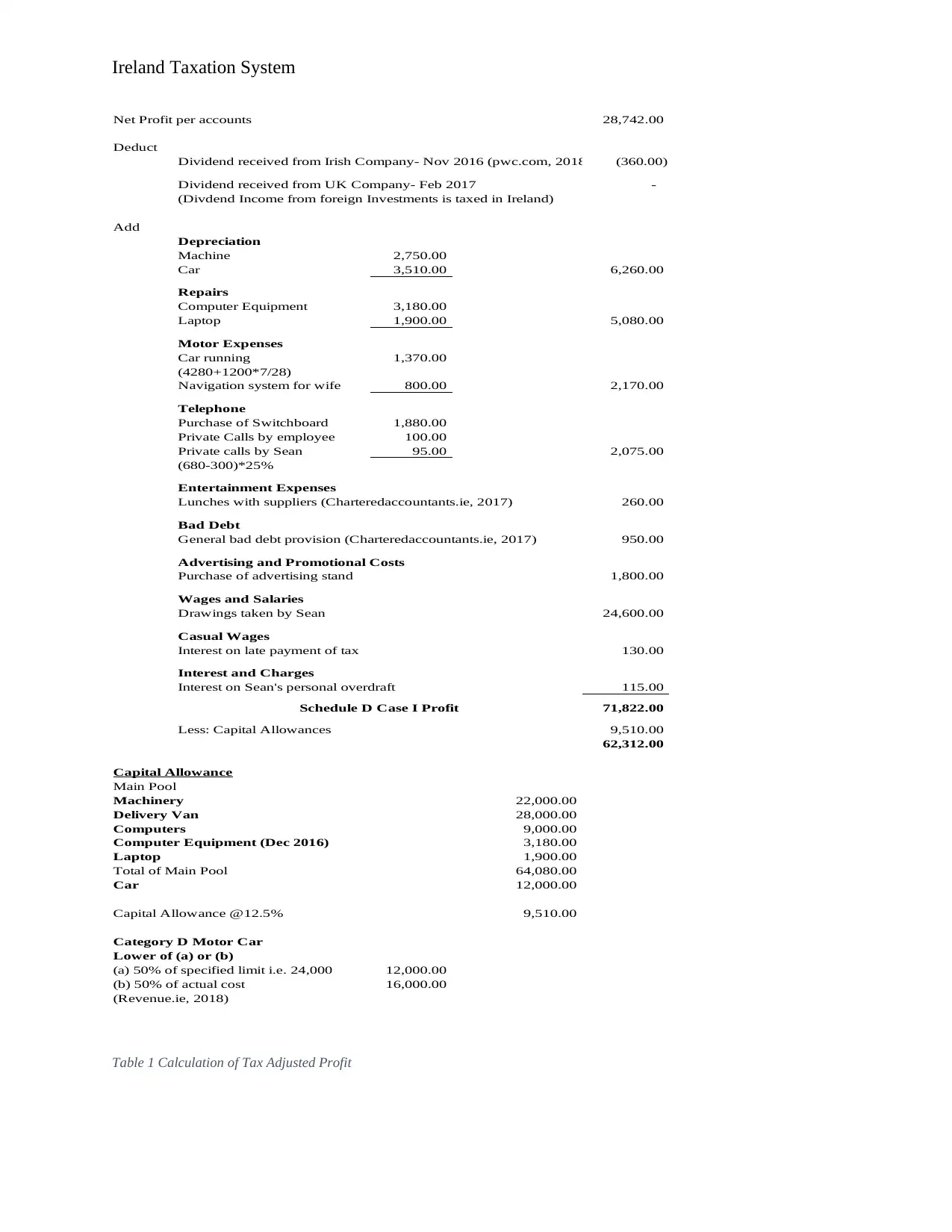
Net Profit per accounts 28,742.00
Deduct
Dividend received from Irish Company- Nov 2016 (pwc.com, 2018 (360.00)
Dividend received from UK Company- Feb 2017 -
(Divdend Income from foreign Investments is taxed in Ireland)
Add
Depreciation
Machine 2,750.00
Car 3,510.00 6,260.00
Repairs
Computer Equipment 3,180.00
Laptop 1,900.00 5,080.00
Motor Expenses
Car running 1,370.00
(4280+1200*7/28)
Navigation system for wife 800.00 2,170.00
Telephone
Purchase of Switchboard 1,880.00
Private Calls by employee 100.00
Private calls by Sean 95.00 2,075.00
(680-300)*25%
Entertainment Expenses
Lunches with suppliers (Charteredaccountants.ie, 2017) 260.00
Bad Debt
General bad debt provision (Charteredaccountants.ie, 2017) 950.00
Advertising and Promotional Costs
Purchase of advertising stand 1,800.00
Wages and Salaries
Drawings taken by Sean 24,600.00
Casual Wages
Interest on late payment of tax 130.00
Interest and Charges
Interest on Sean's personal overdraft 115.00
Schedule D Case I Profit 71,822.00
Less: Capital Allowances 9,510.00
62,312.00
Capital Allowance
Main Pool
Machinery 22,000.00
Delivery Van 28,000.00
Computers 9,000.00
Computer Equipment (Dec 2016) 3,180.00
Laptop 1,900.00
Total of Main Pool 64,080.00
Car 12,000.00
Capital Allowance @12.5% 9,510.00
Category D Motor Car
Lower of (a) or (b)
(a) 50% of specified limit i.e. 24,000 12,000.00
(b) 50% of actual cost 16,000.00
(Revenue.ie, 2018)
Table 1 Calculation of Tax Adjusted Profit
Net Profit per accounts 28,742.00
Deduct
Dividend received from Irish Company- Nov 2016 (pwc.com, 2018 (360.00)
Dividend received from UK Company- Feb 2017 -
(Divdend Income from foreign Investments is taxed in Ireland)
Add
Depreciation
Machine 2,750.00
Car 3,510.00 6,260.00
Repairs
Computer Equipment 3,180.00
Laptop 1,900.00 5,080.00
Motor Expenses
Car running 1,370.00
(4280+1200*7/28)
Navigation system for wife 800.00 2,170.00
Telephone
Purchase of Switchboard 1,880.00
Private Calls by employee 100.00
Private calls by Sean 95.00 2,075.00
(680-300)*25%
Entertainment Expenses
Lunches with suppliers (Charteredaccountants.ie, 2017) 260.00
Bad Debt
General bad debt provision (Charteredaccountants.ie, 2017) 950.00
Advertising and Promotional Costs
Purchase of advertising stand 1,800.00
Wages and Salaries
Drawings taken by Sean 24,600.00
Casual Wages
Interest on late payment of tax 130.00
Interest and Charges
Interest on Sean's personal overdraft 115.00
Schedule D Case I Profit 71,822.00
Less: Capital Allowances 9,510.00
62,312.00
Capital Allowance
Main Pool
Machinery 22,000.00
Delivery Van 28,000.00
Computers 9,000.00
Computer Equipment (Dec 2016) 3,180.00
Laptop 1,900.00
Total of Main Pool 64,080.00
Car 12,000.00
Capital Allowance @12.5% 9,510.00
Category D Motor Car
Lower of (a) or (b)
(a) 50% of specified limit i.e. 24,000 12,000.00
(b) 50% of actual cost 16,000.00
(Revenue.ie, 2018)
Table 1 Calculation of Tax Adjusted Profit
Ireland Taxation System
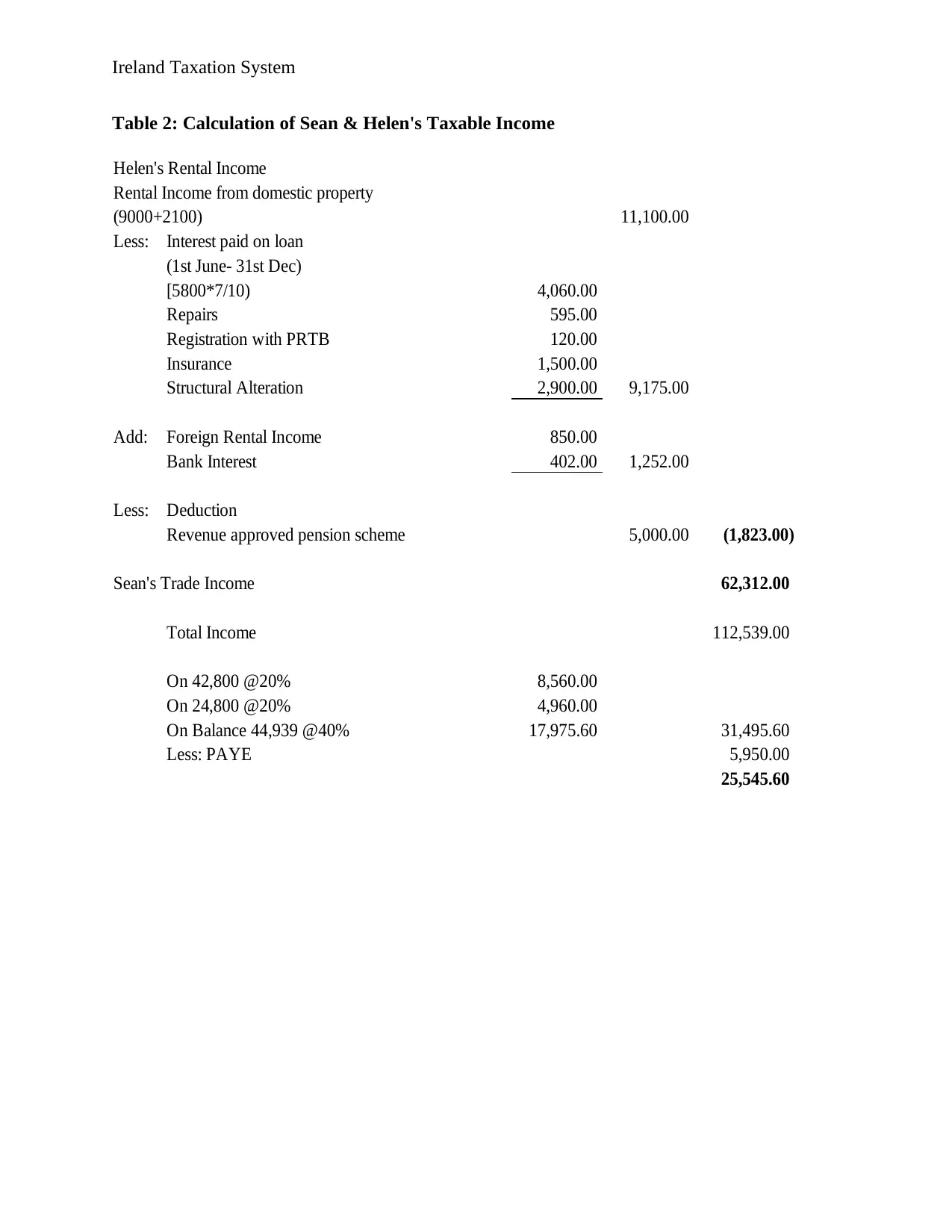
Table 2: Calculation of Sean & Helen's Taxable Income
Helen's Rental Income
Rental Income from domestic property
(9000+2100) 11,100.00
Less: Interest paid on loan
(1st June- 31st Dec)
[5800*7/10) 4,060.00
Repairs 595.00
Registration with PRTB 120.00
Insurance 1,500.00
Structural Alteration 2,900.00 9,175.00
Add: Foreign Rental Income 850.00
Bank Interest 402.00 1,252.00
Less: Deduction
Revenue approved pension scheme 5,000.00 (1,823.00)
Sean's Trade Income 62,312.00
Total Income 112,539.00
On 42,800 @20% 8,560.00
On 24,800 @20% 4,960.00
On Balance 44,939 @40% 17,975.60 31,495.60
Less: PAYE 5,950.00
25,545.60
Table 2: Calculation of Sean & Helen's Taxable Income
Helen's Rental Income
Rental Income from domestic property
(9000+2100) 11,100.00
Less: Interest paid on loan
(1st June- 31st Dec)
[5800*7/10) 4,060.00
Repairs 595.00
Registration with PRTB 120.00
Insurance 1,500.00
Structural Alteration 2,900.00 9,175.00
Add: Foreign Rental Income 850.00
Bank Interest 402.00 1,252.00
Less: Deduction
Revenue approved pension scheme 5,000.00 (1,823.00)
Sean's Trade Income 62,312.00
Total Income 112,539.00
On 42,800 @20% 8,560.00
On 24,800 @20% 4,960.00
On Balance 44,939 @40% 17,975.60 31,495.60
Less: PAYE 5,950.00
25,545.60
⊘ This is a preview!⊘
Do you want full access?
Subscribe today to unlock all pages.
Trusted by 1+ million students worldwide

1 out of 20


Related Documents


Your All-in-One AI-Powered Toolkit for Academic Success.
+13062052269
info@desklib.com
Available 24*7 on WhatsApp / Email
![[object Object]](/_next/static/media/star-bottom.7253800d.svg)
Unlock your academic potential
Copyright © 2020–2026 A2Z Services. All Rights Reserved. Developed and managed by ZUCOL.