Examining Key Issues in Canadian Labor History: Heron's Questions

Verified

Added on  2023/04/19

|4
|545
|84
Homework Assignment
AI Summary
This assignment delves into Canadian labor history by analyzing Heron's reading questions, highlighting critical issues that have challenged the Canadian labor movement. It focuses on two main issues: the importance of collective bargaining in delivering economic benefits and industrial democracy to workers, and the necessity of shaping public policy to support the labor movement. The defensive stance taken by unions in the 1980s and 1990s to protect their position is discussed, along with the role of typical unionists in advocating for better working conditions and protesting against child labor. The assignment also addresses the needs of new, technologically advanced workers in Canada and suggests that unions should adopt more technologically advanced strategies to meet their demands. Desklib offers a wealth of similar assignments and study resources for students.
Document Page
1
Canadian Labor History
tabler-icon-diamond-filled.svg

Paraphrase This Document

Need a fresh take? Get an instant paraphrase of this document with our AI Paraphraser
Document Page
2
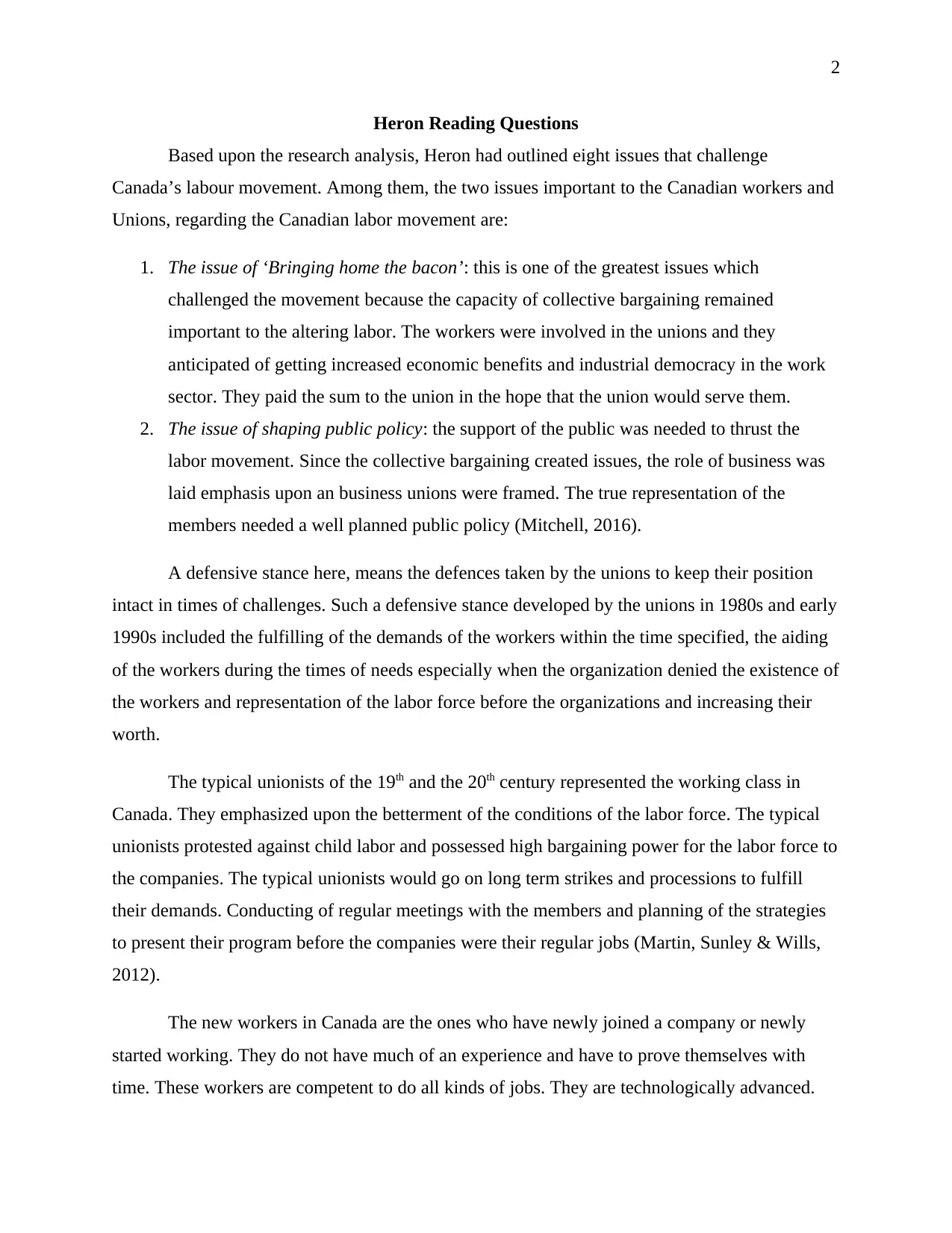
Heron Reading Questions
Based upon the research analysis, Heron had outlined eight issues that challenge
Canada’s labour movement. Among them, the two issues important to the Canadian workers and
Unions, regarding the Canadian labor movement are:
1. The issue of ‘Bringing home the bacon’: this is one of the greatest issues which
challenged the movement because the capacity of collective bargaining remained
important to the altering labor. The workers were involved in the unions and they
anticipated of getting increased economic benefits and industrial democracy in the work
sector. They paid the sum to the union in the hope that the union would serve them.
2. The issue of shaping public policy: the support of the public was needed to thrust the
labor movement. Since the collective bargaining created issues, the role of business was
laid emphasis upon an business unions were framed. The true representation of the
members needed a well planned public policy (Mitchell, 2016).
A defensive stance here, means the defences taken by the unions to keep their position
intact in times of challenges. Such a defensive stance developed by the unions in 1980s and early
1990s included the fulfilling of the demands of the workers within the time specified, the aiding
of the workers during the times of needs especially when the organization denied the existence of
the workers and representation of the labor force before the organizations and increasing their
worth.
The typical unionists of the 19th and the 20th century represented the working class in
Canada. They emphasized upon the betterment of the conditions of the labor force. The typical
unionists protested against child labor and possessed high bargaining power for the labor force to
the companies. The typical unionists would go on long term strikes and processions to fulfill
their demands. Conducting of regular meetings with the members and planning of the strategies
to present their program before the companies were their regular jobs (Martin, Sunley & Wills,
2012).
The new workers in Canada are the ones who have newly joined a company or newly
started working. They do not have much of an experience and have to prove themselves with
time. These workers are competent to do all kinds of jobs. They are technologically advanced.
Document Page
3
They have received training in their respective fields like mining, banking, industrial sector,
private and public sector. The union movement needs to be more technologically advanced while
dealing with the demands of the new workers. These unions should incorporate qualitative
orators and efficient strategies for the implementation of the demands.
Document Page
4
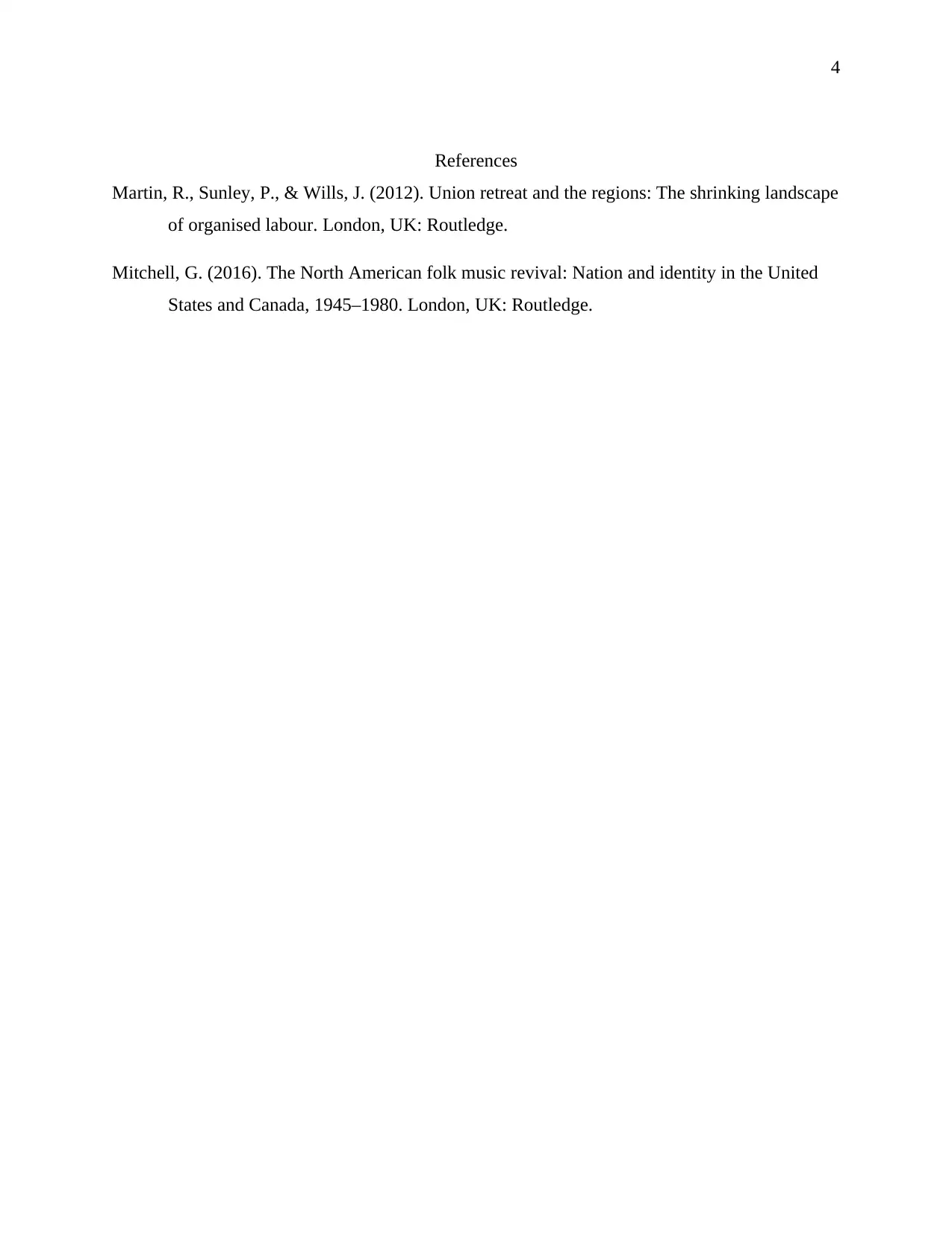
References
Martin, R., Sunley, P., & Wills, J. (2012). Union retreat and the regions: The shrinking landscape
of organised labour. London, UK: Routledge.
Mitchell, G. (2016). The North American folk music revival: Nation and identity in the United
States and Canada, 1945–1980. London, UK: Routledge.
chevron_up_icon
1 out of 4
circle_padding
hide_on_mobile
zoom_out_icon
[object Object]