Comprehensive Report: Issues in Small Business and Entrepreneurship
VerifiedAdded on 2022/12/23
|11
|3823
|31
Report
AI Summary
This report delves into various issues faced by small businesses and entrepreneurs, covering essential themes for success and sustainability. It examines the skills required of entrepreneurs, the complexities of the start-up process, and the financial challenges, including funding gaps, that often hinder growth. The report further analyzes the dynamics of family firms, the opportunities and challenges in export markets, and the role of SMEs in both national and global contexts. It also addresses the factors contributing to SME failure. The report incorporates a literature review, providing a comprehensive overview of the challenges and opportunities within the dynamic field of entrepreneurship. The report provides an in-depth analysis of different aspects of the business environment, offering insights into strategies for success and areas for improvement within the small business sector.
Issues in Small Business and
Entrepreneurship
1
Entrepreneurship
1

Paraphrase This Document
Need a fresh take? Get an instant paraphrase of this document with our AI Paraphraser
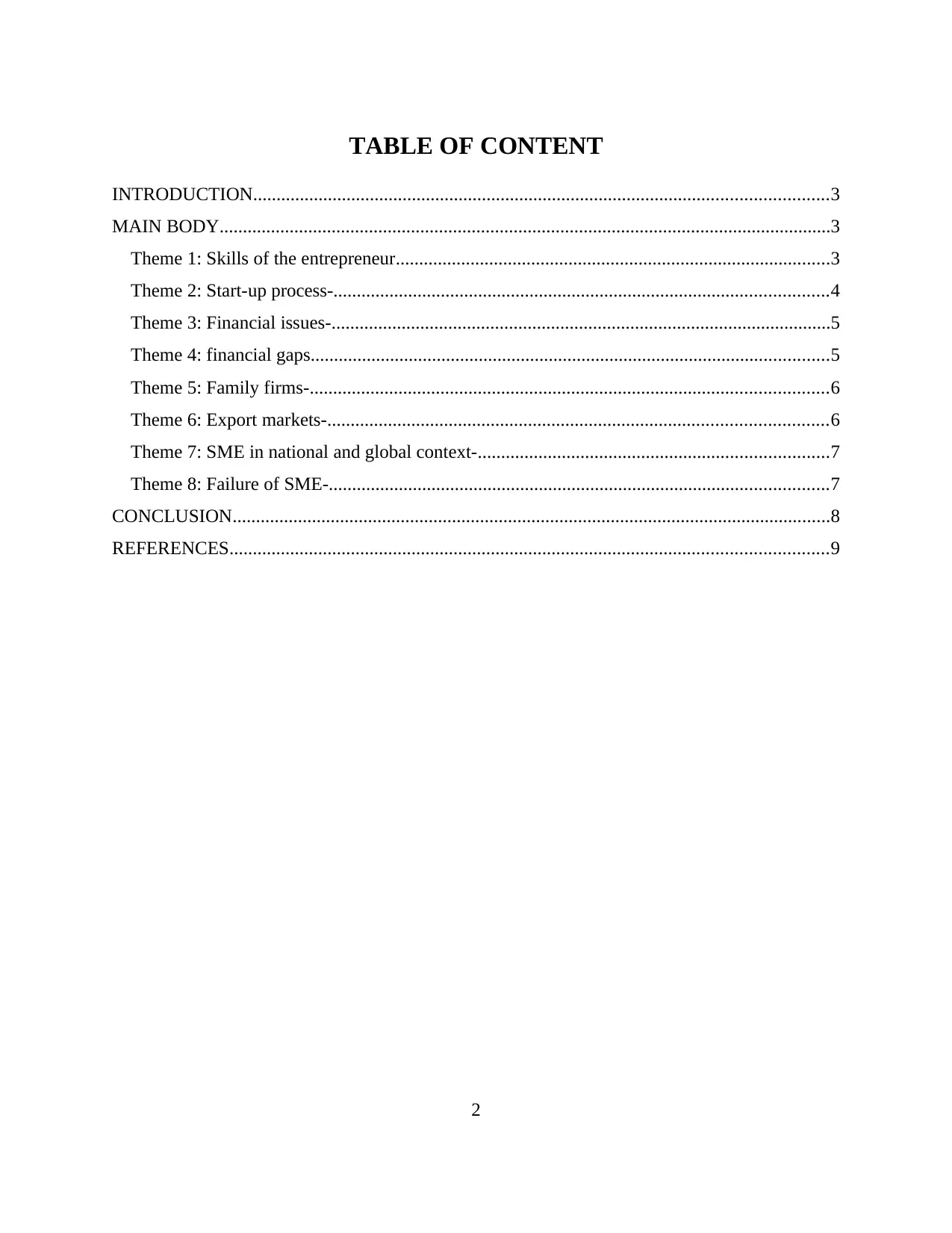
TABLE OF CONTENT
INTRODUCTION...........................................................................................................................3
MAIN BODY...................................................................................................................................3
Theme 1: Skills of the entrepreneur.............................................................................................3
Theme 2: Start-up process-..........................................................................................................4
Theme 3: Financial issues-...........................................................................................................5
Theme 4: financial gaps...............................................................................................................5
Theme 5: Family firms-...............................................................................................................6
Theme 6: Export markets-...........................................................................................................6
Theme 7: SME in national and global context-...........................................................................7
Theme 8: Failure of SME-...........................................................................................................7
CONCLUSION................................................................................................................................8
REFERENCES................................................................................................................................9
2
INTRODUCTION...........................................................................................................................3
MAIN BODY...................................................................................................................................3
Theme 1: Skills of the entrepreneur.............................................................................................3
Theme 2: Start-up process-..........................................................................................................4
Theme 3: Financial issues-...........................................................................................................5
Theme 4: financial gaps...............................................................................................................5
Theme 5: Family firms-...............................................................................................................6
Theme 6: Export markets-...........................................................................................................6
Theme 7: SME in national and global context-...........................................................................7
Theme 8: Failure of SME-...........................................................................................................7
CONCLUSION................................................................................................................................8
REFERENCES................................................................................................................................9
2
INTRODUCTION
Entrepreneur is an individual which is responsible for developing an organization and
tend to take financial risks so that it can achieve high profit margin. Small and medium-sized
enterprise (SME) is a type of non-subsidiary, independent firm which tend to employee lesser
than the given number of employees. Evaluation on the different type of issues which the
entrepreneur faces within the developed organization is done in this report. Analysis on the
different start-up processes is integrated in this report, with that effectiveness of SME in context
to internalization strategies is also being analysed within the analysis.
MAIN BODY
Literature review
Small Business growth is solely dependent on the skills of the entrepreneur and their attitude
towards risk.
Theme 1: Skills of the entrepreneur
According to the Herron, (2020) to become a successful entrepreneur, firstly individual or
any person haver to be strategic thinker it is one of the trait of successful entrepreneur that they
know how to convert the inverse situation in to the opportunity. This is one of the skill which is
needed for a successful entrepreneur. Another skill which the entrepreneur must have is
communication, this is very important skill, as with the help of excellent communication they
can transfer their view and thoughts easily to other people and other can also understand the view
and objective of the entrepreneur. As per the Mamabolo and et.al, (2017) a successful
entrepreneur must be a good sales man who can sell their ideas to other and influences them, if
the person is having this quality they can become a good entrepreneur. This also includes
communication when the person is good communicator they can sell their ideas or product.
Another skill of an entrepreneur is that they have a clear value proposition towards their goal, the
journey of a successful entrepreneur is not easy they have to face ups and downs nut they do not
get impacted from the failure and remain focused to their end game. They never get afraid from
the failures this bring motivation to their colleagues as well. When the leader remain focused
towards the goal their team mates also remain focused to their individual targets . In agreeing
with this Shabbir and et.al, (2019) states that if anyone wants to become successful entrepreneur
3
Entrepreneur is an individual which is responsible for developing an organization and
tend to take financial risks so that it can achieve high profit margin. Small and medium-sized
enterprise (SME) is a type of non-subsidiary, independent firm which tend to employee lesser
than the given number of employees. Evaluation on the different type of issues which the
entrepreneur faces within the developed organization is done in this report. Analysis on the
different start-up processes is integrated in this report, with that effectiveness of SME in context
to internalization strategies is also being analysed within the analysis.
MAIN BODY
Literature review
Small Business growth is solely dependent on the skills of the entrepreneur and their attitude
towards risk.
Theme 1: Skills of the entrepreneur
According to the Herron, (2020) to become a successful entrepreneur, firstly individual or
any person haver to be strategic thinker it is one of the trait of successful entrepreneur that they
know how to convert the inverse situation in to the opportunity. This is one of the skill which is
needed for a successful entrepreneur. Another skill which the entrepreneur must have is
communication, this is very important skill, as with the help of excellent communication they
can transfer their view and thoughts easily to other people and other can also understand the view
and objective of the entrepreneur. As per the Mamabolo and et.al, (2017) a successful
entrepreneur must be a good sales man who can sell their ideas to other and influences them, if
the person is having this quality they can become a good entrepreneur. This also includes
communication when the person is good communicator they can sell their ideas or product.
Another skill of an entrepreneur is that they have a clear value proposition towards their goal, the
journey of a successful entrepreneur is not easy they have to face ups and downs nut they do not
get impacted from the failure and remain focused to their end game. They never get afraid from
the failures this bring motivation to their colleagues as well. When the leader remain focused
towards the goal their team mates also remain focused to their individual targets . In agreeing
with this Shabbir and et.al, (2019) states that if anyone wants to become successful entrepreneur
3
⊘ This is a preview!⊘
Do you want full access?
Subscribe today to unlock all pages.

Trusted by 1+ million students worldwide
they must have an ability to learn. It is one of the most important skill successful entrepreneur
always learn where it is a failure or success they never stop learning because learning make them
more successful in their life. Another skill is that they design a sound business model, they try
to offer unique products to the customer apart from this they set proper budget so that they can
gain profit as well, in the process of decision making they always listen the views and ideas of
other person if they are working in a team, a successful entrepreneur never take decision own by
own they include their workforce and team mates so that they can get good ideas. Because they
believe that the communication must be two way thus they invite the opinions of their
teammates. Another important skill is that successful entrepreneur must be creative if the person
is creative they can do all the things which others cant think to do. As the successful
entrepreneur always try to find something new and want to add new things in their daily work.
But on the flip side Castro and et.al, (2020) states that many entrepreneur get failed whenever
they start any start- up, may be they do not have proper knowledge of market thus their business
cant get success and people do not like the products offered by them. It has been seen that, many
entrepreneur who get failed they drop the idea to become a famous and successful entrepreneur
because they loss their hope and motivation, so it in not necessary that the entrepreneur always
become successful.
Theme 2: Start-up process-
According to the Marx-Schubach, and Schmitz, (2017), an entrepreneur is an innovator
which is responsible for developing new technology, market, product, etc. through which it tends
to ensure that it is able to provide new and rare product to the customers. By which their level of
engagement toward the organization is increased. However, the Lee, Jiménez and Devinney,
(2020) argued that this is not as easy as it is being said because high amount of organizational
expenditures have to be made. Due to the Ma, Yin and Li, (2019) suggested that the entrepreneur
must tend to have an strong economic background. Due to this the introduced SME tend to face
limitations in increasing its geographic reach because of which company faces limitations in
achieving high return of investment.
The Gil and et.al, 2017 said that there are several steps of start-up process, through which
the entrepreneur can implement the proposed business idea on the ground level. The start-up
process mostly consist of steps which are ideation, concept, prototype, business model and
4
always learn where it is a failure or success they never stop learning because learning make them
more successful in their life. Another skill is that they design a sound business model, they try
to offer unique products to the customer apart from this they set proper budget so that they can
gain profit as well, in the process of decision making they always listen the views and ideas of
other person if they are working in a team, a successful entrepreneur never take decision own by
own they include their workforce and team mates so that they can get good ideas. Because they
believe that the communication must be two way thus they invite the opinions of their
teammates. Another important skill is that successful entrepreneur must be creative if the person
is creative they can do all the things which others cant think to do. As the successful
entrepreneur always try to find something new and want to add new things in their daily work.
But on the flip side Castro and et.al, (2020) states that many entrepreneur get failed whenever
they start any start- up, may be they do not have proper knowledge of market thus their business
cant get success and people do not like the products offered by them. It has been seen that, many
entrepreneur who get failed they drop the idea to become a famous and successful entrepreneur
because they loss their hope and motivation, so it in not necessary that the entrepreneur always
become successful.
Theme 2: Start-up process-
According to the Marx-Schubach, and Schmitz, (2017), an entrepreneur is an innovator
which is responsible for developing new technology, market, product, etc. through which it tends
to ensure that it is able to provide new and rare product to the customers. By which their level of
engagement toward the organization is increased. However, the Lee, Jiménez and Devinney,
(2020) argued that this is not as easy as it is being said because high amount of organizational
expenditures have to be made. Due to the Ma, Yin and Li, (2019) suggested that the entrepreneur
must tend to have an strong economic background. Due to this the introduced SME tend to face
limitations in increasing its geographic reach because of which company faces limitations in
achieving high return of investment.
The Gil and et.al, 2017 said that there are several steps of start-up process, through which
the entrepreneur can implement the proposed business idea on the ground level. The start-up
process mostly consist of steps which are ideation, concept, prototype, business model and
4
Paraphrase This Document
Need a fresh take? Get an instant paraphrase of this document with our AI Paraphraser
company. The Caban and et.al, 2019 also said that through this step entrepreneur ensure that it is
able to achieve the desired organizational target. But with that entrepreneur has to face high
amount of complexities and with that the process of development is also a time-consuming
process because of which entrepreneur's economic growth is being affected.
Theme 3: Financial issues-
As per the views of Marques, Gerry and Marques, (2018) growth issues in SME, consist
of an integrated effort of several factors which tend to affect the organizational working of the
SME for the entrepreneur. This consists of inadequate access to market platform, lack of
funding, lack of technology availability and several other factors. Due to this the Nelson (2018)
argued that entrepreneur has to face several challenges. But the entrepreneur has to make several
efforts by which it can increase its knowledge base and has to identify the steps through which it
can minimize the risk which is affecting the growth if the SME.
The Naeem and Li, (2019) suggested that financial issues, this is an important fact which
the entrepreneur often tend to face. This is important because the entrepreneur often tend to take
financial risk so that it is able to implement the theoretical business idea on the ground level and
can achieve an efficient competitive edge. Due to this the Rocha, Teixeira and Biscaia (2019)
comprises that entrepreneur has to identify several fund-raising methods through which it can
achieve the desired task. But Warsame and et.al, (2019) said that since the business idea
proposed by the entrepreneur is the initial stage because of which it may have to face lack of
trust issues because of which it may not be able to achieve the desired amount of investment for
running the business operation.
Theme 4: financial gaps
Morgan and Pontines, (2018) evaluated that Funding gap is the type of gap which the
entrepreneur often tend to face in terms of SME. This happens because the entrepreneur has to
ensure that it is able to achieve high work productivity through which it can achieve an efficient
economic growth. Due to which the Ferreras-Méndez, Fernández-Mesa and Alegre (2019)
suggested that entrepreneur often have to take funding from additional sources like bank, venture
capitalists and business angles through which it can make improvisations in its organizational
working process. As per the views of Kofoed, (2017), in which banks provide loans for the
company has to be repaid by a fixed interval of time and if the entrepreneur is not able to repay
5
able to achieve the desired organizational target. But with that entrepreneur has to face high
amount of complexities and with that the process of development is also a time-consuming
process because of which entrepreneur's economic growth is being affected.
Theme 3: Financial issues-
As per the views of Marques, Gerry and Marques, (2018) growth issues in SME, consist
of an integrated effort of several factors which tend to affect the organizational working of the
SME for the entrepreneur. This consists of inadequate access to market platform, lack of
funding, lack of technology availability and several other factors. Due to this the Nelson (2018)
argued that entrepreneur has to face several challenges. But the entrepreneur has to make several
efforts by which it can increase its knowledge base and has to identify the steps through which it
can minimize the risk which is affecting the growth if the SME.
The Naeem and Li, (2019) suggested that financial issues, this is an important fact which
the entrepreneur often tend to face. This is important because the entrepreneur often tend to take
financial risk so that it is able to implement the theoretical business idea on the ground level and
can achieve an efficient competitive edge. Due to this the Rocha, Teixeira and Biscaia (2019)
comprises that entrepreneur has to identify several fund-raising methods through which it can
achieve the desired task. But Warsame and et.al, (2019) said that since the business idea
proposed by the entrepreneur is the initial stage because of which it may have to face lack of
trust issues because of which it may not be able to achieve the desired amount of investment for
running the business operation.
Theme 4: financial gaps
Morgan and Pontines, (2018) evaluated that Funding gap is the type of gap which the
entrepreneur often tend to face in terms of SME. This happens because the entrepreneur has to
ensure that it is able to achieve high work productivity through which it can achieve an efficient
economic growth. Due to which the Ferreras-Méndez, Fernández-Mesa and Alegre (2019)
suggested that entrepreneur often have to take funding from additional sources like bank, venture
capitalists and business angles through which it can make improvisations in its organizational
working process. As per the views of Kofoed, (2017), in which banks provide loans for the
company has to be repaid by a fixed interval of time and if the entrepreneur is not able to repay
5
the loan then it has to face penalties. But on the other hand, Dye, McKinnon and Van der Byl
(2021) argued that business angels are the business personal which tend to invest their earning in
the organizations which they like. Whereas, venture capitalists often manages to pool the money
through several individuals so that SME by entrepreneur can be resources by funding and make
appropriate improvisation as per its requirements. Now the Aliyev, (2019) identified that since
the entrepreneur is able to identify the different type of organizations because of which it able to
identify that type of funding gap reduction method which is most suitable for the organization.
Theme 5: Family firms-
According to the views of Trinidad (2018) family firms, it is the type of SME in which
the organizational activities are being operated by the entrepreneur belonging to the same family.
The Trinidad, (2018) suggested that this is a efficient way of doing business because each
member is able to identify the desired target and then on that basis tend to perform business
activities. Through which the target can be achieved. But the López-Pérez and et.al, (2018)
analysed that there are several factors which tend to make negative upon the family business.
This includes factors like lack of trust, Control vs Care, lack of shared purpose and cordial
hypocrisy. Due to these operations entrepreneurs are not being able to coordinate their working
process with each other because of which organizational working is being affected.
Theme 6: Export markets-
As per the suggestions of the Falahat and et.al, (2020) developing export market is an
important task which is often being played by the entrepreneurs. This happens due to the fact that
entrepreneurs has to ensure that it is able to achieve a high work productivity. Due to which the
Lambrechts and et.al, (2017) suggested that entrepreneur has to ensure that it is able to increase
the geographic reach of the company. By which it can reach to a wide range of customer and
organizational sales can be increased. However, the Chang, and Webster, (2019) argued that this
is not as easy as it is being said due to the fact that SME has to improvise its working according
to the international trade laws and because of which organizational working will be affected.
With that the Ismail, Alam, and Hamid, (2017) also argued that entrepreneurs has to identify the
different export methods through which the developed product can be transported to the other
geographic reach. This is an important step for the entrepreneurs because it has to ensure that
6
(2021) argued that business angels are the business personal which tend to invest their earning in
the organizations which they like. Whereas, venture capitalists often manages to pool the money
through several individuals so that SME by entrepreneur can be resources by funding and make
appropriate improvisation as per its requirements. Now the Aliyev, (2019) identified that since
the entrepreneur is able to identify the different type of organizations because of which it able to
identify that type of funding gap reduction method which is most suitable for the organization.
Theme 5: Family firms-
According to the views of Trinidad (2018) family firms, it is the type of SME in which
the organizational activities are being operated by the entrepreneur belonging to the same family.
The Trinidad, (2018) suggested that this is a efficient way of doing business because each
member is able to identify the desired target and then on that basis tend to perform business
activities. Through which the target can be achieved. But the López-Pérez and et.al, (2018)
analysed that there are several factors which tend to make negative upon the family business.
This includes factors like lack of trust, Control vs Care, lack of shared purpose and cordial
hypocrisy. Due to these operations entrepreneurs are not being able to coordinate their working
process with each other because of which organizational working is being affected.
Theme 6: Export markets-
As per the suggestions of the Falahat and et.al, (2020) developing export market is an
important task which is often being played by the entrepreneurs. This happens due to the fact that
entrepreneurs has to ensure that it is able to achieve a high work productivity. Due to which the
Lambrechts and et.al, (2017) suggested that entrepreneur has to ensure that it is able to increase
the geographic reach of the company. By which it can reach to a wide range of customer and
organizational sales can be increased. However, the Chang, and Webster, (2019) argued that this
is not as easy as it is being said due to the fact that SME has to improvise its working according
to the international trade laws and because of which organizational working will be affected.
With that the Ismail, Alam, and Hamid, (2017) also argued that entrepreneurs has to identify the
different export methods through which the developed product can be transported to the other
geographic reach. This is an important step for the entrepreneurs because it has to ensure that
6
⊘ This is a preview!⊘
Do you want full access?
Subscribe today to unlock all pages.
Trusted by 1+ million students worldwide
developed products has to be transported in minimum costs. Also at the same time has to ensure
that it is able to minimize the negative impact of transportation on the product.
The Handayani, Ferdinand and Sugiono, (2018) analysed that Internationalist strategy for
SME is that the entrepreneurs must tend to analyse the market condition of the specific targeted
market. By which it can ensure that organizational product placement is being improvised in
such a way that it is able to fulfil the customer requirements of a specific geographic area. This is
an efficient way because Stouraitis, Harun and Kyritsis, (2017) analysed that through this
company can achieve high level of customer engagement and because of which organizational
sales will be increased. Due to this the Akbar and et.al, (2017) suggested that entrepreneur must
closely tend to analyse the market trends and customer's buying procedure. Than on that basis
tend to improvise organizational product placement by which high sales can be achieved. Thus
the Sibanda, Hove-Sibanda and Shava, (2018) suggested that entrepreneur may use market
entering techniques like developing business collaborations. Through which it can ensure that it
is able to reduce the expenditures and also the risk factor is also being reduced.
Theme 7: SME in national and global context-
The Asgary, Ozdemir and Özyürek, (2020) identified that entrepreneur tends to develop
SME by taking high financial risks, but the entrepreneur has to ensure that the organizational
activities are being done in consideration to the legal legislations. This is an important step due
to the fact that changing political conditions often tend to make changes in the legal legislations.
Due to which the Singh and Kumar, (2020) analysed that company has to make changes in its
working process accordingly by which it can ensure that it is able to reduce the chances of facing
penalties. This also becomes significant due to the fact that entrepreneur tends to internalize the
organization and if the company is not able to work as per the cultural heritage of the location.
Then it will make negative impact upon customer's level of engagement with the company.
Theme 8: Failure of SME-
Leboea (2017) said that failures in SME, is an crucial part which the entrepreneur have to
face if the company is not being able to achieve the desired target. Since the entrepreneur has
taken high amount of financial debts then in that case has to make several efforts (Farber, 2021).
Through, this the Doshi and Desai (2017) suggested that through this it can repay the debts
which were taken for having an efficient organizational working. With that entrepreneur can also
7
that it is able to minimize the negative impact of transportation on the product.
The Handayani, Ferdinand and Sugiono, (2018) analysed that Internationalist strategy for
SME is that the entrepreneurs must tend to analyse the market condition of the specific targeted
market. By which it can ensure that organizational product placement is being improvised in
such a way that it is able to fulfil the customer requirements of a specific geographic area. This is
an efficient way because Stouraitis, Harun and Kyritsis, (2017) analysed that through this
company can achieve high level of customer engagement and because of which organizational
sales will be increased. Due to this the Akbar and et.al, (2017) suggested that entrepreneur must
closely tend to analyse the market trends and customer's buying procedure. Than on that basis
tend to improvise organizational product placement by which high sales can be achieved. Thus
the Sibanda, Hove-Sibanda and Shava, (2018) suggested that entrepreneur may use market
entering techniques like developing business collaborations. Through which it can ensure that it
is able to reduce the expenditures and also the risk factor is also being reduced.
Theme 7: SME in national and global context-
The Asgary, Ozdemir and Özyürek, (2020) identified that entrepreneur tends to develop
SME by taking high financial risks, but the entrepreneur has to ensure that the organizational
activities are being done in consideration to the legal legislations. This is an important step due
to the fact that changing political conditions often tend to make changes in the legal legislations.
Due to which the Singh and Kumar, (2020) analysed that company has to make changes in its
working process accordingly by which it can ensure that it is able to reduce the chances of facing
penalties. This also becomes significant due to the fact that entrepreneur tends to internalize the
organization and if the company is not able to work as per the cultural heritage of the location.
Then it will make negative impact upon customer's level of engagement with the company.
Theme 8: Failure of SME-
Leboea (2017) said that failures in SME, is an crucial part which the entrepreneur have to
face if the company is not being able to achieve the desired target. Since the entrepreneur has
taken high amount of financial debts then in that case has to make several efforts (Farber, 2021).
Through, this the Doshi and Desai (2017) suggested that through this it can repay the debts
which were taken for having an efficient organizational working. With that entrepreneur can also
7
Paraphrase This Document
Need a fresh take? Get an instant paraphrase of this document with our AI Paraphraser
use liquidity options for selling the organizational products to generate revenue from the
operations.
CONCLUSION
From the above evaluation it can be concluded that entrepreneur is responsible for taking high
amount of financial risk and then tend to develop working strategy through which it tend to
ensure that it is able to achieve high profit margin. With that it can also be concluded that
entrepreneur has to ensure that it is able to develop efficient working strategy by analysing the
financial issues. Through which it tend to ensure that it is able to achieve a high level of work
productivity and increased chances of goal achievement and also can achieve high profit margin.
8
operations.
CONCLUSION
From the above evaluation it can be concluded that entrepreneur is responsible for taking high
amount of financial risk and then tend to develop working strategy through which it tend to
ensure that it is able to achieve high profit margin. With that it can also be concluded that
entrepreneur has to ensure that it is able to develop efficient working strategy by analysing the
financial issues. Through which it tend to ensure that it is able to achieve a high level of work
productivity and increased chances of goal achievement and also can achieve high profit margin.
8
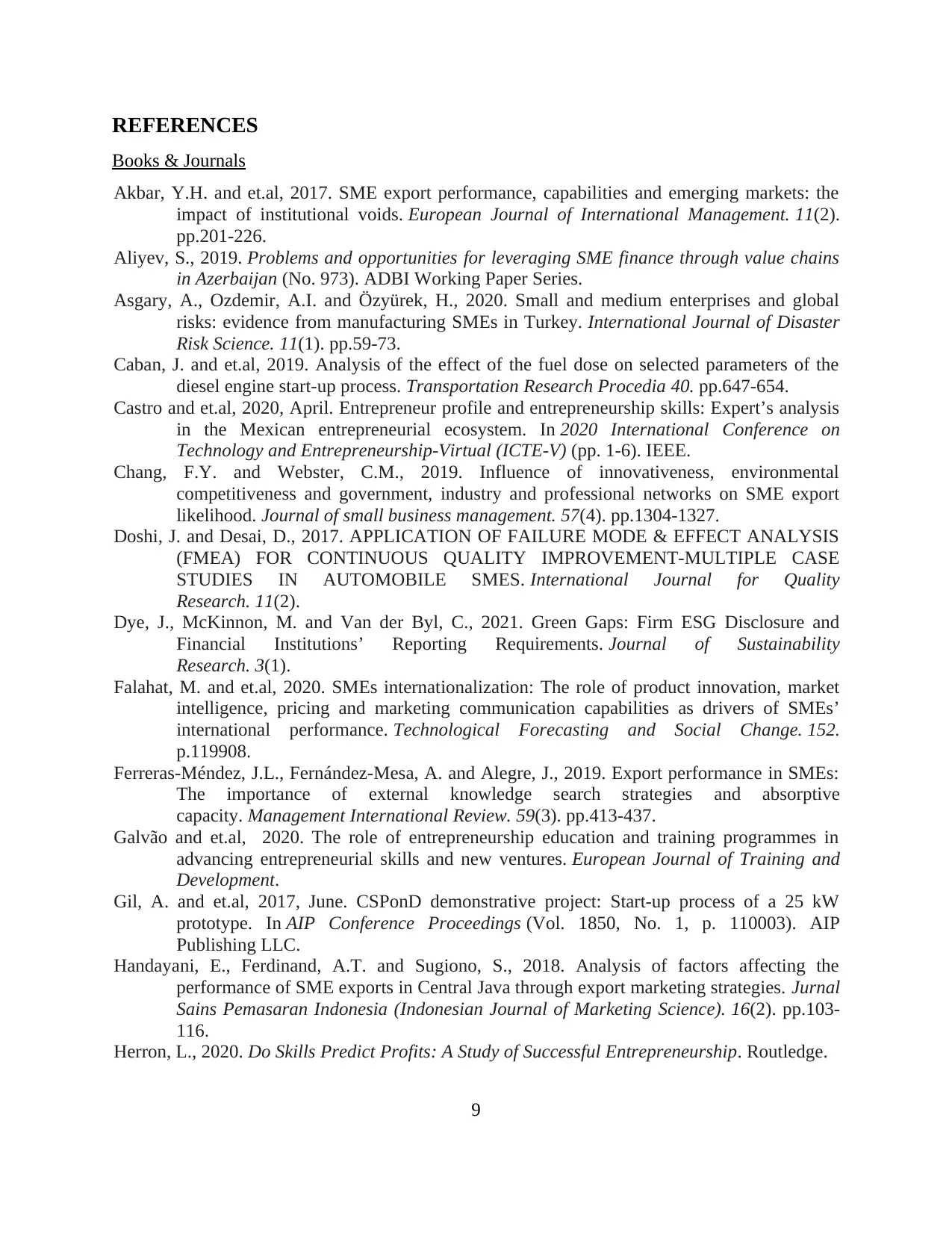
REFERENCES
Books & Journals
Akbar, Y.H. and et.al, 2017. SME export performance, capabilities and emerging markets: the
impact of institutional voids. European Journal of International Management. 11(2).
pp.201-226.
Aliyev, S., 2019. Problems and opportunities for leveraging SME finance through value chains
in Azerbaijan (No. 973). ADBI Working Paper Series.
Asgary, A., Ozdemir, A.I. and Özyürek, H., 2020. Small and medium enterprises and global
risks: evidence from manufacturing SMEs in Turkey. International Journal of Disaster
Risk Science. 11(1). pp.59-73.
Caban, J. and et.al, 2019. Analysis of the effect of the fuel dose on selected parameters of the
diesel engine start-up process. Transportation Research Procedia 40. pp.647-654.
Castro and et.al, 2020, April. Entrepreneur profile and entrepreneurship skills: Expert’s analysis
in the Mexican entrepreneurial ecosystem. In 2020 International Conference on
Technology and Entrepreneurship-Virtual (ICTE-V) (pp. 1-6). IEEE.
Chang, F.Y. and Webster, C.M., 2019. Influence of innovativeness, environmental
competitiveness and government, industry and professional networks on SME export
likelihood. Journal of small business management. 57(4). pp.1304-1327.
Doshi, J. and Desai, D., 2017. APPLICATION OF FAILURE MODE & EFFECT ANALYSIS
(FMEA) FOR CONTINUOUS QUALITY IMPROVEMENT-MULTIPLE CASE
STUDIES IN AUTOMOBILE SMES. International Journal for Quality
Research. 11(2).
Dye, J., McKinnon, M. and Van der Byl, C., 2021. Green Gaps: Firm ESG Disclosure and
Financial Institutions’ Reporting Requirements. Journal of Sustainability
Research. 3(1).
Falahat, M. and et.al, 2020. SMEs internationalization: The role of product innovation, market
intelligence, pricing and marketing communication capabilities as drivers of SMEs’
international performance. Technological Forecasting and Social Change. 152.
p.119908.
Ferreras-Méndez, J.L., Fernández-Mesa, A. and Alegre, J., 2019. Export performance in SMEs:
The importance of external knowledge search strategies and absorptive
capacity. Management International Review. 59(3). pp.413-437.
Galvão and et.al, 2020. The role of entrepreneurship education and training programmes in
advancing entrepreneurial skills and new ventures. European Journal of Training and
Development.
Gil, A. and et.al, 2017, June. CSPonD demonstrative project: Start-up process of a 25 kW
prototype. In AIP Conference Proceedings (Vol. 1850, No. 1, p. 110003). AIP
Publishing LLC.
Handayani, E., Ferdinand, A.T. and Sugiono, S., 2018. Analysis of factors affecting the
performance of SME exports in Central Java through export marketing strategies. Jurnal
Sains Pemasaran Indonesia (Indonesian Journal of Marketing Science). 16(2). pp.103-
116.
Herron, L., 2020. Do Skills Predict Profits: A Study of Successful Entrepreneurship. Routledge.
9
Books & Journals
Akbar, Y.H. and et.al, 2017. SME export performance, capabilities and emerging markets: the
impact of institutional voids. European Journal of International Management. 11(2).
pp.201-226.
Aliyev, S., 2019. Problems and opportunities for leveraging SME finance through value chains
in Azerbaijan (No. 973). ADBI Working Paper Series.
Asgary, A., Ozdemir, A.I. and Özyürek, H., 2020. Small and medium enterprises and global
risks: evidence from manufacturing SMEs in Turkey. International Journal of Disaster
Risk Science. 11(1). pp.59-73.
Caban, J. and et.al, 2019. Analysis of the effect of the fuel dose on selected parameters of the
diesel engine start-up process. Transportation Research Procedia 40. pp.647-654.
Castro and et.al, 2020, April. Entrepreneur profile and entrepreneurship skills: Expert’s analysis
in the Mexican entrepreneurial ecosystem. In 2020 International Conference on
Technology and Entrepreneurship-Virtual (ICTE-V) (pp. 1-6). IEEE.
Chang, F.Y. and Webster, C.M., 2019. Influence of innovativeness, environmental
competitiveness and government, industry and professional networks on SME export
likelihood. Journal of small business management. 57(4). pp.1304-1327.
Doshi, J. and Desai, D., 2017. APPLICATION OF FAILURE MODE & EFFECT ANALYSIS
(FMEA) FOR CONTINUOUS QUALITY IMPROVEMENT-MULTIPLE CASE
STUDIES IN AUTOMOBILE SMES. International Journal for Quality
Research. 11(2).
Dye, J., McKinnon, M. and Van der Byl, C., 2021. Green Gaps: Firm ESG Disclosure and
Financial Institutions’ Reporting Requirements. Journal of Sustainability
Research. 3(1).
Falahat, M. and et.al, 2020. SMEs internationalization: The role of product innovation, market
intelligence, pricing and marketing communication capabilities as drivers of SMEs’
international performance. Technological Forecasting and Social Change. 152.
p.119908.
Ferreras-Méndez, J.L., Fernández-Mesa, A. and Alegre, J., 2019. Export performance in SMEs:
The importance of external knowledge search strategies and absorptive
capacity. Management International Review. 59(3). pp.413-437.
Galvão and et.al, 2020. The role of entrepreneurship education and training programmes in
advancing entrepreneurial skills and new ventures. European Journal of Training and
Development.
Gil, A. and et.al, 2017, June. CSPonD demonstrative project: Start-up process of a 25 kW
prototype. In AIP Conference Proceedings (Vol. 1850, No. 1, p. 110003). AIP
Publishing LLC.
Handayani, E., Ferdinand, A.T. and Sugiono, S., 2018. Analysis of factors affecting the
performance of SME exports in Central Java through export marketing strategies. Jurnal
Sains Pemasaran Indonesia (Indonesian Journal of Marketing Science). 16(2). pp.103-
116.
Herron, L., 2020. Do Skills Predict Profits: A Study of Successful Entrepreneurship. Routledge.
9
⊘ This is a preview!⊘
Do you want full access?
Subscribe today to unlock all pages.
Trusted by 1+ million students worldwide
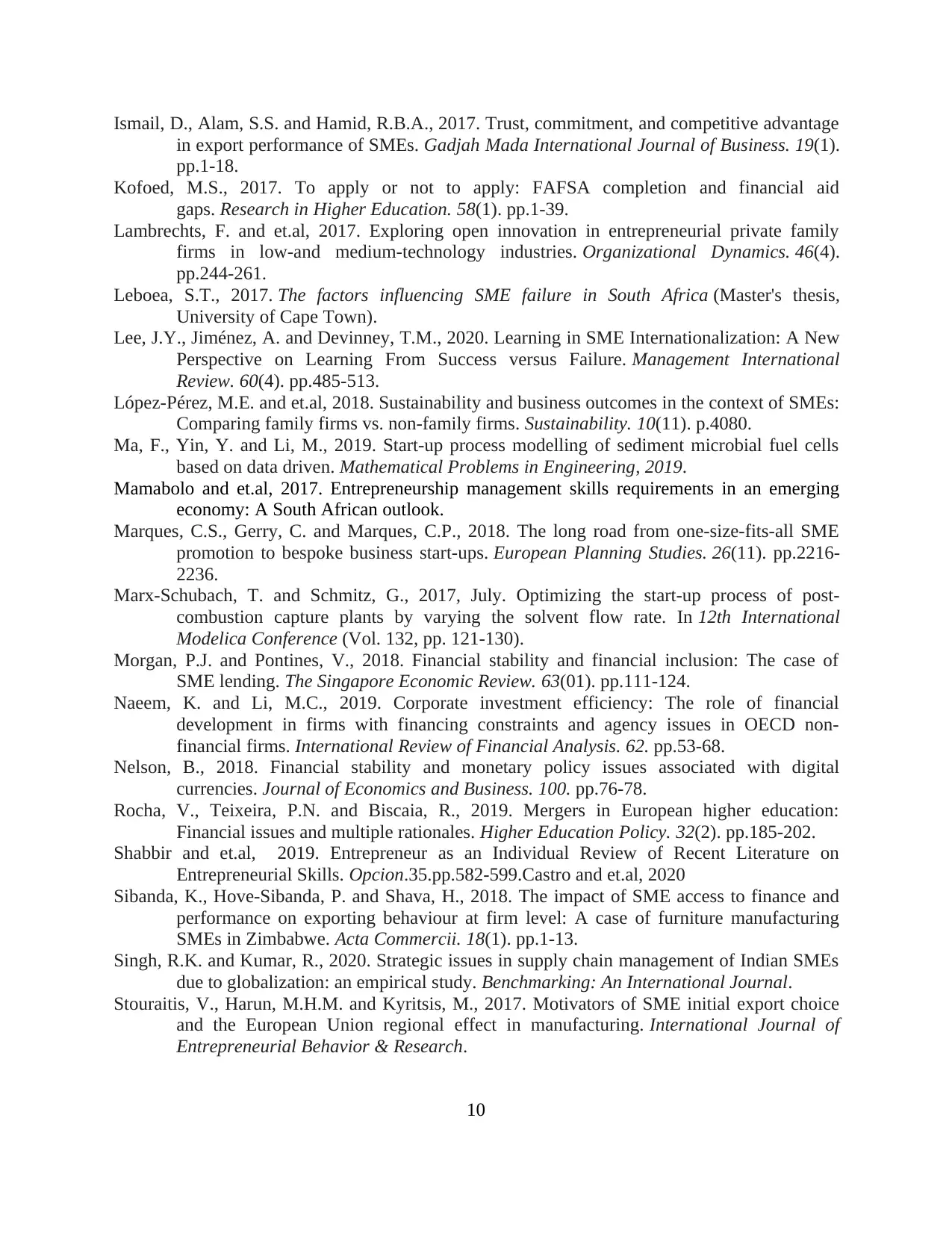
Ismail, D., Alam, S.S. and Hamid, R.B.A., 2017. Trust, commitment, and competitive advantage
in export performance of SMEs. Gadjah Mada International Journal of Business. 19(1).
pp.1-18.
Kofoed, M.S., 2017. To apply or not to apply: FAFSA completion and financial aid
gaps. Research in Higher Education. 58(1). pp.1-39.
Lambrechts, F. and et.al, 2017. Exploring open innovation in entrepreneurial private family
firms in low-and medium-technology industries. Organizational Dynamics. 46(4).
pp.244-261.
Leboea, S.T., 2017. The factors influencing SME failure in South Africa (Master's thesis,
University of Cape Town).
Lee, J.Y., Jiménez, A. and Devinney, T.M., 2020. Learning in SME Internationalization: A New
Perspective on Learning From Success versus Failure. Management International
Review. 60(4). pp.485-513.
López-Pérez, M.E. and et.al, 2018. Sustainability and business outcomes in the context of SMEs:
Comparing family firms vs. non-family firms. Sustainability. 10(11). p.4080.
Ma, F., Yin, Y. and Li, M., 2019. Start-up process modelling of sediment microbial fuel cells
based on data driven. Mathematical Problems in Engineering, 2019.
Mamabolo and et.al, 2017. Entrepreneurship management skills requirements in an emerging
economy: A South African outlook.
Marques, C.S., Gerry, C. and Marques, C.P., 2018. The long road from one-size-fits-all SME
promotion to bespoke business start-ups. European Planning Studies. 26(11). pp.2216-
2236.
Marx-Schubach, T. and Schmitz, G., 2017, July. Optimizing the start-up process of post-
combustion capture plants by varying the solvent flow rate. In 12th International
Modelica Conference (Vol. 132, pp. 121-130).
Morgan, P.J. and Pontines, V., 2018. Financial stability and financial inclusion: The case of
SME lending. The Singapore Economic Review. 63(01). pp.111-124.
Naeem, K. and Li, M.C., 2019. Corporate investment efficiency: The role of financial
development in firms with financing constraints and agency issues in OECD non-
financial firms. International Review of Financial Analysis. 62. pp.53-68.
Nelson, B., 2018. Financial stability and monetary policy issues associated with digital
currencies. Journal of Economics and Business. 100. pp.76-78.
Rocha, V., Teixeira, P.N. and Biscaia, R., 2019. Mergers in European higher education:
Financial issues and multiple rationales. Higher Education Policy. 32(2). pp.185-202.
Shabbir and et.al, 2019. Entrepreneur as an Individual Review of Recent Literature on
Entrepreneurial Skills. Opcion.35.pp.582-599.Castro and et.al, 2020
Sibanda, K., Hove-Sibanda, P. and Shava, H., 2018. The impact of SME access to finance and
performance on exporting behaviour at firm level: A case of furniture manufacturing
SMEs in Zimbabwe. Acta Commercii. 18(1). pp.1-13.
Singh, R.K. and Kumar, R., 2020. Strategic issues in supply chain management of Indian SMEs
due to globalization: an empirical study. Benchmarking: An International Journal.
Stouraitis, V., Harun, M.H.M. and Kyritsis, M., 2017. Motivators of SME initial export choice
and the European Union regional effect in manufacturing. International Journal of
Entrepreneurial Behavior & Research.
10
in export performance of SMEs. Gadjah Mada International Journal of Business. 19(1).
pp.1-18.
Kofoed, M.S., 2017. To apply or not to apply: FAFSA completion and financial aid
gaps. Research in Higher Education. 58(1). pp.1-39.
Lambrechts, F. and et.al, 2017. Exploring open innovation in entrepreneurial private family
firms in low-and medium-technology industries. Organizational Dynamics. 46(4).
pp.244-261.
Leboea, S.T., 2017. The factors influencing SME failure in South Africa (Master's thesis,
University of Cape Town).
Lee, J.Y., Jiménez, A. and Devinney, T.M., 2020. Learning in SME Internationalization: A New
Perspective on Learning From Success versus Failure. Management International
Review. 60(4). pp.485-513.
López-Pérez, M.E. and et.al, 2018. Sustainability and business outcomes in the context of SMEs:
Comparing family firms vs. non-family firms. Sustainability. 10(11). p.4080.
Ma, F., Yin, Y. and Li, M., 2019. Start-up process modelling of sediment microbial fuel cells
based on data driven. Mathematical Problems in Engineering, 2019.
Mamabolo and et.al, 2017. Entrepreneurship management skills requirements in an emerging
economy: A South African outlook.
Marques, C.S., Gerry, C. and Marques, C.P., 2018. The long road from one-size-fits-all SME
promotion to bespoke business start-ups. European Planning Studies. 26(11). pp.2216-
2236.
Marx-Schubach, T. and Schmitz, G., 2017, July. Optimizing the start-up process of post-
combustion capture plants by varying the solvent flow rate. In 12th International
Modelica Conference (Vol. 132, pp. 121-130).
Morgan, P.J. and Pontines, V., 2018. Financial stability and financial inclusion: The case of
SME lending. The Singapore Economic Review. 63(01). pp.111-124.
Naeem, K. and Li, M.C., 2019. Corporate investment efficiency: The role of financial
development in firms with financing constraints and agency issues in OECD non-
financial firms. International Review of Financial Analysis. 62. pp.53-68.
Nelson, B., 2018. Financial stability and monetary policy issues associated with digital
currencies. Journal of Economics and Business. 100. pp.76-78.
Rocha, V., Teixeira, P.N. and Biscaia, R., 2019. Mergers in European higher education:
Financial issues and multiple rationales. Higher Education Policy. 32(2). pp.185-202.
Shabbir and et.al, 2019. Entrepreneur as an Individual Review of Recent Literature on
Entrepreneurial Skills. Opcion.35.pp.582-599.Castro and et.al, 2020
Sibanda, K., Hove-Sibanda, P. and Shava, H., 2018. The impact of SME access to finance and
performance on exporting behaviour at firm level: A case of furniture manufacturing
SMEs in Zimbabwe. Acta Commercii. 18(1). pp.1-13.
Singh, R.K. and Kumar, R., 2020. Strategic issues in supply chain management of Indian SMEs
due to globalization: an empirical study. Benchmarking: An International Journal.
Stouraitis, V., Harun, M.H.M. and Kyritsis, M., 2017. Motivators of SME initial export choice
and the European Union regional effect in manufacturing. International Journal of
Entrepreneurial Behavior & Research.
10
Paraphrase This Document
Need a fresh take? Get an instant paraphrase of this document with our AI Paraphraser
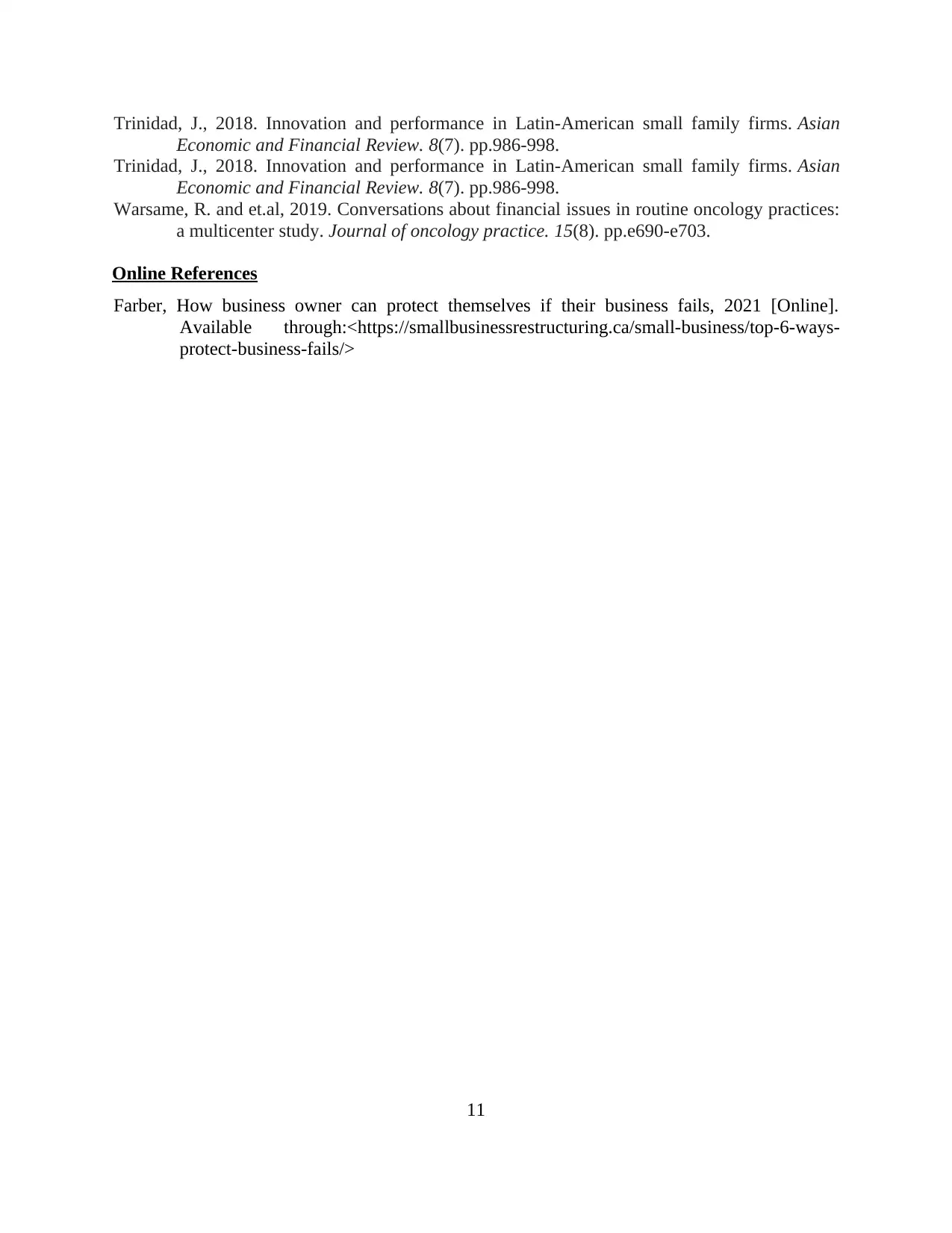
Trinidad, J., 2018. Innovation and performance in Latin-American small family firms. Asian
Economic and Financial Review. 8(7). pp.986-998.
Trinidad, J., 2018. Innovation and performance in Latin-American small family firms. Asian
Economic and Financial Review. 8(7). pp.986-998.
Warsame, R. and et.al, 2019. Conversations about financial issues in routine oncology practices:
a multicenter study. Journal of oncology practice. 15(8). pp.e690-e703.
Online References
Farber, How business owner can protect themselves if their business fails, 2021 [Online].
Available through:<https://smallbusinessrestructuring.ca/small-business/top-6-ways-
protect-business-fails/>
11
Economic and Financial Review. 8(7). pp.986-998.
Trinidad, J., 2018. Innovation and performance in Latin-American small family firms. Asian
Economic and Financial Review. 8(7). pp.986-998.
Warsame, R. and et.al, 2019. Conversations about financial issues in routine oncology practices:
a multicenter study. Journal of oncology practice. 15(8). pp.e690-e703.
Online References
Farber, How business owner can protect themselves if their business fails, 2021 [Online].
Available through:<https://smallbusinessrestructuring.ca/small-business/top-6-ways-
protect-business-fails/>
11

1 out of 11


Related Documents


Your All-in-One AI-Powered Toolkit for Academic Success.
+13062052269
info@desklib.com
Available 24*7 on WhatsApp / Email
![[object Object]](/_next/static/media/star-bottom.7253800d.svg)
Unlock your academic potential
Copyright © 2020–2026 A2Z Services. All Rights Reserved. Developed and managed by ZUCOL.