Research Proposal: The Effectiveness of IT and Business Relationships
VerifiedAdded on 2020/03/16
|21
|4303
|265
Project
AI Summary
This research proposal examines the relationship between IT and business, particularly in the context of business unit divestitures and carve-out projects. The paper begins with an executive summary outlining the strategic use of divestiture, especially in light of changing business strategies and regulatory pressures, and highlights the complexities of IT's role in carve-out projects. The research explores the potential for organizations to create divestiture-ready IT environments through structured carve-out projects. The study aims to answer whether the relationship between IT and business is effective for companies, using Australian data as a basis for analysis. The proposal includes a literature review covering IT work streams in divestitures, IT infrastructure, IT theories, and IT's role in process implementation. The methodology section describes data collection and analysis methods. The findings and discussion sections will analyze the data and discuss managerial implications. The paper concludes by addressing the research questions, acknowledging limitations, and providing recommendations. The proposal underscores the importance of IT in business strategic management and its impact on organizational success.
Running Head: RESEARCH PROPOSAL 1
Business Research Method
Student’s Name
Institutional Affiliation
Date of Submission
Business Research Method
Student’s Name
Institutional Affiliation
Date of Submission

Paraphrase This Document
Need a fresh take? Get an instant paraphrase of this document with our AI Paraphraser
RESEARCH PROPOSAL 2
Executive Summary
Most global multi-business organizations use the strategy of business unit divestiture to have
their portfolios adjusted. The same happens to have resulted from regulatory pressures, legal
pressures or rather a response towards the ever changing business strategies. In accordance to a
divestiture that is typical, systems used in the past to deliver efficient and seamless IT operations
needed to be discarded with regards to regulatory compliances and time demand constraints.
However, with the current acquisition and merger projects, many business organizations find
themselves going for carve-out projects. These projects critically depend on IT systems thus they
are likely to be excluded from processes of due-diligence. This paper will, not only present a
typical carve-out project case study analysis (with regards to a business unit divest) but also
discuss the learned lessons concerning IT management in divestiture of business units. In the
paper, we shall learn that business organizations have the potential of creating IT environments
which are divestiture-ready. By so doing, these organizations have themselves prepared IT-
structured carve-out projects. All in all, this paper will outline a professional research proposal
aimed at proving a projection on the existing relationship between business and IT. The report
will also answer the research question of whether the relationship between IT and business is
effective for companies as it seems or not. Basically, the paper bases its research activity on
Australian data (Agarwal, Tanniru & Wilemon, 1997).
Executive Summary
Most global multi-business organizations use the strategy of business unit divestiture to have
their portfolios adjusted. The same happens to have resulted from regulatory pressures, legal
pressures or rather a response towards the ever changing business strategies. In accordance to a
divestiture that is typical, systems used in the past to deliver efficient and seamless IT operations
needed to be discarded with regards to regulatory compliances and time demand constraints.
However, with the current acquisition and merger projects, many business organizations find
themselves going for carve-out projects. These projects critically depend on IT systems thus they
are likely to be excluded from processes of due-diligence. This paper will, not only present a
typical carve-out project case study analysis (with regards to a business unit divest) but also
discuss the learned lessons concerning IT management in divestiture of business units. In the
paper, we shall learn that business organizations have the potential of creating IT environments
which are divestiture-ready. By so doing, these organizations have themselves prepared IT-
structured carve-out projects. All in all, this paper will outline a professional research proposal
aimed at proving a projection on the existing relationship between business and IT. The report
will also answer the research question of whether the relationship between IT and business is
effective for companies as it seems or not. Basically, the paper bases its research activity on
Australian data (Agarwal, Tanniru & Wilemon, 1997).
RESEARCH PROPOSAL 3
Table of Contents
Introduction.................................................................................................................................................4
i) Problem Statement........................................................................................................................4
ii) Research Questions and Research Aim........................................................................................5
Literature Review........................................................................................................................................5
i) IT Work Stream in Divestitures...................................................................................................5
1. IT Infrastructure...........................................................................................................................6
2. IT Applications............................................................................................................................6
3. IT Organization............................................................................................................................6
4. IT Contracts.................................................................................................................................6
5. Country Coordination..................................................................................................................6
ii) IT Infrastructure...............................................................................................................................7
iii) IT Theories.............................................................................................................................8
iv) IT Role in Processes Implementation.................................................................................10
Methodology.............................................................................................................................................11
i) Data Collection.............................................................................................................................11
ii) Data Analysis...............................................................................................................................11
Findings and Analysis...............................................................................................................................14
Discussion.................................................................................................................................................14
i) Managerial Implications.............................................................................................................14
Conclusion.................................................................................................................................................15
i) Addressing Research Questions and Aims.................................................................................15
ii) Limitations and Recommendations............................................................................................15
Table of Contents
Introduction.................................................................................................................................................4
i) Problem Statement........................................................................................................................4
ii) Research Questions and Research Aim........................................................................................5
Literature Review........................................................................................................................................5
i) IT Work Stream in Divestitures...................................................................................................5
1. IT Infrastructure...........................................................................................................................6
2. IT Applications............................................................................................................................6
3. IT Organization............................................................................................................................6
4. IT Contracts.................................................................................................................................6
5. Country Coordination..................................................................................................................6
ii) IT Infrastructure...............................................................................................................................7
iii) IT Theories.............................................................................................................................8
iv) IT Role in Processes Implementation.................................................................................10
Methodology.............................................................................................................................................11
i) Data Collection.............................................................................................................................11
ii) Data Analysis...............................................................................................................................11
Findings and Analysis...............................................................................................................................14
Discussion.................................................................................................................................................14
i) Managerial Implications.............................................................................................................14
Conclusion.................................................................................................................................................15
i) Addressing Research Questions and Aims.................................................................................15
ii) Limitations and Recommendations............................................................................................15
⊘ This is a preview!⊘
Do you want full access?
Subscribe today to unlock all pages.

Trusted by 1+ million students worldwide
RESEARCH PROPOSAL 4
Introduction
In business strategic management, a technique of business unit divestiture is mostly employed.
Basically, one organization’s acquisition is another one’s divestiture. There are lots of reasons
for divestiture. However, some of the reasons include organizational focus changes, economic
performance being weak and also capital needs. Other reasons as to why business organizations
sell business units may also include contractual obligations or antitrust regulations. Up to now, as
many as 20,000 divestitures have been conducted globally (Repko & Szostak, 2017). The total
value of such processes exceeds an approximation of $900 billon. With regards to many
acquisition and merger research projects, the IT function’s role in a “carve-out” process could be
rather complex. The same function is likely to be of serious strategic and financial implications
for the buyers and the sellers. Let’s take a case study of a company known as Roche
Pharmaceuticals which experienced the same financial implications (Jones, 1991). In its case, the
company was involved in the selling of vitamins division. During the process, it happened to
have underestimated the IT disentanglement cost. The factor of underestimation was about
twenty. Using our described case study and several other cases of risks business organizations
undertake to achieve its objectives after activities of divestiture, we will discuss some of the
responses business organizations make to curb the same challenges faced in such processes of
carving-out. The responses we are interested in, in this case, are those that are focused on IT
components.
i) Problem Statement
Introduction
In business strategic management, a technique of business unit divestiture is mostly employed.
Basically, one organization’s acquisition is another one’s divestiture. There are lots of reasons
for divestiture. However, some of the reasons include organizational focus changes, economic
performance being weak and also capital needs. Other reasons as to why business organizations
sell business units may also include contractual obligations or antitrust regulations. Up to now, as
many as 20,000 divestitures have been conducted globally (Repko & Szostak, 2017). The total
value of such processes exceeds an approximation of $900 billon. With regards to many
acquisition and merger research projects, the IT function’s role in a “carve-out” process could be
rather complex. The same function is likely to be of serious strategic and financial implications
for the buyers and the sellers. Let’s take a case study of a company known as Roche
Pharmaceuticals which experienced the same financial implications (Jones, 1991). In its case, the
company was involved in the selling of vitamins division. During the process, it happened to
have underestimated the IT disentanglement cost. The factor of underestimation was about
twenty. Using our described case study and several other cases of risks business organizations
undertake to achieve its objectives after activities of divestiture, we will discuss some of the
responses business organizations make to curb the same challenges faced in such processes of
carving-out. The responses we are interested in, in this case, are those that are focused on IT
components.
i) Problem Statement
Paraphrase This Document
Need a fresh take? Get an instant paraphrase of this document with our AI Paraphraser
RESEARCH PROPOSAL 5
This paper will have to describe the milestones and phases of an IT structured divestiture project
as one means of meeting the objectives of the research. The description is then followed by
outline of challenges by business organizations during divestiture contracts. The final step is
sharing lessons learned with regards to proper IT structured carve-out project design and
management. The identified issues of concern will be solved after the identification of IT
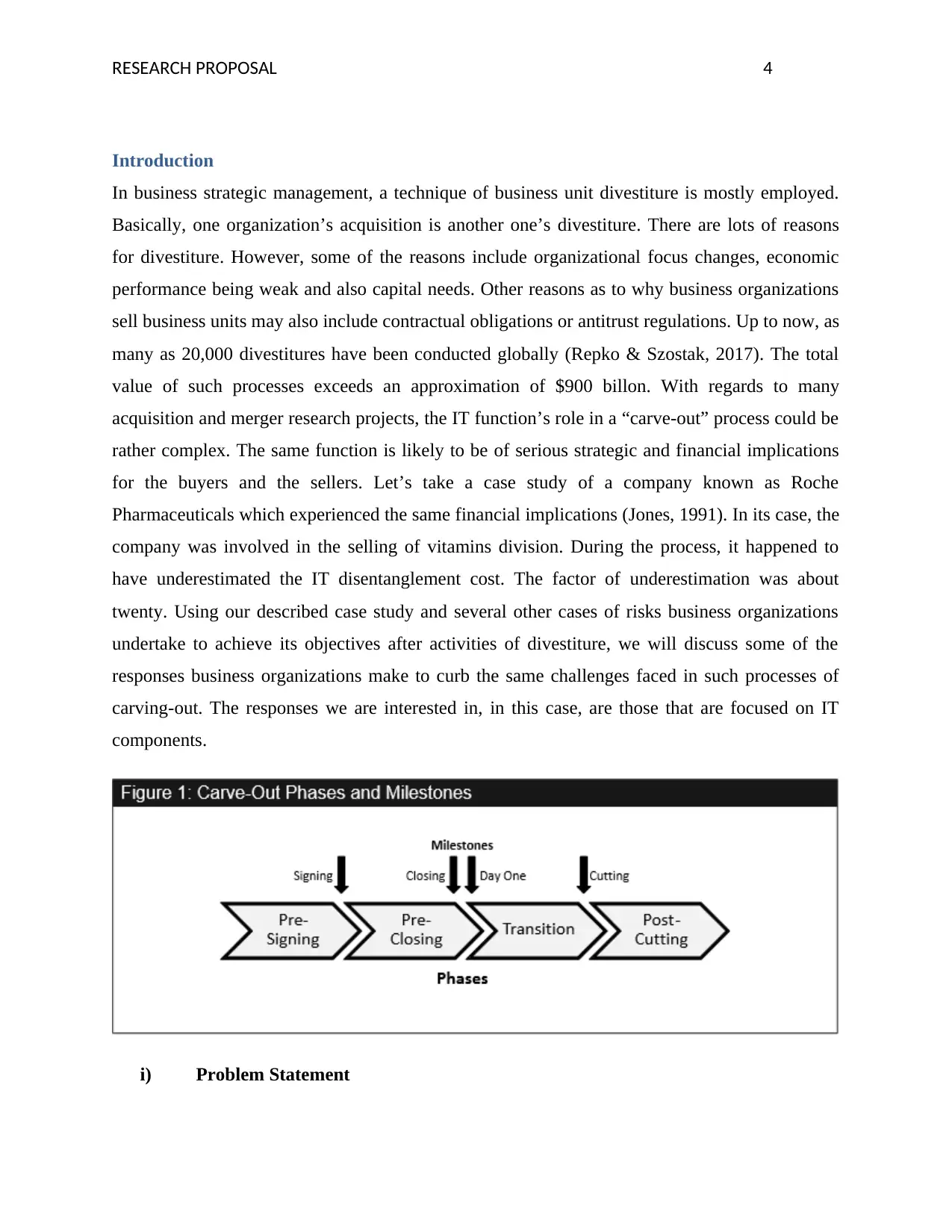
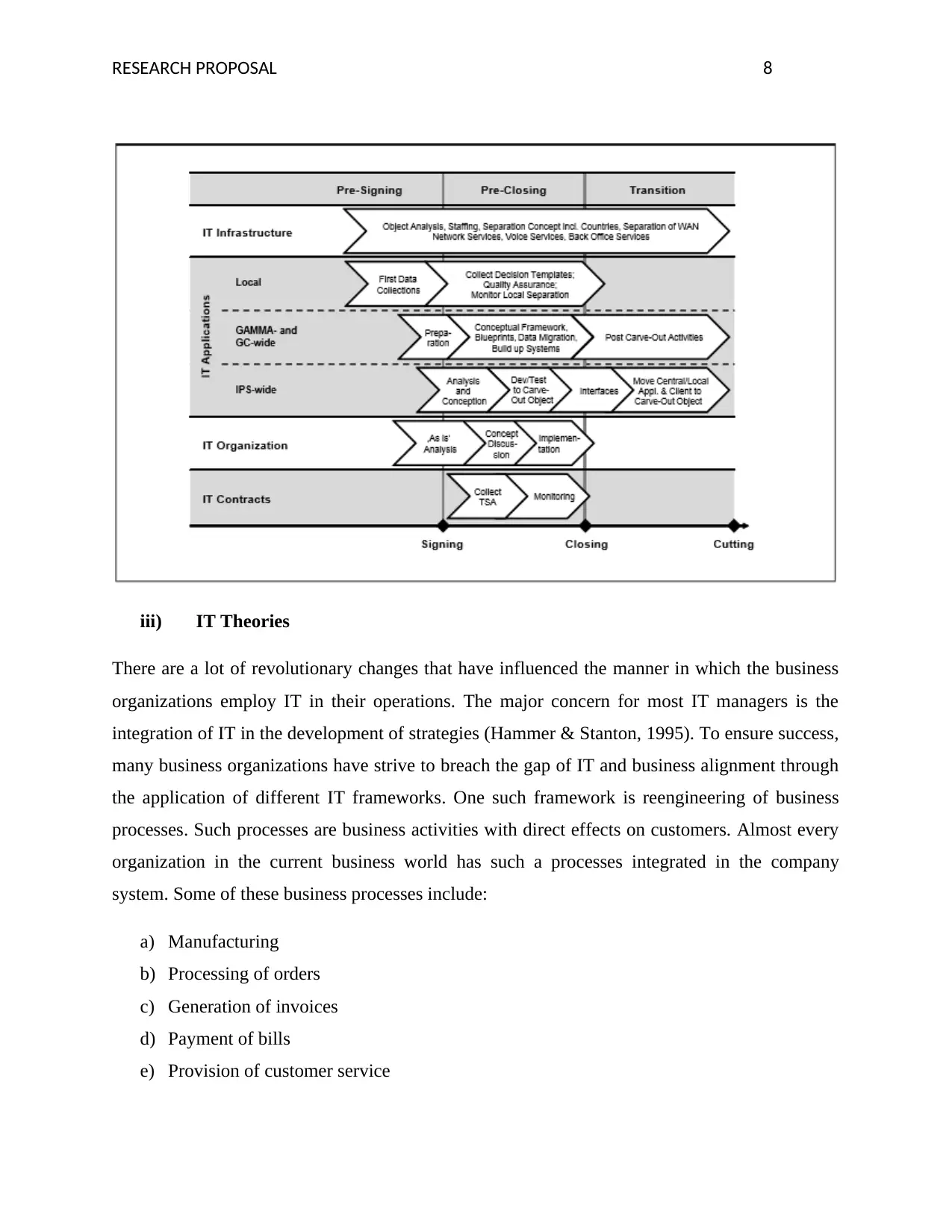
divestiture project phases. Regarding the same, there are four IT carve-out project phases in a
typical organization. As shown in figure 1 above, the first phase is Pre-Signing. This phase is
whereby all preparations and negotiations are performed before signing of the divestiture
contract. In the same phase, a “data room” is established. The room contains a large volume of
files and folders. The folder or files have confidential information like contracts, financial data
and information regarding employees and customers. The purpose of this room is to give the
buyer a chance of conducting due diligence so as to have a basis for the contract at hand. The
second phase is PreClosing. It is at this point that separation jobs get planned followed by the
preparation of systems. The third phase is the Transition. This is the phase in which the bulk of
separation activities get done. The post cutting phase is then the last in the hierarchy. This is the
step in which the physical separation gets done (Sudhakar, 2012).
ii) Research Questions and Research Aim
As mentioned before, this research proposal paper has discussed a typical carve-out project case
study in the introductory section. However, the main activity involving the discussion of learnt
lessons concerning IT management in divestiture of business units is yet to be done. The main
objective of this paper is to solicit the feeling that business organizations have the potential of
creating IT environments which are divestiture-ready through the preparation of IT-structured
carve-out projects. All in all, the paper will prove that there exists a relationship between
business and IT. By doing so, the paper shall have answered the following research question:
1. Does a relationship exist between IT and business?
2. How effective is the relationship for companies?
Literature Review
i) IT Work Stream in Divestitures
This paper will have to describe the milestones and phases of an IT structured divestiture project
as one means of meeting the objectives of the research. The description is then followed by
outline of challenges by business organizations during divestiture contracts. The final step is
sharing lessons learned with regards to proper IT structured carve-out project design and
management. The identified issues of concern will be solved after the identification of IT
divestiture project phases. Regarding the same, there are four IT carve-out project phases in a
typical organization. As shown in figure 1 above, the first phase is Pre-Signing. This phase is
whereby all preparations and negotiations are performed before signing of the divestiture
contract. In the same phase, a “data room” is established. The room contains a large volume of
files and folders. The folder or files have confidential information like contracts, financial data
and information regarding employees and customers. The purpose of this room is to give the
buyer a chance of conducting due diligence so as to have a basis for the contract at hand. The
second phase is PreClosing. It is at this point that separation jobs get planned followed by the
preparation of systems. The third phase is the Transition. This is the phase in which the bulk of
separation activities get done. The post cutting phase is then the last in the hierarchy. This is the
step in which the physical separation gets done (Sudhakar, 2012).
ii) Research Questions and Research Aim
As mentioned before, this research proposal paper has discussed a typical carve-out project case
study in the introductory section. However, the main activity involving the discussion of learnt
lessons concerning IT management in divestiture of business units is yet to be done. The main
objective of this paper is to solicit the feeling that business organizations have the potential of
creating IT environments which are divestiture-ready through the preparation of IT-structured
carve-out projects. All in all, the paper will prove that there exists a relationship between
business and IT. By doing so, the paper shall have answered the following research question:
1. Does a relationship exist between IT and business?
2. How effective is the relationship for companies?
Literature Review
i) IT Work Stream in Divestitures
RESEARCH PROPOSAL 6
The work stream of IT, in this case, is made up of four other sub-streams. These sub-streams
include:
1. IT Infrastructure
This sub-stream is made up of networks, desktop PC, voice, access issues of business partners
and data centers.
2. IT Applications
It is made up of data pertaining to GC applications, IPS applications, local and financial
reporting applications.
3. IT Organization
This sub-stream is made up of HR issues like key personnel.
4. IT Contracts
This section is responsible for the assessment and identification of legal issues and licenses with
regards to hardware and software transfer. However, there is another sub-stream that came to be
added after complexities associated with IT sites. The sub-stream is:
5. Country Coordination
It is associated with the management of carve-out impacts.
The work stream of IT, in this case, is made up of four other sub-streams. These sub-streams
include:
1. IT Infrastructure
This sub-stream is made up of networks, desktop PC, voice, access issues of business partners
and data centers.
2. IT Applications
It is made up of data pertaining to GC applications, IPS applications, local and financial
reporting applications.
3. IT Organization
This sub-stream is made up of HR issues like key personnel.
4. IT Contracts
This section is responsible for the assessment and identification of legal issues and licenses with
regards to hardware and software transfer. However, there is another sub-stream that came to be
added after complexities associated with IT sites. The sub-stream is:
5. Country Coordination
It is associated with the management of carve-out impacts.
⊘ This is a preview!⊘
Do you want full access?
Subscribe today to unlock all pages.
Trusted by 1+ million students worldwide
RESEARCH PROPOSAL 7
ii) IT Infrastructure
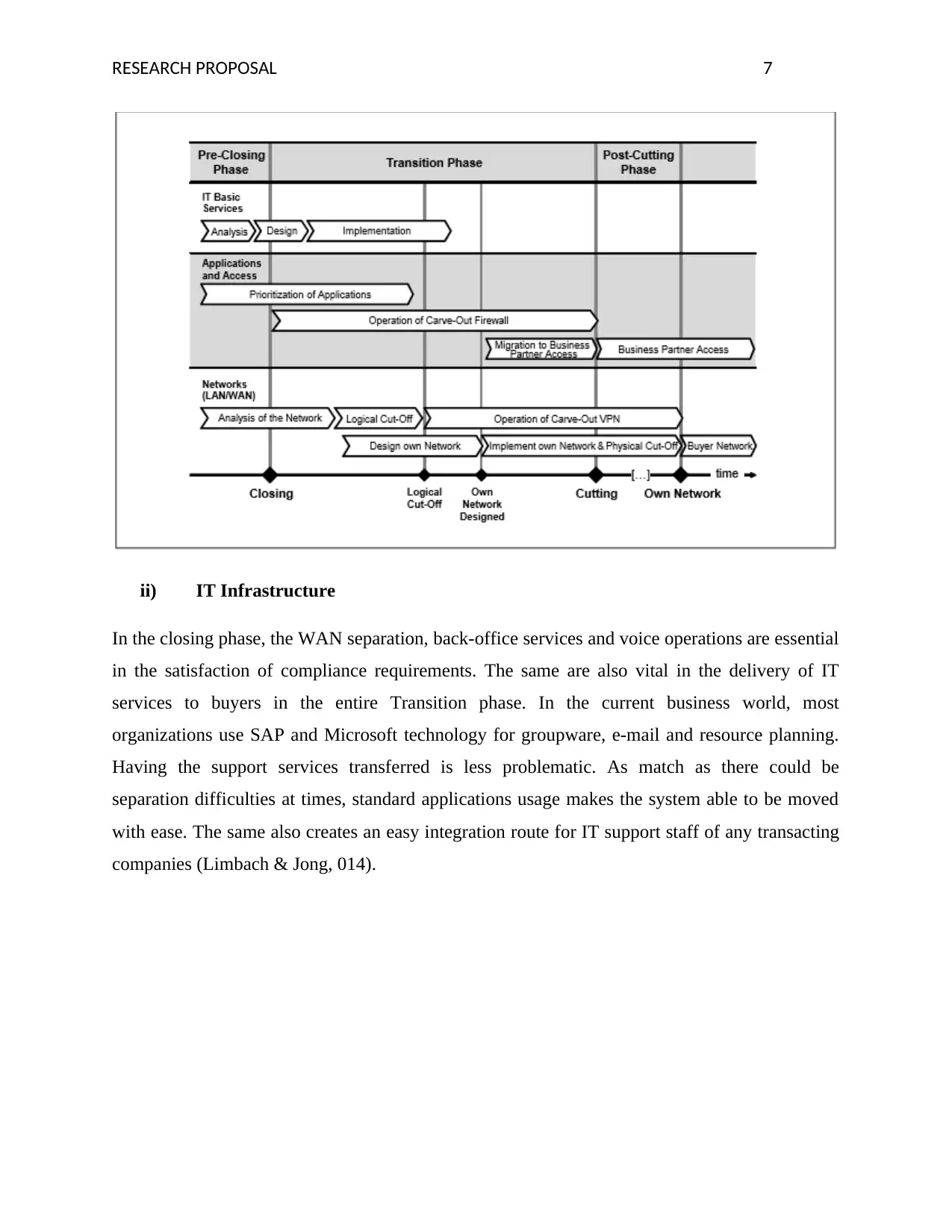
In the closing phase, the WAN separation, back-office services and voice operations are essential
in the satisfaction of compliance requirements. The same are also vital in the delivery of IT
services to buyers in the entire Transition phase. In the current business world, most
organizations use SAP and Microsoft technology for groupware, e-mail and resource planning.
Having the support services transferred is less problematic. As match as there could be
separation difficulties at times, standard applications usage makes the system able to be moved
with ease. The same also creates an easy integration route for IT support staff of any transacting
companies (Limbach & Jong, 014).
ii) IT Infrastructure
In the closing phase, the WAN separation, back-office services and voice operations are essential
in the satisfaction of compliance requirements. The same are also vital in the delivery of IT
services to buyers in the entire Transition phase. In the current business world, most
organizations use SAP and Microsoft technology for groupware, e-mail and resource planning.
Having the support services transferred is less problematic. As match as there could be
separation difficulties at times, standard applications usage makes the system able to be moved
with ease. The same also creates an easy integration route for IT support staff of any transacting
companies (Limbach & Jong, 014).
Paraphrase This Document
Need a fresh take? Get an instant paraphrase of this document with our AI Paraphraser
RESEARCH PROPOSAL 8
iii) IT Theories
There are a lot of revolutionary changes that have influenced the manner in which the business
organizations employ IT in their operations. The major concern for most IT managers is the
integration of IT in the development of strategies (Hammer & Stanton, 1995). To ensure success,
many business organizations have strive to breach the gap of IT and business alignment through
the application of different IT frameworks. One such framework is reengineering of business
processes. Such processes are business activities with direct effects on customers. Almost every
organization in the current business world has such a processes integrated in the company
system. Some of these business processes include:
a) Manufacturing
b) Processing of orders
c) Generation of invoices
d) Payment of bills
e) Provision of customer service
iii) IT Theories
There are a lot of revolutionary changes that have influenced the manner in which the business
organizations employ IT in their operations. The major concern for most IT managers is the
integration of IT in the development of strategies (Hammer & Stanton, 1995). To ensure success,
many business organizations have strive to breach the gap of IT and business alignment through
the application of different IT frameworks. One such framework is reengineering of business
processes. Such processes are business activities with direct effects on customers. Almost every
organization in the current business world has such a processes integrated in the company
system. Some of these business processes include:
a) Manufacturing
b) Processing of orders
c) Generation of invoices
d) Payment of bills
e) Provision of customer service
RESEARCH PROPOSAL 9
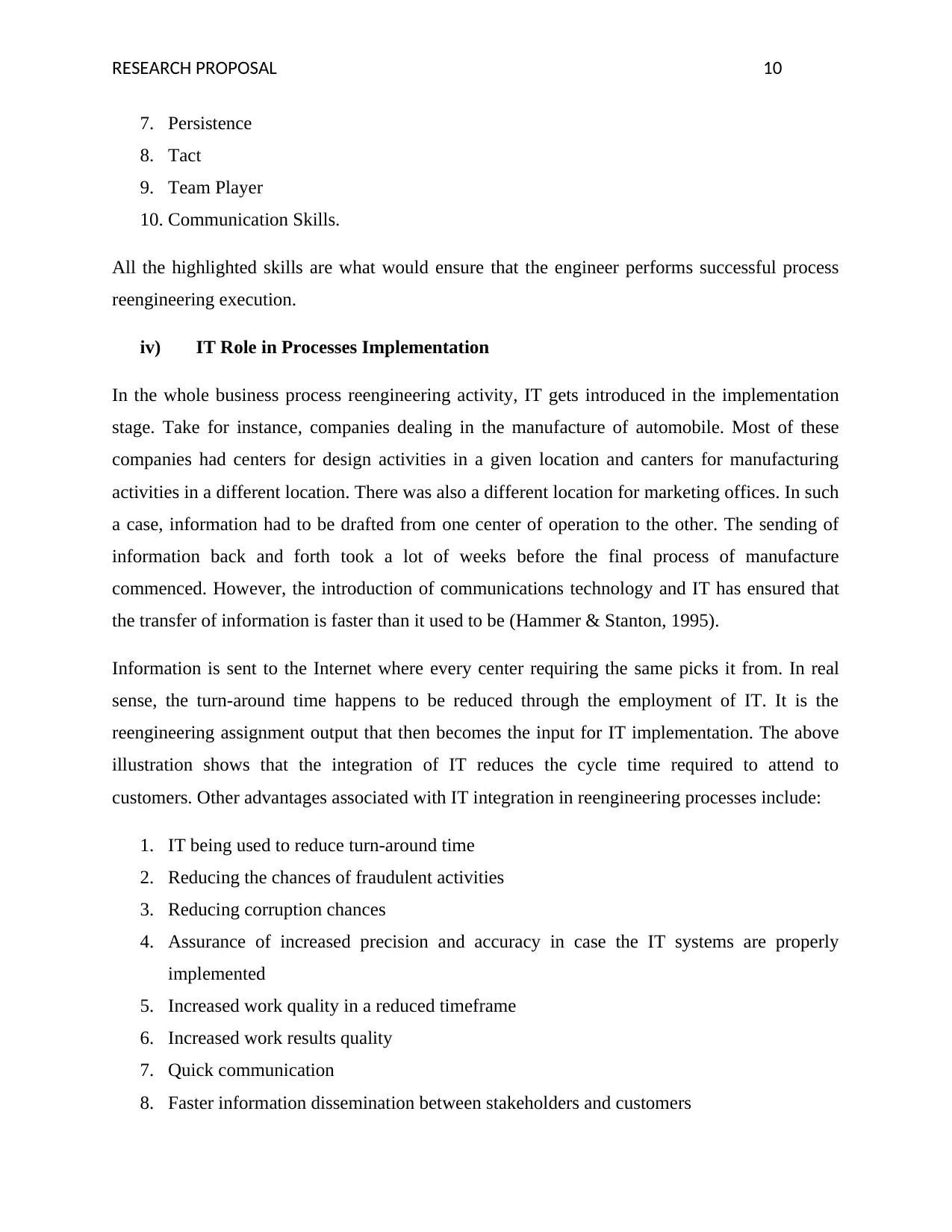
All the named processes can also be reengineered. The steps associated with efforts of
reengineering of business process are outline in the table below:
During the activity of process reengineering, the business organization’s processes that require
reengineering need to be identified. Some of the outcomes associated with processes of
reengineering include:
a) Profit increase
b) Costs reduction
c) Quality improvement
d) Provision of better services.
For this particular activity, a reengineering team is needed. The process of reengineering also
requires commitment from the management body. To ensure that the engineering process is
smoothly executed, the engineer in charge is required to have a profile that includes:
1. Process–orientation
2. Perspectives that are holistic
3. Creativity
4. Restlessness
5. Enthusiasm
6. Optimism
All the named processes can also be reengineered. The steps associated with efforts of
reengineering of business process are outline in the table below:
During the activity of process reengineering, the business organization’s processes that require
reengineering need to be identified. Some of the outcomes associated with processes of
reengineering include:
a) Profit increase
b) Costs reduction
c) Quality improvement
d) Provision of better services.
For this particular activity, a reengineering team is needed. The process of reengineering also
requires commitment from the management body. To ensure that the engineering process is
smoothly executed, the engineer in charge is required to have a profile that includes:
1. Process–orientation
2. Perspectives that are holistic
3. Creativity
4. Restlessness
5. Enthusiasm
6. Optimism
⊘ This is a preview!⊘
Do you want full access?
Subscribe today to unlock all pages.
Trusted by 1+ million students worldwide
RESEARCH PROPOSAL 10
7. Persistence
8. Tact
9. Team Player
10. Communication Skills.
All the highlighted skills are what would ensure that the engineer performs successful process
reengineering execution.
iv) IT Role in Processes Implementation
In the whole business process reengineering activity, IT gets introduced in the implementation
stage. Take for instance, companies dealing in the manufacture of automobile. Most of these
companies had centers for design activities in a given location and canters for manufacturing
activities in a different location. There was also a different location for marketing offices. In such
a case, information had to be drafted from one center of operation to the other. The sending of
information back and forth took a lot of weeks before the final process of manufacture
commenced. However, the introduction of communications technology and IT has ensured that
the transfer of information is faster than it used to be (Hammer & Stanton, 1995).
Information is sent to the Internet where every center requiring the same picks it from. In real
sense, the turn-around time happens to be reduced through the employment of IT. It is the
reengineering assignment output that then becomes the input for IT implementation. The above
illustration shows that the integration of IT reduces the cycle time required to attend to
customers. Other advantages associated with IT integration in reengineering processes include:
1. IT being used to reduce turn-around time
2. Reducing the chances of fraudulent activities
3. Reducing corruption chances
4. Assurance of increased precision and accuracy in case the IT systems are properly
implemented
5. Increased work quality in a reduced timeframe
6. Increased work results quality
7. Quick communication
8. Faster information dissemination between stakeholders and customers
7. Persistence
8. Tact
9. Team Player
10. Communication Skills.
All the highlighted skills are what would ensure that the engineer performs successful process
reengineering execution.
iv) IT Role in Processes Implementation
In the whole business process reengineering activity, IT gets introduced in the implementation
stage. Take for instance, companies dealing in the manufacture of automobile. Most of these
companies had centers for design activities in a given location and canters for manufacturing
activities in a different location. There was also a different location for marketing offices. In such
a case, information had to be drafted from one center of operation to the other. The sending of
information back and forth took a lot of weeks before the final process of manufacture
commenced. However, the introduction of communications technology and IT has ensured that
the transfer of information is faster than it used to be (Hammer & Stanton, 1995).
Information is sent to the Internet where every center requiring the same picks it from. In real
sense, the turn-around time happens to be reduced through the employment of IT. It is the
reengineering assignment output that then becomes the input for IT implementation. The above
illustration shows that the integration of IT reduces the cycle time required to attend to
customers. Other advantages associated with IT integration in reengineering processes include:
1. IT being used to reduce turn-around time
2. Reducing the chances of fraudulent activities
3. Reducing corruption chances
4. Assurance of increased precision and accuracy in case the IT systems are properly
implemented
5. Increased work quality in a reduced timeframe
6. Increased work results quality
7. Quick communication
8. Faster information dissemination between stakeholders and customers
Paraphrase This Document
Need a fresh take? Get an instant paraphrase of this document with our AI Paraphraser
RESEARCH PROPOSAL 11
9. Efficient tracking of progress using IT tools
However, for an organization to have all the highlighted benefits achieved, the employees have
to be properly trained regarding the use of IT applications or any other technology likely to be
employed. Upon determining that processes are able to automate, IT tools, software and
hardware are able to be employed in the implementation of processes. It is the duty of IT project
managers to supervise this stage. In case the IT systems happen to be ready, they are made
available to employees and users within the organization. Some of the tools used in the
implementation of IT systems in this stage include:
1. Tools for project management
2. Database technologies
3. Voice and data communication technologies
4. Networking technologies
5. Web and ecommerce technologies
Methodology
i) Data Collection
The main aim of this paper is to outline a professional research proposal that gives a projection
on the existing relationship between business and IT. From the same, the report will then answer
the research question of whether the relationship between IT and business is effective for
companies as it seems or not. To solicit the required response the paper bases its research activity
on Australian data. According to the obtained information, there are key indicators regarding IT
implementation in business processes. They include:
1. Internet access
2. Broadband usage
3. Web presence
4. Presence of social media
5. Internet commerce
ii) Data Analysis
9. Efficient tracking of progress using IT tools
However, for an organization to have all the highlighted benefits achieved, the employees have
to be properly trained regarding the use of IT applications or any other technology likely to be
employed. Upon determining that processes are able to automate, IT tools, software and
hardware are able to be employed in the implementation of processes. It is the duty of IT project
managers to supervise this stage. In case the IT systems happen to be ready, they are made
available to employees and users within the organization. Some of the tools used in the
implementation of IT systems in this stage include:
1. Tools for project management
2. Database technologies
3. Voice and data communication technologies
4. Networking technologies
5. Web and ecommerce technologies
Methodology
i) Data Collection
The main aim of this paper is to outline a professional research proposal that gives a projection
on the existing relationship between business and IT. From the same, the report will then answer
the research question of whether the relationship between IT and business is effective for
companies as it seems or not. To solicit the required response the paper bases its research activity
on Australian data. According to the obtained information, there are key indicators regarding IT
implementation in business processes. They include:
1. Internet access
2. Broadband usage
3. Web presence
4. Presence of social media
5. Internet commerce
ii) Data Analysis
RESEARCH PROPOSAL 12
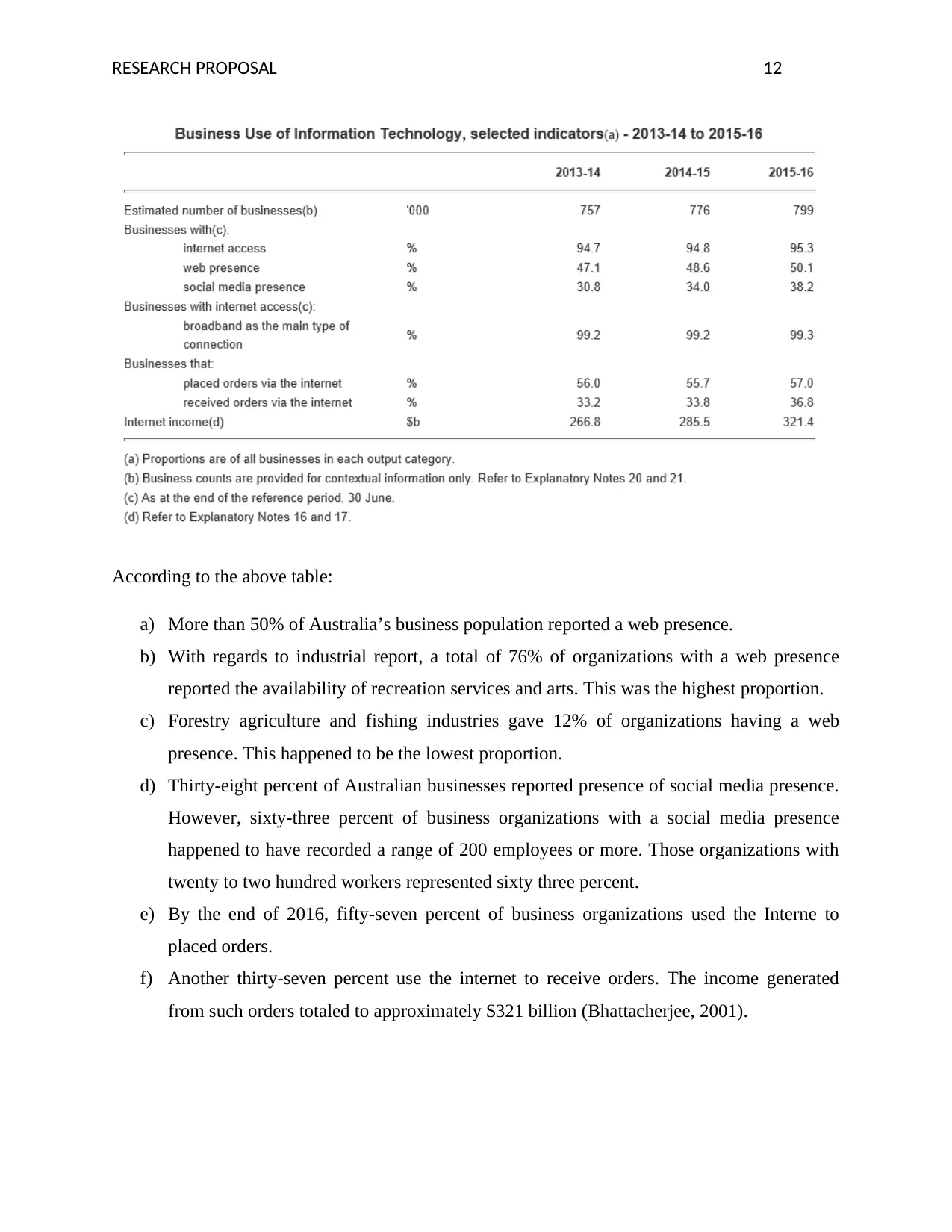
According to the above table:
a) More than 50% of Australia’s business population reported a web presence.
b) With regards to industrial report, a total of 76% of organizations with a web presence
reported the availability of recreation services and arts. This was the highest proportion.
c) Forestry agriculture and fishing industries gave 12% of organizations having a web
presence. This happened to be the lowest proportion.
d) Thirty-eight percent of Australian businesses reported presence of social media presence.
However, sixty-three percent of business organizations with a social media presence
happened to have recorded a range of 200 employees or more. Those organizations with
twenty to two hundred workers represented sixty three percent.
e) By the end of 2016, fifty-seven percent of business organizations used the Interne to
placed orders.
f) Another thirty-seven percent use the internet to receive orders. The income generated
from such orders totaled to approximately $321 billion (Bhattacherjee, 2001).
According to the above table:
a) More than 50% of Australia’s business population reported a web presence.
b) With regards to industrial report, a total of 76% of organizations with a web presence
reported the availability of recreation services and arts. This was the highest proportion.
c) Forestry agriculture and fishing industries gave 12% of organizations having a web
presence. This happened to be the lowest proportion.
d) Thirty-eight percent of Australian businesses reported presence of social media presence.
However, sixty-three percent of business organizations with a social media presence
happened to have recorded a range of 200 employees or more. Those organizations with
twenty to two hundred workers represented sixty three percent.
e) By the end of 2016, fifty-seven percent of business organizations used the Interne to
placed orders.
f) Another thirty-seven percent use the internet to receive orders. The income generated
from such orders totaled to approximately $321 billion (Bhattacherjee, 2001).
⊘ This is a preview!⊘
Do you want full access?
Subscribe today to unlock all pages.
Trusted by 1+ million students worldwide

1 out of 21


Related Documents


Your All-in-One AI-Powered Toolkit for Academic Success.
+13062052269
info@desklib.com
Available 24*7 on WhatsApp / Email
![[object Object]](/_next/static/media/star-bottom.7253800d.svg)
Unlock your academic potential
Copyright © 2020–2026 A2Z Services. All Rights Reserved. Developed and managed by ZUCOL.