University IT Project: Management, Staffing, and Evaluation
VerifiedAdded on 2023/01/13
|20
|5090
|89
Case Study
AI Summary
This case study examines the implementation of an IT initiative within a university setting. It begins by exploring the application of knowledge-based systems and artificial intelligence in education, highlighting their potential to enhance teaching experiences, decision-making, and problem-solving. The case study reviews current IT staffing skills and proposes a staffing policy plan, detailing the roles within a project management team and outlining steps for identifying needs, assessing current situations, and forecasting future staffing requirements. Different staffing approaches, including ethnocentric and polycentric strategies, are also discussed. The IT installation plan is provided. Finally, the case study evaluates the initiative's success and effectiveness. The document provides valuable insights into IT project management, staffing strategies, and the integration of technology within the education sector.
Management in IT
case study
1
case study
1

Paraphrase This Document
Need a fresh take? Get an instant paraphrase of this document with our AI Paraphraser
Table of Contents
Section 1 case study with IT initiative ............................................................................................3
SECTION 2 Review of current it staffing skills..............................................................................4
SECTION 3 Staffing approaches....................................................................................................7
Section 4 IT installation plan ........................................................................................................10
SECTION 5 Evaluation of initiative ............................................................................................14
CONCLUSION..............................................................................................................................17
REFERENCES..............................................................................................................................18
2
Section 1 case study with IT initiative ............................................................................................3
SECTION 2 Review of current it staffing skills..............................................................................4
SECTION 3 Staffing approaches....................................................................................................7
Section 4 IT installation plan ........................................................................................................10
SECTION 5 Evaluation of initiative ............................................................................................14
CONCLUSION..............................................................................................................................17
REFERENCES..............................................................................................................................18
2
Section 1 case study with IT initiative
The tools regarding artificial intelligence can be divided within two wide systems such as
Knowledge based systems (KBSs) as well as computation intelligence (CI). Knowledge base
used the knowledge within the form of symbols and words. This makes the representation
regarding knowledge more easily read as well as understood through a human rather than a
numerically derived implicit models within the intelligence of computation. KBSs involves the
techniques for example rule based ,case based reasoning and model based reasoning. They were
considered as one of the first forms regarding investigation into the AI as well as remains major
theme (Jinwu, 2017). There are early research that focuses on the specialist applicants within
areas such as medicines, chemistry as well as computer hardware. These are the early successes
that focused on the generated great optimism within the A.I. UK universities has failed in yearly
2000 because of lack of development in technology. Researchers attributed this failure to variety
of issues including poor business models, branding, disruptive technologies, lack of
organizational structure that accommodates such challenges, and failure to integrate a blended
approach. The conditions have since changed and are set to change further. Implications of
technological trends has assisted them in improving their teaching experiences. This also assists
them in decision making and problem solving of students. It helps them in easily answering
questions to students. The knowledge based artificial intelligence system assists them in
formulating the ideas and achieving the objectives firmly. Higher education has witnessed huge
amount of change through e-learning process. Universities when engaged in making use of e-
learning process must also consider ethical aspects. They must not be engaged in violating belief,
attitude and thought value of any student. E-learning process has also made organizational
culture better. It has assisted Universities in increasing their efficiency and productivity. Lots of
students have enhanced their learning experience because of this. Within the knowledge based
system there are two roles that can explicit separated as it is considered as the case where two
modules such as knowledge base as well as control module is called as inference engine. There
are some interface capabilities that are also needed regarding a system called practical system.
While the knowledge base system is considered as the conventional program that able to uses a
data file. A KBS is same as human brain that can control processes are considered as
approximately unchanging within their nature. Such as interference engine behaviour of the
individual is continuously modified through the new experiences as well as knowledge such as
3
The tools regarding artificial intelligence can be divided within two wide systems such as
Knowledge based systems (KBSs) as well as computation intelligence (CI). Knowledge base
used the knowledge within the form of symbols and words. This makes the representation
regarding knowledge more easily read as well as understood through a human rather than a
numerically derived implicit models within the intelligence of computation. KBSs involves the
techniques for example rule based ,case based reasoning and model based reasoning. They were
considered as one of the first forms regarding investigation into the AI as well as remains major
theme (Jinwu, 2017). There are early research that focuses on the specialist applicants within
areas such as medicines, chemistry as well as computer hardware. These are the early successes
that focused on the generated great optimism within the A.I. UK universities has failed in yearly
2000 because of lack of development in technology. Researchers attributed this failure to variety
of issues including poor business models, branding, disruptive technologies, lack of
organizational structure that accommodates such challenges, and failure to integrate a blended
approach. The conditions have since changed and are set to change further. Implications of
technological trends has assisted them in improving their teaching experiences. This also assists
them in decision making and problem solving of students. It helps them in easily answering
questions to students. The knowledge based artificial intelligence system assists them in
formulating the ideas and achieving the objectives firmly. Higher education has witnessed huge
amount of change through e-learning process. Universities when engaged in making use of e-
learning process must also consider ethical aspects. They must not be engaged in violating belief,
attitude and thought value of any student. E-learning process has also made organizational
culture better. It has assisted Universities in increasing their efficiency and productivity. Lots of
students have enhanced their learning experience because of this. Within the knowledge based
system there are two roles that can explicit separated as it is considered as the case where two
modules such as knowledge base as well as control module is called as inference engine. There
are some interface capabilities that are also needed regarding a system called practical system.
While the knowledge base system is considered as the conventional program that able to uses a
data file. A KBS is same as human brain that can control processes are considered as
approximately unchanging within their nature. Such as interference engine behaviour of the
individual is continuously modified through the new experiences as well as knowledge such as
3
⊘ This is a preview!⊘
Do you want full access?
Subscribe today to unlock all pages.

Trusted by 1+ million students worldwide
updating the base regarding knowledge. As the knowledge can be represented by explicit within
the knowledge base as it can enter as well as updated accompanied relative ease through domain
experts that unable to have
program expertise. Knowledge engineer provides a bridge among the computer implementation
and domain expertise. These engineer may uses the meta- knowledge which is Knowledge about
knowledge to assure an implementation that is more effective and efficient.
Aims and objectives- The goal of the university is to develop a university that is fully
comprehensive online university model. There are various lessons that are delivered through the
variety regarding media as well as also include the live sessions and recorded sessions. All the
aspects regarding university may be managed online. They have the clear visions as well mission
. Vision of the university received financial funding regarding research and development to be
utilizes for the innovative ideas to assist their students.
SECTION 2 Review of current it staffing skills
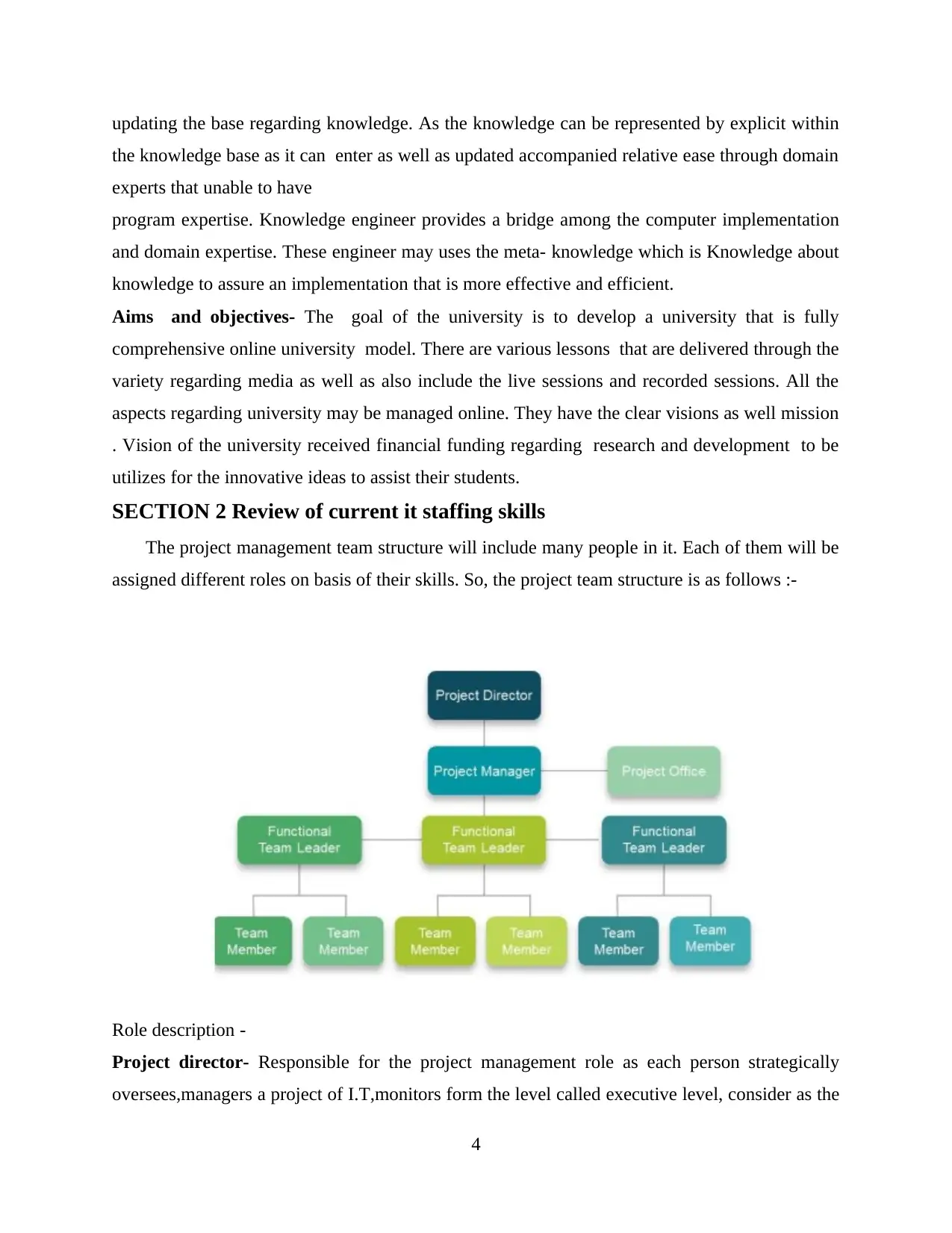
The project management team structure will include many people in it. Each of them will be
assigned different roles on basis of their skills. So, the project team structure is as follows :-
Role description -
Project director- Responsible for the project management role as each person strategically
oversees,managers a project of I.T,monitors form the level called executive level, consider as the
4
the knowledge base as it can enter as well as updated accompanied relative ease through domain
experts that unable to have
program expertise. Knowledge engineer provides a bridge among the computer implementation
and domain expertise. These engineer may uses the meta- knowledge which is Knowledge about
knowledge to assure an implementation that is more effective and efficient.
Aims and objectives- The goal of the university is to develop a university that is fully
comprehensive online university model. There are various lessons that are delivered through the
variety regarding media as well as also include the live sessions and recorded sessions. All the
aspects regarding university may be managed online. They have the clear visions as well mission
. Vision of the university received financial funding regarding research and development to be
utilizes for the innovative ideas to assist their students.
SECTION 2 Review of current it staffing skills
The project management team structure will include many people in it. Each of them will be
assigned different roles on basis of their skills. So, the project team structure is as follows :-
Role description -
Project director- Responsible for the project management role as each person strategically
oversees,managers a project of I.T,monitors form the level called executive level, consider as the
4
Paraphrase This Document
Need a fresh take? Get an instant paraphrase of this document with our AI Paraphraser
most responsible authority within a project. This person can charge accompanied managing team
of IT Members as well as allocated resources.
Project manager- Accountable for the overall responsibilities such as execution,controlling,
monitoring, design, execution as well as closure of the project.
Functional team leader- Accountable for guiding the group of the employees while finishing
project as they are accountable for implementing and developing a timeline their team members
to reach as the end goals.
Team member- To boost a team environment as assists each other to successfully achieve the
goals that can be assigned to them regarding various projects as well as duties (Jinwu, 2017)..
Staffing policy plan
Staffing policy refers a process of getting and selecting employees for required job role. Staffing
policy involve all required skills and guidelines which needs to be followed by employees for
performing job role offered by the organization. In the context of well-established University of
UK which wants to develop a fully comprehensive university model and making an effective use
of technology for all types of activities, require effective staff (Mohamed and et.al., 2018). Staff
plays an important role as they are the one who support companies and universities in
performing their activities and help them in accomplishing goals. There are some objecting of
developing staffing policy such as:
To Get reliable information in order to accomplish university's goals.
To make sure timely satisfaction of university staffing needs with qualified and skilled
personnel.
To make sure effectiveness of staff work in order to increase productivity at grid complex
company.
For getting effective staff and accomplishing goal of the University, it is important for this
University to make an effective staffing policy by following discussed steps:
Identifying staffing needs or business goal: Before making a plan and recruiting
employees, it is important to identify needs or the main reason of staffing. In the context of
university, it can be said that it wants to employ people because of accomplishing its goal of
making its educational system more advance or E-university.
5
of IT Members as well as allocated resources.
Project manager- Accountable for the overall responsibilities such as execution,controlling,
monitoring, design, execution as well as closure of the project.
Functional team leader- Accountable for guiding the group of the employees while finishing
project as they are accountable for implementing and developing a timeline their team members
to reach as the end goals.
Team member- To boost a team environment as assists each other to successfully achieve the
goals that can be assigned to them regarding various projects as well as duties (Jinwu, 2017)..
Staffing policy plan
Staffing policy refers a process of getting and selecting employees for required job role. Staffing
policy involve all required skills and guidelines which needs to be followed by employees for
performing job role offered by the organization. In the context of well-established University of
UK which wants to develop a fully comprehensive university model and making an effective use
of technology for all types of activities, require effective staff (Mohamed and et.al., 2018). Staff
plays an important role as they are the one who support companies and universities in
performing their activities and help them in accomplishing goals. There are some objecting of
developing staffing policy such as:
To Get reliable information in order to accomplish university's goals.
To make sure timely satisfaction of university staffing needs with qualified and skilled
personnel.
To make sure effectiveness of staff work in order to increase productivity at grid complex
company.
For getting effective staff and accomplishing goal of the University, it is important for this
University to make an effective staffing policy by following discussed steps:
Identifying staffing needs or business goal: Before making a plan and recruiting
employees, it is important to identify needs or the main reason of staffing. In the context of
university, it can be said that it wants to employ people because of accomplishing its goal of
making its educational system more advance or E-university.
5
Current staffing situation: After identifying staffing needs, university requires to
analyse its current staffing situation as how many employees it already has and how many it will
require more in order to meet IT needs.
Forecasting future staffing needs: After accessing current staffing, it is also important
to identify future needs. Because this university has an effective vision for which it will require
to have staff who retain within university for the long run. The main important factor for which
university require to follow this step is turnover rate or retention rate.
Gap analysis: By analysing current and future staffing needs, university needs to identify
the gap. In this analysis, it looks at where its staff is now and where it needs to be. In the context
of university, it is identified that it wants to hire effective and skilled IT staff who can help it in
making its educational system advance and managing all activities online.
Staffing plan: After following all steps and identifying staffing needs, university can
make a plan in which it requires including recommendation to implement a corporate training
program with the main aim to address skill gap (How to Develop a Staffing Plan, 2019).
Developing succession policies, effective guidelines and developing training programs,
university can make its effective staffing plan. With the help of this plan it can get skilled
workforce. For making successful policy, it can also be said that university should work with
business leaders as leader can align staffing needs with business goals.
So, from the above, it can be said that by following all steps in a sequence, university can
accomplish its vision of making educational system advance by getting skilled staff members.
University have to adopt the fast as well as changing the environment as the staff
members of the university need to make the change smooth as the Human resource manager
must know the precisely about the skills of the firm's staff, based on the provided information,
university able to organize the training as well as seminars so that the gaps can easily fulfilled as
well as knowledge skills. Mention below some few ways that can reviews the skills of the staff
members.
Give Employee a test- It is considered as the efficient and traditional way to review theoretical
and technical knowledge. Such tests are also conducted within the laboratory conditions, so that
they are unable to provide the precise pictures that the staff members will capable to utilizes the
knowledge within real life or not. These tests can be used by the university occasionally
otherwise that may be disappointed when it comes to the more realistic situations.
6
analyse its current staffing situation as how many employees it already has and how many it will
require more in order to meet IT needs.
Forecasting future staffing needs: After accessing current staffing, it is also important
to identify future needs. Because this university has an effective vision for which it will require
to have staff who retain within university for the long run. The main important factor for which
university require to follow this step is turnover rate or retention rate.
Gap analysis: By analysing current and future staffing needs, university needs to identify
the gap. In this analysis, it looks at where its staff is now and where it needs to be. In the context
of university, it is identified that it wants to hire effective and skilled IT staff who can help it in
making its educational system advance and managing all activities online.
Staffing plan: After following all steps and identifying staffing needs, university can
make a plan in which it requires including recommendation to implement a corporate training
program with the main aim to address skill gap (How to Develop a Staffing Plan, 2019).
Developing succession policies, effective guidelines and developing training programs,
university can make its effective staffing plan. With the help of this plan it can get skilled
workforce. For making successful policy, it can also be said that university should work with
business leaders as leader can align staffing needs with business goals.
So, from the above, it can be said that by following all steps in a sequence, university can
accomplish its vision of making educational system advance by getting skilled staff members.
University have to adopt the fast as well as changing the environment as the staff
members of the university need to make the change smooth as the Human resource manager
must know the precisely about the skills of the firm's staff, based on the provided information,
university able to organize the training as well as seminars so that the gaps can easily fulfilled as
well as knowledge skills. Mention below some few ways that can reviews the skills of the staff
members.
Give Employee a test- It is considered as the efficient and traditional way to review theoretical
and technical knowledge. Such tests are also conducted within the laboratory conditions, so that
they are unable to provide the precise pictures that the staff members will capable to utilizes the
knowledge within real life or not. These tests can be used by the university occasionally
otherwise that may be disappointed when it comes to the more realistic situations.
6
⊘ This is a preview!⊘
Do you want full access?
Subscribe today to unlock all pages.
Trusted by 1+ million students worldwide
Ask them to prepare self – Assessment
Principles or top management people of the university sends a personnel an
questionnaire that they must fill it by own. While on the other hand it might not benefit from
such objective point of view within either way as their analysis is too pessimistic or optimistic as
this method must be used within the combination accompanied objective one or other.
Feedback from teams
This is considered as ask to share the feedback on the performance of each other staff
members as well as focuses on the high level job (Shetty, Polekar, Das,. and Pansambal, 2016)..
Put them within real situations
It is considered as the most efficient way to assess and train the employees, Here nothing
can be better than the real practice, but what happens when the real time comes and the staff
members fails so it make sure that the staff members able to perform task as well as make it start
with other various actions.
SECTION 3 Staffing approaches
Type of structure for project
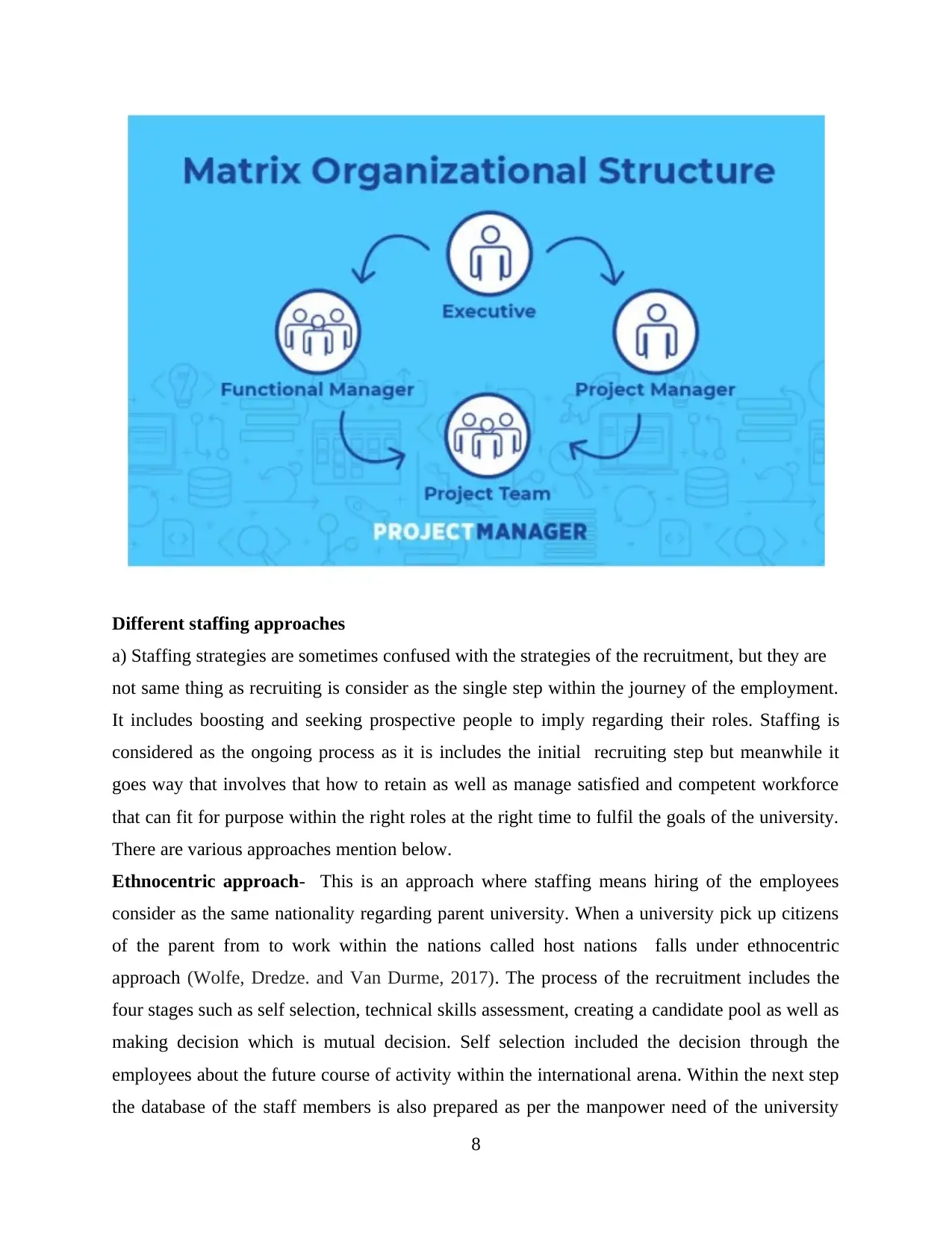
The project will have matrix structure in which there will be project manager, project
team, functional manager and executive.
7
Principles or top management people of the university sends a personnel an
questionnaire that they must fill it by own. While on the other hand it might not benefit from
such objective point of view within either way as their analysis is too pessimistic or optimistic as
this method must be used within the combination accompanied objective one or other.
Feedback from teams
This is considered as ask to share the feedback on the performance of each other staff
members as well as focuses on the high level job (Shetty, Polekar, Das,. and Pansambal, 2016)..
Put them within real situations
It is considered as the most efficient way to assess and train the employees, Here nothing
can be better than the real practice, but what happens when the real time comes and the staff
members fails so it make sure that the staff members able to perform task as well as make it start
with other various actions.
SECTION 3 Staffing approaches
Type of structure for project
The project will have matrix structure in which there will be project manager, project
team, functional manager and executive.
7
Paraphrase This Document
Need a fresh take? Get an instant paraphrase of this document with our AI Paraphraser
Different staffing approaches
a) Staffing strategies are sometimes confused with the strategies of the recruitment, but they are
not same thing as recruiting is consider as the single step within the journey of the employment.
It includes boosting and seeking prospective people to imply regarding their roles. Staffing is
considered as the ongoing process as it is includes the initial recruiting step but meanwhile it
goes way that involves that how to retain as well as manage satisfied and competent workforce
that can fit for purpose within the right roles at the right time to fulfil the goals of the university.
There are various approaches mention below.
Ethnocentric approach- This is an approach where staffing means hiring of the employees
consider as the same nationality regarding parent university. When a university pick up citizens
of the parent from to work within the nations called host nations falls under ethnocentric
approach (Wolfe, Dredze. and Van Durme, 2017). The process of the recruitment includes the
four stages such as self selection, technical skills assessment, creating a candidate pool as well as
making decision which is mutual decision. Self selection included the decision through the
employees about the future course of activity within the international arena. Within the next step
the database of the staff members is also prepared as per the manpower need of the university
8
a) Staffing strategies are sometimes confused with the strategies of the recruitment, but they are
not same thing as recruiting is consider as the single step within the journey of the employment.
It includes boosting and seeking prospective people to imply regarding their roles. Staffing is
considered as the ongoing process as it is includes the initial recruiting step but meanwhile it
goes way that involves that how to retain as well as manage satisfied and competent workforce
that can fit for purpose within the right roles at the right time to fulfil the goals of the university.
There are various approaches mention below.
Ethnocentric approach- This is an approach where staffing means hiring of the employees
consider as the same nationality regarding parent university. When a university pick up citizens
of the parent from to work within the nations called host nations falls under ethnocentric
approach (Wolfe, Dredze. and Van Durme, 2017). The process of the recruitment includes the
four stages such as self selection, technical skills assessment, creating a candidate pool as well as
making decision which is mutual decision. Self selection included the decision through the
employees about the future course of activity within the international arena. Within the next step
the database of the staff members is also prepared as per the manpower need of the university
8
regarding the international operations. After that the database is analysed regarding for choosing
the most and best suitable persons for technical skills assessment and global assignments. Thus,
the best candidate is recognized regarding foreign assignments as well as with his consent sent
to abroad.
Polycentric approach- Here the university adopts the approach of limiting recruitment to the
local public. The aim of adopting approach is to decrease the price regarding cost of the foreign
operations. Even those university that adopt the ethnocentric approach also switch to the
approach called Polycentric approach. The primary aim to handling over the management
regarding local people is to assure that the university understands the conditions of the local
market, cultural ,legal and political scenario better. The university that adopts this framework
have also localized department of the Human resource of the university within that nation.
Various international university operating their branches within the developed nations such as
Japan and Britain that adopts this approach regarding recruiting managers to the various
branches.
Geocentric approach- When a university adopts the strategy regrading recruiting suitable
people for available option in irrespective of their nationalities. It is known as the approach
called geocentric approach. university that truly global within this approaching adopts as it uses
the integrated global business strategy as the operations of the human resource are focussed on
the various factors such as ethical and political factors as well as government laws. It is very hard
to adopt such kind of approach as there are large international university that adopts such
strategy within the success. The recruitment on the foreign soil ,university especially focuses
utilizes the manpower agencies as well as repute to the source new staff, Also the effective
utilization of the internal resources regarding global university and recruitment required to
develop the data internally of the staff members as well as effective system of tracking system to
recognizes the most suitable condition for the posting of the global candidates. It is considered
as the best geocentric approach that utilizes by the managers regarding a business without the
regard for their nation (Wolfe, Dredze. and Van Durme, 2017).
Regiocentric approach
It is considered as the one of the methods regarding the recruitment internationally that
the Multi national university consider as the most suitable for the staff members for the job
regarding the nationality. This approach utilizes that the managers from different nations in
9
the most and best suitable persons for technical skills assessment and global assignments. Thus,
the best candidate is recognized regarding foreign assignments as well as with his consent sent
to abroad.
Polycentric approach- Here the university adopts the approach of limiting recruitment to the
local public. The aim of adopting approach is to decrease the price regarding cost of the foreign
operations. Even those university that adopt the ethnocentric approach also switch to the
approach called Polycentric approach. The primary aim to handling over the management
regarding local people is to assure that the university understands the conditions of the local
market, cultural ,legal and political scenario better. The university that adopts this framework
have also localized department of the Human resource of the university within that nation.
Various international university operating their branches within the developed nations such as
Japan and Britain that adopts this approach regarding recruiting managers to the various
branches.
Geocentric approach- When a university adopts the strategy regrading recruiting suitable
people for available option in irrespective of their nationalities. It is known as the approach
called geocentric approach. university that truly global within this approaching adopts as it uses
the integrated global business strategy as the operations of the human resource are focussed on
the various factors such as ethical and political factors as well as government laws. It is very hard
to adopt such kind of approach as there are large international university that adopts such
strategy within the success. The recruitment on the foreign soil ,university especially focuses
utilizes the manpower agencies as well as repute to the source new staff, Also the effective
utilization of the internal resources regarding global university and recruitment required to
develop the data internally of the staff members as well as effective system of tracking system to
recognizes the most suitable condition for the posting of the global candidates. It is considered
as the best geocentric approach that utilizes by the managers regarding a business without the
regard for their nation (Wolfe, Dredze. and Van Durme, 2017).
Regiocentric approach
It is considered as the one of the methods regarding the recruitment internationally that
the Multi national university consider as the most suitable for the staff members for the job
regarding the nationality. This approach utilizes that the managers from different nations in
9
⊘ This is a preview!⊘
Do you want full access?
Subscribe today to unlock all pages.
Trusted by 1+ million students worldwide
geographical regions of the business. Also, the managers can operate independently within
region as they are not moved normally to the university headquarters.
B) Here university is adopting the Polycentric approach the goals of adopting this framework is
to reduce cost regarding operations of foreign. The basic goal of the handling the local persons
is to ensure that the university focuses on the approach of the cultural market ,local
market ,politician and legal market. The university also adopt such kinds of the framework as
well as also have the capitalized department of the human resource of the organization in that
country (Shetty, Polekar. and Pansambal, 2016)..
c) Ethical impact of the Polycentric approach- The local candidates' skills and knowledge is
lower than the Foreign students and still recruited by the universities for the various company so
this creates a conflict among the university and students as it is highly unethical to the
candidates without having the proper knowledge can be hired for the various posts as it is vital
for the national to hire the skilled and talented labour for enhancing the productivity of the
nations.
Section 4 IT installation plan
Methodology for project
Agile methodology
It is considered as the practices that able to promotes the iteration continuously as well as
testing the development regrading software of the cycle regarding project. Both the testing as
well as development actions are different from the model of waterfall. It has core values such as
collaboration of the consumer over the contract negotiation,working software as well as
individual and interaction of the team over the tools and process.( Mahajan. and Agrawal, 2018).
IT implementation plan
System and software requirements- it is first stage where system and software requirements are
identified. this means hardware and software specifications is selected.
Feasibility study – here, feasibility study is conducted which determine viability of project. the
feasibility is measured in terms of economic, legal way, etc.
Software requirement specification – in this software requirement specification is determined.
User interface requirements- here, the user requirement is identified. this include the entire
interface of app or project.
10
region as they are not moved normally to the university headquarters.
B) Here university is adopting the Polycentric approach the goals of adopting this framework is
to reduce cost regarding operations of foreign. The basic goal of the handling the local persons
is to ensure that the university focuses on the approach of the cultural market ,local
market ,politician and legal market. The university also adopt such kinds of the framework as
well as also have the capitalized department of the human resource of the organization in that
country (Shetty, Polekar. and Pansambal, 2016)..
c) Ethical impact of the Polycentric approach- The local candidates' skills and knowledge is
lower than the Foreign students and still recruited by the universities for the various company so
this creates a conflict among the university and students as it is highly unethical to the
candidates without having the proper knowledge can be hired for the various posts as it is vital
for the national to hire the skilled and talented labour for enhancing the productivity of the
nations.
Section 4 IT installation plan
Methodology for project
Agile methodology
It is considered as the practices that able to promotes the iteration continuously as well as
testing the development regrading software of the cycle regarding project. Both the testing as
well as development actions are different from the model of waterfall. It has core values such as
collaboration of the consumer over the contract negotiation,working software as well as
individual and interaction of the team over the tools and process.( Mahajan. and Agrawal, 2018).
IT implementation plan
System and software requirements- it is first stage where system and software requirements are
identified. this means hardware and software specifications is selected.
Feasibility study – here, feasibility study is conducted which determine viability of project. the
feasibility is measured in terms of economic, legal way, etc.
Software requirement specification – in this software requirement specification is determined.
User interface requirements- here, the user requirement is identified. this include the entire
interface of app or project.
10
Paraphrase This Document
Need a fresh take? Get an instant paraphrase of this document with our AI Paraphraser
Analysis- In this requirement is analysed with project.
Prioritise requirements – the requirement is prioritised on basis of its need.
Selection of hardware and software – the hardware and software are selected on basis of
requirement (Shetty, Polekar, Das,. and Pansambal, 2016).
Design –
Designing IT infrastructure- here, overall IT design is developed.
Coding
Writing code in programming – the programming is done in particular language. Also, codes are
written along with it.
Finding errors- the errors are identified by running programs and codes.
Testing
Testing software and system- the system and software selected are tested. The efficiency of
system is tested with its requirement.
Identifying errors and solving- the results are measured and then compared with standards.
Operations
Installation – in this systems are installed.
Monitoring- here, monitoring of system is done.
Ghantt chart
Task Name Duration Start Finish
System and software
requirements- 3 days Tue 1/28/20 Thu 1/30/20
Feasibility study 3 days Tue 1/28/20 Thu 1/30/20
Software requirement
specification 2 days Fri 1/31/20 Mon 2/3/20
User interface
requirements 3 days Tue 2/4/20 Thu 2/6/20
Analysis 4 days Fri 2/7/20 Wed 2/12/20
Prioritise requirements 4 days Fri 2/7/20 Wed 2/12/20
Selection of hardware and
software 5 days Thu 2/13/20 Wed 2/19/20
Design 7 days Thu 2/20/20 Fri 2/28/20
11
Prioritise requirements – the requirement is prioritised on basis of its need.
Selection of hardware and software – the hardware and software are selected on basis of
requirement (Shetty, Polekar, Das,. and Pansambal, 2016).
Design –
Designing IT infrastructure- here, overall IT design is developed.
Coding
Writing code in programming – the programming is done in particular language. Also, codes are
written along with it.
Finding errors- the errors are identified by running programs and codes.
Testing
Testing software and system- the system and software selected are tested. The efficiency of
system is tested with its requirement.
Identifying errors and solving- the results are measured and then compared with standards.
Operations
Installation – in this systems are installed.
Monitoring- here, monitoring of system is done.
Ghantt chart
Task Name Duration Start Finish
System and software
requirements- 3 days Tue 1/28/20 Thu 1/30/20
Feasibility study 3 days Tue 1/28/20 Thu 1/30/20
Software requirement
specification 2 days Fri 1/31/20 Mon 2/3/20
User interface
requirements 3 days Tue 2/4/20 Thu 2/6/20
Analysis 4 days Fri 2/7/20 Wed 2/12/20
Prioritise requirements 4 days Fri 2/7/20 Wed 2/12/20
Selection of hardware and
software 5 days Thu 2/13/20 Wed 2/19/20
Design 7 days Thu 2/20/20 Fri 2/28/20
11
Designing IT
infrastructure 7 days Thu 2/20/20 Fri 2/28/20
Coding 10 days Mon 3/2/20 Fri 3/13/20
Writing code in
programming 10 days Mon 3/2/20 Fri 3/13/20
Finding errors 5 days Mon 3/16/20 Fri 3/20/20
Testing 8 days Mon 3/23/20 Wed 4/1/20
Testing software and
system 8 days Mon 3/23/20 Wed 4/1/20
Identifying errors and
solving 6 days Thu 4/2/20 Thu 4/9/20
Operations 15 days Fri 4/10/20 Thu 4/30/20
Installation 15 days Fri 4/10/20 Thu 4/30/20
Monitoring 5 days Fri 5/1/20 Thu 5/7/20
Budget
12
infrastructure 7 days Thu 2/20/20 Fri 2/28/20
Coding 10 days Mon 3/2/20 Fri 3/13/20
Writing code in
programming 10 days Mon 3/2/20 Fri 3/13/20
Finding errors 5 days Mon 3/16/20 Fri 3/20/20
Testing 8 days Mon 3/23/20 Wed 4/1/20
Testing software and
system 8 days Mon 3/23/20 Wed 4/1/20
Identifying errors and
solving 6 days Thu 4/2/20 Thu 4/9/20
Operations 15 days Fri 4/10/20 Thu 4/30/20
Installation 15 days Fri 4/10/20 Thu 4/30/20
Monitoring 5 days Fri 5/1/20 Thu 5/7/20
Budget
12
⊘ This is a preview!⊘
Do you want full access?
Subscribe today to unlock all pages.
Trusted by 1+ million students worldwide

1 out of 20


Related Documents


Your All-in-One AI-Powered Toolkit for Academic Success.
+13062052269
info@desklib.com
Available 24*7 on WhatsApp / Email
![[object Object]](/_next/static/media/star-bottom.7253800d.svg)
Unlock your academic potential
Copyright © 2020–2026 A2Z Services. All Rights Reserved. Developed and managed by ZUCOL.