The Impact of Information Technology on Innovation in SMEs Report
VerifiedAdded on 2024/05/21
|15
|4162
|438
Report
AI Summary
This report investigates the role of information technology in fueling innovation within small and medium-sized enterprises (SMEs). It begins by introducing the importance of SMEs and the increasing need for IT adoption to gain a competitive edge. The problem statement highlights challenges in adapting and implementing IT innovations, such as insufficient knowledge, funding issues, and management barriers. The rationale emphasizes the hyper-competitive environment and the necessity for SMEs to adopt innovative processes through IT. The report aims to identify the impact of IT on business performance and explores the relationship between innovation and IT, key determinants, and advantages/disadvantages. It reviews the concept of innovation, the current status of IT investments, IT adoption within SMEs, and the link between IT investment, innovation, and organizational performance. The methodology outlines the research philosophy, approach, design, data collection method, sampling technique, ethical considerations, and limitations. The report concludes by examining how effective synchronization between IT initiatives and innovative activity can lead to improved organizational performance and customer loyalty.

MSTF- RP
1
1

Paraphrase This Document
Need a fresh take? Get an instant paraphrase of this document with our AI Paraphraser
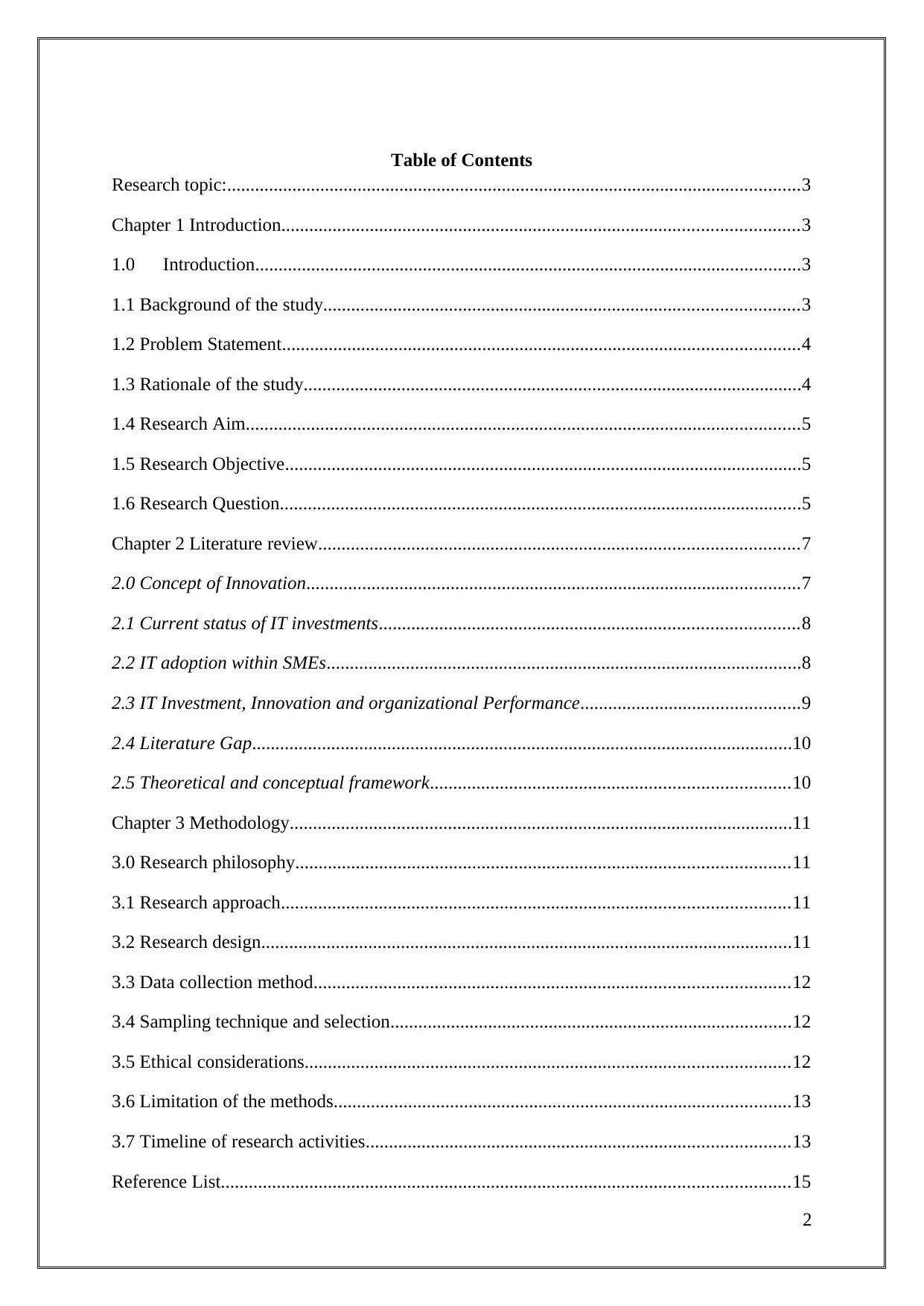
Table of Contents
Research topic:...........................................................................................................................3
Chapter 1 Introduction...............................................................................................................3
1.0 Introduction.....................................................................................................................3
1.1 Background of the study......................................................................................................3
1.2 Problem Statement...............................................................................................................4
1.3 Rationale of the study...........................................................................................................4
1.4 Research Aim.......................................................................................................................5
1.5 Research Objective...............................................................................................................5
1.6 Research Question................................................................................................................5
Chapter 2 Literature review.......................................................................................................7
2.0 Concept of Innovation..........................................................................................................7
2.1 Current status of IT investments..........................................................................................8
2.2 IT adoption within SMEs......................................................................................................8
2.3 IT Investment, Innovation and organizational Performance...............................................9
2.4 Literature Gap....................................................................................................................10
2.5 Theoretical and conceptual framework.............................................................................10
Chapter 3 Methodology............................................................................................................11
3.0 Research philosophy..........................................................................................................11
3.1 Research approach.............................................................................................................11
3.2 Research design..................................................................................................................11
3.3 Data collection method......................................................................................................12
3.4 Sampling technique and selection......................................................................................12
3.5 Ethical considerations........................................................................................................12
3.6 Limitation of the methods..................................................................................................13
3.7 Timeline of research activities...........................................................................................13
Reference List..........................................................................................................................15
2
Research topic:...........................................................................................................................3
Chapter 1 Introduction...............................................................................................................3
1.0 Introduction.....................................................................................................................3
1.1 Background of the study......................................................................................................3
1.2 Problem Statement...............................................................................................................4
1.3 Rationale of the study...........................................................................................................4
1.4 Research Aim.......................................................................................................................5
1.5 Research Objective...............................................................................................................5
1.6 Research Question................................................................................................................5
Chapter 2 Literature review.......................................................................................................7
2.0 Concept of Innovation..........................................................................................................7
2.1 Current status of IT investments..........................................................................................8
2.2 IT adoption within SMEs......................................................................................................8
2.3 IT Investment, Innovation and organizational Performance...............................................9
2.4 Literature Gap....................................................................................................................10
2.5 Theoretical and conceptual framework.............................................................................10
Chapter 3 Methodology............................................................................................................11
3.0 Research philosophy..........................................................................................................11
3.1 Research approach.............................................................................................................11
3.2 Research design..................................................................................................................11
3.3 Data collection method......................................................................................................12
3.4 Sampling technique and selection......................................................................................12
3.5 Ethical considerations........................................................................................................12
3.6 Limitation of the methods..................................................................................................13
3.7 Timeline of research activities...........................................................................................13
Reference List..........................................................................................................................15
2
Research topic:
Fuelling innovation through information technology in SMEs
Chapter 1 Introduction
1.0 Introduction
“Small and medium-sized” organizations currently report for major source of various kinds of
jobs, technical developments and “competitive advantages” for both the developed and
emerging countries. Owing to the increased competition and need for penetrating to
international market undergone by SMEs, these organizations are effectively employing IT
technologies to achieve benefit of its considerable benefits. Most of the previous researches
and studies in this regard have focused on Information Technology adoption in leading
corporations. However, the procedure of IT adoption in SMEs is considerably different. The
aim of this study is to examine and evaluate the mediating influences of IT on the
relationships among process and product innovations as well as organizational performance.
Successful completion of this study would be able to develop an understanding and
knowledge regarding necessity of innovation through IT technologies in SMEs.
1.1 Background of the study
A pledge to innovation has long been measured to be necessary to the achievement of small
and medium-sized ventures. Several researchers have shown the fact that innovation actually
helps to stimulates organizational growth along with useful in providing an important source
of competitive advantage in the deficiency of scale economies. Effective innovation might be
dependent on the attendance of other company-specific competencies and skills. For instance,
substantial evidences have begun to reflect that proper planned employment of “Information
Technology” might be significant in translating organizational strategies to developed
organizational performance. With increasing demand for different information technology
tools mangers now have stated to consider application of IT as a competitive technology in
their organizations. Morgan-Thomas (2016) has opinionated that through information
technology tools, companies could be able to outperform market competitors who do not
3
Fuelling innovation through information technology in SMEs
Chapter 1 Introduction
1.0 Introduction
“Small and medium-sized” organizations currently report for major source of various kinds of
jobs, technical developments and “competitive advantages” for both the developed and
emerging countries. Owing to the increased competition and need for penetrating to
international market undergone by SMEs, these organizations are effectively employing IT
technologies to achieve benefit of its considerable benefits. Most of the previous researches
and studies in this regard have focused on Information Technology adoption in leading
corporations. However, the procedure of IT adoption in SMEs is considerably different. The
aim of this study is to examine and evaluate the mediating influences of IT on the
relationships among process and product innovations as well as organizational performance.
Successful completion of this study would be able to develop an understanding and
knowledge regarding necessity of innovation through IT technologies in SMEs.
1.1 Background of the study
A pledge to innovation has long been measured to be necessary to the achievement of small
and medium-sized ventures. Several researchers have shown the fact that innovation actually
helps to stimulates organizational growth along with useful in providing an important source
of competitive advantage in the deficiency of scale economies. Effective innovation might be
dependent on the attendance of other company-specific competencies and skills. For instance,
substantial evidences have begun to reflect that proper planned employment of “Information
Technology” might be significant in translating organizational strategies to developed
organizational performance. With increasing demand for different information technology
tools mangers now have stated to consider application of IT as a competitive technology in
their organizations. Morgan-Thomas (2016) has opinionated that through information
technology tools, companies could be able to outperform market competitors who do not
3
⊘ This is a preview!⊘
Do you want full access?
Subscribe today to unlock all pages.

Trusted by 1+ million students worldwide
invest in the same area. Study regarding all these areas would be helpful to acknowledge how
and why innovation through IT is necessary within budding SMEs.
1.2 Problem Statement
Precisely, this study is intended to disclose an effective investigation on changing
environment in SMEs because of innovation in the information technology operations.
Though it is an important part of small enterprise and several organizations have realized
necessity of innovation through information technology, several challenges are there within
adaptation and implementation of innovation in this department (Avgerou and Walsham,
2017). Core challenges that have been identified through researchers associated to this field
are insufficient knowledge regarding innovative processes, funding issues, management
barriers and others. These challenges are offering an insight to the current environment of
Information Technology and implementation barriers. Identification of problem statements
related to fuelling innovations with the help of IT operations is helpful to recognize
advantages and disadvantages of this current necessity. On the other hand, problem
statements regarding information technology and innovation would be helpful to recognize
possible methods to overcome difficulties to process innovation swiftly within small and
medium-sized organizations through IT.
1.3 Rationale of the study
The modern financial environment that is dominated by hyper-competition, knowledge and
information uprising and globalization has shaped and transformed the way business is
conducted. Currently keeping pace with the developing efficiency level of SMEs in the
business environment, several organizations are acknowledging importance of innovations in
their organizations (Cavusgil and Knight, 2015). Commercialization of information
technology is becoming an important business necessity in small and medium-sized
organizations. Implementation and adaptation of innovative processes as well as technologies
in this operation is one of the leading issues within SMEs currently.
Increasing business pressure and constant competitive business environment are bestowing
pressure upon organizations to provide most efficient and innovative services and products to
their customers. In order to stand against this market pressure and need of differentiating
organizational image is compelling small and medium-sized to adopt and implement
innovative operations and techniques through information technology.
4
and why innovation through IT is necessary within budding SMEs.
1.2 Problem Statement
Precisely, this study is intended to disclose an effective investigation on changing
environment in SMEs because of innovation in the information technology operations.
Though it is an important part of small enterprise and several organizations have realized
necessity of innovation through information technology, several challenges are there within
adaptation and implementation of innovation in this department (Avgerou and Walsham,
2017). Core challenges that have been identified through researchers associated to this field
are insufficient knowledge regarding innovative processes, funding issues, management
barriers and others. These challenges are offering an insight to the current environment of
Information Technology and implementation barriers. Identification of problem statements
related to fuelling innovations with the help of IT operations is helpful to recognize
advantages and disadvantages of this current necessity. On the other hand, problem
statements regarding information technology and innovation would be helpful to recognize
possible methods to overcome difficulties to process innovation swiftly within small and
medium-sized organizations through IT.
1.3 Rationale of the study
The modern financial environment that is dominated by hyper-competition, knowledge and
information uprising and globalization has shaped and transformed the way business is
conducted. Currently keeping pace with the developing efficiency level of SMEs in the
business environment, several organizations are acknowledging importance of innovations in
their organizations (Cavusgil and Knight, 2015). Commercialization of information
technology is becoming an important business necessity in small and medium-sized
organizations. Implementation and adaptation of innovative processes as well as technologies
in this operation is one of the leading issues within SMEs currently.
Increasing business pressure and constant competitive business environment are bestowing
pressure upon organizations to provide most efficient and innovative services and products to
their customers. In order to stand against this market pressure and need of differentiating
organizational image is compelling small and medium-sized to adopt and implement
innovative operations and techniques through information technology.
4
Paraphrase This Document
Need a fresh take? Get an instant paraphrase of this document with our AI Paraphraser
Currently need of innovations for developing organizational performance and individual
competency level for achieving a leading position in the global market has been increased
and organizations are concerned in providing innovative services through information
technology to their consumers (Singla et al., 2018). All these points are helpful in developing
wider knowledge regarding information technology and its efficiency level for achieving
organizational mission, vision and objectives. Additionally, this study will enhanced
individual understanding level regarding effective innovative concepts and ideas to develop
overall proficiency level of SMEs.
1.4 Research Aim
The aim of this study is to identify necessity and urgency of innovations through information
technology along with its impact on overall business performance.
1.5 Research Objective
The objectives of this study are listed below.
To elaborate and investigate relationship between innovation and information
technology
To identify what are the key determinants and processes of fuelling innovation though
IT in SMEs
To critically evaluate advantages and disadvantages of bringing innovation through IT
operations within SMEs
1.6 Research Question
Research questions are listed below.
What are the key determinants and processes of fuelling innovation though IT in
SMEs?
What are the significant advantages and disadvantages of bringing innovation through
IT operations within SMEs?
How effective relationship between innovation and information technology could help
to develop organizational performance?
5
competency level for achieving a leading position in the global market has been increased
and organizations are concerned in providing innovative services through information
technology to their consumers (Singla et al., 2018). All these points are helpful in developing
wider knowledge regarding information technology and its efficiency level for achieving
organizational mission, vision and objectives. Additionally, this study will enhanced
individual understanding level regarding effective innovative concepts and ideas to develop
overall proficiency level of SMEs.
1.4 Research Aim
The aim of this study is to identify necessity and urgency of innovations through information
technology along with its impact on overall business performance.
1.5 Research Objective
The objectives of this study are listed below.
To elaborate and investigate relationship between innovation and information
technology
To identify what are the key determinants and processes of fuelling innovation though
IT in SMEs
To critically evaluate advantages and disadvantages of bringing innovation through IT
operations within SMEs
1.6 Research Question
Research questions are listed below.
What are the key determinants and processes of fuelling innovation though IT in
SMEs?
What are the significant advantages and disadvantages of bringing innovation through
IT operations within SMEs?
How effective relationship between innovation and information technology could help
to develop organizational performance?
5
Chapter 2 Literature review
2.0 Concept of Innovation
Innovations differ in difficulty and could range from minute changes to present services,
processes and services to get through products, which introduce foremost features or an
exceptional performance. According to Ghobakhloo et al. (2011), procedure definition of
innovation advocates themselves mainly with how the interaction among events and people at
every stage of the main process impacts in subsequent stages, deciding whether the
adaptation procedure would continue or not. On the other hand, Browning (2018) has opined
that innovation within organizations could be considered as a discrete event, which means
change occurs when there is actual approval of risk and the commitment of necessary
resources occurs. Several others have suggested that this process is an idea, concept and
practice that adopting individuals and companies regards as new.
From this viewpoint, it could be said that this newness associated to an organizational
innovation remains a subject of perception. This perception has further been discussed by
Nguyen et al. (2015), as “the willingness to place strong emphasis on research and
development, new products, new services, improved product lines, and general technological
improvement in the industry”. Despite several debates regarding the concept and definition of
innovation, success in this process typically needs effective managerial support as well as
resource commitment. Evaluations of innovation have been categorized into two main
research streams. The former “stream” evaluates matters associated to the diffusion of
innovations around industries, nations and companies. In this specific stream, an innovation
is described as a method, plan or management operation that a company or small business is
applying for the first time, whether or not its competitors have formerly implemented it. As
per the opinions of Nguyen et al. (2015), the later “stream” examines impact of
organizational structures, human resources and strategic procedures on the development as
well as marketing of new services and products. Within this stream, an innovation suggest to
a fresh manufactured goods, which a company has made for their target market and stand for
the commercialization of a creation, in which new creation is an act of insight.
6
2.0 Concept of Innovation
Innovations differ in difficulty and could range from minute changes to present services,
processes and services to get through products, which introduce foremost features or an
exceptional performance. According to Ghobakhloo et al. (2011), procedure definition of
innovation advocates themselves mainly with how the interaction among events and people at
every stage of the main process impacts in subsequent stages, deciding whether the
adaptation procedure would continue or not. On the other hand, Browning (2018) has opined
that innovation within organizations could be considered as a discrete event, which means
change occurs when there is actual approval of risk and the commitment of necessary
resources occurs. Several others have suggested that this process is an idea, concept and
practice that adopting individuals and companies regards as new.
From this viewpoint, it could be said that this newness associated to an organizational
innovation remains a subject of perception. This perception has further been discussed by
Nguyen et al. (2015), as “the willingness to place strong emphasis on research and
development, new products, new services, improved product lines, and general technological
improvement in the industry”. Despite several debates regarding the concept and definition of
innovation, success in this process typically needs effective managerial support as well as
resource commitment. Evaluations of innovation have been categorized into two main
research streams. The former “stream” evaluates matters associated to the diffusion of
innovations around industries, nations and companies. In this specific stream, an innovation
is described as a method, plan or management operation that a company or small business is
applying for the first time, whether or not its competitors have formerly implemented it. As
per the opinions of Nguyen et al. (2015), the later “stream” examines impact of
organizational structures, human resources and strategic procedures on the development as
well as marketing of new services and products. Within this stream, an innovation suggest to
a fresh manufactured goods, which a company has made for their target market and stand for
the commercialization of a creation, in which new creation is an act of insight.
6
⊘ This is a preview!⊘
Do you want full access?
Subscribe today to unlock all pages.
Trusted by 1+ million students worldwide
2.1 Current status of IT investments
With growing usage of IT technologies and commercialization, organizational managers now
consider the application of “Information technology as a competitive technology mostly
applied for the function of strategic plans and the support of organizations’ core
competencies”. As a matter of fact, investments in information technology by small
organizations have drastically escalated currently. According to Pearlson et al. (2016),
information technology could be used to impact an organization’s capability to achieve a
competitive advantage by connecting IT with organizational strategies. Lui et al. (2016) have
suggested that direct relationships between investments in Information technology potentials
and company’s financial performance help to develop overall organizational competitive
advantage. However, since previous researches have focused on the populace of leading and
often varied organizations, queries remain as to whether these outcomes could be generalized
to small businesses. Apparently, the more effective managerial competencies of small
organizations utter the extent of achievement of IT adaptation as well as the resulting positive
influences on economic performance.
2.2 IT adoption within SMEs
The IT adaptation process within small and medium-sized organizations have been
influenced by several factors such as management, organizational characteristics and
behaviours, available resources, consumers, governmental policies, external IT vendors and
consultants, and others. Process of IS/IT adaptation within small organizations have been
increased over the past few years. According to Evans and Bosua (2017), understanding
regarding IT and knowledge is an important resource influencing the process adaptation in
small organizations. Advancement of internal IT related knowledge as well as skills is one of
the most valuable basis needed for offering superior levels of IT implementation as well as
effectiveness within SMEs. On the other hand, Ghobakhloo et al. (2015) has identified that
“financial resources” are one of the considerable important resources that are well-known as
the core Small organizations’ performance need and subsequently critical achievement
factors on the basis of resource-based theory. Generally, currently most of small and
medium-sized organizations facing challenges for not having enough economic backups and
most of the business owners as well as mangers invest their individual assets. From this
discussion, it could be said that “limited financial resources” could induce small
organizations to be careful regarding their investments and assets spending.
7
With growing usage of IT technologies and commercialization, organizational managers now
consider the application of “Information technology as a competitive technology mostly
applied for the function of strategic plans and the support of organizations’ core
competencies”. As a matter of fact, investments in information technology by small
organizations have drastically escalated currently. According to Pearlson et al. (2016),
information technology could be used to impact an organization’s capability to achieve a
competitive advantage by connecting IT with organizational strategies. Lui et al. (2016) have
suggested that direct relationships between investments in Information technology potentials
and company’s financial performance help to develop overall organizational competitive
advantage. However, since previous researches have focused on the populace of leading and
often varied organizations, queries remain as to whether these outcomes could be generalized
to small businesses. Apparently, the more effective managerial competencies of small
organizations utter the extent of achievement of IT adaptation as well as the resulting positive
influences on economic performance.
2.2 IT adoption within SMEs
The IT adaptation process within small and medium-sized organizations have been
influenced by several factors such as management, organizational characteristics and
behaviours, available resources, consumers, governmental policies, external IT vendors and
consultants, and others. Process of IS/IT adaptation within small organizations have been
increased over the past few years. According to Evans and Bosua (2017), understanding
regarding IT and knowledge is an important resource influencing the process adaptation in
small organizations. Advancement of internal IT related knowledge as well as skills is one of
the most valuable basis needed for offering superior levels of IT implementation as well as
effectiveness within SMEs. On the other hand, Ghobakhloo et al. (2015) has identified that
“financial resources” are one of the considerable important resources that are well-known as
the core Small organizations’ performance need and subsequently critical achievement
factors on the basis of resource-based theory. Generally, currently most of small and
medium-sized organizations facing challenges for not having enough economic backups and
most of the business owners as well as mangers invest their individual assets. From this
discussion, it could be said that “limited financial resources” could induce small
organizations to be careful regarding their investments and assets spending.
7
Paraphrase This Document
Need a fresh take? Get an instant paraphrase of this document with our AI Paraphraser
Another essential influencing factor attributable to the higher level management
characteristics in regard of IT investments in small organizations is the CEO innovativeness,
both IT-specific terms and also in general. Individual innovativeness within IT investments
has been identified to be one of the reliable predictor of users’ perception and attitude about
the ease of use and efficiency of latest technologies (Ghobakhloo et al., 2011). Individual
innovativeness within IT could be defined as “the willingness of an individual to try out any
new information technology”.
2.3 IT Investment, Innovation and organizational Performance
Organizational performance is developed when there are effective synchronization among the
basics of a system. For instance, investment in IT alone does not provide proficiency and
growth without a series of corresponding developments and then also assurance in
information technology might detract from short-run profitability. According to Huijbens et
al. (2017), improvement also exists with the common characteristics, that is concentrating on
innovation is expected to impact on organizational systems and structures. For instance, as
innovation involves considerable risk, effective implementation needs making significant
systematic modifications in an organization in order to reduce risk. As per the suggestions of
Dodgson (2018), “open channels of communication, informal decision making and
decentralization, freely coupled decision linkages as well as loosely recognized job
descriptions along with flexibility in procedures and processes are all connected with
innovative activity.”
Information technology is considered as an important point to build innovative capacity of
organizations. Small organizational performance therefore developed when innovative
activity is balanced by IT initiatives, which effect in the efficient introduction of latest
innovative models, procedures and products or services. This process fits well with existing
operation within the firm, promoting effective development of consumer loyalty and
stimulating demands for other products. Results of several investigations in this area have
developed an understanding that small organizational that are pioneering are more likely to
adopt and implement IT infrastructure productively (Yeoh and Popovič, 2016). Generally,
organizational value and status in the market have been increased on those organizations that
are innovative rather than those that did not employ innovative strategies and procedures in
their operations.
8
characteristics in regard of IT investments in small organizations is the CEO innovativeness,
both IT-specific terms and also in general. Individual innovativeness within IT investments
has been identified to be one of the reliable predictor of users’ perception and attitude about
the ease of use and efficiency of latest technologies (Ghobakhloo et al., 2011). Individual
innovativeness within IT could be defined as “the willingness of an individual to try out any
new information technology”.
2.3 IT Investment, Innovation and organizational Performance
Organizational performance is developed when there are effective synchronization among the
basics of a system. For instance, investment in IT alone does not provide proficiency and
growth without a series of corresponding developments and then also assurance in
information technology might detract from short-run profitability. According to Huijbens et
al. (2017), improvement also exists with the common characteristics, that is concentrating on
innovation is expected to impact on organizational systems and structures. For instance, as
innovation involves considerable risk, effective implementation needs making significant
systematic modifications in an organization in order to reduce risk. As per the suggestions of
Dodgson (2018), “open channels of communication, informal decision making and
decentralization, freely coupled decision linkages as well as loosely recognized job
descriptions along with flexibility in procedures and processes are all connected with
innovative activity.”
Information technology is considered as an important point to build innovative capacity of
organizations. Small organizational performance therefore developed when innovative
activity is balanced by IT initiatives, which effect in the efficient introduction of latest
innovative models, procedures and products or services. This process fits well with existing
operation within the firm, promoting effective development of consumer loyalty and
stimulating demands for other products. Results of several investigations in this area have
developed an understanding that small organizational that are pioneering are more likely to
adopt and implement IT infrastructure productively (Yeoh and Popovič, 2016). Generally,
organizational value and status in the market have been increased on those organizations that
are innovative rather than those that did not employ innovative strategies and procedures in
their operations.
8
IT Investment, Innovation and organizational Performance
IT adoption within SMEs
Concept of Innovation Current status of IT investments
2.4 Literature Gap
From the existing literature review part as well as discussion regarding innovativeness and
IT, it could be said that importance of both these factors are increasing day by day. For
successful achievement of organizational objectives and combating with the rapid changing
business environment, innovation and IT investments are really important for most of the
small and medium organizations. On the other hand, from the above literature review part it
could be concluded that through this section identifies and consist of some valuable segments
of IT investments and innovativeness within small organization has deliberately fail to
address key determinants and processes of fuelling innovation though IT in SMEs
elaborative. This point need to be more constructive and expressive of the necessities so that
knowledge and understanding regarding this concept could be developed more. The
literature review part did not effective enough in describing advantages and disadvantages of
bringing innovation through IT operations within SMEs.
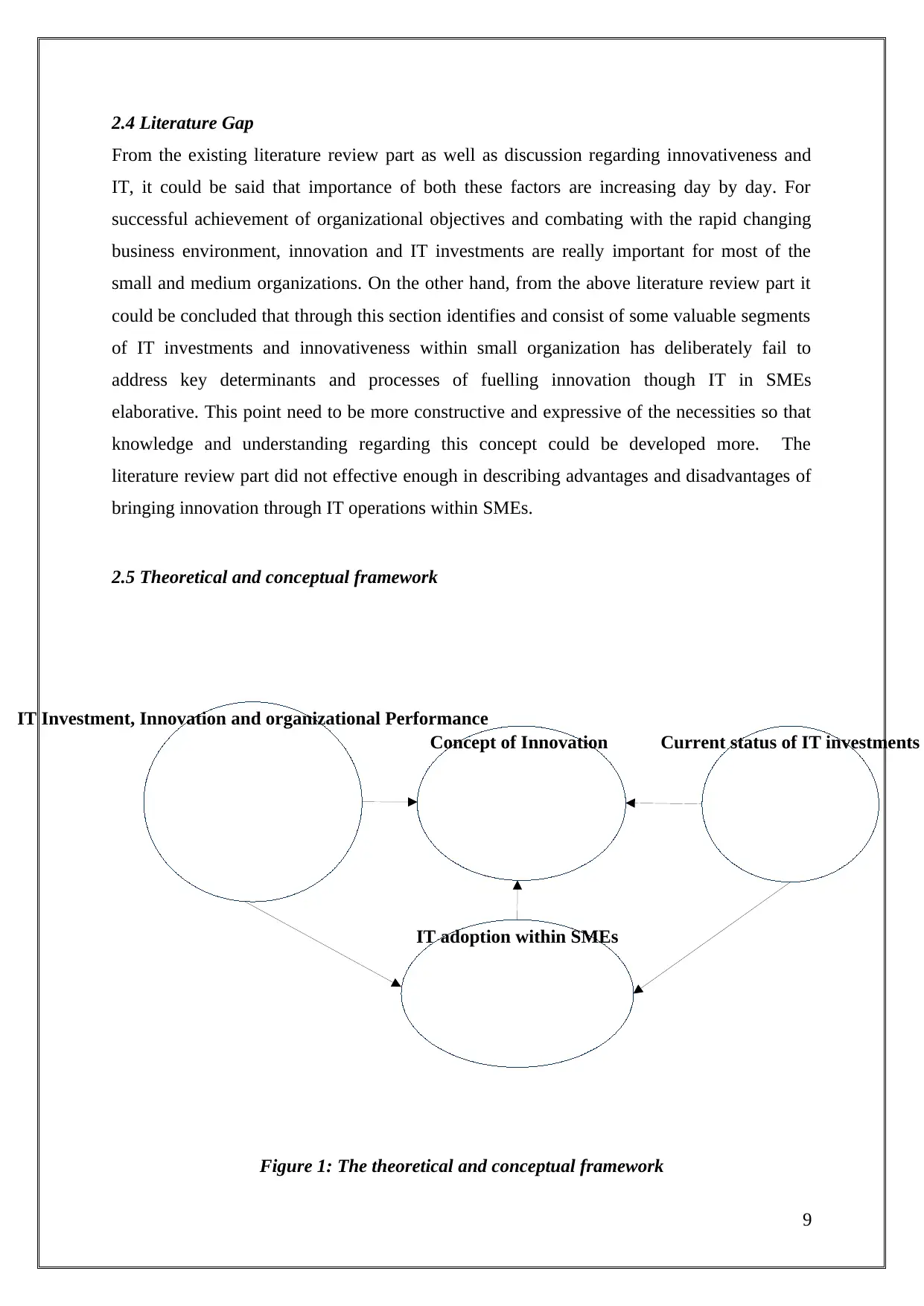
2.5 Theoretical and conceptual framework
Figure 1: The theoretical and conceptual framework
9
IT adoption within SMEs
Concept of Innovation Current status of IT investments
2.4 Literature Gap
From the existing literature review part as well as discussion regarding innovativeness and
IT, it could be said that importance of both these factors are increasing day by day. For
successful achievement of organizational objectives and combating with the rapid changing
business environment, innovation and IT investments are really important for most of the
small and medium organizations. On the other hand, from the above literature review part it
could be concluded that through this section identifies and consist of some valuable segments
of IT investments and innovativeness within small organization has deliberately fail to
address key determinants and processes of fuelling innovation though IT in SMEs
elaborative. This point need to be more constructive and expressive of the necessities so that
knowledge and understanding regarding this concept could be developed more. The
literature review part did not effective enough in describing advantages and disadvantages of
bringing innovation through IT operations within SMEs.
2.5 Theoretical and conceptual framework
Figure 1: The theoretical and conceptual framework
9
⊘ This is a preview!⊘
Do you want full access?
Subscribe today to unlock all pages.
Trusted by 1+ million students worldwide
(Source: Created by the learner)
Chapter 3 Methodology
3.0 Research philosophy
There are diverse types of research philosophies available that are “positivism, realism,
pragmatism and interpretivism”. Among these four types of research philosophies, positivism
research philosophy would be selected for this study. This type of research philosophy would
be effective for analyzing and extracting information from primary and secondary data
collection (Alvesson and Sköldberg, 2017). On the other hand, since an evaluation of
relationship between innovation and IT in SMEs would be examined along with identifying
advantages and disadvantages of innovation within organizations, a systematic and
qualitative evaluation with the help of positivism research philosophy would be useful.
3.1 Research approach
Among all types of research approach, namely inductive and deductive approach, deductive
research approach would be selected for this study. This research approach would be helpful
to complete the entire study within allocated timeframe (Sekaran and Bougie, 2016). The
deductive research approach would be effective for this research as preset theories and prior
researches on innovation through IT technology in small and medium organizations could be
investigated constructively with this approach.
3.2 Research design
Among three types of research designs such as descriptive, exploratory and explanatory
research designs, explanatory research design would be chosen in this study (Sekaran and
Bougie, 2016). This kind of research design would be effective for finding out various data
and concepts pertaining to the research area. This type of research design would be useful for
analyzing influences of innovation in developing employee as well as organizational
efficiency level standing in the midst of developing business environment.
10
Chapter 3 Methodology
3.0 Research philosophy
There are diverse types of research philosophies available that are “positivism, realism,
pragmatism and interpretivism”. Among these four types of research philosophies, positivism
research philosophy would be selected for this study. This type of research philosophy would
be effective for analyzing and extracting information from primary and secondary data
collection (Alvesson and Sköldberg, 2017). On the other hand, since an evaluation of
relationship between innovation and IT in SMEs would be examined along with identifying
advantages and disadvantages of innovation within organizations, a systematic and
qualitative evaluation with the help of positivism research philosophy would be useful.
3.1 Research approach
Among all types of research approach, namely inductive and deductive approach, deductive
research approach would be selected for this study. This research approach would be helpful
to complete the entire study within allocated timeframe (Sekaran and Bougie, 2016). The
deductive research approach would be effective for this research as preset theories and prior
researches on innovation through IT technology in small and medium organizations could be
investigated constructively with this approach.
3.2 Research design
Among three types of research designs such as descriptive, exploratory and explanatory
research designs, explanatory research design would be chosen in this study (Sekaran and
Bougie, 2016). This kind of research design would be effective for finding out various data
and concepts pertaining to the research area. This type of research design would be useful for
analyzing influences of innovation in developing employee as well as organizational
efficiency level standing in the midst of developing business environment.
10
Paraphrase This Document
Need a fresh take? Get an instant paraphrase of this document with our AI Paraphraser
3.3 Data collection method
These two types of data collection processes are “primary and secondary data collection
process”. The secondary data collection process refers to collecting information about the
given research topic through previous investigations done in the same field. Other sources of
secondary data collection process are journals, articles, online sources and others. On the
other hand, the primary data collection process has two parts such as qualitative and
quantitative data collection process. “Quantitative data collection method” helps in gathering
data through a mathematical way and by survey methods. “Qualitative data collection
process” is useful for collecting data and information form interview process of individual
(Alshenqeeti, 2014).
In this study, primary data collection process would be selected as this process would be
helpful in gathering all type of important information regarding the research area through
survey and interview process.
3.4 Sampling technique and selection
Both the probability and non-probability sampling method would be selected for this study
as probability sampling method is essential for Quantitative data collection method. On the
other hand, “non-probability sampling method” is helpful for Qualitative data collection
process (Etikan et al., 2016). The researcher would make a survey questionnaire for fifty
employees form small and medium organizations in order to access the current concern of
these types of companies in implementing innovation through IT technologies. The
researcher would be making an interview questionnaire for three managers from small
business enterprise to develop an understanding regarding their knowledge and concern in
bringing innovation through IT technologies within their companies and what would be their
suggestions regarding this area.
3.5 Ethical considerations
Probable ethical considerations are listed below.
Complete protection of private information of respondents and confidentiality of data
collected should be maintained while examining or investigating about given research
topic.
11
These two types of data collection processes are “primary and secondary data collection
process”. The secondary data collection process refers to collecting information about the
given research topic through previous investigations done in the same field. Other sources of
secondary data collection process are journals, articles, online sources and others. On the
other hand, the primary data collection process has two parts such as qualitative and
quantitative data collection process. “Quantitative data collection method” helps in gathering
data through a mathematical way and by survey methods. “Qualitative data collection
process” is useful for collecting data and information form interview process of individual
(Alshenqeeti, 2014).
In this study, primary data collection process would be selected as this process would be
helpful in gathering all type of important information regarding the research area through
survey and interview process.
3.4 Sampling technique and selection
Both the probability and non-probability sampling method would be selected for this study
as probability sampling method is essential for Quantitative data collection method. On the
other hand, “non-probability sampling method” is helpful for Qualitative data collection
process (Etikan et al., 2016). The researcher would make a survey questionnaire for fifty
employees form small and medium organizations in order to access the current concern of
these types of companies in implementing innovation through IT technologies. The
researcher would be making an interview questionnaire for three managers from small
business enterprise to develop an understanding regarding their knowledge and concern in
bringing innovation through IT technologies within their companies and what would be their
suggestions regarding this area.
3.5 Ethical considerations
Probable ethical considerations are listed below.
Complete protection of private information of respondents and confidentiality of data
collected should be maintained while examining or investigating about given research
topic.
11
Collected information should not be used for any commercial purpose by the
researcher.
Any kind of deceptive information should be avoided as well as representation of
information gathered from primary data collection should be legal.
Respondents should not be influenced or forced to take part within the survey or
interview process by the researcher.
All sources from where data would be gathered should be authentic and mentioned of
authors should be there in the research project.
3.6 Limitation of the methods
Probable research limitations are listed below.
One of the common challenges face by the researcher while conducting the research is
lack of enough information and materials related to the given study topic.
Another research limitation is lack of adequate understanding and knowledge about
the implementation process of data collection method. The researcher should have
effective knowledge regarding process and materials that would have been used in the
study, otherwise effective results could not been acquired from the entire research. On
the other hand, if data collection process is not applied with efficiency, scope of future
study would be limited.
The researcher should have proper understanding about the sample size to establish
statistical information, which is relative and efficient to create informative outcomes.
Another common limitation in the research project is the lack of budget allocation.
Proper financial support should be there while conducting the survey and interviews
otherwise, research could be disrupted.
Sometimes while extracting theoretical data form online sources, the researcher could
face difficulty in their availability.
3.7 Timeline of research activities
Important steps to be followed 1week 2-3
weeks
4-6
weeks
7-10
weeks
11-13
weeks
14-16
weeks
Research topic selection
12
researcher.
Any kind of deceptive information should be avoided as well as representation of
information gathered from primary data collection should be legal.
Respondents should not be influenced or forced to take part within the survey or
interview process by the researcher.
All sources from where data would be gathered should be authentic and mentioned of
authors should be there in the research project.
3.6 Limitation of the methods
Probable research limitations are listed below.
One of the common challenges face by the researcher while conducting the research is
lack of enough information and materials related to the given study topic.
Another research limitation is lack of adequate understanding and knowledge about
the implementation process of data collection method. The researcher should have
effective knowledge regarding process and materials that would have been used in the
study, otherwise effective results could not been acquired from the entire research. On
the other hand, if data collection process is not applied with efficiency, scope of future
study would be limited.
The researcher should have proper understanding about the sample size to establish
statistical information, which is relative and efficient to create informative outcomes.
Another common limitation in the research project is the lack of budget allocation.
Proper financial support should be there while conducting the survey and interviews
otherwise, research could be disrupted.
Sometimes while extracting theoretical data form online sources, the researcher could
face difficulty in their availability.
3.7 Timeline of research activities
Important steps to be followed 1week 2-3
weeks
4-6
weeks
7-10
weeks
11-13
weeks
14-16
weeks
Research topic selection
12
⊘ This is a preview!⊘
Do you want full access?
Subscribe today to unlock all pages.
Trusted by 1+ million students worldwide

1 out of 15


Related Documents


Your All-in-One AI-Powered Toolkit for Academic Success.
+13062052269
info@desklib.com
Available 24*7 on WhatsApp / Email
![[object Object]](/_next/static/media/star-bottom.7253800d.svg)
Unlock your academic potential
Copyright © 2020–2026 A2Z Services. All Rights Reserved. Developed and managed by ZUCOL.