Information Technology Management: User Perspective in Telecom Sector
VerifiedAdded on 2023/06/12
|13
|3095
|244
Report
AI Summary
This report investigates user perspectives and the impact of digital technology within the telecommunications sector. It examines the challenges faced by telecommunication companies, including commoditization and the demand for personalized services, highlighting the importance of personalized experiences and self-care solutions for users. The report also explores the role of data analytics in understanding user behavior and creating personalized service offerings. It further discusses the dispersal of power among users due to the rise of internet giants and the potential for increased social inequalities in the digital age. Finally, the report emphasizes the need for telecommunication organizations to evolve into multi-service providers, offering a range of digital services and partnering with other industries to create new value chains. The user experience and communication supporting technologies have been explored as well.
Running head: INFORMATION TECHNOLOGY MANAGEMENT
Information Technology Management
(User Perspective and Influence of digital technology in Telecommunication)
Name of the student:
Name of the university:
Author Note
Information Technology Management
(User Perspective and Influence of digital technology in Telecommunication)
Name of the student:
Name of the university:
Author Note

Paraphrase This Document
Need a fresh take? Get an instant paraphrase of this document with our AI Paraphraser
1INFORMATION TECHNOLOGY MANAGEMENT
Executive summary
In this report perspective of users and effects of digital technology is investigated under the
telecommunication sector. This is because technology has brought important change top people and
made interactions with others. Moreover, the report shows how the current age has been affecting
the users and various pros and cons of digitalization in the communication sector.
Executive summary
In this report perspective of users and effects of digital technology is investigated under the
telecommunication sector. This is because technology has brought important change top people and
made interactions with others. Moreover, the report shows how the current age has been affecting
the users and various pros and cons of digitalization in the communication sector.
2INFORMATION TECHNOLOGY MANAGEMENT
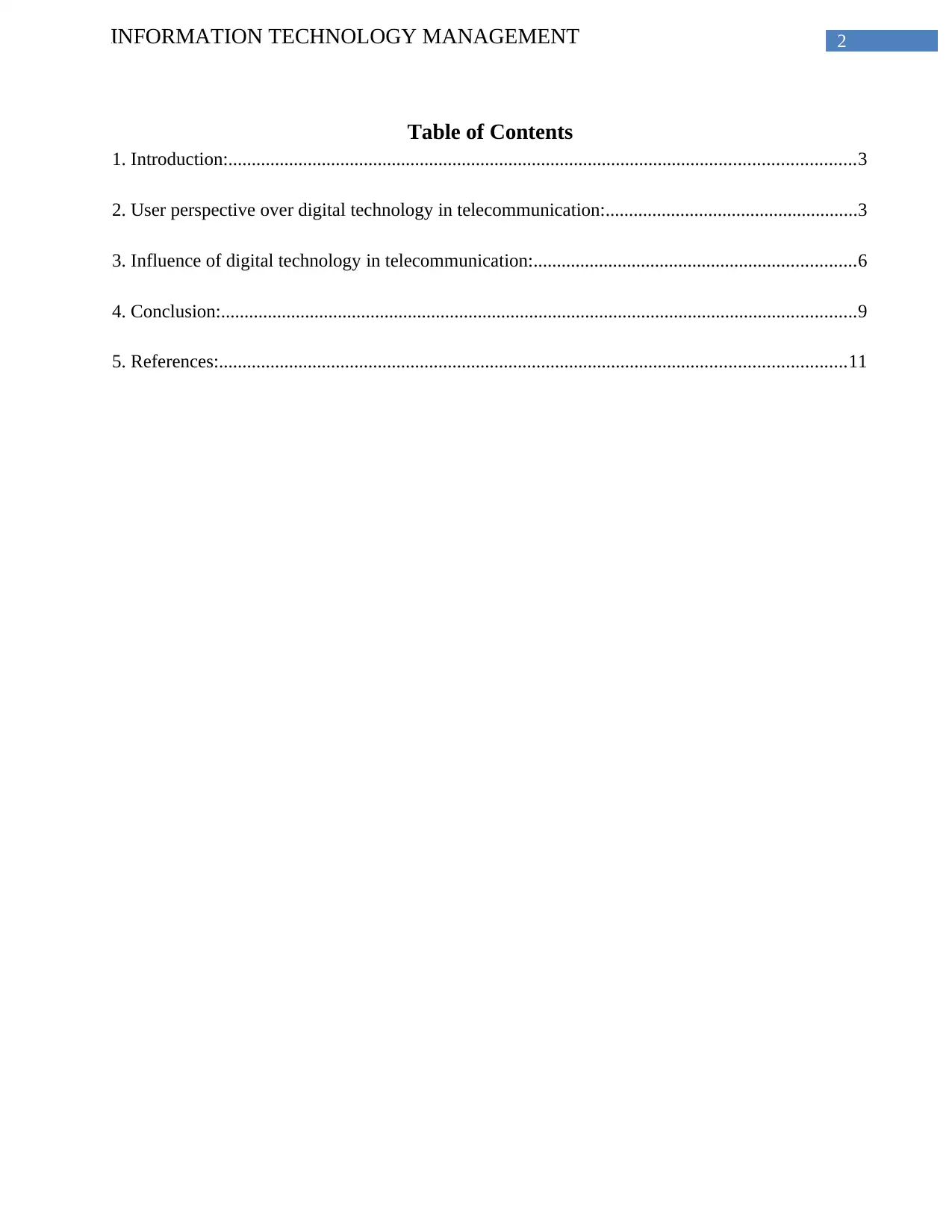
Table of Contents
1. Introduction:......................................................................................................................................3
2. User perspective over digital technology in telecommunication:......................................................3
3. Influence of digital technology in telecommunication:.....................................................................6
4. Conclusion:........................................................................................................................................9
5. References:......................................................................................................................................11
Table of Contents
1. Introduction:......................................................................................................................................3
2. User perspective over digital technology in telecommunication:......................................................3
3. Influence of digital technology in telecommunication:.....................................................................6
4. Conclusion:........................................................................................................................................9
5. References:......................................................................................................................................11
⊘ This is a preview!⊘
Do you want full access?
Subscribe today to unlock all pages.

Trusted by 1+ million students worldwide
3INFORMATION TECHNOLOGY MANAGEMENT
1. Introduction:
The current age has witnessed a huge proliferation of digital communication technologies
along with pervasive computing devices. This has affected highly over various aspects of people’s
lives.
This technology has brought a major change to individual activities and making interaction
with each other. In the following study user perspective and influences of digital technology have
been analyzed in the area of telecommunication.
2. User perspective over digital technology in telecommunication:
Current telecommunication companies have been facing a confluence of various challenges.
This has included commoditization of core connectivity services, different demands of personalized
and differentiated offerings. These are provided by external competitors, digital consumers,
important developments in technology and software and disruptive business models (Baym 2015).
The “renew areas” has successfully transitioned the role of “Digital Life Partner”. The
telecommunication has been focusing on delivering a personalized experience on digital lifecycle.
Thus investments in the infrastructure have been helping to do this. Moreover, the personalized self-
care must become the embedded feature around channel architecture. Here the users are empowered
with intuitive, intelligent, self-care and cross-channel solutions helping to personalize the own
service offering and experience (Pierson and Bauwens 2015). It has been vital to assure that the
“omnichannel” experience has been optimized for current customers and first-time users. The
telecommunication organizations have been accessing a huge volume of customer behavior and
usage data. Further, they have required investing in analytical, predictive and real-time capabilities
1. Introduction:
The current age has witnessed a huge proliferation of digital communication technologies
along with pervasive computing devices. This has affected highly over various aspects of people’s
lives.
This technology has brought a major change to individual activities and making interaction
with each other. In the following study user perspective and influences of digital technology have
been analyzed in the area of telecommunication.
2. User perspective over digital technology in telecommunication:
Current telecommunication companies have been facing a confluence of various challenges.
This has included commoditization of core connectivity services, different demands of personalized
and differentiated offerings. These are provided by external competitors, digital consumers,
important developments in technology and software and disruptive business models (Baym 2015).
The “renew areas” has successfully transitioned the role of “Digital Life Partner”. The
telecommunication has been focusing on delivering a personalized experience on digital lifecycle.
Thus investments in the infrastructure have been helping to do this. Moreover, the personalized self-
care must become the embedded feature around channel architecture. Here the users are empowered
with intuitive, intelligent, self-care and cross-channel solutions helping to personalize the own
service offering and experience (Pierson and Bauwens 2015). It has been vital to assure that the
“omnichannel” experience has been optimized for current customers and first-time users. The
telecommunication organizations have been accessing a huge volume of customer behavior and
usage data. Further, they have required investing in analytical, predictive and real-time capabilities
Paraphrase This Document
Need a fresh take? Get an instant paraphrase of this document with our AI Paraphraser
4INFORMATION TECHNOLOGY MANAGEMENT
helping to parse the data into meaningful, personalized and contextual service offerings and then
monetizing them.
According to a recent survey, the telecommunication users have to pay 20% premium for the
developed digital experience. However, more digitally discerning users have been ready to pay
double for access to a comprehensive ecosystem (Salemink, Strijker and Bosworth 2017). This has
been enabling digital lifestyle around various areas as witnessed by users. The sectors are
communities like services, membership, clubs and interests. Then there are utilities like shopping,
bills and banks, security areas like auto, school and home. Next it includes health like hospitals and
fitness and leisure like tourism, travels, movies and entertainments.
Thus for the digital industry it has been clear sign for users to take opportunities develop
premium value proposition benefitting both users and organizations. The unified user profiling has
been enabling telecom operators to come up with a common platform for analyzing a large volume
of user data through analytical engines (Pierucci 2015). This has been playing a vital role in various
sectors like customer segmentation, customer relationship management, development of business
practices. This has been influencing consumer behavior at particular segments. Thus it has been
helpful to manage all the customer cycle from acquisitions of users until retention and churn.
Though the rise of Internet has brought the new winners the rise of Facebook or Google as also
brought serious dispersal of power for users. Further, monopolization and power asymmetries, at the
light of largely-connected markets over Internet have been the barrier to access to web-market. This
has been also higher than the capitalist markets. The dominant web-companies like Google and
Facebook has been using collective cooperation, activities and participation of users and
communications as the form of free labor. This has been canalized under the private economic gain
(Pon, Seppälä and Kenney 2015). This has been the content and activity created by various users of
helping to parse the data into meaningful, personalized and contextual service offerings and then
monetizing them.
According to a recent survey, the telecommunication users have to pay 20% premium for the
developed digital experience. However, more digitally discerning users have been ready to pay
double for access to a comprehensive ecosystem (Salemink, Strijker and Bosworth 2017). This has
been enabling digital lifestyle around various areas as witnessed by users. The sectors are
communities like services, membership, clubs and interests. Then there are utilities like shopping,
bills and banks, security areas like auto, school and home. Next it includes health like hospitals and
fitness and leisure like tourism, travels, movies and entertainments.
Thus for the digital industry it has been clear sign for users to take opportunities develop
premium value proposition benefitting both users and organizations. The unified user profiling has
been enabling telecom operators to come up with a common platform for analyzing a large volume
of user data through analytical engines (Pierucci 2015). This has been playing a vital role in various
sectors like customer segmentation, customer relationship management, development of business
practices. This has been influencing consumer behavior at particular segments. Thus it has been
helpful to manage all the customer cycle from acquisitions of users until retention and churn.
Though the rise of Internet has brought the new winners the rise of Facebook or Google as also
brought serious dispersal of power for users. Further, monopolization and power asymmetries, at the
light of largely-connected markets over Internet have been the barrier to access to web-market. This
has been also higher than the capitalist markets. The dominant web-companies like Google and
Facebook has been using collective cooperation, activities and participation of users and
communications as the form of free labor. This has been canalized under the private economic gain
(Pon, Seppälä and Kenney 2015). This has been the content and activity created by various users of
5INFORMATION TECHNOLOGY MANAGEMENT
most popular social networks. These have been primary ingredient and primary condition to continue
the financial success and existence of those companies. Though there has been obvious social gains
for the users the platforms to connect friends has been possessing new potentials regarding political
organizations including novel sources of information. This has pointed out that those from a critical
political economy viewpoint of users the financial models of the organizations have been leaving
real producers of content out of substantial economic gain. In this way to has been intensifying
present asymmetries. Though it has been expected that the user has been seeing the reverse
developments, the Internet has developed few tendencies that has been present already under the
capitalist societies at the early stage (Sharma et al. 2017). This has included future expansion of
various commoditization and rise on social inequalities. In this way the rich has been getting richer,
while the poor user has been turning to be poorer. This has been inherent characteristic of the current
digital society. The advanced users of the society with constant Internet access and large level of
digital skills has been continuously able to retrieve advantages to use the ICTs. On the other hand,
the disadvantaged communities have been found to be lagging behind.
In the same way, the most influential and powerful users at online have been those who have
been the already the part of a social elite. It has been especially as comes under the influence of
activism, participation and political engagement (Hesse 2018). Various surveys have also shown that
the study has focused on some democratic potential to use the internet. This has been contrary to
common beliefs that have been found dominant hierarchies and shaping the medium that has been
continuing to celebrate the overall openness. Again it has been found in many cases, that those
asymmetries have been proven to be larger as compared to the case of conventional mass-media. The
evolution of those networks towards the conceptualizing and concentration of the process as the
power law inherent has been the regarded as the “network effect” of the users (Bouwman, de Reuve
and Nikou 2017). This is the current era of digitalization, and the new social norm has been defining
most popular social networks. These have been primary ingredient and primary condition to continue
the financial success and existence of those companies. Though there has been obvious social gains
for the users the platforms to connect friends has been possessing new potentials regarding political
organizations including novel sources of information. This has pointed out that those from a critical
political economy viewpoint of users the financial models of the organizations have been leaving
real producers of content out of substantial economic gain. In this way to has been intensifying
present asymmetries. Though it has been expected that the user has been seeing the reverse
developments, the Internet has developed few tendencies that has been present already under the
capitalist societies at the early stage (Sharma et al. 2017). This has included future expansion of
various commoditization and rise on social inequalities. In this way the rich has been getting richer,
while the poor user has been turning to be poorer. This has been inherent characteristic of the current
digital society. The advanced users of the society with constant Internet access and large level of
digital skills has been continuously able to retrieve advantages to use the ICTs. On the other hand,
the disadvantaged communities have been found to be lagging behind.
In the same way, the most influential and powerful users at online have been those who have
been the already the part of a social elite. It has been especially as comes under the influence of
activism, participation and political engagement (Hesse 2018). Various surveys have also shown that
the study has focused on some democratic potential to use the internet. This has been contrary to
common beliefs that have been found dominant hierarchies and shaping the medium that has been
continuing to celebrate the overall openness. Again it has been found in many cases, that those
asymmetries have been proven to be larger as compared to the case of conventional mass-media. The
evolution of those networks towards the conceptualizing and concentration of the process as the
power law inherent has been the regarded as the “network effect” of the users (Bouwman, de Reuve
and Nikou 2017). This is the current era of digitalization, and the new social norm has been defining
⊘ This is a preview!⊘
Do you want full access?
Subscribe today to unlock all pages.
Trusted by 1+ million students worldwide
6INFORMATION TECHNOLOGY MANAGEMENT
the evolution of commercial and public services. The using and accessing of digital services has thus
shifted from institutional level towards micro and that of the individual users.
3. Influence of digital technology in telecommunication:
As far as new generation of “digital first” users is concerned, communication has been
prerogative than preference. As communication has turned into the norm of lifestyle, users have been
demanding more from network providers. In this way they have been looking for various
differentiated and personalized service offerings helping their digital lives with marked emphasis on
unified experience.
The external competition at the same time has been threatening to disrupt the business model
of telecommunication around various nodes. Here, for example the limited and focused entry of
Google towards broadband services has a shakeup in a market (de Reuver, Sørensen and Basole
2017). This is because conventional service providers have been scrambling to match the quality of
service offerings. Further OTT or “Over-The-Top” messaging services like Snapchat, Skype and
WhatsApp have consisted already disrupted video, voice and text message revenues for telecoms.
Various ranges of future-generation OTT players have been possessing established globally
scalable models of business in different sectors. They have to extend from unified communications
from document management and healthcare (Zhao, Wallis and Singh 2015). As the services have
been growing in popularity they have been adding pressure over revenues of telecom revenue.
However, they have also been augmenting network costs.
Thus amid the transformations, the consistent development in technology and software and
the way of delivery has been forcing telecom companies to invest in up-gradation and modernizing
the infrastructure. However, without the strategy of leveraging the capital investments for extra
the evolution of commercial and public services. The using and accessing of digital services has thus
shifted from institutional level towards micro and that of the individual users.
3. Influence of digital technology in telecommunication:
As far as new generation of “digital first” users is concerned, communication has been
prerogative than preference. As communication has turned into the norm of lifestyle, users have been
demanding more from network providers. In this way they have been looking for various
differentiated and personalized service offerings helping their digital lives with marked emphasis on
unified experience.
The external competition at the same time has been threatening to disrupt the business model
of telecommunication around various nodes. Here, for example the limited and focused entry of
Google towards broadband services has a shakeup in a market (de Reuver, Sørensen and Basole
2017). This is because conventional service providers have been scrambling to match the quality of
service offerings. Further OTT or “Over-The-Top” messaging services like Snapchat, Skype and
WhatsApp have consisted already disrupted video, voice and text message revenues for telecoms.
Various ranges of future-generation OTT players have been possessing established globally
scalable models of business in different sectors. They have to extend from unified communications
from document management and healthcare (Zhao, Wallis and Singh 2015). As the services have
been growing in popularity they have been adding pressure over revenues of telecom revenue.
However, they have also been augmenting network costs.
Thus amid the transformations, the consistent development in technology and software and
the way of delivery has been forcing telecom companies to invest in up-gradation and modernizing
the infrastructure. However, without the strategy of leveraging the capital investments for extra
Paraphrase This Document
Need a fresh take? Get an instant paraphrase of this document with our AI Paraphraser
7INFORMATION TECHNOLOGY MANAGEMENT
revenue profits and streams, the risk has turned into an indirect purveyor of different infrastructure
that has been commoditized.
This has forced telecommunication agencies in redefining the identity of the digital
marketplace. Here, to achieve success under a digital paradigm, the future-generation
telecommunication organizations have been evolving to multi-service providers. It has been
connecting directly with various consumers through the development of latest service offerings.
These have been delivering expected experiences and engagements in relevant and quick manner.
Thus the telecommunication has been turning into the amalgamation of various elements (Lin and
Kim 2016). The first one is the end-to-end “Digital Life Partner” enabling personalized, unified and
seamless experience of digital lifestyle for consumers. Next, there has been ICT/Application
Provider that has been delivering various comprehensive current innovation solutions for different
types of enterprise customers. Moreover, the information providers mining proprietary consumer
data resources have been serving data-hungry consumer industries. Again, banks partnering with
financial institutions have been offering a wide range of digital services and payments. The media
company has not been serving third-party contents and developing content that can be further
monetized (Morabito 2016).
Thus it is seen that the business models have been emerging out where the telecom
companies have been partnering with various industries for developing entirely new end-to-end
chains of digital values. Provided with the enormity of the challenge, the linear and single
transformation has been sufficient to develop such kinds of organizations. The telecommunication
organizations must be adopting two prolonged renew-new strategy centering user experience.
The most passionate fans of social media and digital/mobile communications are rising fast in
overall numbers, impact on other consumers, and the money they spend on the outlets they value.
revenue profits and streams, the risk has turned into an indirect purveyor of different infrastructure
that has been commoditized.
This has forced telecommunication agencies in redefining the identity of the digital
marketplace. Here, to achieve success under a digital paradigm, the future-generation
telecommunication organizations have been evolving to multi-service providers. It has been
connecting directly with various consumers through the development of latest service offerings.
These have been delivering expected experiences and engagements in relevant and quick manner.
Thus the telecommunication has been turning into the amalgamation of various elements (Lin and
Kim 2016). The first one is the end-to-end “Digital Life Partner” enabling personalized, unified and
seamless experience of digital lifestyle for consumers. Next, there has been ICT/Application
Provider that has been delivering various comprehensive current innovation solutions for different
types of enterprise customers. Moreover, the information providers mining proprietary consumer
data resources have been serving data-hungry consumer industries. Again, banks partnering with
financial institutions have been offering a wide range of digital services and payments. The media
company has not been serving third-party contents and developing content that can be further
monetized (Morabito 2016).
Thus it is seen that the business models have been emerging out where the telecom
companies have been partnering with various industries for developing entirely new end-to-end
chains of digital values. Provided with the enormity of the challenge, the linear and single
transformation has been sufficient to develop such kinds of organizations. The telecommunication
organizations must be adopting two prolonged renew-new strategy centering user experience.
The most passionate fans of social media and digital/mobile communications are rising fast in
overall numbers, impact on other consumers, and the money they spend on the outlets they value.
8INFORMATION TECHNOLOGY MANAGEMENT
TMT companies can boost revenues from these valuable fans by first identifying them through
marketing efforts and digital tracking, then directing special offers and incentives to these
“superfans” in return for higher-level subscriptions, increased social-media advocacy, and
participation in digital developmental projects (Lyons et al. 2017).
Effects of technology on communication:
The impact of technology on communications has rapidly moved towards the digital society.
The smartphones, internet and computers have been playing core responsibilities in people’s lives.
The instant messaging and social media has been redefined in the ways where the communications
and relationships are made with each other. Here, the media landscape has been changing
consistently. Under societal level, there have been rising concerns regarding new forms of equality,
polarisation, privacy and disintegration threats (Brión Toucedo 2017). Further developments of
“Internet of things”, smart products, robotizations and artificial intelligence. These are replaced by
few of communication conventionally by people. Further, technology has been the most effective
means of communication. For technology to turn into a communication mean the 3D Printing, virtual
reality and augmented realities has been blurring boundaries at the online and offline worlds. At this
specialization the new technologies have been impacting the kind of communication (Mantokoudis
et al. 2017). Here the queries to be addressed are the effects of digital society over inequality among
individuals, the ways in which instant messaging and smartphones have been affecting interpersonal
communication, and the means to handle privacy threats that are the imposed by mobile phones.
These are effects of social media over polarisation and trusts to media news.
Communication supporting technology:
Every technology has been developed has been successful. There has been dependence on
communication and this has been vital that the technology designers since they have understood the
TMT companies can boost revenues from these valuable fans by first identifying them through
marketing efforts and digital tracking, then directing special offers and incentives to these
“superfans” in return for higher-level subscriptions, increased social-media advocacy, and
participation in digital developmental projects (Lyons et al. 2017).
Effects of technology on communication:
The impact of technology on communications has rapidly moved towards the digital society.
The smartphones, internet and computers have been playing core responsibilities in people’s lives.
The instant messaging and social media has been redefined in the ways where the communications
and relationships are made with each other. Here, the media landscape has been changing
consistently. Under societal level, there have been rising concerns regarding new forms of equality,
polarisation, privacy and disintegration threats (Brión Toucedo 2017). Further developments of
“Internet of things”, smart products, robotizations and artificial intelligence. These are replaced by
few of communication conventionally by people. Further, technology has been the most effective
means of communication. For technology to turn into a communication mean the 3D Printing, virtual
reality and augmented realities has been blurring boundaries at the online and offline worlds. At this
specialization the new technologies have been impacting the kind of communication (Mantokoudis
et al. 2017). Here the queries to be addressed are the effects of digital society over inequality among
individuals, the ways in which instant messaging and smartphones have been affecting interpersonal
communication, and the means to handle privacy threats that are the imposed by mobile phones.
These are effects of social media over polarisation and trusts to media news.
Communication supporting technology:
Every technology has been developed has been successful. There has been dependence on
communication and this has been vital that the technology designers since they have understood the
⊘ This is a preview!⊘
Do you want full access?
Subscribe today to unlock all pages.
Trusted by 1+ million students worldwide
9INFORMATION TECHNOLOGY MANAGEMENT
users and those use situations. Further, the users have been seldom adopting technology and have
been normally appropriating that to make that compatible with their experiences and wishes. The
user experience or UX and usability have been playing a vital role in the success of technologies.
The communication professionals have been serving as user advocates under technological design
process and taking responsibilities of different kinds of user support. Further, they have been also
focusing on various stakeholders under the design process of technology (Larsson 2017). Here for
example, through popularizing multiple advances technologies, critical stakeholders and persuading
investors or facilitating public debate has been regarding the desirability of latest technologies. The
role of communication as the success factors regarding techniques can be analyzed in various ways.
The examples are how to design products for optimal UX. It is needed to be found why people have
been adopting few technologies just almost quickly and some of them have not been. Then it has
been required to be determined how appropriate techniques have fitted into the lives of the jobs and
lives. Then the critical success factors in implementing software within the organizations are needed
to be found and the ways one can support users to make optimal use of technologies is required in
order to be seen.
4. Conclusion:
The above study shows that the combination of evolving technologies, changes in customer
behaviors, external competitions and profitability pressures has been driving the speed of
transformation under telecommunication industry. The study has helped in understanding that in
order to get success radically in this scenario the new generation telecom organizations should be
adopting the “Renew and New” strategy. Further, they should constantly renew the systems,
capabilities and processes for totally exploiting, extending and enriching the core. On the other hand,
users and those use situations. Further, the users have been seldom adopting technology and have
been normally appropriating that to make that compatible with their experiences and wishes. The
user experience or UX and usability have been playing a vital role in the success of technologies.
The communication professionals have been serving as user advocates under technological design
process and taking responsibilities of different kinds of user support. Further, they have been also
focusing on various stakeholders under the design process of technology (Larsson 2017). Here for
example, through popularizing multiple advances technologies, critical stakeholders and persuading
investors or facilitating public debate has been regarding the desirability of latest technologies. The
role of communication as the success factors regarding techniques can be analyzed in various ways.
The examples are how to design products for optimal UX. It is needed to be found why people have
been adopting few technologies just almost quickly and some of them have not been. Then it has
been required to be determined how appropriate techniques have fitted into the lives of the jobs and
lives. Then the critical success factors in implementing software within the organizations are needed
to be found and the ways one can support users to make optimal use of technologies is required in
order to be seen.
4. Conclusion:
The above study shows that the combination of evolving technologies, changes in customer
behaviors, external competitions and profitability pressures has been driving the speed of
transformation under telecommunication industry. The study has helped in understanding that in
order to get success radically in this scenario the new generation telecom organizations should be
adopting the “Renew and New” strategy. Further, they should constantly renew the systems,
capabilities and processes for totally exploiting, extending and enriching the core. On the other hand,
Paraphrase This Document
Need a fresh take? Get an instant paraphrase of this document with our AI Paraphraser
10INFORMATION TECHNOLOGY MANAGEMENT
there must be a heightened focus on disruptive models relevant to digital users in enterprise and
retail segments.
there must be a heightened focus on disruptive models relevant to digital users in enterprise and
retail segments.
11INFORMATION TECHNOLOGY MANAGEMENT
5. References:
Baym, N.K., 2015. Personal connections in the digital age. John Wiley & Sons.
Bouwman, H., de Reuver, M. and Nikou, S., 2017. The impact of Digitalization on Business Models:
How IT Artefacts, Social Media, and Big Data Force Firms to Innovate Their Business Model.
Brión Toucedo, A., 2017. Digitalization, virtualization and scenarios simulation for development
and validation of complex ADAS systems (Doctoral dissertation).
de Reuver, M., Sørensen, C. and Basole, R.C., 2017. The digital platform: a research agenda. Journal
of Information Technology, pp.1-12.
Hesse, A., 2018, January. Digitalization and Leadership-How Experienced Leaders Interpret Daily
Realities in a Digital World. In Proceedings of the 51st Hawaii International Conference on System
Sciences.
Larsson, T., 2017. Telecommunication Exchange Evolution.
Lin, C.A. and Kim, T., 2016. Predicting user response to sponsored advertising on social media via
the technology acceptance model. Computers in Human Behavior, 64, pp.710-718.
Lyons, G., Mokhtarian, P., Dijst, M. and Böcker, L., 2017. The dynamics of urban metabolism in the
face of digitalization and changing lifestyles: Understanding and influencing our cities. Resources,
Conservation and Recycling.
Mantokoudis, G., Koller, R., Guignard, J., Caversaccio, M., Kompis, M. and Senn, P., 2017.
Influence of Telecommunication Modality, Internet Transmission Quality, and Accessories on
Speech Perception in Cochlear Implant Users. Journal of medical Internet research, 19(4).
5. References:
Baym, N.K., 2015. Personal connections in the digital age. John Wiley & Sons.
Bouwman, H., de Reuver, M. and Nikou, S., 2017. The impact of Digitalization on Business Models:
How IT Artefacts, Social Media, and Big Data Force Firms to Innovate Their Business Model.
Brión Toucedo, A., 2017. Digitalization, virtualization and scenarios simulation for development
and validation of complex ADAS systems (Doctoral dissertation).
de Reuver, M., Sørensen, C. and Basole, R.C., 2017. The digital platform: a research agenda. Journal
of Information Technology, pp.1-12.
Hesse, A., 2018, January. Digitalization and Leadership-How Experienced Leaders Interpret Daily
Realities in a Digital World. In Proceedings of the 51st Hawaii International Conference on System
Sciences.
Larsson, T., 2017. Telecommunication Exchange Evolution.
Lin, C.A. and Kim, T., 2016. Predicting user response to sponsored advertising on social media via
the technology acceptance model. Computers in Human Behavior, 64, pp.710-718.
Lyons, G., Mokhtarian, P., Dijst, M. and Böcker, L., 2017. The dynamics of urban metabolism in the
face of digitalization and changing lifestyles: Understanding and influencing our cities. Resources,
Conservation and Recycling.
Mantokoudis, G., Koller, R., Guignard, J., Caversaccio, M., Kompis, M. and Senn, P., 2017.
Influence of Telecommunication Modality, Internet Transmission Quality, and Accessories on
Speech Perception in Cochlear Implant Users. Journal of medical Internet research, 19(4).
⊘ This is a preview!⊘
Do you want full access?
Subscribe today to unlock all pages.
Trusted by 1+ million students worldwide

1 out of 13


Related Documents


Your All-in-One AI-Powered Toolkit for Academic Success.
+13062052269
info@desklib.com
Available 24*7 on WhatsApp / Email
![[object Object]](/_next/static/media/star-bottom.7253800d.svg)
Unlock your academic potential
Copyright © 2020–2026 A2Z Services. All Rights Reserved. Developed and managed by ZUCOL.