University IT Networking Designing: Routing Protocol Evaluation Report

Verified

Added on  2023/06/09

|6
|1399
|381
Report
AI Summary
This report provides a comprehensive analysis of four key routing protocols used in IT networking: RIPv2, OSPF, EIGRP, and BGP. The report begins with an overview of RIPv2, detailing its functionality as a distance vector routing protocol, its limitations in terms of hop count, and its suitability for smaller networks. It discusses the improvements over its predecessor and the security mechanisms implemented. The report then delves into OSPF, a link-state routing protocol, highlighting its suitability for larger enterprise networks and its ability to adapt to network changes by considering factors such as bandwidth, load, and delay. The report explains the maintenance of a link-state database and the use of areas for network administration. Following this, the report examines EIGRP, an advanced distance vector protocol developed by Cisco, discussing its efficiency in sharing routes, reducing broadcast messages, and simplifying network administration through incremental updates. Finally, the report covers BGP, a path vector routing protocol used for exchanging routing information between autonomous systems, and its role in the internet as an exterior border gateway protocol. The report describes the use of peers, TCP sessions, and state variables in BGP.
Document Page
Running head: IT NETWORKING DESIGNING
IT Networking Designing
Name of the Student
Name of the University
Author’s Note
tabler-icon-diamond-filled.svg

Paraphrase This Document

Need a fresh take? Get an instant paraphrase of this document with our AI Paraphraser
Document Page
1
IT NETWORKING DESIGNING
Description of different routing protocols
RIP V2 –
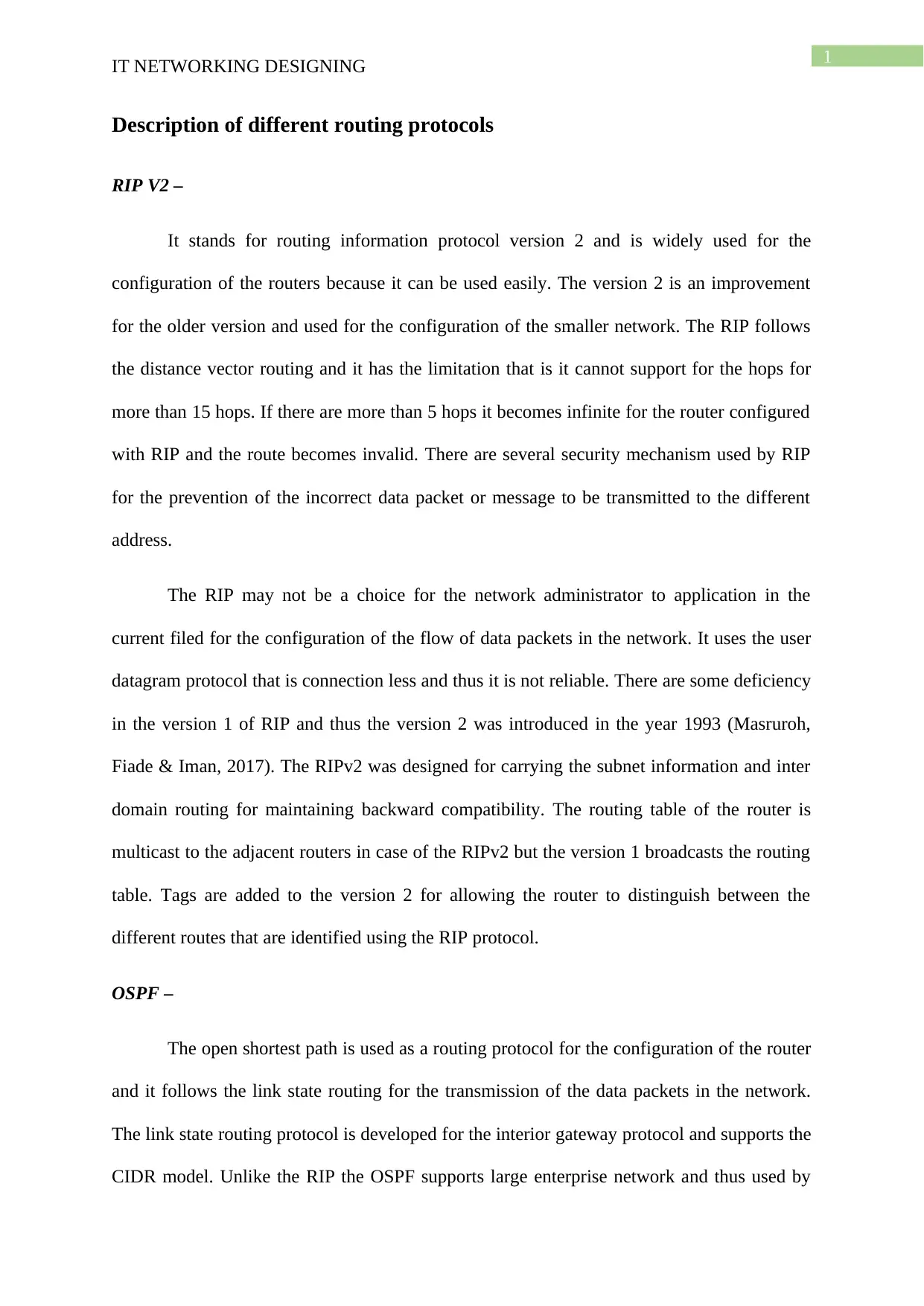
It stands for routing information protocol version 2 and is widely used for the
configuration of the routers because it can be used easily. The version 2 is an improvement
for the older version and used for the configuration of the smaller network. The RIP follows
the distance vector routing and it has the limitation that is it cannot support for the hops for
more than 15 hops. If there are more than 5 hops it becomes infinite for the router configured
with RIP and the route becomes invalid. There are several security mechanism used by RIP
for the prevention of the incorrect data packet or message to be transmitted to the different
address.
The RIP may not be a choice for the network administrator to application in the
current filed for the configuration of the flow of data packets in the network. It uses the user
datagram protocol that is connection less and thus it is not reliable. There are some deficiency
in the version 1 of RIP and thus the version 2 was introduced in the year 1993 (Masruroh,
Fiade & Iman, 2017). The RIPv2 was designed for carrying the subnet information and inter
domain routing for maintaining backward compatibility. The routing table of the router is
multicast to the adjacent routers in case of the RIPv2 but the version 1 broadcasts the routing
table. Tags are added to the version 2 for allowing the router to distinguish between the
different routes that are identified using the RIP protocol.
OSPF –
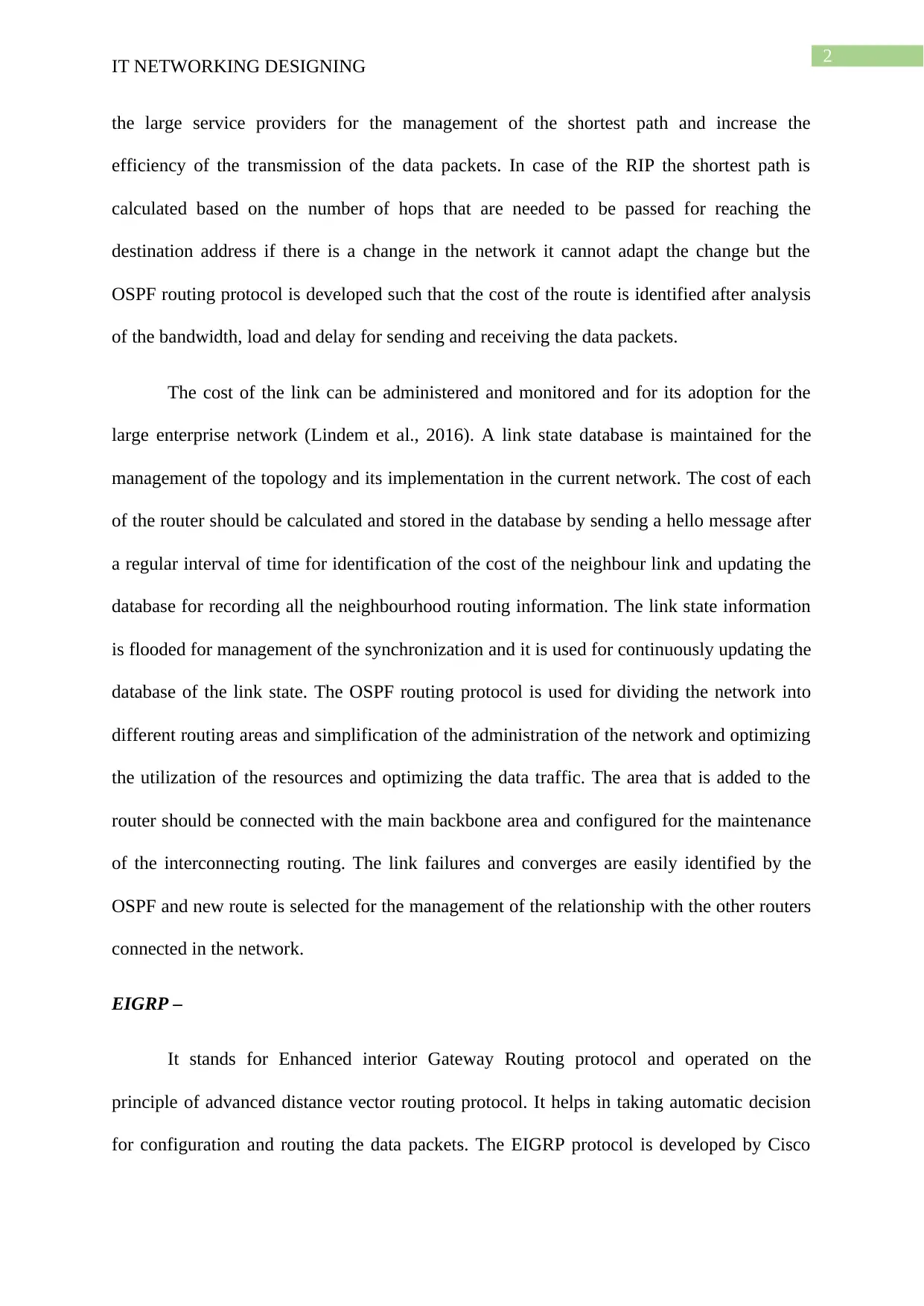
The open shortest path is used as a routing protocol for the configuration of the router
and it follows the link state routing for the transmission of the data packets in the network.
The link state routing protocol is developed for the interior gateway protocol and supports the
CIDR model. Unlike the RIP the OSPF supports large enterprise network and thus used by
Document Page
2
IT NETWORKING DESIGNING
the large service providers for the management of the shortest path and increase the
efficiency of the transmission of the data packets. In case of the RIP the shortest path is
calculated based on the number of hops that are needed to be passed for reaching the
destination address if there is a change in the network it cannot adapt the change but the
OSPF routing protocol is developed such that the cost of the route is identified after analysis
of the bandwidth, load and delay for sending and receiving the data packets.
The cost of the link can be administered and monitored and for its adoption for the
large enterprise network (Lindem et al., 2016). A link state database is maintained for the
management of the topology and its implementation in the current network. The cost of each
of the router should be calculated and stored in the database by sending a hello message after
a regular interval of time for identification of the cost of the neighbour link and updating the
database for recording all the neighbourhood routing information. The link state information
is flooded for management of the synchronization and it is used for continuously updating the
database of the link state. The OSPF routing protocol is used for dividing the network into
different routing areas and simplification of the administration of the network and optimizing
the utilization of the resources and optimizing the data traffic. The area that is added to the
router should be connected with the main backbone area and configured for the maintenance
of the interconnecting routing. The link failures and converges are easily identified by the
OSPF and new route is selected for the management of the relationship with the other routers
connected in the network.
EIGRP –
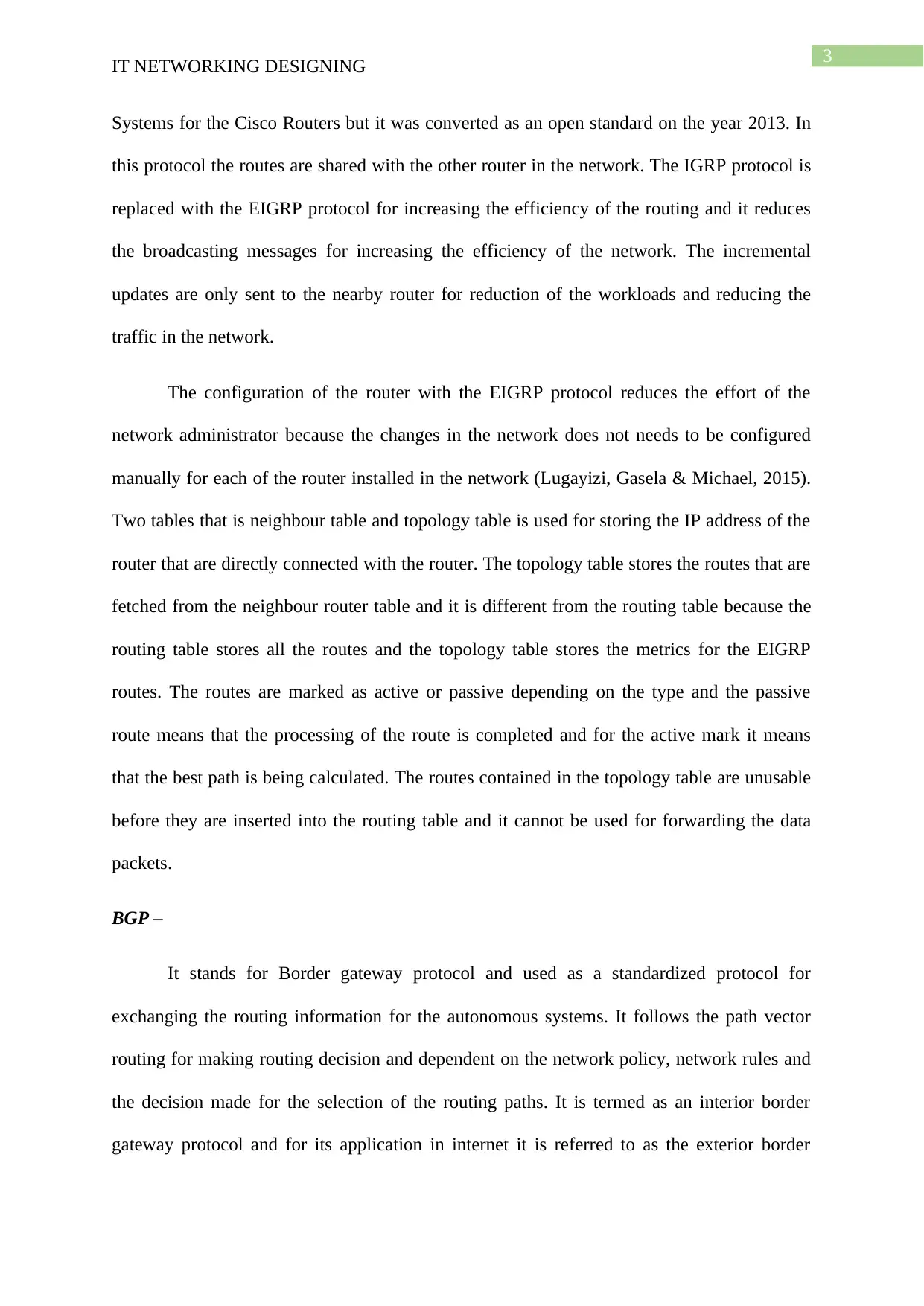
It stands for Enhanced interior Gateway Routing protocol and operated on the
principle of advanced distance vector routing protocol. It helps in taking automatic decision
for configuration and routing the data packets. The EIGRP protocol is developed by Cisco
Document Page
3
IT NETWORKING DESIGNING
Systems for the Cisco Routers but it was converted as an open standard on the year 2013. In
this protocol the routes are shared with the other router in the network. The IGRP protocol is
replaced with the EIGRP protocol for increasing the efficiency of the routing and it reduces
the broadcasting messages for increasing the efficiency of the network. The incremental
updates are only sent to the nearby router for reduction of the workloads and reducing the
traffic in the network.
The configuration of the router with the EIGRP protocol reduces the effort of the
network administrator because the changes in the network does not needs to be configured
manually for each of the router installed in the network (Lugayizi, Gasela & Michael, 2015).
Two tables that is neighbour table and topology table is used for storing the IP address of the
router that are directly connected with the router. The topology table stores the routes that are
fetched from the neighbour router table and it is different from the routing table because the
routing table stores all the routes and the topology table stores the metrics for the EIGRP
routes. The routes are marked as active or passive depending on the type and the passive
route means that the processing of the route is completed and for the active mark it means
that the best path is being calculated. The routes contained in the topology table are unusable
before they are inserted into the routing table and it cannot be used for forwarding the data
packets.
BGP –
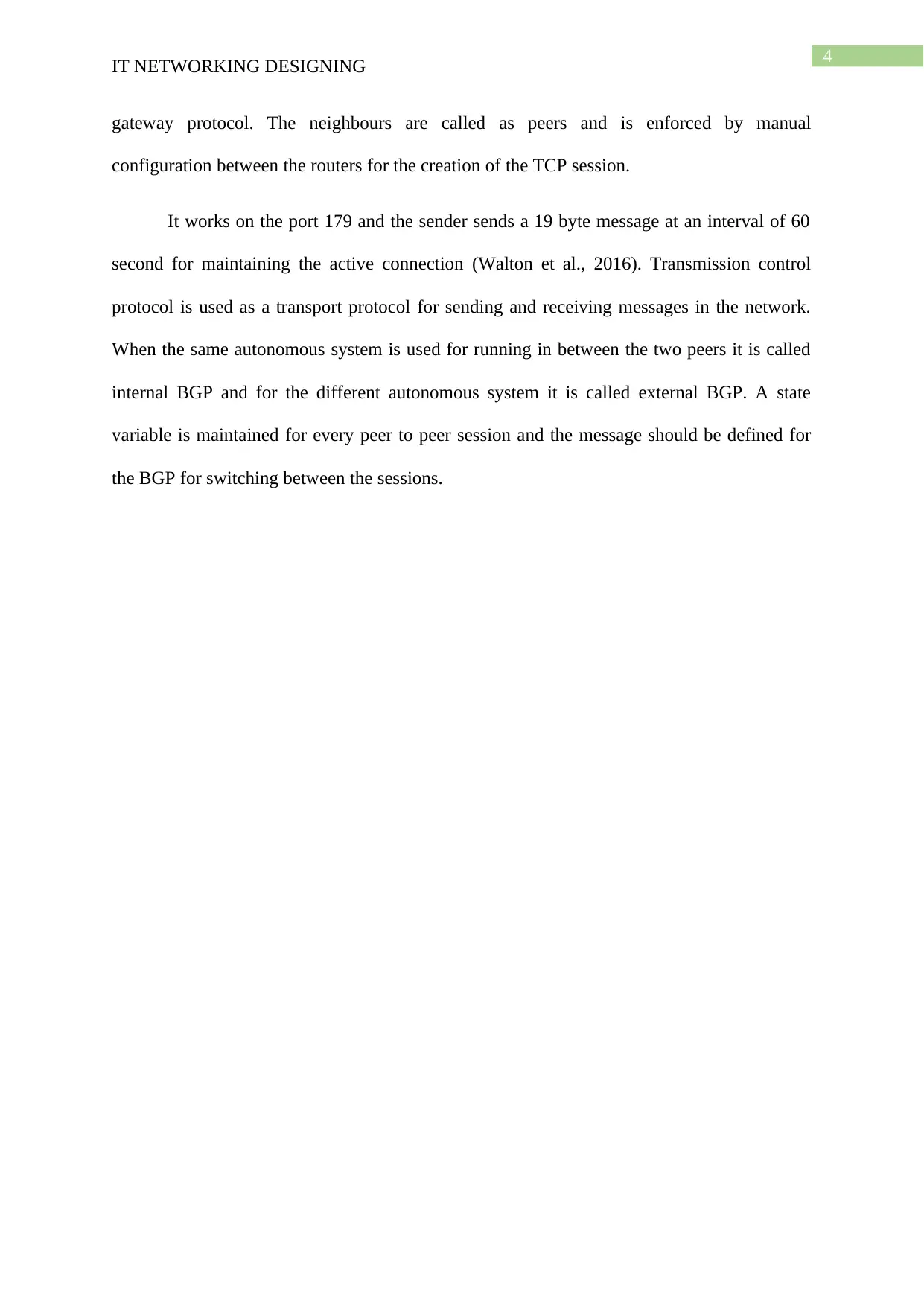
It stands for Border gateway protocol and used as a standardized protocol for
exchanging the routing information for the autonomous systems. It follows the path vector
routing for making routing decision and dependent on the network policy, network rules and
the decision made for the selection of the routing paths. It is termed as an interior border
gateway protocol and for its application in internet it is referred to as the exterior border
tabler-icon-diamond-filled.svg

Paraphrase This Document

Need a fresh take? Get an instant paraphrase of this document with our AI Paraphraser
Document Page
4
IT NETWORKING DESIGNING
gateway protocol. The neighbours are called as peers and is enforced by manual
configuration between the routers for the creation of the TCP session.
It works on the port 179 and the sender sends a 19 byte message at an interval of 60
second for maintaining the active connection (Walton et al., 2016). Transmission control
protocol is used as a transport protocol for sending and receiving messages in the network.
When the same autonomous system is used for running in between the two peers it is called
internal BGP and for the different autonomous system it is called external BGP. A state
variable is maintained for every peer to peer session and the message should be defined for
the BGP for switching between the sessions.
Document Page
5
IT NETWORKING DESIGNING
References
Lindem, A., Shen, N., Vasseur, J. P., Aggarwal, R., & Shaffer, S. (2016). Extensions to
OSPF for Advertising Optional Router Capabilities (No. RFC 7770).
Lugayizi, F. L., Gasela, N., & Michael, E. B. (2015). Performance evaluation of OSPF and
EIGRP routing Protocols for video streaming over next generation
networks. Advances in Computer Science: an International Journal, 4(5), 29-35.
Masruroh, S. U., Fiade, A., & Iman, M. F. (2017, November). Performance evaluation of
routing protocol RIPv2, OSPF, EIGRP with BGP. In Innovative and Creative
Information Technology (ICITech), 2017 International Conference on (pp. 1-7).
IEEE.
Walton, D., Retana, A., Chen, E., & Scudder, J. (2016). Advertisement of multiple paths in
BGP (No. RFC 7911).
chevron_up_icon
1 out of 6
circle_padding
hide_on_mobile
zoom_out_icon
[object Object]