SIT223 - College IT Ethics: A Case Study in Professional Practice

Verified

Added on  2023/03/17

|4
|706
|72
Case Study
AI Summary
This case study examines an ethical dilemma faced by a system administrator at a small college who discovers the institution is using bootlegged engineering design software. The analysis identifies key stakeholders, including students, faculty, and college authorities, and outlines the facts of the scenario, emphasizing the ethical concerns arising from the use of pirated software. The study highlights the major ethical dilemma of balancing the need for updated software with the high cost of licensing, while exploring the rights and duties of each stakeholder. It references the ACS code of ethics, suggesting honesty and adherence to anti-piracy laws are crucial. The analysis proposes ways to resolve the dilemma, such as clarifying the impact of piracy and re-evaluating the college budget, and considers the potential consequences of decisions on stakeholders. Furthermore, the case study emphasizes preventative measures and references Australian anti-piracy laws and policies. Desklib provides similar case studies and solved assignments for students.
Document Page
Running head: ETHICAL SCENARIO ANALYSIS
ETHICAL SCENARIO ANALYSIS
Name of the Student
Name of the University
Author Note
tabler-icon-diamond-filled.svg

Paraphrase This Document

Need a fresh take? Get an instant paraphrase of this document with our AI Paraphraser
Document Page
1ETHICAL SCENARIO ANALYSIS
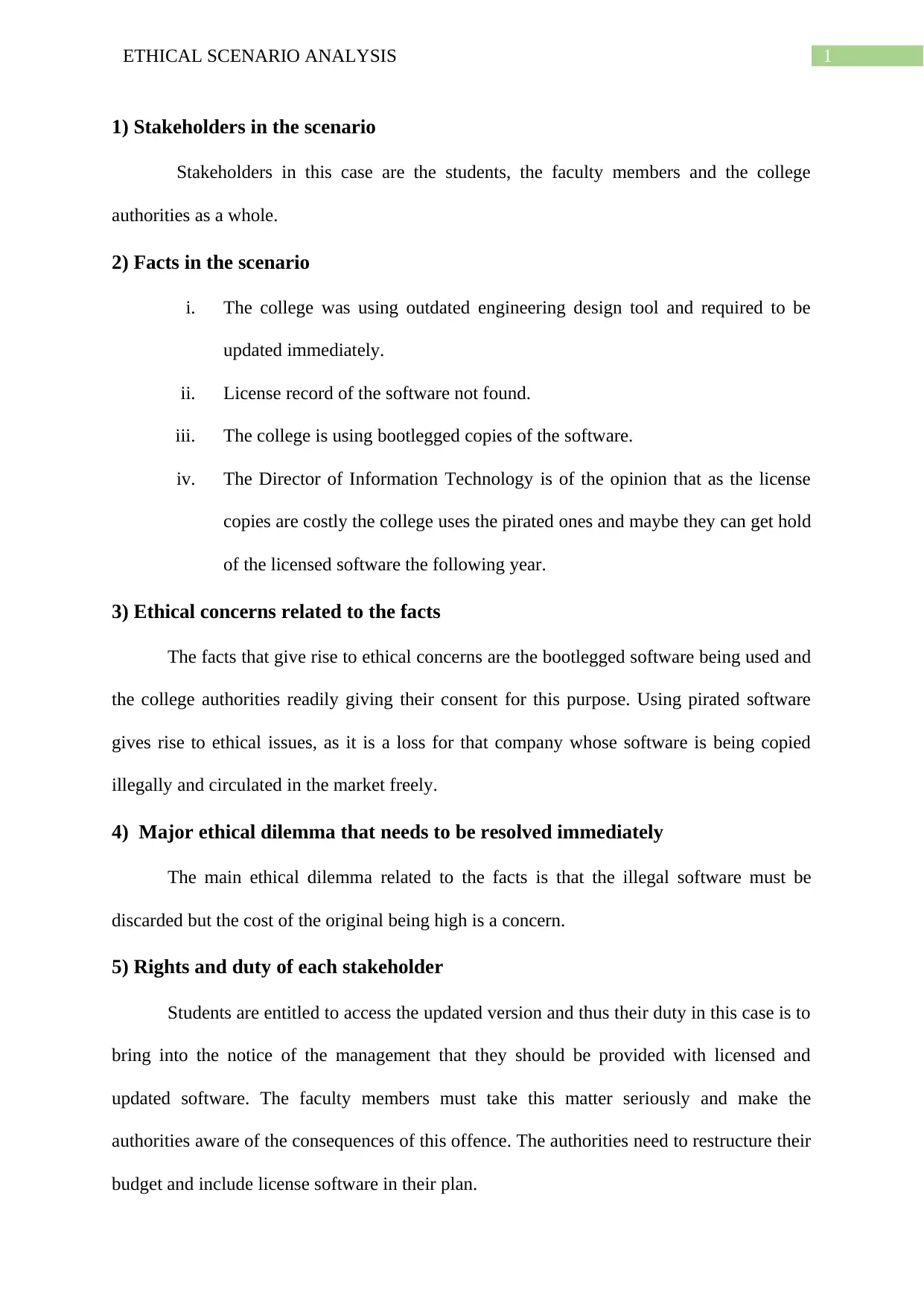
1) Stakeholders in the scenario
Stakeholders in this case are the students, the faculty members and the college
authorities as a whole.
2) Facts in the scenario
i. The college was using outdated engineering design tool and required to be
updated immediately.
ii. License record of the software not found.
iii. The college is using bootlegged copies of the software.
iv. The Director of Information Technology is of the opinion that as the license
copies are costly the college uses the pirated ones and maybe they can get hold
of the licensed software the following year.
3) Ethical concerns related to the facts
The facts that give rise to ethical concerns are the bootlegged software being used and
the college authorities readily giving their consent for this purpose. Using pirated software
gives rise to ethical issues, as it is a loss for that company whose software is being copied
illegally and circulated in the market freely.
4) Major ethical dilemma that needs to be resolved immediately
The main ethical dilemma related to the facts is that the illegal software must be
discarded but the cost of the original being high is a concern.
5) Rights and duty of each stakeholder
Students are entitled to access the updated version and thus their duty in this case is to
bring into the notice of the management that they should be provided with licensed and
updated software. The faculty members must take this matter seriously and make the
authorities aware of the consequences of this offence. The authorities need to restructure their
budget and include license software in their plan.
Document Page
2ETHICAL SCENARIO ANALYSIS
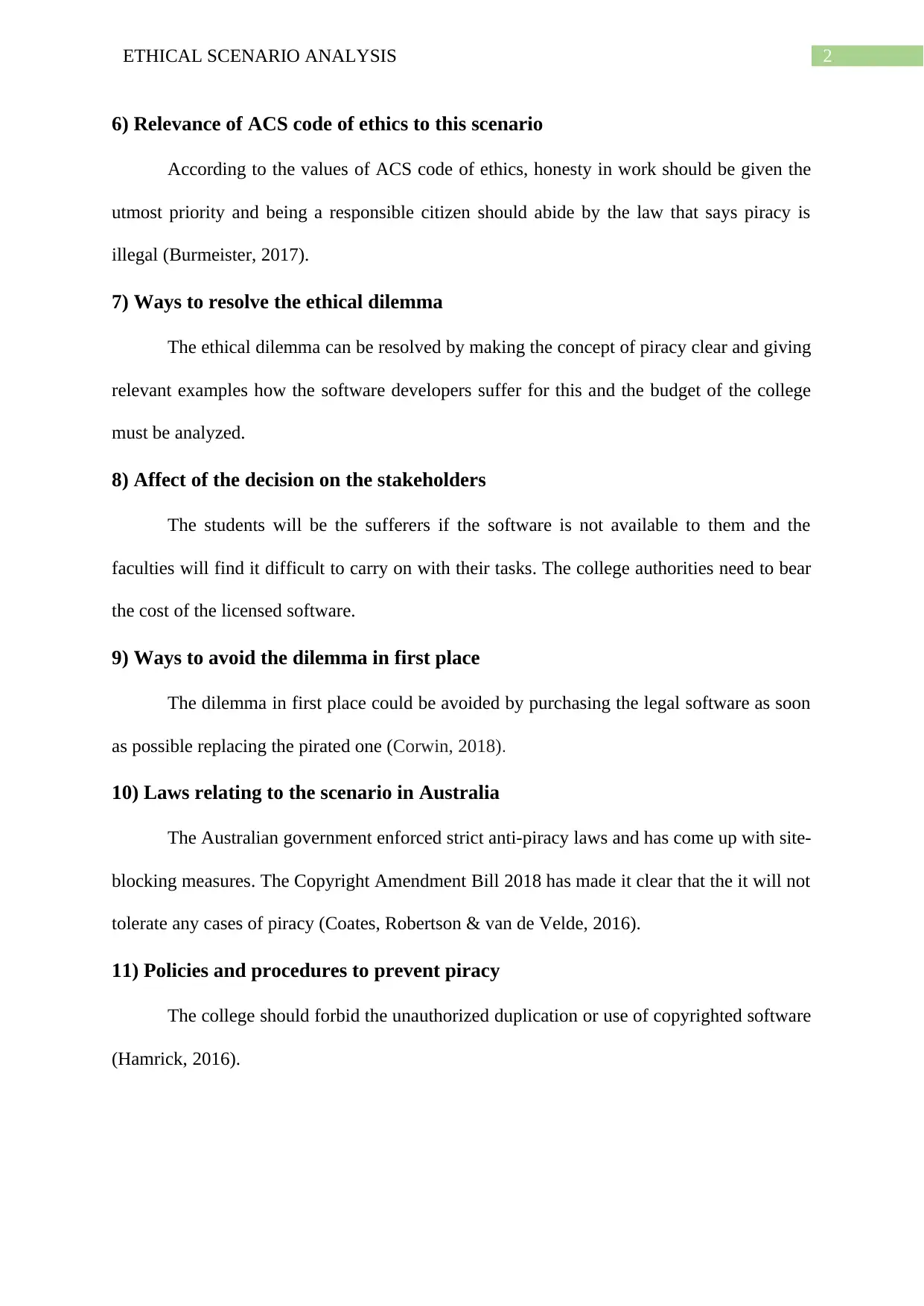
6) Relevance of ACS code of ethics to this scenario
According to the values of ACS code of ethics, honesty in work should be given the
utmost priority and being a responsible citizen should abide by the law that says piracy is
illegal (Burmeister, 2017).
7) Ways to resolve the ethical dilemma
The ethical dilemma can be resolved by making the concept of piracy clear and giving
relevant examples how the software developers suffer for this and the budget of the college
must be analyzed.
8) Affect of the decision on the stakeholders
The students will be the sufferers if the software is not available to them and the
faculties will find it difficult to carry on with their tasks. The college authorities need to bear
the cost of the licensed software.
9) Ways to avoid the dilemma in first place
The dilemma in first place could be avoided by purchasing the legal software as soon
as possible replacing the pirated one (Corwin, 2018).
10) Laws relating to the scenario in Australia
The Australian government enforced strict anti-piracy laws and has come up with site-
blocking measures. The Copyright Amendment Bill 2018 has made it clear that the it will not
tolerate any cases of piracy (Coates, Robertson & van de Velde, 2016).
11) Policies and procedures to prevent piracy
The college should forbid the unauthorized duplication or use of copyrighted software
(Hamrick, 2016).
Document Page
3ETHICAL SCENARIO ANALYSIS
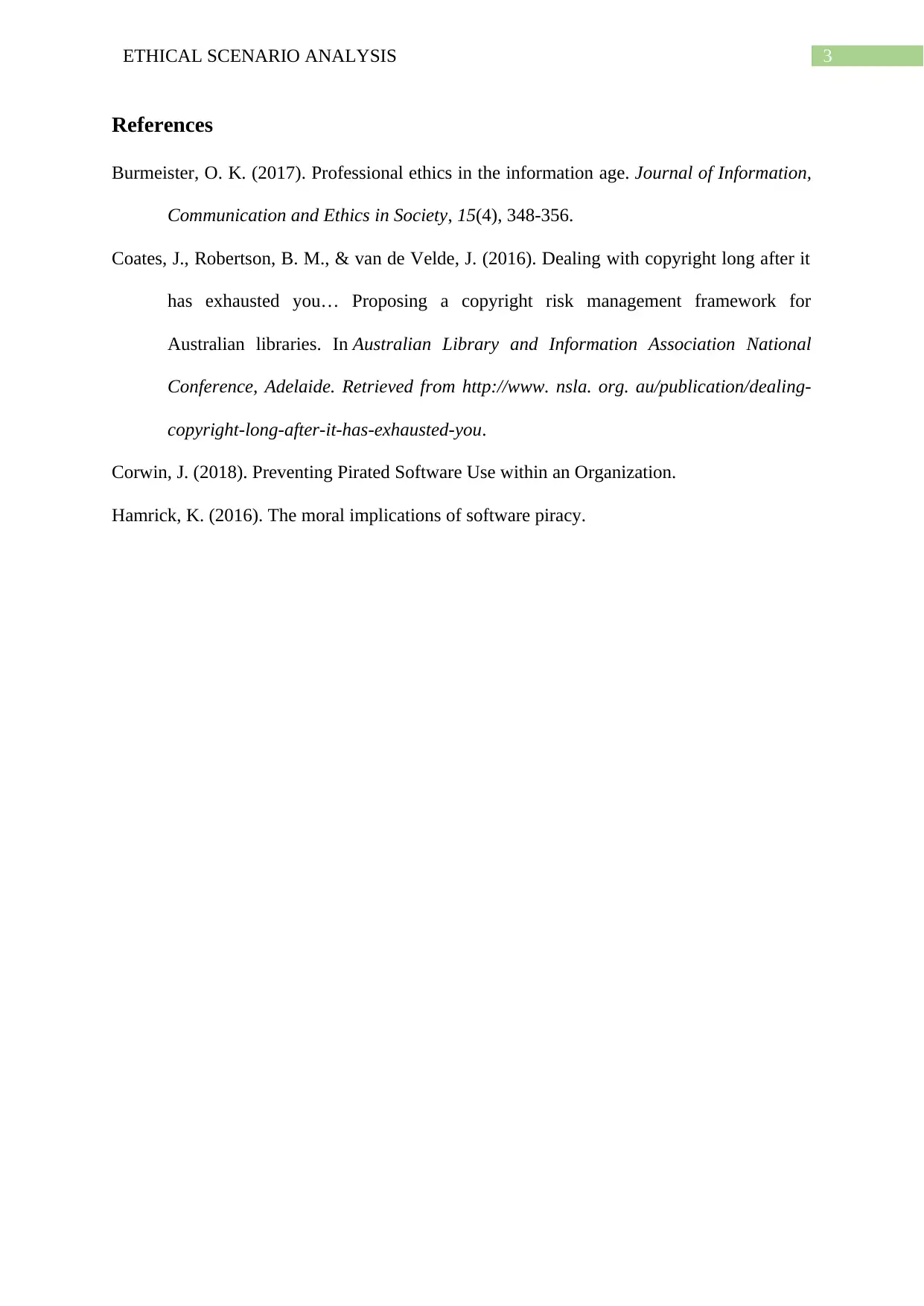
References
Burmeister, O. K. (2017). Professional ethics in the information age. Journal of Information,
Communication and Ethics in Society, 15(4), 348-356.
Coates, J., Robertson, B. M., & van de Velde, J. (2016). Dealing with copyright long after it
has exhausted you… Proposing a copyright risk management framework for
Australian libraries. In Australian Library and Information Association National
Conference, Adelaide. Retrieved from http://www. nsla. org. au/publication/dealing-
copyright-long-after-it-has-exhausted-you.
Corwin, J. (2018). Preventing Pirated Software Use within an Organization.
Hamrick, K. (2016). The moral implications of software piracy.
chevron_up_icon
1 out of 4
circle_padding
hide_on_mobile
zoom_out_icon
[object Object]