ICT508 IT Project Management Exam Paper Solution S1 2019 Murdoch

Verified

Added on  2023/03/29

|5
|1733
|435
Homework Assignment
AI Summary
This document provides a comprehensive solution to an IT Project Management exam, addressing key areas such as stakeholder identification and communication, development of stakeholder management strategies, selection of appropriate communication media, and characteristics of project milestones using SMART criteria. It also explains waterfall and SLOC techniques, cost of quality, project procurement management activities, communication management plans, and work breakdown structures (WBS). Furthermore, the solution evaluates whether a given strategy is problem, opportunity, or directive-based, justifies the need for quality management to include both product and process, describes techniques for quality control in IT projects, and differentiates between CMMI and OPMMM models. The document also defines cost variance, schedule variance, cost performance index, and schedule performance index, and explains the elements included in a statement of work (SOW).
Document Page
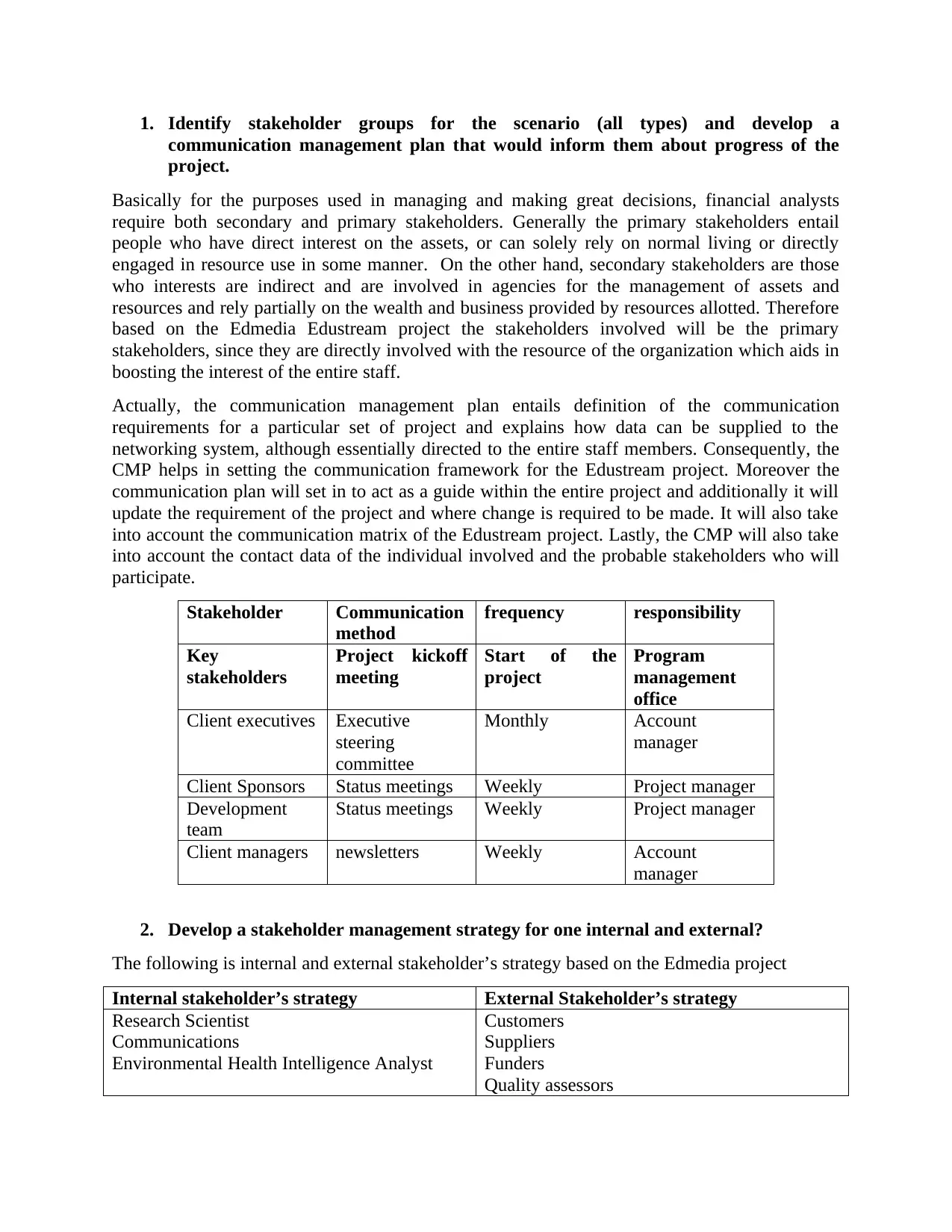
1. Identify stakeholder groups for the scenario (all types) and develop a
communication management plan that would inform them about progress of the
project.
Basically for the purposes used in managing and making great decisions, financial analysts
require both secondary and primary stakeholders. Generally the primary stakeholders entail
people who have direct interest on the assets, or can solely rely on normal living or directly
engaged in resource use in some manner. On the other hand, secondary stakeholders are those
who interests are indirect and are involved in agencies for the management of assets and
resources and rely partially on the wealth and business provided by resources allotted. Therefore
based on the Edmedia Edustream project the stakeholders involved will be the primary
stakeholders, since they are directly involved with the resource of the organization which aids in
boosting the interest of the entire staff.
Actually, the communication management plan entails definition of the communication
requirements for a particular set of project and explains how data can be supplied to the
networking system, although essentially directed to the entire staff members. Consequently, the
CMP helps in setting the communication framework for the Edustream project. Moreover the
communication plan will set in to act as a guide within the entire project and additionally it will
update the requirement of the project and where change is required to be made. It will also take
into account the communication matrix of the Edustream project. Lastly, the CMP will also take
into account the contact data of the individual involved and the probable stakeholders who will
participate.
Stakeholder Communication
method
frequency responsibility
Key
stakeholders
Project kickoff
meeting
Start of the
project
Program
management
office
Client executives Executive
steering
committee
Monthly Account
manager
Client Sponsors Status meetings Weekly Project manager
Development
team
Status meetings Weekly Project manager
Client managers newsletters Weekly Account
manager
2. Develop a stakeholder management strategy for one internal and external?
The following is internal and external stakeholder’s strategy based on the Edmedia project
Internal stakeholder’s strategy External Stakeholder’s strategy
Research Scientist
Communications
Environmental Health Intelligence Analyst
Customers
Suppliers
Funders
Quality assessors
tabler-icon-diamond-filled.svg

Paraphrase This Document

Need a fresh take? Get an instant paraphrase of this document with our AI Paraphraser
Document Page
3. Which media should be suitable for each of your stakeholder?
The most effective media to be employed for each stakeholder in the Edustream project include
the use of intranet and regular mails for each of the stakeholder.
4. What are the characteristics of a milestone? Identify at least two milestones for this
project? Describe each milestone using SMART criteria?
Considering the Edustream project recommendable characteristic of an effective milestone is one
that is specific and measurable. An example of a milestone is based from the managers where
quantitative and meaningful milestone considering 35 units test for the project. Another example
of a milestone is one that enables closure of problems in an effective manner.
5. Explain waterfall-based techniques and SLOC techniques. It advantages and
disadvantages?
Actually the waterfall framework was the first to be introduced. It is also known as the linear
sequential life cycle framework. The technique is understandable and in each section completed
successful another phase commences. The technique is specifically employed in the
establishment of the customer base relationship in organization in order to boost organizational
performance. On the other hand, the SLOC evaluates the efforts done by managerial staff
members. Furthermore experiments have been conducted which assess the level of SLOC in
project management.
Some of the advantages for the waterfall based techniques include:
Considering the waterfall based techniques it is simple and easy to comprehend and
utilize
Easily manageable since it is rigid and comprises of deliverables during the review
process.
Disadvantages for the waterfall based techniques include:
The is no working software generated until the ultimate point of the cycle
Great risk and uncertainty
Whereas, the advantages for the SLOC techniques include:
It is globally recognized
It is linked to the final product
Disadvantages for the SLOC techniques include:
No provision of industry standards used in evaluation of the LOC
Hard in assessing the LOC during the initial phases of a newly implemented design
6. How can the cost of quality be defined? Name and explain two cost categories for
quality that could be included?
Generally cost of quality entails methods that enable an organization in assessing the extent at
which its assets are utilized in events hinder poor quality, which specifically uphold the
organization’s product and services due to internal and external failures.
Document Page
Some of the examples of cost of quality include the internal failure costs linked to the effects
located prior the client accesses the product and external failure costs linked to the effect after
the client gets the products.
7. Describe the activities involved in project procurement management?
Project procurement is basically important when purchasing, leasing and renting external assets
in order to meet your project needs. Therefore this is always a chain like process. Thus there are
certain processes involved in project procurement management, they include:
Plan procurement management – this process is always identified during the planning
stage of a particular project. Therefore, every project manager should provide a document
outlining the procurement contract so that prospective bids can be placed on a certain
project.
Conduct procurement – upon finalising with the entire paper work in the initial phase, the
procurement process is carried out where the bids are being evaluated and awaiting for
approval. Although, prior selecting the bid specific strategies must be employed in order
to come up with the best bid for the project.
The control of procurements – upon signing of the contracts, the management folds the
responsibilities based on the budget and schedules.
Closure procurements – in any project finalizing is very important, as constituting the
detailed agreement of the contractor thus eliminating confusion.
8. A) What is communication management plan?
This is a plan that ensures that efficient communication is achieved within the entire project.
Moreover, about 80% of time is utilized in communications thus efficient project managers must
possess effective communication skills. Additionally, it helps in thinking about the
communication necessities of the projects and how effective the project is.
B) What is WBS? Briefly Explain.
The WBS (Work breakdown Structure) as used in project management is a systems of
deliverables segmented into minor sections. Therefore, a WBS is a core component when
handling projects and helps in organizing team members in a certain project.
Figure 1: Work Breakdown Structure Deliverable
9. Determine whether this is a problem, opportunity and/or directive-based strategy.
Justify your answer.
Document Page
This is an opportunity. The reason behind this is due to the fact that, it enables tracking of events
thus projects will be completed in a successful manner.
10. Why should quality management include both product and process of a project?
Quality management should incorporate both product and processes of a project in order to
ensure certain specification and requirement meet customer’s and stakeholder’s interests.
Moreover initiating quality management entails having both control of products and processes
within any organizational project. This will help in evading issues that might arise in the end due
to inconsistency.
11. Describe three techniques for quality control in I.T projects?
Some of the techniques employed in assessing quality control in IT projects include:
Histogram – generally a histogram comprises of bar charts and different variables that
depict the supply of specific variables over time. Although the graph may take different
shapes in the process of assessing different variables against time.
Pareto charts – the pareto chart comprises of observable features which range from 80 to
20 percent based on the disciplines in context.
Flowcharts – this are logical procedures used in attaining specific objectives in a project.
They are basically drawn considering geometrical objects such as rhombus, rectangular
forms, etc.
12. What is “cost variance, Schedule variance, Cost performance index, schedule
performance index” for the project?
Cost variance entails the disparity amid the cost and the actual incurred budget and prospected
cost total which would have been incurred. Thus in some occasions cost variance is formulated
into typical computational analysis. Hence an example of cost variance can be Labor rate
variance which is effectively used in the Edmedia project
On the other hand, schedule variance is an indicator of whether the project is ahead or behind
and normally utilized in the EVM (Earned Value Management). It is computed by relating
budget cost of work and the budgeted cost of work performed.
Cost performance index (CPI) assesses financial efficiency and accuracy of projects. It exhibits
that amount of work done in every completed unit.
Lastly, schedule performance index (SPI) assess the proximity of a project prospected to be
completed rationalizing it to a specific schedule. This is computed through relating the budgeted
cost of work executed to the acquired value which has been planned.
13. Difference between CMMI and OPMMM model in the project?
CMMI measures the development dimension of an association by deciding whether an
association finishes the particular exercises recorded in the Key Execution Zones (KPA),
careless in regards to whether the fulfillment of such action prompts the ideal outcome.
OPMMM is additionally a movement based methodology however the significant contrast is that
OPMMM adopts a more outcome arranged strategy when characterizing and estimating Key
Execution Territories. CMMI focuses on the fulfillment of explicit assignments or forms and
does not propel the association to concentrate on procedure engineering. OPMMM, then again
tabler-icon-diamond-filled.svg

Paraphrase This Document

Need a fresh take? Get an instant paraphrase of this document with our AI Paraphraser
Document Page
has an iterative lifecycle that coordinates the most recent prescribed procedures from the
business and assaults chances in procedure engineering at a beginning time.
CMMI supplants CMMI in programming advancement forms, yet CMM is as yet pertinent and
proper for successive, movement based administration worldview. Both CMMI and OPMMM
offer significance to desk work and gatherings that divert the board's time and exertion from
genuine work process. CMMI is anyway worried at chronicle forms while CMMI documentation
and gatherings center on key objectives of the associations. CMMI has concentrated
consideration on procedures; however the new OPMMM goes above and beyond and center
consideration on result-arranged procedures.
14. What is statement of work and what element does it include?
Generally statement of work (SOW) is a form of certification which explains entirely the ides of
one’s work involved in clarifying and vendor of deliverables such as timeline and costs. Thus the
SOW includes:
Due dates and deliverables
Tasks and how they are assigned
Assets required for projects, equipment, and the QA processes
Ruling processes for specific projects
The deadline and costs of payments
chevron_up_icon
1 out of 5
circle_padding
hide_on_mobile
zoom_out_icon
[object Object]