IT Project Management Techniques: A Detailed Report on IT Projects
VerifiedAdded on 2020/03/16
|27
|5432
|49
Report
AI Summary
This report provides a detailed analysis of IT project management techniques, exploring both traditional and agile approaches. It covers the project lifecycle, identifying critical roles and stakeholders, and the importance of a well-defined project management plan. The report delves into the basic components of a project plan, its significance in improving IT project success, and includes a contemporary IT project example with a project schedule and budget breakdown. The application of process group modules, decision-making processes, and current issues in IT project management are also discussed. The report emphasizes the importance of effective communication and quality software in IT projects, concluding with a summary of key findings and recommendations. The report also includes appendices with supporting documents like change requests, issue logs, and stakeholder registers.
Running head: IT PROJECT MANAGEMENT TECHNIQUES 1
Project management of information technology
Name:
Institution:
Project management of information technology
Name:
Institution:

Paraphrase This Document
Need a fresh take? Get an instant paraphrase of this document with our AI Paraphraser
IT Project Management Techniques 2
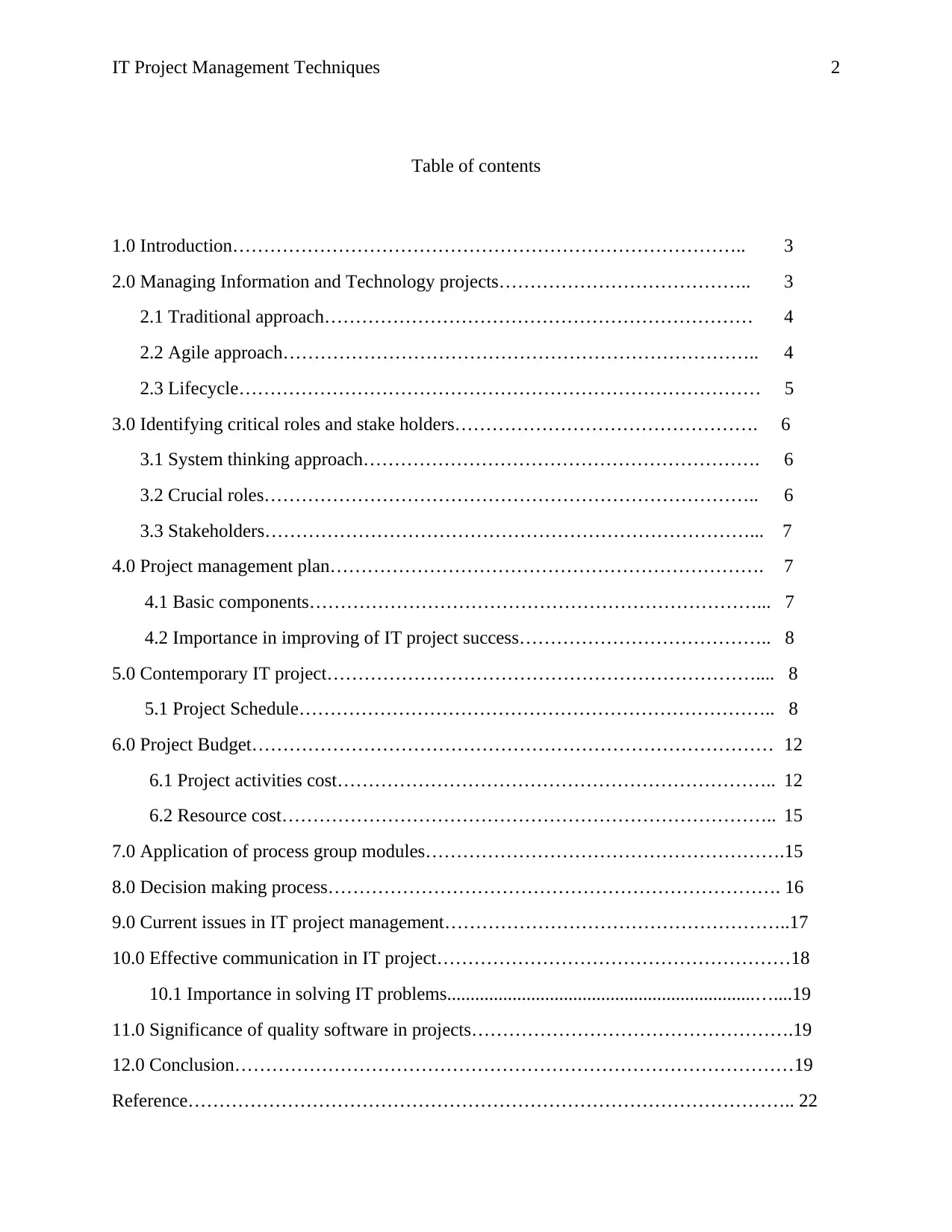
Table of contents
1.0 Introduction……………………………………………………………………….. 3
2.0 Managing Information and Technology projects………………………………….. 3
2.1 Traditional approach…………………………………………………………… 4
2.2 Agile approach………………………………………………………………….. 4
2.3 Lifecycle………………………………………………………………………… 5
3.0 Identifying critical roles and stake holders…………………………………………. 6
3.1 System thinking approach………………………………………………………. 6
3.2 Crucial roles…………………………………………………………………….. 6
3.3 Stakeholders……………………………………………………………………... 7
4.0 Project management plan……………………………………………………………. 7
4.1 Basic components………………………………………………………………... 7
4.2 Importance in improving of IT project success………………………………….. 8
5.0 Contemporary IT project…………………………………………………………….... 8
5.1 Project Schedule………………………………………………………………….. 8
6.0 Project Budget………………………………………………………………………… 12
6.1 Project activities cost…………………………………………………………….. 12
6.2 Resource cost…………………………………………………………………….. 15
7.0 Application of process group modules………………………………………………….15
8.0 Decision making process………………………………………………………………. 16
9.0 Current issues in IT project management………………………………………………..17
10.0 Effective communication in IT project…………………………………………………18
10.1 Importance in solving IT problems..................................................................…....19
11.0 Significance of quality software in projects…………………………………………….19
12.0 Conclusion………………………………………………………………………………19
Reference…………………………………………………………………………………….. 22
Table of contents
1.0 Introduction……………………………………………………………………….. 3
2.0 Managing Information and Technology projects………………………………….. 3
2.1 Traditional approach…………………………………………………………… 4
2.2 Agile approach………………………………………………………………….. 4
2.3 Lifecycle………………………………………………………………………… 5
3.0 Identifying critical roles and stake holders…………………………………………. 6
3.1 System thinking approach………………………………………………………. 6
3.2 Crucial roles…………………………………………………………………….. 6
3.3 Stakeholders……………………………………………………………………... 7
4.0 Project management plan……………………………………………………………. 7
4.1 Basic components………………………………………………………………... 7
4.2 Importance in improving of IT project success………………………………….. 8
5.0 Contemporary IT project…………………………………………………………….... 8
5.1 Project Schedule………………………………………………………………….. 8
6.0 Project Budget………………………………………………………………………… 12
6.1 Project activities cost…………………………………………………………….. 12
6.2 Resource cost…………………………………………………………………….. 15
7.0 Application of process group modules………………………………………………….15
8.0 Decision making process………………………………………………………………. 16
9.0 Current issues in IT project management………………………………………………..17
10.0 Effective communication in IT project…………………………………………………18
10.1 Importance in solving IT problems..................................................................…....19
11.0 Significance of quality software in projects…………………………………………….19
12.0 Conclusion………………………………………………………………………………19
Reference…………………………………………………………………………………….. 22
IT Project Management Techniques 3
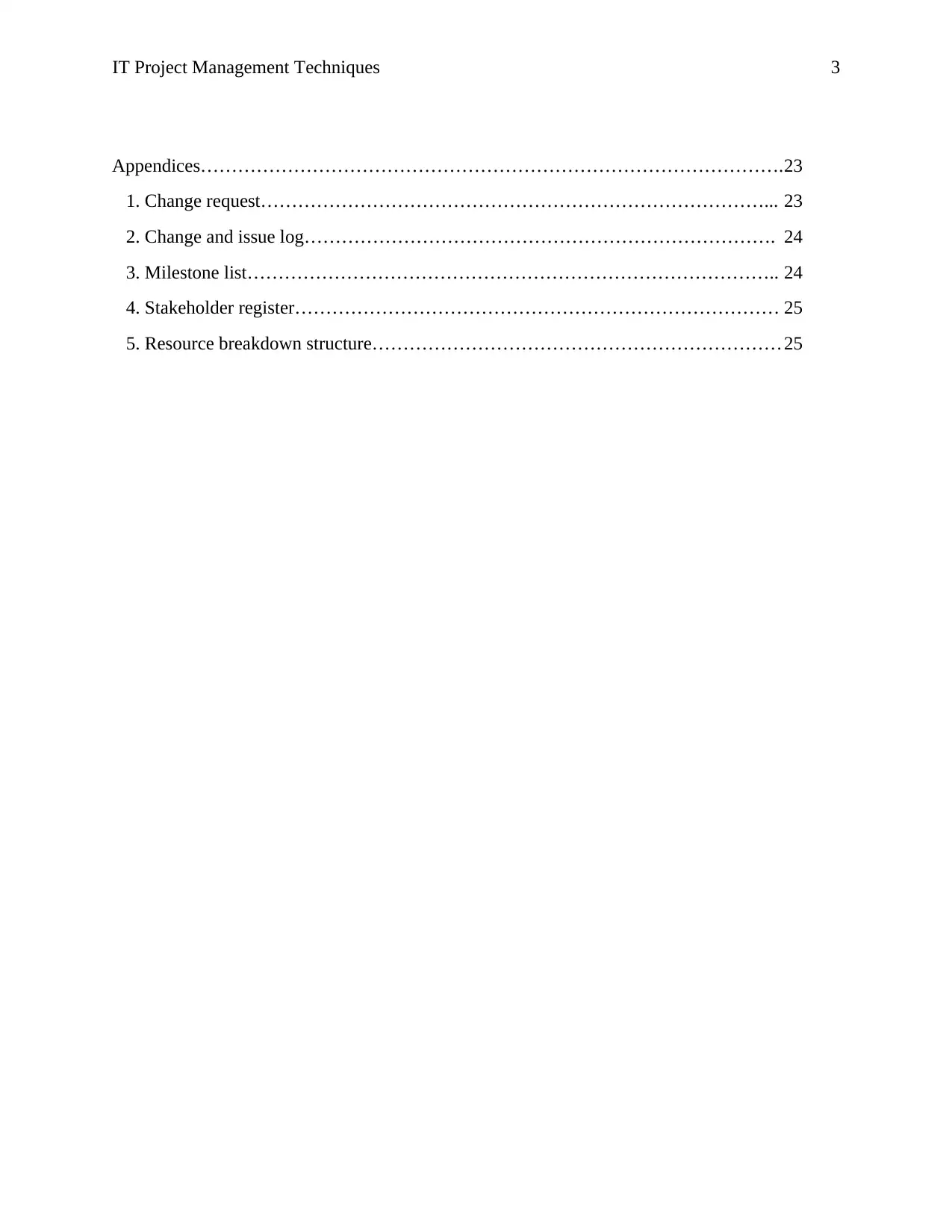
Appendices………………………………………………………………………………….23
1. Change request………………………………………………………………………... 23
2. Change and issue log…………………………………………………………………. 24
3. Milestone list………………………………………………………………………….. 24
4. Stakeholder register…………………………………………………………………… 25
5. Resource breakdown structure…………………………………………………………25
Appendices………………………………………………………………………………….23
1. Change request………………………………………………………………………... 23
2. Change and issue log…………………………………………………………………. 24
3. Milestone list………………………………………………………………………….. 24
4. Stakeholder register…………………………………………………………………… 25
5. Resource breakdown structure…………………………………………………………25
⊘ This is a preview!⊘
Do you want full access?
Subscribe today to unlock all pages.

Trusted by 1+ million students worldwide
IT Project Management Techniques 4
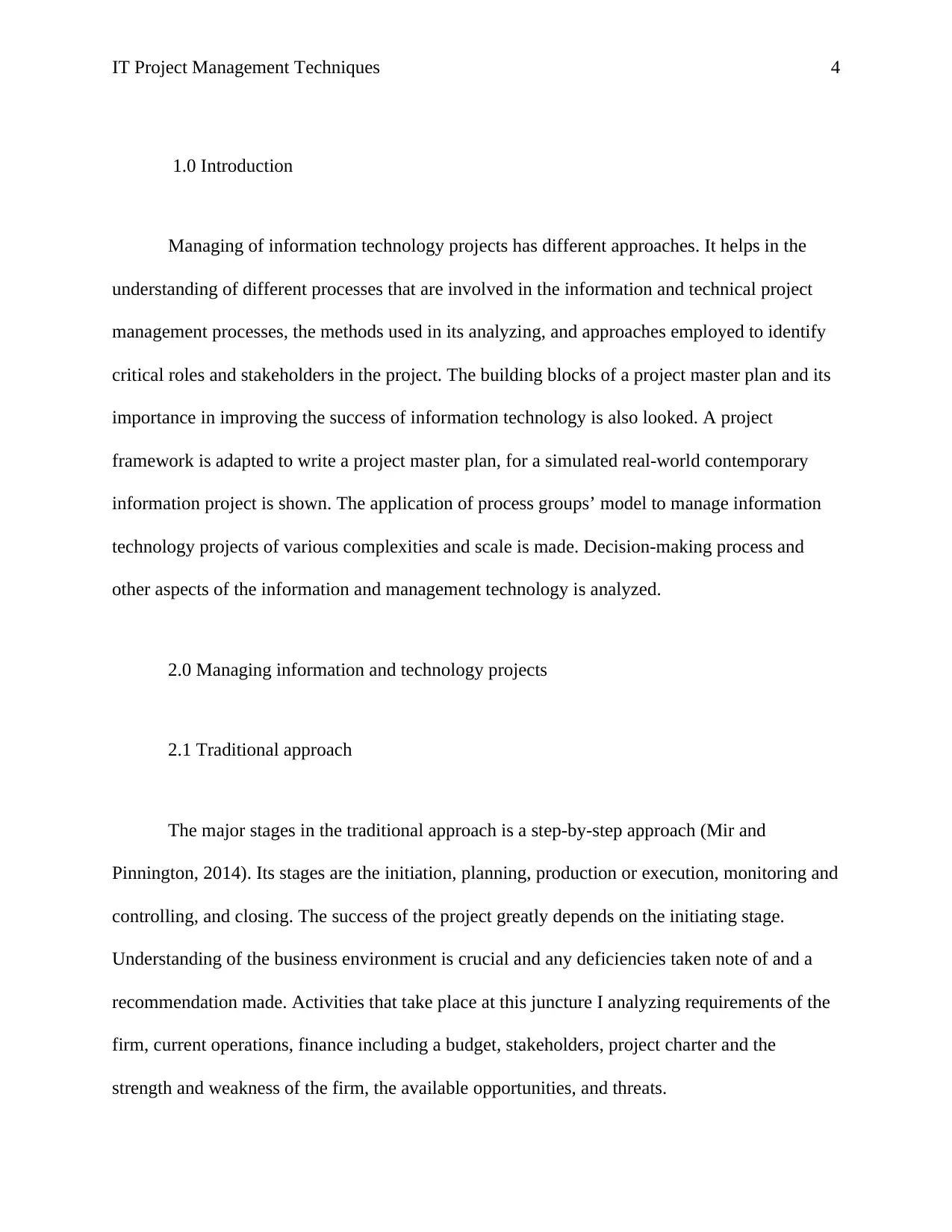
1.0 Introduction
Managing of information technology projects has different approaches. It helps in the
understanding of different processes that are involved in the information and technical project
management processes, the methods used in its analyzing, and approaches employed to identify
critical roles and stakeholders in the project. The building blocks of a project master plan and its
importance in improving the success of information technology is also looked. A project
framework is adapted to write a project master plan, for a simulated real-world contemporary
information project is shown. The application of process groups’ model to manage information
technology projects of various complexities and scale is made. Decision-making process and
other aspects of the information and management technology is analyzed.
2.0 Managing information and technology projects
2.1 Traditional approach
The major stages in the traditional approach is a step-by-step approach (Mir and
Pinnington, 2014). Its stages are the initiation, planning, production or execution, monitoring and
controlling, and closing. The success of the project greatly depends on the initiating stage.
Understanding of the business environment is crucial and any deficiencies taken note of and a
recommendation made. Activities that take place at this juncture I analyzing requirements of the
firm, current operations, finance including a budget, stakeholders, project charter and the
strength and weakness of the firm, the available opportunities, and threats.
1.0 Introduction
Managing of information technology projects has different approaches. It helps in the
understanding of different processes that are involved in the information and technical project
management processes, the methods used in its analyzing, and approaches employed to identify
critical roles and stakeholders in the project. The building blocks of a project master plan and its
importance in improving the success of information technology is also looked. A project
framework is adapted to write a project master plan, for a simulated real-world contemporary
information project is shown. The application of process groups’ model to manage information
technology projects of various complexities and scale is made. Decision-making process and
other aspects of the information and management technology is analyzed.
2.0 Managing information and technology projects
2.1 Traditional approach
The major stages in the traditional approach is a step-by-step approach (Mir and
Pinnington, 2014). Its stages are the initiation, planning, production or execution, monitoring and
controlling, and closing. The success of the project greatly depends on the initiating stage.
Understanding of the business environment is crucial and any deficiencies taken note of and a
recommendation made. Activities that take place at this juncture I analyzing requirements of the
firm, current operations, finance including a budget, stakeholders, project charter and the
strength and weakness of the firm, the available opportunities, and threats.
Paraphrase This Document
Need a fresh take? Get an instant paraphrase of this document with our AI Paraphraser
IT Project Management Techniques 5
Planning of the project follows the initiation with the aim of accomplishing the set goals
of the project. Details are set out on how to plan and scope statement is developed, followed by
the selection of a planning team. Doable goals are set out, and a breakdown of work structure
created. Activities to take place to achieve the feasible is then identified and organized in a
sequence. Estimation of resource required, time and cost are also done then the schedule and
budget developed. The risk is planned for, quality assurance measures designed and the program
is presented for formal approval.
In the execution process, the project management plan doable is executed through
allocation and management of the available resources and budgets. At the monitoring and
controlling stage, ongoing activities are put to measure. The current development and
performance of the project are also measured. Issues and risks are corrected using the formulated
corrective action and only approved changes implemented.
At the project controlling stage, the progress of the project is tracked. It is ensured to be
within the time frame allocated, and the budget. Finally, the closing stage consists the formal
acceptance of the project. The contract is closed together with the project.
2.2 Agile approach
The agile approach is flexible and efficient and has its framework. The first framework is
scrum that is based upon systematic interactions. It involves roles, sprints, and artifacts. Any
obstacle that may prevent the efficient working of the team is eliminated by scrum master who is
Planning of the project follows the initiation with the aim of accomplishing the set goals
of the project. Details are set out on how to plan and scope statement is developed, followed by
the selection of a planning team. Doable goals are set out, and a breakdown of work structure
created. Activities to take place to achieve the feasible is then identified and organized in a
sequence. Estimation of resource required, time and cost are also done then the schedule and
budget developed. The risk is planned for, quality assurance measures designed and the program
is presented for formal approval.
In the execution process, the project management plan doable is executed through
allocation and management of the available resources and budgets. At the monitoring and
controlling stage, ongoing activities are put to measure. The current development and
performance of the project are also measured. Issues and risks are corrected using the formulated
corrective action and only approved changes implemented.
At the project controlling stage, the progress of the project is tracked. It is ensured to be
within the time frame allocated, and the budget. Finally, the closing stage consists the formal
acceptance of the project. The contract is closed together with the project.
2.2 Agile approach
The agile approach is flexible and efficient and has its framework. The first framework is
scrum that is based upon systematic interactions. It involves roles, sprints, and artifacts. Any
obstacle that may prevent the efficient working of the team is eliminated by scrum master who is
IT Project Management Techniques 6
one of the major systematic interaction functions (Schwalble, 2015). Another role is played by
the product owner. He can either be a customer or stakeholder and has an active involvement in
every stage of the project. He is expected to give feedback on every job done on the project. The
scrum team plays the role of product implementation and consists of up to 7 team members.
Sprint is the core unit of work in the scrum and should be a maximum of four weeks for
easier planning and tracking of progress. The three top artifacts are the product backlog, sprint
backlog and sprint burn down the chart.
Extreme programming (XP) in agile approach practices test-driven developments where
tests are used to capture any defect of codes in software thus ensuring high-quality products at
the end of the project. Agile also uses continuous integration (CI) to eliminate integration issues
in projects enabling a rapid deployment of the final products. Pair programming is another of
agile practices that are considered controversial this practice spreads the knowledge of the
project across team members.
2.3 Lifecycles
In the agile process flow consists of concept, inception, construction, release, production,
and retirement. Concepts are first envisioned and prioritized. At beginning team members are
then identified, funds allocated and a discussion on requirements made. Working software is
delivered based on iteration requirements at the construction stage by developing team members.
The final release of iteration into products then follows. Production continues to undergo
one of the major systematic interaction functions (Schwalble, 2015). Another role is played by
the product owner. He can either be a customer or stakeholder and has an active involvement in
every stage of the project. He is expected to give feedback on every job done on the project. The
scrum team plays the role of product implementation and consists of up to 7 team members.
Sprint is the core unit of work in the scrum and should be a maximum of four weeks for
easier planning and tracking of progress. The three top artifacts are the product backlog, sprint
backlog and sprint burn down the chart.
Extreme programming (XP) in agile approach practices test-driven developments where
tests are used to capture any defect of codes in software thus ensuring high-quality products at
the end of the project. Agile also uses continuous integration (CI) to eliminate integration issues
in projects enabling a rapid deployment of the final products. Pair programming is another of
agile practices that are considered controversial this practice spreads the knowledge of the
project across team members.
2.3 Lifecycles
In the agile process flow consists of concept, inception, construction, release, production,
and retirement. Concepts are first envisioned and prioritized. At beginning team members are
then identified, funds allocated and a discussion on requirements made. Working software is
delivered based on iteration requirements at the construction stage by developing team members.
The final release of iteration into products then follows. Production continues to undergo
⊘ This is a preview!⊘
Do you want full access?
Subscribe today to unlock all pages.
Trusted by 1+ million students worldwide
IT Project Management Techniques 7
afterward and at the retirement comes to the end-of-life activities, customer migration and
notification is included.
The traditional life cycle is a step-by-step process and consists of initiation, planning,
execution, performance, and closing of the project.
3.0 Identifying critical roles and stakeholders
3.1 System approach
In employing system thinking approach, the situation is first defined and consideration of
whether the method is applicable. Behavioral patterns are then developed, and the underlying
structure evolved then simulated. Leverage points are then identified and an alternative structure
formed. Simulation of the alternative structure follows, and an adoption approach developed.
3.2 Crucial roles
In the information and technology projects, critical parts can be identified by employing a
system thinking approach. The role of a project manager is one of these functions. The manager
identifies projects and deals with them. He also analyzes the goals of the project and formulates
ways to achieve the said goals. Project performance is also analyzed by the project manager and
its day-to-day development. The project manager is the one to close the project and put into the
record the lessons learned from the project.
afterward and at the retirement comes to the end-of-life activities, customer migration and
notification is included.
The traditional life cycle is a step-by-step process and consists of initiation, planning,
execution, performance, and closing of the project.
3.0 Identifying critical roles and stakeholders
3.1 System approach
In employing system thinking approach, the situation is first defined and consideration of
whether the method is applicable. Behavioral patterns are then developed, and the underlying
structure evolved then simulated. Leverage points are then identified and an alternative structure
formed. Simulation of the alternative structure follows, and an adoption approach developed.
3.2 Crucial roles
In the information and technology projects, critical parts can be identified by employing a
system thinking approach. The role of a project manager is one of these functions. The manager
identifies projects and deals with them. He also analyzes the goals of the project and formulates
ways to achieve the said goals. Project performance is also analyzed by the project manager and
its day-to-day development. The project manager is the one to close the project and put into the
record the lessons learned from the project.
Paraphrase This Document
Need a fresh take? Get an instant paraphrase of this document with our AI Paraphraser
IT Project Management Techniques 8
Another role is the role of a team leader. He is the one who initiates projections by
actually putting words into action for goals to be achieved. The team leader acts as a model by
using his behavior to shape others such as observing of time. Negotiations for the project
provides is done by the team leader and serves as a listener to the employees. He coaches team
members by encouraging them to maximize their potential. A team leader also partakes in work.
A team member is a crucial role, and there is a criterion of one intending to be a team
member (Fleming and Koppelman, 2016). Technical skills of the person are taken into
consideration, their problem-solving skills, interpersonal skills, and organizational skills.
3.3 Stakeholders
They are individuals who are actively involved in projects or have something to lose if
the projects fail. The top management is a stakeholder and may consist of company’s president,
vice-president, directors and division managers. The project team is also a stakeholder. It
consists of people working on the project on a part-time basis.
4.0 Project management plan
4.1 Basic components
The first element is the scope management; it helps with the description of what is
essential in the project and what should be out. The main products of the project are specified
Another role is the role of a team leader. He is the one who initiates projections by
actually putting words into action for goals to be achieved. The team leader acts as a model by
using his behavior to shape others such as observing of time. Negotiations for the project
provides is done by the team leader and serves as a listener to the employees. He coaches team
members by encouraging them to maximize their potential. A team leader also partakes in work.
A team member is a crucial role, and there is a criterion of one intending to be a team
member (Fleming and Koppelman, 2016). Technical skills of the person are taken into
consideration, their problem-solving skills, interpersonal skills, and organizational skills.
3.3 Stakeholders
They are individuals who are actively involved in projects or have something to lose if
the projects fail. The top management is a stakeholder and may consist of company’s president,
vice-president, directors and division managers. The project team is also a stakeholder. It
consists of people working on the project on a part-time basis.
4.0 Project management plan
4.1 Basic components
The first element is the scope management; it helps with the description of what is
essential in the project and what should be out. The main products of the project are specified
IT Project Management Techniques 9
and stipulate a way to measure the performance of the project. Scheduling is the second
component. Its contents include precedence diagrams, resource histograms, Gantt charts and
project life cycle and they help in showing the key deliverables of a project. The third component
is resource management. Every product should have an assignee who takes it responsibility. The
project hierarchy is established, the delegation of authority done, and role descriptions made.
Lastly, is the budgeting and cost management component. Estimation of cost and budgeting is
done and agreed upon.
4.2 Importance of improving IT project success
Project master plan ensures that the end product is part of what was set out in the goals of
the project as a method is defined and chaos organized. Delays and overrunning of costs are
avoided by project plans as a schedule and plan are established. When people come together in
projects, ideas are shared, and inspiration is offered to one another enforcing and encouraging
teamwork. Resources are maximized as project plans ensure that resources are used efficiently
and economically.
5.0 Contemporary information technology project
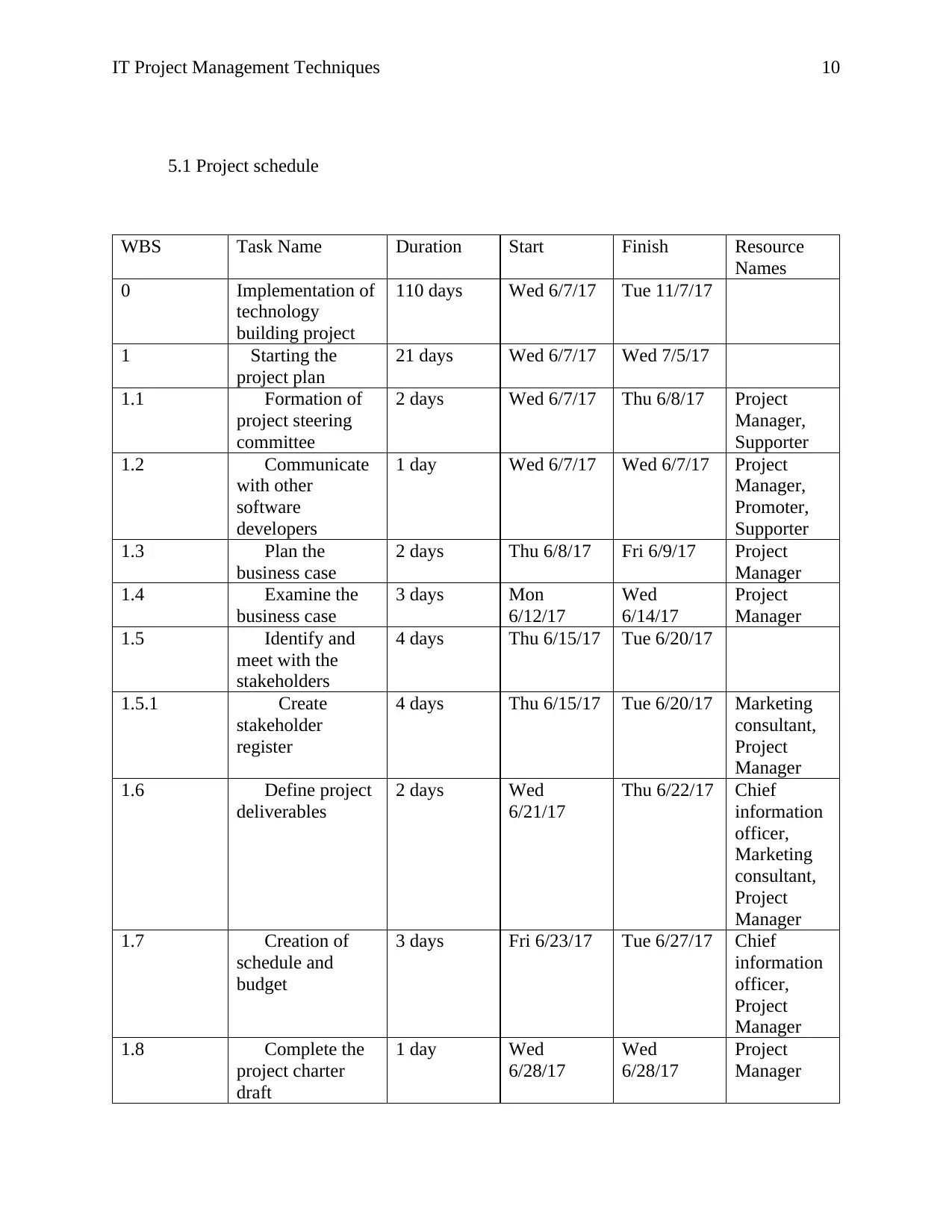
Project management plan using a Scrum framework, the project will be estimated to take
one hundred and twenty days. A day is dedicated to planning the project’s development begins.
Meetings are then held daily to check on the progress and factors such as what is completed,
what is yet to be completed and the challenges faced in the completion.
and stipulate a way to measure the performance of the project. Scheduling is the second
component. Its contents include precedence diagrams, resource histograms, Gantt charts and
project life cycle and they help in showing the key deliverables of a project. The third component
is resource management. Every product should have an assignee who takes it responsibility. The
project hierarchy is established, the delegation of authority done, and role descriptions made.
Lastly, is the budgeting and cost management component. Estimation of cost and budgeting is
done and agreed upon.
4.2 Importance of improving IT project success
Project master plan ensures that the end product is part of what was set out in the goals of
the project as a method is defined and chaos organized. Delays and overrunning of costs are
avoided by project plans as a schedule and plan are established. When people come together in
projects, ideas are shared, and inspiration is offered to one another enforcing and encouraging
teamwork. Resources are maximized as project plans ensure that resources are used efficiently
and economically.
5.0 Contemporary information technology project
Project management plan using a Scrum framework, the project will be estimated to take
one hundred and twenty days. A day is dedicated to planning the project’s development begins.
Meetings are then held daily to check on the progress and factors such as what is completed,
what is yet to be completed and the challenges faced in the completion.
⊘ This is a preview!⊘
Do you want full access?
Subscribe today to unlock all pages.
Trusted by 1+ million students worldwide
IT Project Management Techniques 10
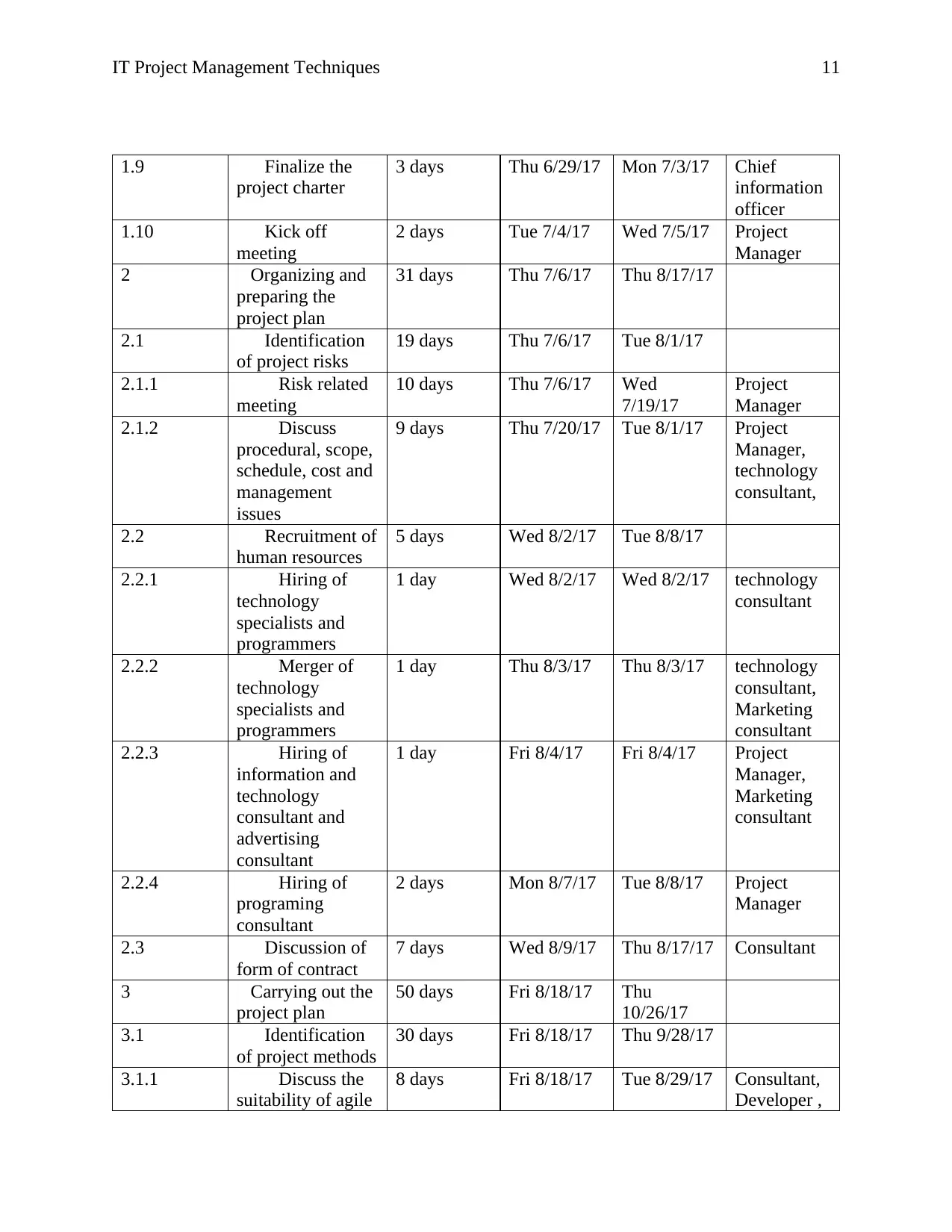
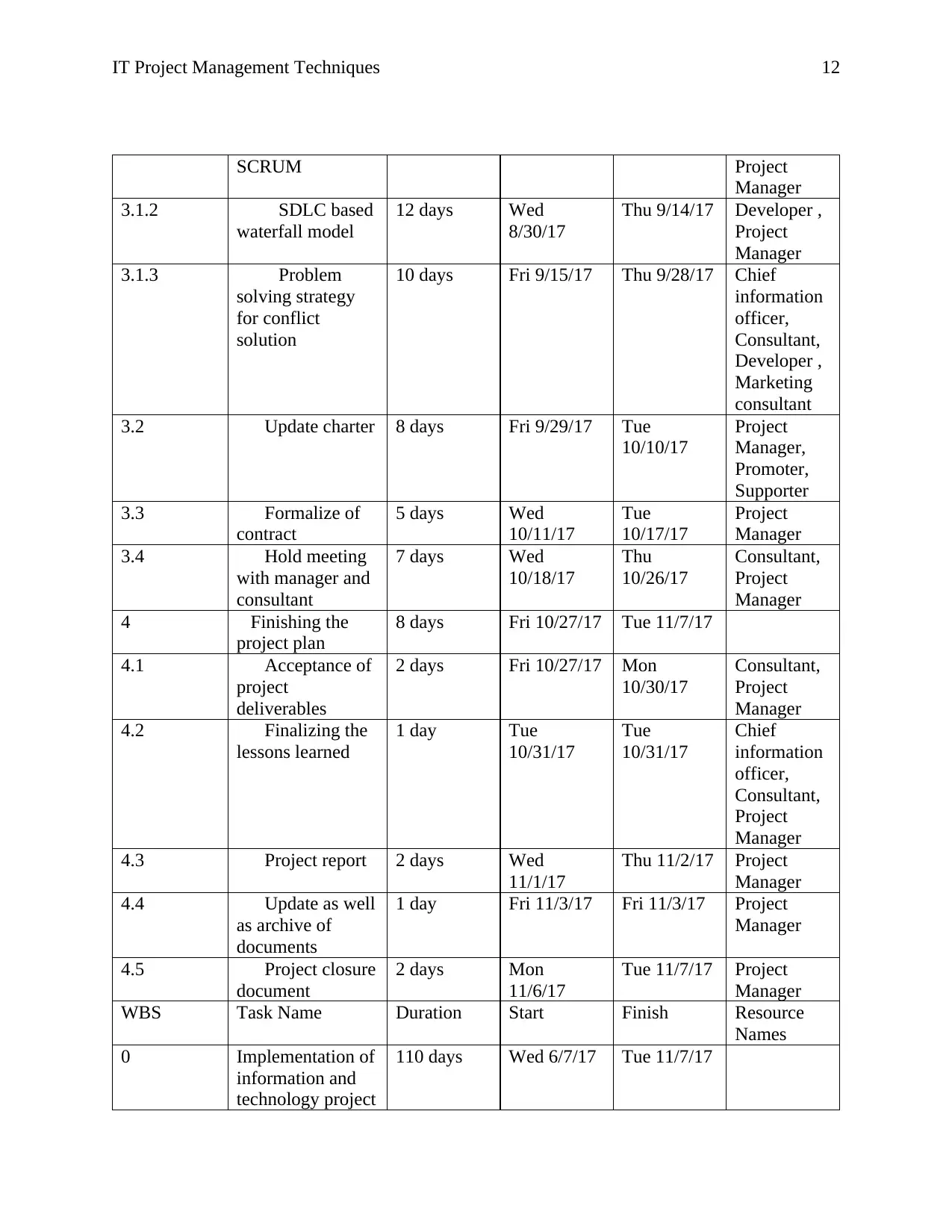
5.1 Project schedule
WBS Task Name Duration Start Finish Resource
Names
0 Implementation of
technology
building project
110 days Wed 6/7/17 Tue 11/7/17
1 Starting the
project plan
21 days Wed 6/7/17 Wed 7/5/17
1.1 Formation of
project steering
committee
2 days Wed 6/7/17 Thu 6/8/17 Project
Manager,
Supporter
1.2 Communicate
with other
software
developers
1 day Wed 6/7/17 Wed 6/7/17 Project
Manager,
Promoter,
Supporter
1.3 Plan the
business case
2 days Thu 6/8/17 Fri 6/9/17 Project
Manager
1.4 Examine the
business case
3 days Mon
6/12/17
Wed
6/14/17
Project
Manager
1.5 Identify and
meet with the
stakeholders
4 days Thu 6/15/17 Tue 6/20/17
1.5.1 Create
stakeholder
register
4 days Thu 6/15/17 Tue 6/20/17 Marketing
consultant,
Project
Manager
1.6 Define project
deliverables
2 days Wed
6/21/17
Thu 6/22/17 Chief
information
officer,
Marketing
consultant,
Project
Manager
1.7 Creation of
schedule and
budget
3 days Fri 6/23/17 Tue 6/27/17 Chief
information
officer,
Project
Manager
1.8 Complete the
project charter
draft
1 day Wed
6/28/17
Wed
6/28/17
Project
Manager
5.1 Project schedule
WBS Task Name Duration Start Finish Resource
Names
0 Implementation of
technology
building project
110 days Wed 6/7/17 Tue 11/7/17
1 Starting the
project plan
21 days Wed 6/7/17 Wed 7/5/17
1.1 Formation of
project steering
committee
2 days Wed 6/7/17 Thu 6/8/17 Project
Manager,
Supporter
1.2 Communicate
with other
software
developers
1 day Wed 6/7/17 Wed 6/7/17 Project
Manager,
Promoter,
Supporter
1.3 Plan the
business case
2 days Thu 6/8/17 Fri 6/9/17 Project
Manager
1.4 Examine the
business case
3 days Mon
6/12/17
Wed
6/14/17
Project
Manager
1.5 Identify and
meet with the
stakeholders
4 days Thu 6/15/17 Tue 6/20/17
1.5.1 Create
stakeholder
register
4 days Thu 6/15/17 Tue 6/20/17 Marketing
consultant,
Project
Manager
1.6 Define project
deliverables
2 days Wed
6/21/17
Thu 6/22/17 Chief
information
officer,
Marketing
consultant,
Project
Manager
1.7 Creation of
schedule and
budget
3 days Fri 6/23/17 Tue 6/27/17 Chief
information
officer,
Project
Manager
1.8 Complete the
project charter
draft
1 day Wed
6/28/17
Wed
6/28/17
Project
Manager
Paraphrase This Document
Need a fresh take? Get an instant paraphrase of this document with our AI Paraphraser
IT Project Management Techniques 11
1.9 Finalize the
project charter
3 days Thu 6/29/17 Mon 7/3/17 Chief
information
officer
1.10 Kick off
meeting
2 days Tue 7/4/17 Wed 7/5/17 Project
Manager
2 Organizing and
preparing the
project plan
31 days Thu 7/6/17 Thu 8/17/17
2.1 Identification
of project risks
19 days Thu 7/6/17 Tue 8/1/17
2.1.1 Risk related
meeting
10 days Thu 7/6/17 Wed
7/19/17
Project
Manager
2.1.2 Discuss
procedural, scope,
schedule, cost and
management
issues
9 days Thu 7/20/17 Tue 8/1/17 Project
Manager,
technology
consultant,
2.2 Recruitment of
human resources
5 days Wed 8/2/17 Tue 8/8/17
2.2.1 Hiring of
technology
specialists and
programmers
1 day Wed 8/2/17 Wed 8/2/17 technology
consultant
2.2.2 Merger of
technology
specialists and
programmers
1 day Thu 8/3/17 Thu 8/3/17 technology
consultant,
Marketing
consultant
2.2.3 Hiring of
information and
technology
consultant and
advertising
consultant
1 day Fri 8/4/17 Fri 8/4/17 Project
Manager,
Marketing
consultant
2.2.4 Hiring of
programing
consultant
2 days Mon 8/7/17 Tue 8/8/17 Project
Manager
2.3 Discussion of
form of contract
7 days Wed 8/9/17 Thu 8/17/17 Consultant
3 Carrying out the
project plan
50 days Fri 8/18/17 Thu
10/26/17
3.1 Identification
of project methods
30 days Fri 8/18/17 Thu 9/28/17
3.1.1 Discuss the
suitability of agile
8 days Fri 8/18/17 Tue 8/29/17 Consultant,
Developer ,
1.9 Finalize the
project charter
3 days Thu 6/29/17 Mon 7/3/17 Chief
information
officer
1.10 Kick off
meeting
2 days Tue 7/4/17 Wed 7/5/17 Project
Manager
2 Organizing and
preparing the
project plan
31 days Thu 7/6/17 Thu 8/17/17
2.1 Identification
of project risks
19 days Thu 7/6/17 Tue 8/1/17
2.1.1 Risk related
meeting
10 days Thu 7/6/17 Wed
7/19/17
Project
Manager
2.1.2 Discuss
procedural, scope,
schedule, cost and
management
issues
9 days Thu 7/20/17 Tue 8/1/17 Project
Manager,
technology
consultant,
2.2 Recruitment of
human resources
5 days Wed 8/2/17 Tue 8/8/17
2.2.1 Hiring of
technology
specialists and
programmers
1 day Wed 8/2/17 Wed 8/2/17 technology
consultant
2.2.2 Merger of
technology
specialists and
programmers
1 day Thu 8/3/17 Thu 8/3/17 technology
consultant,
Marketing
consultant
2.2.3 Hiring of
information and
technology
consultant and
advertising
consultant
1 day Fri 8/4/17 Fri 8/4/17 Project
Manager,
Marketing
consultant
2.2.4 Hiring of
programing
consultant
2 days Mon 8/7/17 Tue 8/8/17 Project
Manager
2.3 Discussion of
form of contract
7 days Wed 8/9/17 Thu 8/17/17 Consultant
3 Carrying out the
project plan
50 days Fri 8/18/17 Thu
10/26/17
3.1 Identification
of project methods
30 days Fri 8/18/17 Thu 9/28/17
3.1.1 Discuss the
suitability of agile
8 days Fri 8/18/17 Tue 8/29/17 Consultant,
Developer ,
IT Project Management Techniques 12
SCRUM Project
Manager
3.1.2 SDLC based
waterfall model
12 days Wed
8/30/17
Thu 9/14/17 Developer ,
Project
Manager
3.1.3 Problem
solving strategy
for conflict
solution
10 days Fri 9/15/17 Thu 9/28/17 Chief
information
officer,
Consultant,
Developer ,
Marketing
consultant
3.2 Update charter 8 days Fri 9/29/17 Tue
10/10/17
Project
Manager,
Promoter,
Supporter
3.3 Formalize of
contract
5 days Wed
10/11/17
Tue
10/17/17
Project
Manager
3.4 Hold meeting
with manager and
consultant
7 days Wed
10/18/17
Thu
10/26/17
Consultant,
Project
Manager
4 Finishing the
project plan
8 days Fri 10/27/17 Tue 11/7/17
4.1 Acceptance of
project
deliverables
2 days Fri 10/27/17 Mon
10/30/17
Consultant,
Project
Manager
4.2 Finalizing the
lessons learned
1 day Tue
10/31/17
Tue
10/31/17
Chief
information
officer,
Consultant,
Project
Manager
4.3 Project report 2 days Wed
11/1/17
Thu 11/2/17 Project
Manager
4.4 Update as well
as archive of
documents
1 day Fri 11/3/17 Fri 11/3/17 Project
Manager
4.5 Project closure
document
2 days Mon
11/6/17
Tue 11/7/17 Project
Manager
WBS Task Name Duration Start Finish Resource
Names
0 Implementation of
information and
technology project
110 days Wed 6/7/17 Tue 11/7/17
SCRUM Project
Manager
3.1.2 SDLC based
waterfall model
12 days Wed
8/30/17
Thu 9/14/17 Developer ,
Project
Manager
3.1.3 Problem
solving strategy
for conflict
solution
10 days Fri 9/15/17 Thu 9/28/17 Chief
information
officer,
Consultant,
Developer ,
Marketing
consultant
3.2 Update charter 8 days Fri 9/29/17 Tue
10/10/17
Project
Manager,
Promoter,
Supporter
3.3 Formalize of
contract
5 days Wed
10/11/17
Tue
10/17/17
Project
Manager
3.4 Hold meeting
with manager and
consultant
7 days Wed
10/18/17
Thu
10/26/17
Consultant,
Project
Manager
4 Finishing the
project plan
8 days Fri 10/27/17 Tue 11/7/17
4.1 Acceptance of
project
deliverables
2 days Fri 10/27/17 Mon
10/30/17
Consultant,
Project
Manager
4.2 Finalizing the
lessons learned
1 day Tue
10/31/17
Tue
10/31/17
Chief
information
officer,
Consultant,
Project
Manager
4.3 Project report 2 days Wed
11/1/17
Thu 11/2/17 Project
Manager
4.4 Update as well
as archive of
documents
1 day Fri 11/3/17 Fri 11/3/17 Project
Manager
4.5 Project closure
document
2 days Mon
11/6/17
Tue 11/7/17 Project
Manager
WBS Task Name Duration Start Finish Resource
Names
0 Implementation of
information and
technology project
110 days Wed 6/7/17 Tue 11/7/17
⊘ This is a preview!⊘
Do you want full access?
Subscribe today to unlock all pages.
Trusted by 1+ million students worldwide

1 out of 27


Related Documents


Your All-in-One AI-Powered Toolkit for Academic Success.
+13062052269
info@desklib.com
Available 24*7 on WhatsApp / Email
![[object Object]](/_next/static/media/star-bottom.7253800d.svg)
Unlock your academic potential
Copyright © 2020–2026 A2Z Services. All Rights Reserved. Developed and managed by ZUCOL.