IT133: APA Formatting of 'The Click-Through Generation' Article

Verified

Added on  2023/06/11

|6
|1159
|59
Practical Assignment
AI Summary
This practical assignment focuses on formatting an article titled 'The Click-Through Generation' according to APA style guidelines. The task involves adding a properly formatted heading, a running head, a title page, and a 100-word abstract summarizing the article's content. Additionally, the assignment requires adding two sources (J. Jopling and M. Prensky) in APA format using the References tool in Word 2013/2016, ensuring that APA is set as the style for the article. The article discusses the characteristics of the Click-Through Generation, their reliance on technology, and the need for educators to adapt their teaching methods. This assignment allows students to practice and demonstrate their understanding of APA formatting conventions.
Document Page
Running Head: THE CLICK-THROUGH GENERATION 1
The click-through generation
tabler-icon-diamond-filled.svg

Paraphrase This Document

Need a fresh take? Get an instant paraphrase of this document with our AI Paraphraser
Document Page
THE CLICK-THROUGH GENERATION 2
Abstract
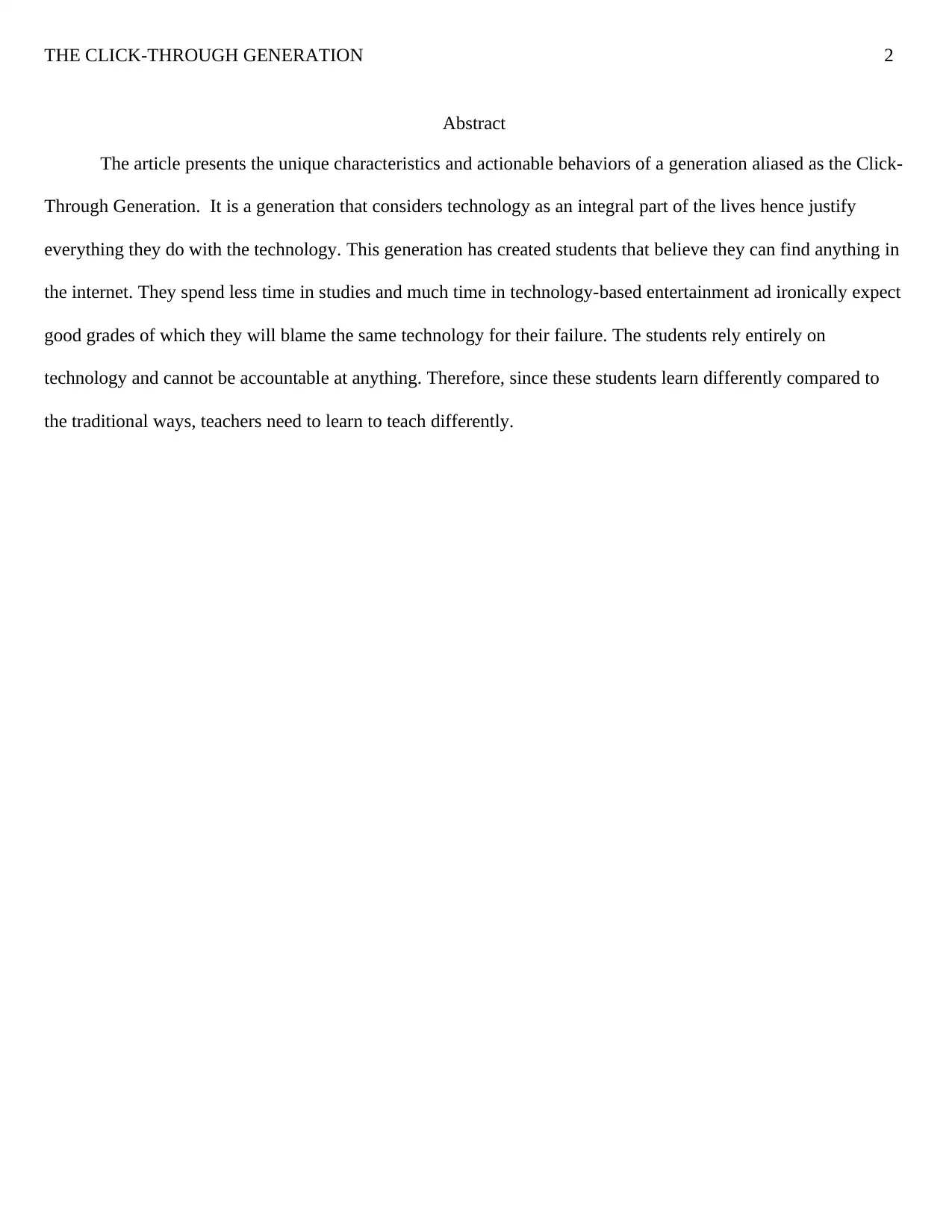
The article presents the unique characteristics and actionable behaviors of a generation aliased as the Click-
Through Generation. It is a generation that considers technology as an integral part of the lives hence justify
everything they do with the technology. This generation has created students that believe they can find anything in
the internet. They spend less time in studies and much time in technology-based entertainment ad ironically expect
good grades of which they will blame the same technology for their failure. The students rely entirely on
technology and cannot be accountable at anything. Therefore, since these students learn differently compared to
the traditional ways, teachers need to learn to teach differently.
Document Page
THE CLICK-THROUGH GENERATION 3
The click-through generation
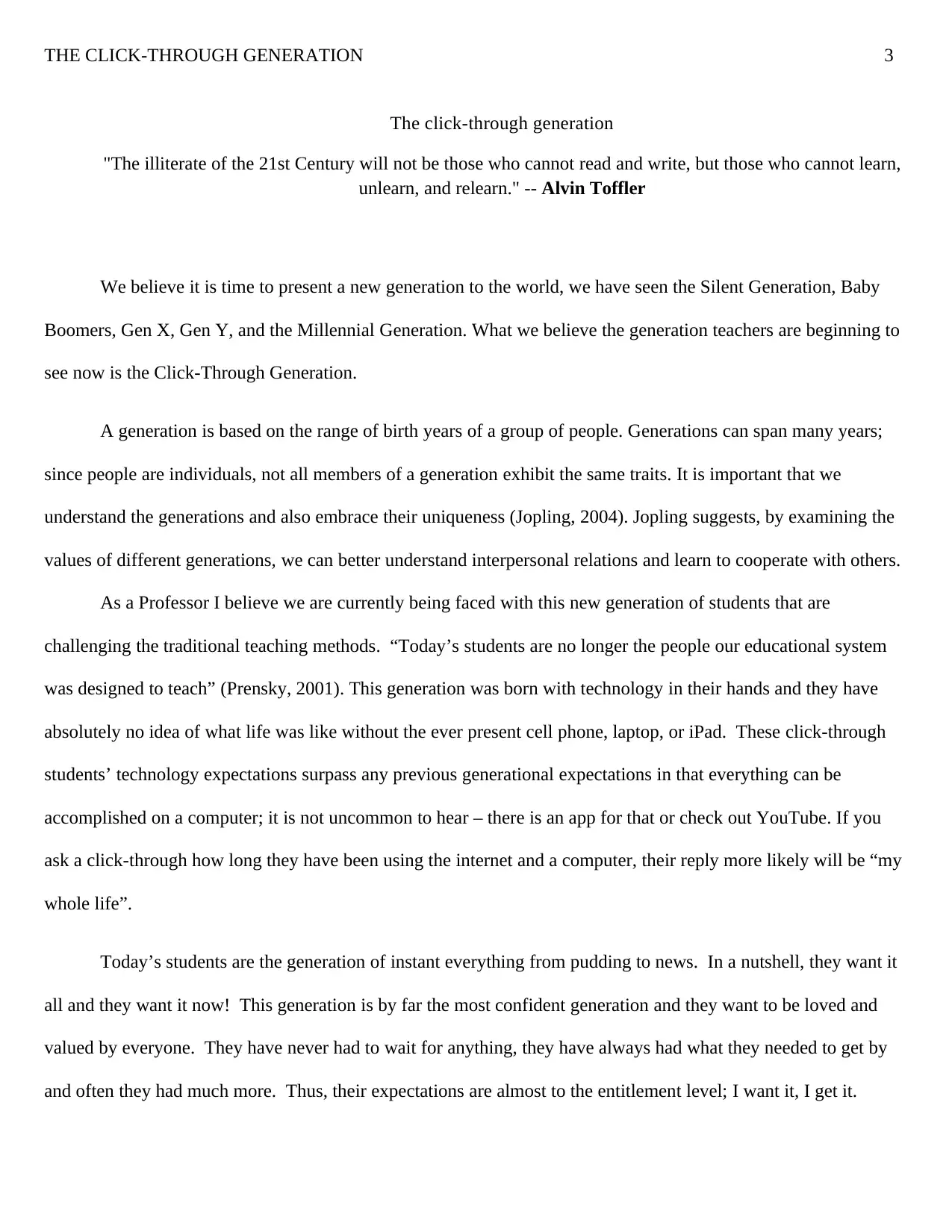
"The illiterate of the 21st Century will not be those who cannot read and write, but those who cannot learn,
unlearn, and relearn." -- Alvin Toffler
We believe it is time to present a new generation to the world, we have seen the Silent Generation, Baby
Boomers, Gen X, Gen Y, and the Millennial Generation. What we believe the generation teachers are beginning to
see now is the Click-Through Generation.
A generation is based on the range of birth years of a group of people. Generations can span many years;
since people are individuals, not all members of a generation exhibit the same traits. It is important that we
understand the generations and also embrace their uniqueness (Jopling, 2004). Jopling suggests, by examining the
values of different generations, we can better understand interpersonal relations and learn to cooperate with others.
As a Professor I believe we are currently being faced with this new generation of students that are
challenging the traditional teaching methods. “Today’s students are no longer the people our educational system
was designed to teach” (Prensky, 2001). This generation was born with technology in their hands and they have
absolutely no idea of what life was like without the ever present cell phone, laptop, or iPad. These click-through
students’ technology expectations surpass any previous generational expectations in that everything can be
accomplished on a computer; it is not uncommon to hear – there is an app for that or check out YouTube. If you
ask a click-through how long they have been using the internet and a computer, their reply more likely will be “my
whole life”.
Today’s students are the generation of instant everything from pudding to news. In a nutshell, they want it
all and they want it now! This generation is by far the most confident generation and they want to be loved and
valued by everyone. They have never had to wait for anything, they have always had what they needed to get by
and often they had much more. Thus, their expectations are almost to the entitlement level; I want it, I get it.
Document Page
THE CLICK-THROUGH GENERATION 4
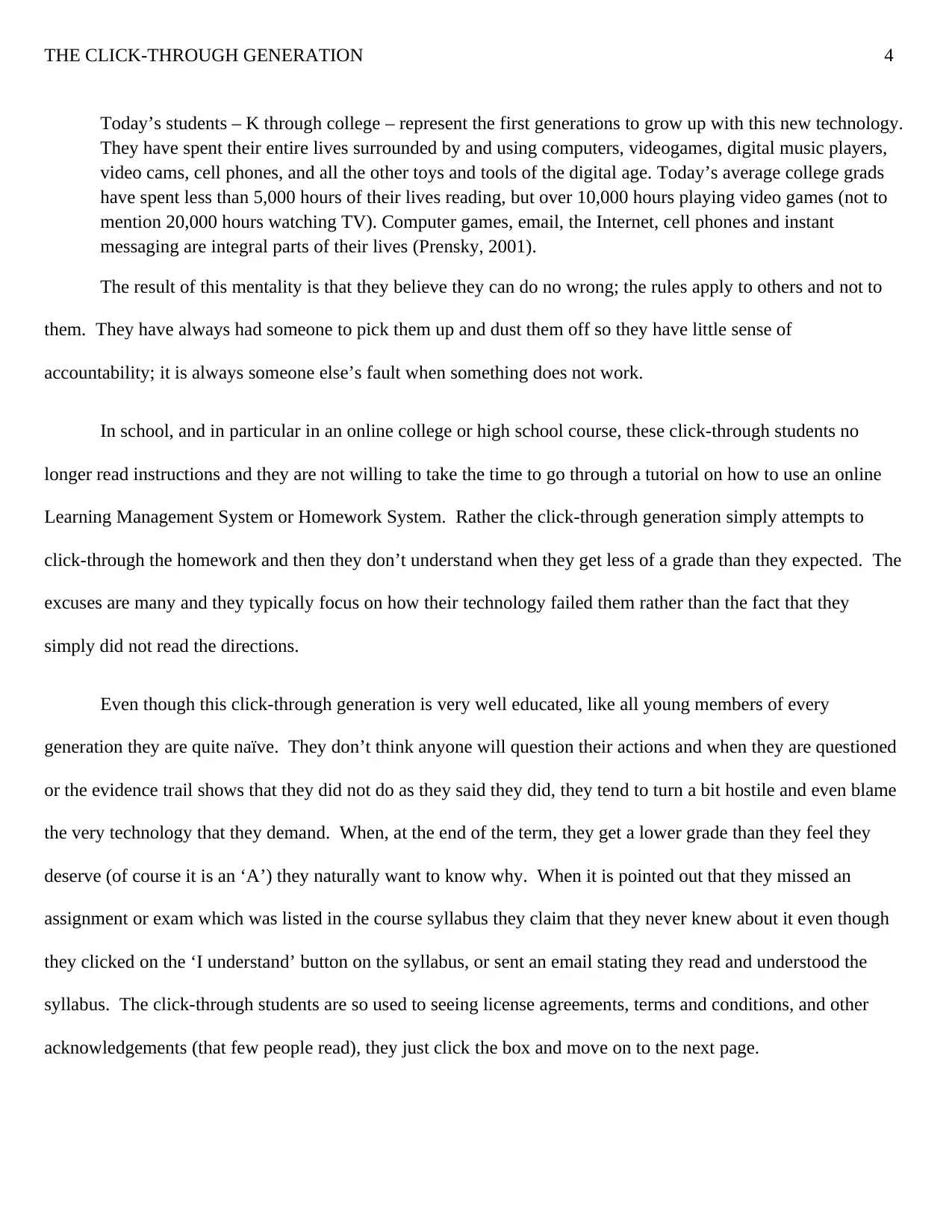
Today’s students – K through college – represent the first generations to grow up with this new technology.
They have spent their entire lives surrounded by and using computers, videogames, digital music players,
video cams, cell phones, and all the other toys and tools of the digital age. Today’s average college grads
have spent less than 5,000 hours of their lives reading, but over 10,000 hours playing video games (not to
mention 20,000 hours watching TV). Computer games, email, the Internet, cell phones and instant
messaging are integral parts of their lives (Prensky, 2001).
The result of this mentality is that they believe they can do no wrong; the rules apply to others and not to
them. They have always had someone to pick them up and dust them off so they have little sense of
accountability; it is always someone else’s fault when something does not work.
In school, and in particular in an online college or high school course, these click-through students no
longer read instructions and they are not willing to take the time to go through a tutorial on how to use an online
Learning Management System or Homework System. Rather the click-through generation simply attempts to
click-through the homework and then they don’t understand when they get less of a grade than they expected. The
excuses are many and they typically focus on how their technology failed them rather than the fact that they
simply did not read the directions.
Even though this click-through generation is very well educated, like all young members of every
generation they are quite naïve. They don’t think anyone will question their actions and when they are questioned
or the evidence trail shows that they did not do as they said they did, they tend to turn a bit hostile and even blame
the very technology that they demand. When, at the end of the term, they get a lower grade than they feel they
deserve (of course it is an ‘A’) they naturally want to know why. When it is pointed out that they missed an
assignment or exam which was listed in the course syllabus they claim that they never knew about it even though
they clicked on the ‘I understand’ button on the syllabus, or sent an email stating they read and understood the
syllabus. The click-through students are so used to seeing license agreements, terms and conditions, and other
acknowledgements (that few people read), they just click the box and move on to the next page.
tabler-icon-diamond-filled.svg

Paraphrase This Document

Need a fresh take? Get an instant paraphrase of this document with our AI Paraphraser
Document Page
THE CLICK-THROUGH GENERATION 5
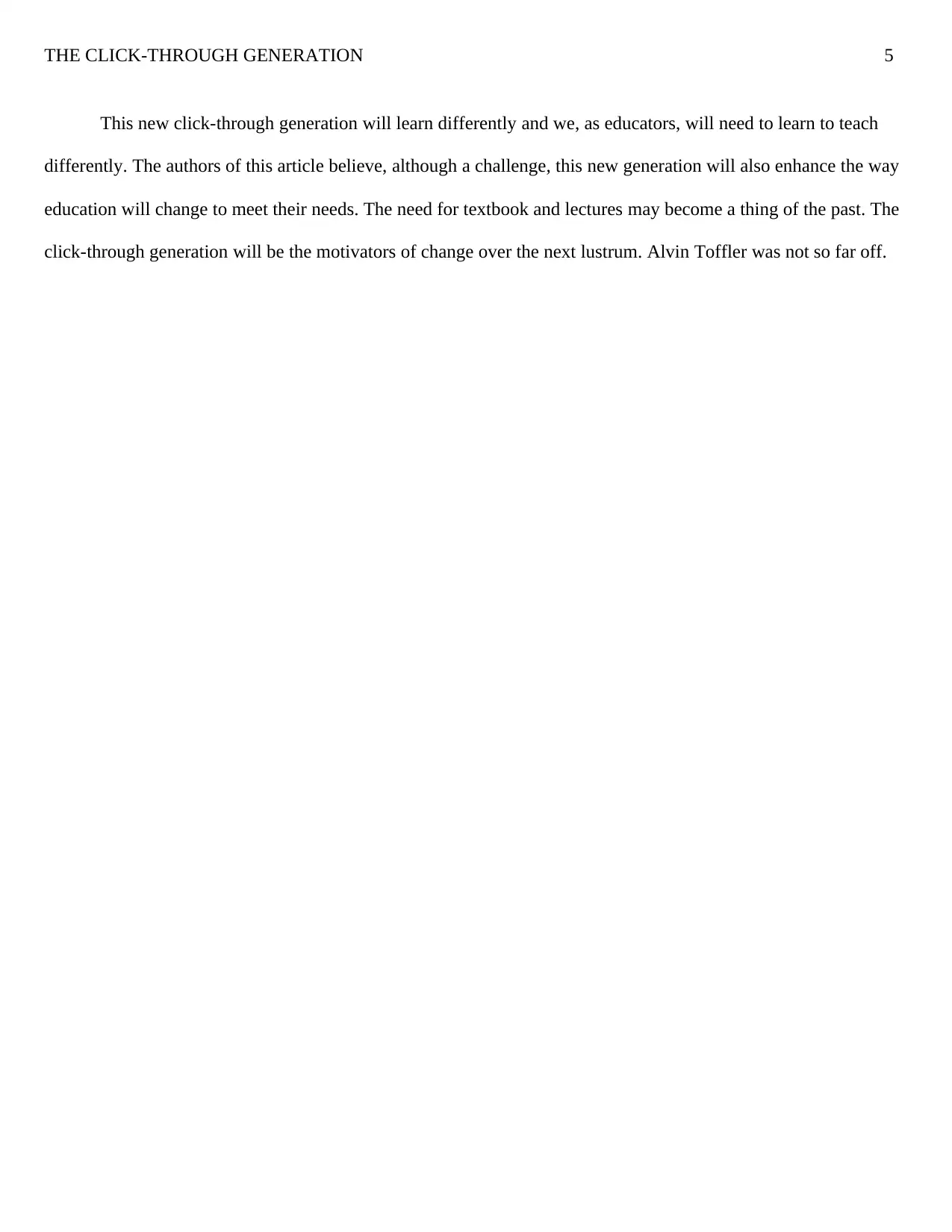
This new click-through generation will learn differently and we, as educators, will need to learn to teach
differently. The authors of this article believe, although a challenge, this new generation will also enhance the way
education will change to meet their needs. The need for textbook and lectures may become a thing of the past. The
click-through generation will be the motivators of change over the next lustrum. Alvin Toffler was not so far off.
Document Page
THE CLICK-THROUGH GENERATION 6
Bibliography
Jopling, J. (2004). Understanding Generations. Extension Service, 36–41.
Prensky, M. (2001). Digital Natives Digital Immigrants. On the Horizon, 12–16.
chevron_up_icon
1 out of 6
circle_padding
hide_on_mobile
zoom_out_icon
[object Object]