Italian Life and Culture: From Mafia to Renaissance and Museums
VerifiedAdded on 2020/03/16
|7
|1666
|66
Essay
AI Summary
This essay delves into various facets of Italian culture, offering a comprehensive overview of its historical and societal aspects. It begins by examining the influence of the Italian mafia, tracing its origins and impact. The essay then explores the significance of the Roman Empire, highlighting its contributions to art, architecture, and cultural advancements. A major focus is placed on the Renaissance period, discussing the roles of prominent artists and philosophers and their impact on Italian life and culture. The essay also touches upon the Naples Italy museums, showcasing their importance in preserving and displaying Italy's rich cultural heritage, including artifacts from the Greek, Roman, and Renaissance eras. The paper concludes by emphasizing the enduring beauty and brilliance of Italian culture, particularly the legacy of the Renaissance and its lasting influence on various fields.
Running head: ITALIAN LIFE AND CULTURE
Italian Life and Culture
Name of the Student
Name of the University
Author Note
Italian Life and Culture
Name of the Student
Name of the University
Author Note

Paraphrase This Document
Need a fresh take? Get an instant paraphrase of this document with our AI Paraphraser
1ITALIAN LIFE AND CULTURE
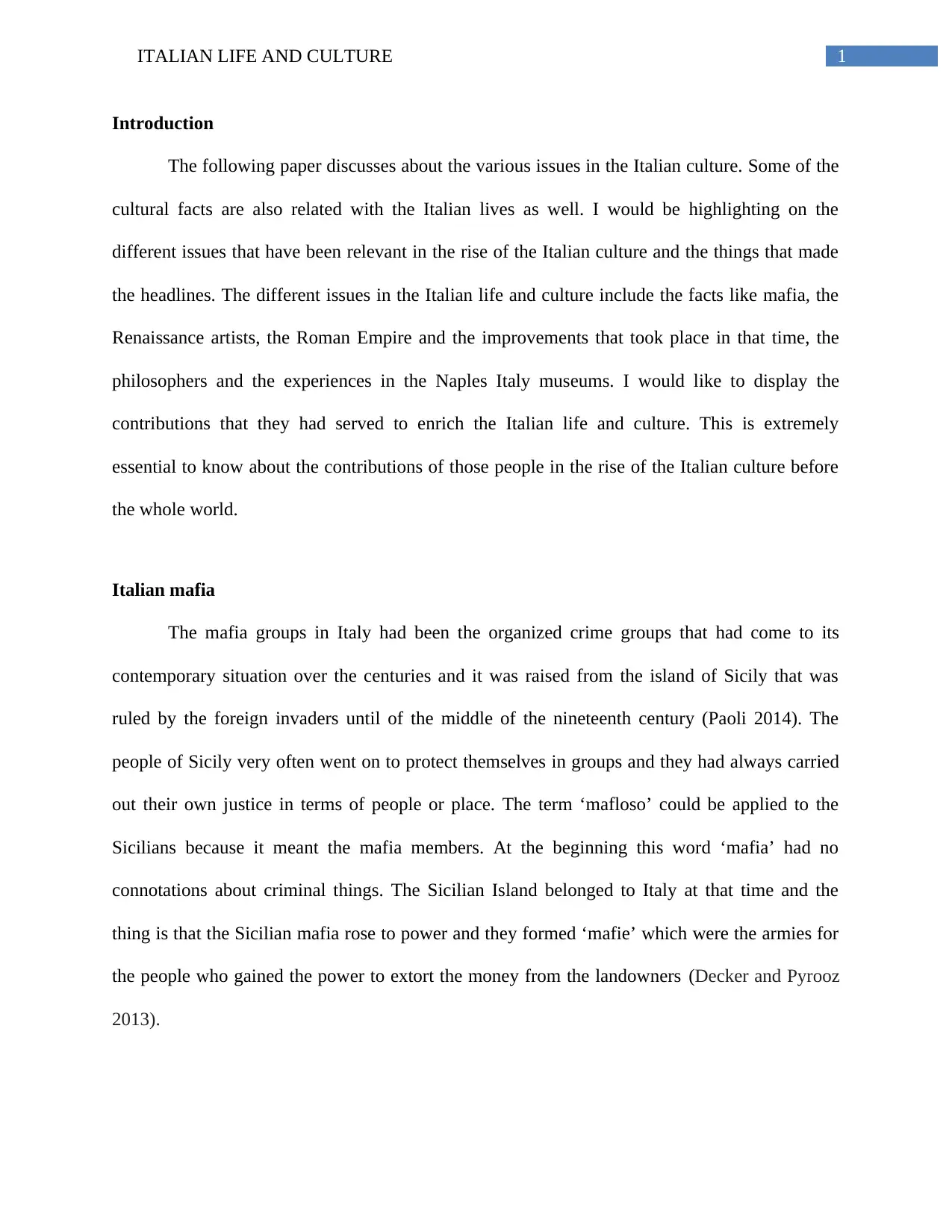
Introduction
The following paper discusses about the various issues in the Italian culture. Some of the
cultural facts are also related with the Italian lives as well. I would be highlighting on the
different issues that have been relevant in the rise of the Italian culture and the things that made
the headlines. The different issues in the Italian life and culture include the facts like mafia, the
Renaissance artists, the Roman Empire and the improvements that took place in that time, the
philosophers and the experiences in the Naples Italy museums. I would like to display the
contributions that they had served to enrich the Italian life and culture. This is extremely
essential to know about the contributions of those people in the rise of the Italian culture before
the whole world.
Italian mafia
The mafia groups in Italy had been the organized crime groups that had come to its
contemporary situation over the centuries and it was raised from the island of Sicily that was
ruled by the foreign invaders until of the middle of the nineteenth century (Paoli 2014). The
people of Sicily very often went on to protect themselves in groups and they had always carried
out their own justice in terms of people or place. The term ‘mafloso’ could be applied to the
Sicilians because it meant the mafia members. At the beginning this word ‘mafia’ had no
connotations about criminal things. The Sicilian Island belonged to Italy at that time and the
thing is that the Sicilian mafia rose to power and they formed ‘mafie’ which were the armies for
the people who gained the power to extort the money from the landowners (Decker and Pyrooz
2013).
Introduction
The following paper discusses about the various issues in the Italian culture. Some of the
cultural facts are also related with the Italian lives as well. I would be highlighting on the
different issues that have been relevant in the rise of the Italian culture and the things that made
the headlines. The different issues in the Italian life and culture include the facts like mafia, the
Renaissance artists, the Roman Empire and the improvements that took place in that time, the
philosophers and the experiences in the Naples Italy museums. I would like to display the
contributions that they had served to enrich the Italian life and culture. This is extremely
essential to know about the contributions of those people in the rise of the Italian culture before
the whole world.
Italian mafia
The mafia groups in Italy had been the organized crime groups that had come to its
contemporary situation over the centuries and it was raised from the island of Sicily that was
ruled by the foreign invaders until of the middle of the nineteenth century (Paoli 2014). The
people of Sicily very often went on to protect themselves in groups and they had always carried
out their own justice in terms of people or place. The term ‘mafloso’ could be applied to the
Sicilians because it meant the mafia members. At the beginning this word ‘mafia’ had no
connotations about criminal things. The Sicilian Island belonged to Italy at that time and the
thing is that the Sicilian mafia rose to power and they formed ‘mafie’ which were the armies for
the people who gained the power to extort the money from the landowners (Decker and Pyrooz
2013).
2ITALIAN LIFE AND CULTURE
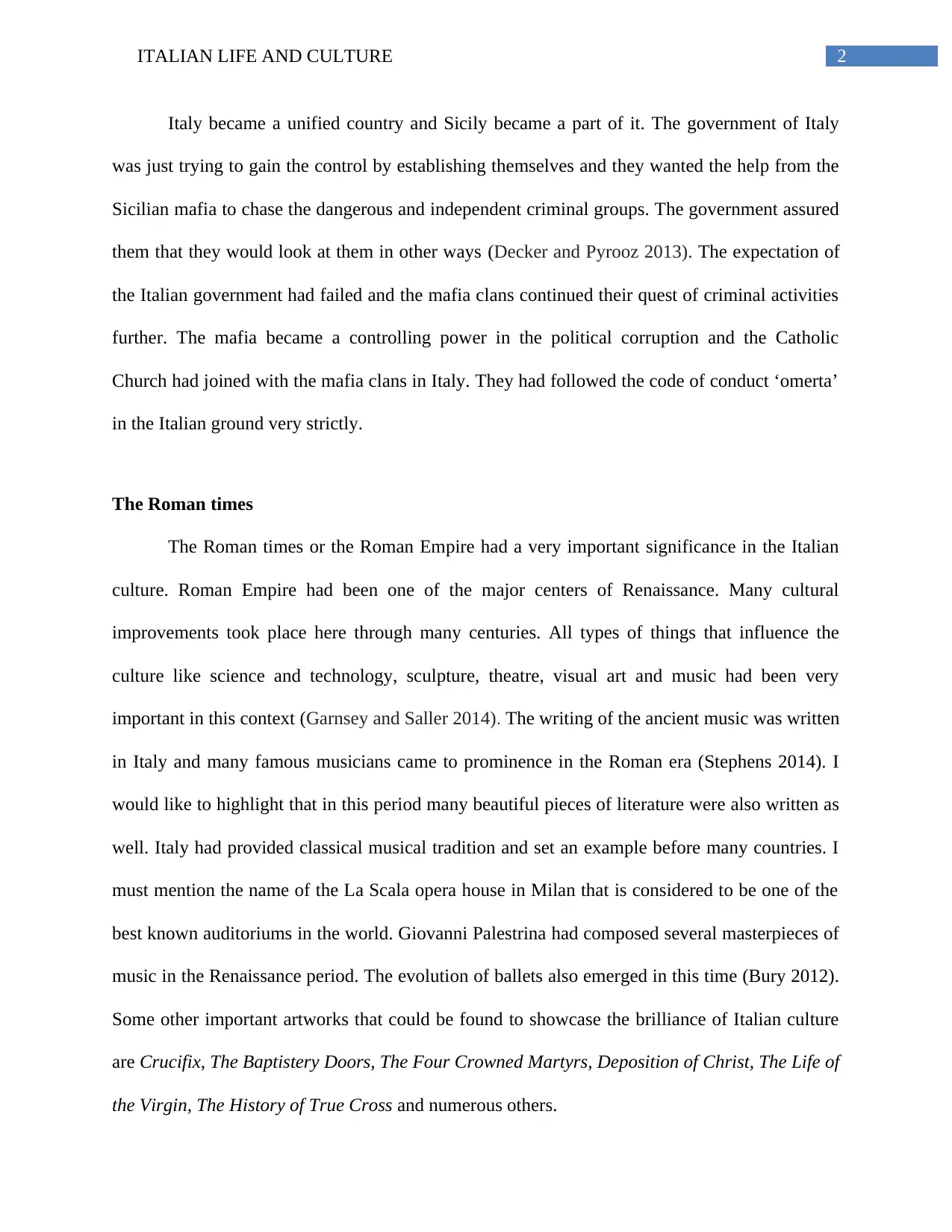
Italy became a unified country and Sicily became a part of it. The government of Italy
was just trying to gain the control by establishing themselves and they wanted the help from the
Sicilian mafia to chase the dangerous and independent criminal groups. The government assured
them that they would look at them in other ways (Decker and Pyrooz 2013). The expectation of
the Italian government had failed and the mafia clans continued their quest of criminal activities
further. The mafia became a controlling power in the political corruption and the Catholic
Church had joined with the mafia clans in Italy. They had followed the code of conduct ‘omerta’
in the Italian ground very strictly.
The Roman times
The Roman times or the Roman Empire had a very important significance in the Italian
culture. Roman Empire had been one of the major centers of Renaissance. Many cultural
improvements took place here through many centuries. All types of things that influence the
culture like science and technology, sculpture, theatre, visual art and music had been very
important in this context (Garnsey and Saller 2014). The writing of the ancient music was written
in Italy and many famous musicians came to prominence in the Roman era (Stephens 2014). I
would like to highlight that in this period many beautiful pieces of literature were also written as
well. Italy had provided classical musical tradition and set an example before many countries. I
must mention the name of the La Scala opera house in Milan that is considered to be one of the
best known auditoriums in the world. Giovanni Palestrina had composed several masterpieces of
music in the Renaissance period. The evolution of ballets also emerged in this time (Bury 2012).
Some other important artworks that could be found to showcase the brilliance of Italian culture
are Crucifix, The Baptistery Doors, The Four Crowned Martyrs, Deposition of Christ, The Life of
the Virgin, The History of True Cross and numerous others.
Italy became a unified country and Sicily became a part of it. The government of Italy
was just trying to gain the control by establishing themselves and they wanted the help from the
Sicilian mafia to chase the dangerous and independent criminal groups. The government assured
them that they would look at them in other ways (Decker and Pyrooz 2013). The expectation of
the Italian government had failed and the mafia clans continued their quest of criminal activities
further. The mafia became a controlling power in the political corruption and the Catholic
Church had joined with the mafia clans in Italy. They had followed the code of conduct ‘omerta’
in the Italian ground very strictly.
The Roman times
The Roman times or the Roman Empire had a very important significance in the Italian
culture. Roman Empire had been one of the major centers of Renaissance. Many cultural
improvements took place here through many centuries. All types of things that influence the
culture like science and technology, sculpture, theatre, visual art and music had been very
important in this context (Garnsey and Saller 2014). The writing of the ancient music was written
in Italy and many famous musicians came to prominence in the Roman era (Stephens 2014). I
would like to highlight that in this period many beautiful pieces of literature were also written as
well. Italy had provided classical musical tradition and set an example before many countries. I
must mention the name of the La Scala opera house in Milan that is considered to be one of the
best known auditoriums in the world. Giovanni Palestrina had composed several masterpieces of
music in the Renaissance period. The evolution of ballets also emerged in this time (Bury 2012).
Some other important artworks that could be found to showcase the brilliance of Italian culture
are Crucifix, The Baptistery Doors, The Four Crowned Martyrs, Deposition of Christ, The Life of
the Virgin, The History of True Cross and numerous others.
⊘ This is a preview!⊘
Do you want full access?
Subscribe today to unlock all pages.

Trusted by 1+ million students worldwide
3ITALIAN LIFE AND CULTURE
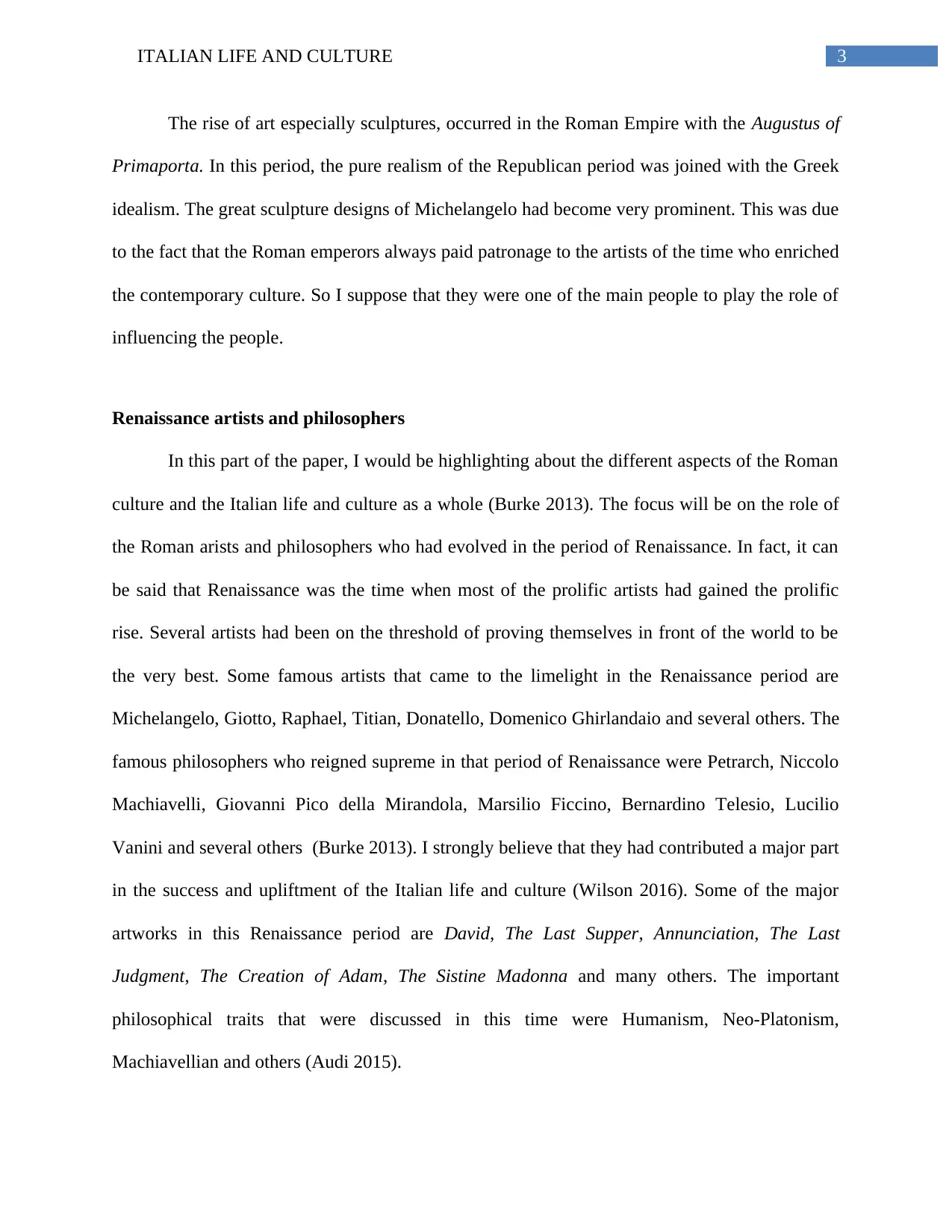
The rise of art especially sculptures, occurred in the Roman Empire with the Augustus of
Primaporta. In this period, the pure realism of the Republican period was joined with the Greek
idealism. The great sculpture designs of Michelangelo had become very prominent. This was due
to the fact that the Roman emperors always paid patronage to the artists of the time who enriched
the contemporary culture. So I suppose that they were one of the main people to play the role of
influencing the people.
Renaissance artists and philosophers
In this part of the paper, I would be highlighting about the different aspects of the Roman
culture and the Italian life and culture as a whole (Burke 2013). The focus will be on the role of
the Roman arists and philosophers who had evolved in the period of Renaissance. In fact, it can
be said that Renaissance was the time when most of the prolific artists had gained the prolific
rise. Several artists had been on the threshold of proving themselves in front of the world to be
the very best. Some famous artists that came to the limelight in the Renaissance period are
Michelangelo, Giotto, Raphael, Titian, Donatello, Domenico Ghirlandaio and several others. The
famous philosophers who reigned supreme in that period of Renaissance were Petrarch, Niccolo
Machiavelli, Giovanni Pico della Mirandola, Marsilio Ficcino, Bernardino Telesio, Lucilio
Vanini and several others (Burke 2013). I strongly believe that they had contributed a major part
in the success and upliftment of the Italian life and culture (Wilson 2016). Some of the major
artworks in this Renaissance period are David, The Last Supper, Annunciation, The Last
Judgment, The Creation of Adam, The Sistine Madonna and many others. The important
philosophical traits that were discussed in this time were Humanism, Neo-Platonism,
Machiavellian and others (Audi 2015).
The rise of art especially sculptures, occurred in the Roman Empire with the Augustus of
Primaporta. In this period, the pure realism of the Republican period was joined with the Greek
idealism. The great sculpture designs of Michelangelo had become very prominent. This was due
to the fact that the Roman emperors always paid patronage to the artists of the time who enriched
the contemporary culture. So I suppose that they were one of the main people to play the role of
influencing the people.
Renaissance artists and philosophers
In this part of the paper, I would be highlighting about the different aspects of the Roman
culture and the Italian life and culture as a whole (Burke 2013). The focus will be on the role of
the Roman arists and philosophers who had evolved in the period of Renaissance. In fact, it can
be said that Renaissance was the time when most of the prolific artists had gained the prolific
rise. Several artists had been on the threshold of proving themselves in front of the world to be
the very best. Some famous artists that came to the limelight in the Renaissance period are
Michelangelo, Giotto, Raphael, Titian, Donatello, Domenico Ghirlandaio and several others. The
famous philosophers who reigned supreme in that period of Renaissance were Petrarch, Niccolo
Machiavelli, Giovanni Pico della Mirandola, Marsilio Ficcino, Bernardino Telesio, Lucilio
Vanini and several others (Burke 2013). I strongly believe that they had contributed a major part
in the success and upliftment of the Italian life and culture (Wilson 2016). Some of the major
artworks in this Renaissance period are David, The Last Supper, Annunciation, The Last
Judgment, The Creation of Adam, The Sistine Madonna and many others. The important
philosophical traits that were discussed in this time were Humanism, Neo-Platonism,
Machiavellian and others (Audi 2015).
Paraphrase This Document
Need a fresh take? Get an instant paraphrase of this document with our AI Paraphraser
4ITALIAN LIFE AND CULTURE
Naples Italy museums
The Naples Italy museum is considered to be one of the most important parts of the
culture of Italy. It is related with the Italian people as well. The museum depicts the history of
several things that have influenced the lives and culture of the people (Amato et al. 2013). The
things that are embedded in the museum are the quality works of the Greek, Roman and
Renaissance times. The things include the typical archaeological things as well. These things
have enriched the culture of Italy to a certain extent. Some of the important figures that are
present in the museum are Farnese Hercules, Farnese Atlas, Farnese Bull, Venus Kallipgyos,
Harmodius and Aristogeiton and several other things.
They have a collection of the busts of many Roman Emperors that shows the rich
tradition Italy had. There are some important instances of mosaics present in the museum from
the ruins of the Pompeii. These important mosaics include Alexander Mosaic that could date
back to 100 BC was found from the House of Faun in Pompeii. Another important instance of
fresco painting was the fresco of Heron and Cobra that was found from the House of
Epigrammes. These things have been found after a tireless effort of the archaeologists to prove
the rich cultural tradition Italy ever possessed. Another important mosaic painting includes the
‘Cave Canem’ (beware of dog). I suppose these are precious documents of the Italian life and
culture and should be preserved for the generations to come (Astarita 2013).
Conclusion
This paper can be concluded by saying that Italian life and culture has been one of the
most beautiful and brilliant pieces of artwork. The Renaissance period has given birth to many
stalwart people in various fields of art. The philosophers of this period also catered to the
Naples Italy museums
The Naples Italy museum is considered to be one of the most important parts of the
culture of Italy. It is related with the Italian people as well. The museum depicts the history of
several things that have influenced the lives and culture of the people (Amato et al. 2013). The
things that are embedded in the museum are the quality works of the Greek, Roman and
Renaissance times. The things include the typical archaeological things as well. These things
have enriched the culture of Italy to a certain extent. Some of the important figures that are
present in the museum are Farnese Hercules, Farnese Atlas, Farnese Bull, Venus Kallipgyos,
Harmodius and Aristogeiton and several other things.
They have a collection of the busts of many Roman Emperors that shows the rich
tradition Italy had. There are some important instances of mosaics present in the museum from
the ruins of the Pompeii. These important mosaics include Alexander Mosaic that could date
back to 100 BC was found from the House of Faun in Pompeii. Another important instance of
fresco painting was the fresco of Heron and Cobra that was found from the House of
Epigrammes. These things have been found after a tireless effort of the archaeologists to prove
the rich cultural tradition Italy ever possessed. Another important mosaic painting includes the
‘Cave Canem’ (beware of dog). I suppose these are precious documents of the Italian life and
culture and should be preserved for the generations to come (Astarita 2013).
Conclusion
This paper can be concluded by saying that Italian life and culture has been one of the
most beautiful and brilliant pieces of artwork. The Renaissance period has given birth to many
stalwart people in various fields of art. The philosophers of this period also catered to the
5ITALIAN LIFE AND CULTURE
betterment of the culture. In this paper, I have discussed various things about the Italian mafia
and its influence on the lives of people. The influence of the Renaissance has been immense in
this sense because the famous works of art, painting, sculpture and philosophical pieces have
evolved in this period only. So, it is of immense significance to know about these things.
betterment of the culture. In this paper, I have discussed various things about the Italian mafia
and its influence on the lives of people. The influence of the Renaissance has been immense in
this sense because the famous works of art, painting, sculpture and philosophical pieces have
evolved in this period only. So, it is of immense significance to know about these things.
⊘ This is a preview!⊘
Do you want full access?
Subscribe today to unlock all pages.
Trusted by 1+ million students worldwide
6ITALIAN LIFE AND CULTURE
References
Amato, F., Chianese, A., Mazzeo, A., Moscato, V., Picariello, A. and Piccialli, F., 2013. The
talking museum project. Procedia Computer Science, 21, pp.114-121.
Astarita, T., 2013. A Companion to Early Modern Naples. Brill.
Audi, R., 2015. The Cambridge dictionary of philosophy.
Burke, P., 2013. The Italian Renaissance: culture and society in Italy. John Wiley & Sons.
Bury, J.B., 2012. History of the later Roman Empire (Vol. 1). Courier Corporation.
Decker, S.H. and Pyrooz, D., 2013. Gangs Another Form of Organized Crime?. In The Oxford
Handbook of Organized Crime.
Garnsey, P. and Saller, R.P., 2014. The Roman Empire: economy, society and culture.
Bloomsbury Publishing.
Paoli, L., 2014. The Italian Mafia. In The Oxford handbook of organized crime.
Stephens, J., 2014. The Italian Renaissance: the origins of intellectual and artistic change before
the Reformation. Routledge.
Wilson, N.G., 2016. From Byzantium to Italy: Greek Studies in the Italian Renaissance.
Bloomsbury Publishing.
References
Amato, F., Chianese, A., Mazzeo, A., Moscato, V., Picariello, A. and Piccialli, F., 2013. The
talking museum project. Procedia Computer Science, 21, pp.114-121.
Astarita, T., 2013. A Companion to Early Modern Naples. Brill.
Audi, R., 2015. The Cambridge dictionary of philosophy.
Burke, P., 2013. The Italian Renaissance: culture and society in Italy. John Wiley & Sons.
Bury, J.B., 2012. History of the later Roman Empire (Vol. 1). Courier Corporation.
Decker, S.H. and Pyrooz, D., 2013. Gangs Another Form of Organized Crime?. In The Oxford
Handbook of Organized Crime.
Garnsey, P. and Saller, R.P., 2014. The Roman Empire: economy, society and culture.
Bloomsbury Publishing.
Paoli, L., 2014. The Italian Mafia. In The Oxford handbook of organized crime.
Stephens, J., 2014. The Italian Renaissance: the origins of intellectual and artistic change before
the Reformation. Routledge.
Wilson, N.G., 2016. From Byzantium to Italy: Greek Studies in the Italian Renaissance.
Bloomsbury Publishing.

1 out of 7


Your All-in-One AI-Powered Toolkit for Academic Success.
+13062052269
info@desklib.com
Available 24*7 on WhatsApp / Email
![[object Object]](/_next/static/media/star-bottom.7253800d.svg)
Unlock your academic potential
Copyright © 2020–2026 A2Z Services. All Rights Reserved. Developed and managed by ZUCOL.