Vermont Council Social Services: Software Analysis, Design Report

Verified

Added on  2023/06/11

|12
|1172
|207
Report
AI Summary
This report provides a detailed analysis of software design and architecture principles, focusing on a case study of Vermont Social Services. It elaborates on system requirements, including both functional and non-functional aspects such as client services, adult services, staff management, data integrity, and system availability. The report uses object modeling techniques and UML diagrams, including use case, sequence, activity, state, and class diagrams, to illustrate the proposed system architecture. The goal is to provide an effective system that reduces employee workload and efficiently manages organizational procedures, demonstrating the practical application of object modeling in software development. Desklib provides access to similar solved assignments and resources for students.
Document Page
Running head: SOFTWARE ANALYSIS DESIGN AND ARCHITECTURE
SOFTWARE ANALYSIS DESIGN AND ARCHITECTURE
Name of the Student
Name of the University
Author Note
tabler-icon-diamond-filled.svg

Paraphrase This Document

Need a fresh take? Get an instant paraphrase of this document with our AI Paraphraser
Document Page
1SOFTWARE ANALYSIS DESIGN AND ARCHITECTURE
ABSTRACT
The report contains the details about the Vermont case study. The discussion of the system
requirements and the different type of illustration about the system of the organization has
been provided in this report. The vitality of the subject of object modelling has been
elaborated in this replort.
Document Page
2SOFTWARE ANALYSIS DESIGN AND ARCHITECTURE
Table of Contents
Introduction................................................................................................................................3
Requirement...............................................................................................................................3
Functional...............................................................................................................................3
Non-functional.......................................................................................................................3
Diagrams....................................................................................................................................4
Conclusion..................................................................................................................................5
Bibliography...............................................................................................................................6
Document Page
3SOFTWARE ANALYSIS DESIGN AND ARCHITECTURE
Introduction
This repot has been used for the description of the object modelling techniques that
are adopted by the organizations in the present times. The techniques are adopted by various
organizations for making the requirement analysis of the new system that they want to
develop. The case study of the Vermont social service has been considered for this report.
The paper has taken into consideration the construction of a new system for
organization that make use the object modelling approach to devise the required system. The
requirements of the system has been described in this report and also the illustrations about
the development of the system, has been provided in this report.
Requirement
There are two types of requirement for a system which are the functional and non-
functional requirements of the system. Both the categories of requirements has been
discussed below
Functional
The functional requirement of the system has been discussed as follows:
Client services: The system should be able to record the details of the clients and allocate
unique ids for identification of the clients. The system is also required to store the details of
the portfolios of the clients and payment information. The system is also required to store the
details of the services that are availed by the clients. The monitoring services are also to be
provided by the system.
Adult services system: The system is required to provide the social the support for the
procedures that they are working on. In addition to this the system is also required to store the
information about the social workers and the procedures that they are working on. Also the
tabler-icon-diamond-filled.svg

Paraphrase This Document

Need a fresh take? Get an instant paraphrase of this document with our AI Paraphraser
Document Page
4SOFTWARE ANALYSIS DESIGN AND ARCHITECTURE
system should be able to record the information about the grades that they are entertaining
currently.
Staff Management: The system should also be able to manage the staffs of the organization
and also the staffs of the organization are to be monitored by the system. The system should
also monitor the business procedures of the organization. The workload of the staffs in the
organization would be managed by the system and the work would be assigned to the staffs
accordingly. The payments of the staffs would also be handled by this system and the audit
would be carried out on the performance of the staffs with the help of the system.
Recording notes: The system be able to allow the staff to record notes that would help them
in recording the progress of the work and refer to it in case of interruptions in the services of
the organizations and the procedures followed by them.
Non-functional
The non-functional requirements of the system are:
Availability: The system should be available to the staffs during their working hours. In care
the system is absent during the working period of the staffs there would be disruption in the
services of the organization. Hence, it is very important the system is available during the
working hours of the employees.
Data Integrity: The data integrity in the system should be maintained so that the system does
not leak out data to the outsiders as the data of the system is very important.
Reliability: The system should be reliable enough. The system should be able to provide the
organization with efficient services and the system should lag or hang in aby type of
situation.
Document Page
5SOFTWARE ANALYSIS DESIGN AND ARCHITECTURE
Diagrams
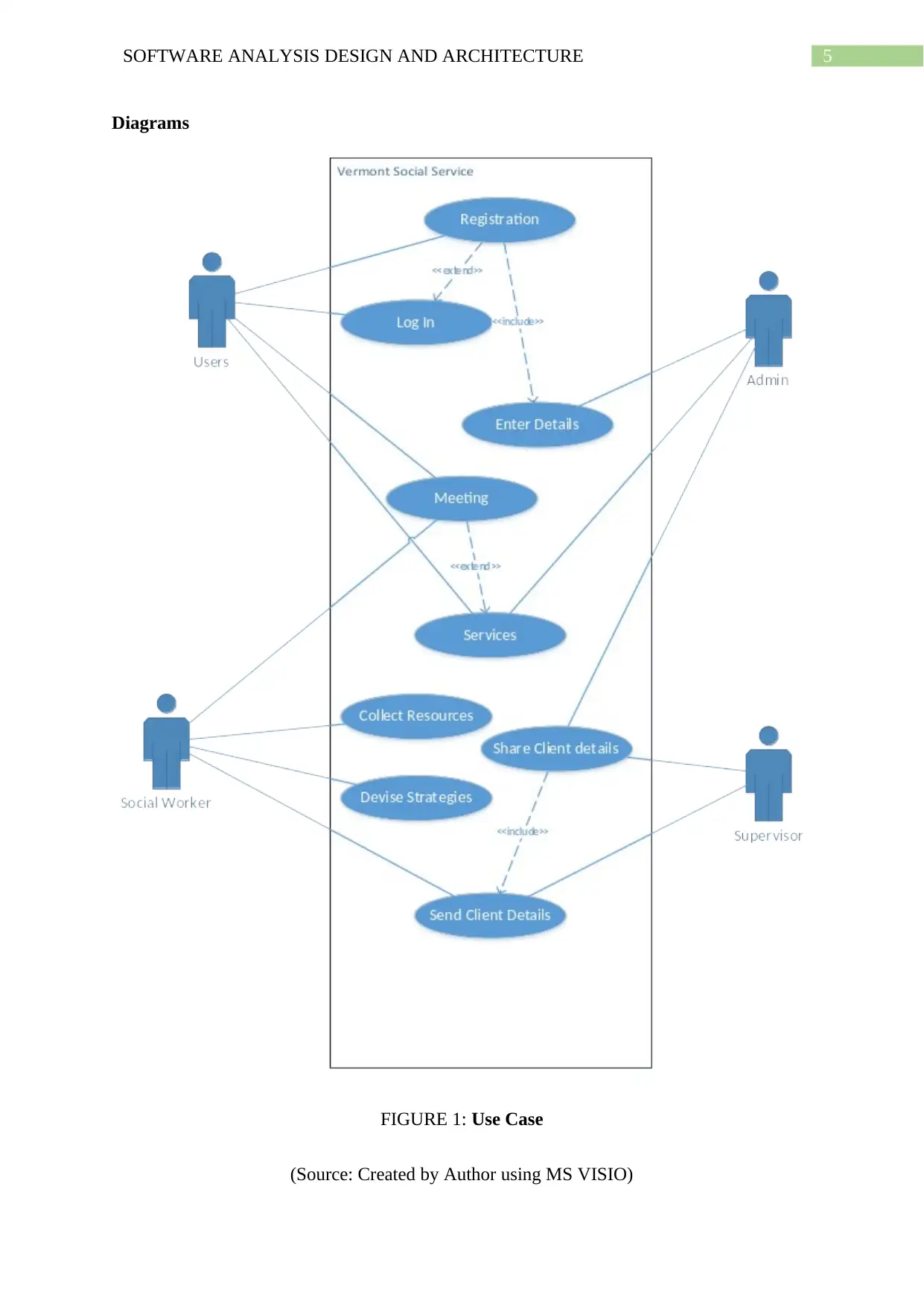
FIGURE 1: Use Case
(Source: Created by Author using MS VISIO)
Document Page
6SOFTWARE ANALYSIS DESIGN AND ARCHITECTURE
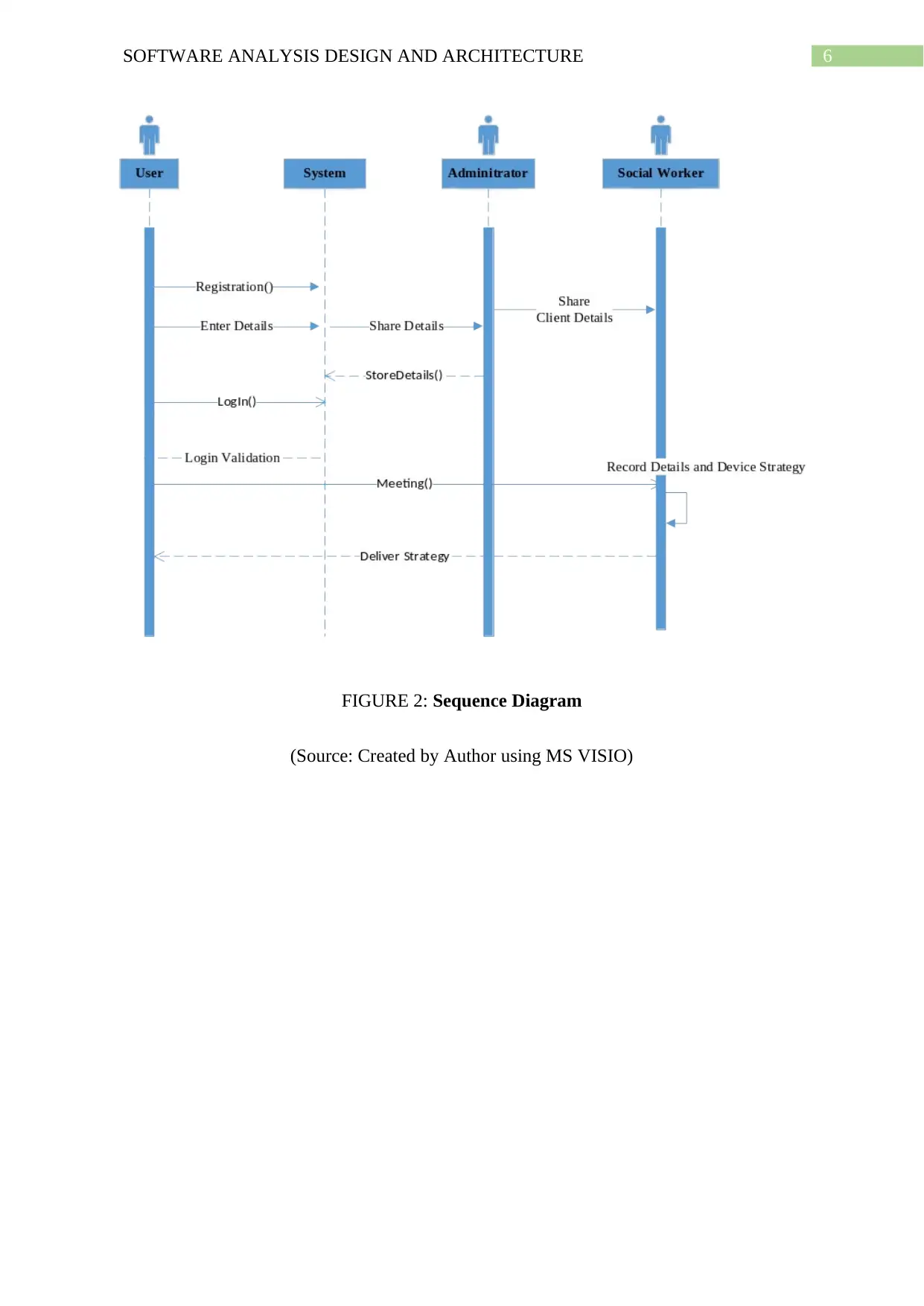
FIGURE 2: Sequence Diagram
(Source: Created by Author using MS VISIO)
tabler-icon-diamond-filled.svg

Paraphrase This Document

Need a fresh take? Get an instant paraphrase of this document with our AI Paraphraser
Document Page
7SOFTWARE ANALYSIS DESIGN AND ARCHITECTURE
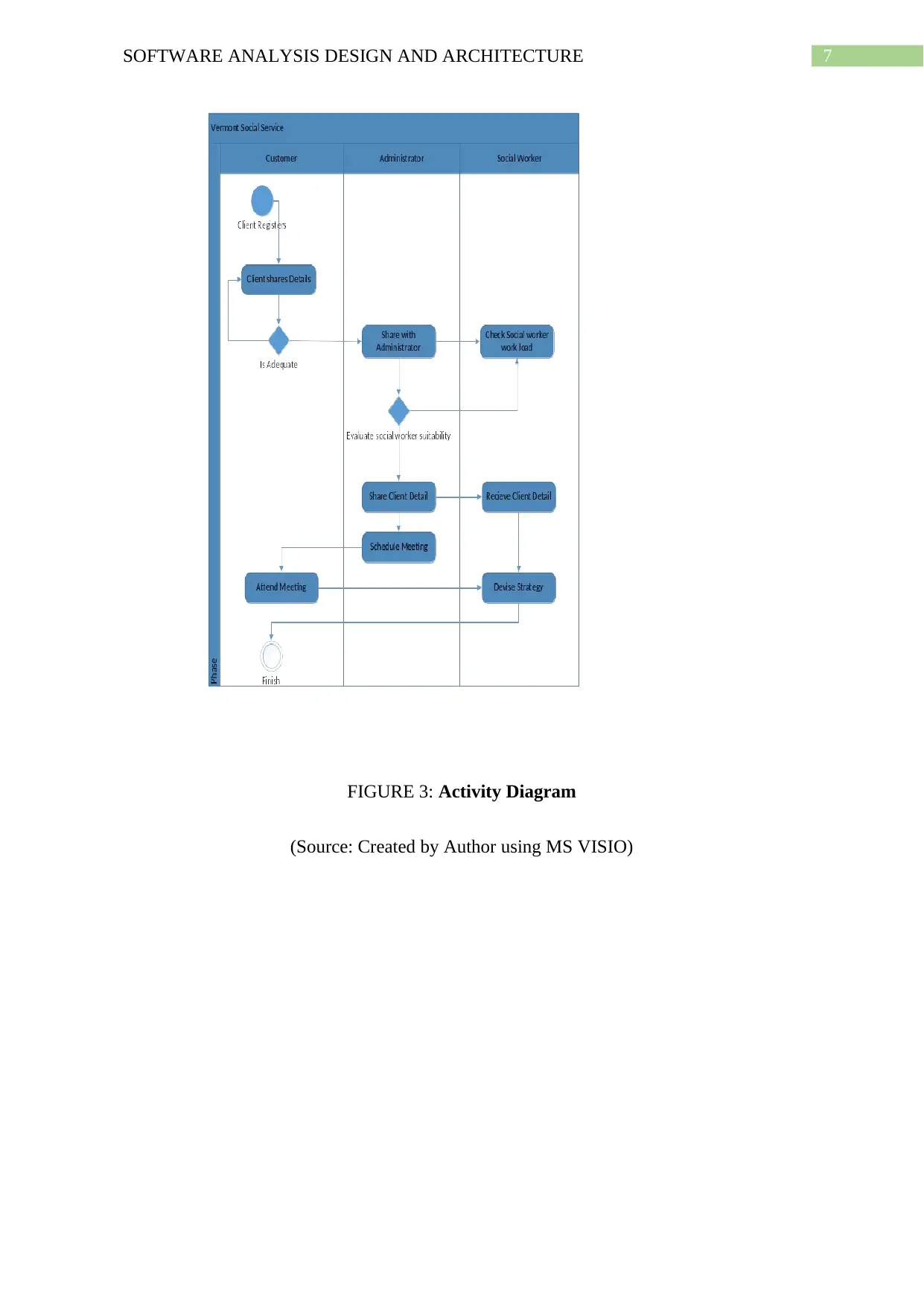
FIGURE 3: Activity Diagram
(Source: Created by Author using MS VISIO)
Document Page
8SOFTWARE ANALYSIS DESIGN AND ARCHITECTURE
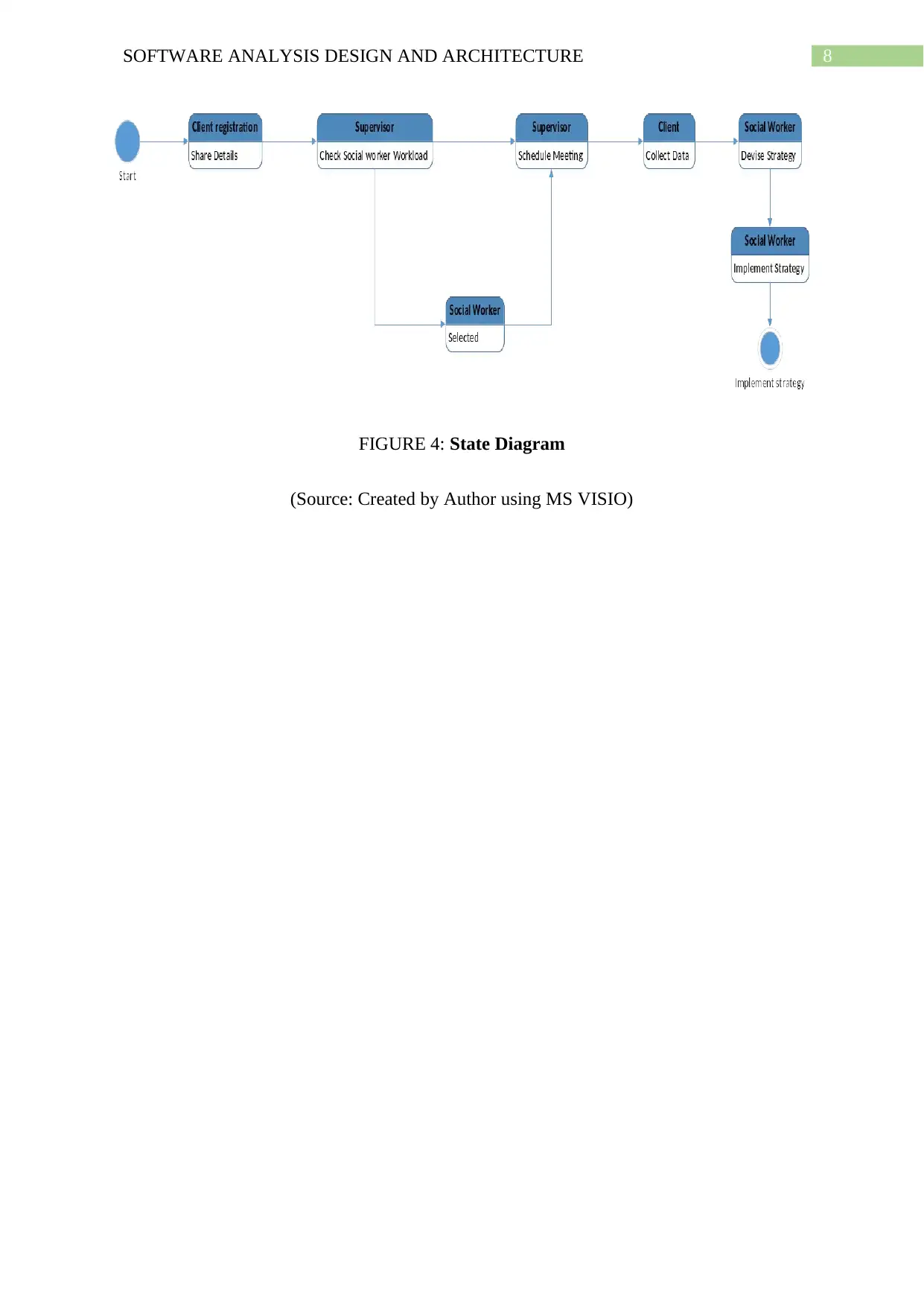
FIGURE 4: State Diagram
(Source: Created by Author using MS VISIO)
Document Page
9SOFTWARE ANALYSIS DESIGN AND ARCHITECTURE
tabler-icon-diamond-filled.svg

Paraphrase This Document

Need a fresh take? Get an instant paraphrase of this document with our AI Paraphraser
Document Page
10SOFTWARE ANALYSIS DESIGN AND ARCHITECTURE
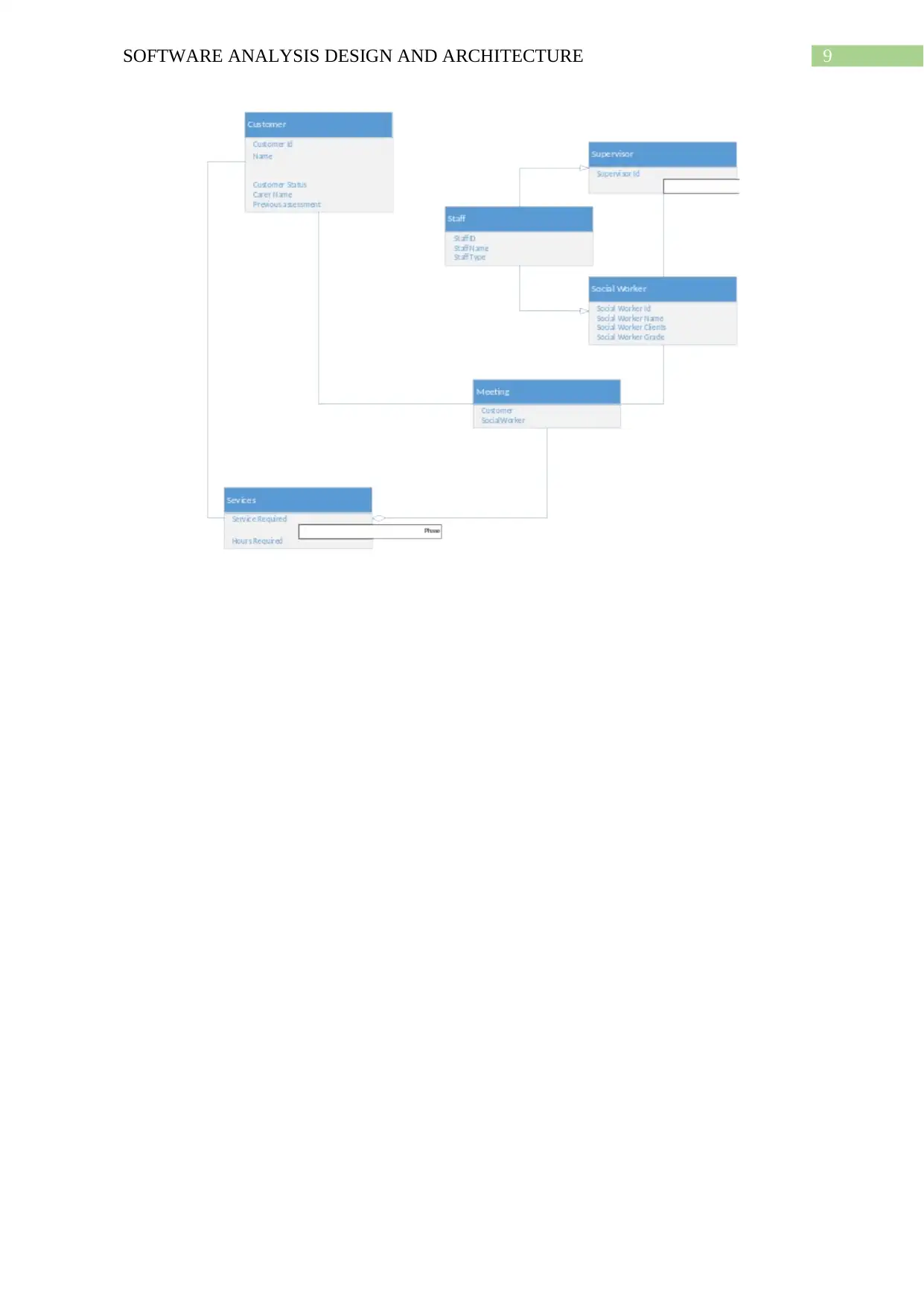
FIGURE 5: Class Diagram
(Source: Created by Author using MS VISIO)
Conclusion
The report has been used portray the effective use of object modelling techniques so
that Vermont social service can design a system for themselves and make use of the object
modelling techniques for their benefit. For conclusion it can be said that system developed
for the organization should be able to provide the organization with an efficient technique to
reduce the workload of the employees and handle the procedures of the system efficiently.
For the convenience of the reader some illustration along with the description of the system
has been provided. This would help the reader to understand the concept of the object
modelling techniques and their utilities.
Document Page
11SOFTWARE ANALYSIS DESIGN AND ARCHITECTURE
Bibliography
Dudin, M., Lyasnikov, N., Veselovsky, M., Sekerin, V., & Aleksakhina, V. (2014). The
problem of forecasting and modelling of the innovative development of social-
economic systems and structures.
Herchi, H., & Abdessalem, W. B. (2012). From user requirements to UML class
diagram. arXiv preprint arXiv:1211.0713.
Jena, A. K., Swain, S. K., & Mohapatra, D. P. (2014, February). A novel approach for test
case generation from UML activity diagram. In Issues and challenges in intelligent
computing techniques (ICICT), 2014 international conference on (pp. 621-629).
IEEE.
Kisler, T., Schiel, F., & Sloetjes, H. (2012, July). Signal processing via web services: the use
case WebMAUS. In Digital Humanities Conference 2012.
Lu, H. (2013). State diagram of phase transition temperatures and solvent‐induced recovery
behavior of shape‐memory polymer. Journal of Applied Polymer Science, 127(4),
2896-2904.
Panthi, V., & Mohapatra, D. P. (2013). Automatic test case generation using sequence
diagram. In Proceedings of International Conference on Advances in Computing (pp.
277-284). Springer, New Delhi.
chevron_up_icon
1 out of 12
circle_padding
hide_on_mobile
zoom_out_icon
[object Object]