ITC571 Project: Smart Home Security using IoT & Power Line System

Verified

Added on  2024/06/28

|3
|1018
|230
Project
AI Summary
This project proposal addresses the increasing need for enhanced security in smart homes using Internet of Things (IoT) and Power Line Carrier (PCS) technology. It highlights the limitations of current security solutions, such as power consumption, authentication issues, and cyber threats. The proposal aims to improve security management by integrating smart sensing techniques, including temperature, speech recognition, face recognition, and skin sensors, with PCS technology. It also suggests incorporating an RS-232 interface to mitigate signal noise and security issues associated with single power lines. The expected outcomes include enhanced security through online monitoring, improved data analysis via cloud integration with Raspberry Pi and sensing devices, and enhanced privacy through smart band and face detection systems. The proposal outlines the research methodology, which involves discussing sensing techniques, defining components of PCS technology, proposing the RS-232 interface technique, and analyzing the RS-232 interface system with IoT technology.
Document Page
Writing Proposal for ITC571
Student Name and ID

Project area
Internet of things
Type of Project
Theoretical
Technology
PCS (Powerline carrier system)
Technique
Smart sensing technique
Domain
IoT: Smart home security
Project name
Power line career system based on smart sensing technique to manage security in Smart-homes
Key words
IoT, Sensors, Security, Smart –home, Sensing techniques, management, Wireless networks, automation
1. Introduction
Background
Information,

Issues and

Current Solutions

1.
Now a day, Security is a very important issue and it is increasing day by day. Advancement in
technology provides many solutions to manage security in homes to provide automation to the

security system and avoid unauthorized access. The IoT based techniques manage security with smart

appliances and help in securing the home from theft. But there are many issues faced by devices and

technology to manage security. These appliances are power consuming as well as create issues at the

monitoring time such as authentication problem, identification error, and interference in security. To

overcome these issues some smart sensing techniques introduced that is based on IOT. Smart sensors

and pyroelectric passive infrared sensor (PIR) is used for authentication. Wireless sensor networks,

Zigbee networks, low power consume-automated services, Motion detection in IOT remote

monitoring system and GPS are used as current technologies for improvement and better

management.

Shortcomings/

limitations in the

current /existing

solutions

2.
Security is increasing with modern technologies but it has some limitations as follows:
The current solution PCS includes technical issues signal noise issue arises during
transmission of bandwidth

PCS technology faces security issue due to single power line
Threats of cyber-attacks and cyber-crime to personal information.
Sensor failure and network issues also generate problem during authentication and
verification.

Importance of

solving this

3.
The research is focusing on solving the issue of PCS through integrating RS-232 interface in the
signal power line.
The sensing techniques controls home appliances as well as monitoring data
tabler-icon-diamond-filled.svg

Paraphrase This Document

Need a fresh take? Get an instant paraphrase of this document with our AI Paraphraser
Document Page
problem through IOT based services. Overlapping in identification can be protected by using PCS technology.
The Power line career system helps in managing the signal power line.

2. The Main objective

and purpose of this

research

Main objectives and purpose of research:

The main aim of the research is to improve security management in smart home by using smart sensing
technologies.

The objective of the research is to identify the Sensing techniques to improve security issue of the smart homes.
To provide privacy protection through PCS technology with remote monitoring system and GPRS.
3. Questions need to be

answered

1. What types of sensing technique used for monitoring of smart homes?

2. How PCS technology merged with sensing technology to manage security?

3. What are the techniques used to solve the issue of PCS technology and manage smart home security?

4. A Brief Description

of Your Proposal
This proposal outlined the issues of the PCS technology and sensing techniques that are useful for managing security in the
smart home system. The sensing techniques includes sensors such as a temperature sensor, the speech recognizing sensor,

face reorganization based sensor and skin sensor. These all are connected with the cloud to control and monitoring things at

smart home. Security management through online system faces many difficulties and not properly operated due to errors.

So, some new techniques are introduced in the above proposal to overcome problems and also the current solution is

provided to increase security.

5. The Process or

Methodology of Your

Project

Steps for proposal are:

Discussing the sensing technique in the smart home to manage the security with the use of PCS technology.
Define the components of sensing techniques and PCS technology in relation to provide security protection to the
smart home.

Proposition of RS-232 interface technique to improve the security issue arises due to the single power line.
Analyse the RS-232 interface system in the Smart home security with the IoT technology.
6. Expected Outcomes
Expected outcome are as follow:
Document Page
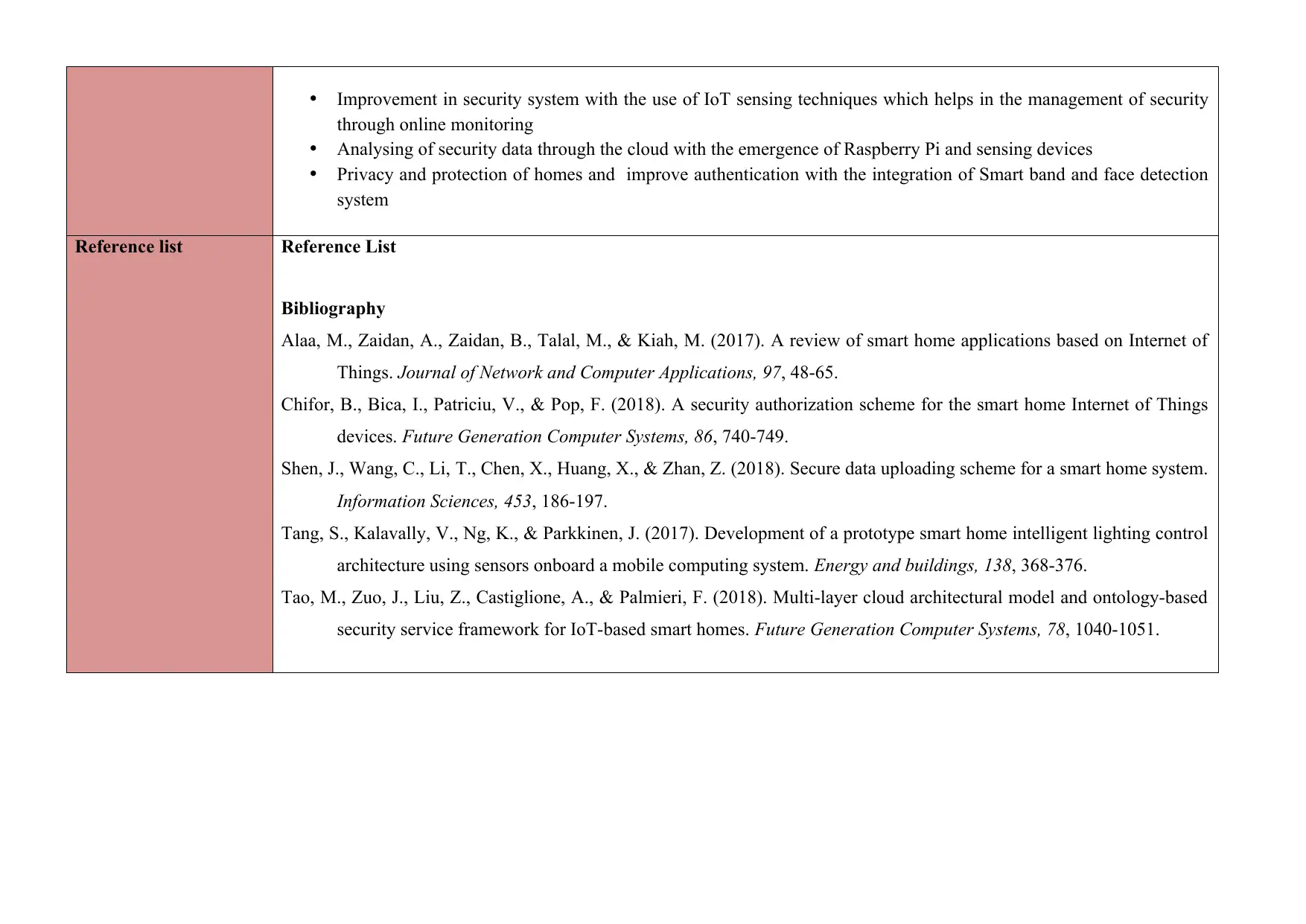
Improvement in security system with the use of IoT sensing techniques which helps in the management of security
through online monitoring

Analysing of security data through the cloud with the emergence of Raspberry Pi and sensing devices
Privacy and protection of homes and improve authentication with the integration of Smart band and face detection
system

Reference list
Reference List
Bibliography

Alaa, M., Zaidan, A., Zaidan, B., Talal, M., & Kiah, M. (2017). A review of smart home applications based on Internet of

Things.
Journal of Network and Computer Applications, 97, 48-65.
Chifor, B., Bica, I., Patriciu, V., & Pop, F. (2018). A security authorization scheme for the smart home Internet of Things

devices.
Future Generation Computer Systems, 86, 740-749.
Shen, J., Wang, C., Li,
T., Chen, X., Huang, X., & Zhan, Z. (2018). Secure data uploading scheme for a smart home system.
Information Sciences, 453
, 186-197.
Tang, S., Kalavally, V., Ng, K., & Parkkinen, J. (2017). Development of a prototype smart home intelligent lighting control

architecture using sensors onboard a mobile computing system.
Energy and buildings, 138, 368-376.
Tao, M., Zuo, J., Liu, Z., Castiglione, A., & Palmieri, F. (2018). Multi-layer cloud architectural model and ontology-based

security service framework for IoT-based smart homes.
Future Generation Computer Systems, 78, 1040-1051.
chevron_up_icon
1 out of 3
circle_padding
hide_on_mobile
zoom_out_icon
[object Object]