James Cook University PY2109: Garden Learning Environment Project

Verified

Added on  2023/06/16

|2
|542
|354
Project
AI Summary
This assignment solution provides a detailed rationale for selecting a garden as a learning environment, emphasizing its benefits for children's development of environmental compassion, enthusiasm for learning, teamwork, and responsibility. It identifies the key users of the space, focusing on kindergarten schoolchildren and their community and social development. The solution outlines various activities suitable for the garden, including hands-on training, playful co-curricular activities, tree planting, soccer, picnics, and environmental education. Furthermore, it addresses the special needs relevant to the space, such as appropriate and hygienic seating arrangements, waste management, safety measures, and hygienic food and water provisions, all crucial for ensuring children's well-being and a conducive learning atmosphere. The study also references scholarly articles that support the claims.
Document Page
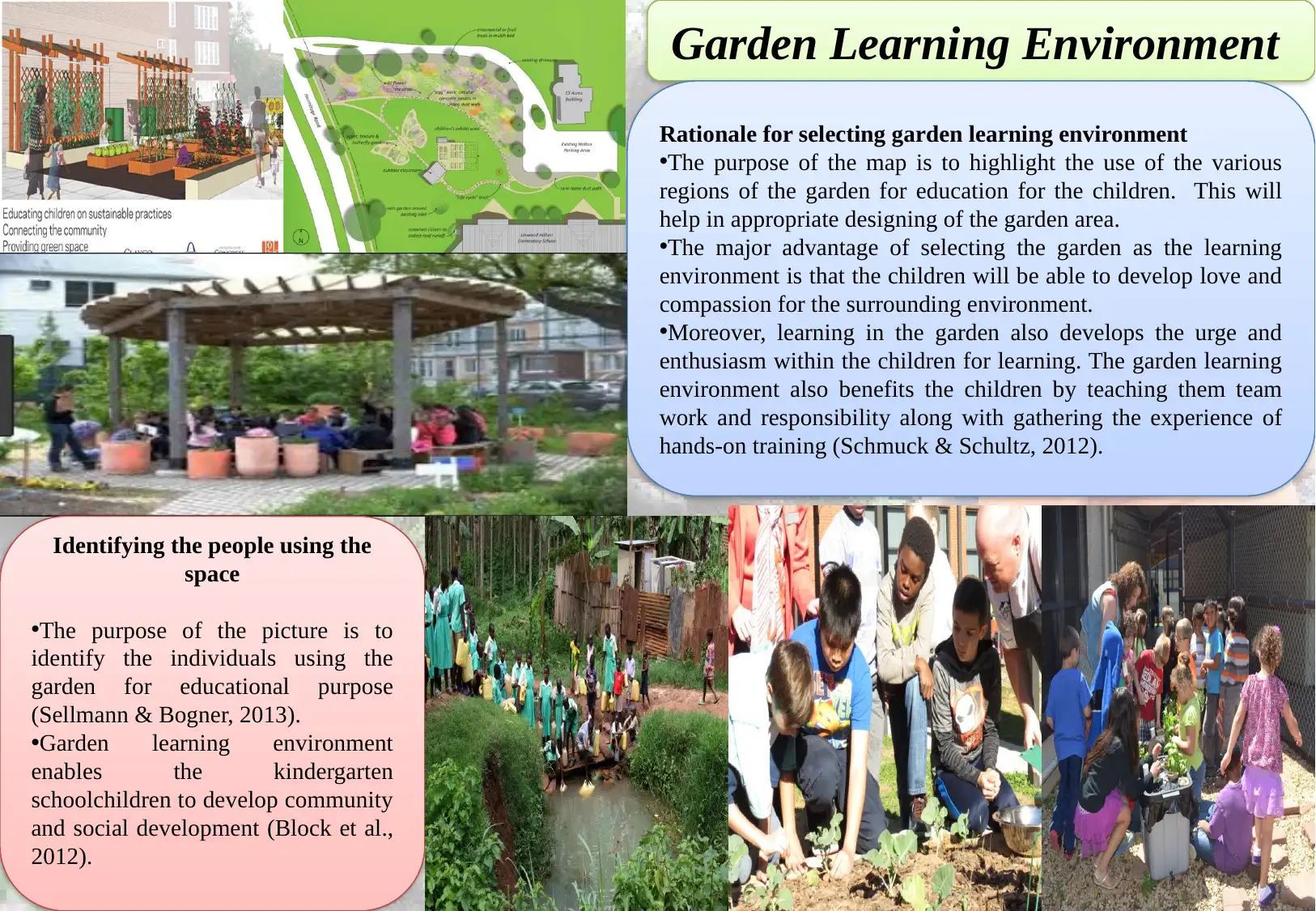
Garden Learning Environment
Rationale for selecting garden learning environment
The purpose of the map is to highlight the use of the various
regions of the garden for education for the children. This will
help in appropriate designing of the garden area.
The major advantage of selecting the garden as the learning
environment is that the children will be able to develop love and
compassion for the surrounding environment.
Moreover, learning in the garden also develops the urge and
enthusiasm within the children for learning. The garden learning
environment also benefits the children by teaching them team
work and responsibility along with gathering the experience of
hands-on training (Schmuck & Schultz, 2012).
Identifying the people using the
space
The purpose of the picture is to
identify the individuals using the
garden for educational purpose
(Sellmann & Bogner, 2013).
Garden learning environment
enables the kindergarten
schoolchildren to develop community
and social development (Block et al.,
2012).
tabler-icon-diamond-filled.svg

Paraphrase This Document

Need a fresh take? Get an instant paraphrase of this document with our AI Paraphraser
Document Page
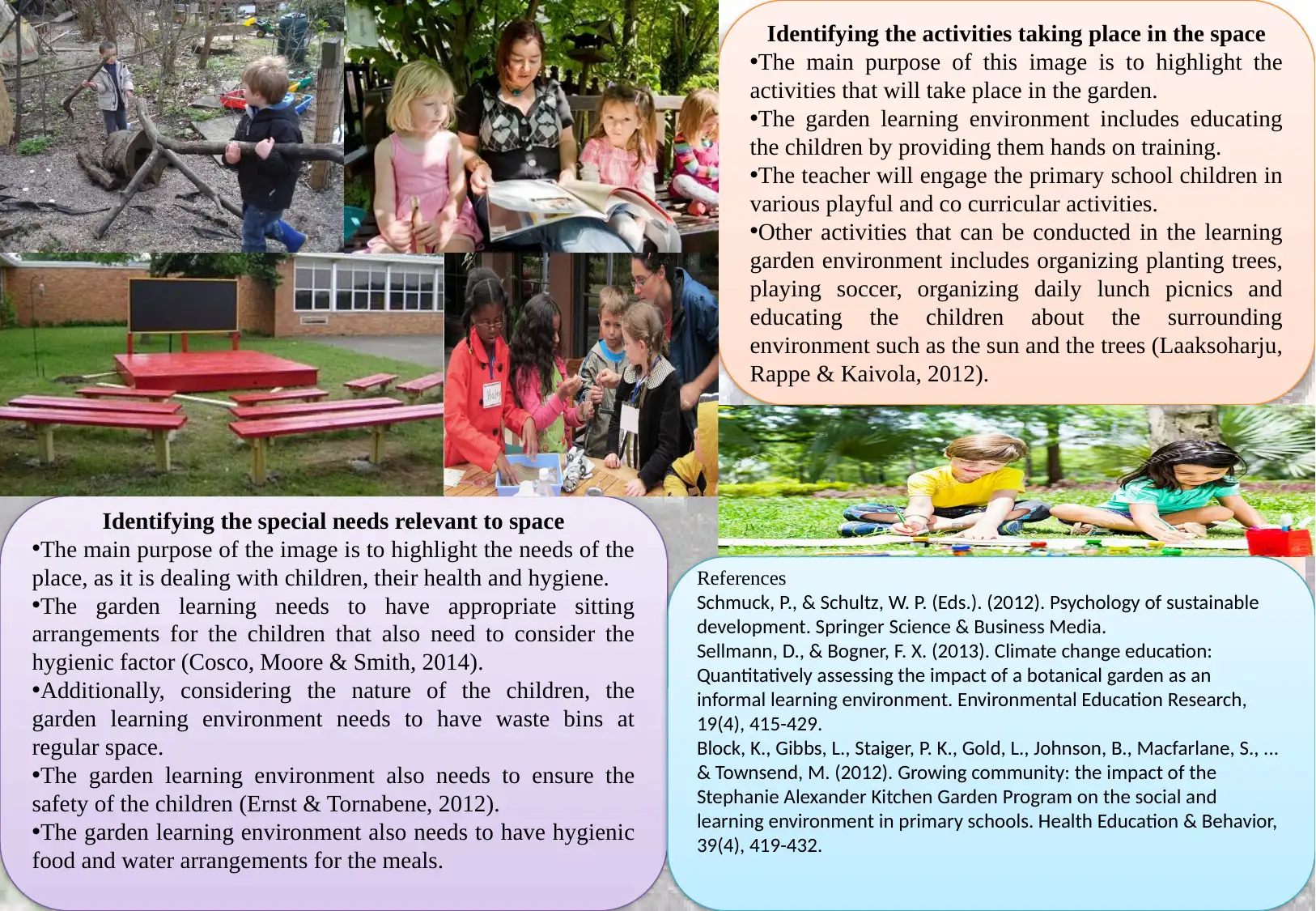
Identifying the activities taking place in the space
The main purpose of this image is to highlight the
activities that will take place in the garden.
The garden learning environment includes educating
the children by providing them hands on training.
The teacher will engage the primary school children in
various playful and co curricular activities.
Other activities that can be conducted in the learning
garden environment includes organizing planting trees,
playing soccer, organizing daily lunch picnics and
educating the children about the surrounding
environment such as the sun and the trees (Laaksoharju,
Rappe & Kaivola, 2012).
Identifying the special needs relevant to space
The main purpose of the image is to highlight the needs of the
place, as it is dealing with children, their health and hygiene.
The garden learning needs to have appropriate sitting
arrangements for the children that also need to consider the
hygienic factor (Cosco, Moore & Smith, 2014).
Additionally, considering the nature of the children, the
garden learning environment needs to have waste bins at
regular space.
The garden learning environment also needs to ensure the
safety of the children (Ernst & Tornabene, 2012).
The garden learning environment also needs to have hygienic
food and water arrangements for the meals.
References
Schmuck, P., & Schultz, W. P. (Eds.). (2012). Psychology of sustainable
development. Springer Science & Business Media.
Sellmann, D., & Bogner, F. X. (2013). Climate change education:
Quantitatively assessing the impact of a botanical garden as an
informal learning environment. Environmental Education Research,
19(4), 415-429.
Block, K., Gibbs, L., Staiger, P. K., Gold, L., Johnson, B., Macfarlane, S., ...
& Townsend, M. (2012). Growing community: the impact of the
Stephanie Alexander Kitchen Garden Program on the social and
learning environment in primary schools. Health Education & Behavior,
39(4), 419-432.
chevron_up_icon
1 out of 2
circle_padding
hide_on_mobile
zoom_out_icon
[object Object]