Analyzing Recent Changes in Japanese Language and Society

Verified

Added on  2023/01/17

|4
|699
|72
Essay
AI Summary
This essay examines the evolving landscape of the Japanese language and its interaction with society. It explores the incorporation of foreign languages, particularly the impact of loanwords from languages like English and Chinese, reflecting globalization and cultural exchange. The discussion covers the historical context of the Japanese language, its vocabulary, and the societal factors driving linguistic changes, including economic, social, and technological influences. The essay highlights how these factors contribute to multiculturalism and the assimilation of new lexical terms. It also touches upon the cultural implications of these changes, the role of language in understanding the self and the world, and the ongoing shifts in Japanese society's linguistic patterns. The essay references key academic sources to support its analysis of these complex linguistic and societal dynamics.
Document Page
Running head: TIME, TRUTH, AND HUMAN CONDITION
TIME, TRUTH, AND HUMAN CONDITION
Name of the student:
Name of the university:
Author note:
tabler-icon-diamond-filled.svg

Paraphrase This Document

Need a fresh take? Get an instant paraphrase of this document with our AI Paraphraser
Document Page
1TIME, TRUTH, AND HUMAN CONDITION
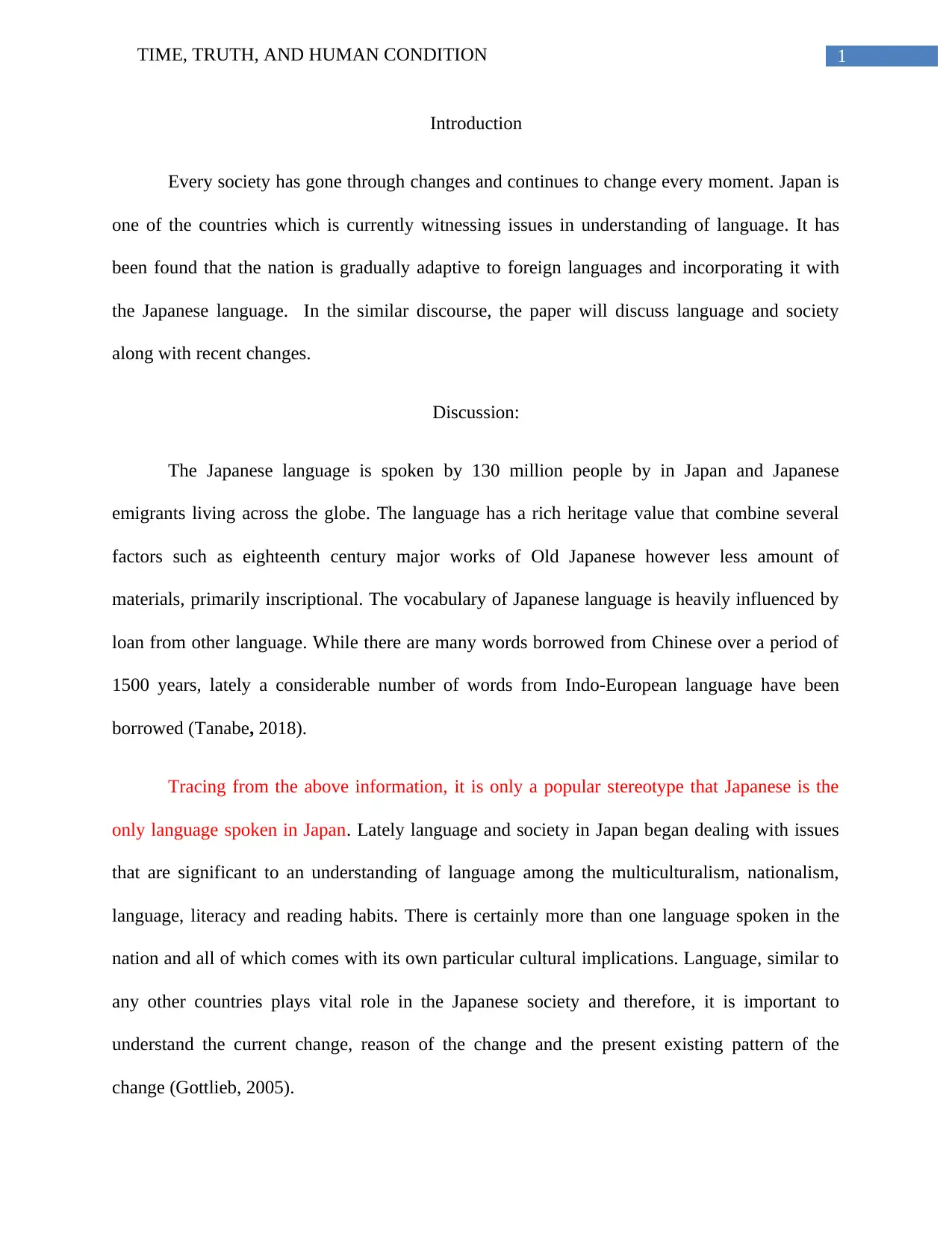
Introduction
Every society has gone through changes and continues to change every moment. Japan is
one of the countries which is currently witnessing issues in understanding of language. It has
been found that the nation is gradually adaptive to foreign languages and incorporating it with
the Japanese language. In the similar discourse, the paper will discuss language and society
along with recent changes.
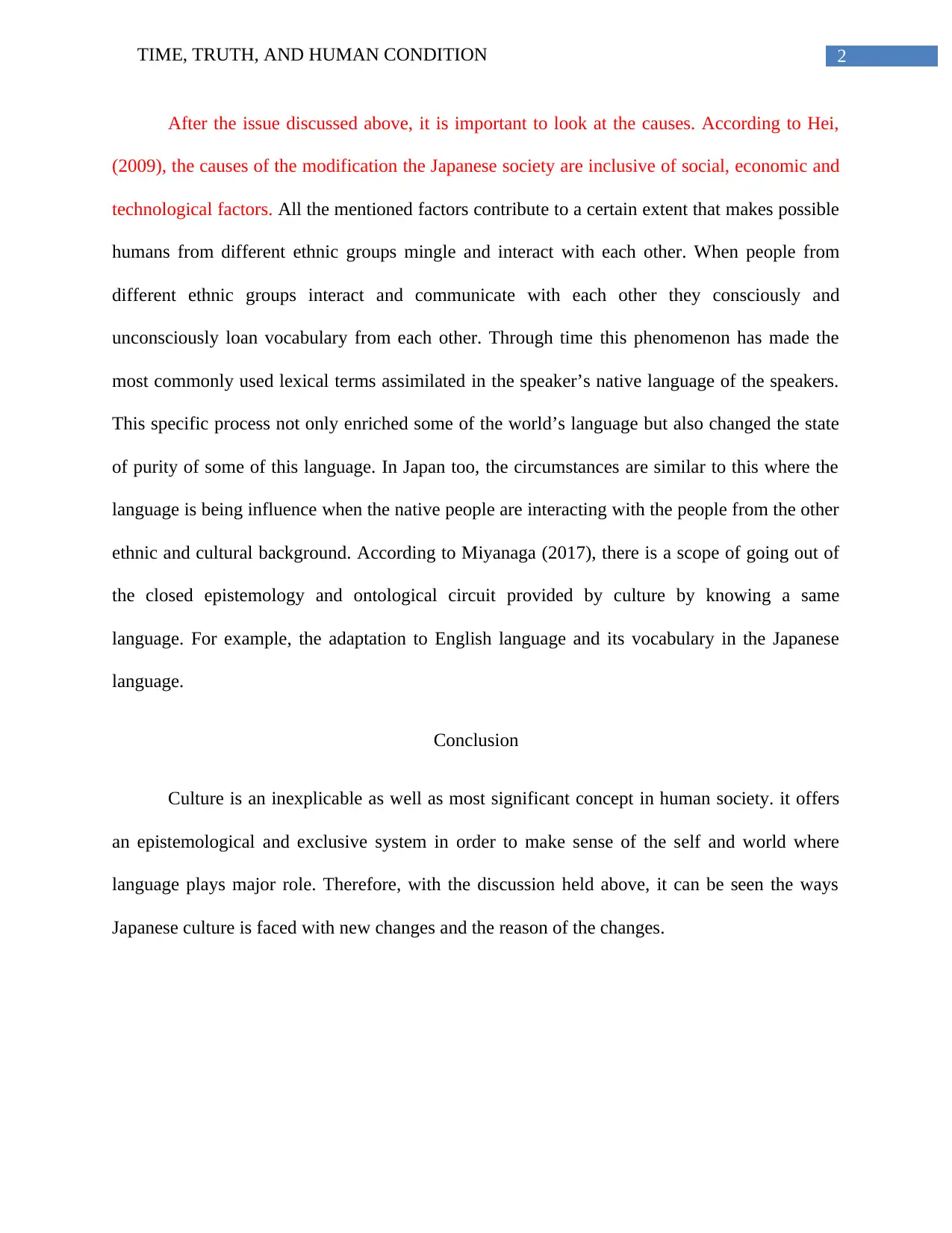
Discussion:
The Japanese language is spoken by 130 million people by in Japan and Japanese
emigrants living across the globe. The language has a rich heritage value that combine several
factors such as eighteenth century major works of Old Japanese however less amount of
materials, primarily inscriptional. The vocabulary of Japanese language is heavily influenced by
loan from other language. While there are many words borrowed from Chinese over a period of
1500 years, lately a considerable number of words from Indo-European language have been
borrowed (Tanabe, 2018).
Tracing from the above information, it is only a popular stereotype that Japanese is the
only language spoken in Japan. Lately language and society in Japan began dealing with issues
that are significant to an understanding of language among the multiculturalism, nationalism,
language, literacy and reading habits. There is certainly more than one language spoken in the
nation and all of which comes with its own particular cultural implications. Language, similar to
any other countries plays vital role in the Japanese society and therefore, it is important to
understand the current change, reason of the change and the present existing pattern of the
change (Gottlieb, 2005).
Document Page
2TIME, TRUTH, AND HUMAN CONDITION
After the issue discussed above, it is important to look at the causes. According to Hei,
(2009), the causes of the modification the Japanese society are inclusive of social, economic and
technological factors. All the mentioned factors contribute to a certain extent that makes possible
humans from different ethnic groups mingle and interact with each other. When people from
different ethnic groups interact and communicate with each other they consciously and
unconsciously loan vocabulary from each other. Through time this phenomenon has made the
most commonly used lexical terms assimilated in the speaker’s native language of the speakers.
This specific process not only enriched some of the world’s language but also changed the state
of purity of some of this language. In Japan too, the circumstances are similar to this where the
language is being influence when the native people are interacting with the people from the other
ethnic and cultural background. According to Miyanaga (2017), there is a scope of going out of
the closed epistemology and ontological circuit provided by culture by knowing a same
language. For example, the adaptation to English language and its vocabulary in the Japanese
language.
Conclusion
Culture is an inexplicable as well as most significant concept in human society. it offers
an epistemological and exclusive system in order to make sense of the self and world where
language plays major role. Therefore, with the discussion held above, it can be seen the ways
Japanese culture is faced with new changes and the reason of the changes.
Document Page
3TIME, TRUTH, AND HUMAN CONDITION
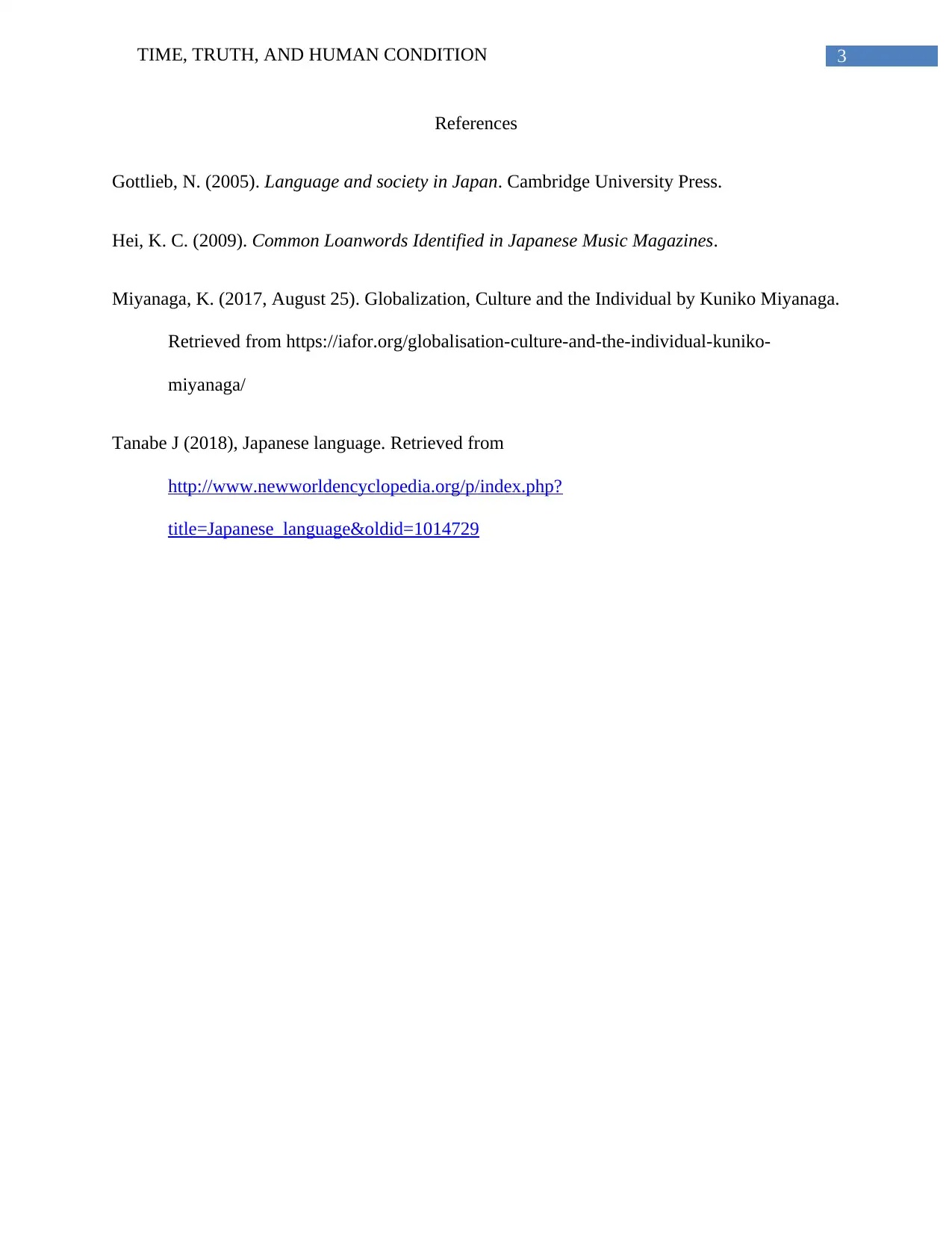
References
Gottlieb, N. (2005). Language and society in Japan. Cambridge University Press.
Hei, K. C. (2009). Common Loanwords Identified in Japanese Music Magazines.
Miyanaga, K. (2017, August 25). Globalization, Culture and the Individual by Kuniko Miyanaga.
Retrieved from https://iafor.org/globalisation-culture-and-the-individual-kuniko-
miyanaga/
Tanabe J (2018), Japanese language. Retrieved from
http://www.newworldencyclopedia.org/p/index.php?
title=Japanese_language&oldid=1014729
chevron_up_icon
1 out of 4
circle_padding
hide_on_mobile
zoom_out_icon
[object Object]