Java Code: Simple and Cartesian Rectangle Class Implementation
VerifiedAdded on  2023/04/08
|12
|1173
|295
Homework Assignment
AI Summary
This assignment provides Java code for implementing a Rectangle class using two different approaches: a simple rectangle with length and width attributes, and a Cartesian rectangle defined by four coordinate points. The simple rectangle class includes methods for calculating area and perimeter, as well as validating input values. The Cartesian rectangle class includes methods for setting dimensions, calculating length and width based on coordinates, determining if the shape is a rectangle or a square, and calculating area and perimeter. The code also includes test classes to demonstrate the functionality of both rectangle implementations. Desklib provides this and other solved assignments and past papers to aid students in their studies.
Code
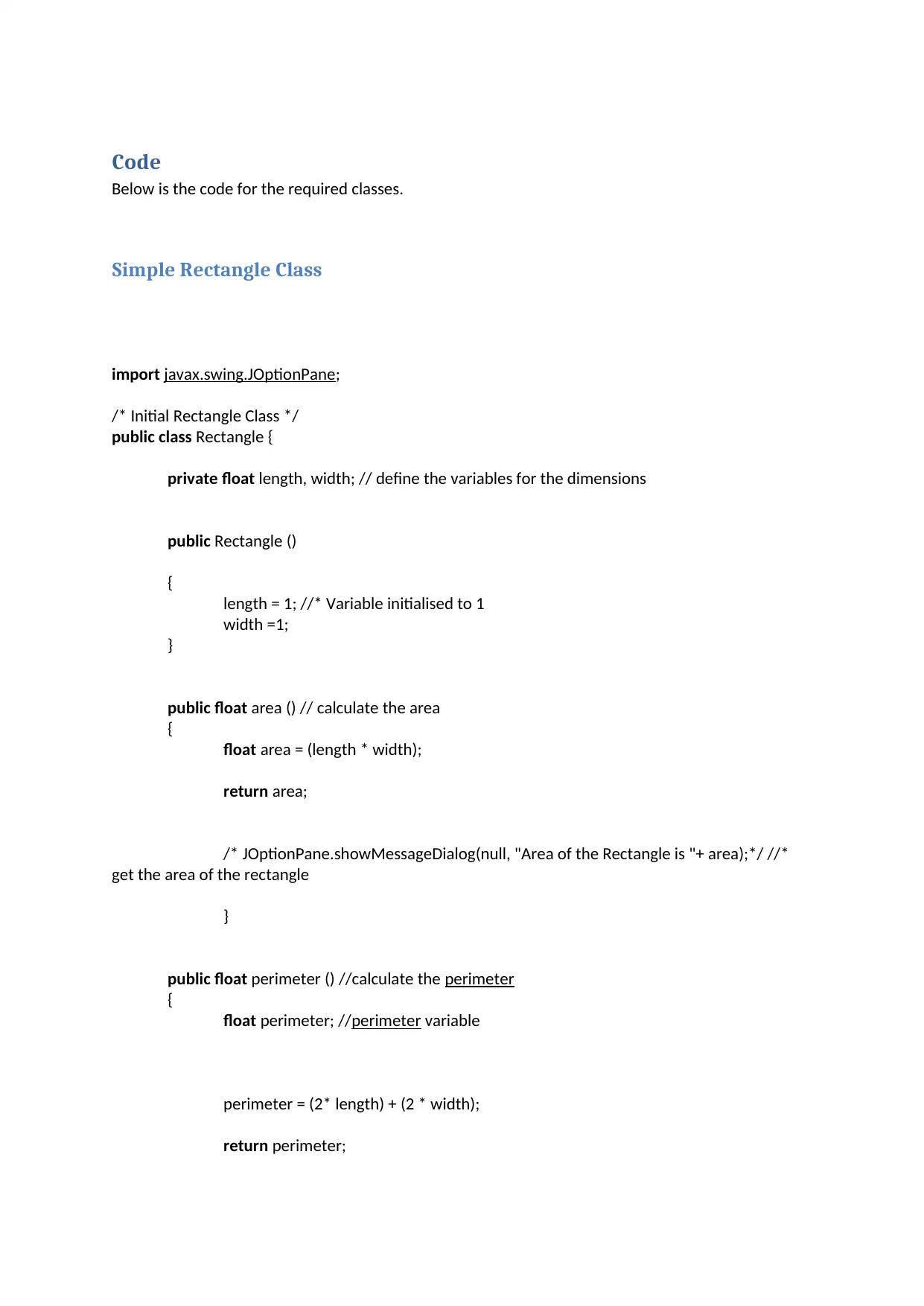
Below is the code for the required classes.
Simple Rectangle Class
import javax.swing.JOptionPane;
/* Initial Rectangle Class */
public class Rectangle {
private float length, width; // define the variables for the dimensions
public Rectangle ()
{
length = 1; //* Variable initialised to 1
width =1;
}
public float area () // calculate the area
{
float area = (length * width);
return area;
/* JOptionPane.showMessageDialog(null, "Area of the Rectangle is "+ area);*/ //*
get the area of the rectangle
}
public float perimeter () //calculate the perimeter
{
float perimeter; //perimeter variable
perimeter = (2* length) + (2 * width);
return perimeter;
Below is the code for the required classes.
Simple Rectangle Class
import javax.swing.JOptionPane;
/* Initial Rectangle Class */
public class Rectangle {
private float length, width; // define the variables for the dimensions
public Rectangle ()
{
length = 1; //* Variable initialised to 1
width =1;
}
public float area () // calculate the area
{
float area = (length * width);
return area;
/* JOptionPane.showMessageDialog(null, "Area of the Rectangle is "+ area);*/ //*
get the area of the rectangle
}
public float perimeter () //calculate the perimeter
{
float perimeter; //perimeter variable
perimeter = (2* length) + (2 * width);
return perimeter;
Paraphrase This Document
Need a fresh take? Get an instant paraphrase of this document with our AI Paraphraser

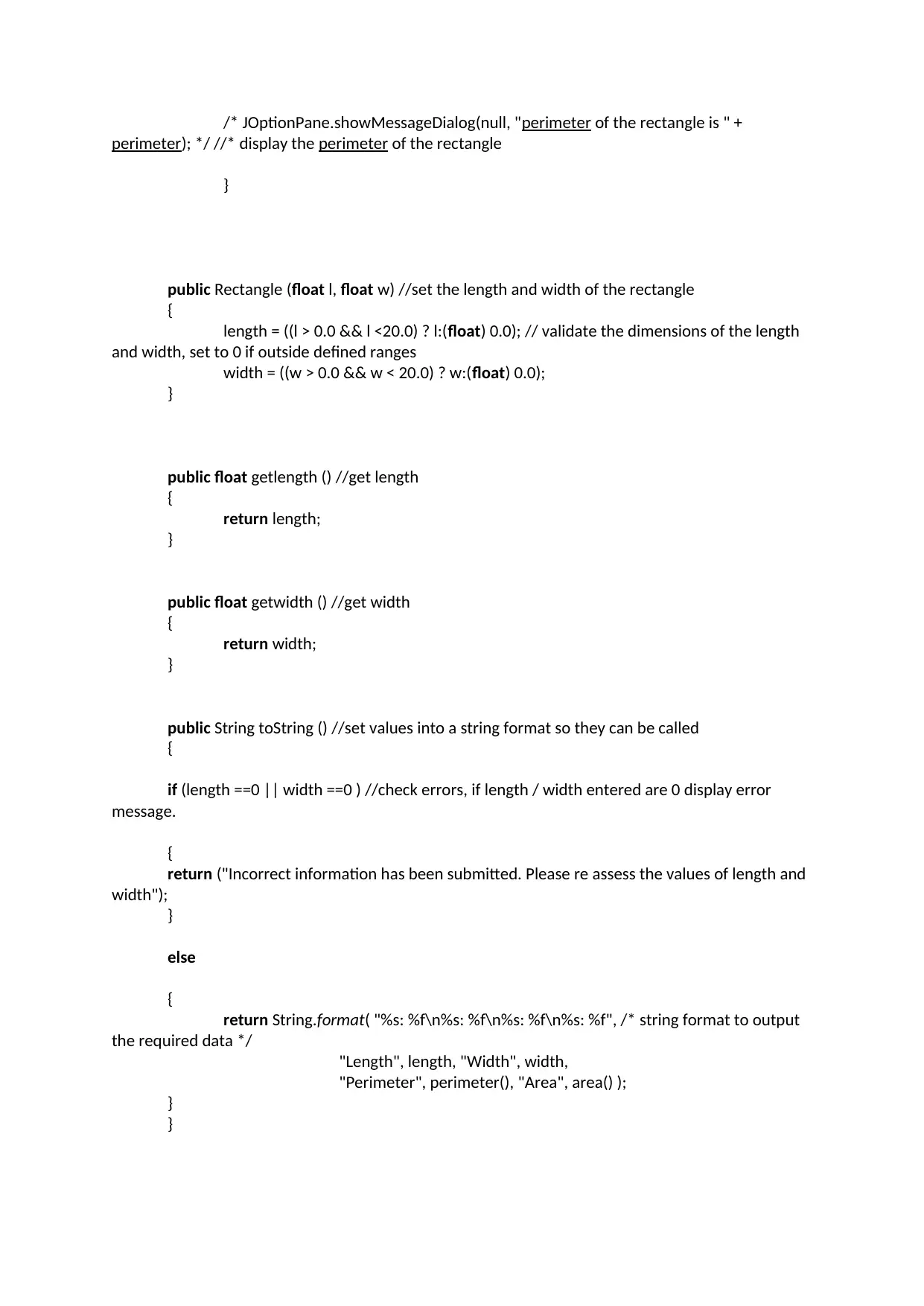
/* JOptionPane.showMessageDialog(null, "perimeter of the rectangle is " +
perimeter); */ //* display the perimeter of the rectangle
}
public Rectangle (float l, float w) //set the length and width of the rectangle
{
length = ((l > 0.0 && l <20.0) ? l:(float) 0.0); // validate the dimensions of the length
and width, set to 0 if outside defined ranges
width = ((w > 0.0 && w < 20.0) ? w:(float) 0.0);
}
public float getlength () //get length
{
return length;
}
public float getwidth () //get width
{
return width;
}
public String toString () //set values into a string format so they can be called
{
if (length ==0 || width ==0 ) //check errors, if length / width entered are 0 display error
message.
{
return ("Incorrect information has been submitted. Please re assess the values of length and
width");
}
else
{
return String.format( "%s: %f\n%s: %f\n%s: %f\n%s: %f", /* string format to output
the required data */
"Length", length, "Width", width,
"Perimeter", perimeter(), "Area", area() );
}
}
perimeter); */ //* display the perimeter of the rectangle
}
public Rectangle (float l, float w) //set the length and width of the rectangle
{
length = ((l > 0.0 && l <20.0) ? l:(float) 0.0); // validate the dimensions of the length
and width, set to 0 if outside defined ranges
width = ((w > 0.0 && w < 20.0) ? w:(float) 0.0);
}
public float getlength () //get length
{
return length;
}
public float getwidth () //get width
{
return width;
}
public String toString () //set values into a string format so they can be called
{
if (length ==0 || width ==0 ) //check errors, if length / width entered are 0 display error
message.
{
return ("Incorrect information has been submitted. Please re assess the values of length and
width");
}
else
{
return String.format( "%s: %f\n%s: %f\n%s: %f\n%s: %f", /* string format to output
the required data */
"Length", length, "Width", width,
"Perimeter", perimeter(), "Area", area() );
}
}

}
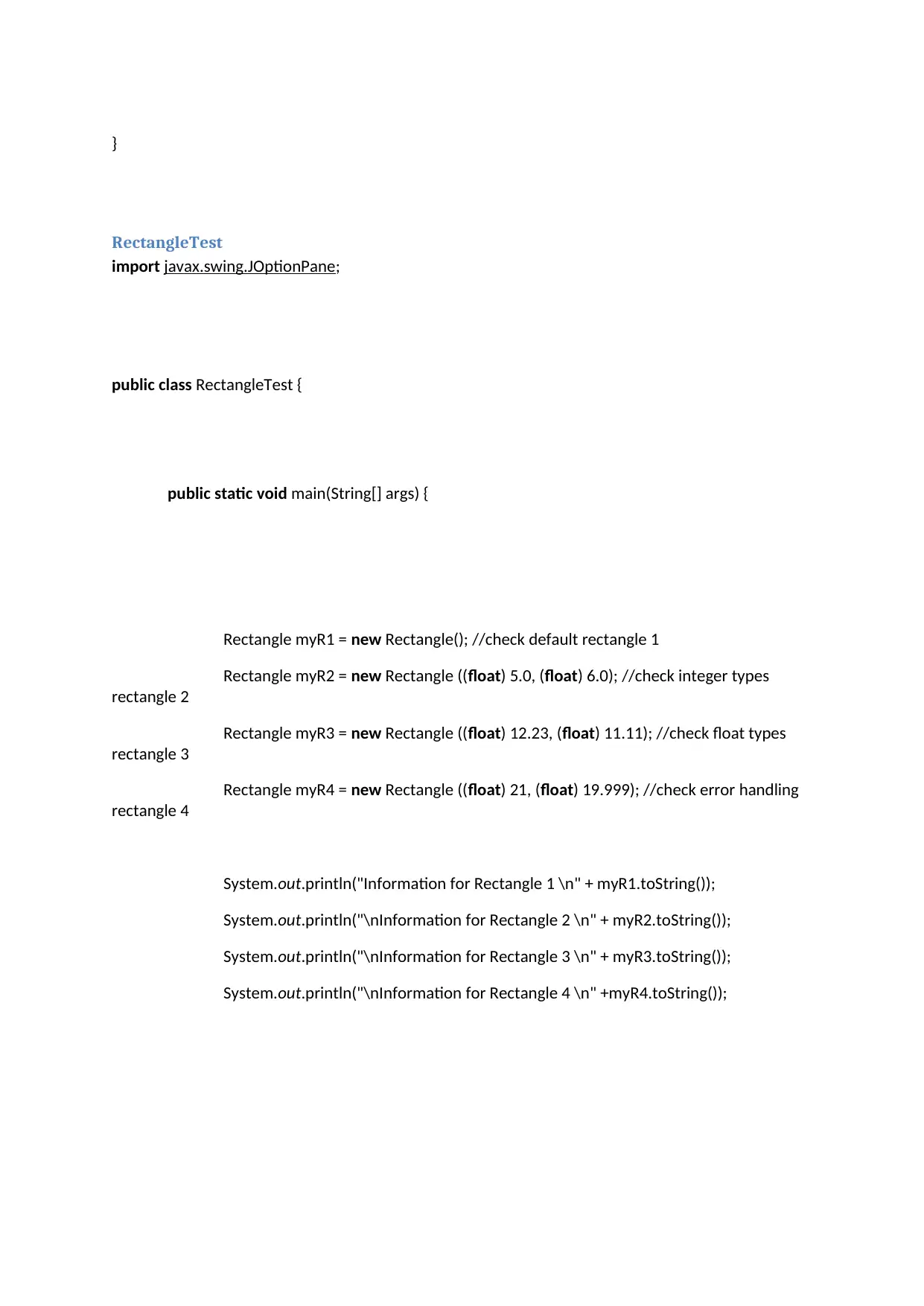
RectangleTest
import javax.swing.JOptionPane;
public class RectangleTest {
public static void main(String[] args) {
Rectangle myR1 = new Rectangle(); //check default rectangle 1
Rectangle myR2 = new Rectangle ((float) 5.0, (float) 6.0); //check integer types
rectangle 2
Rectangle myR3 = new Rectangle ((float) 12.23, (float) 11.11); //check float types
rectangle 3
Rectangle myR4 = new Rectangle ((float) 21, (float) 19.999); //check error handling
rectangle 4
System.out.println("Information for Rectangle 1 \n" + myR1.toString());
System.out.println("\nInformation for Rectangle 2 \n" + myR2.toString());
System.out.println("\nInformation for Rectangle 3 \n" + myR3.toString());
System.out.println("\nInformation for Rectangle 4 \n" +myR4.toString());
RectangleTest
import javax.swing.JOptionPane;
public class RectangleTest {
public static void main(String[] args) {
Rectangle myR1 = new Rectangle(); //check default rectangle 1
Rectangle myR2 = new Rectangle ((float) 5.0, (float) 6.0); //check integer types
rectangle 2
Rectangle myR3 = new Rectangle ((float) 12.23, (float) 11.11); //check float types
rectangle 3
Rectangle myR4 = new Rectangle ((float) 21, (float) 19.999); //check error handling
rectangle 4
System.out.println("Information for Rectangle 1 \n" + myR1.toString());
System.out.println("\nInformation for Rectangle 2 \n" + myR2.toString());
System.out.println("\nInformation for Rectangle 3 \n" + myR3.toString());
System.out.println("\nInformation for Rectangle 4 \n" +myR4.toString());
⊘ This is a preview!⊘
Do you want full access?
Subscribe today to unlock all pages.

Trusted by 1+ million students worldwide

}
}
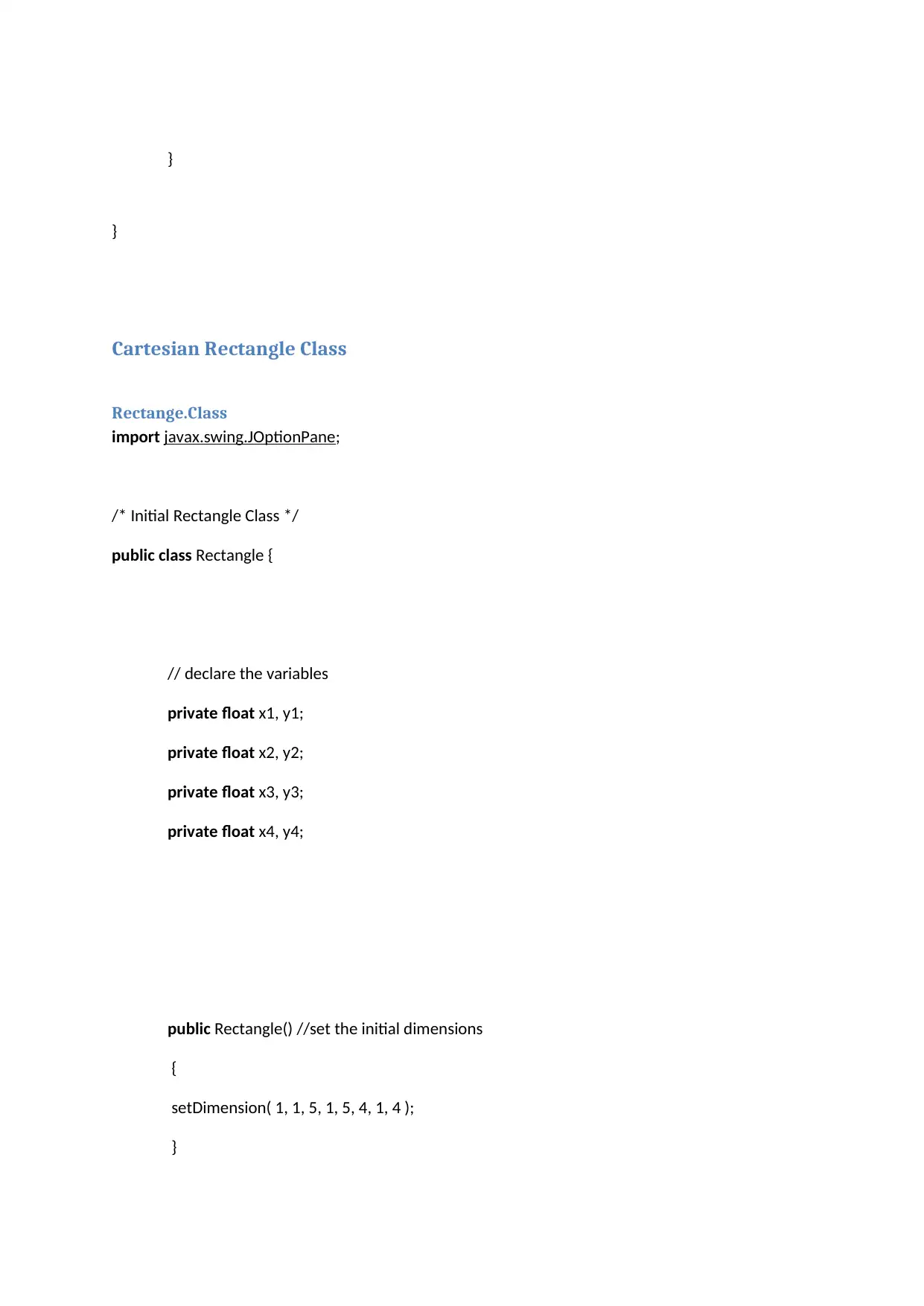
Cartesian Rectangle Class
Rectange.Class
import javax.swing.JOptionPane;
/* Initial Rectangle Class */
public class Rectangle {
// declare the variables
private float x1, y1;
private float x2, y2;
private float x3, y3;
private float x4, y4;
public Rectangle() //set the initial dimensions
{
setDimension( 1, 1, 5, 1, 5, 4, 1, 4 );
}
}
Cartesian Rectangle Class
Rectange.Class
import javax.swing.JOptionPane;
/* Initial Rectangle Class */
public class Rectangle {
// declare the variables
private float x1, y1;
private float x2, y2;
private float x3, y3;
private float x4, y4;
public Rectangle() //set the initial dimensions
{
setDimension( 1, 1, 5, 1, 5, 4, 1, 4 );
}
Paraphrase This Document
Need a fresh take? Get an instant paraphrase of this document with our AI Paraphraser

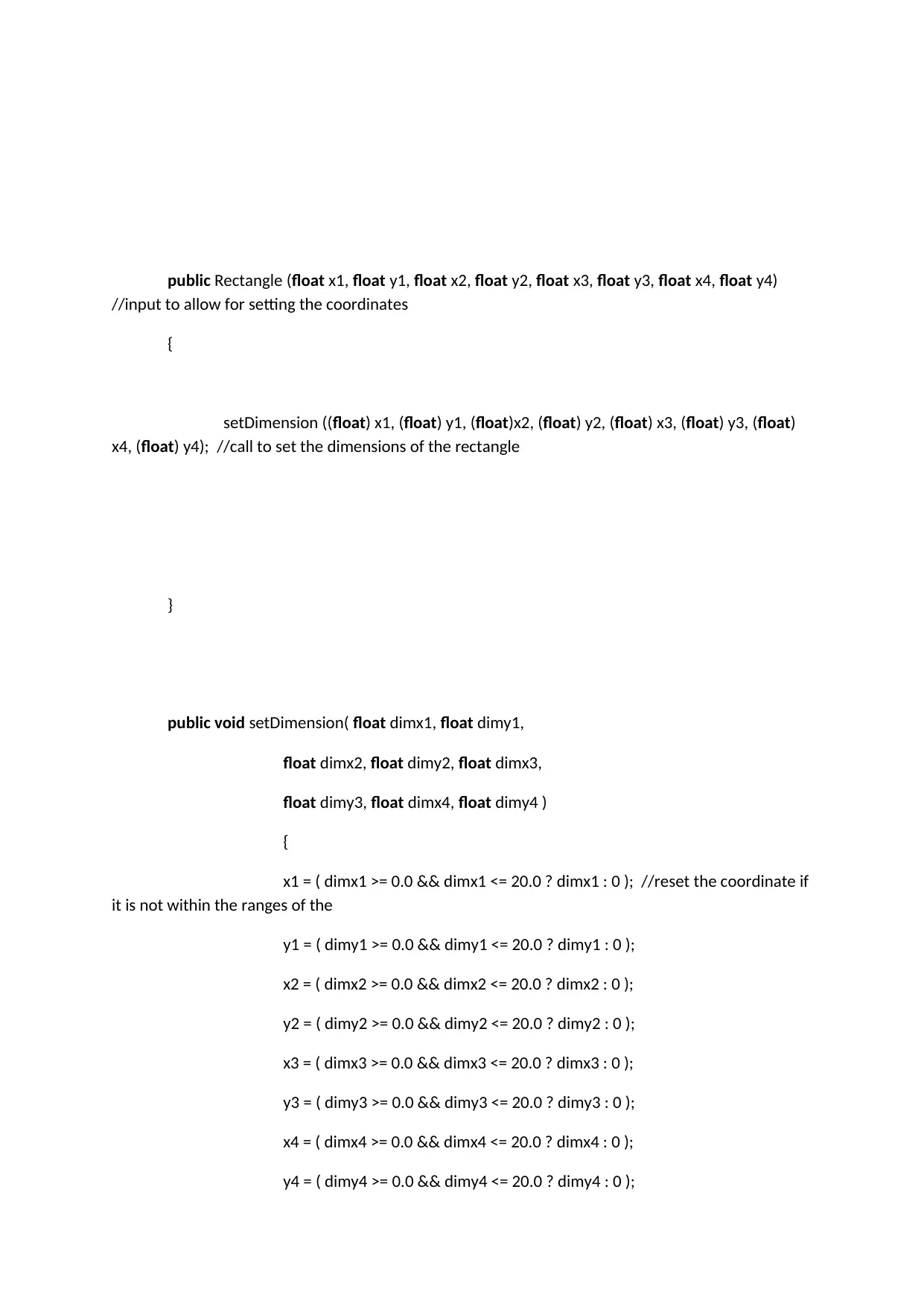
public Rectangle (float x1, float y1, float x2, float y2, float x3, float y3, float x4, float y4)
//input to allow for setting the coordinates
{
setDimension ((float) x1, (float) y1, (float)x2, (float) y2, (float) x3, (float) y3, (float)
x4, (float) y4); //call to set the dimensions of the rectangle
}
public void setDimension( float dimx1, float dimy1,
float dimx2, float dimy2, float dimx3,
float dimy3, float dimx4, float dimy4 )
{
x1 = ( dimx1 >= 0.0 && dimx1 <= 20.0 ? dimx1 : 0 ); //reset the coordinate if
it is not within the ranges of the
y1 = ( dimy1 >= 0.0 && dimy1 <= 20.0 ? dimy1 : 0 );
x2 = ( dimx2 >= 0.0 && dimx2 <= 20.0 ? dimx2 : 0 );
y2 = ( dimy2 >= 0.0 && dimy2 <= 20.0 ? dimy2 : 0 );
x3 = ( dimx3 >= 0.0 && dimx3 <= 20.0 ? dimx3 : 0 );
y3 = ( dimy3 >= 0.0 && dimy3 <= 20.0 ? dimy3 : 0 );
x4 = ( dimx4 >= 0.0 && dimx4 <= 20.0 ? dimx4 : 0 );
y4 = ( dimy4 >= 0.0 && dimy4 <= 20.0 ? dimy4 : 0 );
//input to allow for setting the coordinates
{
setDimension ((float) x1, (float) y1, (float)x2, (float) y2, (float) x3, (float) y3, (float)
x4, (float) y4); //call to set the dimensions of the rectangle
}
public void setDimension( float dimx1, float dimy1,
float dimx2, float dimy2, float dimx3,
float dimy3, float dimx4, float dimy4 )
{
x1 = ( dimx1 >= 0.0 && dimx1 <= 20.0 ? dimx1 : 0 ); //reset the coordinate if
it is not within the ranges of the
y1 = ( dimy1 >= 0.0 && dimy1 <= 20.0 ? dimy1 : 0 );
x2 = ( dimx2 >= 0.0 && dimx2 <= 20.0 ? dimx2 : 0 );
y2 = ( dimy2 >= 0.0 && dimy2 <= 20.0 ? dimy2 : 0 );
x3 = ( dimx3 >= 0.0 && dimx3 <= 20.0 ? dimx3 : 0 );
y3 = ( dimy3 >= 0.0 && dimy3 <= 20.0 ? dimy3 : 0 );
x4 = ( dimx4 >= 0.0 && dimx4 <= 20.0 ? dimx4 : 0 );
y4 = ( dimy4 >= 0.0 && dimy4 <= 20.0 ? dimy4 : 0 );

}
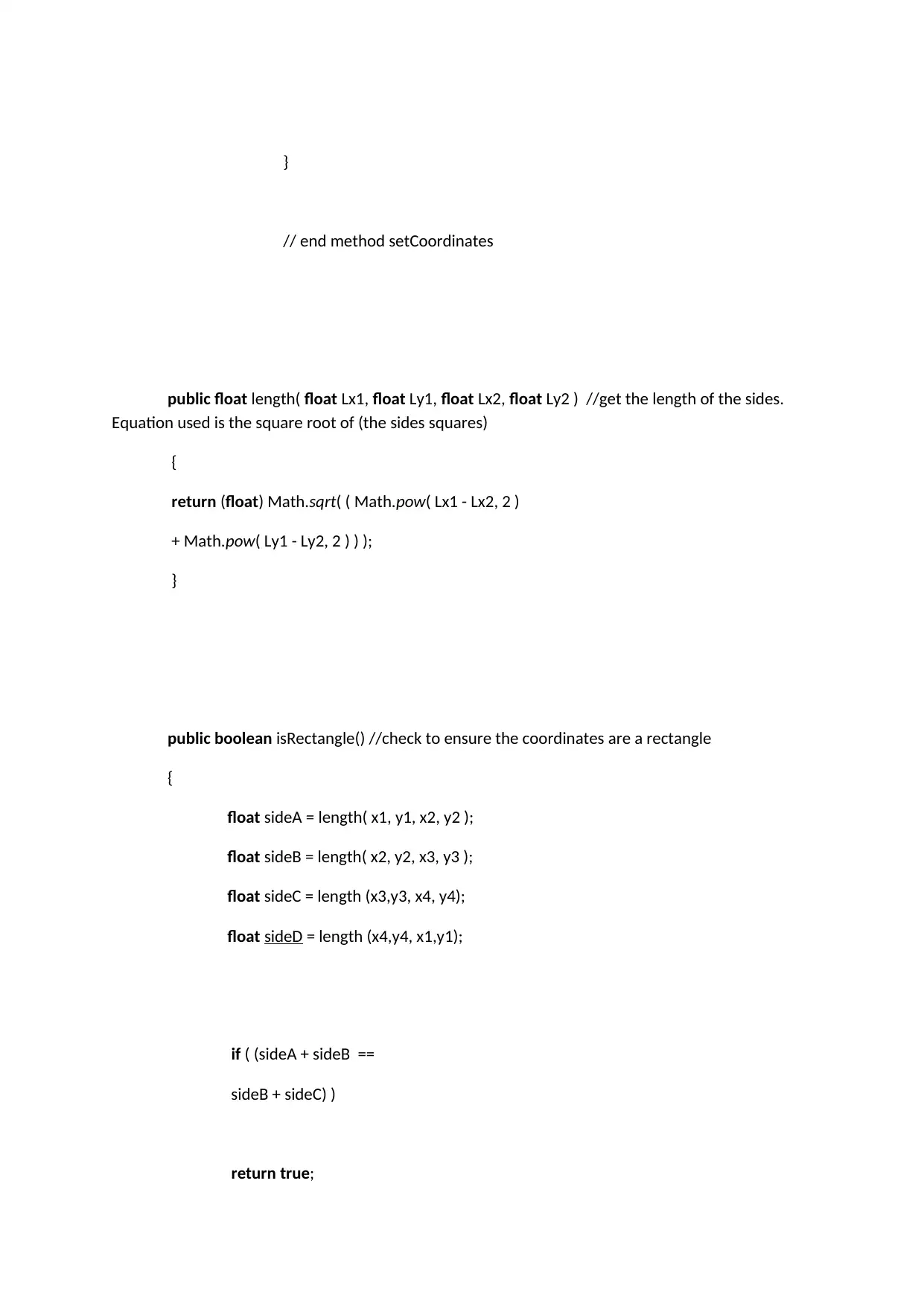
// end method setCoordinates
public float length( float Lx1, float Ly1, float Lx2, float Ly2 ) //get the length of the sides.
Equation used is the square root of (the sides squares)
{
return (float) Math.sqrt( ( Math.pow( Lx1 - Lx2, 2 )
+ Math.pow( Ly1 - Ly2, 2 ) ) );
}
public boolean isRectangle() //check to ensure the coordinates are a rectangle
{
float sideA = length( x1, y1, x2, y2 );
float sideB = length( x2, y2, x3, y3 );
float sideC = length (x3,y3, x4, y4);
float sideD = length (x4,y4, x1,y1);
if ( (sideA + sideB ==
sideB + sideC) )
return true;
// end method setCoordinates
public float length( float Lx1, float Ly1, float Lx2, float Ly2 ) //get the length of the sides.
Equation used is the square root of (the sides squares)
{
return (float) Math.sqrt( ( Math.pow( Lx1 - Lx2, 2 )
+ Math.pow( Ly1 - Ly2, 2 ) ) );
}
public boolean isRectangle() //check to ensure the coordinates are a rectangle
{
float sideA = length( x1, y1, x2, y2 );
float sideB = length( x2, y2, x3, y3 );
float sideC = length (x3,y3, x4, y4);
float sideD = length (x4,y4, x1,y1);
if ( (sideA + sideB ==
sideB + sideC) )
return true;
⊘ This is a preview!⊘
Do you want full access?
Subscribe today to unlock all pages.

Trusted by 1+ million students worldwide

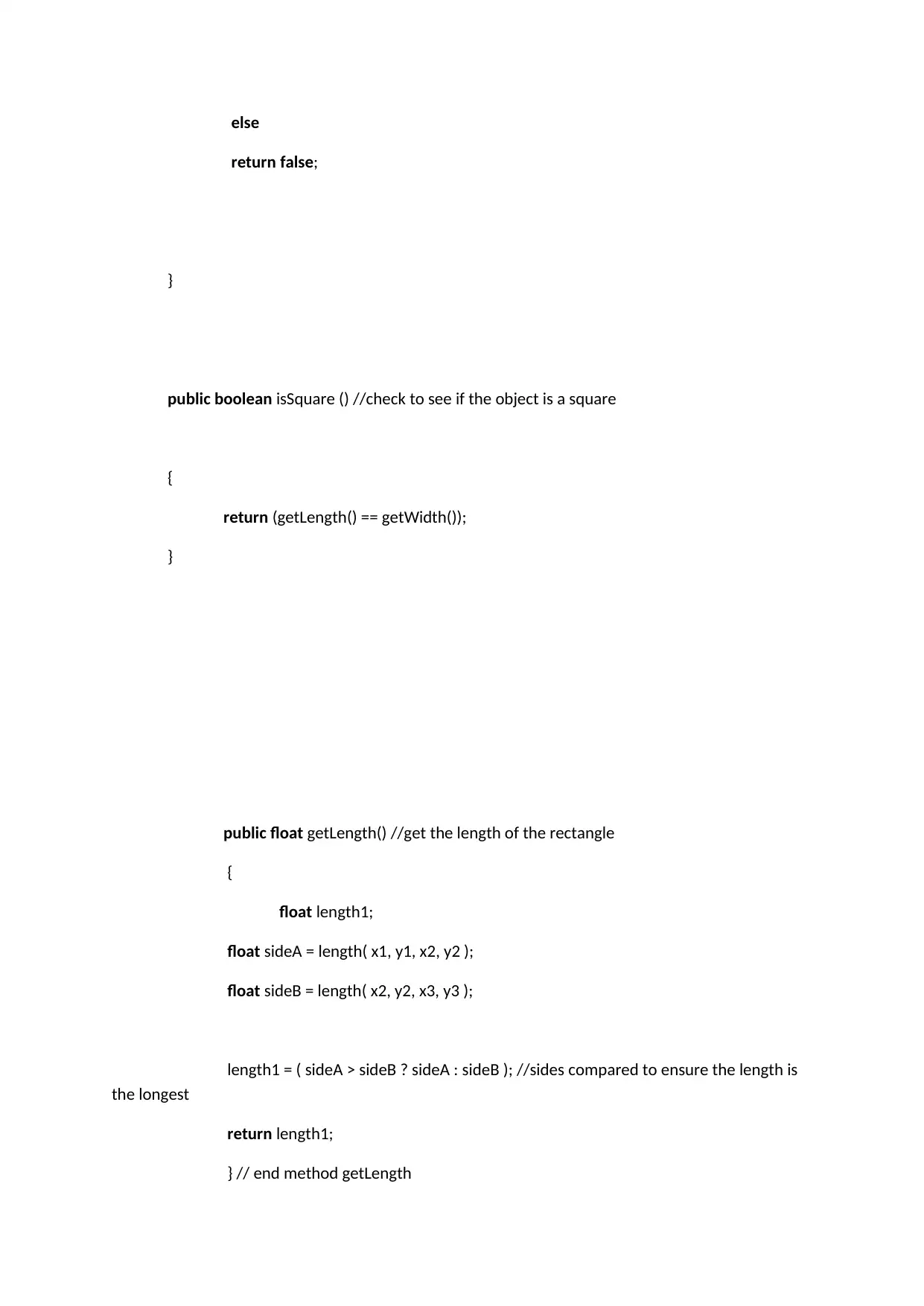
else
return false;
}
public boolean isSquare () //check to see if the object is a square
{
return (getLength() == getWidth());
}
public float getLength() //get the length of the rectangle
{
float length1;
float sideA = length( x1, y1, x2, y2 );
float sideB = length( x2, y2, x3, y3 );
length1 = ( sideA > sideB ? sideA : sideB ); //sides compared to ensure the length is
the longest
return length1;
} // end method getLength
return false;
}
public boolean isSquare () //check to see if the object is a square
{
return (getLength() == getWidth());
}
public float getLength() //get the length of the rectangle
{
float length1;
float sideA = length( x1, y1, x2, y2 );
float sideB = length( x2, y2, x3, y3 );
length1 = ( sideA > sideB ? sideA : sideB ); //sides compared to ensure the length is
the longest
return length1;
} // end method getLength
Paraphrase This Document
Need a fresh take? Get an instant paraphrase of this document with our AI Paraphraser

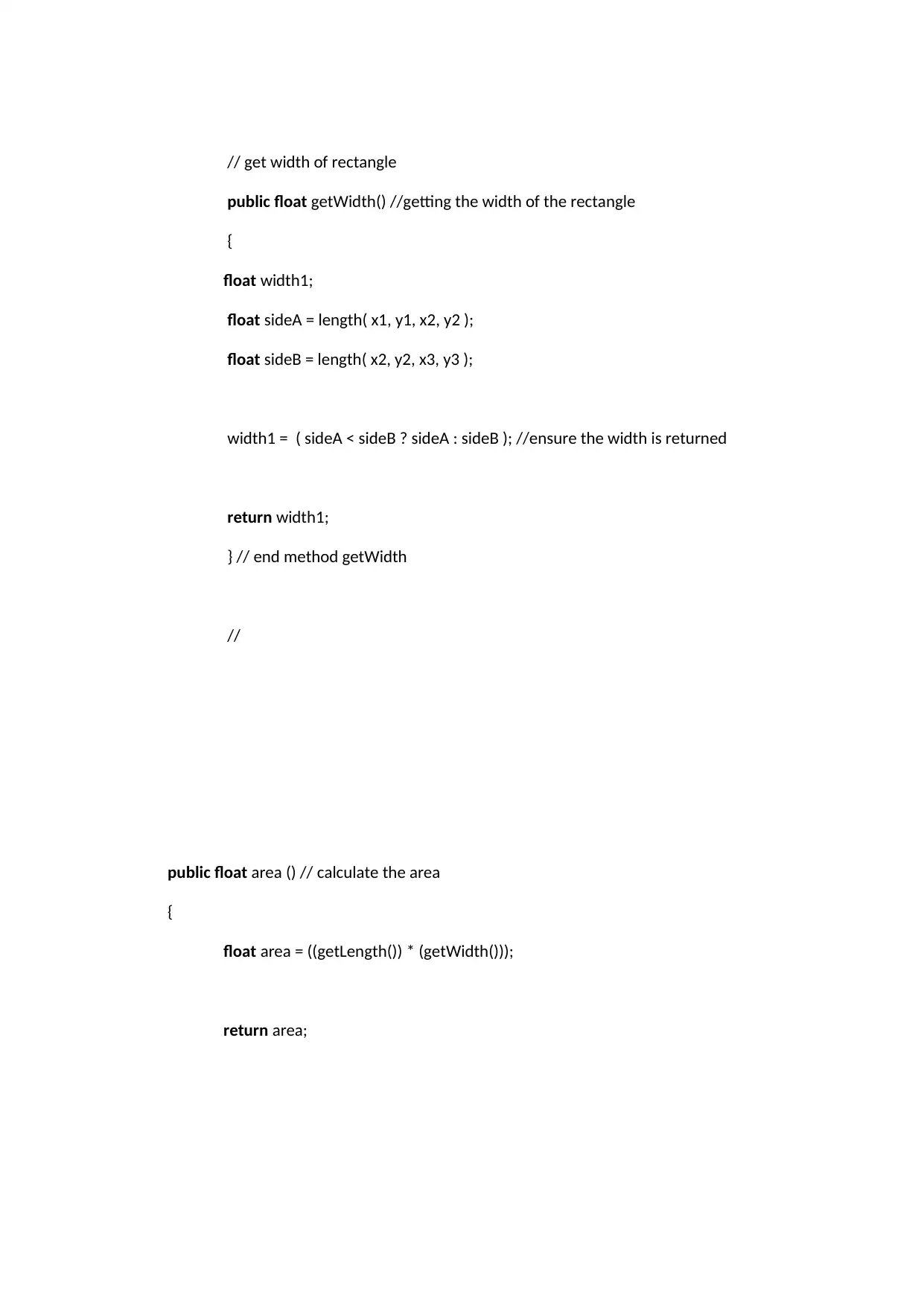
// get width of rectangle
public float getWidth() //getting the width of the rectangle
{
float width1;
float sideA = length( x1, y1, x2, y2 );
float sideB = length( x2, y2, x3, y3 );
width1 = ( sideA < sideB ? sideA : sideB ); //ensure the width is returned
return width1;
} // end method getWidth
//
public float area () // calculate the area
{
float area = ((getLength()) * (getWidth()));
return area;
public float getWidth() //getting the width of the rectangle
{
float width1;
float sideA = length( x1, y1, x2, y2 );
float sideB = length( x2, y2, x3, y3 );
width1 = ( sideA < sideB ? sideA : sideB ); //ensure the width is returned
return width1;
} // end method getWidth
//
public float area () // calculate the area
{
float area = ((getLength()) * (getWidth()));
return area;

}
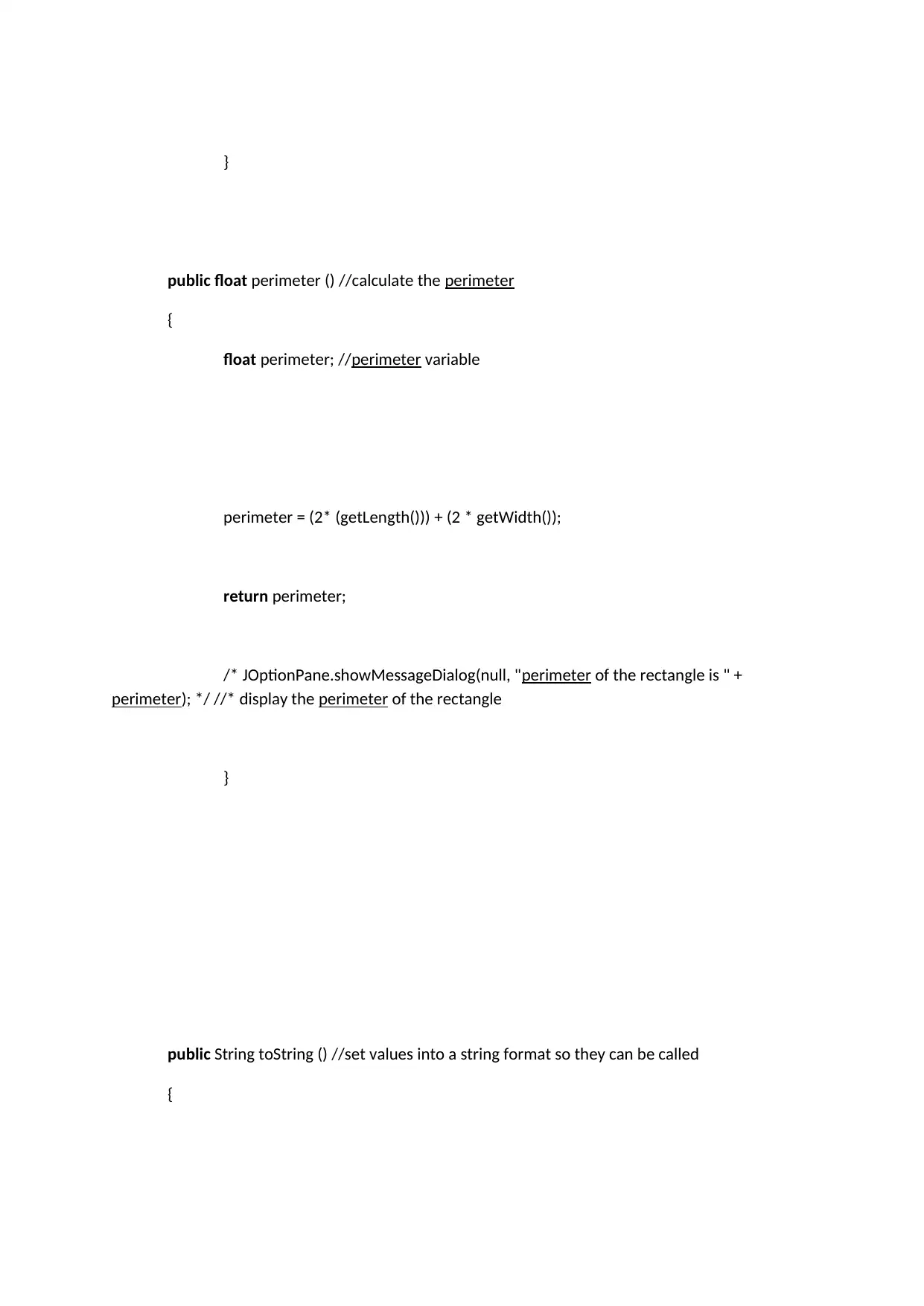
public float perimeter () //calculate the perimeter
{
float perimeter; //perimeter variable
perimeter = (2* (getLength())) + (2 * getWidth());
return perimeter;
/* JOptionPane.showMessageDialog(null, "perimeter of the rectangle is " +
perimeter); */ //* display the perimeter of the rectangle
}
public String toString () //set values into a string format so they can be called
{
public float perimeter () //calculate the perimeter
{
float perimeter; //perimeter variable
perimeter = (2* (getLength())) + (2 * getWidth());
return perimeter;
/* JOptionPane.showMessageDialog(null, "perimeter of the rectangle is " +
perimeter); */ //* display the perimeter of the rectangle
}
public String toString () //set values into a string format so they can be called
{
⊘ This is a preview!⊘
Do you want full access?
Subscribe today to unlock all pages.

Trusted by 1+ million students worldwide

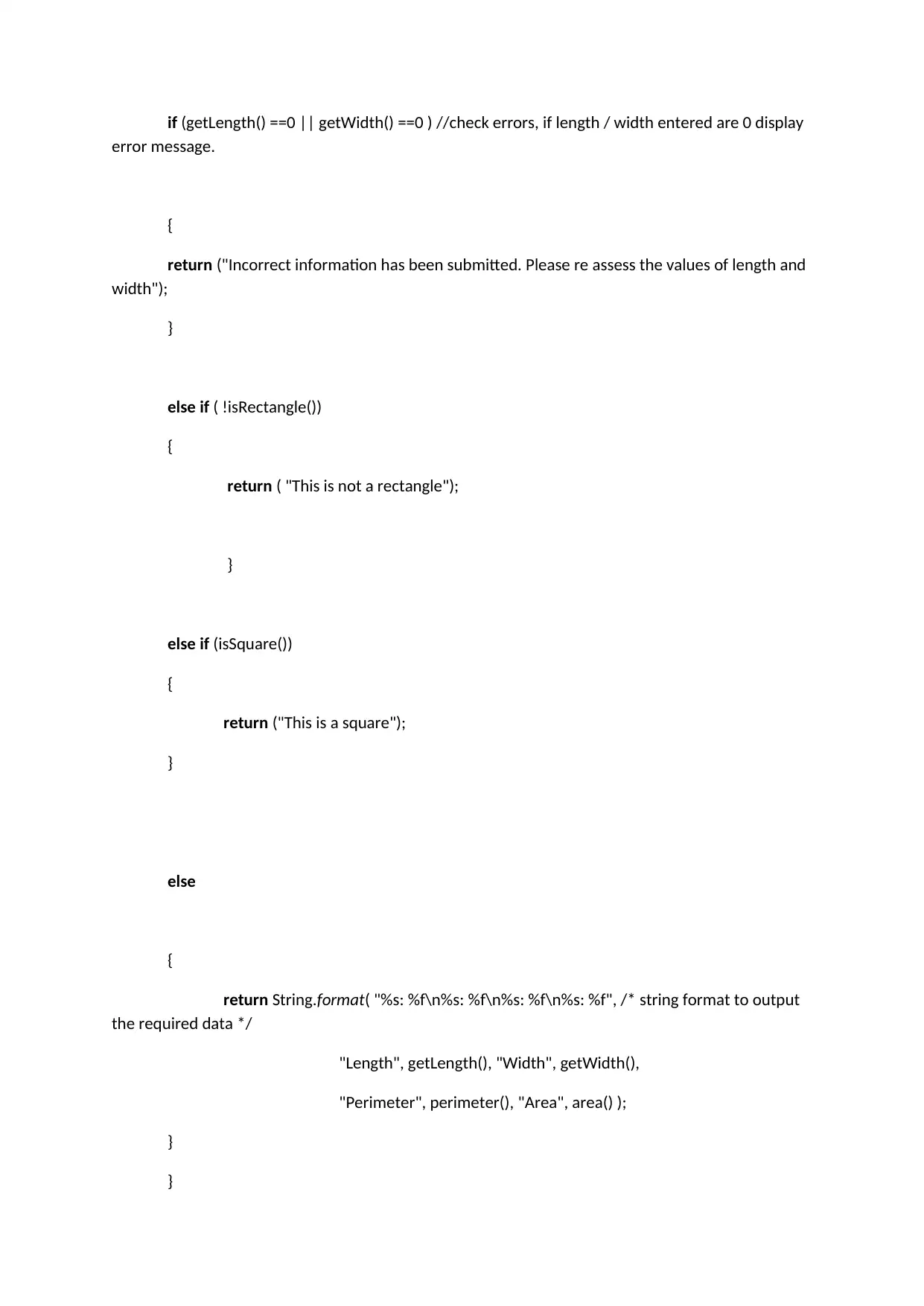
if (getLength() ==0 || getWidth() ==0 ) //check errors, if length / width entered are 0 display
error message.
{
return ("Incorrect information has been submitted. Please re assess the values of length and
width");
}
else if ( !isRectangle())
{
return ( "This is not a rectangle");
}
else if (isSquare())
{
return ("This is a square");
}
else
{
return String.format( "%s: %f\n%s: %f\n%s: %f\n%s: %f", /* string format to output
the required data */
"Length", getLength(), "Width", getWidth(),
"Perimeter", perimeter(), "Area", area() );
}
}
error message.
{
return ("Incorrect information has been submitted. Please re assess the values of length and
width");
}
else if ( !isRectangle())
{
return ( "This is not a rectangle");
}
else if (isSquare())
{
return ("This is a square");
}
else
{
return String.format( "%s: %f\n%s: %f\n%s: %f\n%s: %f", /* string format to output
the required data */
"Length", getLength(), "Width", getWidth(),
"Perimeter", perimeter(), "Area", area() );
}
}
Paraphrase This Document
Need a fresh take? Get an instant paraphrase of this document with our AI Paraphraser

}
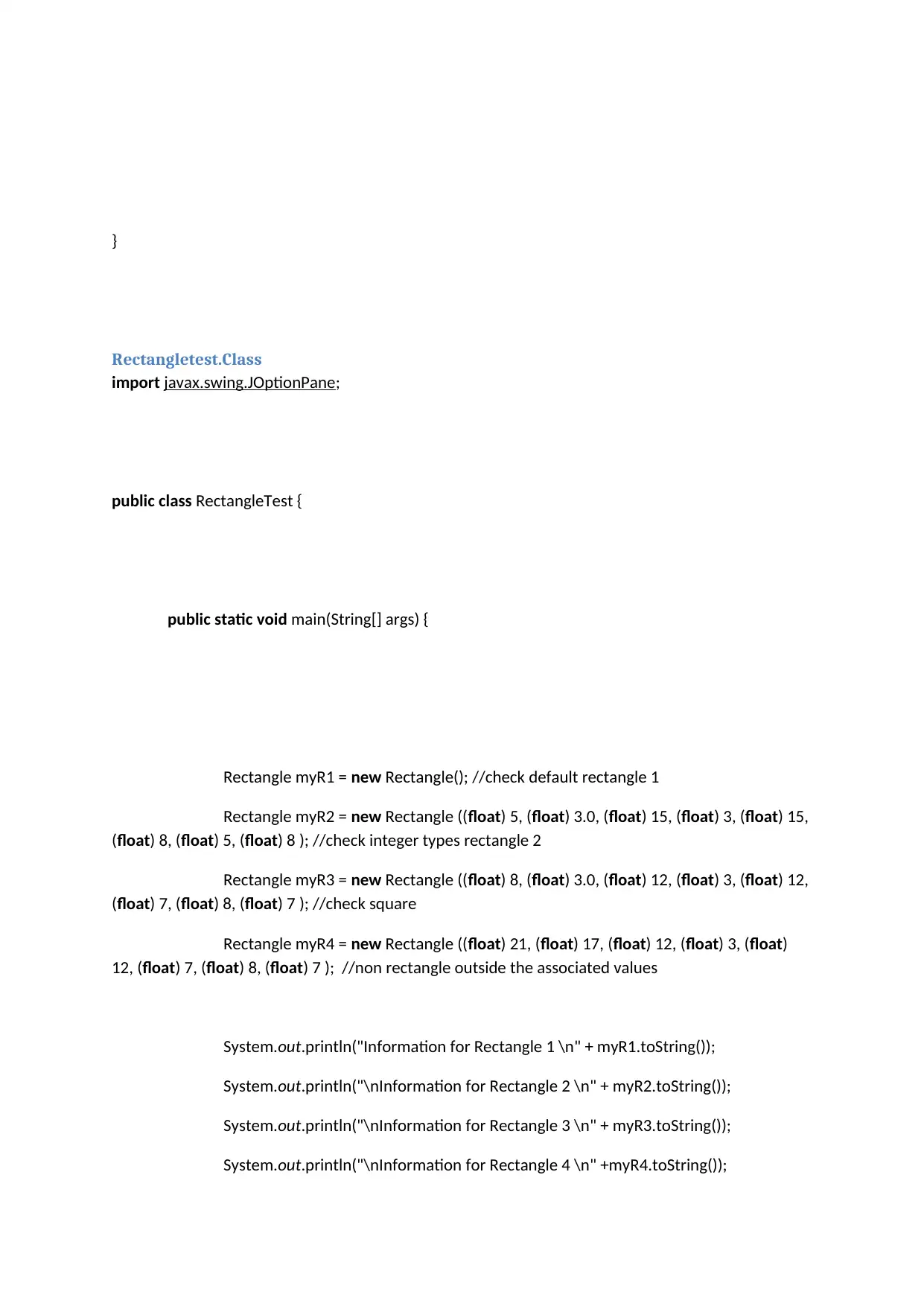
Rectangletest.Class
import javax.swing.JOptionPane;
public class RectangleTest {
public static void main(String[] args) {
Rectangle myR1 = new Rectangle(); //check default rectangle 1
Rectangle myR2 = new Rectangle ((float) 5, (float) 3.0, (float) 15, (float) 3, (float) 15,
(float) 8, (float) 5, (float) 8 ); //check integer types rectangle 2
Rectangle myR3 = new Rectangle ((float) 8, (float) 3.0, (float) 12, (float) 3, (float) 12,
(float) 7, (float) 8, (float) 7 ); //check square
Rectangle myR4 = new Rectangle ((float) 21, (float) 17, (float) 12, (float) 3, (float)
12, (float) 7, (float) 8, (float) 7 ); //non rectangle outside the associated values
System.out.println("Information for Rectangle 1 \n" + myR1.toString());
System.out.println("\nInformation for Rectangle 2 \n" + myR2.toString());
System.out.println("\nInformation for Rectangle 3 \n" + myR3.toString());
System.out.println("\nInformation for Rectangle 4 \n" +myR4.toString());
Rectangletest.Class
import javax.swing.JOptionPane;
public class RectangleTest {
public static void main(String[] args) {
Rectangle myR1 = new Rectangle(); //check default rectangle 1
Rectangle myR2 = new Rectangle ((float) 5, (float) 3.0, (float) 15, (float) 3, (float) 15,
(float) 8, (float) 5, (float) 8 ); //check integer types rectangle 2
Rectangle myR3 = new Rectangle ((float) 8, (float) 3.0, (float) 12, (float) 3, (float) 12,
(float) 7, (float) 8, (float) 7 ); //check square
Rectangle myR4 = new Rectangle ((float) 21, (float) 17, (float) 12, (float) 3, (float)
12, (float) 7, (float) 8, (float) 7 ); //non rectangle outside the associated values
System.out.println("Information for Rectangle 1 \n" + myR1.toString());
System.out.println("\nInformation for Rectangle 2 \n" + myR2.toString());
System.out.println("\nInformation for Rectangle 3 \n" + myR3.toString());
System.out.println("\nInformation for Rectangle 4 \n" +myR4.toString());

}
}
}
⊘ This is a preview!⊘
Do you want full access?
Subscribe today to unlock all pages.

Trusted by 1+ million students worldwide
1 out of 12
Your All-in-One AI-Powered Toolkit for Academic Success.
 +13062052269
info@desklib.com
Available 24*7 on WhatsApp / Email
Unlock your academic potential
Copyright © 2020–2025 A2Z Services. All Rights Reserved. Developed and managed by ZUCOL.