Thomas Jefferson's Role in the Declaration of Independence and Slavery

Verified

Added on  2020/04/13

|3
|434
|65
Discussion Board Post
AI Summary
This discussion analyzes Thomas Jefferson's stance on slavery, examining his role in the Declaration of Independence and its implications for the nascent American nation. Jefferson, though a slave owner, opposed slavery, terming it as a moral depravity and a threat to the nation. The assignment explores his actions, including attempts to ban the slave trade and promote less labor-intensive crops, and his advocacy for gradual emancipation. Despite his efforts, his plans faced criticism. The discussion draws on the historical context, referencing his writings and actions to illustrate the complexity of his views and the challenges in addressing slavery during the founding of the United States. The analysis covers his attempts at emancipation, his political actions to discourage slave labor, and his ultimate failure to fully abolish slavery, thus setting the stage for future conflicts.

Document Page
UNIT:
NAME:
DATE:
tabler-icon-diamond-filled.svg

Paraphrase This Document

Need a fresh take? Get an instant paraphrase of this document with our AI Paraphraser
Document Page
Discussion
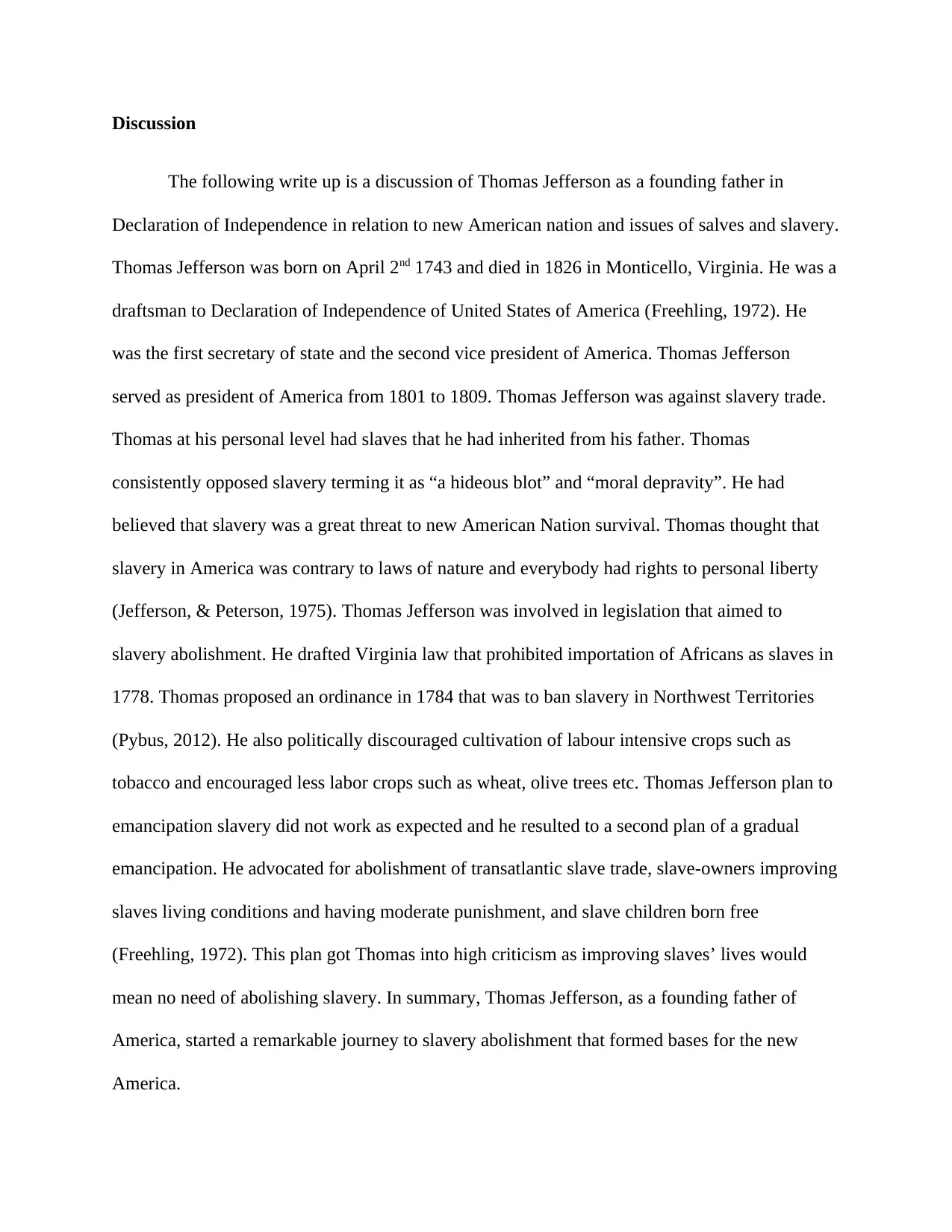
The following write up is a discussion of Thomas Jefferson as a founding father in
Declaration of Independence in relation to new American nation and issues of salves and slavery.
Thomas Jefferson was born on April 2nd 1743 and died in 1826 in Monticello, Virginia. He was a
draftsman to Declaration of Independence of United States of America (Freehling, 1972). He
was the first secretary of state and the second vice president of America. Thomas Jefferson
served as president of America from 1801 to 1809. Thomas Jefferson was against slavery trade.
Thomas at his personal level had slaves that he had inherited from his father. Thomas
consistently opposed slavery terming it as “a hideous blot” and “moral depravity”. He had
believed that slavery was a great threat to new American Nation survival. Thomas thought that
slavery in America was contrary to laws of nature and everybody had rights to personal liberty
(Jefferson, & Peterson, 1975). Thomas Jefferson was involved in legislation that aimed to
slavery abolishment. He drafted Virginia law that prohibited importation of Africans as slaves in
1778. Thomas proposed an ordinance in 1784 that was to ban slavery in Northwest Territories
(Pybus, 2012). He also politically discouraged cultivation of labour intensive crops such as
tobacco and encouraged less labor crops such as wheat, olive trees etc. Thomas Jefferson plan to
emancipation slavery did not work as expected and he resulted to a second plan of a gradual
emancipation. He advocated for abolishment of transatlantic slave trade, slave-owners improving
slaves living conditions and having moderate punishment, and slave children born free
(Freehling, 1972). This plan got Thomas into high criticism as improving slaves’ lives would
mean no need of abolishing slavery. In summary, Thomas Jefferson, as a founding father of
America, started a remarkable journey to slavery abolishment that formed bases for the new
America.
Document Page
References
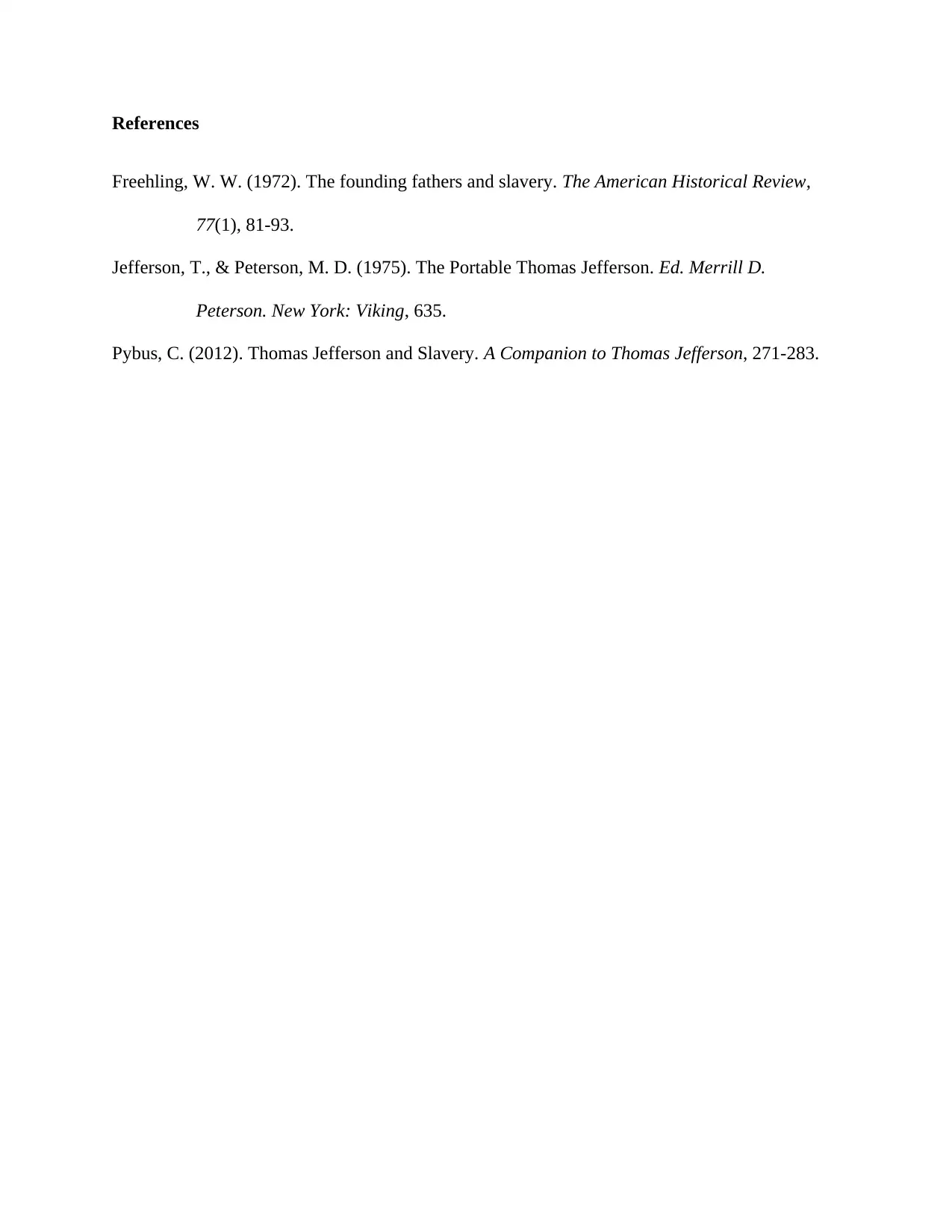
Freehling, W. W. (1972). The founding fathers and slavery. The American Historical Review,
77(1), 81-93.
Jefferson, T., & Peterson, M. D. (1975). The Portable Thomas Jefferson. Ed. Merrill D.
Peterson. New York: Viking, 635.
Pybus, C. (2012). Thomas Jefferson and Slavery. A Companion to Thomas Jefferson, 271-283.
chevron_up_icon
1 out of 3
circle_padding
hide_on_mobile
zoom_out_icon
[object Object]