Designing an Academic Integrity Jenga Game for Further Academic Skills
VerifiedAdded on 2023/06/15
|3
|1262
|254
Creative Assignment
AI Summary
This assignment details the design of an Academic Integrity Jenga game aimed at educating students about academic integrity, plagiarism, and misconduct in an engaging and interactive manner. The game involves students forming teams and answering questions related to academic integrity written on Jenga blocks, with a designated “Professor” providing answers and awarding points. The game emphasizes the importance of academic integrity in universities, highlighting its role in fostering ethical behavior, maintaining institutional credibility, and ensuring the value of degrees. The design process involved skills such as academic research, writing, organization, designing, creativity, and PowerPoint to create a game that is both informative and enjoyable. Sample questions and answers related to academic integrity are also included. Desklib provides students access to past papers and solved assignments.
Instructions for playing the game
BMP3003 Further Academic Skills
An explanation of why academic
integrity at University is so important
Game Design Name
Add Text
References
• Academic integrity are the set essential values which consist of all
aspect and activities performed by a student during their academic
functions. The academic integrity consists of strict guidelines that
help in supporting in the structured learning of academic work
through instilment of values such as honesty, fairness, trust,
respect and responsibility. The concept of academic integrity is
vital for an university as it allows to provide students with the
values of being ethical relative to their work and the university.
• It is curial for university to be consistent and trustworthy in all its
standards relative to the courses as well as assessments. This is
important as it will ensure the community has confidence in the
individual who has graduated from the particular university.
• In addition to this, the individual receiving the degree from the
university will also benefit from academic integrity as they will
be able to feel proud of the high standards they have achieved and
having the knowledge that what they have learned is valuable and
holds credibility in the professional world.
Instructions for the game
The game will require payers (student) to be in equal group along with one “Professor” who will be an
individual with in-depth knowledge of academic misconduct and integrity.
Academic integrity Jenga is a game that will involve the interesting game of Jenga in order to improve players
(Students) knowledge relative to academic plagiarism and integrity along with misconduct.
The objective of the game
The main objective of the game is to focuses upon introducing the concept of academic integrity along with
plagiarism and misconduct in a entertaining manner. This will allow the students to gain vital knowledge relative
to the topic. The questions related to academic integrity will be written on the blocks of Jenga which will make it
interesting as well as interactive.
Rules
Starting the game
The game will be imitate by the “Professor” who will arrange the block of Jegan in a shuffled fashion. The block
of Jenga will contain question related to academic integrity, plagiarism, and academic misconduct. The
“Professor” will be given a task to group teams of players (student) in order top from teams. Each team will have
their own chance to pick a block from the tower of Jenga in order to answer the question written on it. The
“Professor” will hold card with answers relative to the questions on Jenga in the format of alphabetical order of
A, B and C. this will make the game interesting as it will have a quiz format.
Gameplay
The game will begin with one player (student) from the formed teams pulling out a piece of Jenga from the
tower. The player ( student) will read the question out loud to the rest of the teams in order to provide
information. The block will consist of the number which the “ Professor” will link to the answer written on his
cards. If the player (student) is able to answer the question correctly the team will be awarded 10 points. If the
team does not answer they will not be award any points and the question will move on tot he next respective
team for a chance to answer and gain points. The player ( students) have to focus on gaining knowledge as well
as gain highest number of points to win the game. Each team has to also focus upon maintaining the Jenga tower
in order to keep the game continued for as long as possible as it will allow for maximum number of questions to
be answered.
Finishing the game
The game will end only of either all the questions have been answered of if the tower of Jenga collapses.
Academic Jenga
BMP3003 Further Academic Skills
An explanation of why academic
integrity at University is so important
Game Design Name
Add Text
References
• Academic integrity are the set essential values which consist of all
aspect and activities performed by a student during their academic
functions. The academic integrity consists of strict guidelines that
help in supporting in the structured learning of academic work
through instilment of values such as honesty, fairness, trust,
respect and responsibility. The concept of academic integrity is
vital for an university as it allows to provide students with the
values of being ethical relative to their work and the university.
• It is curial for university to be consistent and trustworthy in all its
standards relative to the courses as well as assessments. This is
important as it will ensure the community has confidence in the
individual who has graduated from the particular university.
• In addition to this, the individual receiving the degree from the
university will also benefit from academic integrity as they will
be able to feel proud of the high standards they have achieved and
having the knowledge that what they have learned is valuable and
holds credibility in the professional world.
Instructions for the game
The game will require payers (student) to be in equal group along with one “Professor” who will be an
individual with in-depth knowledge of academic misconduct and integrity.
Academic integrity Jenga is a game that will involve the interesting game of Jenga in order to improve players
(Students) knowledge relative to academic plagiarism and integrity along with misconduct.
The objective of the game
The main objective of the game is to focuses upon introducing the concept of academic integrity along with
plagiarism and misconduct in a entertaining manner. This will allow the students to gain vital knowledge relative
to the topic. The questions related to academic integrity will be written on the blocks of Jenga which will make it
interesting as well as interactive.
Rules
Starting the game
The game will be imitate by the “Professor” who will arrange the block of Jegan in a shuffled fashion. The block
of Jenga will contain question related to academic integrity, plagiarism, and academic misconduct. The
“Professor” will be given a task to group teams of players (student) in order top from teams. Each team will have
their own chance to pick a block from the tower of Jenga in order to answer the question written on it. The
“Professor” will hold card with answers relative to the questions on Jenga in the format of alphabetical order of
A, B and C. this will make the game interesting as it will have a quiz format.
Gameplay
The game will begin with one player (student) from the formed teams pulling out a piece of Jenga from the
tower. The player ( student) will read the question out loud to the rest of the teams in order to provide
information. The block will consist of the number which the “ Professor” will link to the answer written on his
cards. If the player (student) is able to answer the question correctly the team will be awarded 10 points. If the
team does not answer they will not be award any points and the question will move on tot he next respective
team for a chance to answer and gain points. The player ( students) have to focus on gaining knowledge as well
as gain highest number of points to win the game. Each team has to also focus upon maintaining the Jenga tower
in order to keep the game continued for as long as possible as it will allow for maximum number of questions to
be answered.
Finishing the game
The game will end only of either all the questions have been answered of if the tower of Jenga collapses.
Academic Jenga
Paraphrase This Document
Need a fresh take? Get an instant paraphrase of this document with our AI Paraphraser

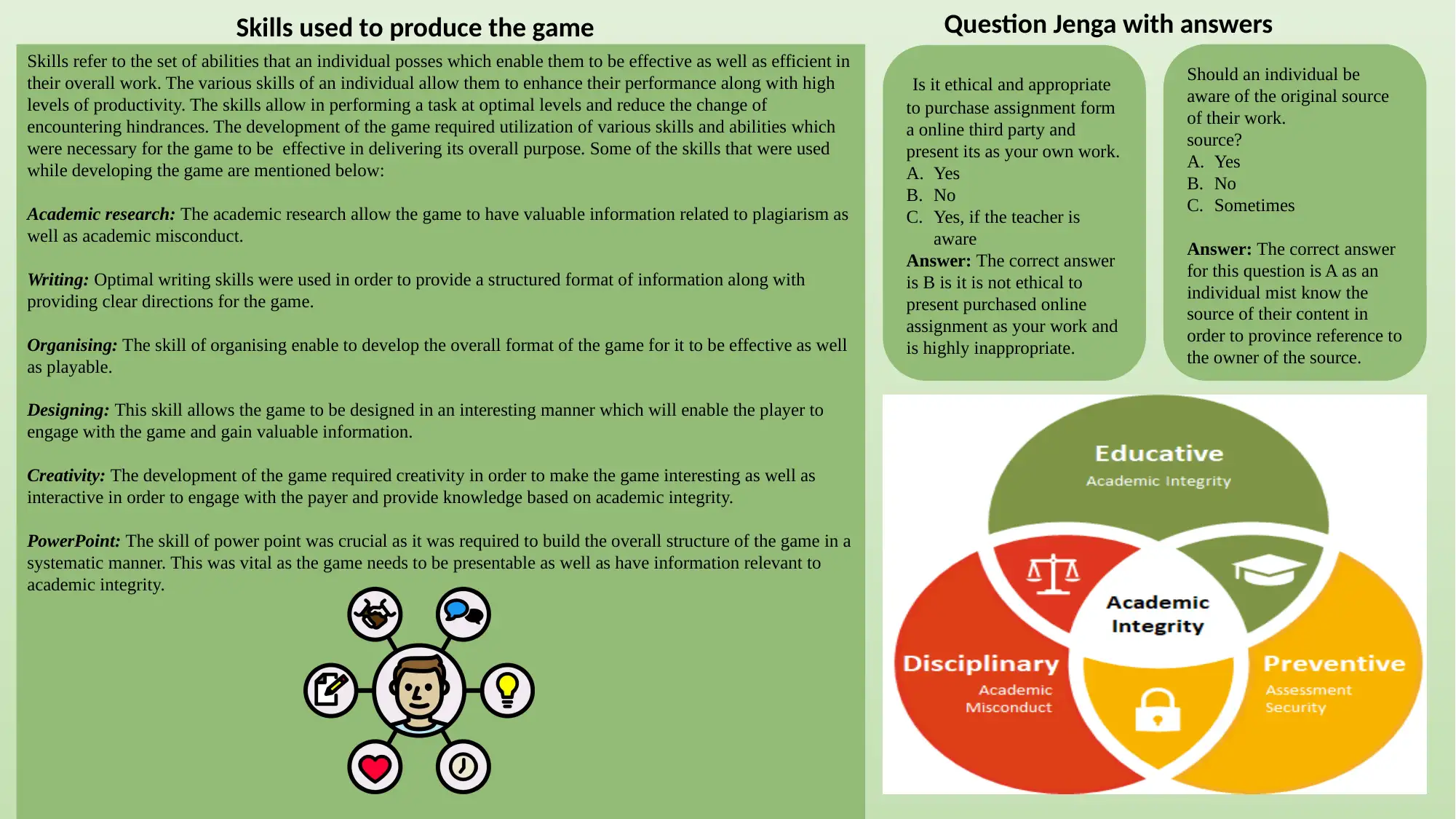
Skills used to produce the game
Skills refer to the set of abilities that an individual posses which enable them to be effective as well as efficient in
their overall work. The various skills of an individual allow them to enhance their performance along with high
levels of productivity. The skills allow in performing a task at optimal levels and reduce the change of
encountering hindrances. The development of the game required utilization of various skills and abilities which
were necessary for the game to be effective in delivering its overall purpose. Some of the skills that were used
while developing the game are mentioned below:
Academic research: The academic research allow the game to have valuable information related to plagiarism as
well as academic misconduct.
Writing: Optimal writing skills were used in order to provide a structured format of information along with
providing clear directions for the game.
Organising: The skill of organising enable to develop the overall format of the game for it to be effective as well
as playable.
Designing: This skill allows the game to be designed in an interesting manner which will enable the player to
engage with the game and gain valuable information.
Creativity: The development of the game required creativity in order to make the game interesting as well as
interactive in order to engage with the payer and provide knowledge based on academic integrity.
PowerPoint: The skill of power point was crucial as it was required to build the overall structure of the game in a
systematic manner. This was vital as the game needs to be presentable as well as have information relevant to
academic integrity.
Question Jenga with answers
Is it ethical and appropriate
to purchase assignment form
a online third party and
present its as your own work.
A. Yes
B. No
C. Yes, if the teacher is
aware
Answer: The correct answer
is B is it is not ethical to
present purchased online
assignment as your work and
is highly inappropriate.
Should an individual be
aware of the original source
of their work.
source?
A. Yes
B. No
C. Sometimes
Answer: The correct answer
for this question is A as an
individual mist know the
source of their content in
order to province reference to
the owner of the source.
Skills refer to the set of abilities that an individual posses which enable them to be effective as well as efficient in
their overall work. The various skills of an individual allow them to enhance their performance along with high
levels of productivity. The skills allow in performing a task at optimal levels and reduce the change of
encountering hindrances. The development of the game required utilization of various skills and abilities which
were necessary for the game to be effective in delivering its overall purpose. Some of the skills that were used
while developing the game are mentioned below:
Academic research: The academic research allow the game to have valuable information related to plagiarism as
well as academic misconduct.
Writing: Optimal writing skills were used in order to provide a structured format of information along with
providing clear directions for the game.
Organising: The skill of organising enable to develop the overall format of the game for it to be effective as well
as playable.
Designing: This skill allows the game to be designed in an interesting manner which will enable the player to
engage with the game and gain valuable information.
Creativity: The development of the game required creativity in order to make the game interesting as well as
interactive in order to engage with the payer and provide knowledge based on academic integrity.
PowerPoint: The skill of power point was crucial as it was required to build the overall structure of the game in a
systematic manner. This was vital as the game needs to be presentable as well as have information relevant to
academic integrity.
Question Jenga with answers
Is it ethical and appropriate
to purchase assignment form
a online third party and
present its as your own work.
A. Yes
B. No
C. Yes, if the teacher is
aware
Answer: The correct answer
is B is it is not ethical to
present purchased online
assignment as your work and
is highly inappropriate.
Should an individual be
aware of the original source
of their work.
source?
A. Yes
B. No
C. Sometimes
Answer: The correct answer
for this question is A as an
individual mist know the
source of their content in
order to province reference to
the owner of the source.

References
• Bretag, T. ed., 2020. A research agenda for academic integrity. Edward Elgar Publishing.
• Chauhan and et. al., 2018. Peer-based interventions on academic integrity: assessing immediate and long term
learning. Journal of Academic Ethics, 16(2). pp.133-149.
• Mahmud, S., Bretag, T. and Foltýnek, T., 2019. Students’ perceptions of plagiarism policy in higher education: A
comparison of the United Kingdom, Czechia, Poland and Romania. Journal of Academic Ethics, 17(3). pp.271-289.
• Sotiriadou and et. al., 2020. The role of authentic assessment to preserve academic integrity and promote skill development
and employability. Studies in Higher Education, 45(11). pp.2132-2148.
• Stoddard, K., 2020. Academic Honesty Quiz.
• Bretag, T. ed., 2020. A research agenda for academic integrity. Edward Elgar Publishing.
• Chauhan and et. al., 2018. Peer-based interventions on academic integrity: assessing immediate and long term
learning. Journal of Academic Ethics, 16(2). pp.133-149.
• Mahmud, S., Bretag, T. and Foltýnek, T., 2019. Students’ perceptions of plagiarism policy in higher education: A
comparison of the United Kingdom, Czechia, Poland and Romania. Journal of Academic Ethics, 17(3). pp.271-289.
• Sotiriadou and et. al., 2020. The role of authentic assessment to preserve academic integrity and promote skill development
and employability. Studies in Higher Education, 45(11). pp.2132-2148.
• Stoddard, K., 2020. Academic Honesty Quiz.
⊘ This is a preview!⊘
Do you want full access?
Subscribe today to unlock all pages.

Trusted by 1+ million students worldwide
1 out of 3
Related Documents
Your All-in-One AI-Powered Toolkit for Academic Success.
+13062052269
info@desklib.com
Available 24*7 on WhatsApp / Email
Unlock your academic potential
Copyright © 2020–2025 A2Z Services. All Rights Reserved. Developed and managed by ZUCOL.