Analyzing Success Factors Impacting Profitability at Jeni's Ice Cream
VerifiedAdded on 2023/06/14
|6
|1409
|273
Case Study
AI Summary
This case study investigates the key success factors that influence the profitability of Jeni's Splendid Ice Cream Company in the USA. It aims to evaluate the strategies employed by the company to differentiate itself from competitors, explore the challenges it faces, and identify mitigation strategies to avoid losses and business-related risks. The research employs a case study approach, analyzing the organization's strategies and culture through questionnaires administered to stakeholders using purposive sampling. Both internal (profit/loss statements, balance sheets, inventory records, sales figures, marketing research) and external secondary data sources (media, trade associations) are utilized to provide a comprehensive understanding of the company's performance and market position.
Running head- RESEARCH ON JENI’S SPLENDID ICE CREAM COMPANY 1.
Research on Jeni’s splendid ice cream company
Name
Institution of Affiliation
Date
Research on Jeni’s splendid ice cream company
Name
Institution of Affiliation
Date
Paraphrase This Document
Need a fresh take? Get an instant paraphrase of this document with our AI Paraphraser

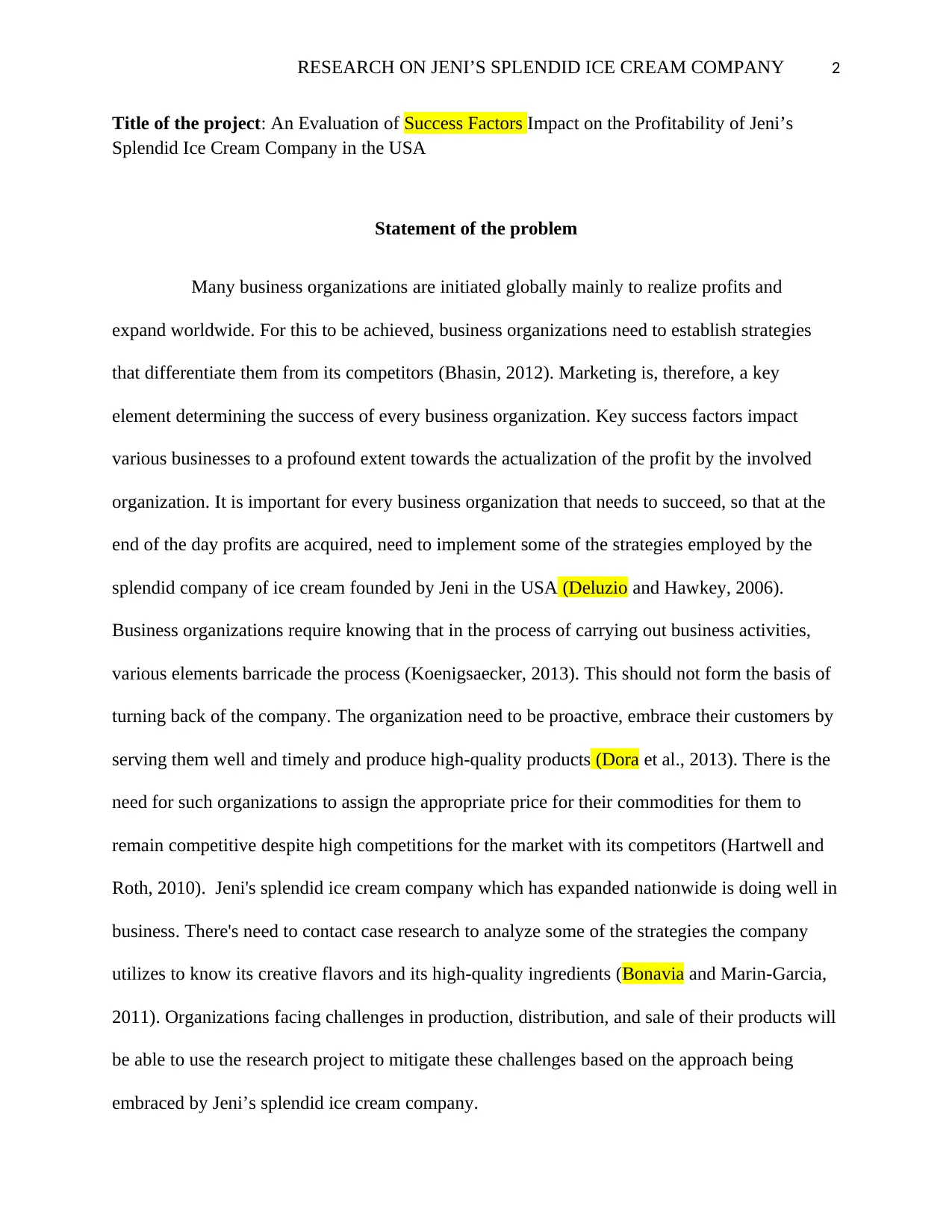
RESEARCH ON JENI’S SPLENDID ICE CREAM COMPANY 2
Title of the project: An Evaluation of Success Factors Impact on the Profitability of Jeni’s
Splendid Ice Cream Company in the USA
Statement of the problem
Many business organizations are initiated globally mainly to realize profits and
expand worldwide. For this to be achieved, business organizations need to establish strategies
that differentiate them from its competitors (Bhasin, 2012). Marketing is, therefore, a key
element determining the success of every business organization. Key success factors impact
various businesses to a profound extent towards the actualization of the profit by the involved
organization. It is important for every business organization that needs to succeed, so that at the
end of the day profits are acquired, need to implement some of the strategies employed by the
splendid company of ice cream founded by Jeni in the USA (Deluzio and Hawkey, 2006).
Business organizations require knowing that in the process of carrying out business activities,
various elements barricade the process (Koenigsaecker, 2013). This should not form the basis of
turning back of the company. The organization need to be proactive, embrace their customers by
serving them well and timely and produce high-quality products (Dora et al., 2013). There is the
need for such organizations to assign the appropriate price for their commodities for them to
remain competitive despite high competitions for the market with its competitors (Hartwell and
Roth, 2010). Jeni's splendid ice cream company which has expanded nationwide is doing well in
business. There's need to contact case research to analyze some of the strategies the company
utilizes to know its creative flavors and its high-quality ingredients (Bonavia and Marin-Garcia,
2011). Organizations facing challenges in production, distribution, and sale of their products will
be able to use the research project to mitigate these challenges based on the approach being
embraced by Jeni’s splendid ice cream company.
Title of the project: An Evaluation of Success Factors Impact on the Profitability of Jeni’s
Splendid Ice Cream Company in the USA
Statement of the problem
Many business organizations are initiated globally mainly to realize profits and
expand worldwide. For this to be achieved, business organizations need to establish strategies
that differentiate them from its competitors (Bhasin, 2012). Marketing is, therefore, a key
element determining the success of every business organization. Key success factors impact
various businesses to a profound extent towards the actualization of the profit by the involved
organization. It is important for every business organization that needs to succeed, so that at the
end of the day profits are acquired, need to implement some of the strategies employed by the
splendid company of ice cream founded by Jeni in the USA (Deluzio and Hawkey, 2006).
Business organizations require knowing that in the process of carrying out business activities,
various elements barricade the process (Koenigsaecker, 2013). This should not form the basis of
turning back of the company. The organization need to be proactive, embrace their customers by
serving them well and timely and produce high-quality products (Dora et al., 2013). There is the
need for such organizations to assign the appropriate price for their commodities for them to
remain competitive despite high competitions for the market with its competitors (Hartwell and
Roth, 2010). Jeni's splendid ice cream company which has expanded nationwide is doing well in
business. There's need to contact case research to analyze some of the strategies the company
utilizes to know its creative flavors and its high-quality ingredients (Bonavia and Marin-Garcia,
2011). Organizations facing challenges in production, distribution, and sale of their products will
be able to use the research project to mitigate these challenges based on the approach being
embraced by Jeni’s splendid ice cream company.

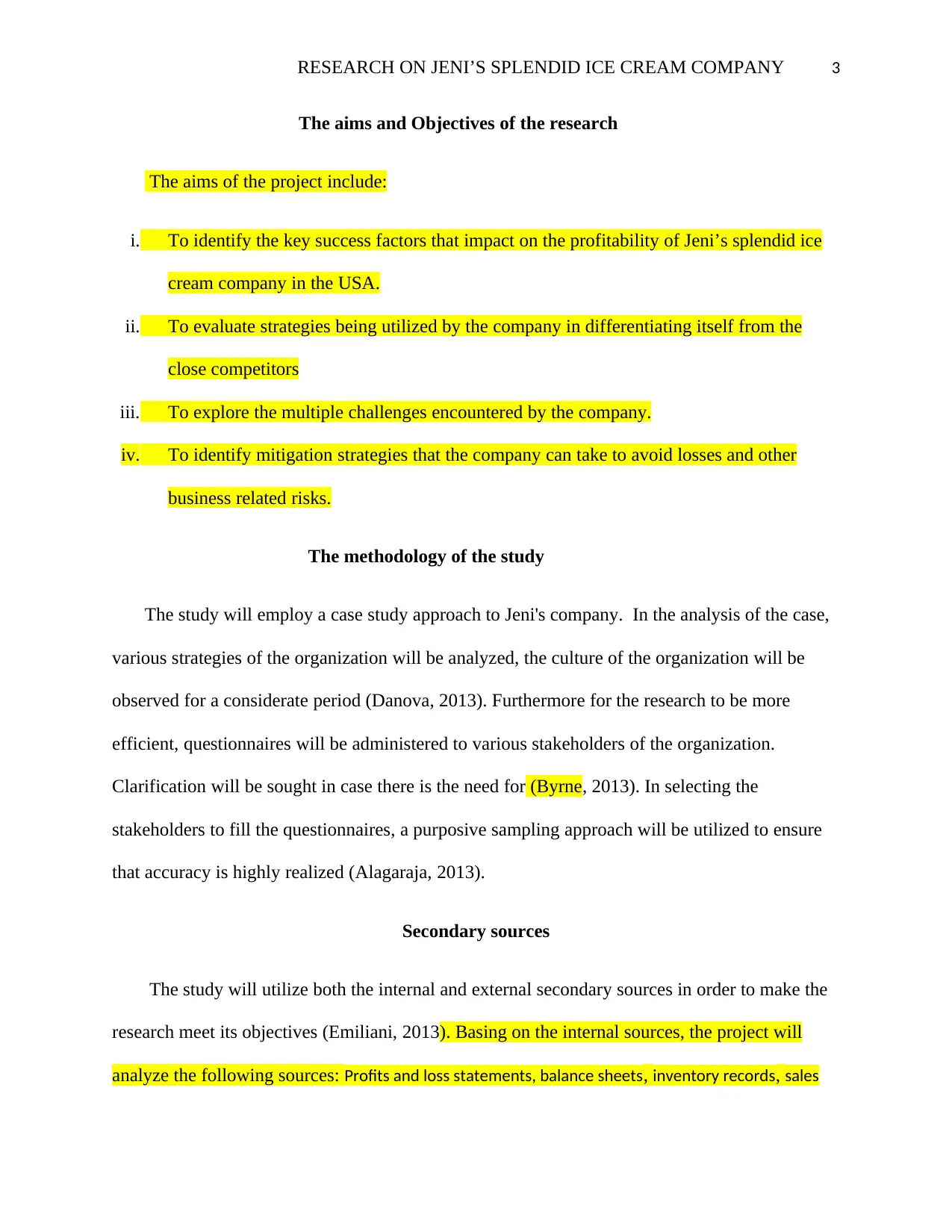
RESEARCH ON JENI’S SPLENDID ICE CREAM COMPANY 3
The aims and Objectives of the research
The aims of the project include:
i. To identify the key success factors that impact on the profitability of Jeni’s splendid ice
cream company in the USA.
ii. To evaluate strategies being utilized by the company in differentiating itself from the
close competitors
iii. To explore the multiple challenges encountered by the company.
iv. To identify mitigation strategies that the company can take to avoid losses and other
business related risks.
The methodology of the study
The study will employ a case study approach to Jeni's company. In the analysis of the case,
various strategies of the organization will be analyzed, the culture of the organization will be
observed for a considerate period (Danova, 2013). Furthermore for the research to be more
efficient, questionnaires will be administered to various stakeholders of the organization.
Clarification will be sought in case there is the need for (Byrne, 2013). In selecting the
stakeholders to fill the questionnaires, a purposive sampling approach will be utilized to ensure
that accuracy is highly realized (Alagaraja, 2013).
Secondary sources
The study will utilize both the internal and external secondary sources in order to make the
research meet its objectives (Emiliani, 2013). Basing on the internal sources, the project will
analyze the following sources: Profits and loss statements, balance sheets, inventory records, sales
The aims and Objectives of the research
The aims of the project include:
i. To identify the key success factors that impact on the profitability of Jeni’s splendid ice
cream company in the USA.
ii. To evaluate strategies being utilized by the company in differentiating itself from the
close competitors
iii. To explore the multiple challenges encountered by the company.
iv. To identify mitigation strategies that the company can take to avoid losses and other
business related risks.
The methodology of the study
The study will employ a case study approach to Jeni's company. In the analysis of the case,
various strategies of the organization will be analyzed, the culture of the organization will be
observed for a considerate period (Danova, 2013). Furthermore for the research to be more
efficient, questionnaires will be administered to various stakeholders of the organization.
Clarification will be sought in case there is the need for (Byrne, 2013). In selecting the
stakeholders to fill the questionnaires, a purposive sampling approach will be utilized to ensure
that accuracy is highly realized (Alagaraja, 2013).
Secondary sources
The study will utilize both the internal and external secondary sources in order to make the
research meet its objectives (Emiliani, 2013). Basing on the internal sources, the project will
analyze the following sources: Profits and loss statements, balance sheets, inventory records, sales
⊘ This is a preview!⊘
Do you want full access?
Subscribe today to unlock all pages.

Trusted by 1+ million students worldwide

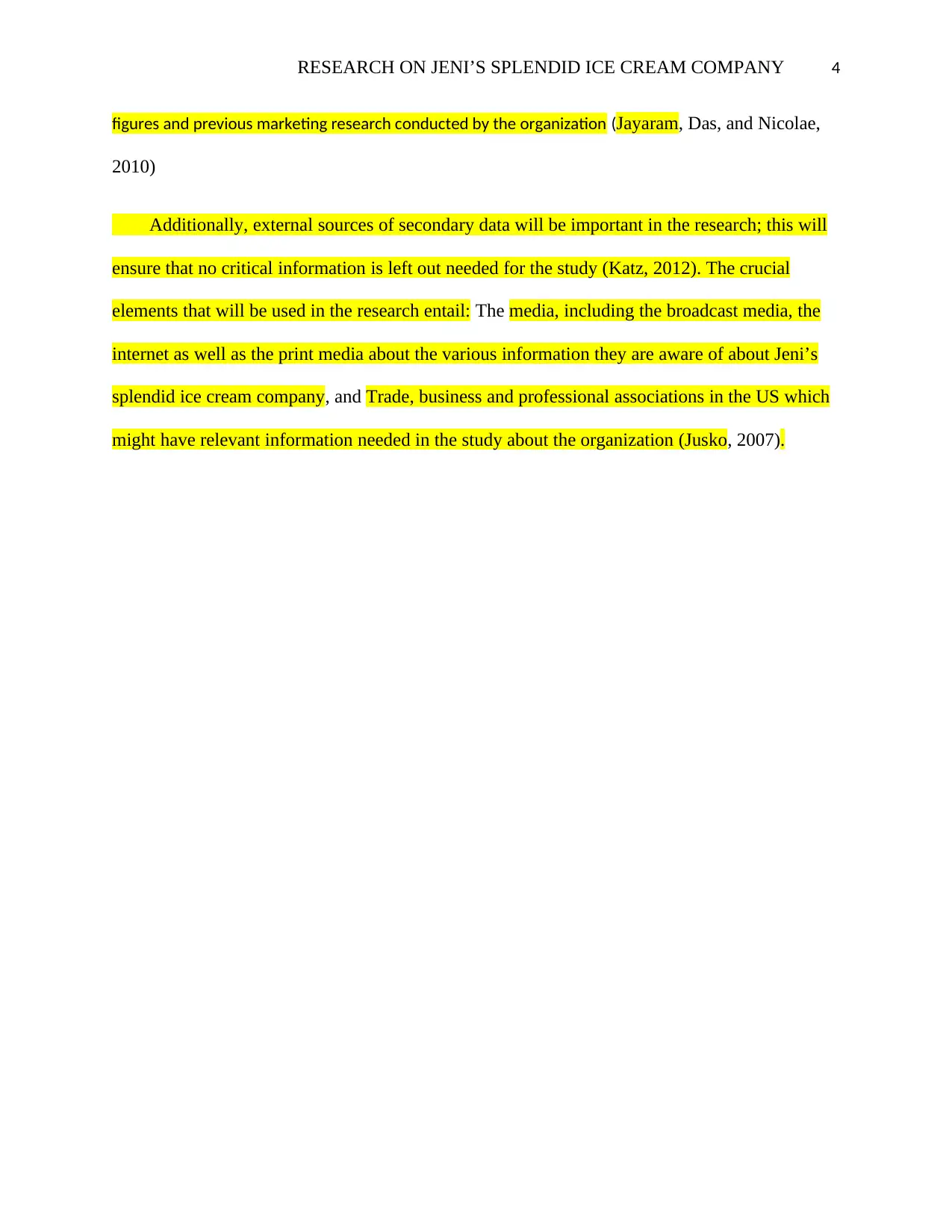
RESEARCH ON JENI’S SPLENDID ICE CREAM COMPANY 4
figures and previous marketing research conducted by the organization (Jayaram, Das, and Nicolae,
2010)
Additionally, external sources of secondary data will be important in the research; this will
ensure that no critical information is left out needed for the study (Katz, 2012). The crucial
elements that will be used in the research entail: The media, including the broadcast media, the
internet as well as the print media about the various information they are aware of about Jeni’s
splendid ice cream company, and Trade, business and professional associations in the US which
might have relevant information needed in the study about the organization (Jusko, 2007).
figures and previous marketing research conducted by the organization (Jayaram, Das, and Nicolae,
2010)
Additionally, external sources of secondary data will be important in the research; this will
ensure that no critical information is left out needed for the study (Katz, 2012). The crucial
elements that will be used in the research entail: The media, including the broadcast media, the
internet as well as the print media about the various information they are aware of about Jeni’s
splendid ice cream company, and Trade, business and professional associations in the US which
might have relevant information needed in the study about the organization (Jusko, 2007).
Paraphrase This Document
Need a fresh take? Get an instant paraphrase of this document with our AI Paraphraser

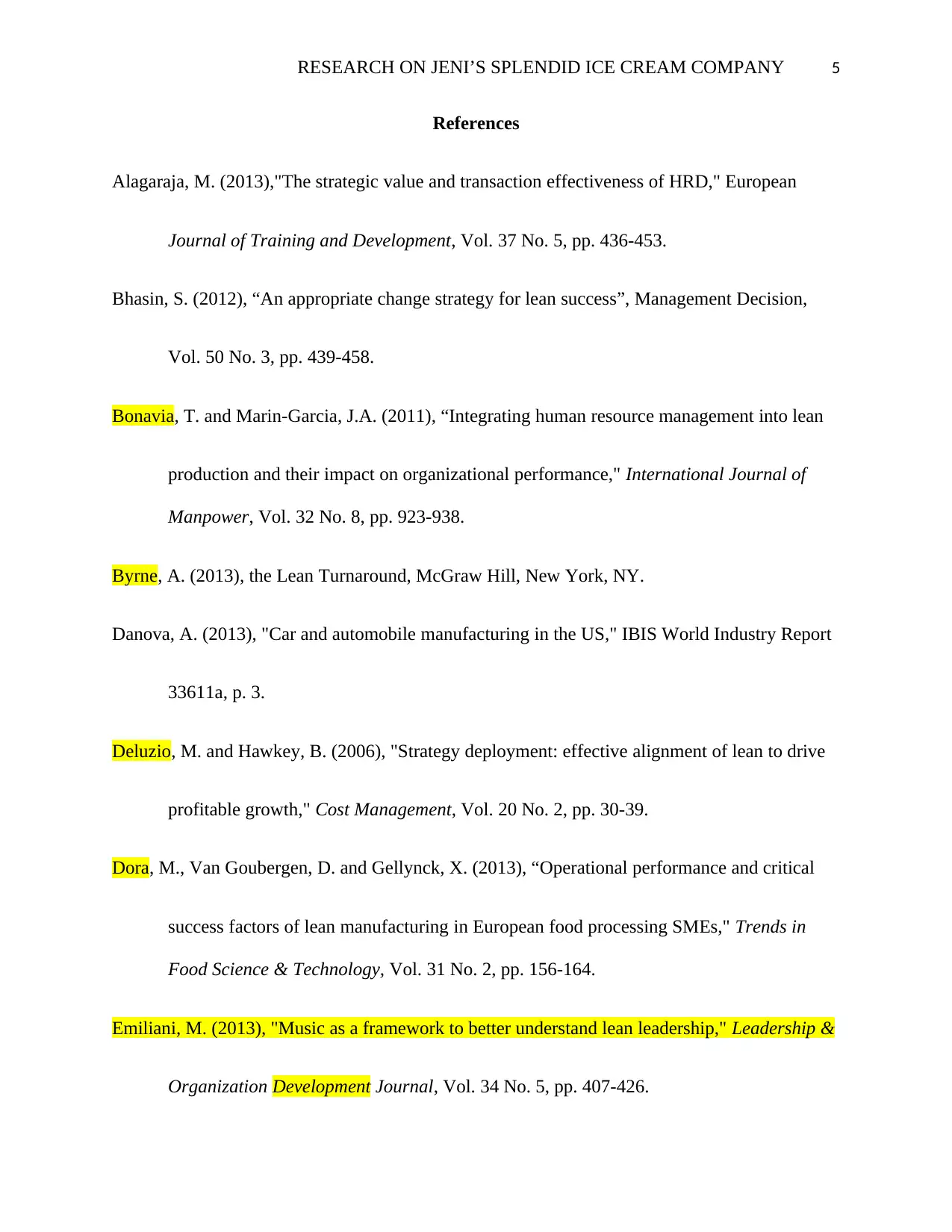
RESEARCH ON JENI’S SPLENDID ICE CREAM COMPANY 5
References
Alagaraja, M. (2013),"The strategic value and transaction effectiveness of HRD," European
Journal of Training and Development, Vol. 37 No. 5, pp. 436-453.
Bhasin, S. (2012), “An appropriate change strategy for lean success”, Management Decision,
Vol. 50 No. 3, pp. 439-458.
Bonavia, T. and Marin-Garcia, J.A. (2011), “Integrating human resource management into lean
production and their impact on organizational performance," International Journal of
Manpower, Vol. 32 No. 8, pp. 923-938.
Byrne, A. (2013), the Lean Turnaround, McGraw Hill, New York, NY.
Danova, A. (2013), "Car and automobile manufacturing in the US," IBIS World Industry Report
33611a, p. 3.
Deluzio, M. and Hawkey, B. (2006), "Strategy deployment: effective alignment of lean to drive
profitable growth," Cost Management, Vol. 20 No. 2, pp. 30-39.
Dora, M., Van Goubergen, D. and Gellynck, X. (2013), “Operational performance and critical
success factors of lean manufacturing in European food processing SMEs," Trends in
Food Science & Technology, Vol. 31 No. 2, pp. 156-164.
Emiliani, M. (2013), "Music as a framework to better understand lean leadership," Leadership &
Organization Development Journal, Vol. 34 No. 5, pp. 407-426.
References
Alagaraja, M. (2013),"The strategic value and transaction effectiveness of HRD," European
Journal of Training and Development, Vol. 37 No. 5, pp. 436-453.
Bhasin, S. (2012), “An appropriate change strategy for lean success”, Management Decision,
Vol. 50 No. 3, pp. 439-458.
Bonavia, T. and Marin-Garcia, J.A. (2011), “Integrating human resource management into lean
production and their impact on organizational performance," International Journal of
Manpower, Vol. 32 No. 8, pp. 923-938.
Byrne, A. (2013), the Lean Turnaround, McGraw Hill, New York, NY.
Danova, A. (2013), "Car and automobile manufacturing in the US," IBIS World Industry Report
33611a, p. 3.
Deluzio, M. and Hawkey, B. (2006), "Strategy deployment: effective alignment of lean to drive
profitable growth," Cost Management, Vol. 20 No. 2, pp. 30-39.
Dora, M., Van Goubergen, D. and Gellynck, X. (2013), “Operational performance and critical
success factors of lean manufacturing in European food processing SMEs," Trends in
Food Science & Technology, Vol. 31 No. 2, pp. 156-164.
Emiliani, M. (2013), "Music as a framework to better understand lean leadership," Leadership &
Organization Development Journal, Vol. 34 No. 5, pp. 407-426.

RESEARCH ON JENI’S SPLENDID ICE CREAM COMPANY 6
Farris, J.A., Van Aken, E.M., Doolen, T.L. and Worley, J. (2008), "Learning from less
successful Kaizen events: a case study," Engineering Management Journal, Vol. 20 No.
3, pp. 10-20.
Fullerton, R.R. and Wempe, W.F. (2009), "Lean manufacturing, non-financial performance
measures and financial performance," International Journal of Operations & Production
Management, Vol. 29 No. 3, pp. 214-240.
Gupta, V., Acharya, P. and Patwardhan, M. (2013), "A strategic and operational approach to
assessing the lean performance in radial tire manufacturing in India," International
Journal of Productivity and Performance Management, Vol. 62 No. 6, pp. 634-651.
Hartwell, J.K., and Roth, G. (2010), “Doing more with less at Ariens: a leadership and
transformation case study," Organization Management Journal, Vol. 7 No. 2, pp. 89-109.
Jayaram, J., Das, A. and Nicolae, M. (2010), "Looking beyond the obvious: unraveling the
Toyota production system," International Journal of Production Economics, Vol. 128
No. 1, pp. 280-291.
Jusko, J. (2007), "Strategic deployment: how to think like Toyota," Industry Week, pp. 34-37.
Katz, J. (2012), "The lean CEO effect," Industry Week, pp. 38-43.
Koenigsaecker, G. (2013), “Leading the lean enterprise transformation," CRC Press Taylor &
Francis Group, Boca Raton, FL.
Farris, J.A., Van Aken, E.M., Doolen, T.L. and Worley, J. (2008), "Learning from less
successful Kaizen events: a case study," Engineering Management Journal, Vol. 20 No.
3, pp. 10-20.
Fullerton, R.R. and Wempe, W.F. (2009), "Lean manufacturing, non-financial performance
measures and financial performance," International Journal of Operations & Production
Management, Vol. 29 No. 3, pp. 214-240.
Gupta, V., Acharya, P. and Patwardhan, M. (2013), "A strategic and operational approach to
assessing the lean performance in radial tire manufacturing in India," International
Journal of Productivity and Performance Management, Vol. 62 No. 6, pp. 634-651.
Hartwell, J.K., and Roth, G. (2010), “Doing more with less at Ariens: a leadership and
transformation case study," Organization Management Journal, Vol. 7 No. 2, pp. 89-109.
Jayaram, J., Das, A. and Nicolae, M. (2010), "Looking beyond the obvious: unraveling the
Toyota production system," International Journal of Production Economics, Vol. 128
No. 1, pp. 280-291.
Jusko, J. (2007), "Strategic deployment: how to think like Toyota," Industry Week, pp. 34-37.
Katz, J. (2012), "The lean CEO effect," Industry Week, pp. 38-43.
Koenigsaecker, G. (2013), “Leading the lean enterprise transformation," CRC Press Taylor &
Francis Group, Boca Raton, FL.
⊘ This is a preview!⊘
Do you want full access?
Subscribe today to unlock all pages.

Trusted by 1+ million students worldwide
1 out of 6
Related Documents
Your All-in-One AI-Powered Toolkit for Academic Success.
+13062052269
info@desklib.com
Available 24*7 on WhatsApp / Email
Unlock your academic potential
Copyright © 2020–2025 A2Z Services. All Rights Reserved. Developed and managed by ZUCOL.