Chapter 2: Job Analysis and its Role in HR Management and Strategy

Verified

Added on  2023/02/02

|26
|1773
|95
Homework Assignment
AI Summary
This document provides a comprehensive overview of job analysis, a fundamental process in Human Resource Management. It defines job analysis as the procedure for determining job duties and the characteristics of individuals needed for those positions. The document details the types of information collected during job analysis, including work activities, human behaviors, machine and equipment usage, performance standards, job context, and human requirements. It explores the uses of job analysis information in recruitment and selection, performance appraisal, compensation, and training. The document outlines the six-step job analysis process, from determining information usage to developing job descriptions and specifications. Various methods for collecting job analysis information are discussed, including interviews, questionnaires, observation, and participant diaries/logs. Quantitative job analysis techniques are introduced, with a focus on writing job descriptions and specifications, including sections like job identification, job summary, responsibilities and duties, and standards of performance. The document concludes with a discussion on competency-based job analysis, highlighting its focus on measurable, observable, behavioral competencies and compares it with traditional job analysis.

Document Page
Chapter 2
Job Analysis
tabler-icon-diamond-filled.svg

Paraphrase This Document

Need a fresh take? Get an instant paraphrase of this document with our AI Paraphraser
Document Page
Job analysis is the procedure which you
determine the duties of the positions and the
characteristics of the people to hire for them. Job
analysis produces information for writing job
descriptions (a list of what the job entails) and a
person specifications (what kind of people to hire
for the job).
Document Page
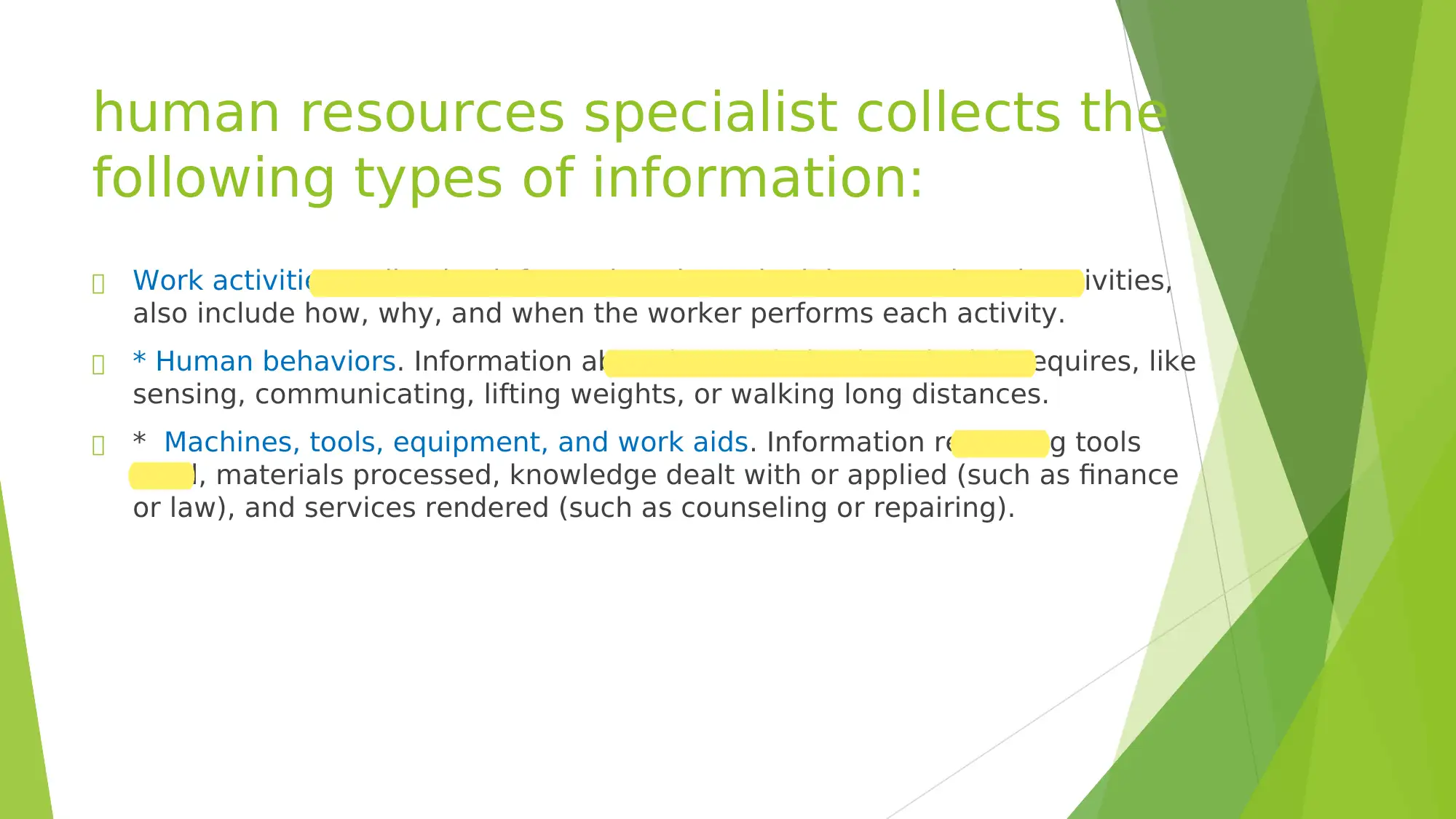
human resources specialist collects the
following types of information:
Work activities. collecting information about the job s actual work activities,
also include how, why, and when the worker performs each activity.
* Human behaviors. Information about human behaviors the job requires, like
sensing, communicating, lifting weights, or walking long distances.
* Machines, tools, equipment, and work aids. Information regarding tools
used, materials processed, knowledge dealt with or applied (such as finance
or law), and services rendered (such as counseling or repairing).
Document Page
* Performance standards. Information about the job s performance standards.
* Job context. Information about such matters as physical working conditions,
work schedule, incentives, and, for instance, the number of people with
whom the employee would normally interact.
* Human requirements. Information such as knowledge or skills (education,
training, work experience) and required personal attributes (aptitudes,
personality, interests).
tabler-icon-diamond-filled.svg

Paraphrase This Document

Need a fresh take? Get an instant paraphrase of this document with our AI Paraphraser
Document Page
Uses of Job Analysis Information :
1. RECRUITMENT AND SELECTION
Information about what duties the job entails and what human characteristics
are required to perform these activities helps managers decide what sort of
people to recruit and hire.
2. PERFORMANCE APPRAISAL
A performance appraisal compares each employee s actual performance with
his or her duties and performance standards. Managers use job analysis to
learn what these duties and standards are.
Document Page
3. COMPENSATION
Compensation (such as salary and bonus) usually depends on the job s
required skill and education level, safety hazards, degree of responsibility,
and so on all factors you assess through job analysis.
4. TRAINING
The job description lists the job s specific duties and requisite skills and
therefore the training that the job requires. Job analysis is important in
helping employers execute their overall strategic plans.
Document Page
Job analysis process:
STEP 1: DECIDE HOW YOU will USE THE INFORMATION:
Some data collection techniques like interviewing the
employee are good for writing job descriptions. Other
techniques, like the position analysis questionnaire
,provide numerical ratings for each job; these can be used
to compare jobs for compensation purposes.
tabler-icon-diamond-filled.svg

Paraphrase This Document

Need a fresh take? Get an instant paraphrase of this document with our AI Paraphraser
Document Page
STEP 2: REVIEW RELEVANT BACKGROUND
INFORMATION SUCH AS ORGANIZATION CHARTS,
PROCESS CHARTS, AND JOB DESCRIPTIONS
The chart should show the title of each position
and, by means of interconnecting lines, who
reports to whom. A process chart provides a more
detailed picture of the work flow.
Document Page
STEP 3: SELECT REPRESENTATIVE POSITIONS
it is usually unnecessary to analyze the jobs of
200 assembly workers when a sample of 10 jobs
will do.
Document Page
STEP 4: ANALYZE THE JOB BY COLLECTING
DATA ON JOB ACTIVITIES, WORKING
CONDITIONS, AND HUMAN TRAITS AND
ABILITIES NEEDED TO PERFORM THE JOB
STEP 5: VERIFY THE JOB ANALYSIS INFORMATION WITH THE
WORKER PERFORMING THE JOB AND WITH HIS IMMEDIATE
SUPERVISOR
This will help confirm that the information is factually
correct and complete and help to gain their acceptance
tabler-icon-diamond-filled.svg

Paraphrase This Document

Need a fresh take? Get an instant paraphrase of this document with our AI Paraphraser
Document Page
STEP 6: DEVELOP A JOB DESCRIPTION AND JOB
SPECIFICATION
The job description describes the activities and
responsibilities of the job, as well as its important
features, such as working conditions. The job
specification summarizes the personal qualities,
traits, skills, and background required for getting
the job done.
Document Page
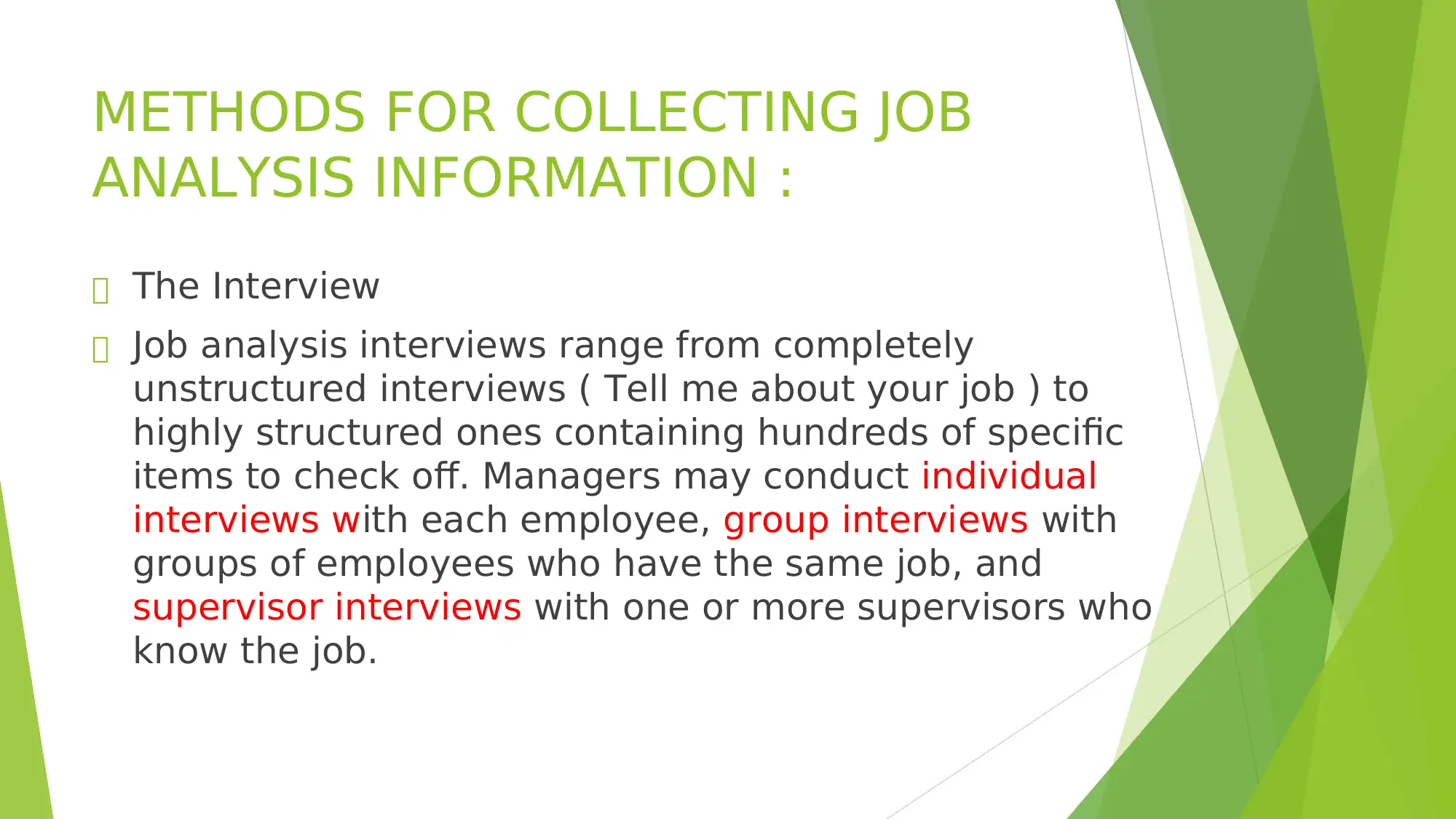
METHODS FOR COLLECTING JOB
ANALYSIS INFORMATION :
The Interview
Job analysis interviews range from completely
unstructured interviews ( Tell me about your job ) to
highly structured ones containing hundreds of specific
items to check off. Managers may conduct individual
interviews with each employee, group interviews with
groups of employees who have the same job, and
supervisor interviews with one or more supervisors who
know the job.
chevron_up_icon
1 out of 26
circle_padding
hide_on_mobile
zoom_out_icon
[object Object]