Subject Guide Assessment 2: Designing Motivating Jobs for Employees
VerifiedAdded on 2023/06/07
|10
|2563
|497
Essay
AI Summary
This essay delves into the critical role of job design in fostering employee motivation and engagement within an organizational context. The assignment explores the thesis that "Motivation through job designing: retain employees with meaningful work," arguing that effective job design is a core function of human resource management. The essay examines various job design techniques, including scientific management, job specialization, job rotation, job enlargement, and job enrichment, and analyzes their impact on employee satisfaction, productivity, and turnover. It incorporates models like the Job Characteristics Model and discusses the importance of elements such as autonomy, feedback, skill variety, task significance, and task identity. The essay concludes by emphasizing the manager's responsibility to design jobs that align with employee skills, preferences, and the organization's goals, ultimately contributing to a more motivated and productive workforce.

Running head: Organizational Behaviour 1
Organizational Behaviour and Management
Organizational Behaviour and Management

Paraphrase This Document
Need a fresh take? Get an instant paraphrase of this document with our AI Paraphraser
Organizational Behaviour 2
There are various reasons why employee motivation is required as it permits management to
meet the objectives of the company. There are various factors that contribute to the motivation of
the employee. The thesis statement for this assignment is “Motivation through job designing:
retain employees with meaningful work”. According to Smith, & Shields, (2013), motivation is
the key to success as it has the ability to increase the productivity of the employees towards
performing the job. With respect to job design, it is considered as the core function of human
resource management which is linked to the specialization of contents, relationships, and
methods of jobs that help in satisfying the requirements related to the organizational along with
the personal needs of the job holder of the employee. The major objective behind designing the
job is to develop job satisfaction to develop quality and to decrease issues of the employee. This
essay will entail various theories to elaborate on the designing of the jobs that engage their
employees to develop motivating jobs.
There are various job techniques of job design that helps managers to create an effective job for
employees of the organization so that they perform in a better way. It has been found that the job
design put a large impact on the employee motivation, job satisfaction, commitment, and
employee turnover. Furthermore, it is required for the manager to understand the importance of
the key elements and their relationship with the process of designing the jobs. The key elements
are the task, motivation, resource allocation and reward systems (Kariru, Odhuno & Kambona,
2013). It has been analyzed that there various models and theories of job designing which should
be considered by the manager of the organization to make a positive environment.
According to Kang, Gatling, & Kim, (2015), scientific management is the theory of the job
design that is proposed a plenty of ideas that have been effective in job design in coming years. It
is required for the manager of the organization to reduce waste by recognizing the most effective
There are various reasons why employee motivation is required as it permits management to
meet the objectives of the company. There are various factors that contribute to the motivation of
the employee. The thesis statement for this assignment is “Motivation through job designing:
retain employees with meaningful work”. According to Smith, & Shields, (2013), motivation is
the key to success as it has the ability to increase the productivity of the employees towards
performing the job. With respect to job design, it is considered as the core function of human
resource management which is linked to the specialization of contents, relationships, and
methods of jobs that help in satisfying the requirements related to the organizational along with
the personal needs of the job holder of the employee. The major objective behind designing the
job is to develop job satisfaction to develop quality and to decrease issues of the employee. This
essay will entail various theories to elaborate on the designing of the jobs that engage their
employees to develop motivating jobs.
There are various job techniques of job design that helps managers to create an effective job for
employees of the organization so that they perform in a better way. It has been found that the job
design put a large impact on the employee motivation, job satisfaction, commitment, and
employee turnover. Furthermore, it is required for the manager to understand the importance of
the key elements and their relationship with the process of designing the jobs. The key elements
are the task, motivation, resource allocation and reward systems (Kariru, Odhuno & Kambona,
2013). It has been analyzed that there various models and theories of job designing which should
be considered by the manager of the organization to make a positive environment.
According to Kang, Gatling, & Kim, (2015), scientific management is the theory of the job
design that is proposed a plenty of ideas that have been effective in job design in coming years. It
is required for the manager of the organization to reduce waste by recognizing the most effective
Organizational Behaviour 3
method to develop the job. By taking help of the time-motion studies, it has been analyzed that
the management of the company could decide how much time is required for each task. The
manager should plan how to develop the plan so that the task could be completed in an efficient
manner. it was apparent that the role of the standardized job performance methods keeps huge
importance in scientific management techniques. Each job in the organization should be planned
accordingly and would be paid in order to perform specifically.
Moreover, job specialization is another theory of designing the job that covers the breaking down
into their easiest elements and allocating them to employees so that each employee of the
organization could perform in a better way. It has been analyzed that the breaking the jobs into
the easiest elements and creating them repetitive eliminate the skill needed off the job and
reduces the cost of staffing. In against of job specialization, Zopiatis, Constanti & Theocharous,
(2014), argued that in the context of the motivation perspective, these kind of jobs are becoming
boring due to repetitive tasks because after some time every time wants some challenging tasks
or something different from their routine tasks. Repetitive tasks can give negative outcomes like
absenteeism. Along with that, it has been analyzed that the job specialization is ineffective in
many cases because changing environments is required in the management where employees
require changing their approach as per the demands of the situation.
Along with that, it has been found that job rotation is another theory of job designing which can
be considered by the manager. It is necessary for the manager of the organization to focus on job
rotation in case of having series of routine jobs that cannot be enriched, that employees might be
shifted from one job to another for the purpose of providing various kinds of knowledge so as to
reduce the monotony. For instance, if the company has four kinds of jobs and four workers, in
method to develop the job. By taking help of the time-motion studies, it has been analyzed that
the management of the company could decide how much time is required for each task. The
manager should plan how to develop the plan so that the task could be completed in an efficient
manner. it was apparent that the role of the standardized job performance methods keeps huge
importance in scientific management techniques. Each job in the organization should be planned
accordingly and would be paid in order to perform specifically.
Moreover, job specialization is another theory of designing the job that covers the breaking down
into their easiest elements and allocating them to employees so that each employee of the
organization could perform in a better way. It has been analyzed that the breaking the jobs into
the easiest elements and creating them repetitive eliminate the skill needed off the job and
reduces the cost of staffing. In against of job specialization, Zopiatis, Constanti & Theocharous,
(2014), argued that in the context of the motivation perspective, these kind of jobs are becoming
boring due to repetitive tasks because after some time every time wants some challenging tasks
or something different from their routine tasks. Repetitive tasks can give negative outcomes like
absenteeism. Along with that, it has been analyzed that the job specialization is ineffective in
many cases because changing environments is required in the management where employees
require changing their approach as per the demands of the situation.
Along with that, it has been found that job rotation is another theory of job designing which can
be considered by the manager. It is necessary for the manager of the organization to focus on job
rotation in case of having series of routine jobs that cannot be enriched, that employees might be
shifted from one job to another for the purpose of providing various kinds of knowledge so as to
reduce the monotony. For instance, if the company has four kinds of jobs and four workers, in
⊘ This is a preview!⊘
Do you want full access?
Subscribe today to unlock all pages.

Trusted by 1+ million students worldwide
Organizational Behaviour 4
such case, it is needed for the manager to rotate these jobs over a planned period of time. The
image of the mentioned example is given below:
Job rotation is the technique that increases the knowledge of the job area and gives the chance to
each employee to get the experience of a different kind of work experience. It brings change to
the working environment that helps in gaining knowledge regarding new tasks. It has been
evaluated that this kind of activity can be considered as an effectual training method as a worker
rotated by a range of linked jobs needs a huge set of job skills, which is encouraging in itself. It
is an effective technique that can spread the motivation environment within the organization.
Along with that, it is referred as an effective process for employees to attain new kind of skills
because when employee moves from their position to another position they are cross-trained to
perform various tasks, thus amplifying the flexibility of the managers to allocate employee
varied tasks of the organization when required. Moreover, job rotation can be referred to as the
technique of transferring knowledge between departments. Job rotation has benefits as well as
such case, it is needed for the manager to rotate these jobs over a planned period of time. The
image of the mentioned example is given below:
Job rotation is the technique that increases the knowledge of the job area and gives the chance to
each employee to get the experience of a different kind of work experience. It brings change to
the working environment that helps in gaining knowledge regarding new tasks. It has been
evaluated that this kind of activity can be considered as an effectual training method as a worker
rotated by a range of linked jobs needs a huge set of job skills, which is encouraging in itself. It
is an effective technique that can spread the motivation environment within the organization.
Along with that, it is referred as an effective process for employees to attain new kind of skills
because when employee moves from their position to another position they are cross-trained to
perform various tasks, thus amplifying the flexibility of the managers to allocate employee
varied tasks of the organization when required. Moreover, job rotation can be referred to as the
technique of transferring knowledge between departments. Job rotation has benefits as well as
Paraphrase This Document
Need a fresh take? Get an instant paraphrase of this document with our AI Paraphraser
Organizational Behaviour 5
eliminating the boredom of employee and relying on the features of jobs under which employee
is performing.
It has been argued by Pierce & Aguinis, (2013), that job enlargement is another technique of the
job designing technique that expands the tasks performed by employees to add more range of
variety. By providing different kinds of the job to worker to be performed, an organization can
reduce the boredom of an employee and can use the human resource in more effective manner.
Duffield, Baldwin, Roche, & Wise, (2014), elaborated that the job enlargement has comparable
advantages as job revolution because it can include education employees a number of tasks. It
has been indicated by the research that when jobs are enlarged, the view of employees towards
themselves changed into the capability of performing a huge range of a set of tasks. It has been
evaluated that the job enlargement is related to the job satisfaction and upper level of quality
customer services that enhance the opportunities for catching mistakes. Meanwhile, the
consequences of job amplification may rely on the kind of enlargement. For instance, job
enlargement entailing the addition of tasks that are quite simple in nature but they have some
negative consequences on the satisfaction of the employee with the job that resulted in fewer
errors which are being caught.
There is another technique which can be evaluated by the manager at the time of designing the
job which is job redesign technique that permits workers more control over on their way of
performing the tasks (Smith & Shields, 2013). It has been found that many companies using job
enrichment as alternatives to job specialization which reduce employee turnover amplify the
productivity and eliminated the absence (Duffield, Baldwin, Roche & Wise, 2014). It allows
employees of the organization to think as per their capability which can be helpful for the
eliminating the boredom of employee and relying on the features of jobs under which employee
is performing.
It has been argued by Pierce & Aguinis, (2013), that job enlargement is another technique of the
job designing technique that expands the tasks performed by employees to add more range of
variety. By providing different kinds of the job to worker to be performed, an organization can
reduce the boredom of an employee and can use the human resource in more effective manner.
Duffield, Baldwin, Roche, & Wise, (2014), elaborated that the job enlargement has comparable
advantages as job revolution because it can include education employees a number of tasks. It
has been indicated by the research that when jobs are enlarged, the view of employees towards
themselves changed into the capability of performing a huge range of a set of tasks. It has been
evaluated that the job enlargement is related to the job satisfaction and upper level of quality
customer services that enhance the opportunities for catching mistakes. Meanwhile, the
consequences of job amplification may rely on the kind of enlargement. For instance, job
enlargement entailing the addition of tasks that are quite simple in nature but they have some
negative consequences on the satisfaction of the employee with the job that resulted in fewer
errors which are being caught.
There is another technique which can be evaluated by the manager at the time of designing the
job which is job redesign technique that permits workers more control over on their way of
performing the tasks (Smith & Shields, 2013). It has been found that many companies using job
enrichment as alternatives to job specialization which reduce employee turnover amplify the
productivity and eliminated the absence (Duffield, Baldwin, Roche & Wise, 2014). It allows
employees of the organization to think as per their capability which can be helpful for the
Organizational Behaviour 6
organization to reduce the unnecessary tasks, in taking shortcuts and amplifying the on the whole
presentation. Simultaneously, there is proof that the technique of job enrichment may bring
unhappiness among a number of employees. It has been found that the expectations of the
employees increased due to amplify of more responsibilities and if management does not able to
fulfill them, it will become the reason of frustration to them. (Tschopp, Grote & Gerber, 2014).
It is required for the manager of the organization at the time of job design to understand that the
concept of job enrichment is not made for everyone as the perception of every employee is
different.
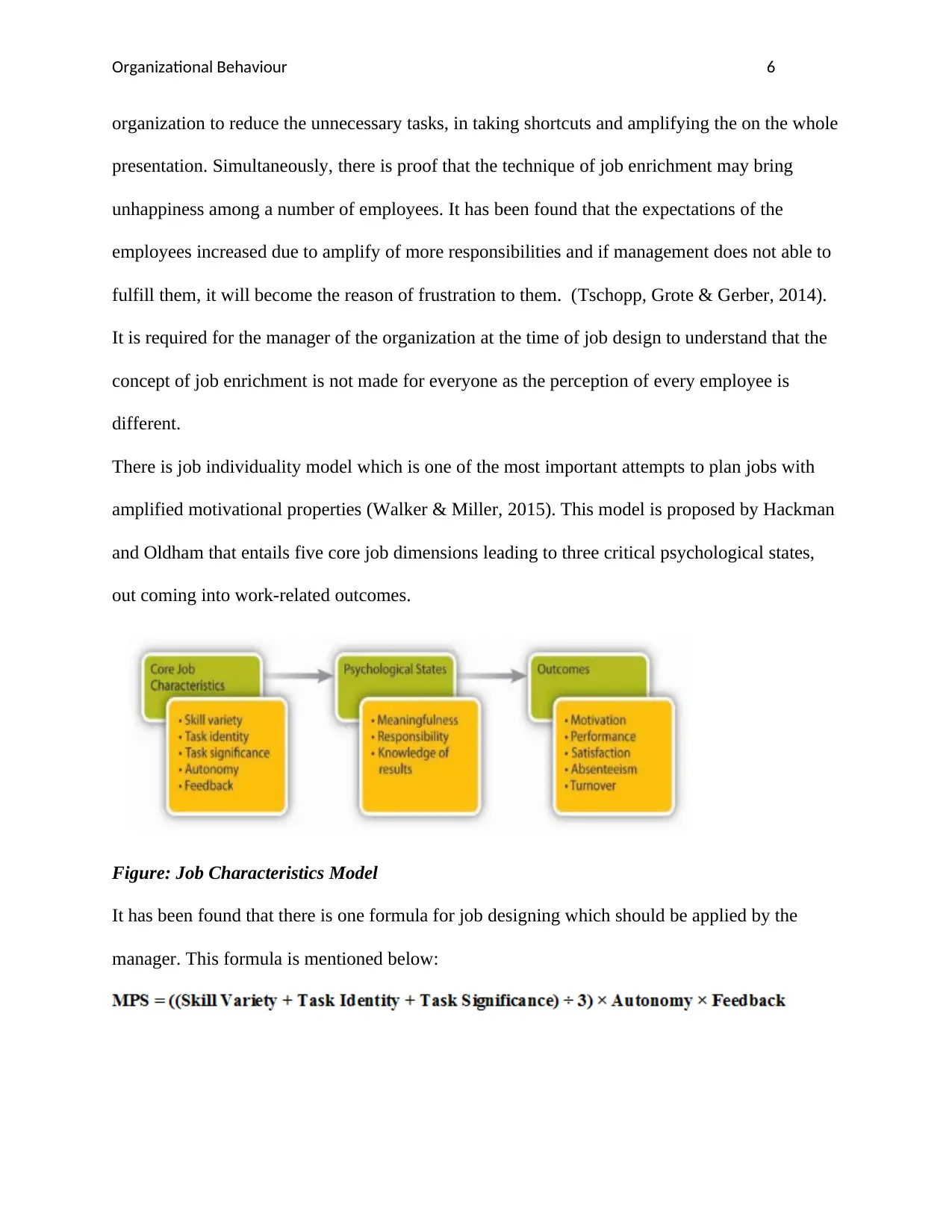
There is job individuality model which is one of the most important attempts to plan jobs with
amplified motivational properties (Walker & Miller, 2015). This model is proposed by Hackman
and Oldham that entails five core job dimensions leading to three critical psychological states,
out coming into work-related outcomes.
Figure: Job Characteristics Model
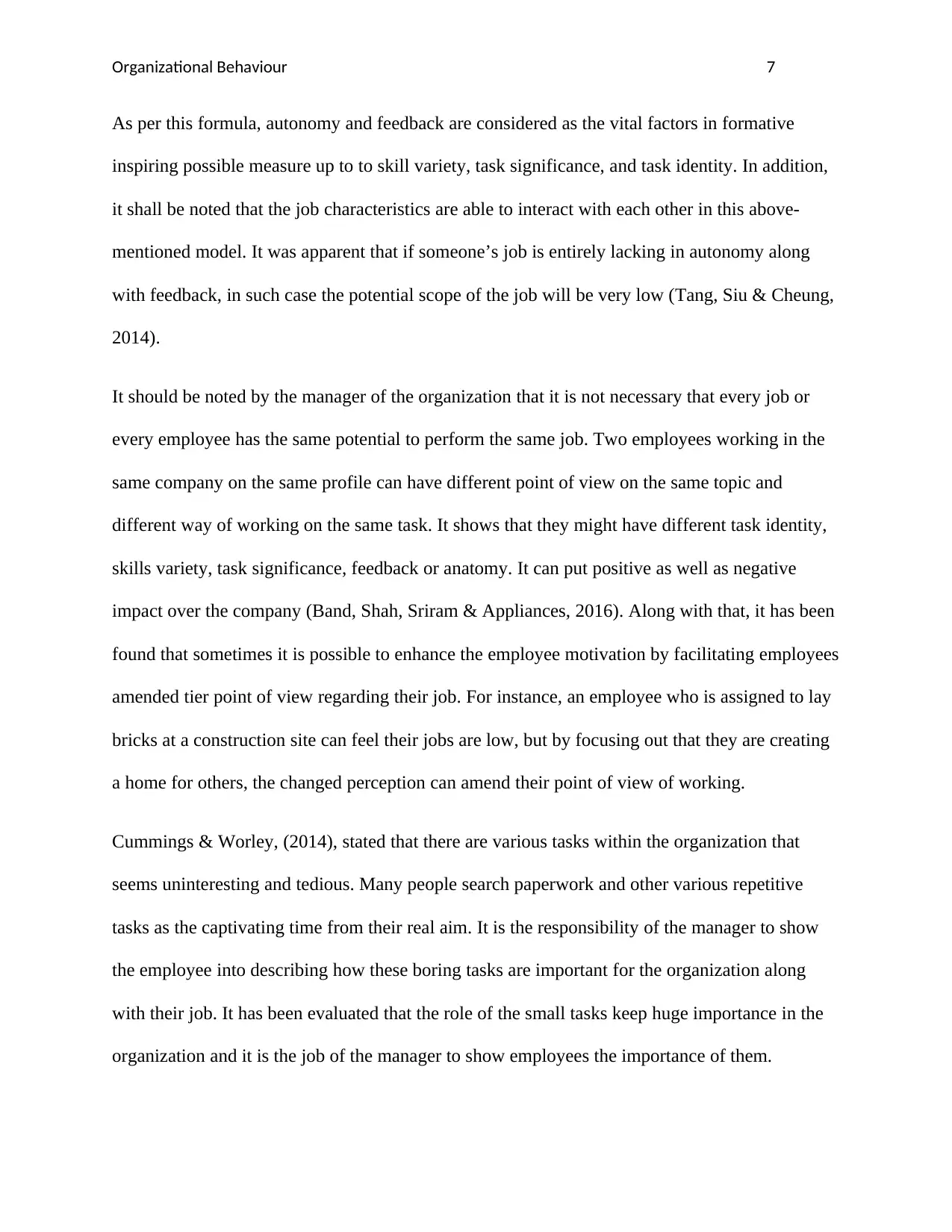
It has been found that there is one formula for job designing which should be applied by the
manager. This formula is mentioned below:
organization to reduce the unnecessary tasks, in taking shortcuts and amplifying the on the whole
presentation. Simultaneously, there is proof that the technique of job enrichment may bring
unhappiness among a number of employees. It has been found that the expectations of the
employees increased due to amplify of more responsibilities and if management does not able to
fulfill them, it will become the reason of frustration to them. (Tschopp, Grote & Gerber, 2014).
It is required for the manager of the organization at the time of job design to understand that the
concept of job enrichment is not made for everyone as the perception of every employee is
different.
There is job individuality model which is one of the most important attempts to plan jobs with
amplified motivational properties (Walker & Miller, 2015). This model is proposed by Hackman
and Oldham that entails five core job dimensions leading to three critical psychological states,
out coming into work-related outcomes.
Figure: Job Characteristics Model
It has been found that there is one formula for job designing which should be applied by the
manager. This formula is mentioned below:
⊘ This is a preview!⊘
Do you want full access?
Subscribe today to unlock all pages.
Trusted by 1+ million students worldwide
Organizational Behaviour 7
As per this formula, autonomy and feedback are considered as the vital factors in formative
inspiring possible measure up to to skill variety, task significance, and task identity. In addition,
it shall be noted that the job characteristics are able to interact with each other in this above-
mentioned model. It was apparent that if someone’s job is entirely lacking in autonomy along
with feedback, in such case the potential scope of the job will be very low (Tang, Siu & Cheung,
2014).
It should be noted by the manager of the organization that it is not necessary that every job or
every employee has the same potential to perform the same job. Two employees working in the
same company on the same profile can have different point of view on the same topic and
different way of working on the same task. It shows that they might have different task identity,
skills variety, task significance, feedback or anatomy. It can put positive as well as negative
impact over the company (Band, Shah, Sriram & Appliances, 2016). Along with that, it has been
found that sometimes it is possible to enhance the employee motivation by facilitating employees
amended tier point of view regarding their job. For instance, an employee who is assigned to lay
bricks at a construction site can feel their jobs are low, but by focusing out that they are creating
a home for others, the changed perception can amend their point of view of working.
Cummings & Worley, (2014), stated that there are various tasks within the organization that
seems uninteresting and tedious. Many people search paperwork and other various repetitive
tasks as the captivating time from their real aim. It is the responsibility of the manager to show
the employee into describing how these boring tasks are important for the organization along
with their job. It has been evaluated that the role of the small tasks keep huge importance in the
organization and it is the job of the manager to show employees the importance of them.
As per this formula, autonomy and feedback are considered as the vital factors in formative
inspiring possible measure up to to skill variety, task significance, and task identity. In addition,
it shall be noted that the job characteristics are able to interact with each other in this above-
mentioned model. It was apparent that if someone’s job is entirely lacking in autonomy along
with feedback, in such case the potential scope of the job will be very low (Tang, Siu & Cheung,
2014).
It should be noted by the manager of the organization that it is not necessary that every job or
every employee has the same potential to perform the same job. Two employees working in the
same company on the same profile can have different point of view on the same topic and
different way of working on the same task. It shows that they might have different task identity,
skills variety, task significance, feedback or anatomy. It can put positive as well as negative
impact over the company (Band, Shah, Sriram & Appliances, 2016). Along with that, it has been
found that sometimes it is possible to enhance the employee motivation by facilitating employees
amended tier point of view regarding their job. For instance, an employee who is assigned to lay
bricks at a construction site can feel their jobs are low, but by focusing out that they are creating
a home for others, the changed perception can amend their point of view of working.
Cummings & Worley, (2014), stated that there are various tasks within the organization that
seems uninteresting and tedious. Many people search paperwork and other various repetitive
tasks as the captivating time from their real aim. It is the responsibility of the manager to show
the employee into describing how these boring tasks are important for the organization along
with their job. It has been evaluated that the role of the small tasks keep huge importance in the
organization and it is the job of the manager to show employees the importance of them.
Paraphrase This Document
Need a fresh take? Get an instant paraphrase of this document with our AI Paraphraser
Organizational Behaviour 8
From the above discussion, it can be concluded that the role of the job design keeps huge
importance in the organization. It is the responsibility of the manager to design the job after
evaluating the skills of the employees because it is not possible that everyone has the same
caliber to perform the task (Danford, 2013). There are various job theories or techniques have
been described in order to bring better understanding of the thesis statement.
The discussion has been made on the job enrichment, job enlargement and job rotation in this
essay which is helpful in taking a decision in the context of designing the job. It has been found
that the motivational working environment can enrich the productivity of the employees that can
contribute to increasing the revenues of the company. Along with that, it has been evaluated that
the job design can help employees of the organization in reducing the unnecessary tasks, in
taking shortcuts and amplifying the overall performance.
From the above discussion, it can be concluded that the role of the job design keeps huge
importance in the organization. It is the responsibility of the manager to design the job after
evaluating the skills of the employees because it is not possible that everyone has the same
caliber to perform the task (Danford, 2013). There are various job theories or techniques have
been described in order to bring better understanding of the thesis statement.
The discussion has been made on the job enrichment, job enlargement and job rotation in this
essay which is helpful in taking a decision in the context of designing the job. It has been found
that the motivational working environment can enrich the productivity of the employees that can
contribute to increasing the revenues of the company. Along with that, it has been evaluated that
the job design can help employees of the organization in reducing the unnecessary tasks, in
taking shortcuts and amplifying the overall performance.
Organizational Behaviour 9
References
Band, G., Shah, N. V., Sriram, R., & Appliances, E. (2016). Herzberg Two Factor Theory among
the Management Faculty in Nagpur City. In International Conference on Management
and Information Systems September (Vol. 23, p. 24).
Cummings, T. G., & Worley, C. G. (2014). Organization development and change. Cengage
learning.
Danford, A. (2013). Japanese management techniques and British workers. Routledge.
Duffield, C., Baldwin, R., Roche, M., & Wise, S. (2014). Job enrichment: creating meaningful
career development opportunities for nurses. Journal of nursing management, 22(6), 697-
706.
Kang, H. J., Gatling, A., & Kim, J. (2015). The impact of supervisory support on organisational
commitment, career satisfaction, and turnover intention for hospitality frontline
employees. Journal of Human Resources in Hospitality & Tourism, 14(1), 68-89.
Kariru, A. N., Odhuno, E., & Kambona, O. O. (2013). Career path determinants of Eco-tourism
and Hospitality Management university graduates. African Journal of Hospitality,
Tourism and Leisure. 2 (4).
Pierce, J. R., & Aguinis, H. (2013). The too-much-of-a-good-thing effect in
management. Journal of Management, 39(2), 313-338.
References
Band, G., Shah, N. V., Sriram, R., & Appliances, E. (2016). Herzberg Two Factor Theory among
the Management Faculty in Nagpur City. In International Conference on Management
and Information Systems September (Vol. 23, p. 24).
Cummings, T. G., & Worley, C. G. (2014). Organization development and change. Cengage
learning.
Danford, A. (2013). Japanese management techniques and British workers. Routledge.
Duffield, C., Baldwin, R., Roche, M., & Wise, S. (2014). Job enrichment: creating meaningful
career development opportunities for nurses. Journal of nursing management, 22(6), 697-
706.
Kang, H. J., Gatling, A., & Kim, J. (2015). The impact of supervisory support on organisational
commitment, career satisfaction, and turnover intention for hospitality frontline
employees. Journal of Human Resources in Hospitality & Tourism, 14(1), 68-89.
Kariru, A. N., Odhuno, E., & Kambona, O. O. (2013). Career path determinants of Eco-tourism
and Hospitality Management university graduates. African Journal of Hospitality,
Tourism and Leisure. 2 (4).
Pierce, J. R., & Aguinis, H. (2013). The too-much-of-a-good-thing effect in
management. Journal of Management, 39(2), 313-338.
⊘ This is a preview!⊘
Do you want full access?
Subscribe today to unlock all pages.
Trusted by 1+ million students worldwide
Organizational Behaviour 10
Smith, D. B., & Shields, J. (2013). Factors related to social service workers' job satisfaction:
Revisiting Herzberg's motivation to work. Administration in Social Work, 37(2), 189-
198.
Tang, S. W., Siu, O. L., & Cheung, F. (2014). A study of work–family enrichment among
Chinese employees: The mediating role between work support and job
satisfaction. Applied Psychology, 63(1), 130-150.
Tschopp, C., Grote, G., & Gerber, M. (2014). How career orientation shapes the job satisfaction–
turnover intention link. Journal of Organisational Behavior. 35(2). 151-171.
Walker, J. R., & Miller, J. E. (2015). Supervision in the Hospitality Industry. (8th). New York:
Wiley.
Zopiatis, A., Constanti, P., &Theocharous, A. L. (2014). Job involvement, commitment,
satisfaction, and turnover: Evidence from hotel employees in Cyprus. Tourism
Management, 41, 129-140.
Smith, D. B., & Shields, J. (2013). Factors related to social service workers' job satisfaction:
Revisiting Herzberg's motivation to work. Administration in Social Work, 37(2), 189-
198.
Tang, S. W., Siu, O. L., & Cheung, F. (2014). A study of work–family enrichment among
Chinese employees: The mediating role between work support and job
satisfaction. Applied Psychology, 63(1), 130-150.
Tschopp, C., Grote, G., & Gerber, M. (2014). How career orientation shapes the job satisfaction–
turnover intention link. Journal of Organisational Behavior. 35(2). 151-171.
Walker, J. R., & Miller, J. E. (2015). Supervision in the Hospitality Industry. (8th). New York:
Wiley.
Zopiatis, A., Constanti, P., &Theocharous, A. L. (2014). Job involvement, commitment,
satisfaction, and turnover: Evidence from hotel employees in Cyprus. Tourism
Management, 41, 129-140.

1 out of 10


Related Documents


Your All-in-One AI-Powered Toolkit for Academic Success.
+13062052269
info@desklib.com
Available 24*7 on WhatsApp / Email
![[object Object]](/_next/static/media/star-bottom.7253800d.svg)
Unlock your academic potential
Copyright © 2020–2026 A2Z Services. All Rights Reserved. Developed and managed by ZUCOL.