Business Strategy Analysis: John Lewis's Macro and Internal Factors
VerifiedAdded on 2020/10/22
|14
|4366
|290
Report
AI Summary
This report provides a comprehensive business strategy analysis of John Lewis, a prominent UK department store chain. The analysis begins with an introduction to business strategy and its importance, followed by an examination of John Lewis's macro-environment using PESTLE analysis, considering political, economic, social, technological, environmental, and legal factors. The report then delves into the internal environment and capabilities of John Lewis using SWOT and VRIO models, evaluating its strengths, weaknesses, opportunities, and threats, as well as its resources and capabilities. Furthermore, the report applies Porter's Five Forces model to assess the competitive forces within John Lewis's market sector. Finally, the report interprets and devises strategic planning for John Lewis, culminating in a strategic management plan and concluding remarks. The analysis covers various aspects of the business, including market position, competitive advantages, and potential challenges, providing a holistic view of John Lewis's strategic approach.
Business Strategy

Paraphrase This Document
Need a fresh take? Get an instant paraphrase of this document with our AI Paraphraser
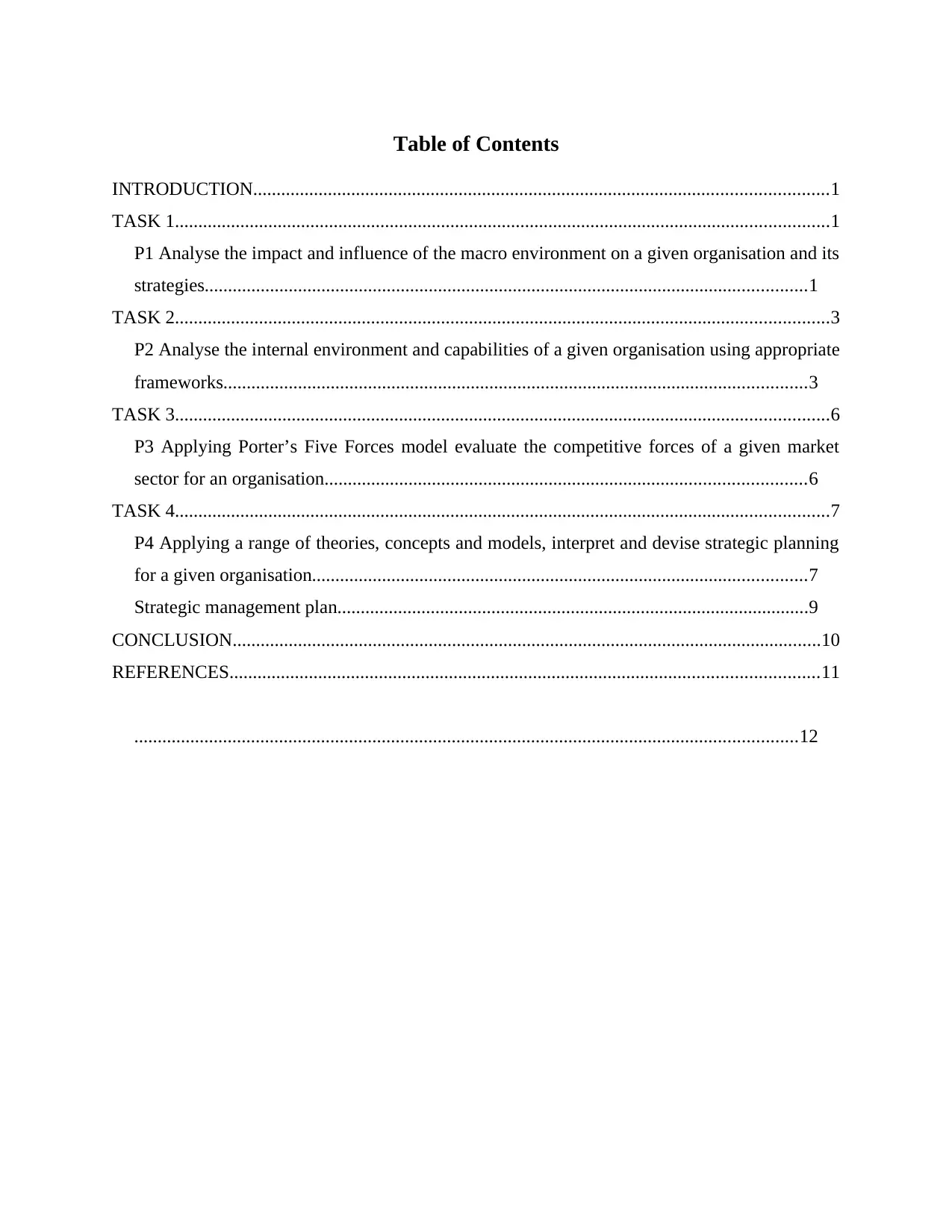
Table of Contents
INTRODUCTION...........................................................................................................................1
TASK 1............................................................................................................................................1
P1 Analyse the impact and influence of the macro environment on a given organisation and its
strategies.................................................................................................................................1
TASK 2............................................................................................................................................3
P2 Analyse the internal environment and capabilities of a given organisation using appropriate
frameworks.............................................................................................................................3
TASK 3............................................................................................................................................6
P3 Applying Porter’s Five Forces model evaluate the competitive forces of a given market
sector for an organisation.......................................................................................................6
TASK 4............................................................................................................................................7
P4 Applying a range of theories, concepts and models, interpret and devise strategic planning
for a given organisation..........................................................................................................7
Strategic management plan.....................................................................................................9
CONCLUSION..............................................................................................................................10
REFERENCES..............................................................................................................................11
..............................................................................................................................................12
INTRODUCTION...........................................................................................................................1
TASK 1............................................................................................................................................1
P1 Analyse the impact and influence of the macro environment on a given organisation and its
strategies.................................................................................................................................1
TASK 2............................................................................................................................................3
P2 Analyse the internal environment and capabilities of a given organisation using appropriate
frameworks.............................................................................................................................3
TASK 3............................................................................................................................................6
P3 Applying Porter’s Five Forces model evaluate the competitive forces of a given market
sector for an organisation.......................................................................................................6
TASK 4............................................................................................................................................7
P4 Applying a range of theories, concepts and models, interpret and devise strategic planning
for a given organisation..........................................................................................................7
Strategic management plan.....................................................................................................9
CONCLUSION..............................................................................................................................10
REFERENCES..............................................................................................................................11
..............................................................................................................................................12
INTRODUCTION
Business strategy refer as the company's working plan in order to achieving its vision,
mission, objectives, competing successfully and gaining financial performance in the business
model. Business strategy can be defined as to understand the course of activity and set of
decisions that will help company in reaching with desired goals and targets. It is the aggregation
of competitive activity and move that business use for gaining attention of large number of
customers, increasing performance, compete success and achievement of goals and objectives
(Amran and et. al., 2016). This strategy will assist in outlining how business can carry out work
in order to achieving and reaching with desired outcomes. It is also called as set of decisions and
course of action in order to assist an entrepreneur for accomplishing specific objective of the
firm. The report is based on John Lewis which is a chan of high end department stores that is
regulating in the United Kingdom. They offer variety of products and services to their customers
in order to satisfy their demand and needs in better manner. Along with this, the main motive of
this assignment is to analyse impact of macro environment on an organisation and its strategies.
Also need to analyse the internal environment and capabilities of given company using
appropriate framework.
TASK 1
P1 Analyse the impact and influence of the macro environment on a given organisation and its
strategies
PESTLE analysis is referring as that method and technique of macro environmental
factors which can be used in environmental scanning components of strategic management. It
can be helpful in evaluating and monitoring various factors which directly effect on business
performance and its productivity. Along with this, it is used by company manager of John Lewis
when new business has begun to start and enter in the international market place. PESTLE
analysis are described as under:
Political factors – It is related with opportunities and pressure which are brought by
political factors and its impact on policies of government on business operations and its
activities. John Lewis is entering in rising market in which UK is the part of the European Union.
It can be analysed that there are various competitors in Europe who can enter into the United
Kingdom market without any limitation (Barberá and et. al., 2012). In this, UK government or
1
Business strategy refer as the company's working plan in order to achieving its vision,
mission, objectives, competing successfully and gaining financial performance in the business
model. Business strategy can be defined as to understand the course of activity and set of
decisions that will help company in reaching with desired goals and targets. It is the aggregation
of competitive activity and move that business use for gaining attention of large number of
customers, increasing performance, compete success and achievement of goals and objectives
(Amran and et. al., 2016). This strategy will assist in outlining how business can carry out work
in order to achieving and reaching with desired outcomes. It is also called as set of decisions and
course of action in order to assist an entrepreneur for accomplishing specific objective of the
firm. The report is based on John Lewis which is a chan of high end department stores that is
regulating in the United Kingdom. They offer variety of products and services to their customers
in order to satisfy their demand and needs in better manner. Along with this, the main motive of
this assignment is to analyse impact of macro environment on an organisation and its strategies.
Also need to analyse the internal environment and capabilities of given company using
appropriate framework.
TASK 1
P1 Analyse the impact and influence of the macro environment on a given organisation and its
strategies
PESTLE analysis is referring as that method and technique of macro environmental
factors which can be used in environmental scanning components of strategic management. It
can be helpful in evaluating and monitoring various factors which directly effect on business
performance and its productivity. Along with this, it is used by company manager of John Lewis
when new business has begun to start and enter in the international market place. PESTLE
analysis are described as under:
Political factors – It is related with opportunities and pressure which are brought by
political factors and its impact on policies of government on business operations and its
activities. John Lewis is entering in rising market in which UK is the part of the European Union.
It can be analysed that there are various competitors in Europe who can enter into the United
Kingdom market without any limitation (Barberá and et. al., 2012). In this, UK government or
1
⊘ This is a preview!⊘
Do you want full access?
Subscribe today to unlock all pages.

Trusted by 1+ million students worldwide
authority are decided to decrease the corporation and association tax from 30% to 28% which
assist John Lewis to enhancing their profitability in the future time period.
Economic factor – The macro environmental includes inflation rate, saving rate, foreign
exchange rate and economic cycle which determine the combination of needs and demand in an
economy. It is mainly associated with economic structure, policies and its impact on business.
During the recession, John Lewis required to stay afloat for business competing in the large
market place (Bharadwaj and et. al., 2013). With the impact of recession, prices of tariff, plans
rise that is not affordable for an individual. John Lewis need to move with market and develop
investment and make efforts to do better performance.
Social factors – It is that factors which directly impact on business operations and
functions. It is required for an organisation is to analyse latest trends and fashion through which
they can attract large number of customers. Consumer shifting priorities and lifestyle correspond
to opportunities for the business concern. John Lewis should introduce more fashionable and
branded product to gain attention of consumers.
Technological factor – It is necessary for an organisation to adopt new and updated
technology which help them in developing demanding products in order to fulfil customer’s
needs. They manage their work through internet where they are sale online goods at reasonable
rate which attract domestic as well as international customers. They use different promotional
channels through which company can easily analyse their users’ needs such as Facebook,
YouTube, Instagram and social media
Environmental factor – In this, the company is renewable sources of resources which
can be used in manufacturing such as cotton and wool that must be environmental friendly. The
major threat s occurs are legal penalty for livestock related to safety and health. It directly effect
on business operations so they required to maintain their wastage and recover this in better
manner (Blackburn, Hart and Wainwright, 2013).
Legal factor – The, norms, regulations and legislation that can impact manner of
performing business is considered as legal factors. This can be tax regulations, consumer
protection and many more. Labour laws are a huge pain for retailers who has to maintain least
cost to stay competitive. John Lewis have had various tussles with legislation over labour related
problems. So, it has to deal with its fair share of legal problems in past.
2
assist John Lewis to enhancing their profitability in the future time period.
Economic factor – The macro environmental includes inflation rate, saving rate, foreign
exchange rate and economic cycle which determine the combination of needs and demand in an
economy. It is mainly associated with economic structure, policies and its impact on business.
During the recession, John Lewis required to stay afloat for business competing in the large
market place (Bharadwaj and et. al., 2013). With the impact of recession, prices of tariff, plans
rise that is not affordable for an individual. John Lewis need to move with market and develop
investment and make efforts to do better performance.
Social factors – It is that factors which directly impact on business operations and
functions. It is required for an organisation is to analyse latest trends and fashion through which
they can attract large number of customers. Consumer shifting priorities and lifestyle correspond
to opportunities for the business concern. John Lewis should introduce more fashionable and
branded product to gain attention of consumers.
Technological factor – It is necessary for an organisation to adopt new and updated
technology which help them in developing demanding products in order to fulfil customer’s
needs. They manage their work through internet where they are sale online goods at reasonable
rate which attract domestic as well as international customers. They use different promotional
channels through which company can easily analyse their users’ needs such as Facebook,
YouTube, Instagram and social media
Environmental factor – In this, the company is renewable sources of resources which
can be used in manufacturing such as cotton and wool that must be environmental friendly. The
major threat s occurs are legal penalty for livestock related to safety and health. It directly effect
on business operations so they required to maintain their wastage and recover this in better
manner (Blackburn, Hart and Wainwright, 2013).
Legal factor – The, norms, regulations and legislation that can impact manner of
performing business is considered as legal factors. This can be tax regulations, consumer
protection and many more. Labour laws are a huge pain for retailers who has to maintain least
cost to stay competitive. John Lewis have had various tussles with legislation over labour related
problems. So, it has to deal with its fair share of legal problems in past.
2
Paraphrase This Document
Need a fresh take? Get an instant paraphrase of this document with our AI Paraphraser
TASK 2
P2 Analyse the internal environment and capabilities of a given organisation using appropriate
frameworks
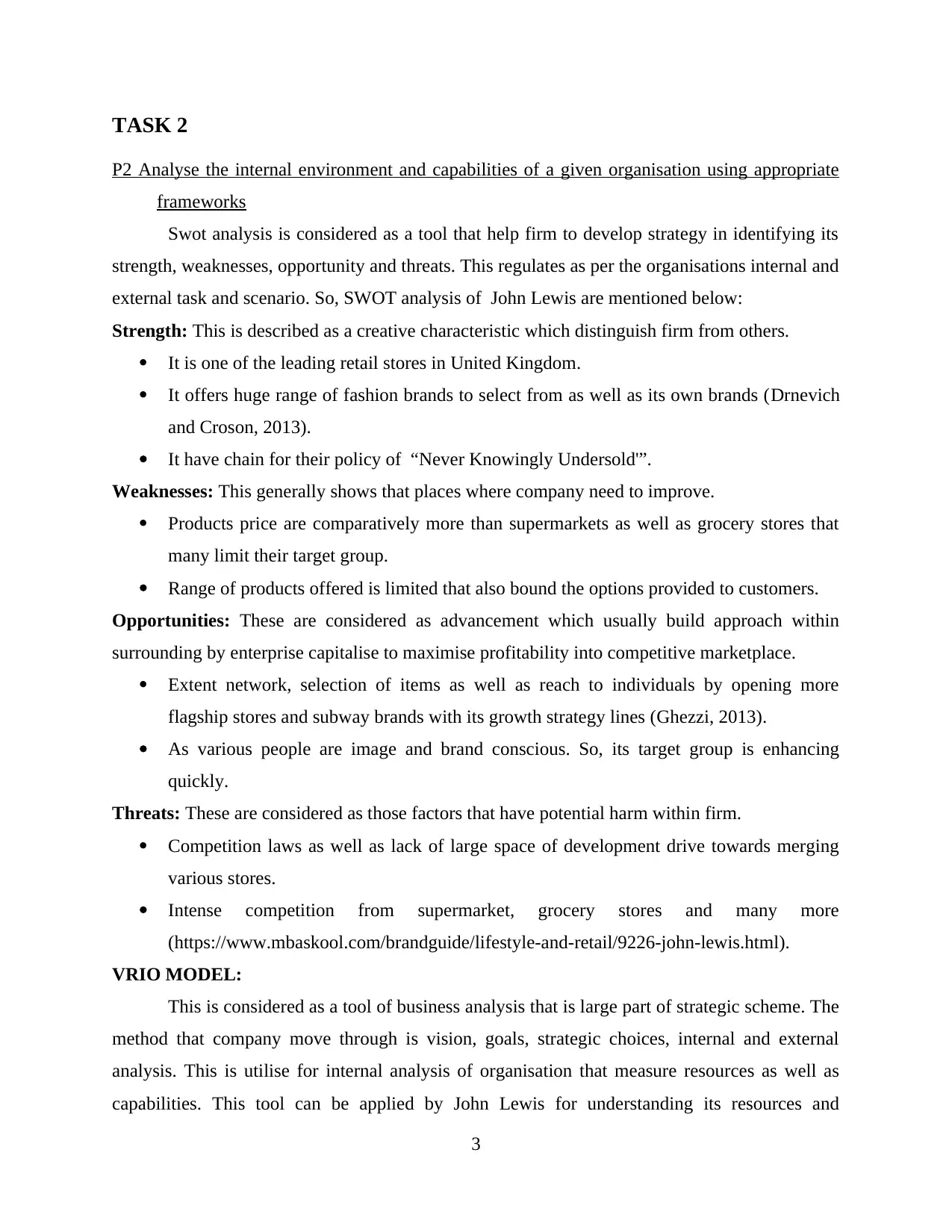
Swot analysis is considered as a tool that help firm to develop strategy in identifying its
strength, weaknesses, opportunity and threats. This regulates as per the organisations internal and
external task and scenario. So, SWOT analysis of John Lewis are mentioned below:
Strength: This is described as a creative characteristic which distinguish firm from others.
It is one of the leading retail stores in United Kingdom.
It offers huge range of fashion brands to select from as well as its own brands (Drnevich
and Croson, 2013).
It have chain for their policy of “Never Knowingly Undersold'”.
Weaknesses: This generally shows that places where company need to improve.
Products price are comparatively more than supermarkets as well as grocery stores that
many limit their target group.
Range of products offered is limited that also bound the options provided to customers.
Opportunities: These are considered as advancement which usually build approach within
surrounding by enterprise capitalise to maximise profitability into competitive marketplace.
Extent network, selection of items as well as reach to individuals by opening more
flagship stores and subway brands with its growth strategy lines (Ghezzi, 2013).
As various people are image and brand conscious. So, its target group is enhancing
quickly.
Threats: These are considered as those factors that have potential harm within firm.
Competition laws as well as lack of large space of development drive towards merging
various stores.
Intense competition from supermarket, grocery stores and many more
(https://www.mbaskool.com/brandguide/lifestyle-and-retail/9226-john-lewis.html).
VRIO MODEL:
This is considered as a tool of business analysis that is large part of strategic scheme. The
method that company move through is vision, goals, strategic choices, internal and external
analysis. This is utilise for internal analysis of organisation that measure resources as well as
capabilities. This tool can be applied by John Lewis for understanding its resources and
3
P2 Analyse the internal environment and capabilities of a given organisation using appropriate
frameworks
Swot analysis is considered as a tool that help firm to develop strategy in identifying its
strength, weaknesses, opportunity and threats. This regulates as per the organisations internal and
external task and scenario. So, SWOT analysis of John Lewis are mentioned below:
Strength: This is described as a creative characteristic which distinguish firm from others.
It is one of the leading retail stores in United Kingdom.
It offers huge range of fashion brands to select from as well as its own brands (Drnevich
and Croson, 2013).
It have chain for their policy of “Never Knowingly Undersold'”.
Weaknesses: This generally shows that places where company need to improve.
Products price are comparatively more than supermarkets as well as grocery stores that
many limit their target group.
Range of products offered is limited that also bound the options provided to customers.
Opportunities: These are considered as advancement which usually build approach within
surrounding by enterprise capitalise to maximise profitability into competitive marketplace.
Extent network, selection of items as well as reach to individuals by opening more
flagship stores and subway brands with its growth strategy lines (Ghezzi, 2013).
As various people are image and brand conscious. So, its target group is enhancing
quickly.
Threats: These are considered as those factors that have potential harm within firm.
Competition laws as well as lack of large space of development drive towards merging
various stores.
Intense competition from supermarket, grocery stores and many more
(https://www.mbaskool.com/brandguide/lifestyle-and-retail/9226-john-lewis.html).
VRIO MODEL:
This is considered as a tool of business analysis that is large part of strategic scheme. The
method that company move through is vision, goals, strategic choices, internal and external
analysis. This is utilise for internal analysis of organisation that measure resources as well as
capabilities. This tool can be applied by John Lewis for understanding its resources and
3
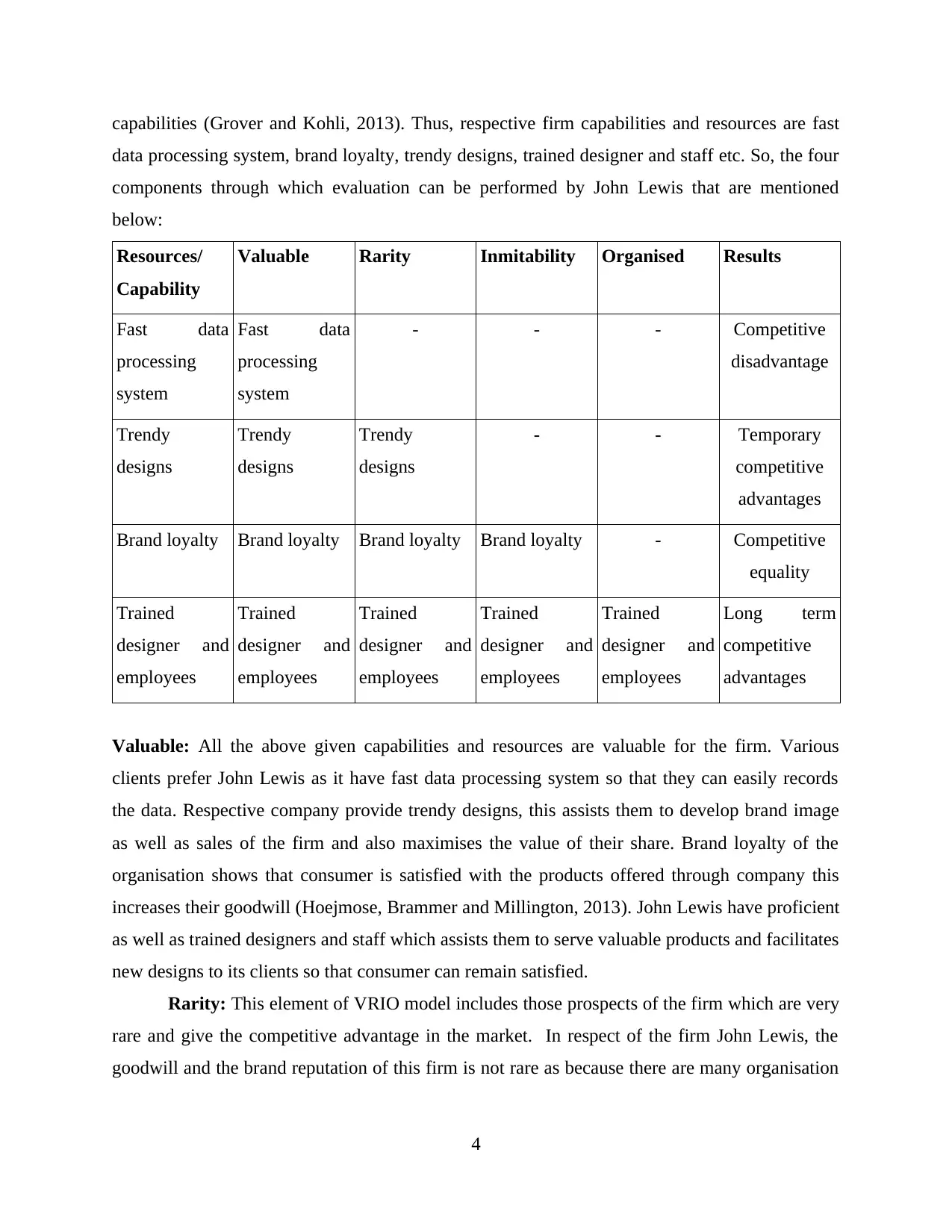
capabilities (Grover and Kohli, 2013). Thus, respective firm capabilities and resources are fast
data processing system, brand loyalty, trendy designs, trained designer and staff etc. So, the four
components through which evaluation can be performed by John Lewis that are mentioned
below:
Resources/
Capability
Valuable Rarity Inmitability Organised Results
Fast data
processing
system
Fast data
processing
system
- - - Competitive
disadvantage
Trendy
designs
Trendy
designs
Trendy
designs
- - Temporary
competitive
advantages
Brand loyalty Brand loyalty Brand loyalty Brand loyalty - Competitive
equality
Trained
designer and
employees
Trained
designer and
employees
Trained
designer and
employees
Trained
designer and
employees
Trained
designer and
employees
Long term
competitive
advantages
Valuable: All the above given capabilities and resources are valuable for the firm. Various
clients prefer John Lewis as it have fast data processing system so that they can easily records
the data. Respective company provide trendy designs, this assists them to develop brand image
as well as sales of the firm and also maximises the value of their share. Brand loyalty of the
organisation shows that consumer is satisfied with the products offered through company this
increases their goodwill (Hoejmose, Brammer and Millington, 2013). John Lewis have proficient
as well as trained designers and staff which assists them to serve valuable products and facilitates
new designs to its clients so that consumer can remain satisfied.
Rarity: This element of VRIO model includes those prospects of the firm which are very
rare and give the competitive advantage in the market. In respect of the firm John Lewis, the
goodwill and the brand reputation of this firm is not rare as because there are many organisation
4
data processing system, brand loyalty, trendy designs, trained designer and staff etc. So, the four
components through which evaluation can be performed by John Lewis that are mentioned
below:
Resources/
Capability
Valuable Rarity Inmitability Organised Results
Fast data
processing
system
Fast data
processing
system
- - - Competitive
disadvantage
Trendy
designs
Trendy
designs
Trendy
designs
- - Temporary
competitive
advantages
Brand loyalty Brand loyalty Brand loyalty Brand loyalty - Competitive
equality
Trained
designer and
employees
Trained
designer and
employees
Trained
designer and
employees
Trained
designer and
employees
Trained
designer and
employees
Long term
competitive
advantages
Valuable: All the above given capabilities and resources are valuable for the firm. Various
clients prefer John Lewis as it have fast data processing system so that they can easily records
the data. Respective company provide trendy designs, this assists them to develop brand image
as well as sales of the firm and also maximises the value of their share. Brand loyalty of the
organisation shows that consumer is satisfied with the products offered through company this
increases their goodwill (Hoejmose, Brammer and Millington, 2013). John Lewis have proficient
as well as trained designers and staff which assists them to serve valuable products and facilitates
new designs to its clients so that consumer can remain satisfied.
Rarity: This element of VRIO model includes those prospects of the firm which are very
rare and give the competitive advantage in the market. In respect of the firm John Lewis, the
goodwill and the brand reputation of this firm is not rare as because there are many organisation
4
⊘ This is a preview!⊘
Do you want full access?
Subscribe today to unlock all pages.
Trusted by 1+ million students worldwide
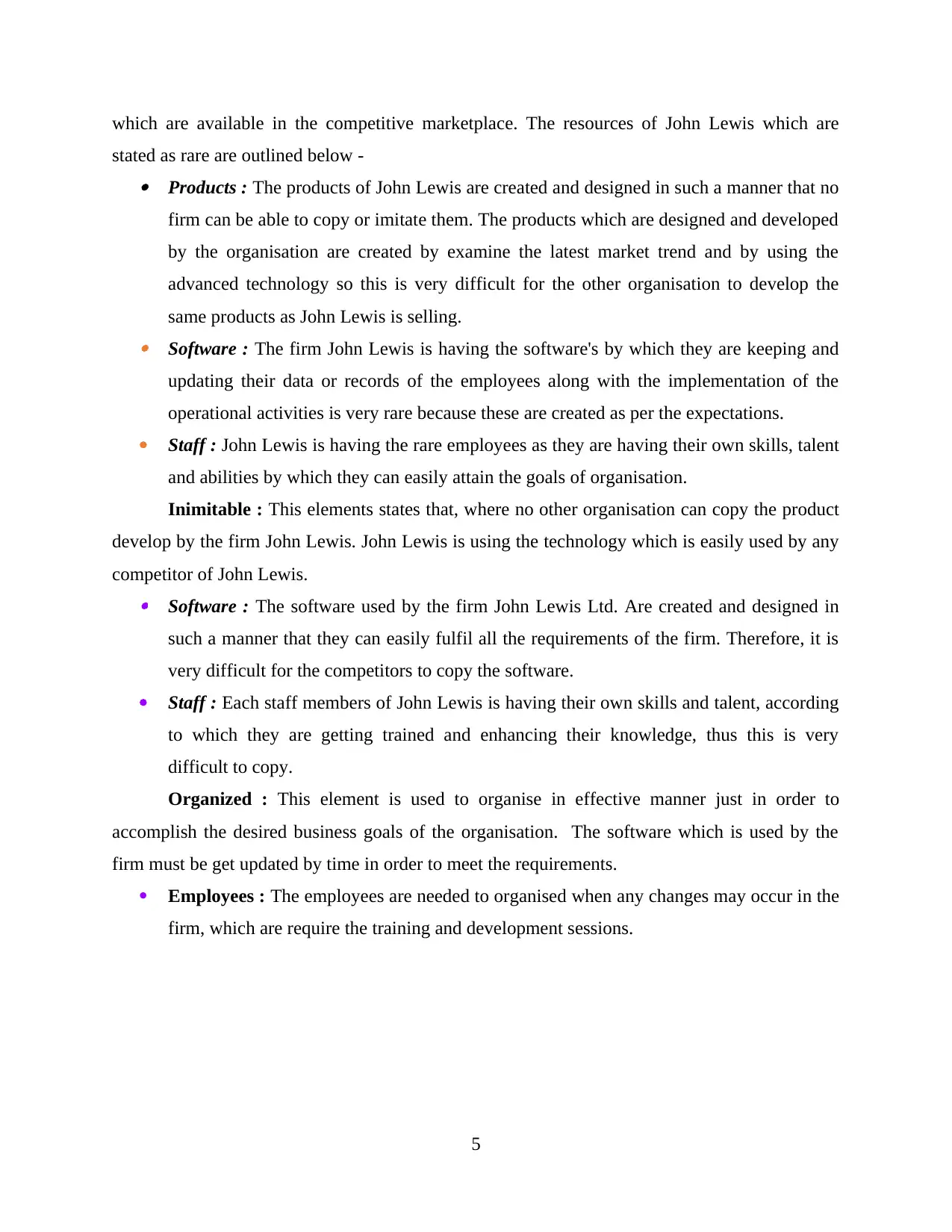
which are available in the competitive marketplace. The resources of John Lewis which are
stated as rare are outlined below - Products : The products of John Lewis are created and designed in such a manner that no
firm can be able to copy or imitate them. The products which are designed and developed
by the organisation are created by examine the latest market trend and by using the
advanced technology so this is very difficult for the other organisation to develop the
same products as John Lewis is selling. Software : The firm John Lewis is having the software's by which they are keeping and
updating their data or records of the employees along with the implementation of the
operational activities is very rare because these are created as per the expectations.
Staff : John Lewis is having the rare employees as they are having their own skills, talent
and abilities by which they can easily attain the goals of organisation.
Inimitable : This elements states that, where no other organisation can copy the product
develop by the firm John Lewis. John Lewis is using the technology which is easily used by any
competitor of John Lewis. Software : The software used by the firm John Lewis Ltd. Are created and designed in
such a manner that they can easily fulfil all the requirements of the firm. Therefore, it is
very difficult for the competitors to copy the software.
Staff : Each staff members of John Lewis is having their own skills and talent, according
to which they are getting trained and enhancing their knowledge, thus this is very
difficult to copy.
Organized : This element is used to organise in effective manner just in order to
accomplish the desired business goals of the organisation. The software which is used by the
firm must be get updated by time in order to meet the requirements.
Employees : The employees are needed to organised when any changes may occur in the
firm, which are require the training and development sessions.
5
stated as rare are outlined below - Products : The products of John Lewis are created and designed in such a manner that no
firm can be able to copy or imitate them. The products which are designed and developed
by the organisation are created by examine the latest market trend and by using the
advanced technology so this is very difficult for the other organisation to develop the
same products as John Lewis is selling. Software : The firm John Lewis is having the software's by which they are keeping and
updating their data or records of the employees along with the implementation of the
operational activities is very rare because these are created as per the expectations.
Staff : John Lewis is having the rare employees as they are having their own skills, talent
and abilities by which they can easily attain the goals of organisation.
Inimitable : This elements states that, where no other organisation can copy the product
develop by the firm John Lewis. John Lewis is using the technology which is easily used by any
competitor of John Lewis. Software : The software used by the firm John Lewis Ltd. Are created and designed in
such a manner that they can easily fulfil all the requirements of the firm. Therefore, it is
very difficult for the competitors to copy the software.
Staff : Each staff members of John Lewis is having their own skills and talent, according
to which they are getting trained and enhancing their knowledge, thus this is very
difficult to copy.
Organized : This element is used to organise in effective manner just in order to
accomplish the desired business goals of the organisation. The software which is used by the
firm must be get updated by time in order to meet the requirements.
Employees : The employees are needed to organised when any changes may occur in the
firm, which are require the training and development sessions.
5
Paraphrase This Document
Need a fresh take? Get an instant paraphrase of this document with our AI Paraphraser
TASK 3
P3 Applying Porter’s Five Forces model evaluate the competitive forces of a given market sector
for an organisation
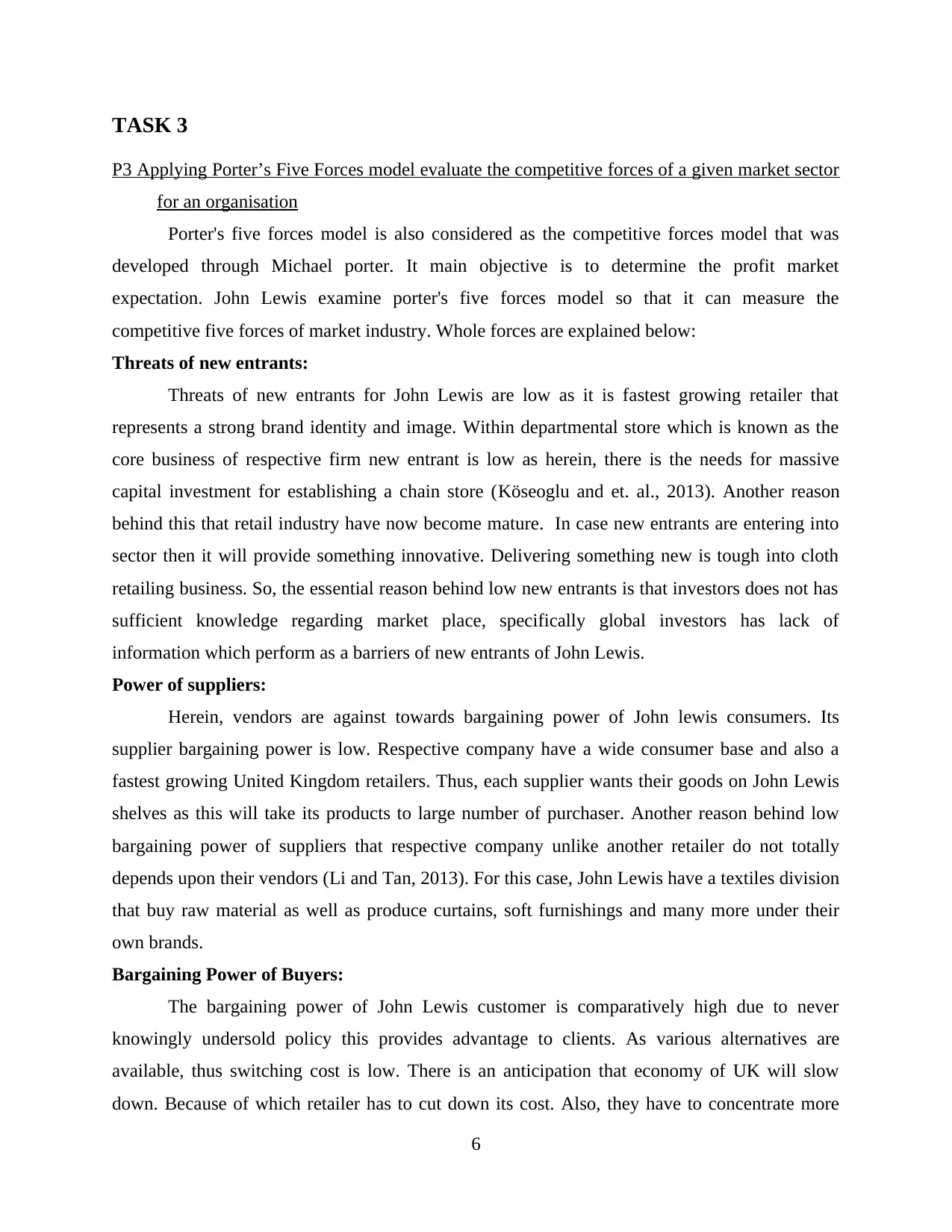
Porter's five forces model is also considered as the competitive forces model that was
developed through Michael porter. It main objective is to determine the profit market
expectation. John Lewis examine porter's five forces model so that it can measure the
competitive five forces of market industry. Whole forces are explained below:
Threats of new entrants:
Threats of new entrants for John Lewis are low as it is fastest growing retailer that
represents a strong brand identity and image. Within departmental store which is known as the
core business of respective firm new entrant is low as herein, there is the needs for massive
capital investment for establishing a chain store (Köseoglu and et. al., 2013). Another reason
behind this that retail industry have now become mature. In case new entrants are entering into
sector then it will provide something innovative. Delivering something new is tough into cloth
retailing business. So, the essential reason behind low new entrants is that investors does not has
sufficient knowledge regarding market place, specifically global investors has lack of
information which perform as a barriers of new entrants of John Lewis.
Power of suppliers:
Herein, vendors are against towards bargaining power of John lewis consumers. Its
supplier bargaining power is low. Respective company have a wide consumer base and also a
fastest growing United Kingdom retailers. Thus, each supplier wants their goods on John Lewis
shelves as this will take its products to large number of purchaser. Another reason behind low
bargaining power of suppliers that respective company unlike another retailer do not totally
depends upon their vendors (Li and Tan, 2013). For this case, John Lewis have a textiles division
that buy raw material as well as produce curtains, soft furnishings and many more under their
own brands.
Bargaining Power of Buyers:
The bargaining power of John Lewis customer is comparatively high due to never
knowingly undersold policy this provides advantage to clients. As various alternatives are
available, thus switching cost is low. There is an anticipation that economy of UK will slow
down. Because of which retailer has to cut down its cost. Also, they have to concentrate more
6
P3 Applying Porter’s Five Forces model evaluate the competitive forces of a given market sector
for an organisation
Porter's five forces model is also considered as the competitive forces model that was
developed through Michael porter. It main objective is to determine the profit market
expectation. John Lewis examine porter's five forces model so that it can measure the
competitive five forces of market industry. Whole forces are explained below:
Threats of new entrants:
Threats of new entrants for John Lewis are low as it is fastest growing retailer that
represents a strong brand identity and image. Within departmental store which is known as the
core business of respective firm new entrant is low as herein, there is the needs for massive
capital investment for establishing a chain store (Köseoglu and et. al., 2013). Another reason
behind this that retail industry have now become mature. In case new entrants are entering into
sector then it will provide something innovative. Delivering something new is tough into cloth
retailing business. So, the essential reason behind low new entrants is that investors does not has
sufficient knowledge regarding market place, specifically global investors has lack of
information which perform as a barriers of new entrants of John Lewis.
Power of suppliers:
Herein, vendors are against towards bargaining power of John lewis consumers. Its
supplier bargaining power is low. Respective company have a wide consumer base and also a
fastest growing United Kingdom retailers. Thus, each supplier wants their goods on John Lewis
shelves as this will take its products to large number of purchaser. Another reason behind low
bargaining power of suppliers that respective company unlike another retailer do not totally
depends upon their vendors (Li and Tan, 2013). For this case, John Lewis have a textiles division
that buy raw material as well as produce curtains, soft furnishings and many more under their
own brands.
Bargaining Power of Buyers:
The bargaining power of John Lewis customer is comparatively high due to never
knowingly undersold policy this provides advantage to clients. As various alternatives are
available, thus switching cost is low. There is an anticipation that economy of UK will slow
down. Because of which retailer has to cut down its cost. Also, they have to concentrate more
6
upon consumers requirements. Because of all this factors provided, bargaining power of
respective firm clients is high.
Threats of substitutes:
Threats of substitutes is relatively low as the trends of online shopping is growing
rapidly. More numbers of consumers consider to shop from stores as they can interact with it
physically as well as viewing the real product before doing any type of purchasing. Therefore, it
is low.
Competitive rivalry:
John Lewis is providing huge range of items such as clothing, drinks, food and so on in
order to build a positive relation with their target customers. Because of this, it has large
competition from super markets like TESCO, The level of competitive rivalry in retail sectors is
high as various retailers compete within who can represent effective price, service as well as
complement through sorts of activities such as advertisements, promotion, deals to grab attention
of clients etc. Thus, the threats not only comes from stores but also from online retail sector that
are trending currently (Maté, Trujillo and Mylopoulos, 2012).
Thus, from the above mentioned model it is analysed that as retail industry are growing
so John Lewis have to deal with various competitors. So its level of competitive rivalry is high.
Threats of new entrants is low as to enter into new market rivals has to come up with something
innovative. Also, their threats of new entrants and bargaining power of suppliers is also low.
TASK 4
P4 Applying a range of theories, concepts and models, interpret and devise strategic planning for
a given organisation
Ansoff Matrix is considered as the strategic tool which provides guidelines to
management team, executives, marketing team and other growth strategies for the purpose of
future growth. In context of John Lewis, it can be said that senior management team of this
company have used this tool for understanding all the feasible strategies for growth and then
choose best one among them all. In the same context all of these strategies for John Lewis are
defined as below:
7
respective firm clients is high.
Threats of substitutes:
Threats of substitutes is relatively low as the trends of online shopping is growing
rapidly. More numbers of consumers consider to shop from stores as they can interact with it
physically as well as viewing the real product before doing any type of purchasing. Therefore, it
is low.
Competitive rivalry:
John Lewis is providing huge range of items such as clothing, drinks, food and so on in
order to build a positive relation with their target customers. Because of this, it has large
competition from super markets like TESCO, The level of competitive rivalry in retail sectors is
high as various retailers compete within who can represent effective price, service as well as
complement through sorts of activities such as advertisements, promotion, deals to grab attention
of clients etc. Thus, the threats not only comes from stores but also from online retail sector that
are trending currently (Maté, Trujillo and Mylopoulos, 2012).
Thus, from the above mentioned model it is analysed that as retail industry are growing
so John Lewis have to deal with various competitors. So its level of competitive rivalry is high.
Threats of new entrants is low as to enter into new market rivals has to come up with something
innovative. Also, their threats of new entrants and bargaining power of suppliers is also low.
TASK 4
P4 Applying a range of theories, concepts and models, interpret and devise strategic planning for
a given organisation
Ansoff Matrix is considered as the strategic tool which provides guidelines to
management team, executives, marketing team and other growth strategies for the purpose of
future growth. In context of John Lewis, it can be said that senior management team of this
company have used this tool for understanding all the feasible strategies for growth and then
choose best one among them all. In the same context all of these strategies for John Lewis are
defined as below:
7
⊘ This is a preview!⊘
Do you want full access?
Subscribe today to unlock all pages.
Trusted by 1+ million students worldwide
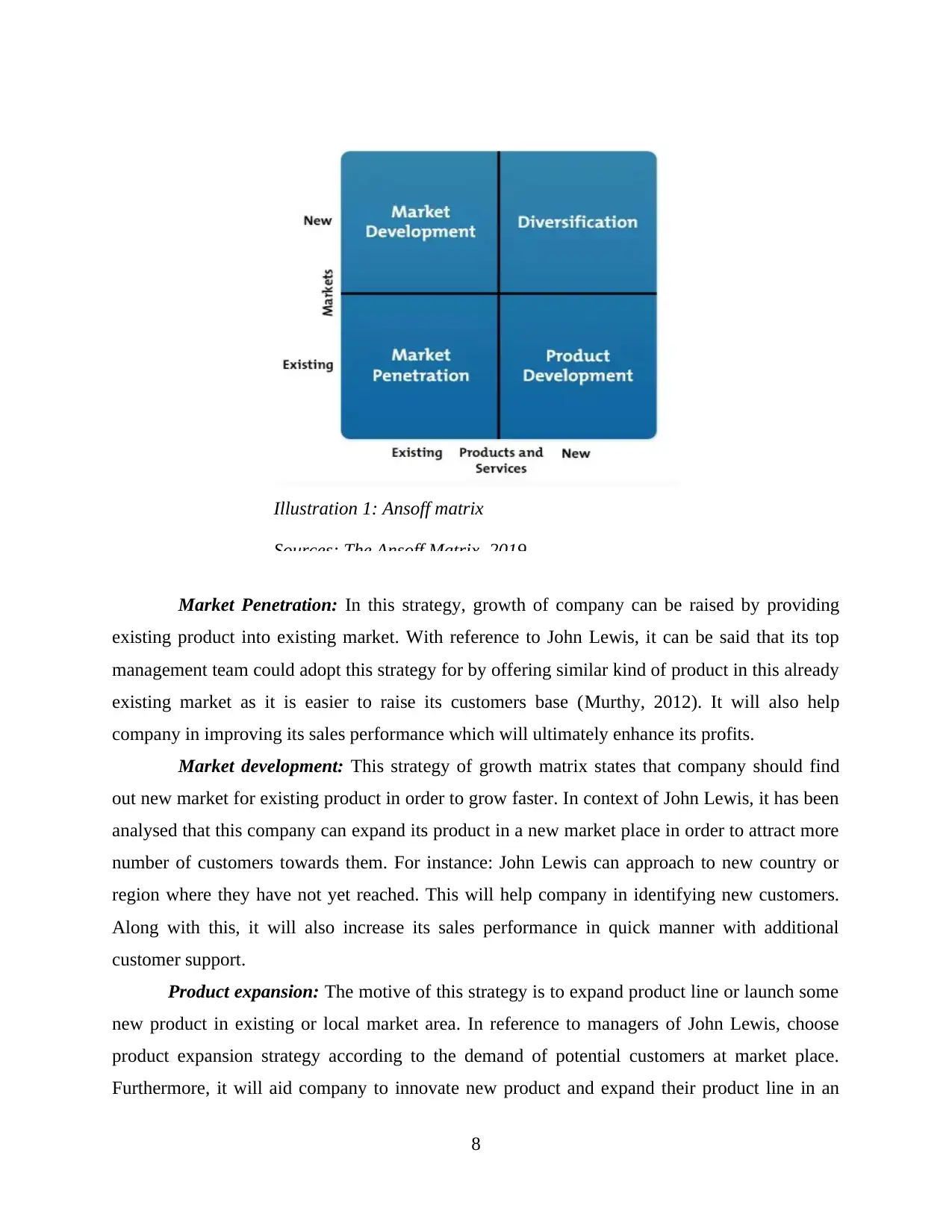
Market Penetration: In this strategy, growth of company can be raised by providing
existing product into existing market. With reference to John Lewis, it can be said that its top
management team could adopt this strategy for by offering similar kind of product in this already
existing market as it is easier to raise its customers base (Murthy, 2012). It will also help
company in improving its sales performance which will ultimately enhance its profits.
Market development: This strategy of growth matrix states that company should find
out new market for existing product in order to grow faster. In context of John Lewis, it has been
analysed that this company can expand its product in a new market place in order to attract more
number of customers towards them. For instance: John Lewis can approach to new country or
region where they have not yet reached. This will help company in identifying new customers.
Along with this, it will also increase its sales performance in quick manner with additional
customer support.
Product expansion: The motive of this strategy is to expand product line or launch some
new product in existing or local market area. In reference to managers of John Lewis, choose
product expansion strategy according to the demand of potential customers at market place.
Furthermore, it will aid company to innovate new product and expand their product line in an
8
Illustration 1: Ansoff matrix
Sources: The Ansoff Matrix, 2019.
existing product into existing market. With reference to John Lewis, it can be said that its top
management team could adopt this strategy for by offering similar kind of product in this already
existing market as it is easier to raise its customers base (Murthy, 2012). It will also help
company in improving its sales performance which will ultimately enhance its profits.
Market development: This strategy of growth matrix states that company should find
out new market for existing product in order to grow faster. In context of John Lewis, it has been
analysed that this company can expand its product in a new market place in order to attract more
number of customers towards them. For instance: John Lewis can approach to new country or
region where they have not yet reached. This will help company in identifying new customers.
Along with this, it will also increase its sales performance in quick manner with additional
customer support.
Product expansion: The motive of this strategy is to expand product line or launch some
new product in existing or local market area. In reference to managers of John Lewis, choose
product expansion strategy according to the demand of potential customers at market place.
Furthermore, it will aid company to innovate new product and expand their product line in an
8
Illustration 1: Ansoff matrix
Sources: The Ansoff Matrix, 2019.
Paraphrase This Document
Need a fresh take? Get an instant paraphrase of this document with our AI Paraphraser
effective manner (Oestreicher-Singer and Zalmanson, 2013). With the help of this, they will
attract more customers towards their brand and earn more profit for long term survival at
competitive market place.
Diversification: In this strategy main motive of company is to offer new product into the
new market area. This is a risk strategy because it is not possible for company to always attract
new customer and retain old customers for longer period of time. Also, it is tough for them to
gain support from customers at the new market place. In context to, managers of John Lewis opt
these strategies within a company, then it will become most expensive operation for them
(Brewster, 2017). Along with this, they should adopt many marketing strategies in order to
maintain positive image of a company at competitive marketplace. As a result, this will instantly
affect a stage of profitability of the company, this is because their expenses is more from their
total revenue.
From the above mentioned strategies, it has been evaluated that, John Lewis managers
must adopt market penetration strategy in their working area. This is because, it will aid
company to grab ample amount of market share by creating awareness about their product for
attracting customers towards them.
Strategic management plan
Strategic management plan is a framework developed by the top management team of
John Lewis Ltd. This plan is developed to transfer or communicate various key factors mainly
associated with the company to their shareholders. John Lewis Ltd. Strategic management plan
are as follows:
Aim: First and foremost, aim of John Lewis Ltd. is to provide high quality products to
their customers as well as to enhance their functionality within the market place.
Vision: John Lewis Ltd. Deals in retail sector. Their vision statement is to capture large
market share and to become leader at an international level.
Mission statement: Mission of John Lewis Ltd. is to provide high quality products to
their customers and retain them for a long period of time by satisfying their needs and wants.
Values: John Lewis Ltd. Is a retail company. It is one of the biggest company who
believes that while performing business functions, company should work in an ethical manner as
well as creates transparency.
9
attract more customers towards their brand and earn more profit for long term survival at
competitive market place.
Diversification: In this strategy main motive of company is to offer new product into the
new market area. This is a risk strategy because it is not possible for company to always attract
new customer and retain old customers for longer period of time. Also, it is tough for them to
gain support from customers at the new market place. In context to, managers of John Lewis opt
these strategies within a company, then it will become most expensive operation for them
(Brewster, 2017). Along with this, they should adopt many marketing strategies in order to
maintain positive image of a company at competitive marketplace. As a result, this will instantly
affect a stage of profitability of the company, this is because their expenses is more from their
total revenue.
From the above mentioned strategies, it has been evaluated that, John Lewis managers
must adopt market penetration strategy in their working area. This is because, it will aid
company to grab ample amount of market share by creating awareness about their product for
attracting customers towards them.
Strategic management plan
Strategic management plan is a framework developed by the top management team of
John Lewis Ltd. This plan is developed to transfer or communicate various key factors mainly
associated with the company to their shareholders. John Lewis Ltd. Strategic management plan
are as follows:
Aim: First and foremost, aim of John Lewis Ltd. is to provide high quality products to
their customers as well as to enhance their functionality within the market place.
Vision: John Lewis Ltd. Deals in retail sector. Their vision statement is to capture large
market share and to become leader at an international level.
Mission statement: Mission of John Lewis Ltd. is to provide high quality products to
their customers and retain them for a long period of time by satisfying their needs and wants.
Values: John Lewis Ltd. Is a retail company. It is one of the biggest company who
believes that while performing business functions, company should work in an ethical manner as
well as creates transparency.
9
Strategies and tactics: John Lewis Ltd. Adopted market penetration strategy in order to
attract ample number of customers towards their company within the existing marketplace. As a
result, company will gain competitive advantages and generate huge amount of revenue
(Scholes, 2015). On the other hand, tactics used by the managers is they will launch high quality
goods at very affordable price, so that they can easily attract large number of customers.
CONCLUSION
From the above described report, it can be concluded that business strategy is beneficial
for an organisation which help them in reaching with desired goals and targets. It will help in
achieving potential objectives of the company. Along with this, it is necessary for an
organisation to analyse and examine both internal as well external environmental factors to
smoothly run their business activities in the large competitive market place. In this, PESTLE
analysis assist in identifying and knowing about marketing environment and company has been
adopted diversification strategy in order to enhancing or increasing market share and income.
Through VRIO model, they can easily analyse and understand about the resources and
capabilities of an organisation for best utilisation. Porters five force model has been used in order
to measure and evaluate threats, suppliers, customers, buyers and other survival and growth of
the market place.
10
attract ample number of customers towards their company within the existing marketplace. As a
result, company will gain competitive advantages and generate huge amount of revenue
(Scholes, 2015). On the other hand, tactics used by the managers is they will launch high quality
goods at very affordable price, so that they can easily attract large number of customers.
CONCLUSION
From the above described report, it can be concluded that business strategy is beneficial
for an organisation which help them in reaching with desired goals and targets. It will help in
achieving potential objectives of the company. Along with this, it is necessary for an
organisation to analyse and examine both internal as well external environmental factors to
smoothly run their business activities in the large competitive market place. In this, PESTLE
analysis assist in identifying and knowing about marketing environment and company has been
adopted diversification strategy in order to enhancing or increasing market share and income.
Through VRIO model, they can easily analyse and understand about the resources and
capabilities of an organisation for best utilisation. Porters five force model has been used in order
to measure and evaluate threats, suppliers, customers, buyers and other survival and growth of
the market place.
10
⊘ This is a preview!⊘
Do you want full access?
Subscribe today to unlock all pages.
Trusted by 1+ million students worldwide

1 out of 14


Related Documents


Your All-in-One AI-Powered Toolkit for Academic Success.
+13062052269
info@desklib.com
Available 24*7 on WhatsApp / Email
![[object Object]](/_next/static/media/star-bottom.7253800d.svg)
Unlock your academic potential
Copyright © 2020–2026 A2Z Services. All Rights Reserved. Developed and managed by ZUCOL.