Online Journalism Ethics and Code of Conduct in Australia
VerifiedAdded on 2020/04/07
|12
|3691
|159
Essay
AI Summary
This essay investigates the ethical dilemmas faced by online journalists in Australia, focusing on the role and limitations of codes of conduct in the context of press freedom. It explores the significance of ethical principles, the impact of social responsibility theory, and the challenges posed by language and journalistic practices. The essay examines the case of overt and implied racism in Australia despite the code of ethics, and offers recommendations for alternative approaches, referencing the MEAA's code of ethics review. The essay highlights the importance of ethical considerations in journalism, particularly in the digital age, and the need for journalists to balance freedom and responsibility in their work. It also addresses limitations, such as the impact of language and the potential for inaccurate reporting, and underscores the importance of ethical practices regardless of whether journalism is viewed as a profession or a trade. The essay concludes by emphasizing the need for ethical conduct in journalism, especially in light of threats to press freedom in Australia.
Running Head: JOURNALISTS ETHICAL DILEMMA 1
Online journalists face new ethical dilemma-Discussion on role of codes in Australia
<Student ID>
<Student Name>
<University Name>
Online journalists face new ethical dilemma-Discussion on role of codes in Australia
<Student ID>
<Student Name>
<University Name>

Paraphrase This Document
Need a fresh take? Get an instant paraphrase of this document with our AI Paraphraser
JOURNALISTS ETHICAL DILEMMA 2
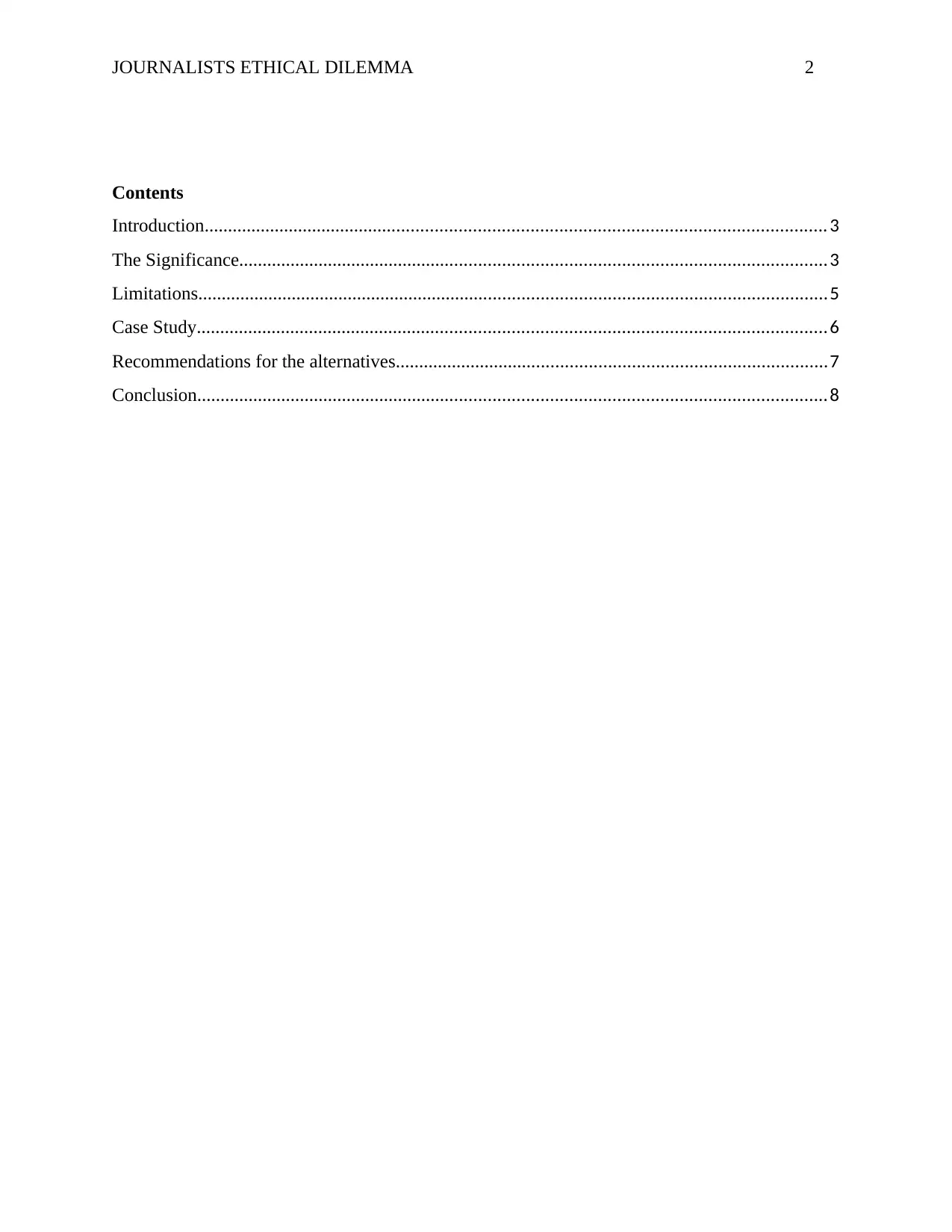
Contents
Introduction................................................................................................................................... 3
The Significance............................................................................................................................ 3
Limitations.....................................................................................................................................5
Case Study..................................................................................................................................... 6
Recommendations for the alternatives...........................................................................................7
Conclusion..................................................................................................................................... 8
Contents
Introduction................................................................................................................................... 3
The Significance............................................................................................................................ 3
Limitations.....................................................................................................................................5
Case Study..................................................................................................................................... 6
Recommendations for the alternatives...........................................................................................7
Conclusion..................................................................................................................................... 8
JOURNALISTS ETHICAL DILEMMA 3
Introduction
In this paper the chances of applying the principles that are fundamental relating to one of
the key religious in the world with respect to the practice of seeking the truth and telling the
truth in the contemporary era is being explored and is questioned whether this ethical framework
is well matched with the journalism as the fourth estate initiative. According to the researcher,
this is however not meant to be a religious exposition since he neither belongs to Buddhism nor
he is an expert in the philosophy of Buddhist. It has been stated that none of the topics in the
academic paper has arisen like this in just a vacuum, so here he has explained the context related
with both personal and professional which has risen with this issue from over the four decades
and has strengthened it in the recent year (Barnes, 2015). Most of the academic work in this
paper is related to the field of media law where its focus is mainly upon the application of laws
and regulations practically to the work done by the journalists. From period to period the
undertakings have been venturing into the ethical and regulatory frameworks of media in which
the legislative, the philosophical, and self-regulatory framework have informed and related to the
investigation of the laws that are actually impacting upon the journalists. Professional, ethical
codes are not considered to be the religious treatises neither they are the holy scriptures that are
written or spoken as the codes of practice for any kind of specific occupation (Craig, Ketterer &
Yousuf, 2017). However, in this paper, neither of them is discussed. Rather, it has been set out
on exploring the foundational teachings of journalism ethics that are focusing on the purer life
might notify the practice of journalism. At some of the stages, it becomes obvious that some of
the elements of the libertarian model of the journalism might not be compatible with such kind of
principles especially if they are being interpreted in the narrowest manner (Deuze & Yeshua,
2001).
The Significance
Simultaneously, the scholars those are most prominent have inclined in exploring the
subject with respect to moral theory, social theory and logical theory instead of experimental
observations often with inherent understandings and also the assumptions that are derived from
the theory of social responsibility. Some of the researchers (for example, Day 1991; Klaidman
and Beauchamp 1987) have even discussed the responsibilities of journalists in the context of the
broader obligations of journalism in general to the society and in particular to the social
Introduction
In this paper the chances of applying the principles that are fundamental relating to one of
the key religious in the world with respect to the practice of seeking the truth and telling the
truth in the contemporary era is being explored and is questioned whether this ethical framework
is well matched with the journalism as the fourth estate initiative. According to the researcher,
this is however not meant to be a religious exposition since he neither belongs to Buddhism nor
he is an expert in the philosophy of Buddhist. It has been stated that none of the topics in the
academic paper has arisen like this in just a vacuum, so here he has explained the context related
with both personal and professional which has risen with this issue from over the four decades
and has strengthened it in the recent year (Barnes, 2015). Most of the academic work in this
paper is related to the field of media law where its focus is mainly upon the application of laws
and regulations practically to the work done by the journalists. From period to period the
undertakings have been venturing into the ethical and regulatory frameworks of media in which
the legislative, the philosophical, and self-regulatory framework have informed and related to the
investigation of the laws that are actually impacting upon the journalists. Professional, ethical
codes are not considered to be the religious treatises neither they are the holy scriptures that are
written or spoken as the codes of practice for any kind of specific occupation (Craig, Ketterer &
Yousuf, 2017). However, in this paper, neither of them is discussed. Rather, it has been set out
on exploring the foundational teachings of journalism ethics that are focusing on the purer life
might notify the practice of journalism. At some of the stages, it becomes obvious that some of
the elements of the libertarian model of the journalism might not be compatible with such kind of
principles especially if they are being interpreted in the narrowest manner (Deuze & Yeshua,
2001).
The Significance
Simultaneously, the scholars those are most prominent have inclined in exploring the
subject with respect to moral theory, social theory and logical theory instead of experimental
observations often with inherent understandings and also the assumptions that are derived from
the theory of social responsibility. Some of the researchers (for example, Day 1991; Klaidman
and Beauchamp 1987) have even discussed the responsibilities of journalists in the context of the
broader obligations of journalism in general to the society and in particular to the social
⊘ This is a preview!⊘
Do you want full access?
Subscribe today to unlock all pages.

Trusted by 1+ million students worldwide
JOURNALISTS ETHICAL DILEMMA 4
responsibility theory (Friend & Singer, 2015). While some of the scholars (Hodges 1986; Elliott
1986) have outlined the responsibilities of media with regards to the ethical principles which can
be applied to the journalism along with any kind of human interaction in which a choice on
moral can be made.
The work carried out by Friend & Singer is of particular significance with respect to the
role of codes in Australia in relation to online journalists face a new ethical dilemma (Friend &
Singer, 2015). He has extensively written regarding the importance of the individual autonomy
and individualism in journalism. During this process, there was a warning against communitarian
tendencies. While it was argued by him that it is important for the journalists to combine
responsibility and freedom for producing the responsible freedom (García-Avilés & Maciá-
Barber, 2014). More recently, he explained the views which were reflecting on the concern that
is considerable regarding the survival of the idea of press freedom. He even argued for a short
time that slowly but unalterably there is an unfolding of the communitarian worldview. Also, he
said that the role of code in Australia over the online journalists is in the form of order and the
community spirit which can be taken over from the individualism and from social chaos. By
doing so, they will be losing the importance of institution (Giles et al., 2015).
Press freedom will be allowing the journalists in Australia to examine and report any case
accurately with respect to governments, any big corporations, and the power in their society.
Only with the help of press freedom that is genuine, the voters will be able to make informed
decisions near the ballot box every two years. Without which the public will be put in the
darkness where they will not have any idea of what is actually going on and what is done by
government in their name. Recently in Australia, it has been noticed that there were many threats
to this code of conduct in restricting the press freedom compelling the way the journalists work
and silencing the real news stories from becoming public (Hanusch et al., 2015). It will not be an
exaggeration to say that when all these changes are combined the greatest assault is represented
by them in Australian on press freedom in peacetime and real journalism in which the public
interest is being criminalized. Though press freedom is a global issue campaigning about that for
the journalist’s right in going about their business without any harassment, censorship or
persecution is the code of practice of MEAA (Hanusch, 2015).
responsibility theory (Friend & Singer, 2015). While some of the scholars (Hodges 1986; Elliott
1986) have outlined the responsibilities of media with regards to the ethical principles which can
be applied to the journalism along with any kind of human interaction in which a choice on
moral can be made.
The work carried out by Friend & Singer is of particular significance with respect to the
role of codes in Australia in relation to online journalists face a new ethical dilemma (Friend &
Singer, 2015). He has extensively written regarding the importance of the individual autonomy
and individualism in journalism. During this process, there was a warning against communitarian
tendencies. While it was argued by him that it is important for the journalists to combine
responsibility and freedom for producing the responsible freedom (García-Avilés & Maciá-
Barber, 2014). More recently, he explained the views which were reflecting on the concern that
is considerable regarding the survival of the idea of press freedom. He even argued for a short
time that slowly but unalterably there is an unfolding of the communitarian worldview. Also, he
said that the role of code in Australia over the online journalists is in the form of order and the
community spirit which can be taken over from the individualism and from social chaos. By
doing so, they will be losing the importance of institution (Giles et al., 2015).
Press freedom will be allowing the journalists in Australia to examine and report any case
accurately with respect to governments, any big corporations, and the power in their society.
Only with the help of press freedom that is genuine, the voters will be able to make informed
decisions near the ballot box every two years. Without which the public will be put in the
darkness where they will not have any idea of what is actually going on and what is done by
government in their name. Recently in Australia, it has been noticed that there were many threats
to this code of conduct in restricting the press freedom compelling the way the journalists work
and silencing the real news stories from becoming public (Hanusch et al., 2015). It will not be an
exaggeration to say that when all these changes are combined the greatest assault is represented
by them in Australian on press freedom in peacetime and real journalism in which the public
interest is being criminalized. Though press freedom is a global issue campaigning about that for
the journalist’s right in going about their business without any harassment, censorship or
persecution is the code of practice of MEAA (Hanusch, 2015).
Paraphrase This Document
Need a fresh take? Get an instant paraphrase of this document with our AI Paraphraser
JOURNALISTS ETHICAL DILEMMA 5
Limitations
In the whole summary described above, it seems to be very clear that there would be
some limitations with respect to the social responsibility theory as a code of practice in Australia;
though it continues to be the fundamentally important in understanding the journalism ethics.
However, there are some exceptions other than some of the approaches that have been developed
from the perceptions that are based on the communitarianism and other have been sparked by the
concern regarding the role of the Western media in the third world (Hanusch, 2013). The
limitation is that most of the interpretations that are on the journalism ethics have been grounded
in the social responsibility theory or they are being rest on the assumptions which have been
derived from the theory of aspects.
A good journalism can be testified with thousands of examples with respect to words
which can bring the writers, viewers, listeners, and readers to the joy. Equal to this there are
many examples which indicated the poor journalism where the limitation is the language which
can obscure reduce responses and even stop people from their different thinking (Larsen, 2016).
With all the journalistic reports there is an underlying difficulty irrespective of the journalist how
much talented they are and the compositions they made, no matter how powerful or moving the
end result might be. It is the issue related to language which is the biggest limitation. It is very
obvious to observe that any interpretation made by the journalist is mediated by language and
that even one of the best reports cannot go beyond the language which is a role of code because
the report itself is solely comprised of language. These limitations have been lightened by the
(Joyce et al., 2017) an Australian historian. He has observed the survivors of the Holocaust who
has made an attempt in recounting their disturbing experiences. It is very common that
journalists themselves will be complaining about the inadequacies of the talent, experiences, and
resources. However, the journalists are aware of the limitations of the language along back and
for many years they have made numerous attempts in overcoming these limitations (Porter &
Prenzler, 2016).
Of course on its own, the journalistic truth cannot be ensured by accuracy. A report made
by the journalist can be accurate in content absolutely but at the same time, it might have focused
on the things that are marginal to the event which is being reported. Indeed the journalists might
often do the lies in the report accurately and the sources of the accurate report will know what
Limitations
In the whole summary described above, it seems to be very clear that there would be
some limitations with respect to the social responsibility theory as a code of practice in Australia;
though it continues to be the fundamentally important in understanding the journalism ethics.
However, there are some exceptions other than some of the approaches that have been developed
from the perceptions that are based on the communitarianism and other have been sparked by the
concern regarding the role of the Western media in the third world (Hanusch, 2013). The
limitation is that most of the interpretations that are on the journalism ethics have been grounded
in the social responsibility theory or they are being rest on the assumptions which have been
derived from the theory of aspects.
A good journalism can be testified with thousands of examples with respect to words
which can bring the writers, viewers, listeners, and readers to the joy. Equal to this there are
many examples which indicated the poor journalism where the limitation is the language which
can obscure reduce responses and even stop people from their different thinking (Larsen, 2016).
With all the journalistic reports there is an underlying difficulty irrespective of the journalist how
much talented they are and the compositions they made, no matter how powerful or moving the
end result might be. It is the issue related to language which is the biggest limitation. It is very
obvious to observe that any interpretation made by the journalist is mediated by language and
that even one of the best reports cannot go beyond the language which is a role of code because
the report itself is solely comprised of language. These limitations have been lightened by the
(Joyce et al., 2017) an Australian historian. He has observed the survivors of the Holocaust who
has made an attempt in recounting their disturbing experiences. It is very common that
journalists themselves will be complaining about the inadequacies of the talent, experiences, and
resources. However, the journalists are aware of the limitations of the language along back and
for many years they have made numerous attempts in overcoming these limitations (Porter &
Prenzler, 2016).
Of course on its own, the journalistic truth cannot be ensured by accuracy. A report made
by the journalist can be accurate in content absolutely but at the same time, it might have focused
on the things that are marginal to the event which is being reported. Indeed the journalists might
often do the lies in the report accurately and the sources of the accurate report will know what
JOURNALISTS ETHICAL DILEMMA 6
had happened (Tiplady, Walsh & Phillips, 2015). This kind of situation is even more worsened
with the techniques that are used by the journalists in gathering the information. For instance, the
attention to the limitations has been drawn by Malcolm (1994) in relation to the interview
format. It has been claimed in this is that most of the interviews the interviewer and the subject
both will be giving more than what is actually necessary.
Case Study
In support of the role of code in Australia for the online journalists to face new ethical
dilemma there is an example of the case which points out that in Australia there is still the
existence of instances relating to overt and implied racism in spite of the code of ethics of
journalists, innumerable codes of practice, and the procedures related to the complaints of the
Australian (Weiss, 2015)However, this is not the main purpose of the discussion in resolving the
debate that is made over the professionalism in journalism. It is significant in presenting the
acknowledgment of the consequences for the journalistic ethics in this argument of the debate
that is prolonged that is stimulated by the unreliable nature of the connection that exists between
professionalism and journalism. There is a consequence that arises because of a conflict between
the people who will be claiming that journalism is just considered to be a trade or a craft. But the
individual who will be seeking that position of journalism is a form of the profession than it
means that they have failed in responding to the ethical discussion in the manner where the
conservative professionals will be regarded as standards (Tiplady, Walsh & Phillips, 2015).
The other point is that this debate has diverted the attention of the people from the ground
of the unethical conduct of the journalists even after the ethical principles of the journalism are
found to be far more significant when compared with the journalists calling them professionals
or not. Certainly, the main focus of the argument has been placed upon whether the journalism is
a profession or not or what would be the necessary things which can place itself as a profession
but fairly the ethical practice of the journalism. When all these factors have been combined, it
has helped in explaining why there are no instances in supporting the unethical behavior of
journalists. These evaluations have been held widely; hence for instance, it is claimed by Porter
& Prenzler (2016) that journalists will be differing more, perhaps, in moral probity than in any
kind of calling from the high morale and principled to the permanently grubby (Porter &
had happened (Tiplady, Walsh & Phillips, 2015). This kind of situation is even more worsened
with the techniques that are used by the journalists in gathering the information. For instance, the
attention to the limitations has been drawn by Malcolm (1994) in relation to the interview
format. It has been claimed in this is that most of the interviews the interviewer and the subject
both will be giving more than what is actually necessary.
Case Study
In support of the role of code in Australia for the online journalists to face new ethical
dilemma there is an example of the case which points out that in Australia there is still the
existence of instances relating to overt and implied racism in spite of the code of ethics of
journalists, innumerable codes of practice, and the procedures related to the complaints of the
Australian (Weiss, 2015)However, this is not the main purpose of the discussion in resolving the
debate that is made over the professionalism in journalism. It is significant in presenting the
acknowledgment of the consequences for the journalistic ethics in this argument of the debate
that is prolonged that is stimulated by the unreliable nature of the connection that exists between
professionalism and journalism. There is a consequence that arises because of a conflict between
the people who will be claiming that journalism is just considered to be a trade or a craft. But the
individual who will be seeking that position of journalism is a form of the profession than it
means that they have failed in responding to the ethical discussion in the manner where the
conservative professionals will be regarded as standards (Tiplady, Walsh & Phillips, 2015).
The other point is that this debate has diverted the attention of the people from the ground
of the unethical conduct of the journalists even after the ethical principles of the journalism are
found to be far more significant when compared with the journalists calling them professionals
or not. Certainly, the main focus of the argument has been placed upon whether the journalism is
a profession or not or what would be the necessary things which can place itself as a profession
but fairly the ethical practice of the journalism. When all these factors have been combined, it
has helped in explaining why there are no instances in supporting the unethical behavior of
journalists. These evaluations have been held widely; hence for instance, it is claimed by Porter
& Prenzler (2016) that journalists will be differing more, perhaps, in moral probity than in any
kind of calling from the high morale and principled to the permanently grubby (Porter &
⊘ This is a preview!⊘
Do you want full access?
Subscribe today to unlock all pages.
Trusted by 1+ million students worldwide
JOURNALISTS ETHICAL DILEMMA 7
Prenzler, 2016) that media responsibility is an expression that is very close to the oxymoron
condition where one will be finding themselves compared with the integrity of police,
intelligence of military, and society of Sydney.
Although it is not clearly stated that a perspective from a journalist that have risen above
is understood in much of the journalistic work that has been published in Australia before. From
reports, many instances that are carried in the daily newspapers of Australia have to avail this
point. The pointed one is a minor story in which the content and nature are determined clearly by
the values of news while the outcome is the combination of the values of the news and the
individual viewpoint of a journalist.
Recommendations for the alternatives
In order to be supportive for the code, it is expected that the report from the ethics review
committee of the MEAA (1997) would be apt. In reviewing the code of ethics of MEAA
journalists the committee has been set up in the year 1993 (Larsen, 2016). In this report, a brief
discussion regarding the role of journalism has been included in general and in particular the
codes of ethics. But the terms of reference were specifically directed at the MEAA code and
hence some useful recommendations have been incorporated into it about the content and
provisions of that code. In this, there was no inclusion of a broader range of theoretical
discussion of ethics.
By Hanusch et al. journalism ethics has been referred to as the discussion of the
objectivity and professionalism incidentally when a revival of the fourth estate notion of the
press founded on the notions of journalistic autonomy and independence was called by her. It has
been argued by her that however, the role of the press from the fourth estate view is ideal for
most of the journalists the forecasts in achieving this have been declined (Hanusch et al., 2015).
It is due to the increased concentration of the ownership of media, the increased pressures of
commercialism and the ethical standards that are declining have led the public in becoming more
cautious of the media.
Prenzler, 2016) that media responsibility is an expression that is very close to the oxymoron
condition where one will be finding themselves compared with the integrity of police,
intelligence of military, and society of Sydney.
Although it is not clearly stated that a perspective from a journalist that have risen above
is understood in much of the journalistic work that has been published in Australia before. From
reports, many instances that are carried in the daily newspapers of Australia have to avail this
point. The pointed one is a minor story in which the content and nature are determined clearly by
the values of news while the outcome is the combination of the values of the news and the
individual viewpoint of a journalist.
Recommendations for the alternatives
In order to be supportive for the code, it is expected that the report from the ethics review
committee of the MEAA (1997) would be apt. In reviewing the code of ethics of MEAA
journalists the committee has been set up in the year 1993 (Larsen, 2016). In this report, a brief
discussion regarding the role of journalism has been included in general and in particular the
codes of ethics. But the terms of reference were specifically directed at the MEAA code and
hence some useful recommendations have been incorporated into it about the content and
provisions of that code. In this, there was no inclusion of a broader range of theoretical
discussion of ethics.
By Hanusch et al. journalism ethics has been referred to as the discussion of the
objectivity and professionalism incidentally when a revival of the fourth estate notion of the
press founded on the notions of journalistic autonomy and independence was called by her. It has
been argued by her that however, the role of the press from the fourth estate view is ideal for
most of the journalists the forecasts in achieving this have been declined (Hanusch et al., 2015).
It is due to the increased concentration of the ownership of media, the increased pressures of
commercialism and the ethical standards that are declining have led the public in becoming more
cautious of the media.
Paraphrase This Document
Need a fresh take? Get an instant paraphrase of this document with our AI Paraphraser
JOURNALISTS ETHICAL DILEMMA 8
Conclusion
Journalism is a sensitive and complex profession due to various reasons. The
professionals need to act in a responsible way to share the truth with the masses and the masses
need to support the journalists to voice their opinion in the best way possible. The journalism
work has a significant impact on the general public and the objective of the profession cannot be
fulfilled without the proper support of the people. In case of the online journalism profession, the
complexity gets magnified due to the involvement of a larger section of the population. In the
complex scenario, the ethical dilemmas need to be carefully identified relating to the new media
platform i.e. the internet (Díaz-Campo & Segado-Boj, 2015). Due to the influence of various
factors such as the cultural diversity in the environment, globalization of media, social approach
towards media and the crucial impact of technology on journalism, the ethical concerns faced by
journalists has heightened. The paper has been specially modeled to highlight the ethical
concerns faced by the online journalists (Fisher, 2016).
The philosophical basis of journalist code of conduct must be understood so that the
online journalists can use key journalistic concepts that can help them to make ethical decision-
making. The online journalism environment is influenced by a web of external elements that beat
the objective of the profession. It is vital to understand such ethical challenges so that the best
practice can be adopted by the journalists to share the truth in the open public forum. The
language issue that exists in the online journalism platform needs to be effectively tackled so that
the disorientation of the news will not take place. The public is extremely sensitivity so
responsible journalism practices need to be adopted so that the right message reaches them in the
best way possible. The freedom of expression must not be hindered due to language concerns.
The journalists are the few individuals that have the power to positively influence the
masses to bring about a favourable change in the social front. The writing weapon that they have
must be put to the most effective use so that the ethical responsibilities are productively met in
the process. They must be able to establish the link between the relevant traditions relating to
moral philosophy and the requirements of the public. This responsible journalism approach can
enhance its overall functional aspects (Weiss, 2015).
Increase in the level of professionalism is a necessity in the journalism field since it can
boost the flow of the accurate message. People have the right to be aware of the correct political
Conclusion
Journalism is a sensitive and complex profession due to various reasons. The
professionals need to act in a responsible way to share the truth with the masses and the masses
need to support the journalists to voice their opinion in the best way possible. The journalism
work has a significant impact on the general public and the objective of the profession cannot be
fulfilled without the proper support of the people. In case of the online journalism profession, the
complexity gets magnified due to the involvement of a larger section of the population. In the
complex scenario, the ethical dilemmas need to be carefully identified relating to the new media
platform i.e. the internet (Díaz-Campo & Segado-Boj, 2015). Due to the influence of various
factors such as the cultural diversity in the environment, globalization of media, social approach
towards media and the crucial impact of technology on journalism, the ethical concerns faced by
journalists has heightened. The paper has been specially modeled to highlight the ethical
concerns faced by the online journalists (Fisher, 2016).
The philosophical basis of journalist code of conduct must be understood so that the
online journalists can use key journalistic concepts that can help them to make ethical decision-
making. The online journalism environment is influenced by a web of external elements that beat
the objective of the profession. It is vital to understand such ethical challenges so that the best
practice can be adopted by the journalists to share the truth in the open public forum. The
language issue that exists in the online journalism platform needs to be effectively tackled so that
the disorientation of the news will not take place. The public is extremely sensitivity so
responsible journalism practices need to be adopted so that the right message reaches them in the
best way possible. The freedom of expression must not be hindered due to language concerns.
The journalists are the few individuals that have the power to positively influence the
masses to bring about a favourable change in the social front. The writing weapon that they have
must be put to the most effective use so that the ethical responsibilities are productively met in
the process. They must be able to establish the link between the relevant traditions relating to
moral philosophy and the requirements of the public. This responsible journalism approach can
enhance its overall functional aspects (Weiss, 2015).
Increase in the level of professionalism is a necessity in the journalism field since it can
boost the flow of the accurate message. People have the right to be aware of the correct political
JOURNALISTS ETHICAL DILEMMA 9
and social environment that exists around them. Thus all the ethical aspects need to be taken into
account while delivering the service to the end users i.e. the general public. There have been a
number of instances, where the journalists have exhibited poor professional behaviour. There are
instances where these professionals manipulate words of the interviewees in order to get the
attention from the public. Such cheap tactics must be avoided by the professionals since their
actions have a direct or indirect impact on the public (Weiss, 2015).
A vital change that can be brought about in the journalism front can be introduced by the
online journalists themselves. Since they are the ones who have the power to bring about a
change in the society, their personal ideas and principals need to be strong enough to
differentiate between the right and the wrong things. In Australia and in the rest of the world, all
the ethical aspects need to be taken into consideration so that the challenges that appear in the
path can be effectively removed. The responsible behaviour on part of the online journalists is
the need of the times to reduce the amount of chaos that exists in the world.
and social environment that exists around them. Thus all the ethical aspects need to be taken into
account while delivering the service to the end users i.e. the general public. There have been a
number of instances, where the journalists have exhibited poor professional behaviour. There are
instances where these professionals manipulate words of the interviewees in order to get the
attention from the public. Such cheap tactics must be avoided by the professionals since their
actions have a direct or indirect impact on the public (Weiss, 2015).
A vital change that can be brought about in the journalism front can be introduced by the
online journalists themselves. Since they are the ones who have the power to bring about a
change in the society, their personal ideas and principals need to be strong enough to
differentiate between the right and the wrong things. In Australia and in the rest of the world, all
the ethical aspects need to be taken into consideration so that the challenges that appear in the
path can be effectively removed. The responsible behaviour on part of the online journalists is
the need of the times to reduce the amount of chaos that exists in the world.
⊘ This is a preview!⊘
Do you want full access?
Subscribe today to unlock all pages.
Trusted by 1+ million students worldwide
JOURNALISTS ETHICAL DILEMMA 10
References
Barnes, L. (2015). Trauma training in Australia and New Zealand: Necessary but confusing.
Australian Journalism Review, 37(1), 121.
Craig, D., Ketterer, S., &Yousuf, M. (2017). To Post or Not to Post: Online Discussion of Gun
Permit Mapping and the Development of Ethical Standards in Data Journalism. Journalism
& Mass Communication Quarterly, 94(1), 168-188.
Deuze, M., &Yeshua, D. (2001). Online journalists face new ethical dilemmas: Lessons from the
Netherlands. Journal of Mass Media Ethics, 16(4), 273-292.
Díaz-Campo, J., &Segado-Boj, F. (2015). Journalism ethics in a digital environment: How
journalistic codes of ethics have been adapted to the Internet and ICTs in countries around
the world. Telematics and Informatics, 32(4), 735-744.
Fisher, C. (2016). Ten shades of truth: A study of Australian journalists’ shift to political PR.
Public Relations Review, 42(4), 665-672.
Friend, C., & Singer, J. (2015).Online journalism ethics: Traditions and transitions. Routledge.
García-Avilés, J. A., &Maciá-Barber, C. (2014). Journalists' perceptions about regulation and
conflicts in their work: the case of Madrid-based news professionals. Observatorio (OBS*),
8(2), 123-142.
Giles, E. L., Holmes, M., McColl, E., Sniehotta, F. F., & Adams, J. M. (2015). Acceptability of
financial incentives for breastfeeding: thematic analysis of readers’ comments to UK
online news reports. BMC pregnancy and childbirth, 15(1), 116.
References
Barnes, L. (2015). Trauma training in Australia and New Zealand: Necessary but confusing.
Australian Journalism Review, 37(1), 121.
Craig, D., Ketterer, S., &Yousuf, M. (2017). To Post or Not to Post: Online Discussion of Gun
Permit Mapping and the Development of Ethical Standards in Data Journalism. Journalism
& Mass Communication Quarterly, 94(1), 168-188.
Deuze, M., &Yeshua, D. (2001). Online journalists face new ethical dilemmas: Lessons from the
Netherlands. Journal of Mass Media Ethics, 16(4), 273-292.
Díaz-Campo, J., &Segado-Boj, F. (2015). Journalism ethics in a digital environment: How
journalistic codes of ethics have been adapted to the Internet and ICTs in countries around
the world. Telematics and Informatics, 32(4), 735-744.
Fisher, C. (2016). Ten shades of truth: A study of Australian journalists’ shift to political PR.
Public Relations Review, 42(4), 665-672.
Friend, C., & Singer, J. (2015).Online journalism ethics: Traditions and transitions. Routledge.
García-Avilés, J. A., &Maciá-Barber, C. (2014). Journalists' perceptions about regulation and
conflicts in their work: the case of Madrid-based news professionals. Observatorio (OBS*),
8(2), 123-142.
Giles, E. L., Holmes, M., McColl, E., Sniehotta, F. F., & Adams, J. M. (2015). Acceptability of
financial incentives for breastfeeding: thematic analysis of readers’ comments to UK
online news reports. BMC pregnancy and childbirth, 15(1), 116.
Paraphrase This Document
Need a fresh take? Get an instant paraphrase of this document with our AI Paraphraser
JOURNALISTS ETHICAL DILEMMA 11
Hanusch, F., Clifford, K., Davies, K., English, P., Fulton, J., Lindgren, M., ...& Zion, L. (2015).
Australian journalism students' professional views and news consumption: Results from a
representative study. Australian Journalism Review, 37(1), 5.
Hanusch, F. (2015). Transformative times: Australian journalists' perceptions of changes in their
work. Media International Australia, 155(1), 38-53.
Hanusch, F. (2013). Journalists in times of change: Evidence from a new survey of Australia’s
journalistic workforce. Australian Journalism Review, 35(1), 29-42.
Larsen, A. G. (2016). Investigative Reporting in the Networked Media Environment: Journalists’
use of social media in reporting violent extremism. Journalism Practice, 1-15.
Joyce, V. D. M. H., Saldaña, M., Weiss, A. S., &Alves, R. C. (2017). Ethical perspectives in
Latin America’s journalism community: A comparative analysis of acceptance of
controversial practice for investigative reporting. International Communication Gazette,
1748048516688131.
Porter, L. E., &Prenzler, T. (2016). The code of silence and ethical perceptions: Exploring police
officer unwillingness to report misconduct. Policing: An International Journal of Police
Strategies & Management, 39(2), 370-386.
Tiplady, C. M., Walsh, D. B., & Phillips, C. J. C. (2015).Ethical issues concerning the public
viewing of media broadcasts of animal cruelty.Journal of Agricultural and Environmental
Ethics, 28(4), 635-645.
Hanusch, F., Clifford, K., Davies, K., English, P., Fulton, J., Lindgren, M., ...& Zion, L. (2015).
Australian journalism students' professional views and news consumption: Results from a
representative study. Australian Journalism Review, 37(1), 5.
Hanusch, F. (2015). Transformative times: Australian journalists' perceptions of changes in their
work. Media International Australia, 155(1), 38-53.
Hanusch, F. (2013). Journalists in times of change: Evidence from a new survey of Australia’s
journalistic workforce. Australian Journalism Review, 35(1), 29-42.
Larsen, A. G. (2016). Investigative Reporting in the Networked Media Environment: Journalists’
use of social media in reporting violent extremism. Journalism Practice, 1-15.
Joyce, V. D. M. H., Saldaña, M., Weiss, A. S., &Alves, R. C. (2017). Ethical perspectives in
Latin America’s journalism community: A comparative analysis of acceptance of
controversial practice for investigative reporting. International Communication Gazette,
1748048516688131.
Porter, L. E., &Prenzler, T. (2016). The code of silence and ethical perceptions: Exploring police
officer unwillingness to report misconduct. Policing: An International Journal of Police
Strategies & Management, 39(2), 370-386.
Tiplady, C. M., Walsh, D. B., & Phillips, C. J. C. (2015).Ethical issues concerning the public
viewing of media broadcasts of animal cruelty.Journal of Agricultural and Environmental
Ethics, 28(4), 635-645.
JOURNALISTS ETHICAL DILEMMA 12
Weiss, A. S. (2015). The digital and social media journalist: A comparative analysis of
journalists in Argentina, Brazil, Colombia, Mexico, and Peru. International
Communication Gazette, 77(1), 74-101.
Weiss, A. S. (2015). The digital and social media journalist: A comparative analysis of
journalists in Argentina, Brazil, Colombia, Mexico, and Peru. International
Communication Gazette, 77(1), 74-101.
⊘ This is a preview!⊘
Do you want full access?
Subscribe today to unlock all pages.
Trusted by 1+ million students worldwide

1 out of 12


Related Documents


Your All-in-One AI-Powered Toolkit for Academic Success.
+13062052269
info@desklib.com
Available 24*7 on WhatsApp / Email
![[object Object]](/_next/static/media/star-bottom.7253800d.svg)
Unlock your academic potential
Copyright © 2020–2026 A2Z Services. All Rights Reserved. Developed and managed by ZUCOL.