Judicial Review vs. Administrative Discretion: A Legal Analysis
VerifiedAdded on 2022/11/02
|5
|1787
|397
Essay
AI Summary
This essay examines the critical relationship between judicial review and administrative discretion, focusing on the extent to which judges should defer to administrative decision-makers. It analyzes the principles of legal unreasonableness, proportionality, and jurisdictional error, drawing on the case of Minister for Immigration and Border Protection v Stretton (2016) and other relevant case law. The essay explores the doctrine of separation of powers, the basic principles of judicial review and administrative decision-making, and the importance of checks and balances. It highlights the differences in the roles of judges engaged in judicial review and administrative decision-makers, emphasizing that judges must not overstep their supervisory role by substituting their view for that of the decision-maker. The essay considers concepts such as the 'national interest' clause, the accountability of ministers, and the application of proportionality to the discretionary power. The conclusion underscores the varying parameters for actions of judiciary and administrative decision-makers in the context of judicial review and administrative discretion. The essay draws from secondary authority including journal articles and academic arguments, offering a well-reasoned and researched analysis of the topic.
Introduction
In the given case of Minister for Immigration and Border Protection v Stretton (2016) 237 FCR 11,
the court held the requirements of judicial review of the verdict of Minister resulting in the
abrogation of respondent’s visa rights on grounds of character as defined under the section 501(2)
of the Migration Act 1958(Cth)2. The respondent, who was an Australian resident for a major
portion of life with adequate family and acquaintances connections, was held liable for a child sex
offense. The court performed judicial reviewthe discretionary powers of the Minister on the basis of
legal unreasonableness. Judiciary also examines whether the discretionary power is an unlawful or
lawful exercise of power and if, lacks arbitrariness, capriciousness or irrational.
There is presence of ubiquitous debate and discussions over the exercise of judicial review and the
discretion of administrative decision-makers under various legislative mechanisms. However, there
exists a doctrine of separation of power which mentions that all the major pillars of democracy
such as legislative, executive and judiciary acts as a separate entity and performs their functions
separately. As legislators are entitled to issue enactments. The executive is responsible for the
implementation of law and judiciary holds the duty for adjudication. All these legislative, executive
and judiciary are also responsible for the creation of checks and balances over each other therefore
judiciary exercises judicial review over the functions of executive and legislators.
Although we are intended to find out the difference between the judges engaged in judicial review
and administrative decision-makers, some others aspects of judicial review and administrative
discretionare also required to be discussed as follows;
What is judicial review
Judicial review is the system of examining the constitutional validity of administrative legislation,
originated in the judiciary of the United States, that has ability to review various laws and actions of
the legislators and executives to examine constitutionality of that respective law or adequate action.
It is designated as the part of checks and balances that the three branches of government used to
limit each other to ensure the balance of power3.
Purpose of Judicial review
Purpose for the exercise of this power lies in the adequate action of legislative Motive behind the
practice of judicial review is to examine the actions of legislative, executive arms to determine the
compliance of constitutional provisions. Along with this, it is also a practice used toprevent the
misuse of power of administrative discretion and to ensure just and fair treatment to the common
man under the spirit of the law.It binds the administrative authorities within the limits of the
powerdelegated by the statutes
Why we need judicial review-
The need for judicial review lies in the ambit of legislative discretion and executive sovereignty.
Greater the scope of administrative discretion, greater will be a chance for abuse of power,
therefore, consequently, greater will be needed for judicial review. The wider the discretion, the
greater is the need for restrictions in its exercise. Global experiences have proved that concentration
of discretion into the hands of a person or group of people, will certainly lead to its abuse.
Therefore, to avoid the abuse of discretionary powers, the need for judicial review is legitimate.
1 "Barnet Jade - Find Recent Australian Legal Decisions, Judgments, Case Summaries For Legal
Professionals (Judgments And Decisions Enhanced)", Jade.Io (Webpage, 2019)
<https://jade.io/summary/mnc/2016/FCAFC/11>.
2 "MIGRATION ACT 1958 - SECT 501Refusal Or Cancellation Of Visa On Character Grounds",
Www5.Austlii.Edu.Au (Webpage, 2019)
<http://www5.austlii.edu.au/au/legis/cth/consol_act/ma1958118/s501.html>.
3 "Judicial Review | Law", Encyclopedia Britannica (Webpage, 2019)
<https://www.britannica.com/topic/judicial-review>.
In the given case of Minister for Immigration and Border Protection v Stretton (2016) 237 FCR 11,
the court held the requirements of judicial review of the verdict of Minister resulting in the
abrogation of respondent’s visa rights on grounds of character as defined under the section 501(2)
of the Migration Act 1958(Cth)2. The respondent, who was an Australian resident for a major
portion of life with adequate family and acquaintances connections, was held liable for a child sex
offense. The court performed judicial reviewthe discretionary powers of the Minister on the basis of
legal unreasonableness. Judiciary also examines whether the discretionary power is an unlawful or
lawful exercise of power and if, lacks arbitrariness, capriciousness or irrational.
There is presence of ubiquitous debate and discussions over the exercise of judicial review and the
discretion of administrative decision-makers under various legislative mechanisms. However, there
exists a doctrine of separation of power which mentions that all the major pillars of democracy
such as legislative, executive and judiciary acts as a separate entity and performs their functions
separately. As legislators are entitled to issue enactments. The executive is responsible for the
implementation of law and judiciary holds the duty for adjudication. All these legislative, executive
and judiciary are also responsible for the creation of checks and balances over each other therefore
judiciary exercises judicial review over the functions of executive and legislators.
Although we are intended to find out the difference between the judges engaged in judicial review
and administrative decision-makers, some others aspects of judicial review and administrative
discretionare also required to be discussed as follows;
What is judicial review
Judicial review is the system of examining the constitutional validity of administrative legislation,
originated in the judiciary of the United States, that has ability to review various laws and actions of
the legislators and executives to examine constitutionality of that respective law or adequate action.
It is designated as the part of checks and balances that the three branches of government used to
limit each other to ensure the balance of power3.
Purpose of Judicial review
Purpose for the exercise of this power lies in the adequate action of legislative Motive behind the
practice of judicial review is to examine the actions of legislative, executive arms to determine the
compliance of constitutional provisions. Along with this, it is also a practice used toprevent the
misuse of power of administrative discretion and to ensure just and fair treatment to the common
man under the spirit of the law.It binds the administrative authorities within the limits of the
powerdelegated by the statutes
Why we need judicial review-
The need for judicial review lies in the ambit of legislative discretion and executive sovereignty.
Greater the scope of administrative discretion, greater will be a chance for abuse of power,
therefore, consequently, greater will be needed for judicial review. The wider the discretion, the
greater is the need for restrictions in its exercise. Global experiences have proved that concentration
of discretion into the hands of a person or group of people, will certainly lead to its abuse.
Therefore, to avoid the abuse of discretionary powers, the need for judicial review is legitimate.
1 "Barnet Jade - Find Recent Australian Legal Decisions, Judgments, Case Summaries For Legal
Professionals (Judgments And Decisions Enhanced)", Jade.Io (Webpage, 2019)
<https://jade.io/summary/mnc/2016/FCAFC/11>.
2 "MIGRATION ACT 1958 - SECT 501Refusal Or Cancellation Of Visa On Character Grounds",
Www5.Austlii.Edu.Au (Webpage, 2019)
<http://www5.austlii.edu.au/au/legis/cth/consol_act/ma1958118/s501.html>.
3 "Judicial Review | Law", Encyclopedia Britannica (Webpage, 2019)
<https://www.britannica.com/topic/judicial-review>.
Paraphrase This Document
Need a fresh take? Get an instant paraphrase of this document with our AI Paraphraser

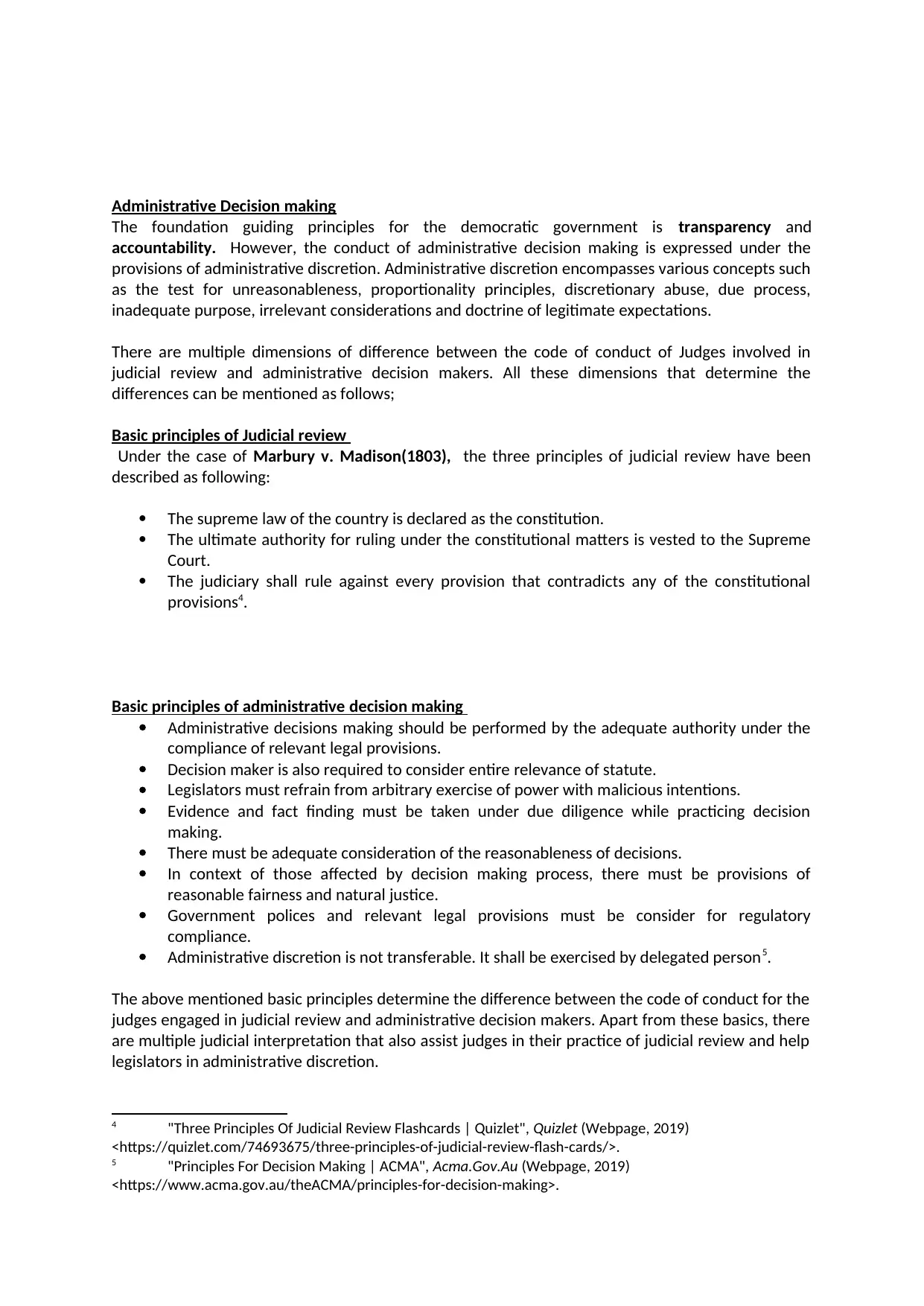
Administrative Decision making
The foundation guiding principles for the democratic government is transparency and
accountability. However, the conduct of administrative decision making is expressed under the
provisions of administrative discretion. Administrative discretion encompasses various concepts such
as the test for unreasonableness, proportionality principles, discretionary abuse, due process,
inadequate purpose, irrelevant considerations and doctrine of legitimate expectations.
There are multiple dimensions of difference between the code of conduct of Judges involved in
judicial review and administrative decision makers. All these dimensions that determine the
differences can be mentioned as follows;
Basic principles of Judicial review
Under the case of Marbury v. Madison(1803), the three principles of judicial review have been
described as following:
The supreme law of the country is declared as the constitution.
The ultimate authority for ruling under the constitutional matters is vested to the Supreme
Court.
The judiciary shall rule against every provision that contradicts any of the constitutional
provisions4.
Basic principles of administrative decision making
Administrative decisions making should be performed by the adequate authority under the
compliance of relevant legal provisions.
Decision maker is also required to consider entire relevance of statute.
Legislators must refrain from arbitrary exercise of power with malicious intentions.
Evidence and fact finding must be taken under due diligence while practicing decision
making.
There must be adequate consideration of the reasonableness of decisions.
In context of those affected by decision making process, there must be provisions of
reasonable fairness and natural justice.
Government polices and relevant legal provisions must be consider for regulatory
compliance.
Administrative discretion is not transferable. It shall be exercised by delegated person5.
The above mentioned basic principles determine the difference between the code of conduct for the
judges engaged in judicial review and administrative decision makers. Apart from these basics, there
are multiple judicial interpretation that also assist judges in their practice of judicial review and help
legislators in administrative discretion.
4 "Three Principles Of Judicial Review Flashcards | Quizlet", Quizlet (Webpage, 2019)
<https://quizlet.com/74693675/three-principles-of-judicial-review-flash-cards/>.
5 "Principles For Decision Making | ACMA", Acma.Gov.Au (Webpage, 2019)
<https://www.acma.gov.au/theACMA/principles-for-decision-making>.
The foundation guiding principles for the democratic government is transparency and
accountability. However, the conduct of administrative decision making is expressed under the
provisions of administrative discretion. Administrative discretion encompasses various concepts such
as the test for unreasonableness, proportionality principles, discretionary abuse, due process,
inadequate purpose, irrelevant considerations and doctrine of legitimate expectations.
There are multiple dimensions of difference between the code of conduct of Judges involved in
judicial review and administrative decision makers. All these dimensions that determine the
differences can be mentioned as follows;
Basic principles of Judicial review
Under the case of Marbury v. Madison(1803), the three principles of judicial review have been
described as following:
The supreme law of the country is declared as the constitution.
The ultimate authority for ruling under the constitutional matters is vested to the Supreme
Court.
The judiciary shall rule against every provision that contradicts any of the constitutional
provisions4.
Basic principles of administrative decision making
Administrative decisions making should be performed by the adequate authority under the
compliance of relevant legal provisions.
Decision maker is also required to consider entire relevance of statute.
Legislators must refrain from arbitrary exercise of power with malicious intentions.
Evidence and fact finding must be taken under due diligence while practicing decision
making.
There must be adequate consideration of the reasonableness of decisions.
In context of those affected by decision making process, there must be provisions of
reasonable fairness and natural justice.
Government polices and relevant legal provisions must be consider for regulatory
compliance.
Administrative discretion is not transferable. It shall be exercised by delegated person5.
The above mentioned basic principles determine the difference between the code of conduct for the
judges engaged in judicial review and administrative decision makers. Apart from these basics, there
are multiple judicial interpretation that also assist judges in their practice of judicial review and help
legislators in administrative discretion.
4 "Three Principles Of Judicial Review Flashcards | Quizlet", Quizlet (Webpage, 2019)
<https://quizlet.com/74693675/three-principles-of-judicial-review-flash-cards/>.
5 "Principles For Decision Making | ACMA", Acma.Gov.Au (Webpage, 2019)
<https://www.acma.gov.au/theACMA/principles-for-decision-making>.

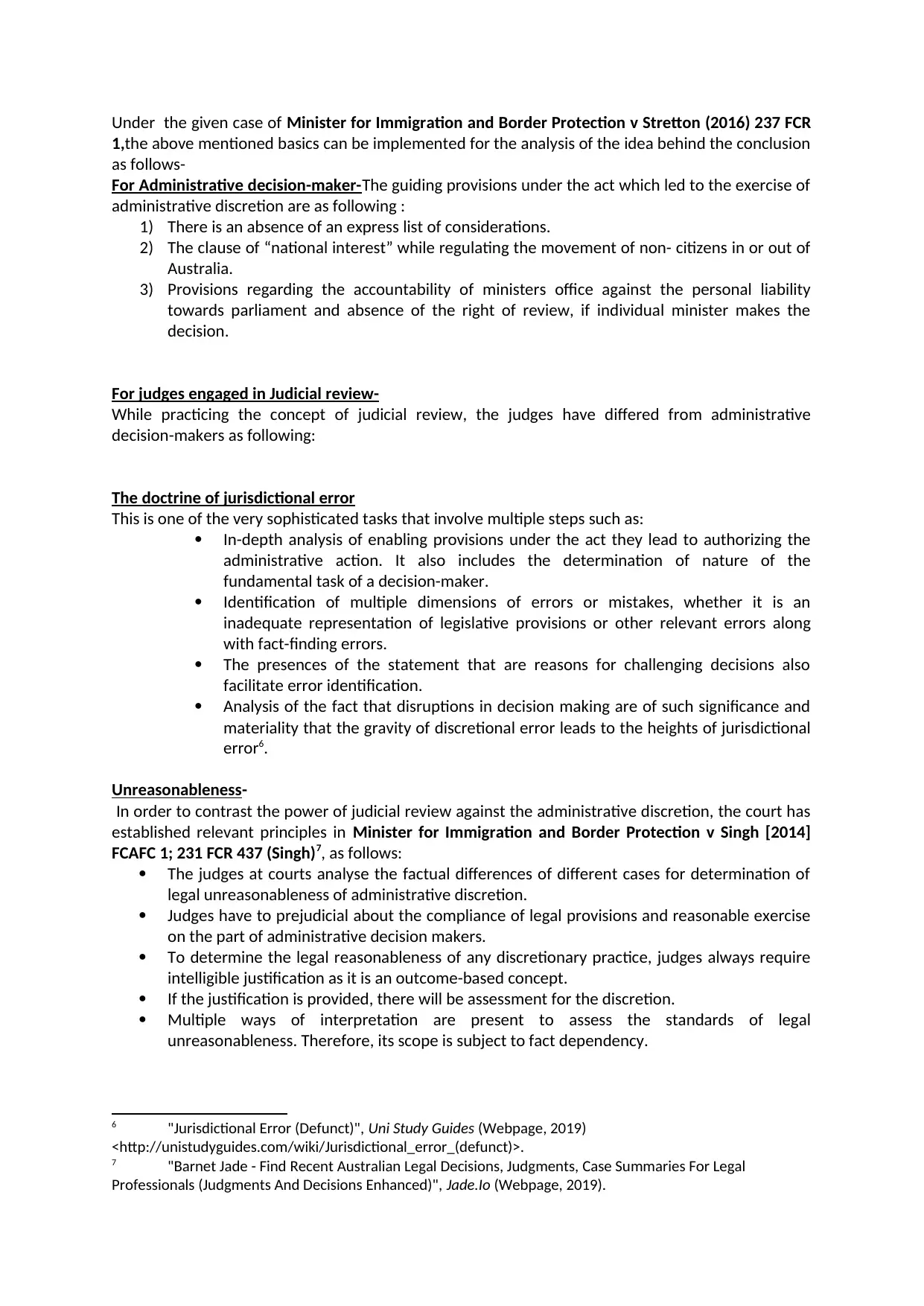
Under the given case of Minister for Immigration and Border Protection v Stretton (2016) 237 FCR
1,the above mentioned basics can be implemented for the analysis of the idea behind the conclusion
as follows-
For Administrative decision-maker-The guiding provisions under the act which led to the exercise of
administrative discretion are as following :
1) There is an absence of an express list of considerations.
2) The clause of “national interest” while regulating the movement of non- citizens in or out of
Australia.
3) Provisions regarding the accountability of ministers office against the personal liability
towards parliament and absence of the right of review, if individual minister makes the
decision.
For judges engaged in Judicial review-
While practicing the concept of judicial review, the judges have differed from administrative
decision-makers as following:
The doctrine of jurisdictional error
This is one of the very sophisticated tasks that involve multiple steps such as:
In-depth analysis of enabling provisions under the act they lead to authorizing the
administrative action. It also includes the determination of nature of the
fundamental task of a decision-maker.
Identification of multiple dimensions of errors or mistakes, whether it is an
inadequate representation of legislative provisions or other relevant errors along
with fact-finding errors.
The presences of the statement that are reasons for challenging decisions also
facilitate error identification.
Analysis of the fact that disruptions in decision making are of such significance and
materiality that the gravity of discretional error leads to the heights of jurisdictional
error6.
Unreasonableness-
In order to contrast the power of judicial review against the administrative discretion, the court has
established relevant principles in Minister for Immigration and Border Protection v Singh [2014]
FCAFC 1; 231 FCR 437 (Singh)7, as follows:
The judges at courts analyse the factual differences of different cases for determination of
legal unreasonableness of administrative discretion.
Judges have to prejudicial about the compliance of legal provisions and reasonable exercise
on the part of administrative decision makers.
To determine the legal reasonableness of any discretionary practice, judges always require
intelligible justification as it is an outcome-based concept.
If the justification is provided, there will be assessment for the discretion.
Multiple ways of interpretation are present to assess the standards of legal
unreasonableness. Therefore, its scope is subject to fact dependency.
6 "Jurisdictional Error (Defunct)", Uni Study Guides (Webpage, 2019)
<http://unistudyguides.com/wiki/Jurisdictional_error_(defunct)>.
7 "Barnet Jade - Find Recent Australian Legal Decisions, Judgments, Case Summaries For Legal
Professionals (Judgments And Decisions Enhanced)", Jade.Io (Webpage, 2019).
1,the above mentioned basics can be implemented for the analysis of the idea behind the conclusion
as follows-
For Administrative decision-maker-The guiding provisions under the act which led to the exercise of
administrative discretion are as following :
1) There is an absence of an express list of considerations.
2) The clause of “national interest” while regulating the movement of non- citizens in or out of
Australia.
3) Provisions regarding the accountability of ministers office against the personal liability
towards parliament and absence of the right of review, if individual minister makes the
decision.
For judges engaged in Judicial review-
While practicing the concept of judicial review, the judges have differed from administrative
decision-makers as following:
The doctrine of jurisdictional error
This is one of the very sophisticated tasks that involve multiple steps such as:
In-depth analysis of enabling provisions under the act they lead to authorizing the
administrative action. It also includes the determination of nature of the
fundamental task of a decision-maker.
Identification of multiple dimensions of errors or mistakes, whether it is an
inadequate representation of legislative provisions or other relevant errors along
with fact-finding errors.
The presences of the statement that are reasons for challenging decisions also
facilitate error identification.
Analysis of the fact that disruptions in decision making are of such significance and
materiality that the gravity of discretional error leads to the heights of jurisdictional
error6.
Unreasonableness-
In order to contrast the power of judicial review against the administrative discretion, the court has
established relevant principles in Minister for Immigration and Border Protection v Singh [2014]
FCAFC 1; 231 FCR 437 (Singh)7, as follows:
The judges at courts analyse the factual differences of different cases for determination of
legal unreasonableness of administrative discretion.
Judges have to prejudicial about the compliance of legal provisions and reasonable exercise
on the part of administrative decision makers.
To determine the legal reasonableness of any discretionary practice, judges always require
intelligible justification as it is an outcome-based concept.
If the justification is provided, there will be assessment for the discretion.
Multiple ways of interpretation are present to assess the standards of legal
unreasonableness. Therefore, its scope is subject to fact dependency.
6 "Jurisdictional Error (Defunct)", Uni Study Guides (Webpage, 2019)
<http://unistudyguides.com/wiki/Jurisdictional_error_(defunct)>.
7 "Barnet Jade - Find Recent Australian Legal Decisions, Judgments, Case Summaries For Legal
Professionals (Judgments And Decisions Enhanced)", Jade.Io (Webpage, 2019).
⊘ This is a preview!⊘
Do you want full access?
Subscribe today to unlock all pages.

Trusted by 1+ million students worldwide

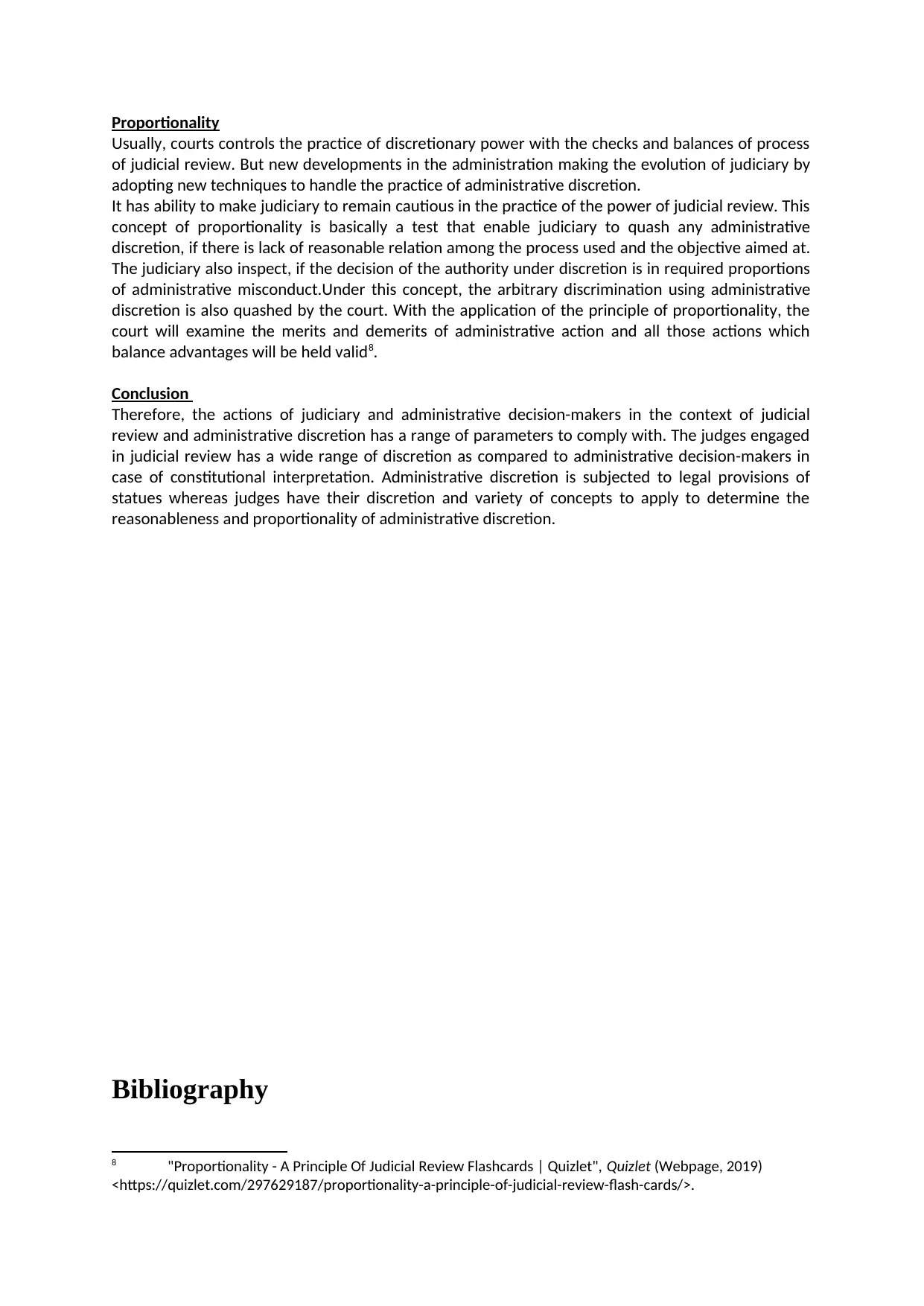
Proportionality
Usually, courts controls the practice of discretionary power with the checks and balances of process
of judicial review. But new developments in the administration making the evolution of judiciary by
adopting new techniques to handle the practice of administrative discretion.
It has ability to make judiciary to remain cautious in the practice of the power of judicial review. This
concept of proportionality is basically a test that enable judiciary to quash any administrative
discretion, if there is lack of reasonable relation among the process used and the objective aimed at.
The judiciary also inspect, if the decision of the authority under discretion is in required proportions
of administrative misconduct.Under this concept, the arbitrary discrimination using administrative
discretion is also quashed by the court. With the application of the principle of proportionality, the
court will examine the merits and demerits of administrative action and all those actions which
balance advantages will be held valid8.
Conclusion
Therefore, the actions of judiciary and administrative decision-makers in the context of judicial
review and administrative discretion has a range of parameters to comply with. The judges engaged
in judicial review has a wide range of discretion as compared to administrative decision-makers in
case of constitutional interpretation. Administrative discretion is subjected to legal provisions of
statues whereas judges have their discretion and variety of concepts to apply to determine the
reasonableness and proportionality of administrative discretion.
Bibliography
8 "Proportionality - A Principle Of Judicial Review Flashcards | Quizlet", Quizlet (Webpage, 2019)
<https://quizlet.com/297629187/proportionality-a-principle-of-judicial-review-flash-cards/>.
Usually, courts controls the practice of discretionary power with the checks and balances of process
of judicial review. But new developments in the administration making the evolution of judiciary by
adopting new techniques to handle the practice of administrative discretion.
It has ability to make judiciary to remain cautious in the practice of the power of judicial review. This
concept of proportionality is basically a test that enable judiciary to quash any administrative
discretion, if there is lack of reasonable relation among the process used and the objective aimed at.
The judiciary also inspect, if the decision of the authority under discretion is in required proportions
of administrative misconduct.Under this concept, the arbitrary discrimination using administrative
discretion is also quashed by the court. With the application of the principle of proportionality, the
court will examine the merits and demerits of administrative action and all those actions which
balance advantages will be held valid8.
Conclusion
Therefore, the actions of judiciary and administrative decision-makers in the context of judicial
review and administrative discretion has a range of parameters to comply with. The judges engaged
in judicial review has a wide range of discretion as compared to administrative decision-makers in
case of constitutional interpretation. Administrative discretion is subjected to legal provisions of
statues whereas judges have their discretion and variety of concepts to apply to determine the
reasonableness and proportionality of administrative discretion.
Bibliography
8 "Proportionality - A Principle Of Judicial Review Flashcards | Quizlet", Quizlet (Webpage, 2019)
<https://quizlet.com/297629187/proportionality-a-principle-of-judicial-review-flash-cards/>.
Paraphrase This Document
Need a fresh take? Get an instant paraphrase of this document with our AI Paraphraser

"Barnet Jade - Find Recent Australian Legal Decisions, Judgments, Case Summaries For
Legal Professionals (Judgments And Decisions Enhanced)", Jade.Io (Webpage, 2019)
<https://jade.io/summary/mnc/2016/FCAFC/11>
"Barnet Jade - Find Recent Australian Legal Decisions, Judgments, Case Summaries For
Legal Professionals (Judgments And Decisions Enhanced)", Jade.Io (Webpage, 2019)
<https://jade.io/summary/mnc/2014/FCAFC/1>
"Judicial Review | Law", Encyclopedia Britannica (Webpage, 2019)
<https://www.britannica.com/topic/judicial-review>
"Jurisdictional Error (Defunct)", Uni Study Guides (Webpage, 2019)
<http://unistudyguides.com/wiki/Jurisdictional_error_(defunct)>
"MIGRATION ACT 1958 - SECT 501Refusal Or Cancellation Of Visa On Character
Grounds", Www5.Austlii.Edu.Au (Webpage, 2019)
<http://www5.austlii.edu.au/au/legis/cth/consol_act/ma1958118/s501.html>
"Principles For Decision Making | ACMA", Acma.Gov.Au (Webpage, 2019)
<https://www.acma.gov.au/theACMA/principles-for-decision-making>
"Proportionality - A Principle Of Judicial Review Flashcards | Quizlet", Quizlet (Webpage,
2019) <https://quizlet.com/297629187/proportionality-a-principle-of-judicial-review-flash-
cards/>
"Three Principles Of Judicial Review Flashcards | Quizlet", Quizlet (Webpage, 2019)
<https://quizlet.com/74693675/three-principles-of-judicial-review-flash-cards/>
Legal Professionals (Judgments And Decisions Enhanced)", Jade.Io (Webpage, 2019)
<https://jade.io/summary/mnc/2016/FCAFC/11>
"Barnet Jade - Find Recent Australian Legal Decisions, Judgments, Case Summaries For
Legal Professionals (Judgments And Decisions Enhanced)", Jade.Io (Webpage, 2019)
<https://jade.io/summary/mnc/2014/FCAFC/1>
"Judicial Review | Law", Encyclopedia Britannica (Webpage, 2019)
<https://www.britannica.com/topic/judicial-review>
"Jurisdictional Error (Defunct)", Uni Study Guides (Webpage, 2019)
<http://unistudyguides.com/wiki/Jurisdictional_error_(defunct)>
"MIGRATION ACT 1958 - SECT 501Refusal Or Cancellation Of Visa On Character
Grounds", Www5.Austlii.Edu.Au (Webpage, 2019)
<http://www5.austlii.edu.au/au/legis/cth/consol_act/ma1958118/s501.html>
"Principles For Decision Making | ACMA", Acma.Gov.Au (Webpage, 2019)
<https://www.acma.gov.au/theACMA/principles-for-decision-making>
"Proportionality - A Principle Of Judicial Review Flashcards | Quizlet", Quizlet (Webpage,
2019) <https://quizlet.com/297629187/proportionality-a-principle-of-judicial-review-flash-
cards/>
"Three Principles Of Judicial Review Flashcards | Quizlet", Quizlet (Webpage, 2019)
<https://quizlet.com/74693675/three-principles-of-judicial-review-flash-cards/>
1 out of 5
Related Documents
Your All-in-One AI-Powered Toolkit for Academic Success.
+13062052269
info@desklib.com
Available 24*7 on WhatsApp / Email
Unlock your academic potential
Copyright © 2020–2025 A2Z Services. All Rights Reserved. Developed and managed by ZUCOL.