Discovery Centre Design: Floor Plan and Activities for 5-Year-Olds
VerifiedAdded on 2023/06/11
|9
|1480
|307
Practical Assignment
AI Summary
This assignment outlines the design of a Discovery Centre tailored for 5-year-old children (K1 students), including a detailed floor plan and wall space design with a rationale for creating a safe and conducive learning environment. It includes two engaging learning activities focused on the frog life cycle and plant life cycle, explaining how these activities are developmentally appropriate and promote process skills. The activity plans detail learning objectives, materials, activity descriptions, and scripts for introducing the activities to children, emphasizing visual and kinesthetic learning. The report concludes that engaging activities are essential for developing children's mental capabilities and promoting collaborative learning.

Discovery of
the World
Individual
assignment
1
the World
Individual
assignment
1

Paraphrase This Document
Need a fresh take? Get an instant paraphrase of this document with our AI Paraphraser
Contents
INTRODUCTION...........................................................................................................................3
MAIN BODY...................................................................................................................................3
Rationale for floor and wall space design..............................................................................3
Activity Plan Template 1........................................................................................................4
Activity Plan Template 2........................................................................................................6
CONCLUSION................................................................................................................................8
REFRENCES...................................................................................................................................9
2
INTRODUCTION...........................................................................................................................3
MAIN BODY...................................................................................................................................3
Rationale for floor and wall space design..............................................................................3
Activity Plan Template 1........................................................................................................4
Activity Plan Template 2........................................................................................................6
CONCLUSION................................................................................................................................8
REFRENCES...................................................................................................................................9
2
INTRODUCTION
Participation of children in various outdoor activities during their school time is
important for their mental and physical growth as they are able to collaborate with their peers to
understand various learning concepts and develop social skills (Mathieu, 2021). This report
provides a floor plan design along with wall plan design find activities to be conducted in the
discovery center. In addition to this activity plan for two activities to be conducted in the
discovery center are also provided in this report.
MAIN BODY
Rationale for floor and wall space design
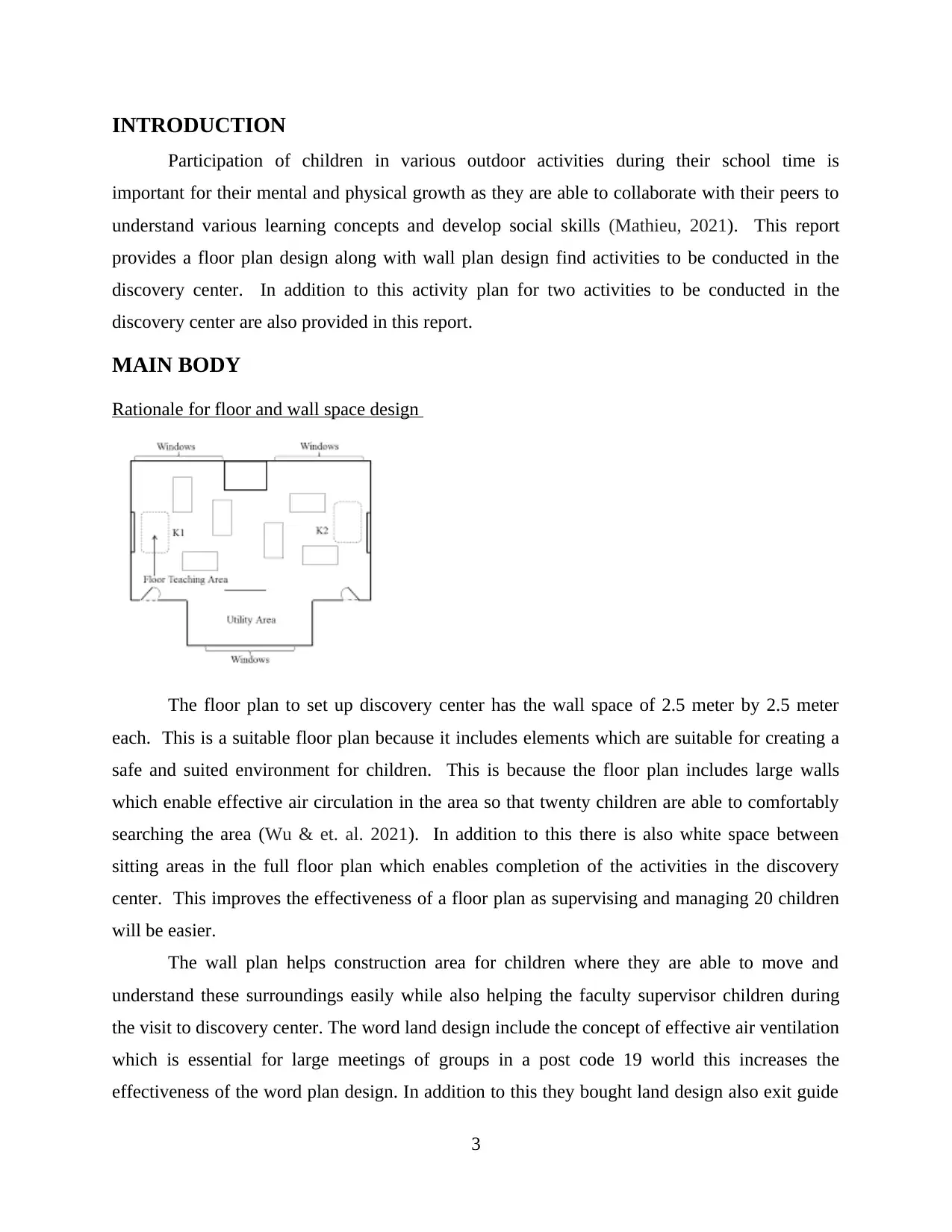
The floor plan to set up discovery center has the wall space of 2.5 meter by 2.5 meter
each. This is a suitable floor plan because it includes elements which are suitable for creating a
safe and suited environment for children. This is because the floor plan includes large walls
which enable effective air circulation in the area so that twenty children are able to comfortably
searching the area (Wu & et. al. 2021). In addition to this there is also white space between
sitting areas in the full floor plan which enables completion of the activities in the discovery
center. This improves the effectiveness of a floor plan as supervising and managing 20 children
will be easier.
The wall plan helps construction area for children where they are able to move and
understand these surroundings easily while also helping the faculty supervisor children during
the visit to discovery center. The word land design include the concept of effective air ventilation
which is essential for large meetings of groups in a post code 19 world this increases the
effectiveness of the word plan design. In addition to this they bought land design also exit guide
3
Participation of children in various outdoor activities during their school time is
important for their mental and physical growth as they are able to collaborate with their peers to
understand various learning concepts and develop social skills (Mathieu, 2021). This report
provides a floor plan design along with wall plan design find activities to be conducted in the
discovery center. In addition to this activity plan for two activities to be conducted in the
discovery center are also provided in this report.
MAIN BODY
Rationale for floor and wall space design
The floor plan to set up discovery center has the wall space of 2.5 meter by 2.5 meter
each. This is a suitable floor plan because it includes elements which are suitable for creating a
safe and suited environment for children. This is because the floor plan includes large walls
which enable effective air circulation in the area so that twenty children are able to comfortably
searching the area (Wu & et. al. 2021). In addition to this there is also white space between
sitting areas in the full floor plan which enables completion of the activities in the discovery
center. This improves the effectiveness of a floor plan as supervising and managing 20 children
will be easier.
The wall plan helps construction area for children where they are able to move and
understand these surroundings easily while also helping the faculty supervisor children during
the visit to discovery center. The word land design include the concept of effective air ventilation
which is essential for large meetings of groups in a post code 19 world this increases the
effectiveness of the word plan design. In addition to this they bought land design also exit guide
3
⊘ This is a preview!⊘
Do you want full access?
Subscribe today to unlock all pages.

Trusted by 1+ million students worldwide
for effectively implementing both the war plan design and floor space design which is suitable
for timely completion of the activities in the discovery center.
Activity Plan Template 1
Topic / Theme: Frog life cycle (Continuity and change)
Name of the activity: Life and nature Age group of children: 5 years old / K1
Rationale: The reason for using frog life cycle as the activity which will be completed in the
study centre is that it will help students develop on the idea provided in the first assessment by
focusing on animal life cycle. This children will be able to understand the concept of
metamorphosis after looking at the example of frog life cycle and applying their knowledge
previously gained from assignment one and the activity surrounding the butterfly life cycle. This
is because visual and kinaesthetic learning style are suitable for young children (Law & et. al..
2021).
Learning objective(s): Children will be able to
To learn about life-cycle of frog
To understand the concept of metamorphosis
To learn about animal transformation
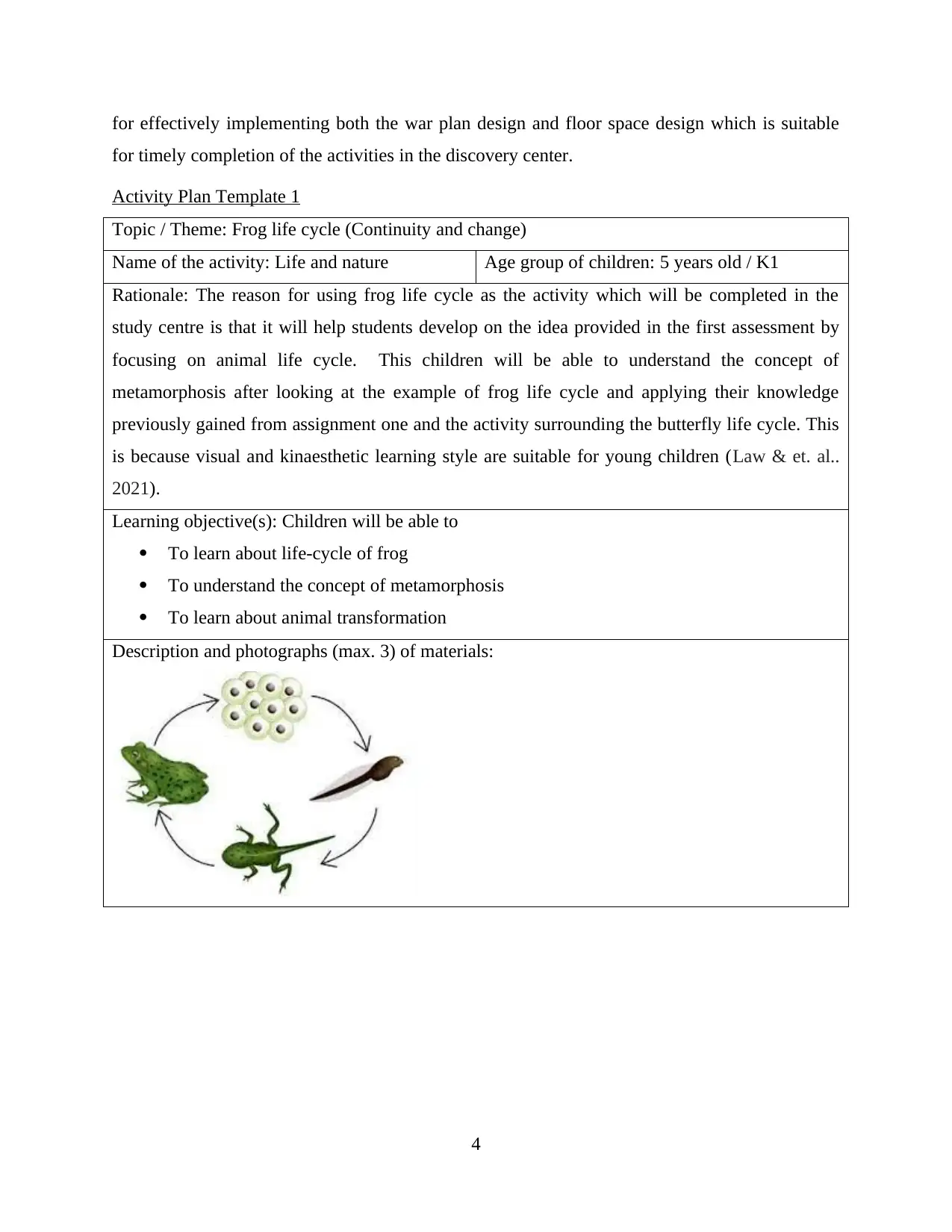
Description and photographs (max. 3) of materials:
4
for timely completion of the activities in the discovery center.
Activity Plan Template 1
Topic / Theme: Frog life cycle (Continuity and change)
Name of the activity: Life and nature Age group of children: 5 years old / K1
Rationale: The reason for using frog life cycle as the activity which will be completed in the
study centre is that it will help students develop on the idea provided in the first assessment by
focusing on animal life cycle. This children will be able to understand the concept of
metamorphosis after looking at the example of frog life cycle and applying their knowledge
previously gained from assignment one and the activity surrounding the butterfly life cycle. This
is because visual and kinaesthetic learning style are suitable for young children (Law & et. al..
2021).
Learning objective(s): Children will be able to
To learn about life-cycle of frog
To understand the concept of metamorphosis
To learn about animal transformation
Description and photographs (max. 3) of materials:
4
Paraphrase This Document
Need a fresh take? Get an instant paraphrase of this document with our AI Paraphraser
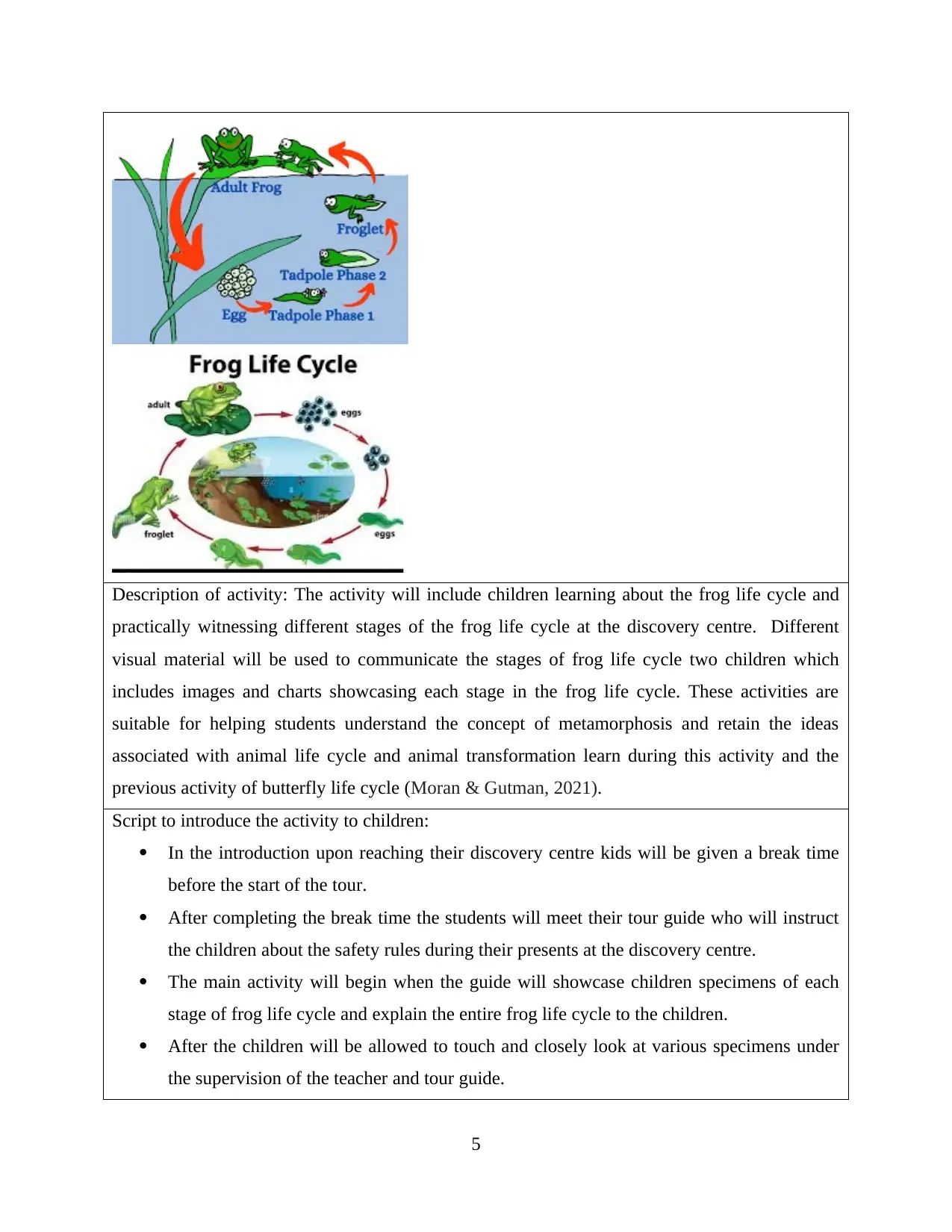
Description of activity: The activity will include children learning about the frog life cycle and
practically witnessing different stages of the frog life cycle at the discovery centre. Different
visual material will be used to communicate the stages of frog life cycle two children which
includes images and charts showcasing each stage in the frog life cycle. These activities are
suitable for helping students understand the concept of metamorphosis and retain the ideas
associated with animal life cycle and animal transformation learn during this activity and the
previous activity of butterfly life cycle (Moran & Gutman, 2021).
Script to introduce the activity to children:
In the introduction upon reaching their discovery centre kids will be given a break time
before the start of the tour.
After completing the break time the students will meet their tour guide who will instruct
the children about the safety rules during their presents at the discovery centre.
The main activity will begin when the guide will showcase children specimens of each
stage of frog life cycle and explain the entire frog life cycle to the children.
After the children will be allowed to touch and closely look at various specimens under
the supervision of the teacher and tour guide.
5
practically witnessing different stages of the frog life cycle at the discovery centre. Different
visual material will be used to communicate the stages of frog life cycle two children which
includes images and charts showcasing each stage in the frog life cycle. These activities are
suitable for helping students understand the concept of metamorphosis and retain the ideas
associated with animal life cycle and animal transformation learn during this activity and the
previous activity of butterfly life cycle (Moran & Gutman, 2021).
Script to introduce the activity to children:
In the introduction upon reaching their discovery centre kids will be given a break time
before the start of the tour.
After completing the break time the students will meet their tour guide who will instruct
the children about the safety rules during their presents at the discovery centre.
The main activity will begin when the guide will showcase children specimens of each
stage of frog life cycle and explain the entire frog life cycle to the children.
After the children will be allowed to touch and closely look at various specimens under
the supervision of the teacher and tour guide.
5
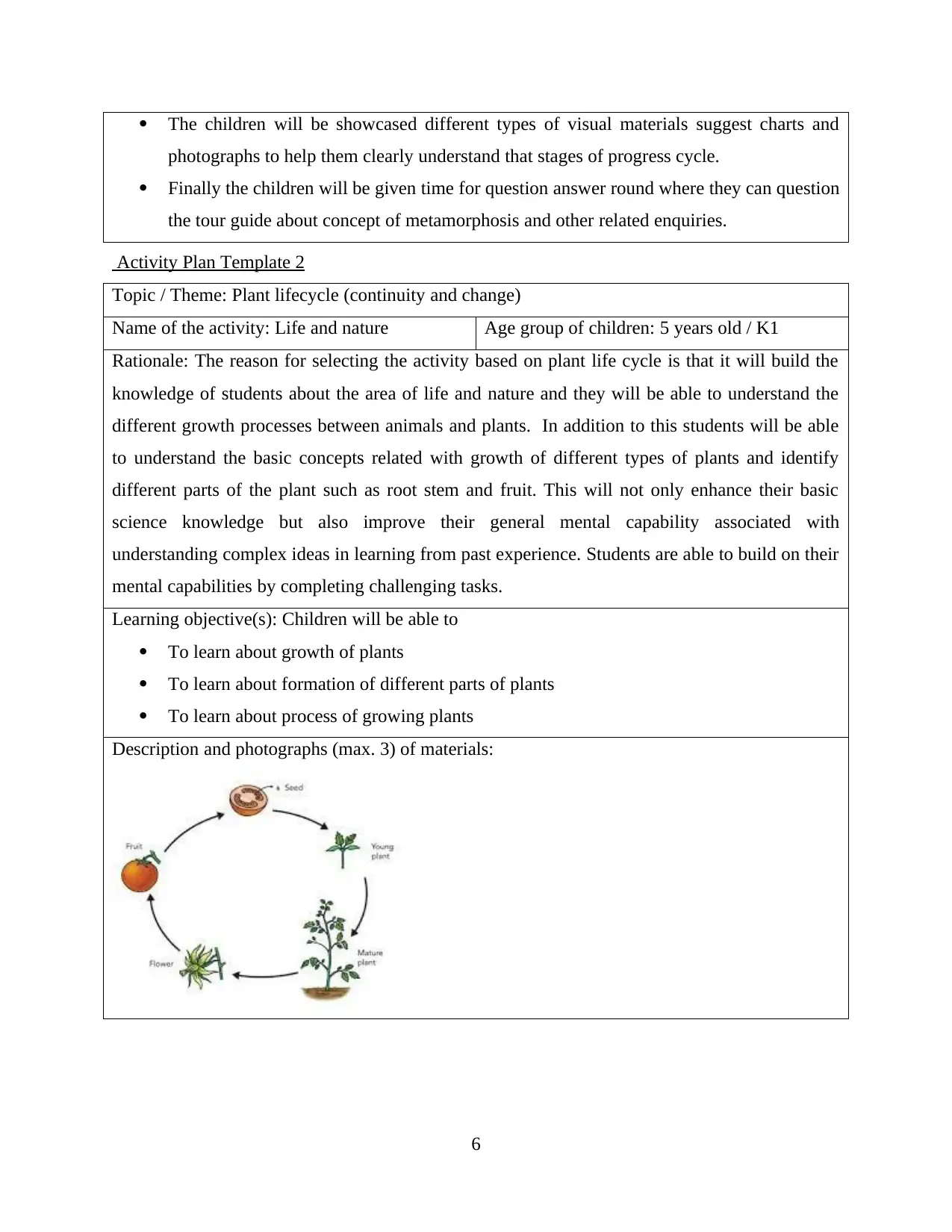
The children will be showcased different types of visual materials suggest charts and
photographs to help them clearly understand that stages of progress cycle.
Finally the children will be given time for question answer round where they can question
the tour guide about concept of metamorphosis and other related enquiries.
Activity Plan Template 2
Topic / Theme: Plant lifecycle (continuity and change)
Name of the activity: Life and nature Age group of children: 5 years old / K1
Rationale: The reason for selecting the activity based on plant life cycle is that it will build the
knowledge of students about the area of life and nature and they will be able to understand the
different growth processes between animals and plants. In addition to this students will be able
to understand the basic concepts related with growth of different types of plants and identify
different parts of the plant such as root stem and fruit. This will not only enhance their basic
science knowledge but also improve their general mental capability associated with
understanding complex ideas in learning from past experience. Students are able to build on their
mental capabilities by completing challenging tasks.
Learning objective(s): Children will be able to
To learn about growth of plants
To learn about formation of different parts of plants
To learn about process of growing plants
Description and photographs (max. 3) of materials:
6
photographs to help them clearly understand that stages of progress cycle.
Finally the children will be given time for question answer round where they can question
the tour guide about concept of metamorphosis and other related enquiries.
Activity Plan Template 2
Topic / Theme: Plant lifecycle (continuity and change)
Name of the activity: Life and nature Age group of children: 5 years old / K1
Rationale: The reason for selecting the activity based on plant life cycle is that it will build the
knowledge of students about the area of life and nature and they will be able to understand the
different growth processes between animals and plants. In addition to this students will be able
to understand the basic concepts related with growth of different types of plants and identify
different parts of the plant such as root stem and fruit. This will not only enhance their basic
science knowledge but also improve their general mental capability associated with
understanding complex ideas in learning from past experience. Students are able to build on their
mental capabilities by completing challenging tasks.
Learning objective(s): Children will be able to
To learn about growth of plants
To learn about formation of different parts of plants
To learn about process of growing plants
Description and photographs (max. 3) of materials:
6
⊘ This is a preview!⊘
Do you want full access?
Subscribe today to unlock all pages.
Trusted by 1+ million students worldwide
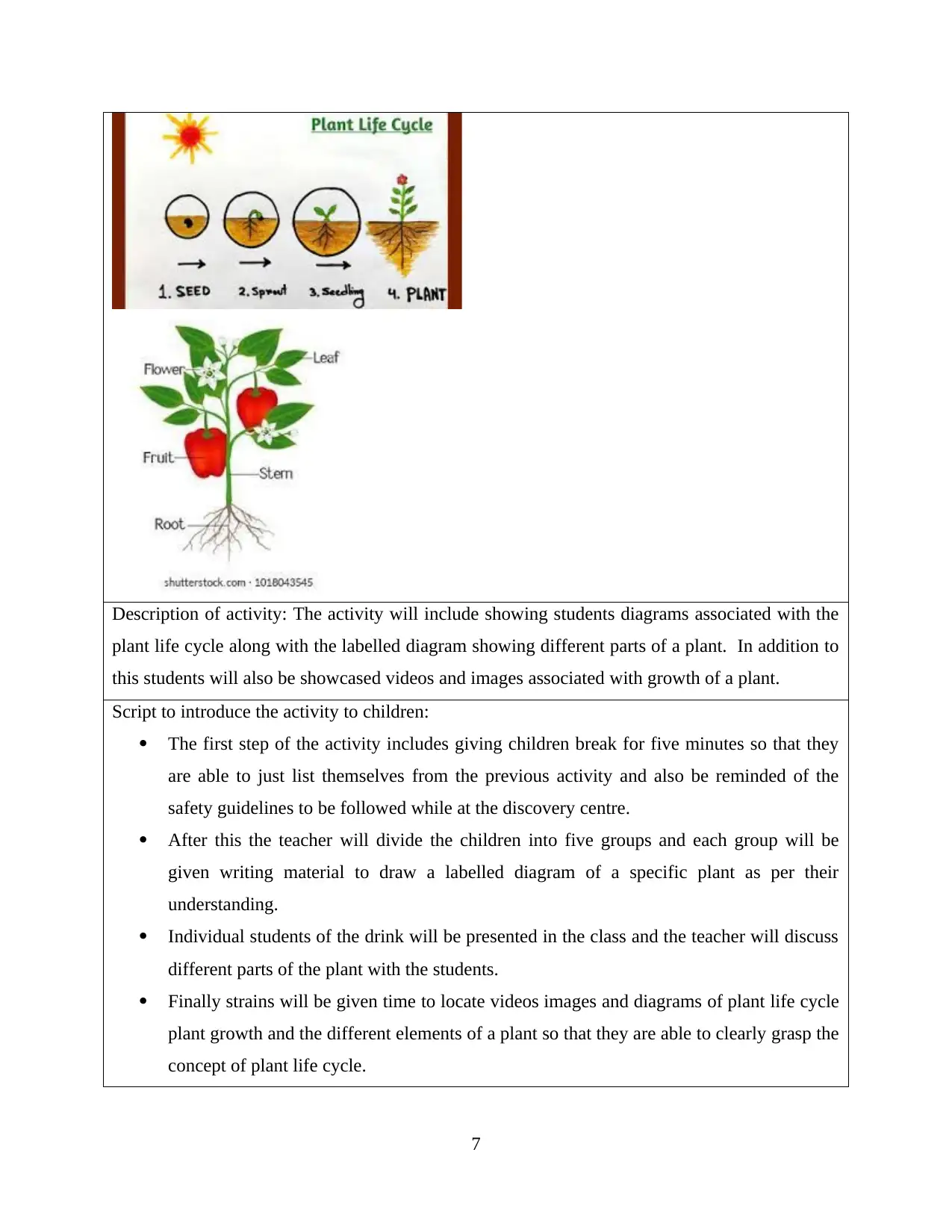
Description of activity: The activity will include showing students diagrams associated with the
plant life cycle along with the labelled diagram showing different parts of a plant. In addition to
this students will also be showcased videos and images associated with growth of a plant.
Script to introduce the activity to children:
The first step of the activity includes giving children break for five minutes so that they
are able to just list themselves from the previous activity and also be reminded of the
safety guidelines to be followed while at the discovery centre.
After this the teacher will divide the children into five groups and each group will be
given writing material to draw a labelled diagram of a specific plant as per their
understanding.
Individual students of the drink will be presented in the class and the teacher will discuss
different parts of the plant with the students.
Finally strains will be given time to locate videos images and diagrams of plant life cycle
plant growth and the different elements of a plant so that they are able to clearly grasp the
concept of plant life cycle.
7
plant life cycle along with the labelled diagram showing different parts of a plant. In addition to
this students will also be showcased videos and images associated with growth of a plant.
Script to introduce the activity to children:
The first step of the activity includes giving children break for five minutes so that they
are able to just list themselves from the previous activity and also be reminded of the
safety guidelines to be followed while at the discovery centre.
After this the teacher will divide the children into five groups and each group will be
given writing material to draw a labelled diagram of a specific plant as per their
understanding.
Individual students of the drink will be presented in the class and the teacher will discuss
different parts of the plant with the students.
Finally strains will be given time to locate videos images and diagrams of plant life cycle
plant growth and the different elements of a plant so that they are able to clearly grasp the
concept of plant life cycle.
7
Paraphrase This Document
Need a fresh take? Get an instant paraphrase of this document with our AI Paraphraser
CONCLUSION
From the above report it is determined that it is essential for students to develop mental
capabilities through engaging activities so that they are able to actively participate in learning
opportunities. This can be completed by developing creative activities which help students learn
in a collaborative manner. This can be completed by using an activity plan template so that the
learning objectives of the activity are determined beforehand is going to be so timely completion
of the activities.
8
From the above report it is determined that it is essential for students to develop mental
capabilities through engaging activities so that they are able to actively participate in learning
opportunities. This can be completed by developing creative activities which help students learn
in a collaborative manner. This can be completed by using an activity plan template so that the
learning objectives of the activity are determined beforehand is going to be so timely completion
of the activities.
8
REFRENCES
Books and Journals
Mathieu, S. (2021). Unpacking the Childcare and Education Policy Response to the COVID-19
Pandemic: Insights from the Canadian Province of Quebec. Journal of Childhood
Studies, 63-78.
Wu & et. al. (2021). Indoor mapping and modeling by parsing floor plan images. International
Journal of Geographical Information Science, 35(6), 1205-1231.
Law & et. al.. (2021). Tele‐practice for children and young people with communication
disabilities: Employing the COM‐B model to review the intervention literature and
inform guidance for practitioners. International Journal of Language & Communication
Disorders, 56(2), 415-434.
Moran, R., & Gutman, L. M. (2021). Mental health training to improve communication with
children and adolescents: A process evaluation. Journal of Clinical Nursing, 30(3-4),
415-432.
9
Books and Journals
Mathieu, S. (2021). Unpacking the Childcare and Education Policy Response to the COVID-19
Pandemic: Insights from the Canadian Province of Quebec. Journal of Childhood
Studies, 63-78.
Wu & et. al. (2021). Indoor mapping and modeling by parsing floor plan images. International
Journal of Geographical Information Science, 35(6), 1205-1231.
Law & et. al.. (2021). Tele‐practice for children and young people with communication
disabilities: Employing the COM‐B model to review the intervention literature and
inform guidance for practitioners. International Journal of Language & Communication
Disorders, 56(2), 415-434.
Moran, R., & Gutman, L. M. (2021). Mental health training to improve communication with
children and adolescents: A process evaluation. Journal of Clinical Nursing, 30(3-4),
415-432.
9
⊘ This is a preview!⊘
Do you want full access?
Subscribe today to unlock all pages.
Trusted by 1+ million students worldwide

1 out of 9


Your All-in-One AI-Powered Toolkit for Academic Success.
+13062052269
info@desklib.com
Available 24*7 on WhatsApp / Email
![[object Object]](/_next/static/media/star-bottom.7253800d.svg)
Unlock your academic potential
Copyright © 2020–2026 A2Z Services. All Rights Reserved. Developed and managed by ZUCOL.