Financial Management and Longevity: Kajima Corporation Case Study
VerifiedAdded on 2023/06/05
|10
|2451
|478
Case Study
AI Summary
This case study delves into the financial management of Kajima Corporation, a long-standing Japanese construction company owned and controlled by the Kajima family since its founding in 1840. It examines the family's history, ownership structure, and governance practices, highlighting how the first-born son typically inherits leadership roles. The analysis covers the distribution of profits, voting rights, and the involvement of various stakeholders in management. It also discusses factors contributing to the company's longevity, such as a commitment to quality construction, long-term portfolio views, and maintaining a reputation for trustworthiness. The study provides insights into how Kajima Corporation's unique family-oriented approach has shaped its financial strategies and sustained its success over generations. Desklib offers this and many other solved assignments for students.

Running head:FINANCIAL MANAGEMENT OF FAMILY BUSINESS1
Kajima Corporation: Japan Construction Company
Name of the student:
Name of the University:
Authors Note:
Kajima Corporation: Japan Construction Company
Name of the student:
Name of the University:
Authors Note:

Paraphrase This Document
Need a fresh take? Get an instant paraphrase of this document with our AI Paraphraser
1FINANCIAL MANAGEMENT OF FAMILY BUSINESS
Introduction
Kajima Corporation is a construction company located in Japan. The company is owned by
the family and was founded in the year of 1840; it has its headquarters located in
"Motoakasaka, Minato, and Tokyo”. The company is best known for "DIB-200" proposal
(Binder, 2006).
History of the family
History of the family refers to social history branch which deals with sociocultural evolution
for kinship groups starting from historic or pre-historic to the modern times. Families have
basic and universal roles to play within the society (Schilling, 2008).
The family of Kajima has roots in Tokorozawa city, Saitama prefecture. Initially the family
was having a humble background but because of Iwakichi it is one of the greatest families in
the world. The founder of Kajima Company of family, Iwakichi kajima was born in the year
of 1816 in today's "Tokorozawa city, Saitama prefecture". Iwakichi kajima trained in
carpentry within Yotsuya district in Edo currently known as Tokyo(Schilling, 2008). He
obtained a master's carpentry certificate and within the year of 1840 he established a
carpentry shop within Edo.As a family, the inheritance of the property is conducted in the
format that the first born is the one responsible for the inheritance of the family property
(Kajima Corporation, 2014). The same applies to Kajima Corporation, it’s only the first born
who inherit the company property.
The company is characterized by this history, it was begun by IwakichiKajima as a carpentry
business with Edo presently known as Tokyo in the year of 1840(Binder, 2006). The family
extended its services in 1860 through carrying out there first western-style building within
Yokohama (Ei-Ichiban Kan); in the year 1880, the family established Kajima Gumi (Kajima
Introduction
Kajima Corporation is a construction company located in Japan. The company is owned by
the family and was founded in the year of 1840; it has its headquarters located in
"Motoakasaka, Minato, and Tokyo”. The company is best known for "DIB-200" proposal
(Binder, 2006).
History of the family
History of the family refers to social history branch which deals with sociocultural evolution
for kinship groups starting from historic or pre-historic to the modern times. Families have
basic and universal roles to play within the society (Schilling, 2008).
The family of Kajima has roots in Tokorozawa city, Saitama prefecture. Initially the family
was having a humble background but because of Iwakichi it is one of the greatest families in
the world. The founder of Kajima Company of family, Iwakichi kajima was born in the year
of 1816 in today's "Tokorozawa city, Saitama prefecture". Iwakichi kajima trained in
carpentry within Yotsuya district in Edo currently known as Tokyo(Schilling, 2008). He
obtained a master's carpentry certificate and within the year of 1840 he established a
carpentry shop within Edo.As a family, the inheritance of the property is conducted in the
format that the first born is the one responsible for the inheritance of the family property
(Kajima Corporation, 2014). The same applies to Kajima Corporation, it’s only the first born
who inherit the company property.
The company is characterized by this history, it was begun by IwakichiKajima as a carpentry
business with Edo presently known as Tokyo in the year of 1840(Binder, 2006). The family
extended its services in 1860 through carrying out there first western-style building within
Yokohama (Ei-Ichiban Kan); in the year 1880, the family established Kajima Gumi (Kajima
2FINANCIAL MANAGEMENT OF FAMILY BUSINESS
corporation, 2014). The family also established Railway construction projects in Taiwan and
Korea in the year of 1899; the family company also participates in reconstruction works due
to Great "Kanto earthquake" in the year of 1923(Binder, 2006). In the year of 1945 the
family company participates in post-war reconstruction (Kajima Corporation, 2014). The
family company has participated in the construction of a number of projects till the year of
2011 of recent when it completes Dubai Metro (Callaghan, 2016).
Family tree for Kajima
The family tree of kajiima is represented in the format such that the oldest generation is the
one to appear at the top while the new generation of the family appears at the bottom of the
tree(Binder, 2006). It also represents ancestry of the family closely to resemblance of a tree
where the top is wider than the bottom (Binder, 2006). Kajima ancestry charts of an
individual family tree appear to the left while his ancestors on the right (Kajima Corporation,
2014).
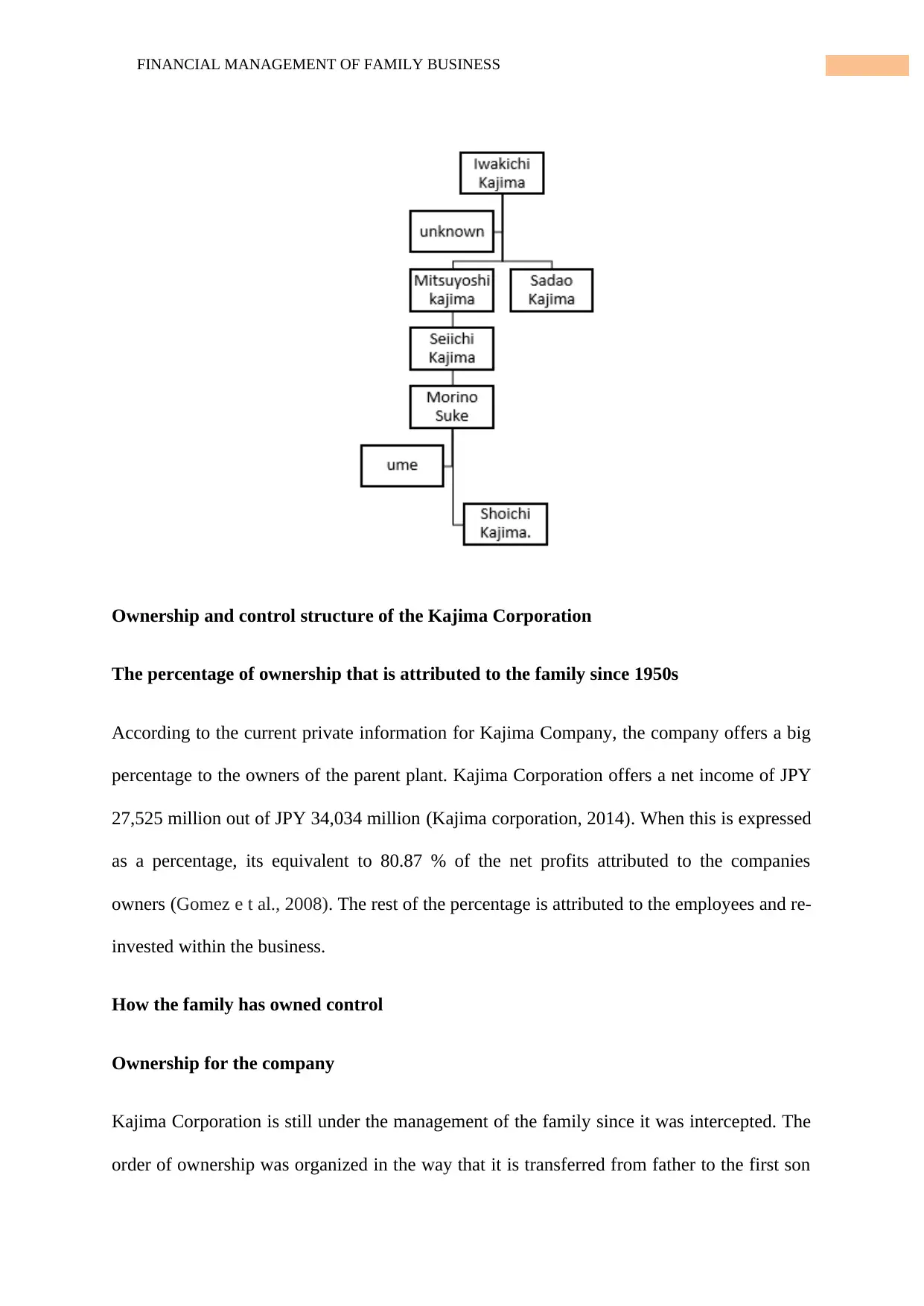
Kajima family consists of the following people;
Kajima family trees possess many themes. One of these themes encompass direct descents for
a single figure, commonly known as the ancestors for the living person (Kajima Corporation,
2014). The second theme includes members of the particular surname. consists of members
holding a certain office (Deslandes, 2014).
Diagram representing a family tree of kajima
corporation, 2014). The family also established Railway construction projects in Taiwan and
Korea in the year of 1899; the family company also participates in reconstruction works due
to Great "Kanto earthquake" in the year of 1923(Binder, 2006). In the year of 1945 the
family company participates in post-war reconstruction (Kajima Corporation, 2014). The
family company has participated in the construction of a number of projects till the year of
2011 of recent when it completes Dubai Metro (Callaghan, 2016).
Family tree for Kajima
The family tree of kajiima is represented in the format such that the oldest generation is the
one to appear at the top while the new generation of the family appears at the bottom of the
tree(Binder, 2006). It also represents ancestry of the family closely to resemblance of a tree
where the top is wider than the bottom (Binder, 2006). Kajima ancestry charts of an
individual family tree appear to the left while his ancestors on the right (Kajima Corporation,
2014).
Kajima family consists of the following people;
Kajima family trees possess many themes. One of these themes encompass direct descents for
a single figure, commonly known as the ancestors for the living person (Kajima Corporation,
2014). The second theme includes members of the particular surname. consists of members
holding a certain office (Deslandes, 2014).
Diagram representing a family tree of kajima
⊘ This is a preview!⊘
Do you want full access?
Subscribe today to unlock all pages.

Trusted by 1+ million students worldwide
3FINANCIAL MANAGEMENT OF FAMILY BUSINESS
Ownership and control structure of the Kajima Corporation
The percentage of ownership that is attributed to the family since 1950s
According to the current private information for Kajima Company, the company offers a big
percentage to the owners of the parent plant. Kajima Corporation offers a net income of JPY
27,525 million out of JPY 34,034 million (Kajima corporation, 2014). When this is expressed
as a percentage, its equivalent to 80.87 % of the net profits attributed to the companies
owners (Gomez e t al., 2008). The rest of the percentage is attributed to the employees and re-
invested within the business.
How the family has owned control
Ownership for the company
Kajima Corporation is still under the management of the family since it was intercepted. The
order of ownership was organized in the way that it is transferred from father to the first son
Ownership and control structure of the Kajima Corporation
The percentage of ownership that is attributed to the family since 1950s
According to the current private information for Kajima Company, the company offers a big
percentage to the owners of the parent plant. Kajima Corporation offers a net income of JPY
27,525 million out of JPY 34,034 million (Kajima corporation, 2014). When this is expressed
as a percentage, its equivalent to 80.87 % of the net profits attributed to the companies
owners (Gomez e t al., 2008). The rest of the percentage is attributed to the employees and re-
invested within the business.
How the family has owned control
Ownership for the company
Kajima Corporation is still under the management of the family since it was intercepted. The
order of ownership was organized in the way that it is transferred from father to the first son
Paraphrase This Document
Need a fresh take? Get an instant paraphrase of this document with our AI Paraphraser
4FINANCIAL MANAGEMENT OF FAMILY BUSINESS
(Kajima Corporation, 2014). However several year back or ago, Seiichi Kajima's marriage
gave no sons, the daughter known as Ume got married to Morino Suke who was a scholar and
career diplomat, he was adopted and brought into the family and he acquired the name
Kajima(Gomez e t al., 2008). Currently, his first son known as Shoichi Kajima is the
president of the company while at the same time the brother-in-law for both the company
honorary chairman and company chairman (Gomez e t al., 2008)
Voting and selections of leaders
The top leaders within Kajima Corporation are not voted by common employees, they are
hereditary where first sons are chosen as the president of the corporation (Kajima
Corporation, 2014). For example Sochi Kajima was is the current president of the corporation
after his father was adopted into the family of Kajima after getting married to the daughter of
Seiichi Kajima(Gomez e t al., 2008). The board of directors always meet monthly at least
once so as to have discussions and decisions about the different management policies(Gomez
e t al., 2008). In these meetings they always make decisions on which employees are better
than the others such that they are granted promotion and be leading the rest(Kajima
Corporation, 2014). The board of directors are also responsible for supervising the executions
of the business as well as confirmation of the progress of the management plans(Binder,
2006). .
Special Voting rights
There are special voting rights within the company and these are granted to the board of
managers which is responsible for carrying out all the selection of leaders in the
organization(Binder, 2006).
Participation management
(Kajima Corporation, 2014). However several year back or ago, Seiichi Kajima's marriage
gave no sons, the daughter known as Ume got married to Morino Suke who was a scholar and
career diplomat, he was adopted and brought into the family and he acquired the name
Kajima(Gomez e t al., 2008). Currently, his first son known as Shoichi Kajima is the
president of the company while at the same time the brother-in-law for both the company
honorary chairman and company chairman (Gomez e t al., 2008)
Voting and selections of leaders
The top leaders within Kajima Corporation are not voted by common employees, they are
hereditary where first sons are chosen as the president of the corporation (Kajima
Corporation, 2014). For example Sochi Kajima was is the current president of the corporation
after his father was adopted into the family of Kajima after getting married to the daughter of
Seiichi Kajima(Gomez e t al., 2008). The board of directors always meet monthly at least
once so as to have discussions and decisions about the different management policies(Gomez
e t al., 2008). In these meetings they always make decisions on which employees are better
than the others such that they are granted promotion and be leading the rest(Kajima
Corporation, 2014). The board of directors are also responsible for supervising the executions
of the business as well as confirmation of the progress of the management plans(Binder,
2006). .
Special Voting rights
There are special voting rights within the company and these are granted to the board of
managers which is responsible for carrying out all the selection of leaders in the
organization(Binder, 2006).
Participation management
5FINANCIAL MANAGEMENT OF FAMILY BUSINESS
There are different individuals who actively and passively carryout the management of the
corporation or participate in the corporation management(Kajima corporation, 2014). Some
of the individuals who actively participate in the management of the corporation are the board
of directors and the chosen leaders(Binder, 2006). Individuals who passively participate in
the management of the corporation are the different shareholders, government as well as the
customers who are offered services(Kajima Corporation, 2014).
Call option
The use of call option is to raise revenue for the Investors(Kajima Corporation, 2014). Calls
are always bought when investors think the existing price share for the underlying security is
rising; they do either sell a call if they expect a fall(Gomez e t al., 2008). Put options are
giving shareholders rights of selling underlying assets at a given price(Kajima Corporation,
2014). The call option for this company is very favourable to the investors since at a few
times do they sell a call(Binder, 2006).
Management structure of the firm
The management of Kajima is similar to that of other Family owned business. The business is
characterized with the following structure where all the top most leaders are family members.
The company is led by the board of directors which comprises of nine leaders or members.
The uppermost leader of the corporation is the Chairman representative
Director(SadaoUmeda) and is the supreme leader of the board. The second board member is
President Representative Director (Mitsuyoshi Nakamura)(Kajima Corporation, 2014). The
third board member is the Director senior Advisor(Shoichi kajima), the fourth board member
is representative director executive vice president(Naoki Atsumi), and the firth board member
is Representative Director and executive vice president (Hiroshi Kaneko). Sixth board
member is the representative director, executive vice president (TamiharuTashiro), another
There are different individuals who actively and passively carryout the management of the
corporation or participate in the corporation management(Kajima corporation, 2014). Some
of the individuals who actively participate in the management of the corporation are the board
of directors and the chosen leaders(Binder, 2006). Individuals who passively participate in
the management of the corporation are the different shareholders, government as well as the
customers who are offered services(Kajima Corporation, 2014).
Call option
The use of call option is to raise revenue for the Investors(Kajima Corporation, 2014). Calls
are always bought when investors think the existing price share for the underlying security is
rising; they do either sell a call if they expect a fall(Gomez e t al., 2008). Put options are
giving shareholders rights of selling underlying assets at a given price(Kajima Corporation,
2014). The call option for this company is very favourable to the investors since at a few
times do they sell a call(Binder, 2006).
Management structure of the firm
The management of Kajima is similar to that of other Family owned business. The business is
characterized with the following structure where all the top most leaders are family members.
The company is led by the board of directors which comprises of nine leaders or members.
The uppermost leader of the corporation is the Chairman representative
Director(SadaoUmeda) and is the supreme leader of the board. The second board member is
President Representative Director (Mitsuyoshi Nakamura)(Kajima Corporation, 2014). The
third board member is the Director senior Advisor(Shoichi kajima), the fourth board member
is representative director executive vice president(Naoki Atsumi), and the firth board member
is Representative Director and executive vice president (Hiroshi Kaneko). Sixth board
member is the representative director, executive vice president (TamiharuTashiro), another
⊘ This is a preview!⊘
Do you want full access?
Subscribe today to unlock all pages.
Trusted by 1+ million students worldwide
6FINANCIAL MANAGEMENT OF FAMILY BUSINESS
board member is senior executive officer (Hiroshi Ishikawa), another board member is
Director and president Kajima Institute publishing co, Ltd (Koichi Kajima), and the last
board member is director, senior executive officer (Kaoru). Therefore the board of governors
has 9 members. Besides the board of directors there also exist corporate Auditors and
executive officers(Kajima Corporation, 2014).
Executive officers are divided into senior executive officers who are 11 members, it has
executive officers who are 27 members, as well as managing executive officers who are 14
members (Kajima Corporation, 2014).
The board structure of the firm
Succession
The top leaders within the organisation are always chosen through succession where the first
son becomes the owner of the company and is trained prior becoming one. The president of
the company is also from Kajima family where the both the company honorary chairman and
company chairman are brothers in-law. When selecting the president or other top leaders the
criteria of first born succeeding there biological fathers are followed.
Ownership of firm and profits
The board structure of the firm receives an equivalent of 80.87% of the net profits obtained
by the firm.
Governance of the firm
The board of governors comprises of nine members; most of these members are from the
kajima family. The board of director consists of people with the following titles;the
uppermost leader of the corporation is the Chairman representative Director as the supreme
board member is senior executive officer (Hiroshi Ishikawa), another board member is
Director and president Kajima Institute publishing co, Ltd (Koichi Kajima), and the last
board member is director, senior executive officer (Kaoru). Therefore the board of governors
has 9 members. Besides the board of directors there also exist corporate Auditors and
executive officers(Kajima Corporation, 2014).
Executive officers are divided into senior executive officers who are 11 members, it has
executive officers who are 27 members, as well as managing executive officers who are 14
members (Kajima Corporation, 2014).
The board structure of the firm
Succession
The top leaders within the organisation are always chosen through succession where the first
son becomes the owner of the company and is trained prior becoming one. The president of
the company is also from Kajima family where the both the company honorary chairman and
company chairman are brothers in-law. When selecting the president or other top leaders the
criteria of first born succeeding there biological fathers are followed.
Ownership of firm and profits
The board structure of the firm receives an equivalent of 80.87% of the net profits obtained
by the firm.
Governance of the firm
The board of governors comprises of nine members; most of these members are from the
kajima family. The board of director consists of people with the following titles;the
uppermost leader of the corporation is the Chairman representative Director as the supreme
Paraphrase This Document
Need a fresh take? Get an instant paraphrase of this document with our AI Paraphraser
7FINANCIAL MANAGEMENT OF FAMILY BUSINESS
leader of the board. The second board member is President Representative Director. The third
board member is the Director senior Advisor, the fourth board member is representative
director executive vice president, the firth board member is Representative Director and
executive vice president (Hiroshi Kaneko)(Kajima Corporation, 2014). Sixth board member
is the representative director, executive vice president, another board member is senior
executive officer, another board member is Director and president Kajima Institute publishing
co, Ltd, and the last board member is director, senior executive officer.
Value and goal of the firm.
The value of the company is to promote better production as required by the client (Kajima
Corporation, 2014).
Factors that have contributed to the longevity of the firm as Family business
One the factors that have led to the long-term existence of this family business is the great
management of the business. The overall leader comes from the same family who usually can
be trained on how to conduct business successfully. The business enterprise also has nine
devoted board members together with a strong executive comprising of senior executive,
managing executive, and executive(Kajima Corporation, 2014).
Another factor is the business is centred at promoting better construction services, this gives
it a chance to out compete all the other existing construction industries since it is one the
well-known enterprises with china and Asia as a whole. Some of the destructions to buildings
after wars and earthquakes in Japan are re-constructed by this company; it also carries out
constructions within other countries. It’s a company good in making sales.
The other factor is that the company has always maintained a long-term portfolio view, over
years since its establishment the company has been focusing on long-term performance and
leader of the board. The second board member is President Representative Director. The third
board member is the Director senior Advisor, the fourth board member is representative
director executive vice president, the firth board member is Representative Director and
executive vice president (Hiroshi Kaneko)(Kajima Corporation, 2014). Sixth board member
is the representative director, executive vice president, another board member is senior
executive officer, another board member is Director and president Kajima Institute publishing
co, Ltd, and the last board member is director, senior executive officer.
Value and goal of the firm.
The value of the company is to promote better production as required by the client (Kajima
Corporation, 2014).
Factors that have contributed to the longevity of the firm as Family business
One the factors that have led to the long-term existence of this family business is the great
management of the business. The overall leader comes from the same family who usually can
be trained on how to conduct business successfully. The business enterprise also has nine
devoted board members together with a strong executive comprising of senior executive,
managing executive, and executive(Kajima Corporation, 2014).
Another factor is the business is centred at promoting better construction services, this gives
it a chance to out compete all the other existing construction industries since it is one the
well-known enterprises with china and Asia as a whole. Some of the destructions to buildings
after wars and earthquakes in Japan are re-constructed by this company; it also carries out
constructions within other countries. It’s a company good in making sales.
The other factor is that the company has always maintained a long-term portfolio view, over
years since its establishment the company has been focusing on long-term performance and
8FINANCIAL MANAGEMENT OF FAMILY BUSINESS
growth so as to avoid the risking of family's control of the business and wealth. This has
helped in shielding the business from temptations which are the major cause of many
corporation coming on their knees-of chasing maximum short-term profits and performance
at expenses of long-term health of the company(Kajima Corporation, 2014).
The other factor why the company has maintained its longevity is its determination to offer
services to the country by keeping the good name which was established in 1940 by the
company founder. Keeping a good name is conducted through being trustful to the different
clients with in the country. Trustfulness and honesty are one of the core values for the
company while providing services within Asia.
growth so as to avoid the risking of family's control of the business and wealth. This has
helped in shielding the business from temptations which are the major cause of many
corporation coming on their knees-of chasing maximum short-term profits and performance
at expenses of long-term health of the company(Kajima Corporation, 2014).
The other factor why the company has maintained its longevity is its determination to offer
services to the country by keeping the good name which was established in 1940 by the
company founder. Keeping a good name is conducted through being trustful to the different
clients with in the country. Trustfulness and honesty are one of the core values for the
company while providing services within Asia.
⊘ This is a preview!⊘
Do you want full access?
Subscribe today to unlock all pages.
Trusted by 1+ million students worldwide
9FINANCIAL MANAGEMENT OF FAMILY BUSINESS
References
Binder, G. (2006). 101 of the World's Tallest Buildings. Council on Tall Buildings and Urban
Habitat. images Publishing. p. 13. ISBN 978-1-864-70173-9.
Callaghan, G. (2016). "New wood: how it will change our skyline". The Sydney Morning
Herald. Retrieved 6 September 2017.
Deslandes G., (2014), “Management in Xenophon's Philosophy : a Retrospective Analysis”,
38th Annual Research Conference, Philosophy of Management, 2014, July 14–16,
Chicago
Gomez, Mejia, Luis R.; David B. Balkin; Robert L. Cardy. (2008). Management: People,
Performance, Change, 3rd edition. New York: McGraw-Hill. p. 19. ISBN 978-0-07-
302743-2.
Halpin, Daniel W.; Senior, Bolivar A. (2010). Construction Management (4 ed.), Hoboken,
NJ: John Wiley & Sons, p. 9, ISBN 9780470447239, retrieved May 16, 2015
kajimacorporation.(2014).CorporateData.Retrievedfromhttps://www.kajima.co.jp/english/
prof/outline/index.html
kajimacorporation.(2014).Financialhighlights.Retrievedfromhttps://www.kajima.co.jp/
english/ir/highlight/index.html
Schilling, M. (2008). "Airplane flick tells only half the story." The Japan Times.
References
Binder, G. (2006). 101 of the World's Tallest Buildings. Council on Tall Buildings and Urban
Habitat. images Publishing. p. 13. ISBN 978-1-864-70173-9.
Callaghan, G. (2016). "New wood: how it will change our skyline". The Sydney Morning
Herald. Retrieved 6 September 2017.
Deslandes G., (2014), “Management in Xenophon's Philosophy : a Retrospective Analysis”,
38th Annual Research Conference, Philosophy of Management, 2014, July 14–16,
Chicago
Gomez, Mejia, Luis R.; David B. Balkin; Robert L. Cardy. (2008). Management: People,
Performance, Change, 3rd edition. New York: McGraw-Hill. p. 19. ISBN 978-0-07-
302743-2.
Halpin, Daniel W.; Senior, Bolivar A. (2010). Construction Management (4 ed.), Hoboken,
NJ: John Wiley & Sons, p. 9, ISBN 9780470447239, retrieved May 16, 2015
kajimacorporation.(2014).CorporateData.Retrievedfromhttps://www.kajima.co.jp/english/
prof/outline/index.html
kajimacorporation.(2014).Financialhighlights.Retrievedfromhttps://www.kajima.co.jp/
english/ir/highlight/index.html
Schilling, M. (2008). "Airplane flick tells only half the story." The Japan Times.

1 out of 10


Your All-in-One AI-Powered Toolkit for Academic Success.
+13062052269
info@desklib.com
Available 24*7 on WhatsApp / Email
![[object Object]](/_next/static/media/star-bottom.7253800d.svg)
Unlock your academic potential
Copyright © 2020–2025 A2Z Services. All Rights Reserved. Developed and managed by ZUCOL.