Kerikeri Stream Project Proposal: Assessing Stream Health, New Zealand
VerifiedAdded on 2022/09/22
|11
|2975
|30
Report
AI Summary
This project proposal outlines a study on the Kerikeri Stream in New Zealand, aiming to assess its health and integrity. The research will analyze the stream's structural, physical, and natural composition, identifying factors affecting its health and the impact of human activities. The study will employ macroinvertebrates as bioindicators, collecting data from various sites along the stream and analyzing it using statistical methods such as ANOVA, Pearson correlation, and canonical correspondence analysis. The proposal includes detailed methodologies for data collection and analysis, equipment and cost estimations, and risk management strategies. The project aims to design a framework for measuring stream health and provide recommendations for improved conservation strategies to the New Zealand government. The study emphasizes the importance of understanding freshwater ecosystems and the threats they face, particularly from land-use changes and pollution.
Running head: KERIKERI STREAM PROJECT PROPOSAL 1
Kerikeri stream Project Proposal
Name of Student
Institution Affiliation
Kerikeri stream Project Proposal
Name of Student
Institution Affiliation

Paraphrase This Document
Need a fresh take? Get an instant paraphrase of this document with our AI Paraphraser
Running head: KERIKERI STREAM PROJECT PROPOSAL 2
Background and Rationale 3
Background 3
Rationale 3
Aims and Objectives 4
Aims 4
Objectives 4
Methods 4
Data Collection 5
Data Analysis 5
Equipment and Costs, Risk Management 6
Equipment and Costs 6
Risk Management 7
Logistics and Timelines 8
References 10
1. Background and Rationale
1.1. Background
The freshwater composition of the earth water cover is about 0.01% and only covers
about 0.8% of the Earth’s surface (Singh et al., 2017). The freshwaters covers are among the
Background and Rationale 3
Background 3
Rationale 3
Aims and Objectives 4
Aims 4
Objectives 4
Methods 4
Data Collection 5
Data Analysis 5
Equipment and Costs, Risk Management 6
Equipment and Costs 6
Risk Management 7
Logistics and Timelines 8
References 10
1. Background and Rationale
1.1. Background
The freshwater composition of the earth water cover is about 0.01% and only covers
about 0.8% of the Earth’s surface (Singh et al., 2017). The freshwaters covers are among the
Running head: KERIKERI STREAM PROJECT PROPOSAL 3
most critical and threatened ecosystems in the entire world hence having a clear understanding of
their health and integrity is of paramount importance. Understanding the integrity and the health
status of the water streams is important to factor to consider when planning and implementing
any water conservations and management strategies before the health is completely affected
(Salmaso et al., 2018).
Globally, the key threat to the freshness of the water ecosystem has been the rapid growth
and changes in land use. A state that has been increasing and intensifying over the past decade.
The most recent land use has been for crop growth and production which in turn has affected the
proximal ecosystems due to the critical changes in the crop use areas (Hendryx et al., 2013). The
advancement in the use of fertilizers and the pesticides in agricultural practices has a negative
impact on the health and integrity of freshwaters. This chemical gets drained into the freshwater
and together with sedimentation and eutrophication, affects the health status of water.
Deforestation has also contributed to this sorry state of affairs as the extensive land usages
normally result into increase in temperature and general quantity of the light in the streams. This
when coupled with the negative impacts of eutrophication, causes a decrease in the quantity and
quality of the freshwaters (Wu et al., 2017)
The stream score for macroinvertebrate sample is normally calculated by averaging the
general pollution sensitivity grade number of the key families present in the stream. This normal
range from 10(most sensitive) to 1(which is most tolerant). The stream score using associated
bands of signal scores is used to indicate the level of quality of the water in the stream. This is
categorised in clean, possible mild pollution, probable moderate pollution and probable severe
pollution
1.2. Rationale
Evaluation of stream health has been one of the critical and hottest research topics in the
recent decade among the developed countries such as the USA, France, Canada, Germany and
England (Kido, 2013). The environment of the environment by the human resulted in serious
threats to the environment and ecological impacts on the lotic ecosystems. Due to this trend,
several simple chemical and biodiversity studies have been conducted to evaluate the health of
the ecology among different habitat. Most of this study has not been conducted in the stream and
rivers as it involves a lot of analysis and consideration to ensure the correct result is drawn from
the study. The stream health analysis involves not only the analysis of water chemistry but also
the structural analysis of the physical composition of the habitat. In addition, the hydrological
conditions of the stream are equally important and are always but into consideration not to
mention the biotic compositions which are involved in the various functions of the ecology
(Kellner & Hubbart, 2017).
Stream health diagnosis thus is complicated and requires a well-established framework to
ensure all the components of the stream health are studies to ensure non-biased reporting on the
health status of the stream. This project proposal proposes Kerikeri stream, a framework that
uses bioindicator of macroinvertebrate to measure the integrity of the stream water as it provides
most critical and threatened ecosystems in the entire world hence having a clear understanding of
their health and integrity is of paramount importance. Understanding the integrity and the health
status of the water streams is important to factor to consider when planning and implementing
any water conservations and management strategies before the health is completely affected
(Salmaso et al., 2018).
Globally, the key threat to the freshness of the water ecosystem has been the rapid growth
and changes in land use. A state that has been increasing and intensifying over the past decade.
The most recent land use has been for crop growth and production which in turn has affected the
proximal ecosystems due to the critical changes in the crop use areas (Hendryx et al., 2013). The
advancement in the use of fertilizers and the pesticides in agricultural practices has a negative
impact on the health and integrity of freshwaters. This chemical gets drained into the freshwater
and together with sedimentation and eutrophication, affects the health status of water.
Deforestation has also contributed to this sorry state of affairs as the extensive land usages
normally result into increase in temperature and general quantity of the light in the streams. This
when coupled with the negative impacts of eutrophication, causes a decrease in the quantity and
quality of the freshwaters (Wu et al., 2017)
The stream score for macroinvertebrate sample is normally calculated by averaging the
general pollution sensitivity grade number of the key families present in the stream. This normal
range from 10(most sensitive) to 1(which is most tolerant). The stream score using associated
bands of signal scores is used to indicate the level of quality of the water in the stream. This is
categorised in clean, possible mild pollution, probable moderate pollution and probable severe
pollution
1.2. Rationale
Evaluation of stream health has been one of the critical and hottest research topics in the
recent decade among the developed countries such as the USA, France, Canada, Germany and
England (Kido, 2013). The environment of the environment by the human resulted in serious
threats to the environment and ecological impacts on the lotic ecosystems. Due to this trend,
several simple chemical and biodiversity studies have been conducted to evaluate the health of
the ecology among different habitat. Most of this study has not been conducted in the stream and
rivers as it involves a lot of analysis and consideration to ensure the correct result is drawn from
the study. The stream health analysis involves not only the analysis of water chemistry but also
the structural analysis of the physical composition of the habitat. In addition, the hydrological
conditions of the stream are equally important and are always but into consideration not to
mention the biotic compositions which are involved in the various functions of the ecology
(Kellner & Hubbart, 2017).
Stream health diagnosis thus is complicated and requires a well-established framework to
ensure all the components of the stream health are studies to ensure non-biased reporting on the
health status of the stream. This project proposal proposes Kerikeri stream, a framework that
uses bioindicator of macroinvertebrate to measure the integrity of the stream water as it provides
⊘ This is a preview!⊘
Do you want full access?
Subscribe today to unlock all pages.

Trusted by 1+ million students worldwide
Running head: KERIKERI STREAM PROJECT PROPOSAL 4
a more comprehensive, easier to implement and provides easier sampling technique to
implement (Einheuser et al., 2013)
2. Aims and Objectives
2.1. Aims
The aims of this research are to conduct the stream health status and integrity of the
kerikeri River in southern New Zealand. To achieve this aim, the research proposes the following
key objective
2.2. Objectives
The objectives of this research proposal are
● Analysing the structural, physical and natural composition of the kerikeri river ecosystem
● Identify the factors that affect the stream health and integrity of kerikeri river
● Analyse the impact of human activities on the stream health and integrity of kerikeri river
● To design a framework that uses bioindicators to measure stream health of River kerikeri
● Provide recommendation to the New Zealand government strategic management on better
stream health conservation strategies
3. Methods
The study area for this research is along River kerikeri located along South New Zealand
and the climate region is generally warm temperate although with some dry summers and
temperature in the medium range. The altitude of the area of study ranges between 1000m to
1200m above the sea level
Due to the regions geography, climate and orography, the area of study have a very large
number of running waters which are mainly from large rivers and some from streams. The river
kerikeri area landscape consists of land with woodlands made of pine, eucalyptus reforestation
and some broadleaf forest. The river kerikeri region was critical for the study due to its readily
available streams and rivers banks along it which would be key to conducting the health and
integrity of the streams using the bioindicators method (Dalu et al., 2018)
In order to conduct multivariate classification test, sensitivity score will be used based on
the environment variable of pH, electrical conductivity,altitude and number of solid wastes in the
stream. The multivariate analysis will be done in SPSS to gauge the true positive rates within the
stream under study
3.1. Data Collection
The regions of the river will be sampled at four different sites located in the upper,
middle and its low stretches to ensure non-bias research. The key criteria used in the sampling is
a more comprehensive, easier to implement and provides easier sampling technique to
implement (Einheuser et al., 2013)
2. Aims and Objectives
2.1. Aims
The aims of this research are to conduct the stream health status and integrity of the
kerikeri River in southern New Zealand. To achieve this aim, the research proposes the following
key objective
2.2. Objectives
The objectives of this research proposal are
● Analysing the structural, physical and natural composition of the kerikeri river ecosystem
● Identify the factors that affect the stream health and integrity of kerikeri river
● Analyse the impact of human activities on the stream health and integrity of kerikeri river
● To design a framework that uses bioindicators to measure stream health of River kerikeri
● Provide recommendation to the New Zealand government strategic management on better
stream health conservation strategies
3. Methods
The study area for this research is along River kerikeri located along South New Zealand
and the climate region is generally warm temperate although with some dry summers and
temperature in the medium range. The altitude of the area of study ranges between 1000m to
1200m above the sea level
Due to the regions geography, climate and orography, the area of study have a very large
number of running waters which are mainly from large rivers and some from streams. The river
kerikeri area landscape consists of land with woodlands made of pine, eucalyptus reforestation
and some broadleaf forest. The river kerikeri region was critical for the study due to its readily
available streams and rivers banks along it which would be key to conducting the health and
integrity of the streams using the bioindicators method (Dalu et al., 2018)
In order to conduct multivariate classification test, sensitivity score will be used based on
the environment variable of pH, electrical conductivity,altitude and number of solid wastes in the
stream. The multivariate analysis will be done in SPSS to gauge the true positive rates within the
stream under study
3.1. Data Collection
The regions of the river will be sampled at four different sites located in the upper,
middle and its low stretches to ensure non-bias research. The key criteria used in the sampling is
Paraphrase This Document
Need a fresh take? Get an instant paraphrase of this document with our AI Paraphraser
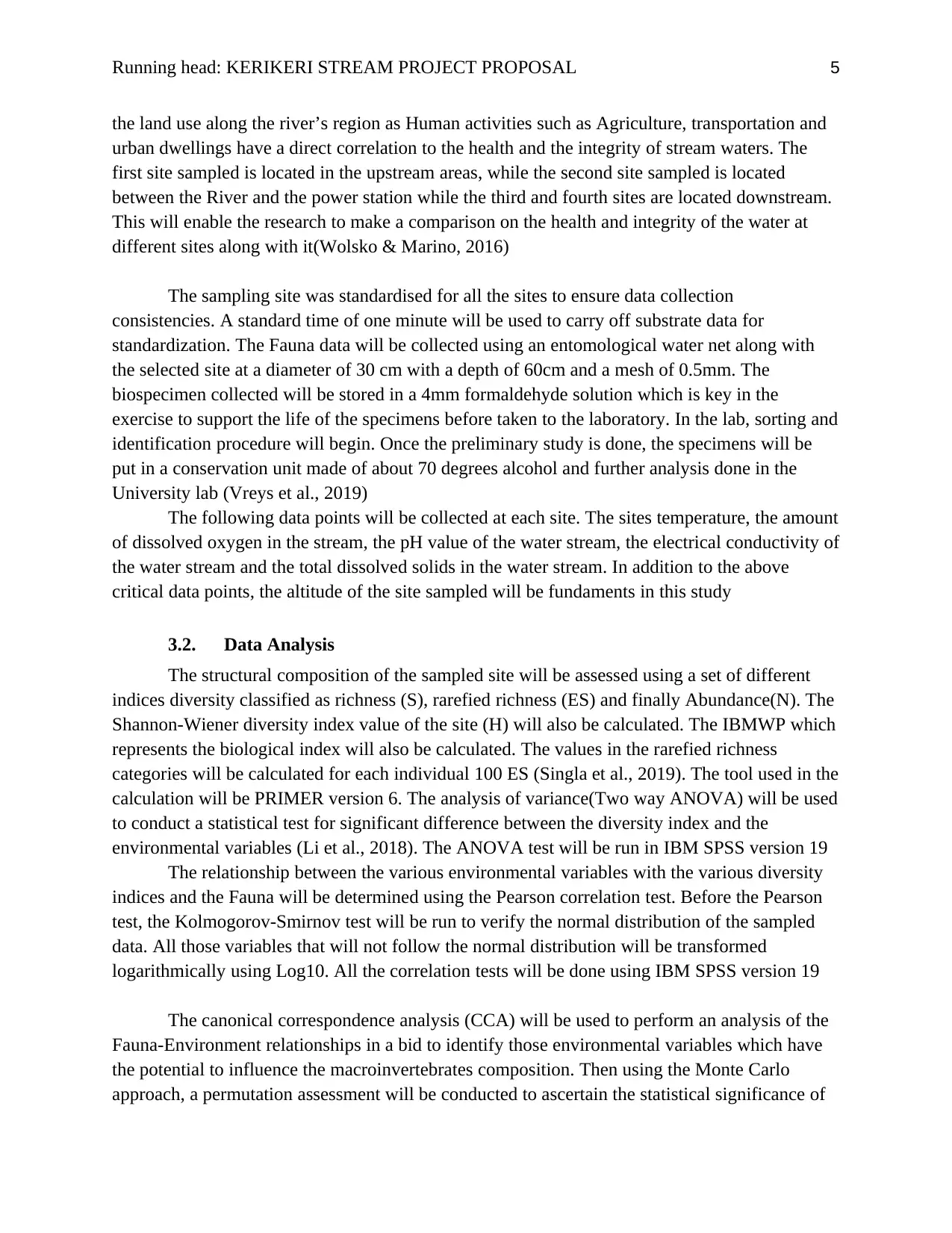
Running head: KERIKERI STREAM PROJECT PROPOSAL 5
the land use along the river’s region as Human activities such as Agriculture, transportation and
urban dwellings have a direct correlation to the health and the integrity of stream waters. The
first site sampled is located in the upstream areas, while the second site sampled is located
between the River and the power station while the third and fourth sites are located downstream.
This will enable the research to make a comparison on the health and integrity of the water at
different sites along with it(Wolsko & Marino, 2016)
The sampling site was standardised for all the sites to ensure data collection
consistencies. A standard time of one minute will be used to carry off substrate data for
standardization. The Fauna data will be collected using an entomological water net along with
the selected site at a diameter of 30 cm with a depth of 60cm and a mesh of 0.5mm. The
biospecimen collected will be stored in a 4mm formaldehyde solution which is key in the
exercise to support the life of the specimens before taken to the laboratory. In the lab, sorting and
identification procedure will begin. Once the preliminary study is done, the specimens will be
put in a conservation unit made of about 70 degrees alcohol and further analysis done in the
University lab (Vreys et al., 2019)
The following data points will be collected at each site. The sites temperature, the amount
of dissolved oxygen in the stream, the pH value of the water stream, the electrical conductivity of
the water stream and the total dissolved solids in the water stream. In addition to the above
critical data points, the altitude of the site sampled will be fundaments in this study
3.2. Data Analysis
The structural composition of the sampled site will be assessed using a set of different
indices diversity classified as richness (S), rarefied richness (ES) and finally Abundance(N). The
Shannon-Wiener diversity index value of the site (H) will also be calculated. The IBMWP which
represents the biological index will also be calculated. The values in the rarefied richness
categories will be calculated for each individual 100 ES (Singla et al., 2019). The tool used in the
calculation will be PRIMER version 6. The analysis of variance(Two way ANOVA) will be used
to conduct a statistical test for significant difference between the diversity index and the
environmental variables (Li et al., 2018). The ANOVA test will be run in IBM SPSS version 19
The relationship between the various environmental variables with the various diversity
indices and the Fauna will be determined using the Pearson correlation test. Before the Pearson
test, the Kolmogorov-Smirnov test will be run to verify the normal distribution of the sampled
data. All those variables that will not follow the normal distribution will be transformed
logarithmically using Log10. All the correlation tests will be done using IBM SPSS version 19
The canonical correspondence analysis (CCA) will be used to perform an analysis of the
Fauna-Environment relationships in a bid to identify those environmental variables which have
the potential to influence the macroinvertebrates composition. Then using the Monte Carlo
approach, a permutation assessment will be conducted to ascertain the statistical significance of
the land use along the river’s region as Human activities such as Agriculture, transportation and
urban dwellings have a direct correlation to the health and the integrity of stream waters. The
first site sampled is located in the upstream areas, while the second site sampled is located
between the River and the power station while the third and fourth sites are located downstream.
This will enable the research to make a comparison on the health and integrity of the water at
different sites along with it(Wolsko & Marino, 2016)
The sampling site was standardised for all the sites to ensure data collection
consistencies. A standard time of one minute will be used to carry off substrate data for
standardization. The Fauna data will be collected using an entomological water net along with
the selected site at a diameter of 30 cm with a depth of 60cm and a mesh of 0.5mm. The
biospecimen collected will be stored in a 4mm formaldehyde solution which is key in the
exercise to support the life of the specimens before taken to the laboratory. In the lab, sorting and
identification procedure will begin. Once the preliminary study is done, the specimens will be
put in a conservation unit made of about 70 degrees alcohol and further analysis done in the
University lab (Vreys et al., 2019)
The following data points will be collected at each site. The sites temperature, the amount
of dissolved oxygen in the stream, the pH value of the water stream, the electrical conductivity of
the water stream and the total dissolved solids in the water stream. In addition to the above
critical data points, the altitude of the site sampled will be fundaments in this study
3.2. Data Analysis
The structural composition of the sampled site will be assessed using a set of different
indices diversity classified as richness (S), rarefied richness (ES) and finally Abundance(N). The
Shannon-Wiener diversity index value of the site (H) will also be calculated. The IBMWP which
represents the biological index will also be calculated. The values in the rarefied richness
categories will be calculated for each individual 100 ES (Singla et al., 2019). The tool used in the
calculation will be PRIMER version 6. The analysis of variance(Two way ANOVA) will be used
to conduct a statistical test for significant difference between the diversity index and the
environmental variables (Li et al., 2018). The ANOVA test will be run in IBM SPSS version 19
The relationship between the various environmental variables with the various diversity
indices and the Fauna will be determined using the Pearson correlation test. Before the Pearson
test, the Kolmogorov-Smirnov test will be run to verify the normal distribution of the sampled
data. All those variables that will not follow the normal distribution will be transformed
logarithmically using Log10. All the correlation tests will be done using IBM SPSS version 19
The canonical correspondence analysis (CCA) will be used to perform an analysis of the
Fauna-Environment relationships in a bid to identify those environmental variables which have
the potential to influence the macroinvertebrates composition. Then using the Monte Carlo
approach, a permutation assessment will be conducted to ascertain the statistical significance of
Running head: KERIKERI STREAM PROJECT PROPOSAL 6
the various environmental variables. The environmental factors to be considered in the
assessment include the pH, temperature of the water, the amount of dissolved oxygen and the
general conductivity of the stream water (Ashton & Tenbensel, 2012)
4. Equipment and Costs, Risk Management
4.1. Equipment and Costs
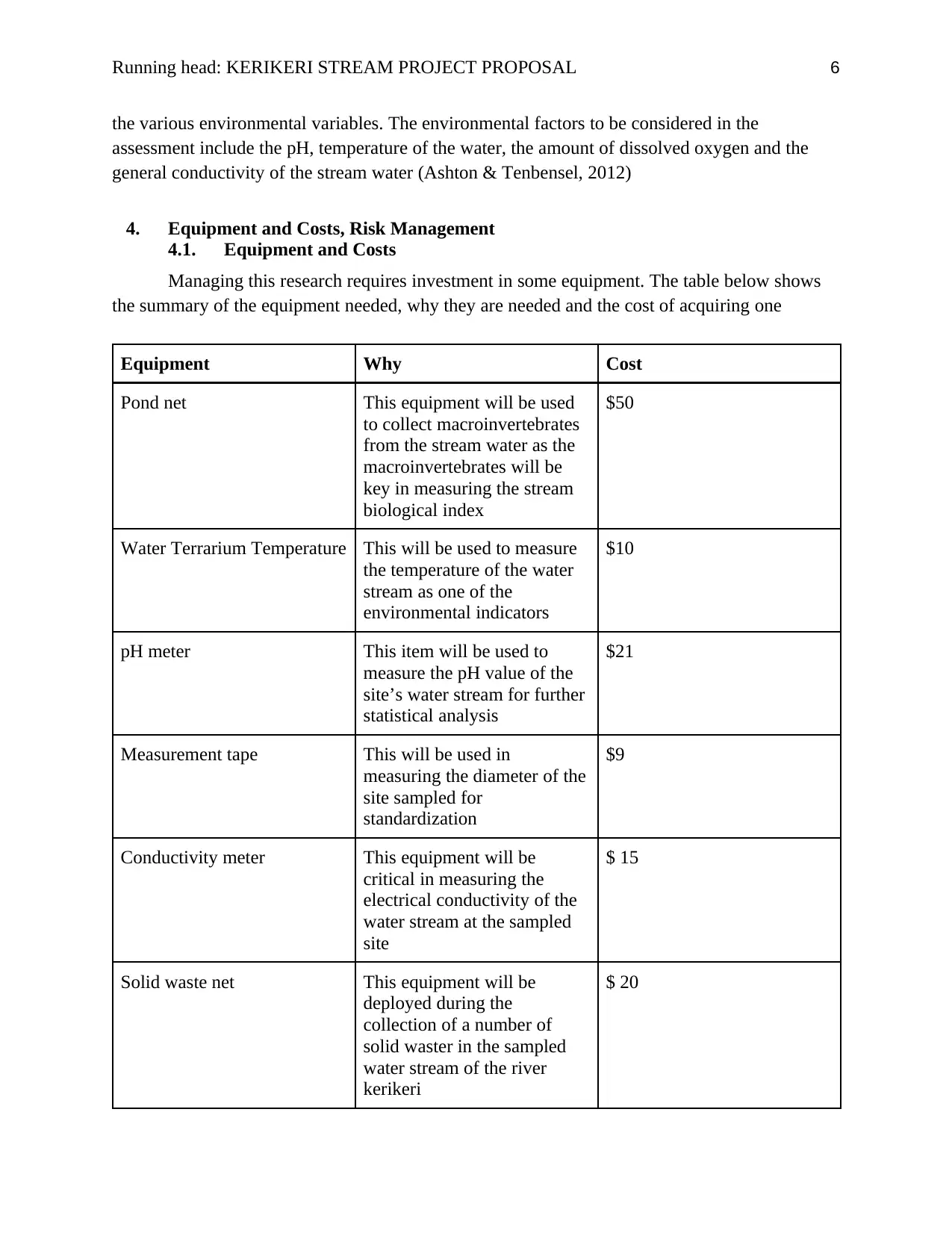
Managing this research requires investment in some equipment. The table below shows
the summary of the equipment needed, why they are needed and the cost of acquiring one
Equipment Why Cost
Pond net This equipment will be used
to collect macroinvertebrates
from the stream water as the
macroinvertebrates will be
key in measuring the stream
biological index
$50
Water Terrarium Temperature This will be used to measure
the temperature of the water
stream as one of the
environmental indicators
$10
pH meter This item will be used to
measure the pH value of the
site’s water stream for further
statistical analysis
$21
Measurement tape This will be used in
measuring the diameter of the
site sampled for
standardization
$9
Conductivity meter This equipment will be
critical in measuring the
electrical conductivity of the
water stream at the sampled
site
$ 15
Solid waste net This equipment will be
deployed during the
collection of a number of
solid waster in the sampled
water stream of the river
kerikeri
$ 20
the various environmental variables. The environmental factors to be considered in the
assessment include the pH, temperature of the water, the amount of dissolved oxygen and the
general conductivity of the stream water (Ashton & Tenbensel, 2012)
4. Equipment and Costs, Risk Management
4.1. Equipment and Costs
Managing this research requires investment in some equipment. The table below shows
the summary of the equipment needed, why they are needed and the cost of acquiring one
Equipment Why Cost
Pond net This equipment will be used
to collect macroinvertebrates
from the stream water as the
macroinvertebrates will be
key in measuring the stream
biological index
$50
Water Terrarium Temperature This will be used to measure
the temperature of the water
stream as one of the
environmental indicators
$10
pH meter This item will be used to
measure the pH value of the
site’s water stream for further
statistical analysis
$21
Measurement tape This will be used in
measuring the diameter of the
site sampled for
standardization
$9
Conductivity meter This equipment will be
critical in measuring the
electrical conductivity of the
water stream at the sampled
site
$ 15
Solid waste net This equipment will be
deployed during the
collection of a number of
solid waster in the sampled
water stream of the river
kerikeri
$ 20
⊘ This is a preview!⊘
Do you want full access?
Subscribe today to unlock all pages.
Trusted by 1+ million students worldwide
Running head: KERIKERI STREAM PROJECT PROPOSAL 7
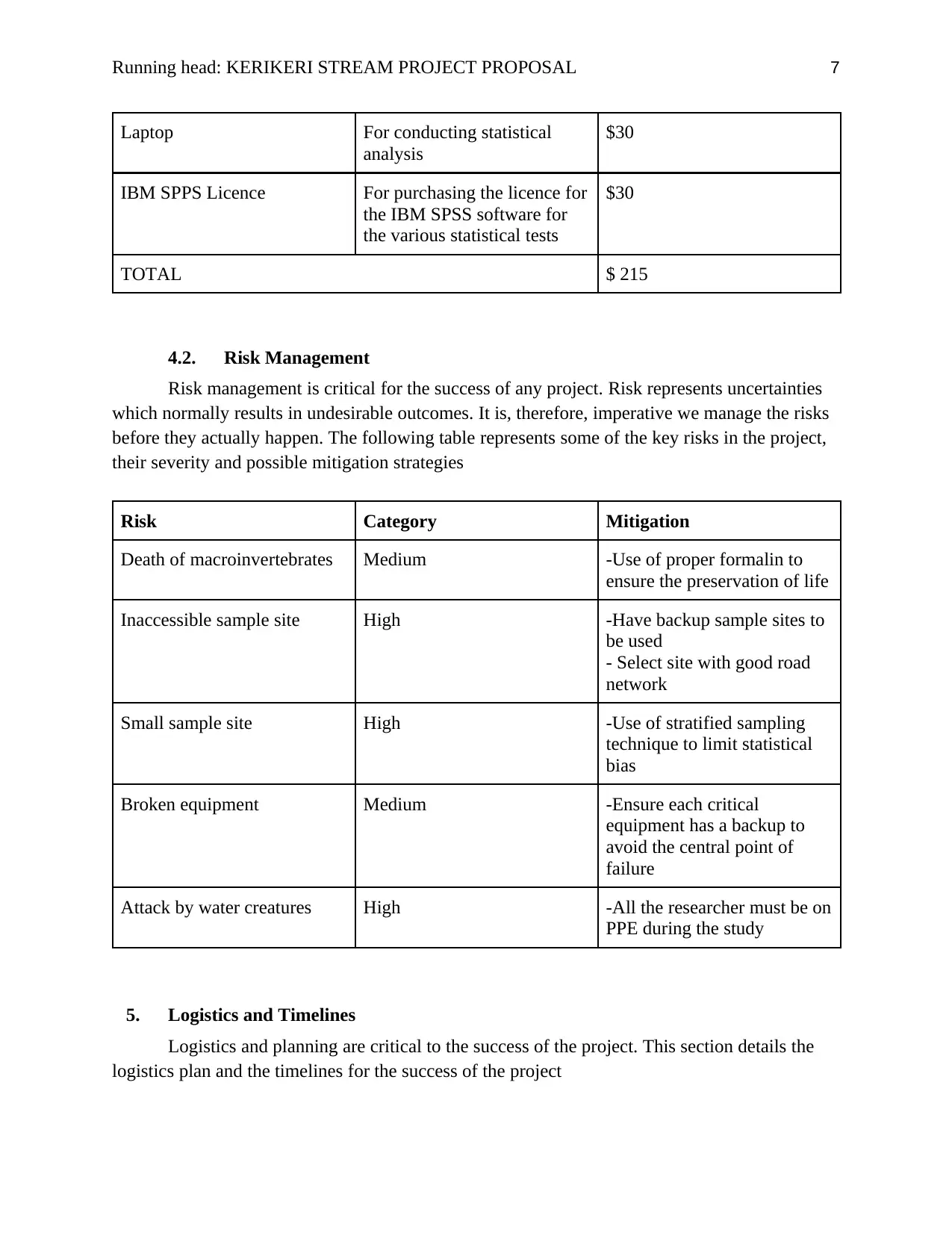
Laptop For conducting statistical
analysis
$30
IBM SPPS Licence For purchasing the licence for
the IBM SPSS software for
the various statistical tests
$30
TOTAL $ 215
4.2. Risk Management
Risk management is critical for the success of any project. Risk represents uncertainties
which normally results in undesirable outcomes. It is, therefore, imperative we manage the risks
before they actually happen. The following table represents some of the key risks in the project,
their severity and possible mitigation strategies
Risk Category Mitigation
Death of macroinvertebrates Medium -Use of proper formalin to
ensure the preservation of life
Inaccessible sample site High -Have backup sample sites to
be used
- Select site with good road
network
Small sample site High -Use of stratified sampling
technique to limit statistical
bias
Broken equipment Medium -Ensure each critical
equipment has a backup to
avoid the central point of
failure
Attack by water creatures High -All the researcher must be on
PPE during the study
5. Logistics and Timelines
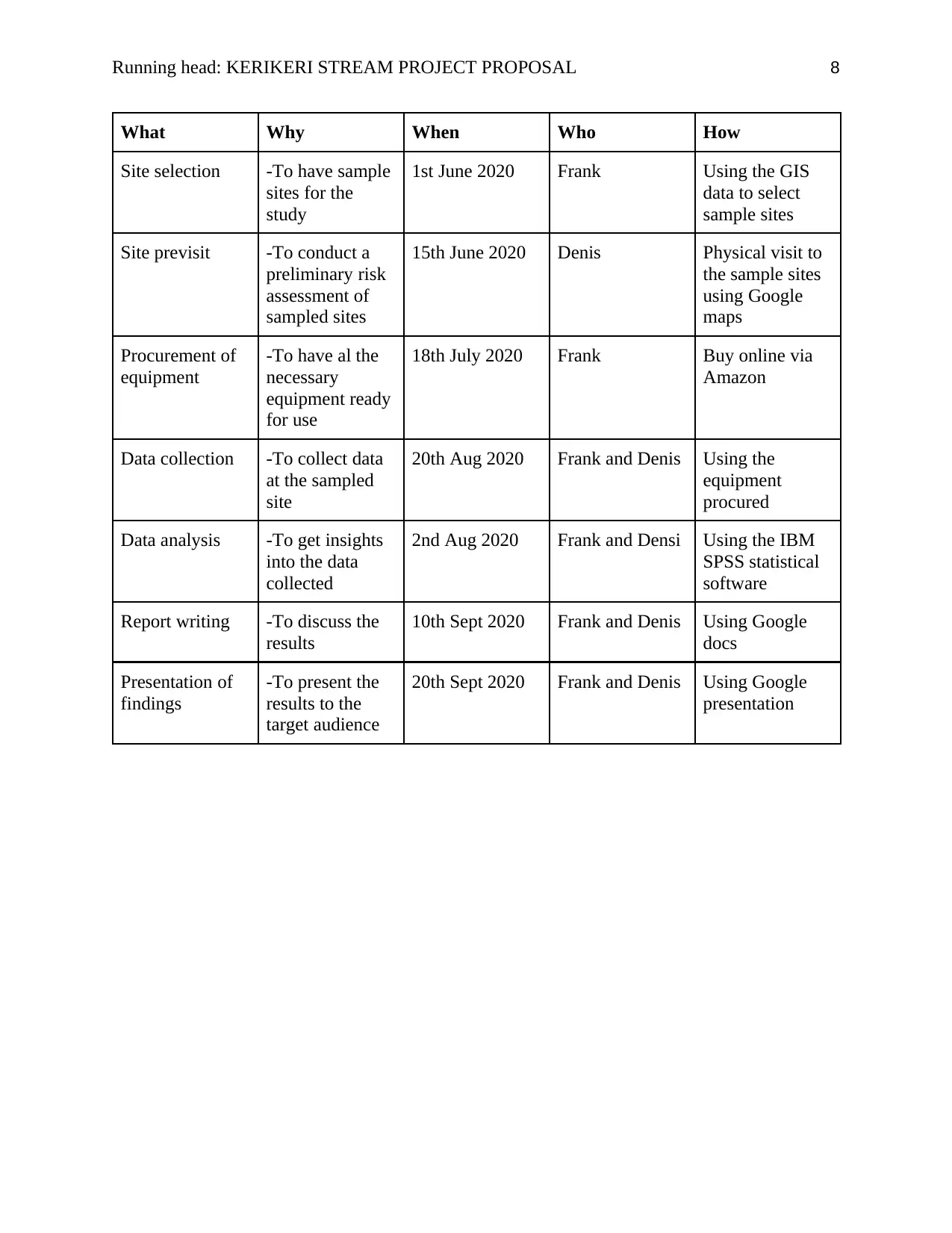
Logistics and planning are critical to the success of the project. This section details the
logistics plan and the timelines for the success of the project
Laptop For conducting statistical
analysis
$30
IBM SPPS Licence For purchasing the licence for
the IBM SPSS software for
the various statistical tests
$30
TOTAL $ 215
4.2. Risk Management
Risk management is critical for the success of any project. Risk represents uncertainties
which normally results in undesirable outcomes. It is, therefore, imperative we manage the risks
before they actually happen. The following table represents some of the key risks in the project,
their severity and possible mitigation strategies
Risk Category Mitigation
Death of macroinvertebrates Medium -Use of proper formalin to
ensure the preservation of life
Inaccessible sample site High -Have backup sample sites to
be used
- Select site with good road
network
Small sample site High -Use of stratified sampling
technique to limit statistical
bias
Broken equipment Medium -Ensure each critical
equipment has a backup to
avoid the central point of
failure
Attack by water creatures High -All the researcher must be on
PPE during the study
5. Logistics and Timelines
Logistics and planning are critical to the success of the project. This section details the
logistics plan and the timelines for the success of the project
Paraphrase This Document
Need a fresh take? Get an instant paraphrase of this document with our AI Paraphraser
Running head: KERIKERI STREAM PROJECT PROPOSAL 8
What Why When Who How
Site selection -To have sample
sites for the
study
1st June 2020 Frank Using the GIS
data to select
sample sites
Site previsit -To conduct a
preliminary risk
assessment of
sampled sites
15th June 2020 Denis Physical visit to
the sample sites
using Google
maps
Procurement of
equipment
-To have al the
necessary
equipment ready
for use
18th July 2020 Frank Buy online via
Amazon
Data collection -To collect data
at the sampled
site
20th Aug 2020 Frank and Denis Using the
equipment
procured
Data analysis -To get insights
into the data
collected
2nd Aug 2020 Frank and Densi Using the IBM
SPSS statistical
software
Report writing -To discuss the
results
10th Sept 2020 Frank and Denis Using Google
docs
Presentation of
findings
-To present the
results to the
target audience
20th Sept 2020 Frank and Denis Using Google
presentation
What Why When Who How
Site selection -To have sample
sites for the
study
1st June 2020 Frank Using the GIS
data to select
sample sites
Site previsit -To conduct a
preliminary risk
assessment of
sampled sites
15th June 2020 Denis Physical visit to
the sample sites
using Google
maps
Procurement of
equipment
-To have al the
necessary
equipment ready
for use
18th July 2020 Frank Buy online via
Amazon
Data collection -To collect data
at the sampled
site
20th Aug 2020 Frank and Denis Using the
equipment
procured
Data analysis -To get insights
into the data
collected
2nd Aug 2020 Frank and Densi Using the IBM
SPSS statistical
software
Report writing -To discuss the
results
10th Sept 2020 Frank and Denis Using Google
docs
Presentation of
findings
-To present the
results to the
target audience
20th Sept 2020 Frank and Denis Using Google
presentation
Running head: KERIKERI STREAM PROJECT PROPOSAL 9
6. References
Ashton, T., & Tenbensel, T. (2012). Health reform in New Zealand: Short-term gain but long-
term pain? Expert Review of Pharmacoeconomics & Outcomes Research; London,
12(5), 579–588. http://dx.doi.org/10.1586/erp.12.58
Dalu, T., Link to external site, this link will open in a new window, Wasserman, R. J., Wu, Q.,
Froneman, W. P., & Weyl, O. L. F. (2018). River sediment metal and nutrient variations
along an urban–agriculture gradient in an arid austral landscape: Implications for
environmental health. Environmental Science and Pollution Research International;
Heidelberg, 25(3), 2842–2852. http://dx.doi.org/10.1007/s11356-017-0728-1
Einheuser, M. D., Nejadhashemi, A. P., Wang, L., Sowa, S. P., & Woznicki, S. A. (2013).
Linking Biological Integrity and Watershed Models to Assess the Impacts of Historical
Land Use and Climate Changes on Stream Health. Environmental Management; New
York, 51(6), 1147–1163. http://dx.doi.org/10.1007/s00267-013-0043-7
6. References
Ashton, T., & Tenbensel, T. (2012). Health reform in New Zealand: Short-term gain but long-
term pain? Expert Review of Pharmacoeconomics & Outcomes Research; London,
12(5), 579–588. http://dx.doi.org/10.1586/erp.12.58
Dalu, T., Link to external site, this link will open in a new window, Wasserman, R. J., Wu, Q.,
Froneman, W. P., & Weyl, O. L. F. (2018). River sediment metal and nutrient variations
along an urban–agriculture gradient in an arid austral landscape: Implications for
environmental health. Environmental Science and Pollution Research International;
Heidelberg, 25(3), 2842–2852. http://dx.doi.org/10.1007/s11356-017-0728-1
Einheuser, M. D., Nejadhashemi, A. P., Wang, L., Sowa, S. P., & Woznicki, S. A. (2013).
Linking Biological Integrity and Watershed Models to Assess the Impacts of Historical
Land Use and Climate Changes on Stream Health. Environmental Management; New
York, 51(6), 1147–1163. http://dx.doi.org/10.1007/s00267-013-0043-7
⊘ This is a preview!⊘
Do you want full access?
Subscribe today to unlock all pages.
Trusted by 1+ million students worldwide
Running head: KERIKERI STREAM PROJECT PROPOSAL 10
Hendryx, M., Ahern, M. M., & Zullig, K. J. (2013). Improving the Environmental Quality
Component of the County Health Rankings Model. American Journal of Public Health;
Washington, 103(4), 727–732.
Kellner, E., & Hubbart, J. A. (2017). Application of the experimental watershed approach to
advance urban watershed precipitation/discharge understanding. Urban Ecosystems;
Salzburg, 20(4), 799–810. http://dx.doi.org/10.1007/s11252-016-0631-4
Kido, M. H. (2013). A native species-based index of biological integrity for Hawaiian stream
environments. Environmental Monitoring and Assessment; Dordrecht, 185(5), 4063–
4075. http://dx.doi.org/10.1007/s10661-012-2849-9
Li, S., Yang, W., Wang, L., Chen, K., Xu, S., & Wang, B. (2018). Influences of environmental
factors on macroinvertebrate assemblages: Differences between mountain and lowland
ecoregions, Wei River, China. Environmental Monitoring and Assessment; Dordrecht,
190(3), 1–13. http://dx.doi.org/10.1007/s10661-018-6516-7
Salmaso, F., Crosa, G., Espa, P., Gentili, G., Quadroni, S., & Zaccara, S. (2018). Benthic
macroinvertebrates response to water management in a lowland river: Effects of hydro-
power vs irrigation off-stream diversions. Environmental Monitoring and Assessment;
Dordrecht, 190(1), 1–12. http://dx.doi.org/10.1007/s10661-017-6390-8
Singh, A. T., Laluraj, C. M., Sharma, P., Patel, L. K., & Thamban, M. (2017). Export fluxes of
geochemical solutes in the meltwater stream of Sutri Dhaka Glacier, Chandra basin,
Western Himalaya. Environmental Monitoring and Assessment; Dordrecht, 189(11), 1–
13. http://dx.doi.org/10.1007/s10661-017-6268-9
Singla, V. I., Sutton, P. M., & Woodruff, T. J. (2019). The Environmental Protection Agency
Toxic Substances Control Act Systematic Review Method May Curtail Science Used to
Inform Policies, With Profound Implications for Public Health. American Journal of Public
Health; Washington, 109(7), 982–984. http://dx.doi.org/10.2105/AJPH.2019.305068
Vreys, N., Amé, M. V., Filippi, I., Cazenave, J., Valdés, M. E., & Bistoni, M. A. (2019). Effect of
Hendryx, M., Ahern, M. M., & Zullig, K. J. (2013). Improving the Environmental Quality
Component of the County Health Rankings Model. American Journal of Public Health;
Washington, 103(4), 727–732.
Kellner, E., & Hubbart, J. A. (2017). Application of the experimental watershed approach to
advance urban watershed precipitation/discharge understanding. Urban Ecosystems;
Salzburg, 20(4), 799–810. http://dx.doi.org/10.1007/s11252-016-0631-4
Kido, M. H. (2013). A native species-based index of biological integrity for Hawaiian stream
environments. Environmental Monitoring and Assessment; Dordrecht, 185(5), 4063–
4075. http://dx.doi.org/10.1007/s10661-012-2849-9
Li, S., Yang, W., Wang, L., Chen, K., Xu, S., & Wang, B. (2018). Influences of environmental
factors on macroinvertebrate assemblages: Differences between mountain and lowland
ecoregions, Wei River, China. Environmental Monitoring and Assessment; Dordrecht,
190(3), 1–13. http://dx.doi.org/10.1007/s10661-018-6516-7
Salmaso, F., Crosa, G., Espa, P., Gentili, G., Quadroni, S., & Zaccara, S. (2018). Benthic
macroinvertebrates response to water management in a lowland river: Effects of hydro-
power vs irrigation off-stream diversions. Environmental Monitoring and Assessment;
Dordrecht, 190(1), 1–12. http://dx.doi.org/10.1007/s10661-017-6390-8
Singh, A. T., Laluraj, C. M., Sharma, P., Patel, L. K., & Thamban, M. (2017). Export fluxes of
geochemical solutes in the meltwater stream of Sutri Dhaka Glacier, Chandra basin,
Western Himalaya. Environmental Monitoring and Assessment; Dordrecht, 189(11), 1–
13. http://dx.doi.org/10.1007/s10661-017-6268-9
Singla, V. I., Sutton, P. M., & Woodruff, T. J. (2019). The Environmental Protection Agency
Toxic Substances Control Act Systematic Review Method May Curtail Science Used to
Inform Policies, With Profound Implications for Public Health. American Journal of Public
Health; Washington, 109(7), 982–984. http://dx.doi.org/10.2105/AJPH.2019.305068
Vreys, N., Amé, M. V., Filippi, I., Cazenave, J., Valdés, M. E., & Bistoni, M. A. (2019). Effect of
Paraphrase This Document
Need a fresh take? Get an instant paraphrase of this document with our AI Paraphraser
Running head: KERIKERI STREAM PROJECT PROPOSAL 11
Landscape Changes on Water Quality and Health Status of Heptapterus mustelinus
(Siluriformes, Heptapteridae). Archives of Environmental Contamination and Toxicology;
New York, 76(3), 453–468. http://dx.doi.org/10.1007/s00244-018-00593-7
Wolsko, C., & Marino, E. (2016). Disasters, migrations, and the unintended consequences of
urbanization: What’s the harm in getting out of harm’s way? Population and
Environment; New York, 37(4), 411–428. http://dx.doi.org/10.1007/s11111-015-0248-1
Wu, M., Xiang, J., Chen, F., Fu, C., & Xu, G. (2017). Occurrence and risk assessment of
antidepressants in Huangpu River of Shanghai, China. Environmental Science and
Pollution Research International; Heidelberg, 24(25), 20291–20299.
http://dx.doi.org/10.1007/s11356-017-9293-x
Landscape Changes on Water Quality and Health Status of Heptapterus mustelinus
(Siluriformes, Heptapteridae). Archives of Environmental Contamination and Toxicology;
New York, 76(3), 453–468. http://dx.doi.org/10.1007/s00244-018-00593-7
Wolsko, C., & Marino, E. (2016). Disasters, migrations, and the unintended consequences of
urbanization: What’s the harm in getting out of harm’s way? Population and
Environment; New York, 37(4), 411–428. http://dx.doi.org/10.1007/s11111-015-0248-1
Wu, M., Xiang, J., Chen, F., Fu, C., & Xu, G. (2017). Occurrence and risk assessment of
antidepressants in Huangpu River of Shanghai, China. Environmental Science and
Pollution Research International; Heidelberg, 24(25), 20291–20299.
http://dx.doi.org/10.1007/s11356-017-9293-x

1 out of 11


Related Documents


Your All-in-One AI-Powered Toolkit for Academic Success.
+13062052269
info@desklib.com
Available 24*7 on WhatsApp / Email
![[object Object]](/_next/static/media/star-bottom.7253800d.svg)
Unlock your academic potential
Copyright © 2020–2025 A2Z Services. All Rights Reserved. Developed and managed by ZUCOL.