Action Research on KG1 Students’ Physical Engagement Level in PE
VerifiedAdded on 2023/06/08
|20
|6028
|466
Project
AI Summary
This action research project investigates the physical engagement levels of KG1 students during PE lessons, addressing the rationale for the study, which stems from the importance of physical activity for young children's development and the perceived inefficiencies of current PE practices. The research aims to identify factors that decrease student engagement, such as the length of lessons, and to examine the benefits of physical activity, including improved fitness, skill development, and peer relationships. The study employs a quantitative data collection method, favoring it for its ability to provide clear, statistically analyzable data. Data collection methods considered include case studies, interviews, secondary sources, and survey questionnaires, highlighting the need to understand and improve physical education in First School due to a scarcity of research and viewpoint in this case. Ultimately, the project seeks to determine suitable PE lesson durations and strategies to enhance engagement, contributing to students' health, well-being, and academic performance, with the data collected from the sampled respondents and analysed to obtain the appropriate findings.
Assignment
Action Research Commentary
Project Title: Investigation on First School (KG1) Students’ Physical Engagement Level during
PE lesson.
School Based Independent Study
Student ID Number
1
Action Research Commentary
Project Title: Investigation on First School (KG1) Students’ Physical Engagement Level during
PE lesson.
School Based Independent Study
Student ID Number
1

Paraphrase This Document
Need a fresh take? Get an instant paraphrase of this document with our AI Paraphraser
Research Rationale
This research topic is considered relevant since it examines important aspects regarding the first
school (KG1) students. Students at this level of education learn through various ways in order to
gain skills and become more knowledgeable. However, these young children cannot be made to
learn in classroom only, they should also be engaged in physical activities which can help them
become fit and healthy. This is always done during PE lessons. Through this research, it is
possible to investigate on the first school (KG1) students’ physical engagement level during PE
lessons. Ways that can be used to increase the students’ engagement in physical activities can
also be examined. This is important and relevant since the existing ways which are used in first
school students’ physical engagement level are not efficient. They decrease the students’ level of
physical engagement during first school PE lesson. Most of the PE lessons are scheduled to take
place for a period of 70 minutes which is too long for them to concentrate throughout this time
period (Vazou, 2019). Most students complain of fatigue and thirsty which make them move up
and down and give excuses to avoid participation thus reducing their concentration. This study
has the capacity to address these issues appropriately. This study will in determining a suitable
duration time period of First School PE lesson which will assist now and even in future when
implement. This study will be conducted within a short period of time where data will be
collected from the sampled respondents and analysed to obtain the appropriate findings. Less
expensive and less time consuming methods will be used to collect data. This will ensure that
little amount of money is spent and the data is collected within a short period of time.
When conducted successfully, this research will bring with it a number of benefits. Some of the
benefits that will come as a result of this study include; understanding ways through which
kindergarten students are able to improve their body fitness and the potential mass index which
can make the students more healthy and active in class. In the process of maintain their physical
fitness during the PE lesson, students will be made to participate in various activities. This
include varied invasion game activities, swimming and aquatic sports, a range of net games,
aesthetic sports like gymnastic, dance and trampolining , team building, recreational spirts and
outdoor education. Each of these activities aims at engaging the students in a prolonged physical
activity which helps to boost their fitness and the level of skills. In addition, this study will also
provide more explanation on factors affecting the First School students’ engagement level in
2
This research topic is considered relevant since it examines important aspects regarding the first
school (KG1) students. Students at this level of education learn through various ways in order to
gain skills and become more knowledgeable. However, these young children cannot be made to
learn in classroom only, they should also be engaged in physical activities which can help them
become fit and healthy. This is always done during PE lessons. Through this research, it is
possible to investigate on the first school (KG1) students’ physical engagement level during PE
lessons. Ways that can be used to increase the students’ engagement in physical activities can
also be examined. This is important and relevant since the existing ways which are used in first
school students’ physical engagement level are not efficient. They decrease the students’ level of
physical engagement during first school PE lesson. Most of the PE lessons are scheduled to take
place for a period of 70 minutes which is too long for them to concentrate throughout this time
period (Vazou, 2019). Most students complain of fatigue and thirsty which make them move up
and down and give excuses to avoid participation thus reducing their concentration. This study
has the capacity to address these issues appropriately. This study will in determining a suitable
duration time period of First School PE lesson which will assist now and even in future when
implement. This study will be conducted within a short period of time where data will be
collected from the sampled respondents and analysed to obtain the appropriate findings. Less
expensive and less time consuming methods will be used to collect data. This will ensure that
little amount of money is spent and the data is collected within a short period of time.
When conducted successfully, this research will bring with it a number of benefits. Some of the
benefits that will come as a result of this study include; understanding ways through which
kindergarten students are able to improve their body fitness and the potential mass index which
can make the students more healthy and active in class. In the process of maintain their physical
fitness during the PE lesson, students will be made to participate in various activities. This
include varied invasion game activities, swimming and aquatic sports, a range of net games,
aesthetic sports like gymnastic, dance and trampolining , team building, recreational spirts and
outdoor education. Each of these activities aims at engaging the students in a prolonged physical
activity which helps to boost their fitness and the level of skills. In addition, this study will also
provide more explanation on factors affecting the First School students’ engagement level in
2
physical activity. This will basically be determined through values that are possessed by the
students towards physical activity programs and motive. Also there is a description on how the
young children sense hop for doing better in physical activity in the PE lesson mediates their
level of engagement in various achievement situations.
Aims
This study consist of the main aim and specific aims that can be used to achieve the main aim.
When these specific aims are accomplished, the main expectation of this study shall be achieved.
Main aim
This is to investigate on First School (KG1) Students’ Physical Engagement Level during PE
lesson.
Specific aims
These include;
i. To identify factors that lead to decease in the student’s level of physical engagement
during first school PE lesson and how to address them.
ii. To examine the benefits of First School (KG1) Students’ Physical Engagement in PE
lesson.
The nature of the main aim is basically on the level of physical engagement of First School
students during the PE lesson. The First school PE and Health lessons are all done practically
hence during this lesson, the PE teachers are able to monitor the level of engagement of these
students throughout the entire lesson. From the observation and feedback that have been obtained
from the PE teachers of KG1 students, it has been noted that most of the students tends to have a
feeling of falling away or declining as the length of the lesson progresses. This may be
contributed to long length of the lesson which make the students to feel inactive and loose
concentration. However, it is important to ensure that the kindergarten children are made to grasp
better skills and knowledge during the PE lesson. This can only be achieved when the lesson is
made meaningful whereby all students are made to remain active throughout the lesson. When
this is done, their level of physical engagement will be monitored and appropriate adjustments
made.
3
students towards physical activity programs and motive. Also there is a description on how the
young children sense hop for doing better in physical activity in the PE lesson mediates their
level of engagement in various achievement situations.
Aims
This study consist of the main aim and specific aims that can be used to achieve the main aim.
When these specific aims are accomplished, the main expectation of this study shall be achieved.
Main aim
This is to investigate on First School (KG1) Students’ Physical Engagement Level during PE
lesson.
Specific aims
These include;
i. To identify factors that lead to decease in the student’s level of physical engagement
during first school PE lesson and how to address them.
ii. To examine the benefits of First School (KG1) Students’ Physical Engagement in PE
lesson.
The nature of the main aim is basically on the level of physical engagement of First School
students during the PE lesson. The First school PE and Health lessons are all done practically
hence during this lesson, the PE teachers are able to monitor the level of engagement of these
students throughout the entire lesson. From the observation and feedback that have been obtained
from the PE teachers of KG1 students, it has been noted that most of the students tends to have a
feeling of falling away or declining as the length of the lesson progresses. This may be
contributed to long length of the lesson which make the students to feel inactive and loose
concentration. However, it is important to ensure that the kindergarten children are made to grasp
better skills and knowledge during the PE lesson. This can only be achieved when the lesson is
made meaningful whereby all students are made to remain active throughout the lesson. When
this is done, their level of physical engagement will be monitored and appropriate adjustments
made.
3
⊘ This is a preview!⊘
Do you want full access?
Subscribe today to unlock all pages.

Trusted by 1+ million students worldwide
On the other hand, considering the specific aims of this study, the first aim basically identifies
the factors that lead to decease in the student’s level of physical engagement during first school
PE lesson and how to address them. The level of concentration of the younger children has been
found to be very small. This research deals with KG1 students who aged between 4 to 7 years.
These are very young children which needs to be natured in a professional way by their PE
teachers. A number of factors have been found to be route cause of decrease in the student’s
level of physical engagement. One of these factors is likely to be the length of the PE lesson.
From the previous research that have been conducted with regards to this, it was found that the
students who aged between 4 to 7 years should be engaged in at least 60 minutes of physical
activity per day. Also, it has been noted that the current decrease in the levels of physical
activities of young children has become a global concern (Petrušič, 2021). Therefore, it is of
great concern to identify and address these factors in order to ensure that children have not
become victims of a range of chronic illness like high blood pressure and obesity.
The second specific aim examines the benefits of First School (KG1) Students’ Physical
Engagement in PE lesson. When kindergarten students are engaged in physical activities, they
enjoy more benefits that are associated with this PE lesson. However, these benefits can only be
realized when the PE lessons are made to be of more quality. Some of these benefits include;
Improved physical fitness- the first school (KG1) students who are engaged in physical activities
grow to become physically fit. These activities helps in improving the children’s muscular
strength, body composition, flexibility, muscular endurance and cardiovascular endurance. All
these body coordination contributes to body fitness (Annesi, 2019).
Development of skill. This is another benefit that is associated with the students’ physical
engagement in PE lesson. In this case, the young children develop motor skills which enables
them to be not only safe and successful but also satisfying in physical activities that they are
engaged in.
Another benefit is the regular and healthy physical activity. This plays a great role as it provides
a wide range of developmentally appropriate activities for all the First School Students who are
involved in the PE lesson.
4
the factors that lead to decease in the student’s level of physical engagement during first school
PE lesson and how to address them. The level of concentration of the younger children has been
found to be very small. This research deals with KG1 students who aged between 4 to 7 years.
These are very young children which needs to be natured in a professional way by their PE
teachers. A number of factors have been found to be route cause of decrease in the student’s
level of physical engagement. One of these factors is likely to be the length of the PE lesson.
From the previous research that have been conducted with regards to this, it was found that the
students who aged between 4 to 7 years should be engaged in at least 60 minutes of physical
activity per day. Also, it has been noted that the current decrease in the levels of physical
activities of young children has become a global concern (Petrušič, 2021). Therefore, it is of
great concern to identify and address these factors in order to ensure that children have not
become victims of a range of chronic illness like high blood pressure and obesity.
The second specific aim examines the benefits of First School (KG1) Students’ Physical
Engagement in PE lesson. When kindergarten students are engaged in physical activities, they
enjoy more benefits that are associated with this PE lesson. However, these benefits can only be
realized when the PE lessons are made to be of more quality. Some of these benefits include;
Improved physical fitness- the first school (KG1) students who are engaged in physical activities
grow to become physically fit. These activities helps in improving the children’s muscular
strength, body composition, flexibility, muscular endurance and cardiovascular endurance. All
these body coordination contributes to body fitness (Annesi, 2019).
Development of skill. This is another benefit that is associated with the students’ physical
engagement in PE lesson. In this case, the young children develop motor skills which enables
them to be not only safe and successful but also satisfying in physical activities that they are
engaged in.
Another benefit is the regular and healthy physical activity. This plays a great role as it provides
a wide range of developmentally appropriate activities for all the First School Students who are
involved in the PE lesson.
4
Paraphrase This Document
Need a fresh take? Get an instant paraphrase of this document with our AI Paraphraser
When kindergarten children engage in physical lessons, they gain support of other subject areas.
In this scenario, the students reinforces the knowledge they have acquired across the curriculum.
Students tends to have wider scope of understanding concepts while in class since their level of
understanding is increased.
There is an improved judgement for First School (KG1) students when they are engaged in PE
lesson. It has been found that the quality physical education has the ability to influence the moral
development. In this case, the kindergarten children have the opportunity to assume leadership,
cooperate with others. In addition, the students are able to question the actions and regulations
and also accept the responsibility of their own behaviour (Dudley, 2018).
Strengthening of peer relationship among the young children is another importance of physical
engagement in PE lesson. The PE lesson is a major platform that can help the younger children
to socialize with others successfully and grant them an opportunity to learn positive skills from
their PE teacher. Being able to participate in gymnastics, dances, games and sports helps greatly
in building the peer culture.
Another great benefit of students’ physical engagement in PE lesson is the improved self-
confidence and self-esteem. Through PE lesson under the guidance of the PE teacher, the
kindergarten children are able to be instilled with stronger sense of self-worth based on their
mastery of skills and concept in physical activities. Through this exposure, the students can
become more assertive, self-controlled, confident and independent (Macdonald, 2021).
When the first school students engage in practical PE lessons, they are able to experience their
set goals. In this case, it is found that the physical education grants the children the opportunity
to set and work towards personal and achievable goals. Not forgetting a self-discipline which is
acquired by these children during their PE lesson as they interact with other in various games
like swimming and playing of football (Lander, 2017).
There is need to increase the information regarding the physical Education in First School since
the research shows a scarcity of information and viewpoint in this case. Therefore, it is very
crucial to understand the benefits that come with the student engagement in the PE lesson.
5
In this scenario, the students reinforces the knowledge they have acquired across the curriculum.
Students tends to have wider scope of understanding concepts while in class since their level of
understanding is increased.
There is an improved judgement for First School (KG1) students when they are engaged in PE
lesson. It has been found that the quality physical education has the ability to influence the moral
development. In this case, the kindergarten children have the opportunity to assume leadership,
cooperate with others. In addition, the students are able to question the actions and regulations
and also accept the responsibility of their own behaviour (Dudley, 2018).
Strengthening of peer relationship among the young children is another importance of physical
engagement in PE lesson. The PE lesson is a major platform that can help the younger children
to socialize with others successfully and grant them an opportunity to learn positive skills from
their PE teacher. Being able to participate in gymnastics, dances, games and sports helps greatly
in building the peer culture.
Another great benefit of students’ physical engagement in PE lesson is the improved self-
confidence and self-esteem. Through PE lesson under the guidance of the PE teacher, the
kindergarten children are able to be instilled with stronger sense of self-worth based on their
mastery of skills and concept in physical activities. Through this exposure, the students can
become more assertive, self-controlled, confident and independent (Macdonald, 2021).
When the first school students engage in practical PE lessons, they are able to experience their
set goals. In this case, it is found that the physical education grants the children the opportunity
to set and work towards personal and achievable goals. Not forgetting a self-discipline which is
acquired by these children during their PE lesson as they interact with other in various games
like swimming and playing of football (Lander, 2017).
There is need to increase the information regarding the physical Education in First School since
the research shows a scarcity of information and viewpoint in this case. Therefore, it is very
crucial to understand the benefits that come with the student engagement in the PE lesson.
5
Methodology
The research technique primarily consists of a well-defined approach that is used in the data
collection process in order to meet the study's goal and objective. It aids in providing a
comprehensive description of the research strategy, research design, study area, research
population, and data collection techniques. There are a variety of ways that can be employed to
perform a research study. These include qualitative, quantitative and mixed methods. However,
in this study, quantitative data collection method was employed. This method was preferred over
the qualitative due to a number of reasons. With quantitative method, the data obtained can
easily be communicated and analyzed using statistical methods since it involves the use of
numbers. This give a clear understanding to the reader of what the research is all about. This
method allows for prediction and confirmation of the results. In addition, the collected data is
easy to analyze and gives a clear visual impression when presented through tables and graphs.
There are different methods that can be used to gather data. These include the use questionnaire
survey, interview, case study and the use of secondary sources.
Case study
This is one of the method that is used in the data collection process. In this method, there is use
of in-depth descriptive information about specific entities of some cases are gathered, organized,
interpreted and finally presented in a narrative format where the reader has to understand the
statement presented in order to draw a better conclusion (Martin, 2017).
Interview
This is basically a qualitative method of data collection whereby the researcher asks open-ended
questions to the respondents and collect the required data about the topic of study. In other
words, this method of data collection involves two or more people who exchanges information
using a series of questions and answers. In this case, the questions are designed by the researcher
based on his or her topic of study.
Use of secondary sources
These are the existing sources of information that can be referred to by the researcher to collect
data regarding the topic of study. The secondary sources help in providing good overviews
6
The research technique primarily consists of a well-defined approach that is used in the data
collection process in order to meet the study's goal and objective. It aids in providing a
comprehensive description of the research strategy, research design, study area, research
population, and data collection techniques. There are a variety of ways that can be employed to
perform a research study. These include qualitative, quantitative and mixed methods. However,
in this study, quantitative data collection method was employed. This method was preferred over
the qualitative due to a number of reasons. With quantitative method, the data obtained can
easily be communicated and analyzed using statistical methods since it involves the use of
numbers. This give a clear understanding to the reader of what the research is all about. This
method allows for prediction and confirmation of the results. In addition, the collected data is
easy to analyze and gives a clear visual impression when presented through tables and graphs.
There are different methods that can be used to gather data. These include the use questionnaire
survey, interview, case study and the use of secondary sources.
Case study
This is one of the method that is used in the data collection process. In this method, there is use
of in-depth descriptive information about specific entities of some cases are gathered, organized,
interpreted and finally presented in a narrative format where the reader has to understand the
statement presented in order to draw a better conclusion (Martin, 2017).
Interview
This is basically a qualitative method of data collection whereby the researcher asks open-ended
questions to the respondents and collect the required data about the topic of study. In other
words, this method of data collection involves two or more people who exchanges information
using a series of questions and answers. In this case, the questions are designed by the researcher
based on his or her topic of study.
Use of secondary sources
These are the existing sources of information that can be referred to by the researcher to collect
data regarding the topic of study. The secondary sources help in providing good overviews
6
⊘ This is a preview!⊘
Do you want full access?
Subscribe today to unlock all pages.
Trusted by 1+ million students worldwide
about the topic of the study. This method of data collection is associated with several advantages.
These include the availability of more clarification of the research question, easier to access and
there less cost involved.
Survey Questionnaire
This is a method of data collection whereby a set of questions is designed in a specified form
which can be in soft copy or printed. These set of questions can either be open-ended or closed
ended. These questions are then presented to the respondents to fill and return after they are
complete. This method allows the researcher to collect, analyze and interpret data from different
respondents. In this case, same question can be asked to different respondents in the same way.
In this study, the survey questionnaire was the preferred method of data collection. The
questionnaire form consisting of various questions was designed and presented to the
respondents. This questionnaire was designed in such a way that it addresses the aims of this
study. The questions were basically in line with the First School (KG1) Students’ Physical
Engagement Level during PE lesson. Different aspects of this topic was captured within the
designed questionnaire.
Questionnaire Design
The questionnaire survey for this study was created in such a way that it comprised two
components. The first segment contained information about the respondents' backgrounds, while
the second piece focused on various aspects of First Grade (KG1) Students' Physical
Engagement Level during PE class. The questions were structured in such a way that each was
meant to address a specific aspect of this study topic. There were both open-ended and closed-
ended questions in this set. Respondents were given a lot of leeway in the open ended questions
to express their thoughts on the topic. Closed ended questions, on the other hand, consisted of
choices from which each respondent was required to select only one that he or she thought was
the best. All of these questions, however, were linked together in such a way that the answers to
each one contributed to the final results. It's worth noting that these questions were created in
such a way that they're not only easy to understand, but also straight to the point.
The questionnaire survey form that was used to collect data is as follows;
7
These include the availability of more clarification of the research question, easier to access and
there less cost involved.
Survey Questionnaire
This is a method of data collection whereby a set of questions is designed in a specified form
which can be in soft copy or printed. These set of questions can either be open-ended or closed
ended. These questions are then presented to the respondents to fill and return after they are
complete. This method allows the researcher to collect, analyze and interpret data from different
respondents. In this case, same question can be asked to different respondents in the same way.
In this study, the survey questionnaire was the preferred method of data collection. The
questionnaire form consisting of various questions was designed and presented to the
respondents. This questionnaire was designed in such a way that it addresses the aims of this
study. The questions were basically in line with the First School (KG1) Students’ Physical
Engagement Level during PE lesson. Different aspects of this topic was captured within the
designed questionnaire.
Questionnaire Design
The questionnaire survey for this study was created in such a way that it comprised two
components. The first segment contained information about the respondents' backgrounds, while
the second piece focused on various aspects of First Grade (KG1) Students' Physical
Engagement Level during PE class. The questions were structured in such a way that each was
meant to address a specific aspect of this study topic. There were both open-ended and closed-
ended questions in this set. Respondents were given a lot of leeway in the open ended questions
to express their thoughts on the topic. Closed ended questions, on the other hand, consisted of
choices from which each respondent was required to select only one that he or she thought was
the best. All of these questions, however, were linked together in such a way that the answers to
each one contributed to the final results. It's worth noting that these questions were created in
such a way that they're not only easy to understand, but also straight to the point.
The questionnaire survey form that was used to collect data is as follows;
7
Paraphrase This Document
Need a fresh take? Get an instant paraphrase of this document with our AI Paraphraser
A Survey on First School (KG1) Students’ Physical Engagement Level during PE lesson.
I'd like to extend a genuine invitation to my valued respondents to join in this study. I'd like to
point out that none of the questions in this survey pertain to your personal or professional
information. I sincerely promise that the information you offer in this questionnaire will be kept
totally confidential and used solely for academic study.
Thank you all so much for your assistance and support.
Section 1: Respondents’ Background.
1. What is your gender? Kindly tick in the box provided
A. Male [ ]
B. Female [ ]
2. How old are you?
A. 18-25 years [ ]
B. 25-30 years[ ]
C. 30-35 years [ ]
D. 35-40 years [ ]
3. Tick appropriately in the box provided the role you play as a teacher.
A. Head teacher [ ]
B. Games teacher [ ]
C. Class teacher [ ]
4. Which level of education are you?
A. Master’s degree [ ]
B. Bachelor’s degree [ ]
C. PHD [ ]
Section 2: General information about First School (KG1) Students’ Physical Engagement
Level during PE lesson for KG1P, KG1M and KG1G.
5. Which types of games do your students engage in during the PE lesson?
6. How long do you take during the PE lesson?
8
I'd like to extend a genuine invitation to my valued respondents to join in this study. I'd like to
point out that none of the questions in this survey pertain to your personal or professional
information. I sincerely promise that the information you offer in this questionnaire will be kept
totally confidential and used solely for academic study.
Thank you all so much for your assistance and support.
Section 1: Respondents’ Background.
1. What is your gender? Kindly tick in the box provided
A. Male [ ]
B. Female [ ]
2. How old are you?
A. 18-25 years [ ]
B. 25-30 years[ ]
C. 30-35 years [ ]
D. 35-40 years [ ]
3. Tick appropriately in the box provided the role you play as a teacher.
A. Head teacher [ ]
B. Games teacher [ ]
C. Class teacher [ ]
4. Which level of education are you?
A. Master’s degree [ ]
B. Bachelor’s degree [ ]
C. PHD [ ]
Section 2: General information about First School (KG1) Students’ Physical Engagement
Level during PE lesson for KG1P, KG1M and KG1G.
5. Which types of games do your students engage in during the PE lesson?
6. How long do you take during the PE lesson?
8
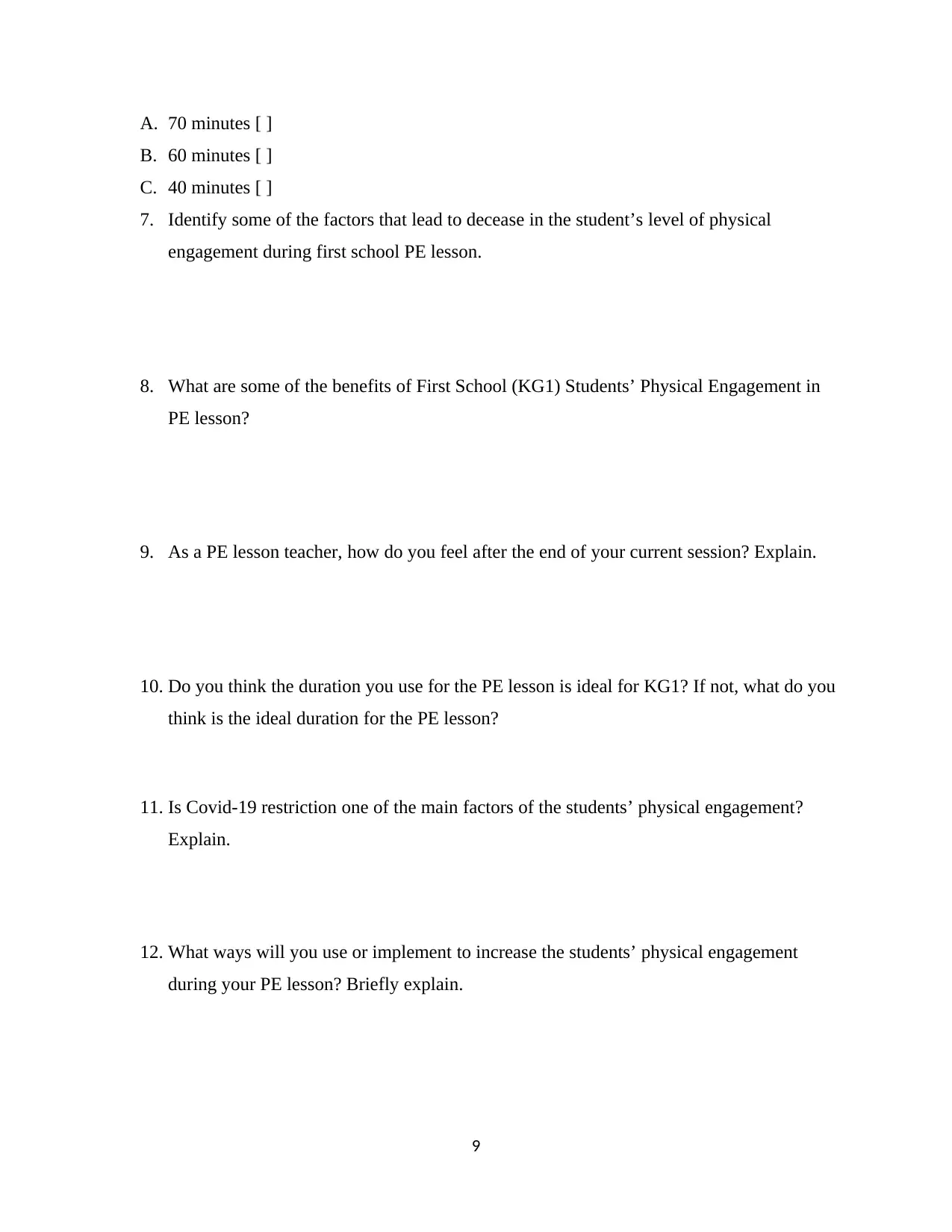
A. 70 minutes [ ]
B. 60 minutes [ ]
C. 40 minutes [ ]
7. Identify some of the factors that lead to decease in the student’s level of physical
engagement during first school PE lesson.
8. What are some of the benefits of First School (KG1) Students’ Physical Engagement in
PE lesson?
9. As a PE lesson teacher, how do you feel after the end of your current session? Explain.
10. Do you think the duration you use for the PE lesson is ideal for KG1? If not, what do you
think is the ideal duration for the PE lesson?
11. Is Covid-19 restriction one of the main factors of the students’ physical engagement?
Explain.
12. What ways will you use or implement to increase the students’ physical engagement
during your PE lesson? Briefly explain.
9
B. 60 minutes [ ]
C. 40 minutes [ ]
7. Identify some of the factors that lead to decease in the student’s level of physical
engagement during first school PE lesson.
8. What are some of the benefits of First School (KG1) Students’ Physical Engagement in
PE lesson?
9. As a PE lesson teacher, how do you feel after the end of your current session? Explain.
10. Do you think the duration you use for the PE lesson is ideal for KG1? If not, what do you
think is the ideal duration for the PE lesson?
11. Is Covid-19 restriction one of the main factors of the students’ physical engagement?
Explain.
12. What ways will you use or implement to increase the students’ physical engagement
during your PE lesson? Briefly explain.
9
⊘ This is a preview!⊘
Do you want full access?
Subscribe today to unlock all pages.
Trusted by 1+ million students worldwide
Sampling
The process of selecting a subset of the overall population from whom data will be collected
during the research is known as sampling. In this scenario, it's crucial to think about the most
practical sort of sampling, in which a specific population is chosen since they're a good supply of
data for the research topic. In this case, the teachers from kindergarten school who are dealing
with younger children were sampled for the study. This study was just a smaller one and hence a
small sample size was considered. Only 85 teachers were chosen from different kindergarten
schools. These teachers chosen were mainly handling three classes. These classes included
KG1P, KG1M and KG1G. The number of students in KG1P and KG1M were 18 for each class
while those in KG1G were 19.
Findings
After the completion of the data collection process, the analysis had to be carried out and the
findings drawn from the collected data. This was very important as it helps the researcher to
ascertain whether the aims of the study have been achieved. It is important to note that during
this study, all the 85 respondents who were sampled for data collection process turned out for the
study. They participated well in the study and gave their various views with regards to the
questions that were presented to them. The following findings were obtained from data collected;
Teacher’s role
Category Number of respondents
Head teacher 9
Games teacher 41
Class teacher 35
From the table above, it is seen that the highest number of teachers who turned up for this study
were games teachers followed closely by the class teachers. The least number were the head
teachers. Since the main aim of the study was about the First School (KG1) Students’ Physical
Engagement Level during PE lesson, the data obtained was reliable since the highest of
respondents were the games teachers who participate in PE lessons as they engage the young
children in the physical activities.
10
The process of selecting a subset of the overall population from whom data will be collected
during the research is known as sampling. In this scenario, it's crucial to think about the most
practical sort of sampling, in which a specific population is chosen since they're a good supply of
data for the research topic. In this case, the teachers from kindergarten school who are dealing
with younger children were sampled for the study. This study was just a smaller one and hence a
small sample size was considered. Only 85 teachers were chosen from different kindergarten
schools. These teachers chosen were mainly handling three classes. These classes included
KG1P, KG1M and KG1G. The number of students in KG1P and KG1M were 18 for each class
while those in KG1G were 19.
Findings
After the completion of the data collection process, the analysis had to be carried out and the
findings drawn from the collected data. This was very important as it helps the researcher to
ascertain whether the aims of the study have been achieved. It is important to note that during
this study, all the 85 respondents who were sampled for data collection process turned out for the
study. They participated well in the study and gave their various views with regards to the
questions that were presented to them. The following findings were obtained from data collected;
Teacher’s role
Category Number of respondents
Head teacher 9
Games teacher 41
Class teacher 35
From the table above, it is seen that the highest number of teachers who turned up for this study
were games teachers followed closely by the class teachers. The least number were the head
teachers. Since the main aim of the study was about the First School (KG1) Students’ Physical
Engagement Level during PE lesson, the data obtained was reliable since the highest of
respondents were the games teachers who participate in PE lessons as they engage the young
children in the physical activities.
10
Paraphrase This Document
Need a fresh take? Get an instant paraphrase of this document with our AI Paraphraser
Educational level
The following table outlines the level of education of teachers who participated in the study.
Level of education Number of respondents
Master’s degree 45
Bachelor’s degree 28
PHD 12
From the table above, it is seen that most of the respondents have attained the master degree.
This shows that most of them were professionals and had a lot of experience in handling the
kindergarten children during the PE lessons.
Duration of the PE lesson
The table below outlines the feedback that were given by various respondents concerning the
duration of the lesson which looks ideal for the younger children.
Duration of time Number of respondents
70 minutes 11
60 minutes 23
40 minutes 51
11
The following table outlines the level of education of teachers who participated in the study.
Level of education Number of respondents
Master’s degree 45
Bachelor’s degree 28
PHD 12
From the table above, it is seen that most of the respondents have attained the master degree.
This shows that most of them were professionals and had a lot of experience in handling the
kindergarten children during the PE lessons.
Duration of the PE lesson
The table below outlines the feedback that were given by various respondents concerning the
duration of the lesson which looks ideal for the younger children.
Duration of time Number of respondents
70 minutes 11
60 minutes 23
40 minutes 51
11
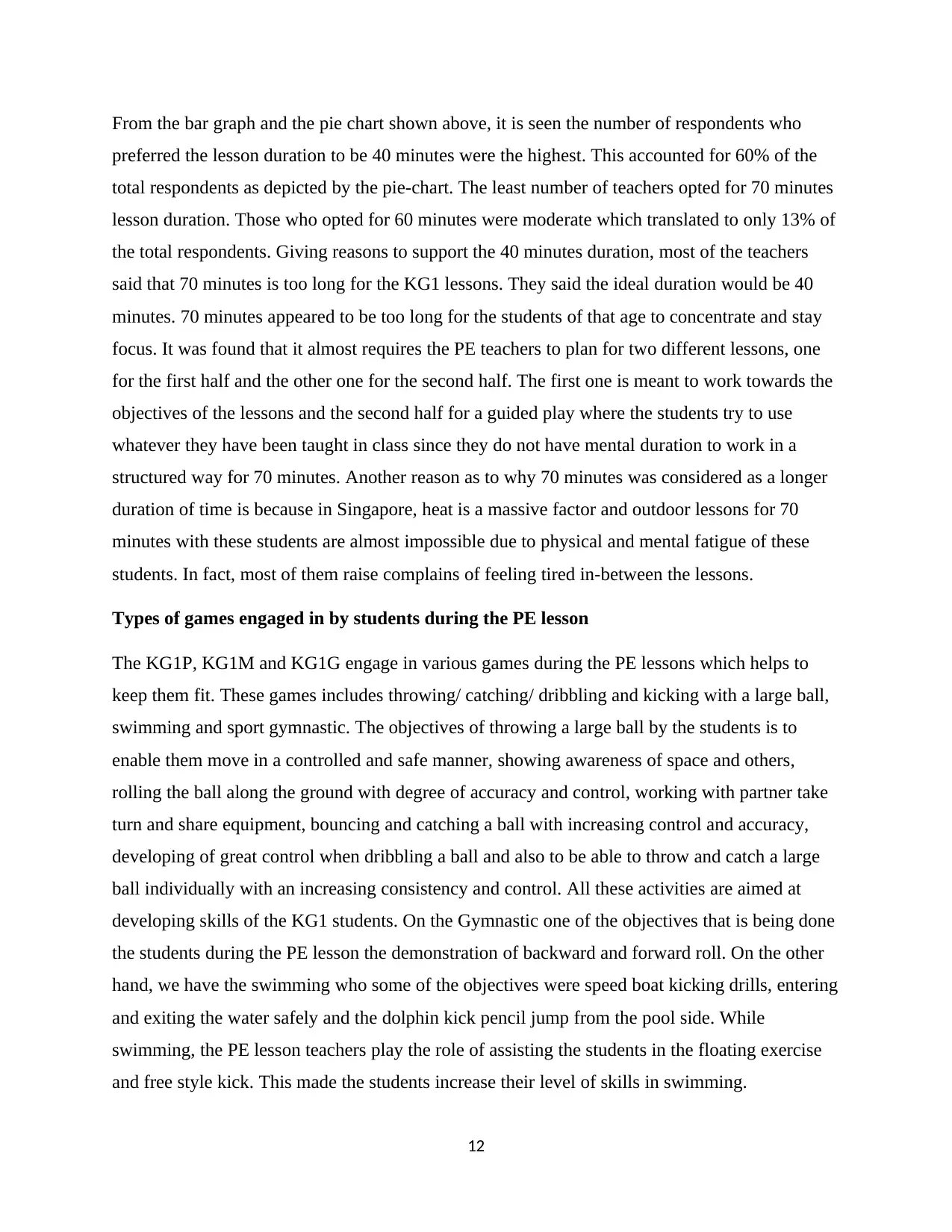
From the bar graph and the pie chart shown above, it is seen the number of respondents who
preferred the lesson duration to be 40 minutes were the highest. This accounted for 60% of the
total respondents as depicted by the pie-chart. The least number of teachers opted for 70 minutes
lesson duration. Those who opted for 60 minutes were moderate which translated to only 13% of
the total respondents. Giving reasons to support the 40 minutes duration, most of the teachers
said that 70 minutes is too long for the KG1 lessons. They said the ideal duration would be 40
minutes. 70 minutes appeared to be too long for the students of that age to concentrate and stay
focus. It was found that it almost requires the PE teachers to plan for two different lessons, one
for the first half and the other one for the second half. The first one is meant to work towards the
objectives of the lessons and the second half for a guided play where the students try to use
whatever they have been taught in class since they do not have mental duration to work in a
structured way for 70 minutes. Another reason as to why 70 minutes was considered as a longer
duration of time is because in Singapore, heat is a massive factor and outdoor lessons for 70
minutes with these students are almost impossible due to physical and mental fatigue of these
students. In fact, most of them raise complains of feeling tired in-between the lessons.
Types of games engaged in by students during the PE lesson
The KG1P, KG1M and KG1G engage in various games during the PE lessons which helps to
keep them fit. These games includes throwing/ catching/ dribbling and kicking with a large ball,
swimming and sport gymnastic. The objectives of throwing a large ball by the students is to
enable them move in a controlled and safe manner, showing awareness of space and others,
rolling the ball along the ground with degree of accuracy and control, working with partner take
turn and share equipment, bouncing and catching a ball with increasing control and accuracy,
developing of great control when dribbling a ball and also to be able to throw and catch a large
ball individually with an increasing consistency and control. All these activities are aimed at
developing skills of the KG1 students. On the Gymnastic one of the objectives that is being done
the students during the PE lesson the demonstration of backward and forward roll. On the other
hand, we have the swimming who some of the objectives were speed boat kicking drills, entering
and exiting the water safely and the dolphin kick pencil jump from the pool side. While
swimming, the PE lesson teachers play the role of assisting the students in the floating exercise
and free style kick. This made the students increase their level of skills in swimming.
12
preferred the lesson duration to be 40 minutes were the highest. This accounted for 60% of the
total respondents as depicted by the pie-chart. The least number of teachers opted for 70 minutes
lesson duration. Those who opted for 60 minutes were moderate which translated to only 13% of
the total respondents. Giving reasons to support the 40 minutes duration, most of the teachers
said that 70 minutes is too long for the KG1 lessons. They said the ideal duration would be 40
minutes. 70 minutes appeared to be too long for the students of that age to concentrate and stay
focus. It was found that it almost requires the PE teachers to plan for two different lessons, one
for the first half and the other one for the second half. The first one is meant to work towards the
objectives of the lessons and the second half for a guided play where the students try to use
whatever they have been taught in class since they do not have mental duration to work in a
structured way for 70 minutes. Another reason as to why 70 minutes was considered as a longer
duration of time is because in Singapore, heat is a massive factor and outdoor lessons for 70
minutes with these students are almost impossible due to physical and mental fatigue of these
students. In fact, most of them raise complains of feeling tired in-between the lessons.
Types of games engaged in by students during the PE lesson
The KG1P, KG1M and KG1G engage in various games during the PE lessons which helps to
keep them fit. These games includes throwing/ catching/ dribbling and kicking with a large ball,
swimming and sport gymnastic. The objectives of throwing a large ball by the students is to
enable them move in a controlled and safe manner, showing awareness of space and others,
rolling the ball along the ground with degree of accuracy and control, working with partner take
turn and share equipment, bouncing and catching a ball with increasing control and accuracy,
developing of great control when dribbling a ball and also to be able to throw and catch a large
ball individually with an increasing consistency and control. All these activities are aimed at
developing skills of the KG1 students. On the Gymnastic one of the objectives that is being done
the students during the PE lesson the demonstration of backward and forward roll. On the other
hand, we have the swimming who some of the objectives were speed boat kicking drills, entering
and exiting the water safely and the dolphin kick pencil jump from the pool side. While
swimming, the PE lesson teachers play the role of assisting the students in the floating exercise
and free style kick. This made the students increase their level of skills in swimming.
12
⊘ This is a preview!⊘
Do you want full access?
Subscribe today to unlock all pages.
Trusted by 1+ million students worldwide

1 out of 20


Related Documents


Your All-in-One AI-Powered Toolkit for Academic Success.
+13062052269
info@desklib.com
Available 24*7 on WhatsApp / Email
![[object Object]](/_next/static/media/star-bottom.7253800d.svg)
Unlock your academic potential
Copyright © 2020–2026 A2Z Services. All Rights Reserved. Developed and managed by ZUCOL.