Kindergarten Classroom Observation: Diversity and Cultural Sensitivity

Verified

Added on  2023/04/11

|7
|1201
|320
Report
AI Summary
This report provides an observation of a kindergarten classroom, focusing on the presence and promotion of cultural sensitivity and diversity. The report examines how the classroom environment, teacher interactions, and school activities reflect multicultural and non-sexist approaches. It assesses the ways in which teachers are sensitive to the needs of children and families with diverse backgrounds, and how the school demonstrates diversity through displays and activities. The overall tone of the school and classroom is analyzed to determine if students feel encouraged to share their opinions and be themselves. The report also includes suggestions for improving cultural sensitivity within the school and classroom, drawing inspiration from examples of culturally diverse activities and resources. Desklib provides access to similar solved assignments and study resources for students.
Document Page
Running head: MANAGEMENT
Kindergarten level observation
Name of the student
Name of the university
Author Note:
tabler-icon-diamond-filled.svg

Paraphrase This Document

Need a fresh take? Get an instant paraphrase of this document with our AI Paraphraser
Document Page
2
MANAGEMENT
In what ways did the design and setup of the classroom display cultural sensitivity to
the children in the classroom? If you did not see evidence of this, describe what was
missing and how you would set up your classroom to be culturally sensitive.
How did the class activities demonstrate a multicultural, non- sexist approach? If you
did not see evidence of this, describe what was missing and how you would alter the
activity in your classroom.
Answers:
A multicultural society can be best presented by means of a culturally responsive
curriculum. According to, Blanchard et al. (2018) the schools that has the capability to
acknowledge the diversity of their students has the capability to understand the importance of
promoting cultural awareness. The visit to the kindergarten has been essential and effective as
because some quality observations based on the schools has been collected by the visitors. The
design and setup of the classrooms created the ultimate atmosphere that provided the evidence
about the cultural sensitivity. Some of the set up included the likes of the;
a. The most important observation in the kindergartens was that the teachers had created
the classroom environment in such a friendly manner that has helped them to reduce
the mental gap in between the children and them. The reduction in the gap helps them
to be much closer and friendlier towards the students. This helps the kids to express
themselves fearlessly and make their future growth much better.
b. The absence of any kind of racism and the presence of students coming from diverse
sections of the society makes the classroom friendlier and culturally sensitive in
nature.
Document Page
3
MANAGEMENT
Multicultural Education is one of the new trends in the education system across the globe.
The approach to include all the different students, coming from a variety of diverse backgrounds
and promoting education amongst them can be said to be the multicultural form of education. As
said earlier, the presence of different types of culturally varied students in the kindergarten is one
of the greatest examples of multicultural education. Apart from this the teachers encourage the
children to do what they like and also engage with the students in such a manner that promotes
multiculturalism. Lastly the presence of the co-ed system is present within the schools. The
recent rise in the sexist activities has prompted the managements of the kindergartens to make a
psychometric test compulsory for the students.
In what ways were the teachers sensitive to and meeting the needs of children and
families with differing backgrounds? Do you agree with their approach? How would
you do so in your own classroom? If you did not see evidence of this, how could the
teacher alter what he/she was doing to meet the needs of those families?
Answers:
It has been observed in the kindergartens that students need more than just good
teachers and smaller class sizes to address the diverse needs and challenges of the future.
The teachers in the kindergartens are extremely sensitive towards the culture of the
students and support the different activities that they prefer to carry on in the schools. The
teachers also have regular meetings and discussion sessions with the parents of the
children who help them to have a clear understanding of the problems that the students
face and accordingly address those problems. I totally approach to the following process
followed by the teachers as healthy discussions can be beneficial for both the parties to
build a better future for the children.
Document Page
4
MANAGEMENT
It will be my duty to follow such an approach as following such an approach in
the classroom will be great and efficient for my students. However, in the absence of
such an approach, it will be my duty to point out the problems to the teachers in the
kindergartens. How did the school as a whole demonstrate diversity and cultural sensitivity? (What did
you notice in the halls, the display cases, on the calendar?) How would you help your
school to become more culturally sensitive?
Answers:
The school that was visited by me presented a diverse and cultural atmosphere by
means of different activities. First of all the school had students from a varied range of
communities, with different kinds of backgrounds. The presence of different children
coming from a large range of backgrounds was one of the most important perspectives
that promoted diversity. The diversity culture was also present as a result of the different
books in the library, different artworks that displayed diverse cultures and stories.
However, the most important promotion of cultural diversity and sensitivity was the
encouragement of the teachers to draw diverse range of pictures that promoted unity and
diversity.
I noticed different pictures, hand drawn calendars that promoted cultural diversity
among the school.
tabler-icon-diamond-filled.svg

Paraphrase This Document

Need a fresh take? Get an instant paraphrase of this document with our AI Paraphraser
Document Page
5
MANAGEMENT
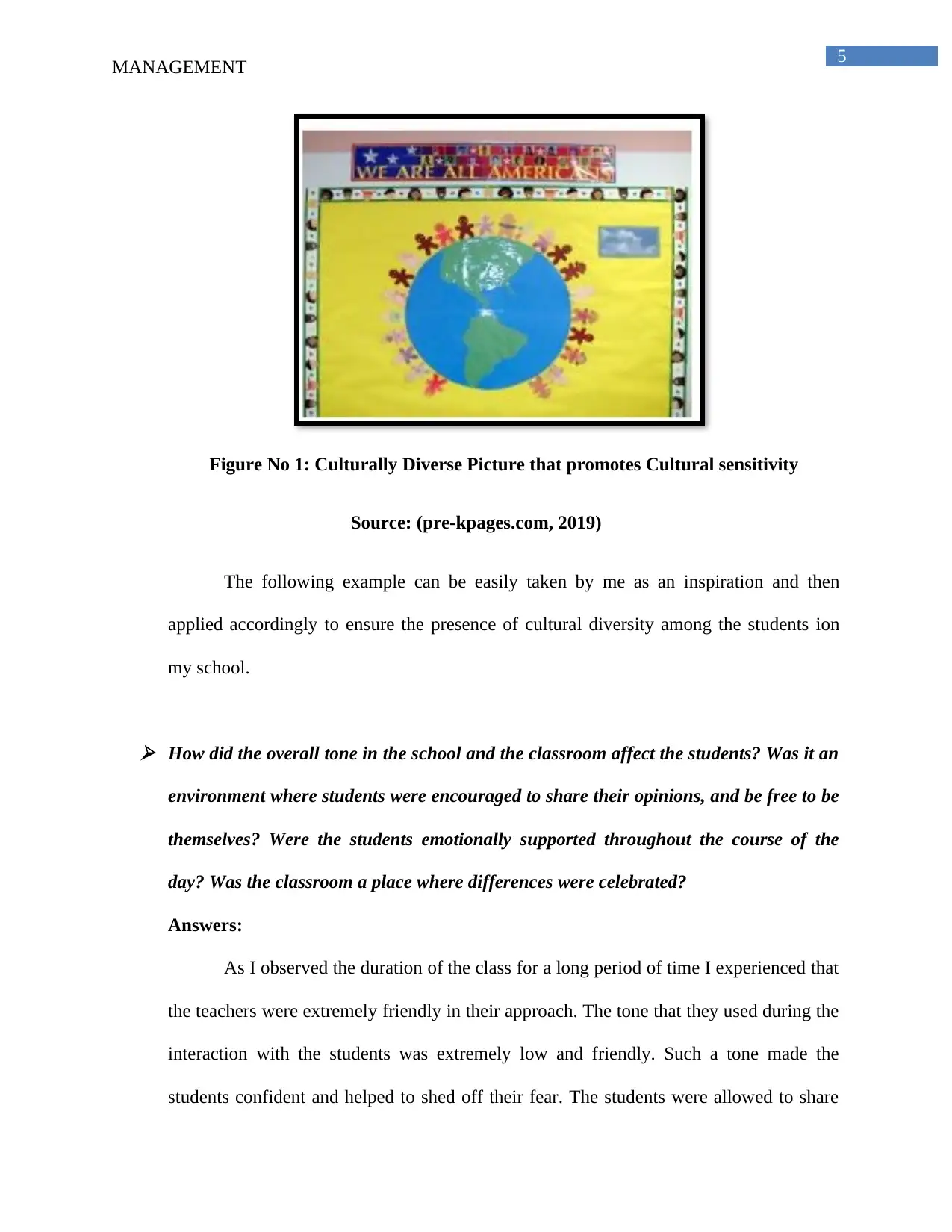
Figure No 1: Culturally Diverse Picture that promotes Cultural sensitivity
Source: (pre-kpages.com, 2019)
The following example can be easily taken by me as an inspiration and then
applied accordingly to ensure the presence of cultural diversity among the students ion
my school.
How did the overall tone in the school and the classroom affect the students? Was it an
environment where students were encouraged to share their opinions, and be free to be
themselves? Were the students emotionally supported throughout the course of the
day? Was the classroom a place where differences were celebrated?
Answers:
As I observed the duration of the class for a long period of time I experienced that
the teachers were extremely friendly in their approach. The tone that they used during the
interaction with the students was extremely low and friendly. Such a tone made the
students confident and helped to shed off their fear. The students were allowed to share
Document Page
6
MANAGEMENT
their opinions and easily be free in nature. I observed that the students were supported all
along the course of the day and the teachers treated each and every of the students in
exactly the same manner which helped to avoid the promotion of difference.
Document Page
7
MANAGEMENT
References and Bibliography
Blanchard, S. B., Yeh, C. J., Johnson, S. C., Schlierf, E. E., Dixon-Washington, C., & Lee, A.
(2018). Students’ Perception of Embedding Cultural Diversity Content into Early
Childhood Courses. Journal of Research Initiatives, 3(3), 6.
Here, S., play, d., centers, l., plans, l., & tips, t. (2019). Teaching Diversity in Preschool Pre-K
and Kindergarten. Retrieved from https://www.pre-kpages.com/multicultural/
Layne, H., & Lipponen, L. (2016). Student teachers in the contact zone: developing critical
intercultural ‘teacherhood’in kindergarten teacher education. Globalisation, Societies and
Education, 14(1), 110-126.
Rissanen, I., Kuusisto, E., & Kuusisto, A. (2016). Developing teachers' intercultural sensitivity:
Case study on a pilot course in Finnish teacher education. Teaching and Teacher
Education, 59, 446-456.
Starr, E. M., Martini, T. S., & Kuo, B. C. (2016). Transition to kindergarten for children with
autism spectrum disorder: A focus group study with ethnically diverse parents, teachers,
and early intervention service providers. Focus on Autism and Other Developmental
Disabilities, 31(2), 115-128.
Woodhead, M. (2015). Psychology and the cultural construction of children’s needs.
In Constructing and reconstructing childhood (pp. 54-73). Routledge.
chevron_up_icon
1 out of 7
circle_padding
hide_on_mobile
zoom_out_icon
[object Object]