Operational Plan for Office Renovation: Kingfisher Office Relocation
VerifiedAdded on 2020/04/21
|7
|1716
|150
Report
AI Summary
This report presents an operational plan for Kingfisher's office relocation, aiming to provide a centralized and improved workspace. The plan outlines resource requirements, determined using a Work Breakdown Structure (WBS), and details stakeholder management, including communication methods and roles for key personnel like the General Manager, Marketing Manager, and Finance Manager. The report describes the sourcing and acquisition process, emphasizing the importance of quotations and approvals. It also covers project execution, including team training and the role of the scrum master in risk management and documentation. A scope management plan is detailed, outlining responsibilities and change request procedures, alongside a comprehensive risk management section identifying potential risks and mitigation strategies. Finally, the plan includes project monitoring and evaluation using KPIs and project management tools to track timelines, costs, and variances. This comprehensive approach ensures the successful relocation of Kingfisher's offices.

Operational Plan Management: Kingfisher Office Relocation
Name
Date
Name
Date
Paraphrase This Document
Need a fresh take? Get an instant paraphrase of this document with our AI Paraphraser

Operational Plan for Office Renovation for Kingfisher
Kingfisher is a retailer with three offices located in Australia; as business grows, the
organization is seeking to provide a more centralized location to serve customers in Perth as well as
to provide a bigger and comfortable office space for staff. The aim of the renovation plan is to
relocate offices to better serve customers. As a result, Kingfisher will need to ensure the new office
premises have the right facilities for staff productivity and use by clients. The premise must be
renovated and custom designed to meet the staff requirements, as well as be fitted with new suitable
furniture and have services such as electricity, plumbing, Internet, and communications put in place.
This operational plan is aimed at achieving the following Key Results Areas which are also the key
performance indicators;
Complete the renovation, acquisition, and completion of relocation within the provided time
limit
Undertake the entire operation within the given budget allocation
Have the office ready for use by staff and clients as per the given time duration
This operational plan details resource identification and the process used in determining the
resource requirements. It also details how research will be done when sourcing for resources and
suitable acquisition methods for the project. Further, this operational plan details how the budgets
for the renovation plan will be developed and how stakeholders will be consulted. The processes for
getting approvals are also detailed through a scope management plan and the organization and
workplace procedures that will impact the operation plan implementation. In summary, this
operational plan details its development, implementation, and evaluation
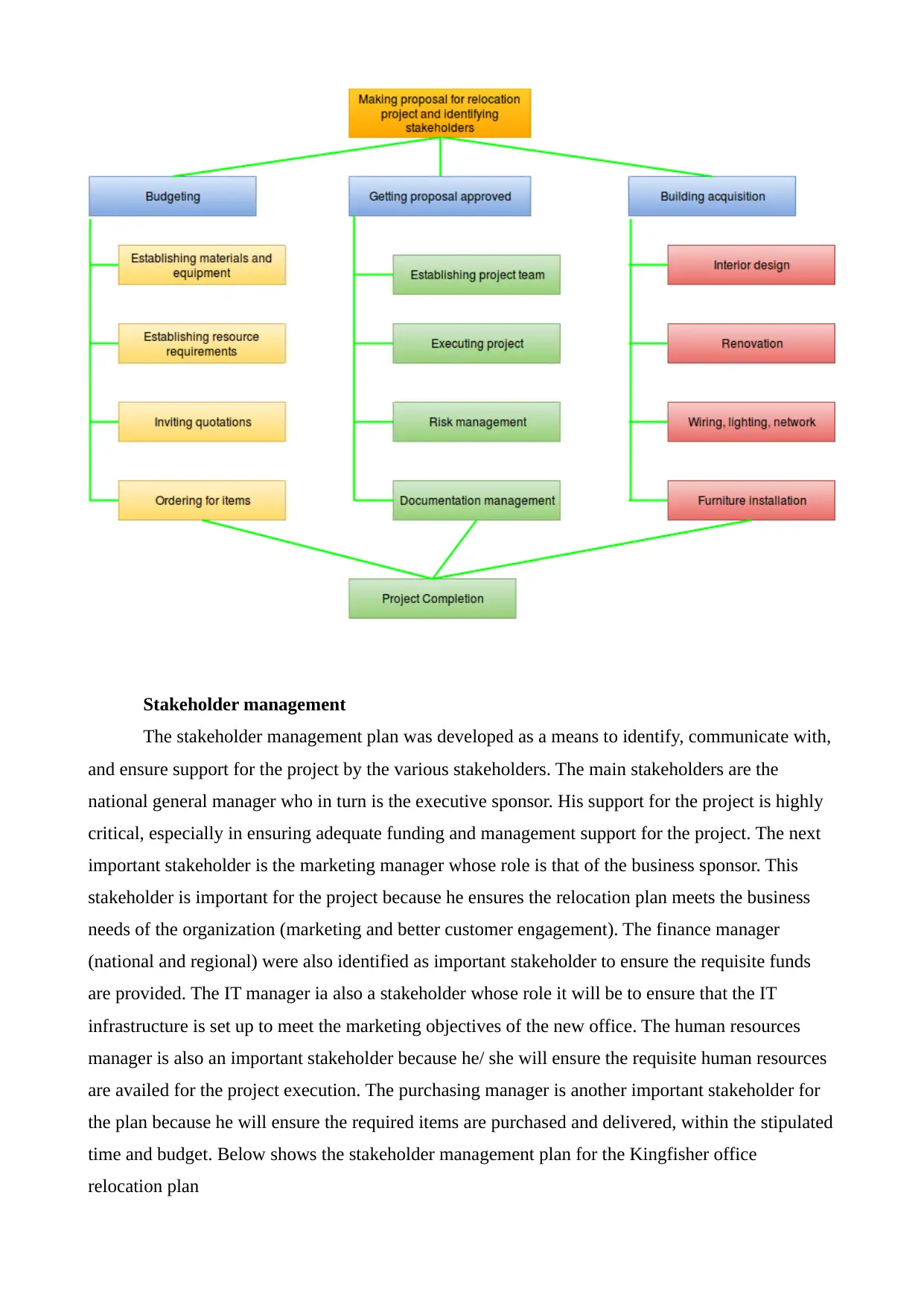
The resource requirements are determined by defining the tasks to be undertaken to achieve
the goals of the plan, which is office relocation to a new premise. To establish the required
resources, the WBS (work breakdown structure) is developed to organize the tasks to be undertaken
into smaller manageable units in a hierarchical manner. The figure below shows the WBS for the
renovation plan; the WBS helped identify all tasks and formed the basis for developing the plan’s
budget
Kingfisher is a retailer with three offices located in Australia; as business grows, the
organization is seeking to provide a more centralized location to serve customers in Perth as well as
to provide a bigger and comfortable office space for staff. The aim of the renovation plan is to
relocate offices to better serve customers. As a result, Kingfisher will need to ensure the new office
premises have the right facilities for staff productivity and use by clients. The premise must be
renovated and custom designed to meet the staff requirements, as well as be fitted with new suitable
furniture and have services such as electricity, plumbing, Internet, and communications put in place.
This operational plan is aimed at achieving the following Key Results Areas which are also the key
performance indicators;
Complete the renovation, acquisition, and completion of relocation within the provided time
limit
Undertake the entire operation within the given budget allocation
Have the office ready for use by staff and clients as per the given time duration
This operational plan details resource identification and the process used in determining the
resource requirements. It also details how research will be done when sourcing for resources and
suitable acquisition methods for the project. Further, this operational plan details how the budgets
for the renovation plan will be developed and how stakeholders will be consulted. The processes for
getting approvals are also detailed through a scope management plan and the organization and
workplace procedures that will impact the operation plan implementation. In summary, this
operational plan details its development, implementation, and evaluation
The resource requirements are determined by defining the tasks to be undertaken to achieve
the goals of the plan, which is office relocation to a new premise. To establish the required
resources, the WBS (work breakdown structure) is developed to organize the tasks to be undertaken
into smaller manageable units in a hierarchical manner. The figure below shows the WBS for the
renovation plan; the WBS helped identify all tasks and formed the basis for developing the plan’s
budget

Stakeholder management
The stakeholder management plan was developed as a means to identify, communicate with,
and ensure support for the project by the various stakeholders. The main stakeholders are the
national general manager who in turn is the executive sponsor. His support for the project is highly
critical, especially in ensuring adequate funding and management support for the project. The next
important stakeholder is the marketing manager whose role is that of the business sponsor. This
stakeholder is important for the project because he ensures the relocation plan meets the business
needs of the organization (marketing and better customer engagement). The finance manager
(national and regional) were also identified as important stakeholder to ensure the requisite funds
are provided. The IT manager ia also a stakeholder whose role it will be to ensure that the IT
infrastructure is set up to meet the marketing objectives of the new office. The human resources
manager is also an important stakeholder because he/ she will ensure the requisite human resources
are availed for the project execution. The purchasing manager is another important stakeholder for
the plan because he will ensure the required items are purchased and delivered, within the stipulated
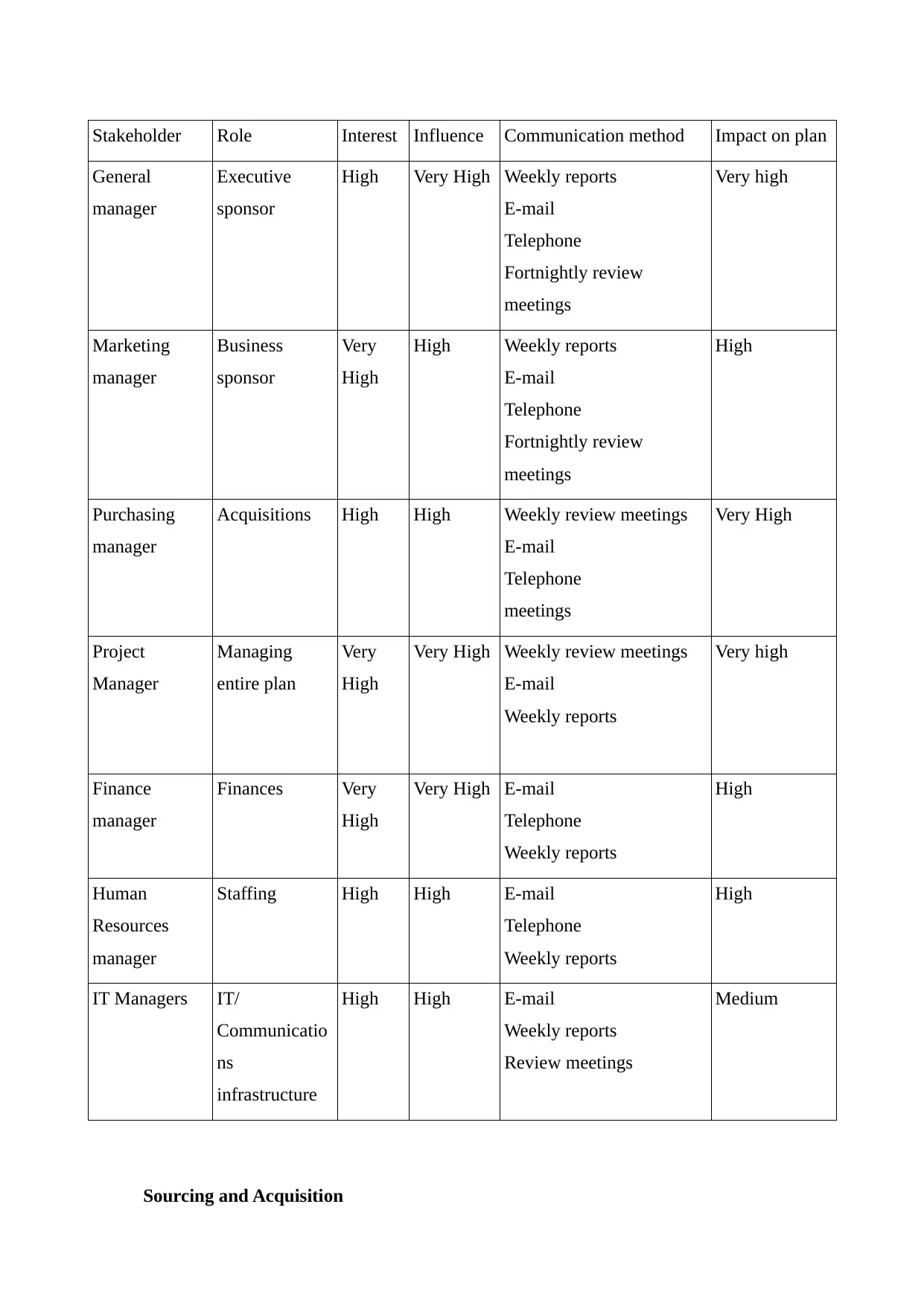
time and budget. Below shows the stakeholder management plan for the Kingfisher office
relocation plan
The stakeholder management plan was developed as a means to identify, communicate with,
and ensure support for the project by the various stakeholders. The main stakeholders are the
national general manager who in turn is the executive sponsor. His support for the project is highly
critical, especially in ensuring adequate funding and management support for the project. The next
important stakeholder is the marketing manager whose role is that of the business sponsor. This
stakeholder is important for the project because he ensures the relocation plan meets the business
needs of the organization (marketing and better customer engagement). The finance manager
(national and regional) were also identified as important stakeholder to ensure the requisite funds
are provided. The IT manager ia also a stakeholder whose role it will be to ensure that the IT
infrastructure is set up to meet the marketing objectives of the new office. The human resources
manager is also an important stakeholder because he/ she will ensure the requisite human resources
are availed for the project execution. The purchasing manager is another important stakeholder for
the plan because he will ensure the required items are purchased and delivered, within the stipulated
time and budget. Below shows the stakeholder management plan for the Kingfisher office
relocation plan
⊘ This is a preview!⊘
Do you want full access?
Subscribe today to unlock all pages.

Trusted by 1+ million students worldwide

Stakeholder Role Interest Influence Communication method Impact on plan
General
manager
Executive
sponsor
High Very High Weekly reports
E-mail
Telephone
Fortnightly review
meetings
Very high
Marketing
manager
Business
sponsor
Very
High
High Weekly reports
E-mail
Telephone
Fortnightly review
meetings
High
Purchasing
manager
Acquisitions High High Weekly review meetings
E-mail
Telephone
meetings
Very High
Project
Manager
Managing
entire plan
Very
High
Very High Weekly review meetings
E-mail
Weekly reports
Very high
Finance
manager
Finances Very
High
Very High E-mail
Telephone
Weekly reports
High
Human
Resources
manager
Staffing High High E-mail
Telephone
Weekly reports
High
IT Managers IT/
Communicatio
ns
infrastructure
High High E-mail
Weekly reports
Review meetings
Medium
Sourcing and Acquisition
General
manager
Executive
sponsor
High Very High Weekly reports
Telephone
Fortnightly review
meetings
Very high
Marketing
manager
Business
sponsor
Very
High
High Weekly reports
Telephone
Fortnightly review
meetings
High
Purchasing
manager
Acquisitions High High Weekly review meetings
Telephone
meetings
Very High
Project
Manager
Managing
entire plan
Very
High
Very High Weekly review meetings
Weekly reports
Very high
Finance
manager
Finances Very
High
Very High E-mail
Telephone
Weekly reports
High
Human
Resources
manager
Staffing High High E-mail
Telephone
Weekly reports
High
IT Managers IT/
Communicatio
ns
infrastructure
High High E-mail
Weekly reports
Review meetings
Medium
Sourcing and Acquisition
Paraphrase This Document
Need a fresh take? Get an instant paraphrase of this document with our AI Paraphraser

The materials to be purchased were developed by the marketing manager based on the needs
analysis for the staff at the new office. The prices were then obtained by inviting interested
suppliers to submit quotations for the various items of furniture and other fixtures, including
renovating the office, interior design, and wiring the facility. For every item, three quotations were
obtained and their terms evaluated before selecting the best supplier (in terms of value for money
and other terms) and selected. The approvals for the items were obtained from the executive and
business sponsors and their authority given for the acquisition and the works to commence, starting
with the renovation of the office facility. Any changes were managed through the scope
management plan and the approvals of the relevant stakeholders sought to effect changes. Scope
changes were to be avoided by ensuring proper planning for the entire project. After developing the
WBS, the staff needed for the project were identified and recruited, including those to help with
handling of the items and staff to undertake refurbishing the office space.
Execution
The teams were assembled and given the necessary training and instruction by the various
stakeholders and the project manager. This was to ensure all the project team members knew their
roles and why those roles were necessary in the first place. The team then had various meetings in
which the tasks to be undertaken and the activities to be undertaken and their time lines were
determined. The scrum maser for the project was responsible for all documentation and having
these communicated to the relevant stakeholders. The scrum master was also responsible for
managing risks in the plan, designing mitigation measures, and developing contingency plans for
the project. The execution of the project was monitored constantly by the project manager and
documented, with reports communicated to the various stakeholders as per the stakeholder
management plan.
Scope Management
This was done using a scope management plan in which the scope of the relocation was
defined and roles and responsibilities assigned. The scope was to migrate to the new office by
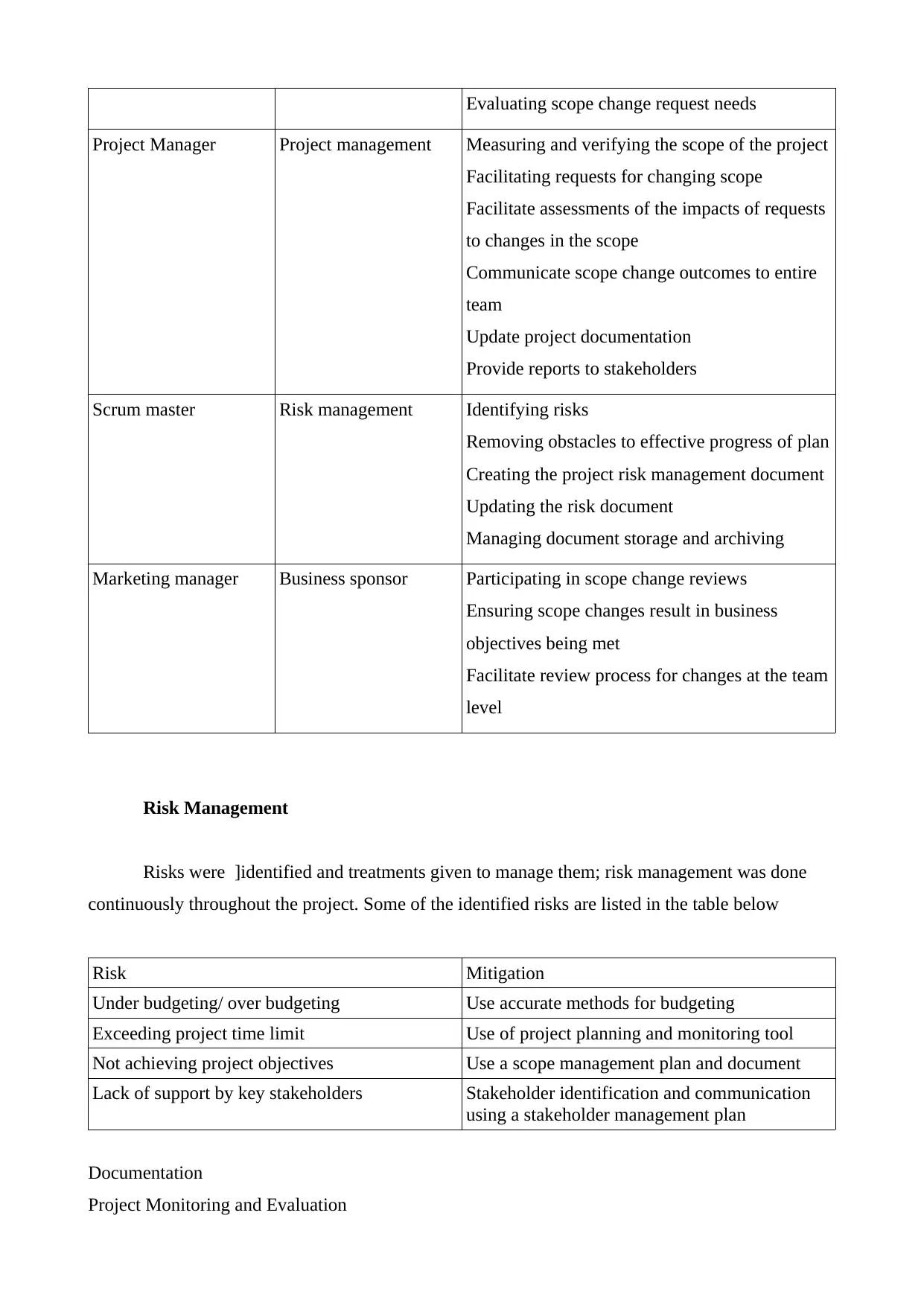
August 14 using the availed resources and within the prescribed budget. The table below outlines
the scope management plan
Person Role Responsibilities
General Manager Executive Sponsor Approving or denying change requests to project
scope (as appropriate)
Accepting the deliverables
analysis for the staff at the new office. The prices were then obtained by inviting interested
suppliers to submit quotations for the various items of furniture and other fixtures, including
renovating the office, interior design, and wiring the facility. For every item, three quotations were
obtained and their terms evaluated before selecting the best supplier (in terms of value for money
and other terms) and selected. The approvals for the items were obtained from the executive and
business sponsors and their authority given for the acquisition and the works to commence, starting
with the renovation of the office facility. Any changes were managed through the scope
management plan and the approvals of the relevant stakeholders sought to effect changes. Scope
changes were to be avoided by ensuring proper planning for the entire project. After developing the
WBS, the staff needed for the project were identified and recruited, including those to help with
handling of the items and staff to undertake refurbishing the office space.
Execution
The teams were assembled and given the necessary training and instruction by the various
stakeholders and the project manager. This was to ensure all the project team members knew their
roles and why those roles were necessary in the first place. The team then had various meetings in
which the tasks to be undertaken and the activities to be undertaken and their time lines were
determined. The scrum maser for the project was responsible for all documentation and having
these communicated to the relevant stakeholders. The scrum master was also responsible for
managing risks in the plan, designing mitigation measures, and developing contingency plans for
the project. The execution of the project was monitored constantly by the project manager and
documented, with reports communicated to the various stakeholders as per the stakeholder
management plan.
Scope Management
This was done using a scope management plan in which the scope of the relocation was
defined and roles and responsibilities assigned. The scope was to migrate to the new office by
August 14 using the availed resources and within the prescribed budget. The table below outlines
the scope management plan
Person Role Responsibilities
General Manager Executive Sponsor Approving or denying change requests to project
scope (as appropriate)
Accepting the deliverables

Evaluating scope change request needs
Project Manager Project management Measuring and verifying the scope of the project
Facilitating requests for changing scope
Facilitate assessments of the impacts of requests
to changes in the scope
Communicate scope change outcomes to entire
team
Update project documentation
Provide reports to stakeholders
Scrum master Risk management Identifying risks
Removing obstacles to effective progress of plan
Creating the project risk management document
Updating the risk document
Managing document storage and archiving
Marketing manager Business sponsor Participating in scope change reviews
Ensuring scope changes result in business
objectives being met
Facilitate review process for changes at the team
level
Risk Management
Risks were ]identified and treatments given to manage them; risk management was done
continuously throughout the project. Some of the identified risks are listed in the table below
Risk Mitigation
Under budgeting/ over budgeting Use accurate methods for budgeting
Exceeding project time limit Use of project planning and monitoring tool
Not achieving project objectives Use a scope management plan and document
Lack of support by key stakeholders Stakeholder identification and communication
using a stakeholder management plan
Documentation
Project Monitoring and Evaluation
Project Manager Project management Measuring and verifying the scope of the project
Facilitating requests for changing scope
Facilitate assessments of the impacts of requests
to changes in the scope
Communicate scope change outcomes to entire
team
Update project documentation
Provide reports to stakeholders
Scrum master Risk management Identifying risks
Removing obstacles to effective progress of plan
Creating the project risk management document
Updating the risk document
Managing document storage and archiving
Marketing manager Business sponsor Participating in scope change reviews
Ensuring scope changes result in business
objectives being met
Facilitate review process for changes at the team
level
Risk Management
Risks were ]identified and treatments given to manage them; risk management was done
continuously throughout the project. Some of the identified risks are listed in the table below
Risk Mitigation
Under budgeting/ over budgeting Use accurate methods for budgeting
Exceeding project time limit Use of project planning and monitoring tool
Not achieving project objectives Use a scope management plan and document
Lack of support by key stakeholders Stakeholder identification and communication
using a stakeholder management plan
Documentation
Project Monitoring and Evaluation
⊘ This is a preview!⊘
Do you want full access?
Subscribe today to unlock all pages.

Trusted by 1+ million students worldwide

The operational plan used the KPIs (key performance indicators) approach for monitoring and
evaluating the progress of the report. Using a project management tool (the Gantt chart) and the
WBS as well as the task list, the KPIs were monitored using these tools while the project was being
executed. The deliveries for various items and furniture were time bound, as were the completion of
the various project tasks. These were monitored using the project management software tool so that
the project manager, for instance, would know when a task was going over its time schedule or
when costs were exceeding budget. The variances in costs were computed (see appendix I) and the
percentages used to monitor when red flags on project costs would appear and contingency
measures put in place, including when to use the contingency budget and when to request scope
changes so that some item sources were changed or their specifications changed to meet the project
budget allocation
evaluating the progress of the report. Using a project management tool (the Gantt chart) and the
WBS as well as the task list, the KPIs were monitored using these tools while the project was being
executed. The deliveries for various items and furniture were time bound, as were the completion of
the various project tasks. These were monitored using the project management software tool so that
the project manager, for instance, would know when a task was going over its time schedule or
when costs were exceeding budget. The variances in costs were computed (see appendix I) and the
percentages used to monitor when red flags on project costs would appear and contingency
measures put in place, including when to use the contingency budget and when to request scope
changes so that some item sources were changed or their specifications changed to meet the project
budget allocation
1 out of 7
Related Documents
Your All-in-One AI-Powered Toolkit for Academic Success.
+13062052269
info@desklib.com
Available 24*7 on WhatsApp / Email
Unlock your academic potential
Copyright © 2020–2026 A2Z Services. All Rights Reserved. Developed and managed by ZUCOL.