Analyzing KISS & OFF Merger: Management Styles, Challenges & Solutions
VerifiedAdded on 2023/04/22
|10
|3255
|264
Report
AI Summary
This report analyzes the merger between Kincade Industrial Sanitary Seating (KISS) and Occupational Fixtures and Fasteners (OFF), highlighting the differences in their organizational design and management styles. KISS maintains a rigid, traditional leadership structure, while OFF employs a participative approach. The report applies the Social Identity theory to explain potential employee resistance and challenges arising from the merger, particularly for OFF employees adapting to KISS's stringent rules. Key challenges include implementing traditional leadership, managing resistance, and maintaining morale and operational efficiency. The report suggests measures to improve communication and integration, such as retaining key OFF personnel and establishing dedicated communication managers to address employee concerns. The overall goal is to ensure a smooth transition and leverage the strengths of both companies while minimizing disruption and demotivation among employees. Desklib offers a variety of solved assignments and past papers to help students understand complex business scenarios.

Running head: MANAGEMENT
Management
Student’s Name
University Name
Author’s Note
Management
Student’s Name
University Name
Author’s Note

Paraphrase This Document
Need a fresh take? Get an instant paraphrase of this document with our AI Paraphraser
2MANAGEMENT
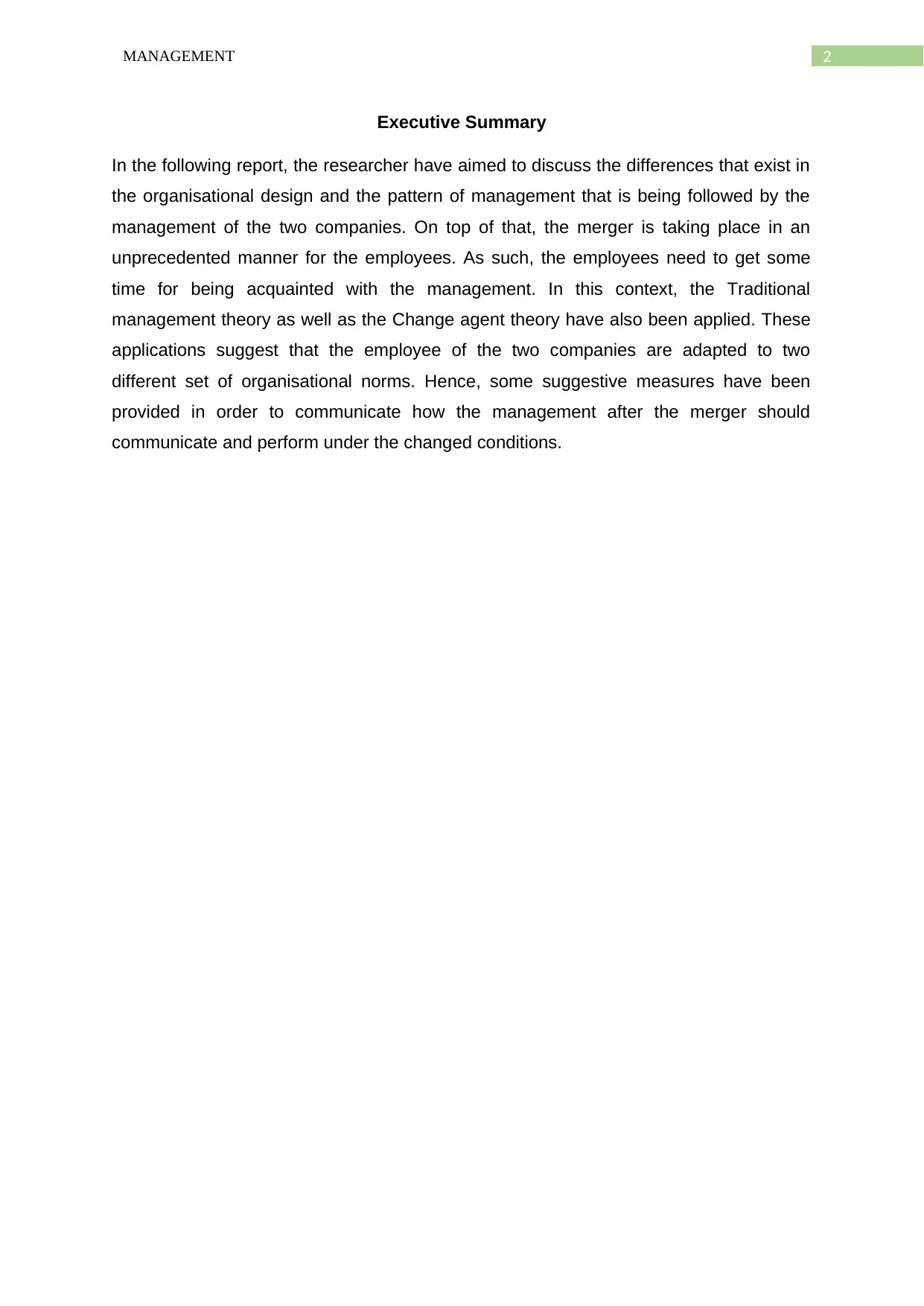
Executive Summary
In the following report, the researcher have aimed to discuss the differences that exist in
the organisational design and the pattern of management that is being followed by the
management of the two companies. On top of that, the merger is taking place in an
unprecedented manner for the employees. As such, the employees need to get some
time for being acquainted with the management. In this context, the Traditional
management theory as well as the Change agent theory have also been applied. These
applications suggest that the employee of the two companies are adapted to two
different set of organisational norms. Hence, some suggestive measures have been
provided in order to communicate how the management after the merger should
communicate and perform under the changed conditions.
Executive Summary
In the following report, the researcher have aimed to discuss the differences that exist in
the organisational design and the pattern of management that is being followed by the
management of the two companies. On top of that, the merger is taking place in an
unprecedented manner for the employees. As such, the employees need to get some
time for being acquainted with the management. In this context, the Traditional
management theory as well as the Change agent theory have also been applied. These
applications suggest that the employee of the two companies are adapted to two
different set of organisational norms. Hence, some suggestive measures have been
provided in order to communicate how the management after the merger should
communicate and perform under the changed conditions.
3MANAGEMENT
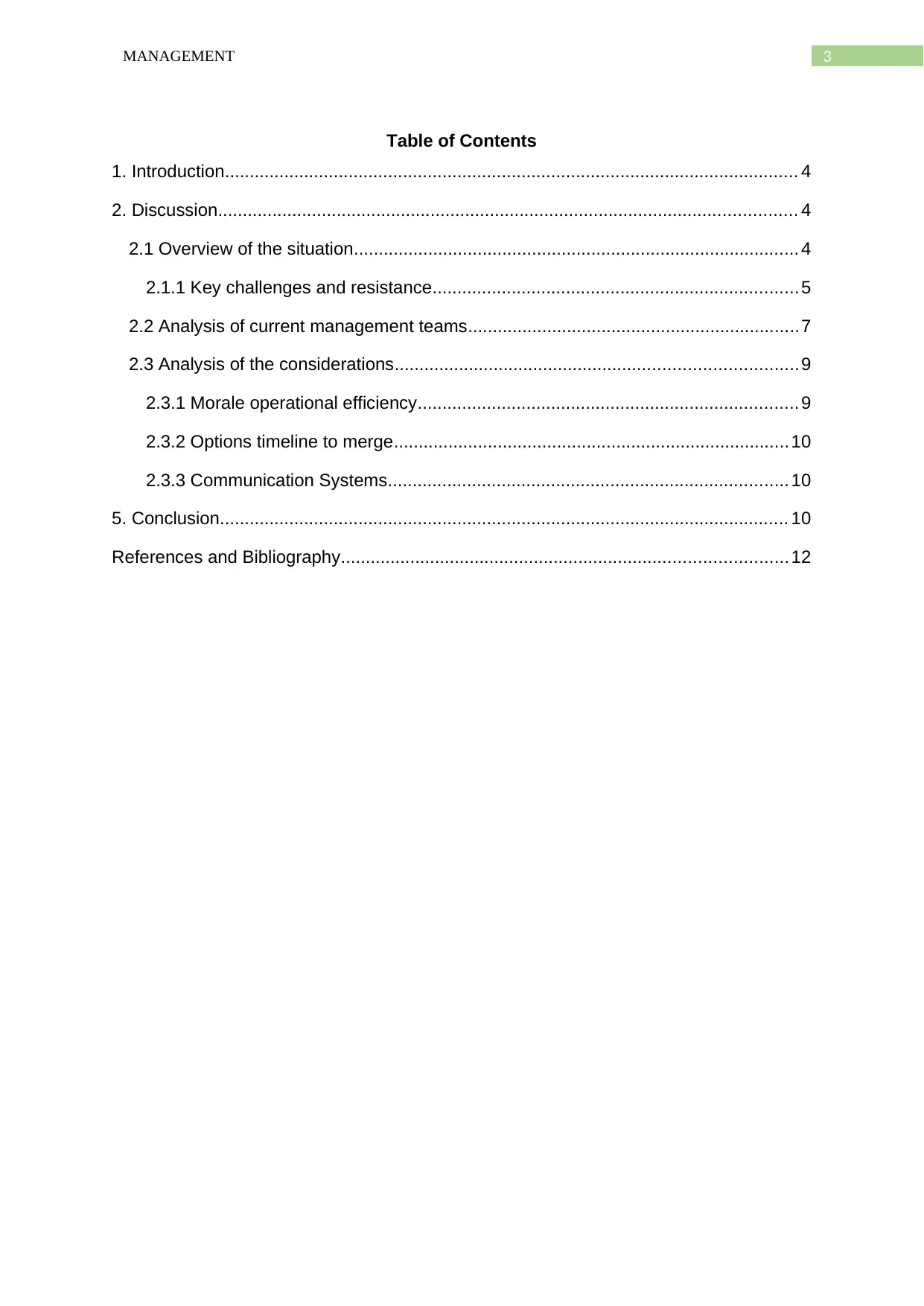
Table of Contents
1. Introduction.................................................................................................................... 4
2. Discussion..................................................................................................................... 4
2.1 Overview of the situation.......................................................................................... 4
2.1.1 Key challenges and resistance..........................................................................5
2.2 Analysis of current management teams...................................................................7
2.3 Analysis of the considerations.................................................................................9
2.3.1 Morale operational efficiency............................................................................. 9
2.3.2 Options timeline to merge................................................................................10
2.3.3 Communication Systems................................................................................. 10
5. Conclusion................................................................................................................... 10
References and Bibliography.......................................................................................... 12
Table of Contents
1. Introduction.................................................................................................................... 4
2. Discussion..................................................................................................................... 4
2.1 Overview of the situation.......................................................................................... 4
2.1.1 Key challenges and resistance..........................................................................5
2.2 Analysis of current management teams...................................................................7
2.3 Analysis of the considerations.................................................................................9
2.3.1 Morale operational efficiency............................................................................. 9
2.3.2 Options timeline to merge................................................................................10
2.3.3 Communication Systems................................................................................. 10
5. Conclusion................................................................................................................... 10
References and Bibliography.......................................................................................... 12
⊘ This is a preview!⊘
Do you want full access?
Subscribe today to unlock all pages.

Trusted by 1+ million students worldwide
4MANAGEMENT
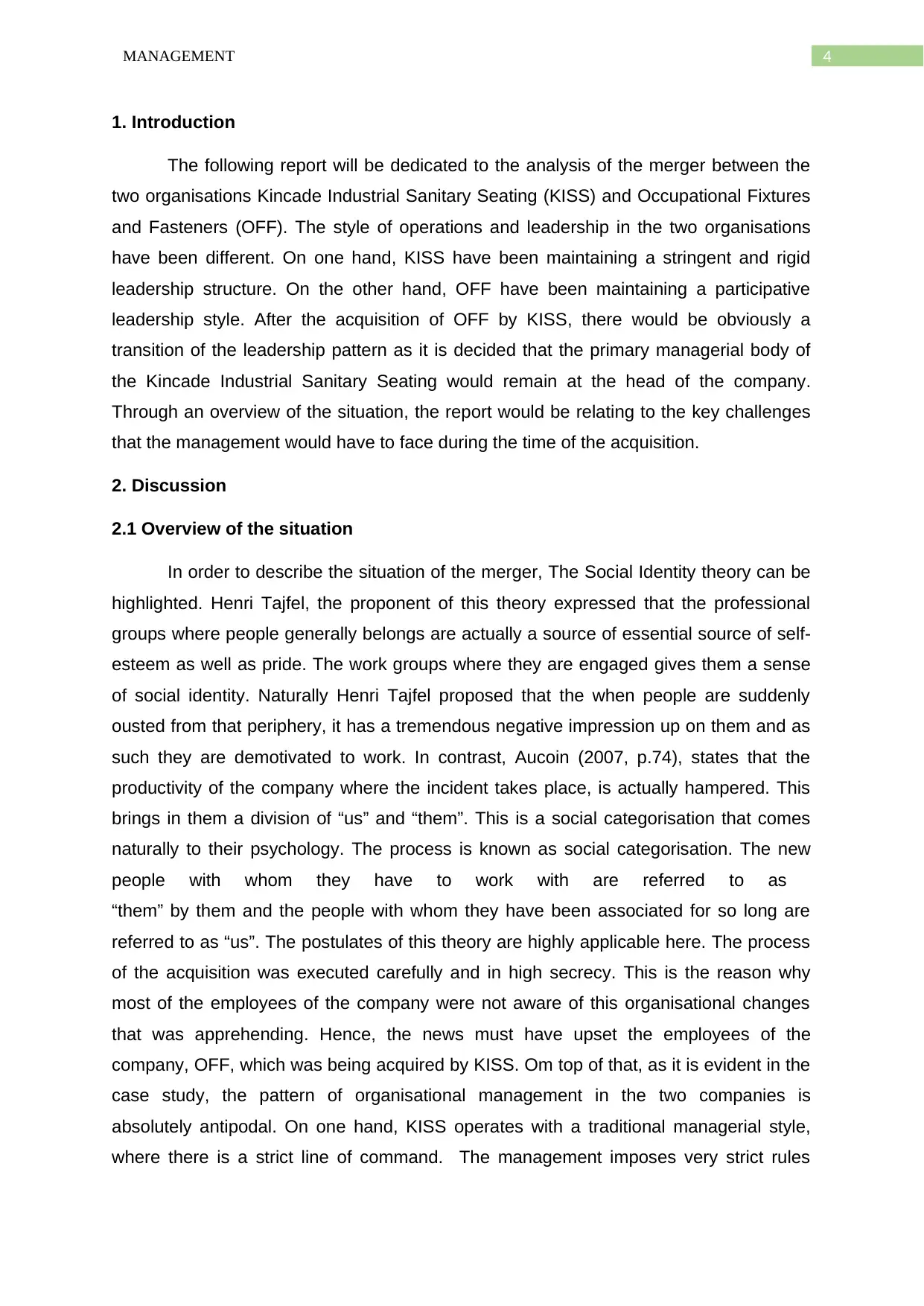
1. Introduction
The following report will be dedicated to the analysis of the merger between the
two organisations Kincade Industrial Sanitary Seating (KISS) and Occupational Fixtures
and Fasteners (OFF). The style of operations and leadership in the two organisations
have been different. On one hand, KISS have been maintaining a stringent and rigid
leadership structure. On the other hand, OFF have been maintaining a participative
leadership style. After the acquisition of OFF by KISS, there would be obviously a
transition of the leadership pattern as it is decided that the primary managerial body of
the Kincade Industrial Sanitary Seating would remain at the head of the company.
Through an overview of the situation, the report would be relating to the key challenges
that the management would have to face during the time of the acquisition.
2. Discussion
2.1 Overview of the situation
In order to describe the situation of the merger, The Social Identity theory can be
highlighted. Henri Tajfel, the proponent of this theory expressed that the professional
groups where people generally belongs are actually a source of essential source of self-
esteem as well as pride. The work groups where they are engaged gives them a sense
of social identity. Naturally Henri Tajfel proposed that the when people are suddenly
ousted from that periphery, it has a tremendous negative impression up on them and as
such they are demotivated to work. In contrast, Aucoin (2007, p.74), states that the
productivity of the company where the incident takes place, is actually hampered. This
brings in them a division of “us” and “them”. This is a social categorisation that comes
naturally to their psychology. The process is known as social categorisation. The new
people with whom they have to work with are referred to as
“them” by them and the people with whom they have been associated for so long are
referred to as “us”. The postulates of this theory are highly applicable here. The process
of the acquisition was executed carefully and in high secrecy. This is the reason why
most of the employees of the company were not aware of this organisational changes
that was apprehending. Hence, the news must have upset the employees of the
company, OFF, which was being acquired by KISS. Om top of that, as it is evident in the
case study, the pattern of organisational management in the two companies is
absolutely antipodal. On one hand, KISS operates with a traditional managerial style,
where there is a strict line of command. The management imposes very strict rules
1. Introduction
The following report will be dedicated to the analysis of the merger between the
two organisations Kincade Industrial Sanitary Seating (KISS) and Occupational Fixtures
and Fasteners (OFF). The style of operations and leadership in the two organisations
have been different. On one hand, KISS have been maintaining a stringent and rigid
leadership structure. On the other hand, OFF have been maintaining a participative
leadership style. After the acquisition of OFF by KISS, there would be obviously a
transition of the leadership pattern as it is decided that the primary managerial body of
the Kincade Industrial Sanitary Seating would remain at the head of the company.
Through an overview of the situation, the report would be relating to the key challenges
that the management would have to face during the time of the acquisition.
2. Discussion
2.1 Overview of the situation
In order to describe the situation of the merger, The Social Identity theory can be
highlighted. Henri Tajfel, the proponent of this theory expressed that the professional
groups where people generally belongs are actually a source of essential source of self-
esteem as well as pride. The work groups where they are engaged gives them a sense
of social identity. Naturally Henri Tajfel proposed that the when people are suddenly
ousted from that periphery, it has a tremendous negative impression up on them and as
such they are demotivated to work. In contrast, Aucoin (2007, p.74), states that the
productivity of the company where the incident takes place, is actually hampered. This
brings in them a division of “us” and “them”. This is a social categorisation that comes
naturally to their psychology. The process is known as social categorisation. The new
people with whom they have to work with are referred to as
“them” by them and the people with whom they have been associated for so long are
referred to as “us”. The postulates of this theory are highly applicable here. The process
of the acquisition was executed carefully and in high secrecy. This is the reason why
most of the employees of the company were not aware of this organisational changes
that was apprehending. Hence, the news must have upset the employees of the
company, OFF, which was being acquired by KISS. Om top of that, as it is evident in the
case study, the pattern of organisational management in the two companies is
absolutely antipodal. On one hand, KISS operates with a traditional managerial style,
where there is a strict line of command. The management imposes very strict rules
Paraphrase This Document
Need a fresh take? Get an instant paraphrase of this document with our AI Paraphraser
5MANAGEMENT
regarding the work hours also and overtime is mandatory for the employees on
conditional grounds. On the contrary, the management of the OFF Company is
absolutely lenient. There are self-directed work groups, who used to enjoy advantages
like flexibility of the working hours, additional superannuation, and a liberal vacation
policy and so on. In conclusion it can be easily commented that the working atmosphere
in the OFF Company is much more liberal. Hence, it is evident that the employees of the
OFF Company after the merger of the companies would be facing a large struggle. The
rigidity of the KISS Company would crop up large number of issues for the employees.
As an outcome they would feel much more alienated.
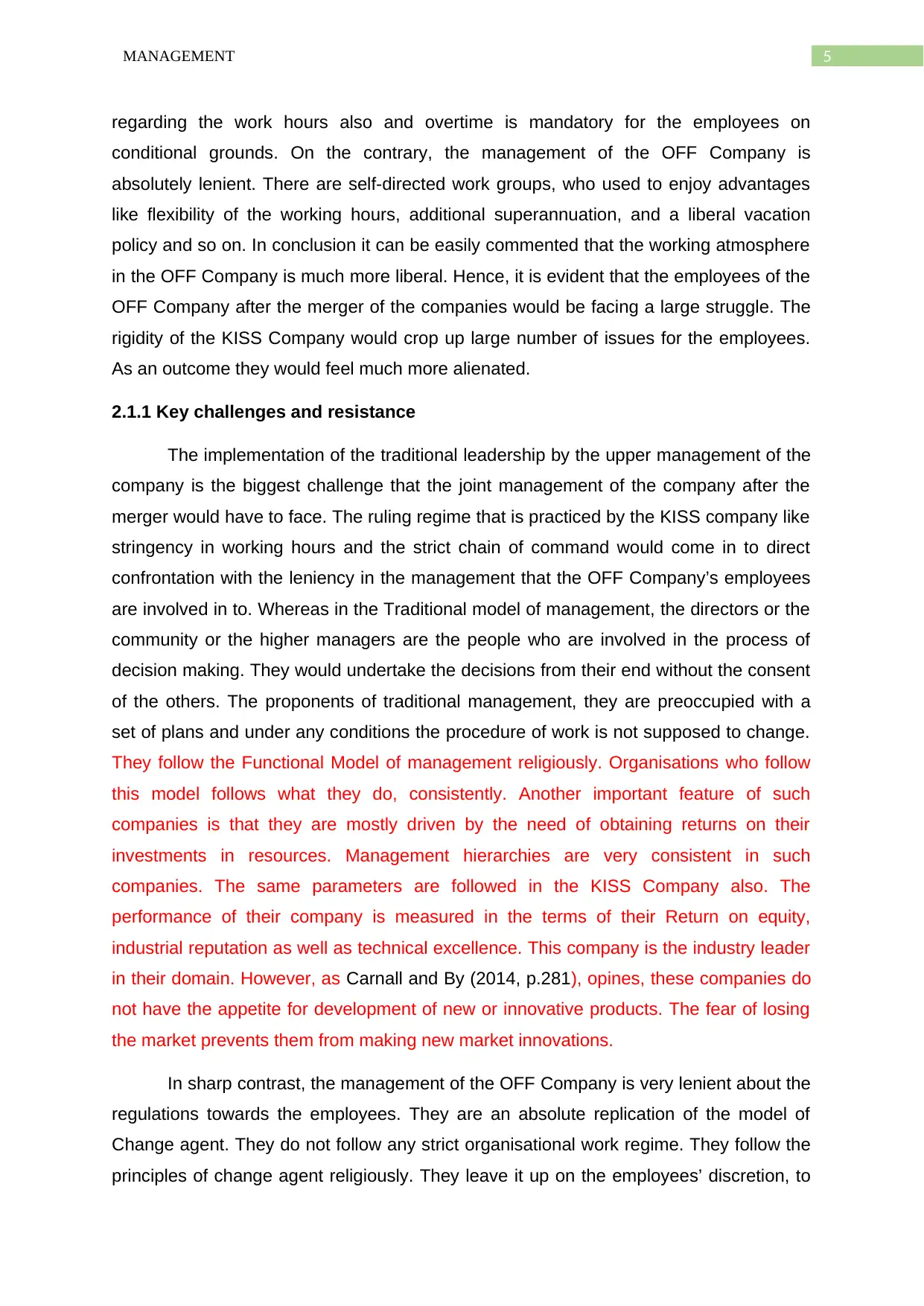
2.1.1 Key challenges and resistance
The implementation of the traditional leadership by the upper management of the
company is the biggest challenge that the joint management of the company after the
merger would have to face. The ruling regime that is practiced by the KISS company like
stringency in working hours and the strict chain of command would come in to direct
confrontation with the leniency in the management that the OFF Company’s employees
are involved in to. Whereas in the Traditional model of management, the directors or the
community or the higher managers are the people who are involved in the process of
decision making. They would undertake the decisions from their end without the consent
of the others. The proponents of traditional management, they are preoccupied with a
set of plans and under any conditions the procedure of work is not supposed to change.
They follow the Functional Model of management religiously. Organisations who follow
this model follows what they do, consistently. Another important feature of such
companies is that they are mostly driven by the need of obtaining returns on their
investments in resources. Management hierarchies are very consistent in such
companies. The same parameters are followed in the KISS Company also. The
performance of their company is measured in the terms of their Return on equity,
industrial reputation as well as technical excellence. This company is the industry leader
in their domain. However, as Carnall and By (2014, p.281), opines, these companies do
not have the appetite for development of new or innovative products. The fear of losing
the market prevents them from making new market innovations.
In sharp contrast, the management of the OFF Company is very lenient about the
regulations towards the employees. They are an absolute replication of the model of
Change agent. They do not follow any strict organisational work regime. They follow the
principles of change agent religiously. They leave it up on the employees’ discretion, to
regarding the work hours also and overtime is mandatory for the employees on
conditional grounds. On the contrary, the management of the OFF Company is
absolutely lenient. There are self-directed work groups, who used to enjoy advantages
like flexibility of the working hours, additional superannuation, and a liberal vacation
policy and so on. In conclusion it can be easily commented that the working atmosphere
in the OFF Company is much more liberal. Hence, it is evident that the employees of the
OFF Company after the merger of the companies would be facing a large struggle. The
rigidity of the KISS Company would crop up large number of issues for the employees.
As an outcome they would feel much more alienated.
2.1.1 Key challenges and resistance
The implementation of the traditional leadership by the upper management of the
company is the biggest challenge that the joint management of the company after the
merger would have to face. The ruling regime that is practiced by the KISS company like
stringency in working hours and the strict chain of command would come in to direct
confrontation with the leniency in the management that the OFF Company’s employees
are involved in to. Whereas in the Traditional model of management, the directors or the
community or the higher managers are the people who are involved in the process of
decision making. They would undertake the decisions from their end without the consent
of the others. The proponents of traditional management, they are preoccupied with a
set of plans and under any conditions the procedure of work is not supposed to change.
They follow the Functional Model of management religiously. Organisations who follow
this model follows what they do, consistently. Another important feature of such
companies is that they are mostly driven by the need of obtaining returns on their
investments in resources. Management hierarchies are very consistent in such
companies. The same parameters are followed in the KISS Company also. The
performance of their company is measured in the terms of their Return on equity,
industrial reputation as well as technical excellence. This company is the industry leader
in their domain. However, as Carnall and By (2014, p.281), opines, these companies do
not have the appetite for development of new or innovative products. The fear of losing
the market prevents them from making new market innovations.
In sharp contrast, the management of the OFF Company is very lenient about the
regulations towards the employees. They are an absolute replication of the model of
Change agent. They do not follow any strict organisational work regime. They follow the
principles of change agent religiously. They leave it up on the employees’ discretion, to
6MANAGEMENT
engage in participative management. In the company, the decisions are made in the
lowest levels of the company and the actins suggested by the work groups in the lower
orders of the company are simply sanctioned or rejected by the higher management. In
order to enhance their manufacturing capability, the company was all set to start the
production of toilet seats with their revolutionary ideas.
However, after the merger of the companies, the ideologies of the employees to
develop their revolutionary design would be dropped. The employees would feel
demotivated. However, they need to understand the difference between efficiency and
effectiveness. Making extensive and exemplary use of the resources they have
commendably met the organisational objectives. Naturally, the question might arise in
their minds, why is the change needed?
In this context, an example can be cited. A company in Europe have been
manufacturing electromechanical weighing equipment in 1970s (Collins 1999, p.173).
They needed to develop their products at a more economic cost. They needed to indulge
in to competitive pricing as well as better service support for more impactful marketing of
the products. This is why the company decided to develop electronic technology for
electromagnetic weighing. As an outcome, the company made larger profits and this
transition also helped them in their future transition. The employees of OFF have been
bred under much fragile command chain. Hence, it is essential that the departmental
heads for the employees who arrives from OFF to KISS remain unchanged. This is
because in state of abrupt and dynamic change, it is impossible to assimilate the entire
work force from OFF in to the working order of KISS. Again, the participation ratio of the
workers of KISS and OFF in the merged company is almost 1 to 6. Hence, in this state, it
is also not possible that the workers of the KISS Company would adopt some of the
leadership traits of OFF (Bourne 2016, p.171). Again, it might occur that the strategic
alliance as well as the dynamic disruption brought about by the confluence of the two
companies might help them to enter a different or an associated industry in the future,
like the German company Brenntag did. From the domain of egg selling they entered in
to the sector of chemical manufacturing and distribution. Latter they even expanded in to
crude oil and motor fuels. However, it is very important that at this stage, the president of
the joint company Mr M.Y Whey understands that the employees of OFF Company
under their former organisational model have given commendable production and
showed immense advancement in terms of innovation in the field of production. Hence, it
engage in participative management. In the company, the decisions are made in the
lowest levels of the company and the actins suggested by the work groups in the lower
orders of the company are simply sanctioned or rejected by the higher management. In
order to enhance their manufacturing capability, the company was all set to start the
production of toilet seats with their revolutionary ideas.
However, after the merger of the companies, the ideologies of the employees to
develop their revolutionary design would be dropped. The employees would feel
demotivated. However, they need to understand the difference between efficiency and
effectiveness. Making extensive and exemplary use of the resources they have
commendably met the organisational objectives. Naturally, the question might arise in
their minds, why is the change needed?
In this context, an example can be cited. A company in Europe have been
manufacturing electromechanical weighing equipment in 1970s (Collins 1999, p.173).
They needed to develop their products at a more economic cost. They needed to indulge
in to competitive pricing as well as better service support for more impactful marketing of
the products. This is why the company decided to develop electronic technology for
electromagnetic weighing. As an outcome, the company made larger profits and this
transition also helped them in their future transition. The employees of OFF have been
bred under much fragile command chain. Hence, it is essential that the departmental
heads for the employees who arrives from OFF to KISS remain unchanged. This is
because in state of abrupt and dynamic change, it is impossible to assimilate the entire
work force from OFF in to the working order of KISS. Again, the participation ratio of the
workers of KISS and OFF in the merged company is almost 1 to 6. Hence, in this state, it
is also not possible that the workers of the KISS Company would adopt some of the
leadership traits of OFF (Bourne 2016, p.171). Again, it might occur that the strategic
alliance as well as the dynamic disruption brought about by the confluence of the two
companies might help them to enter a different or an associated industry in the future,
like the German company Brenntag did. From the domain of egg selling they entered in
to the sector of chemical manufacturing and distribution. Latter they even expanded in to
crude oil and motor fuels. However, it is very important that at this stage, the president of
the joint company Mr M.Y Whey understands that the employees of OFF Company
under their former organisational model have given commendable production and
showed immense advancement in terms of innovation in the field of production. Hence, it
⊘ This is a preview!⊘
Do you want full access?
Subscribe today to unlock all pages.
Trusted by 1+ million students worldwide
7MANAGEMENT
is recommendable they would give the best production if their work environment is not
much alternated.
2.2 Analysis of current management teams
Currently the management of the company KISS is involved in a stereotypical mode of
production wherein they are supposed to deliver production of the most successful items
and at the lowest production cost. This is the formula that they have helped them to
remain atop in the industry. Their mode of operation is much production oriented. Owing
to the difference in the operational styles of the companies, the four stage of acquisition
process as suggested by Marks and Mirvis can be implemented by the joint
management of the merged company (Hayes 2010, p.91). The step of the identification
of the acquisition objectives have to be determined early. There should be an exact
perspective through which the joint management of the company would analyse how
they would utilise the resources like people skills, technologies and product designs of
the merged organisation. Again, it is very essential that the acquisition over view of the
company be prepared also. This would ensure smooth operations after the acquisition.
The team leaders and the assistant production managers should be definitely absorbed
from OFF. This is because, the team leaders are best acquainted with the way in which
the employees can be made to give their best production and this is very essential
especially in the initial phase of market operations of the KISS Company after the
completion of the merger. Other than that, two of the departmental heads of the OFF
Company and three of the R&D managers out of their team of 12 managers who used to
manipulate the most of the research and development activities should be maintained by
the KISS management and their president
(Burrell & Morgan 2017, p.421). Besides, the president should also consider the
appointment of one of the specialised managers and most preferably the
Communication manager from the OFF Company to the new company formed after the
merger. The employees of both the companies would have to experience some new
changes and they would also have to adopt with some of the alienated conditions. This
is emphatically true for the employees of the OFF Company since it is their employees
who would need to adopt mostly the condition of affairs in the new company formed after
the merger. It is also essential that a communication manager be maintained for the
employees of the KISS. This is why it is essential that two communication managers,
one for the prospect of the employees of the employees of each company would have to
be incorporated (Hayes 2010, p.422). The communication managers would perform the
is recommendable they would give the best production if their work environment is not
much alternated.
2.2 Analysis of current management teams
Currently the management of the company KISS is involved in a stereotypical mode of
production wherein they are supposed to deliver production of the most successful items
and at the lowest production cost. This is the formula that they have helped them to
remain atop in the industry. Their mode of operation is much production oriented. Owing
to the difference in the operational styles of the companies, the four stage of acquisition
process as suggested by Marks and Mirvis can be implemented by the joint
management of the merged company (Hayes 2010, p.91). The step of the identification
of the acquisition objectives have to be determined early. There should be an exact
perspective through which the joint management of the company would analyse how
they would utilise the resources like people skills, technologies and product designs of
the merged organisation. Again, it is very essential that the acquisition over view of the
company be prepared also. This would ensure smooth operations after the acquisition.
The team leaders and the assistant production managers should be definitely absorbed
from OFF. This is because, the team leaders are best acquainted with the way in which
the employees can be made to give their best production and this is very essential
especially in the initial phase of market operations of the KISS Company after the
completion of the merger. Other than that, two of the departmental heads of the OFF
Company and three of the R&D managers out of their team of 12 managers who used to
manipulate the most of the research and development activities should be maintained by
the KISS management and their president
(Burrell & Morgan 2017, p.421). Besides, the president should also consider the
appointment of one of the specialised managers and most preferably the
Communication manager from the OFF Company to the new company formed after the
merger. The employees of both the companies would have to experience some new
changes and they would also have to adopt with some of the alienated conditions. This
is emphatically true for the employees of the OFF Company since it is their employees
who would need to adopt mostly the condition of affairs in the new company formed after
the merger. It is also essential that a communication manager be maintained for the
employees of the KISS. This is why it is essential that two communication managers,
one for the prospect of the employees of the employees of each company would have to
be incorporated (Hayes 2010, p.422). The communication managers would perform the
Paraphrase This Document
Need a fresh take? Get an instant paraphrase of this document with our AI Paraphraser
8MANAGEMENT
role of communicating the issue that the employees of both of the domains face in the
new and changed conditions.
The last stage of the plan as propose by Marks and Mirvis is the development of an
Implementation Plan. This is based upon the accreditation of the overview and the
acquisition plan by the higher management.
2.3 Analysis of the considerations
2.3.1 Morale operational efficiency
There would be a change in the perception of the employees from both ends.
This is again mostly true for the employees of the OFF Company. They have been
adjusted with an absolutely different working condition. An instance can be suppose.
They have been acquainted with a working condition where they could have taken a
leave on any flexible dates and enjoyed other flexibilities in terms of medical and other
form of leaves. In the new condition, the management body have to consider two
aspects. In case if they suppose that all the organisational norms of the KISS Company
would be imposed up on the added employees. They must remember that they are not
employing a single employee. They are acquiring a company that have over 150
employees. In this condition they have to relax their organisational norms to some
extent. Either they need to relax some of their rigid organisational rules for all the
employees. However, analysing the organisational evidences provided by Shields (2006,
p.332), it can be commented that the employees of the KISS Company who have been
already working in the company might raise questions regarding the reasons of the
sudden relaxation of the rules. On another condition they might also undertake a
different initiative. They can allow the set of workers under the departmental heads of
OFF Company to continue their operations in the way they gave been doing with the
same advantage and facilities. They can at best impose a similar salary structure. The
holiday and other medical leave related benefits can be kept unaltered (Waddell et al.
2014). It is upon the president to select either of the initiatives that might be best suited
for the organisation and their budgetary implications.
2.3.2 Options timeline to merge
For the initial six months of operations, the employees of the OFF Company
should be provided with the above stated advantages and during that time period they
can be provided with rigorous on-job training so that they are able to adopt to the new
conditions and norms (Calvo-Mora, Navarro-García & Periañez-Cristobal 2015, p.1341).
role of communicating the issue that the employees of both of the domains face in the
new and changed conditions.
The last stage of the plan as propose by Marks and Mirvis is the development of an
Implementation Plan. This is based upon the accreditation of the overview and the
acquisition plan by the higher management.
2.3 Analysis of the considerations
2.3.1 Morale operational efficiency
There would be a change in the perception of the employees from both ends.
This is again mostly true for the employees of the OFF Company. They have been
adjusted with an absolutely different working condition. An instance can be suppose.
They have been acquainted with a working condition where they could have taken a
leave on any flexible dates and enjoyed other flexibilities in terms of medical and other
form of leaves. In the new condition, the management body have to consider two
aspects. In case if they suppose that all the organisational norms of the KISS Company
would be imposed up on the added employees. They must remember that they are not
employing a single employee. They are acquiring a company that have over 150
employees. In this condition they have to relax their organisational norms to some
extent. Either they need to relax some of their rigid organisational rules for all the
employees. However, analysing the organisational evidences provided by Shields (2006,
p.332), it can be commented that the employees of the KISS Company who have been
already working in the company might raise questions regarding the reasons of the
sudden relaxation of the rules. On another condition they might also undertake a
different initiative. They can allow the set of workers under the departmental heads of
OFF Company to continue their operations in the way they gave been doing with the
same advantage and facilities. They can at best impose a similar salary structure. The
holiday and other medical leave related benefits can be kept unaltered (Waddell et al.
2014). It is upon the president to select either of the initiatives that might be best suited
for the organisation and their budgetary implications.
2.3.2 Options timeline to merge
For the initial six months of operations, the employees of the OFF Company
should be provided with the above stated advantages and during that time period they
can be provided with rigorous on-job training so that they are able to adopt to the new
conditions and norms (Calvo-Mora, Navarro-García & Periañez-Cristobal 2015, p.1341).
9MANAGEMENT
The next 6 months would be dedicated for the transition of the employees. In the initial
six months the management should be deciding the changes the changes that they
require in their organisational pattern.
2.3.3 Communication Systems
Besides, the president should also consider the appointment of one of the
specialised managers and most preferably the Communication manager from the OFF
Company to the new company formed after the merger. The employees of both the
companies would have to experience some new changes and they would also have to
adopt with some of the alienated conditions. This is emphatically true for the employees
of the OFF Company since it is their employees who would need to adopt mostly the
condition of affairs in the new company formed after the merger. It is also essential that
a communication manager be maintained for the employees of the KISS. This is why it is
essential that two communication managers, one for the prospect of the employees of
the employees of each company would have to be incorporated (Hayes 2010, p.423).
5. Conclusion
In conclusion, it can be stated that the employees of the KISS Company have
worked under much more stringent conditions than the employees of OFF. Hence, it is
required that they gets some time in the new merged conditions to adopt with the
conditions, the application of the traditional management and the change agent theory
also makes it apparent that mode of operations of both companies were widely different.
Hence, it is recommendable that the managerial designations as discussed in the course
of the study be maintained and a timeframe as suggested in the report be maintained.
The next 6 months would be dedicated for the transition of the employees. In the initial
six months the management should be deciding the changes the changes that they
require in their organisational pattern.
2.3.3 Communication Systems
Besides, the president should also consider the appointment of one of the
specialised managers and most preferably the Communication manager from the OFF
Company to the new company formed after the merger. The employees of both the
companies would have to experience some new changes and they would also have to
adopt with some of the alienated conditions. This is emphatically true for the employees
of the OFF Company since it is their employees who would need to adopt mostly the
condition of affairs in the new company formed after the merger. It is also essential that
a communication manager be maintained for the employees of the KISS. This is why it is
essential that two communication managers, one for the prospect of the employees of
the employees of each company would have to be incorporated (Hayes 2010, p.423).
5. Conclusion
In conclusion, it can be stated that the employees of the KISS Company have
worked under much more stringent conditions than the employees of OFF. Hence, it is
required that they gets some time in the new merged conditions to adopt with the
conditions, the application of the traditional management and the change agent theory
also makes it apparent that mode of operations of both companies were widely different.
Hence, it is recommendable that the managerial designations as discussed in the course
of the study be maintained and a timeframe as suggested in the report be maintained.
⊘ This is a preview!⊘
Do you want full access?
Subscribe today to unlock all pages.
Trusted by 1+ million students worldwide
10MANAGEMENT
References and Bibliography
Aucoin, B.M 2007, ‘Projects create change, and change needs leadership’, Rightbrain
project management a complementary approach, Management Concepts, Vienna, VA,
pp. 73-92.
Bourne, L., 2016. Stakeholder relationship management: a maturity model for
organisational implementation. Routledge.
Burrell, G. & Morgan, G., 2017. Sociological paradigms and organisational analysis:
Elements of the sociology of corporate life. Routledge.
Calvo-Mora, A., Navarro-García, A. & Periañez-Cristobal, R., 2015. Project to improve
knowledge management and key business results through the EFQM excellence model.
International Journal of Project Management, 33(8), pp.1638-1651.
Carnall, C & By, RT 2014, Managing change in organizations, 6 rd edn. Pearson
Education Limited, Harlow, UK, pp. 195-225 & 279-285.
Collins, D 1999, Organizational change sociological perspectives, Routledge, London,
pp. 1-8 & 170-174.
Hayes, J 2010, ‘Merging groups: combining people for enhanced performance’ The
theory and practice of change management, 3 rd edn., Palgrave Macmillan, New York,
NY, pp. 407-424.
Hayes, J 2010, ‘Restructuring for strategic gain: mergers and acquisitions’ The theory
and practice of change management, 3 rd edn., Palgrave Macmillan, New York, NY, pp.
394-406.
Shields, J.L 2006, ‘Organization and culture change’ in Enterprise transformation
understanding and enabling fundamental change, eds W Rouse, John Wiley & Sons
Inc., Hoboken, New Jersey, pp. 331-358.
Waddell, D.M, Creed, A, Cummings, T.G, & Worley, C.G 2014, Organisational change:
development and transformation, 6 th edn., Cengage Learning Australia Pty Limited,
South Melbourne, Vic.
References and Bibliography
Aucoin, B.M 2007, ‘Projects create change, and change needs leadership’, Rightbrain
project management a complementary approach, Management Concepts, Vienna, VA,
pp. 73-92.
Bourne, L., 2016. Stakeholder relationship management: a maturity model for
organisational implementation. Routledge.
Burrell, G. & Morgan, G., 2017. Sociological paradigms and organisational analysis:
Elements of the sociology of corporate life. Routledge.
Calvo-Mora, A., Navarro-García, A. & Periañez-Cristobal, R., 2015. Project to improve
knowledge management and key business results through the EFQM excellence model.
International Journal of Project Management, 33(8), pp.1638-1651.
Carnall, C & By, RT 2014, Managing change in organizations, 6 rd edn. Pearson
Education Limited, Harlow, UK, pp. 195-225 & 279-285.
Collins, D 1999, Organizational change sociological perspectives, Routledge, London,
pp. 1-8 & 170-174.
Hayes, J 2010, ‘Merging groups: combining people for enhanced performance’ The
theory and practice of change management, 3 rd edn., Palgrave Macmillan, New York,
NY, pp. 407-424.
Hayes, J 2010, ‘Restructuring for strategic gain: mergers and acquisitions’ The theory
and practice of change management, 3 rd edn., Palgrave Macmillan, New York, NY, pp.
394-406.
Shields, J.L 2006, ‘Organization and culture change’ in Enterprise transformation
understanding and enabling fundamental change, eds W Rouse, John Wiley & Sons
Inc., Hoboken, New Jersey, pp. 331-358.
Waddell, D.M, Creed, A, Cummings, T.G, & Worley, C.G 2014, Organisational change:
development and transformation, 6 th edn., Cengage Learning Australia Pty Limited,
South Melbourne, Vic.

1 out of 10


Your All-in-One AI-Powered Toolkit for Academic Success.
+13062052269
info@desklib.com
Available 24*7 on WhatsApp / Email
![[object Object]](/_next/static/media/star-bottom.7253800d.svg)
Unlock your academic potential
Copyright © 2020–2026 A2Z Services. All Rights Reserved. Developed and managed by ZUCOL.