Knowledge Management and Analytics Strategies in Reserve Bank of NZ
VerifiedAdded on  2023/06/06
|5
|1103
|223
Report
AI Summary
This report analyzes appropriate knowledge creation modes, suitable knowledge management approaches, and effective tools for The Reserve Bank of New Zealand. It argues for the adoption of socialization and externalization from the SECI model for knowledge creation. The codification approach is recommended for knowledge management, addressing challenges like staff turnover and the demand for specialized skills by recording and storing knowledge in explicit forms supported by ICT. Content repositories and social software are proposed as suitable tools to manage and share information, ensuring knowledge retention and facilitating knowledge sharing between veteran and new employees. The report further evaluates the velocity and viscosity of these tools in the context of the bank's operational needs, highlighting their benefits in swiftly transferring and retaining detailed information and tacit knowledge.
Knowledge Management and Analytics 1
KNOWLEDGE MANAGEMENT AND ANALYTICS
Name
Course
Professor
Institution
City and state
Date
KNOWLEDGE MANAGEMENT AND ANALYTICS
Name
Course
Professor
Institution
City and state
Date
Paraphrase This Document
Need a fresh take? Get an instant paraphrase of this document with our AI Paraphraser

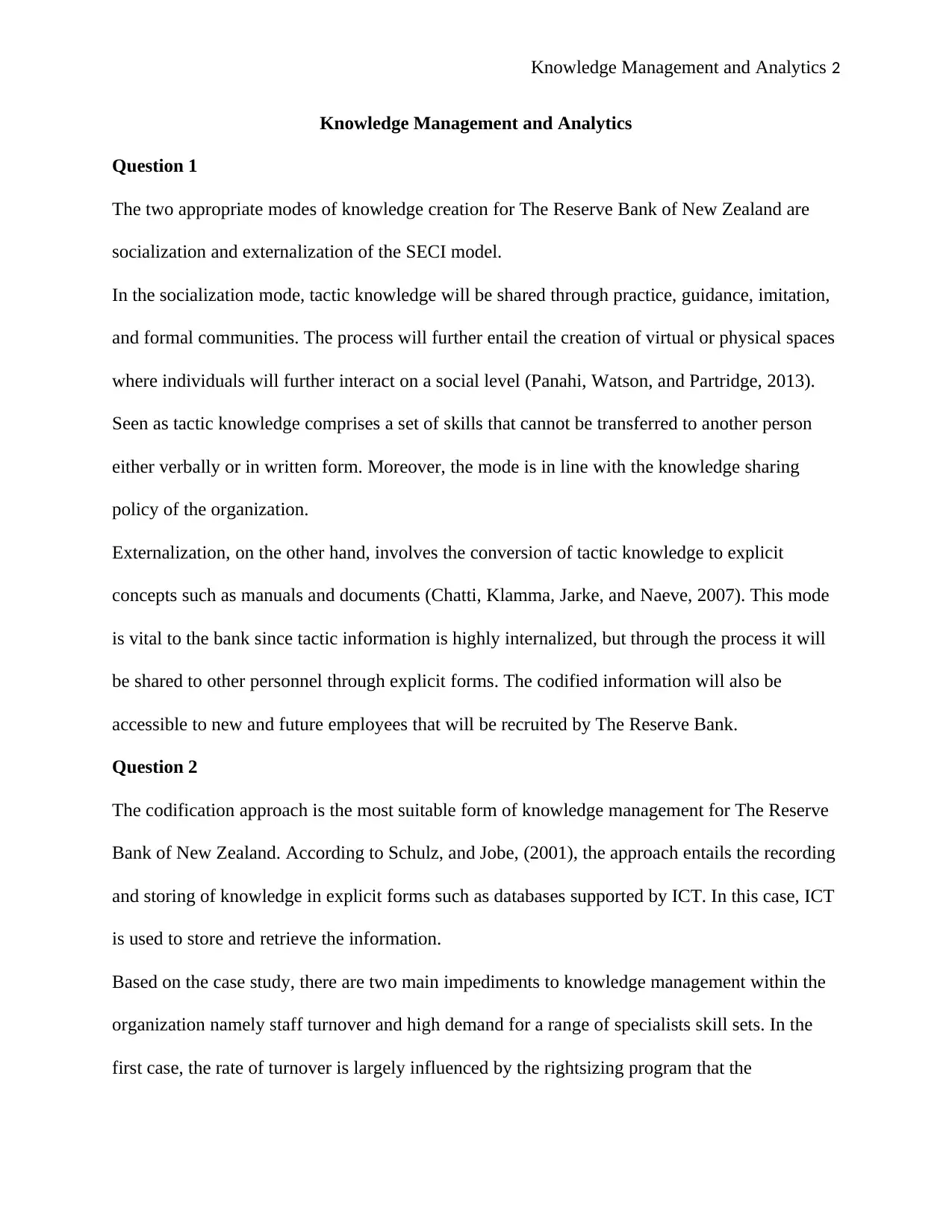
Knowledge Management and Analytics 2
Knowledge Management and Analytics
Question 1
The two appropriate modes of knowledge creation for The Reserve Bank of New Zealand are
socialization and externalization of the SECI model.
In the socialization mode, tactic knowledge will be shared through practice, guidance, imitation,
and formal communities. The process will further entail the creation of virtual or physical spaces
where individuals will further interact on a social level (Panahi, Watson, and Partridge, 2013).
Seen as tactic knowledge comprises a set of skills that cannot be transferred to another person
either verbally or in written form. Moreover, the mode is in line with the knowledge sharing
policy of the organization.
Externalization, on the other hand, involves the conversion of tactic knowledge to explicit
concepts such as manuals and documents (Chatti, Klamma, Jarke, and Naeve, 2007). This mode
is vital to the bank since tactic information is highly internalized, but through the process it will
be shared to other personnel through explicit forms. The codified information will also be
accessible to new and future employees that will be recruited by The Reserve Bank.
Question 2
The codification approach is the most suitable form of knowledge management for The Reserve
Bank of New Zealand. According to Schulz, and Jobe, (2001), the approach entails the recording
and storing of knowledge in explicit forms such as databases supported by ICT. In this case, ICT
is used to store and retrieve the information.
Based on the case study, there are two main impediments to knowledge management within the
organization namely staff turnover and high demand for a range of specialists skill sets. In the
first case, the rate of turnover is largely influenced by the rightsizing program that the
Knowledge Management and Analytics
Question 1
The two appropriate modes of knowledge creation for The Reserve Bank of New Zealand are
socialization and externalization of the SECI model.
In the socialization mode, tactic knowledge will be shared through practice, guidance, imitation,
and formal communities. The process will further entail the creation of virtual or physical spaces
where individuals will further interact on a social level (Panahi, Watson, and Partridge, 2013).
Seen as tactic knowledge comprises a set of skills that cannot be transferred to another person
either verbally or in written form. Moreover, the mode is in line with the knowledge sharing
policy of the organization.
Externalization, on the other hand, involves the conversion of tactic knowledge to explicit
concepts such as manuals and documents (Chatti, Klamma, Jarke, and Naeve, 2007). This mode
is vital to the bank since tactic information is highly internalized, but through the process it will
be shared to other personnel through explicit forms. The codified information will also be
accessible to new and future employees that will be recruited by The Reserve Bank.
Question 2
The codification approach is the most suitable form of knowledge management for The Reserve
Bank of New Zealand. According to Schulz, and Jobe, (2001), the approach entails the recording
and storing of knowledge in explicit forms such as databases supported by ICT. In this case, ICT
is used to store and retrieve the information.
Based on the case study, there are two main impediments to knowledge management within the
organization namely staff turnover and high demand for a range of specialists skill sets. In the
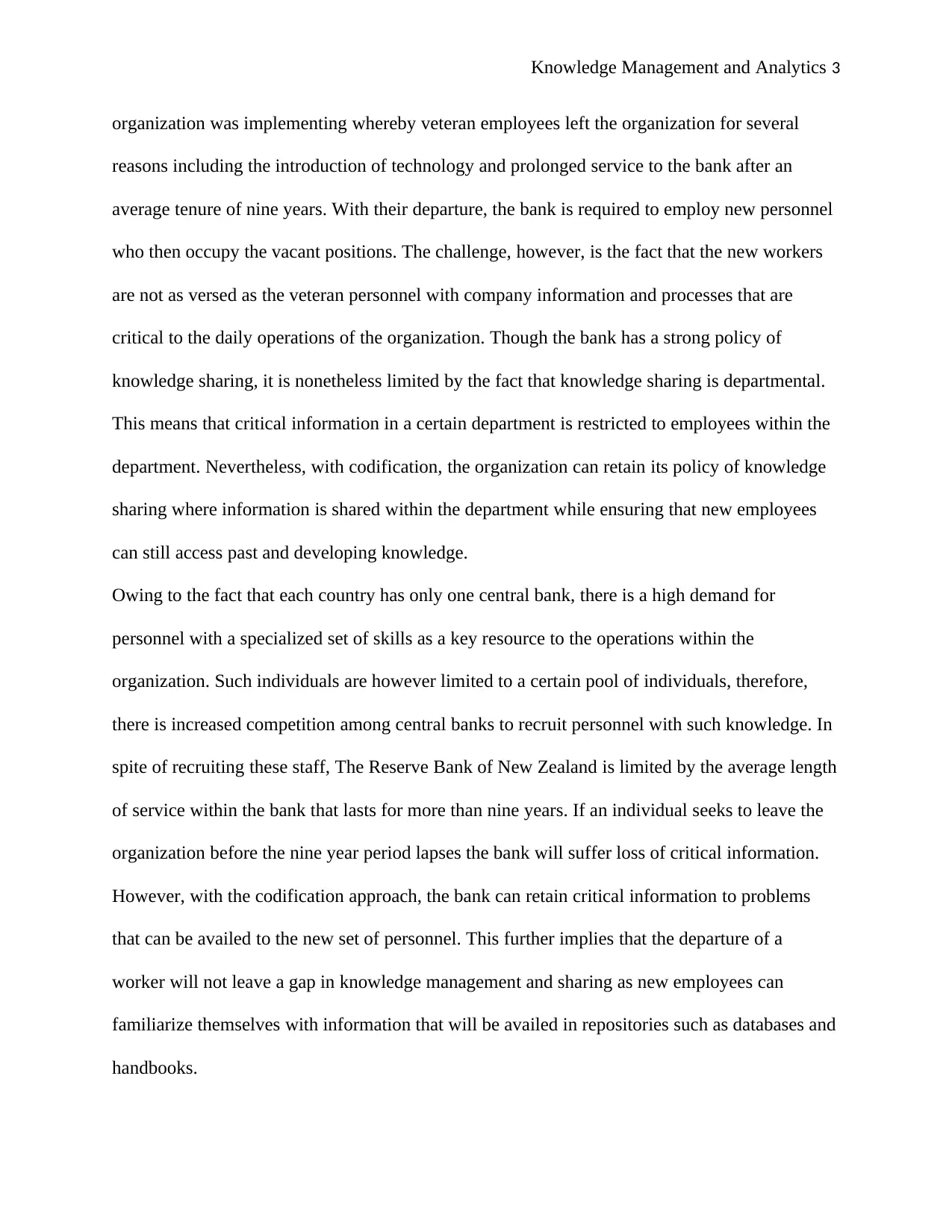
first case, the rate of turnover is largely influenced by the rightsizing program that the

Knowledge Management and Analytics 3
organization was implementing whereby veteran employees left the organization for several
reasons including the introduction of technology and prolonged service to the bank after an
average tenure of nine years. With their departure, the bank is required to employ new personnel
who then occupy the vacant positions. The challenge, however, is the fact that the new workers
are not as versed as the veteran personnel with company information and processes that are
critical to the daily operations of the organization. Though the bank has a strong policy of
knowledge sharing, it is nonetheless limited by the fact that knowledge sharing is departmental.
This means that critical information in a certain department is restricted to employees within the
department. Nevertheless, with codification, the organization can retain its policy of knowledge
sharing where information is shared within the department while ensuring that new employees
can still access past and developing knowledge.
Owing to the fact that each country has only one central bank, there is a high demand for
personnel with a specialized set of skills as a key resource to the operations within the
organization. Such individuals are however limited to a certain pool of individuals, therefore,
there is increased competition among central banks to recruit personnel with such knowledge. In
spite of recruiting these staff, The Reserve Bank of New Zealand is limited by the average length
of service within the bank that lasts for more than nine years. If an individual seeks to leave the
organization before the nine year period lapses the bank will suffer loss of critical information.
However, with the codification approach, the bank can retain critical information to problems
that can be availed to the new set of personnel. This further implies that the departure of a
worker will not leave a gap in knowledge management and sharing as new employees can
familiarize themselves with information that will be availed in repositories such as databases and
handbooks.
organization was implementing whereby veteran employees left the organization for several
reasons including the introduction of technology and prolonged service to the bank after an
average tenure of nine years. With their departure, the bank is required to employ new personnel
who then occupy the vacant positions. The challenge, however, is the fact that the new workers
are not as versed as the veteran personnel with company information and processes that are
critical to the daily operations of the organization. Though the bank has a strong policy of
knowledge sharing, it is nonetheless limited by the fact that knowledge sharing is departmental.
This means that critical information in a certain department is restricted to employees within the
department. Nevertheless, with codification, the organization can retain its policy of knowledge
sharing where information is shared within the department while ensuring that new employees
can still access past and developing knowledge.
Owing to the fact that each country has only one central bank, there is a high demand for
personnel with a specialized set of skills as a key resource to the operations within the
organization. Such individuals are however limited to a certain pool of individuals, therefore,
there is increased competition among central banks to recruit personnel with such knowledge. In
spite of recruiting these staff, The Reserve Bank of New Zealand is limited by the average length
of service within the bank that lasts for more than nine years. If an individual seeks to leave the
organization before the nine year period lapses the bank will suffer loss of critical information.
However, with the codification approach, the bank can retain critical information to problems
that can be availed to the new set of personnel. This further implies that the departure of a
worker will not leave a gap in knowledge management and sharing as new employees can
familiarize themselves with information that will be availed in repositories such as databases and
handbooks.
⊘ This is a preview!⊘
Do you want full access?
Subscribe today to unlock all pages.

Trusted by 1+ million students worldwide

Knowledge Management and Analytics 4
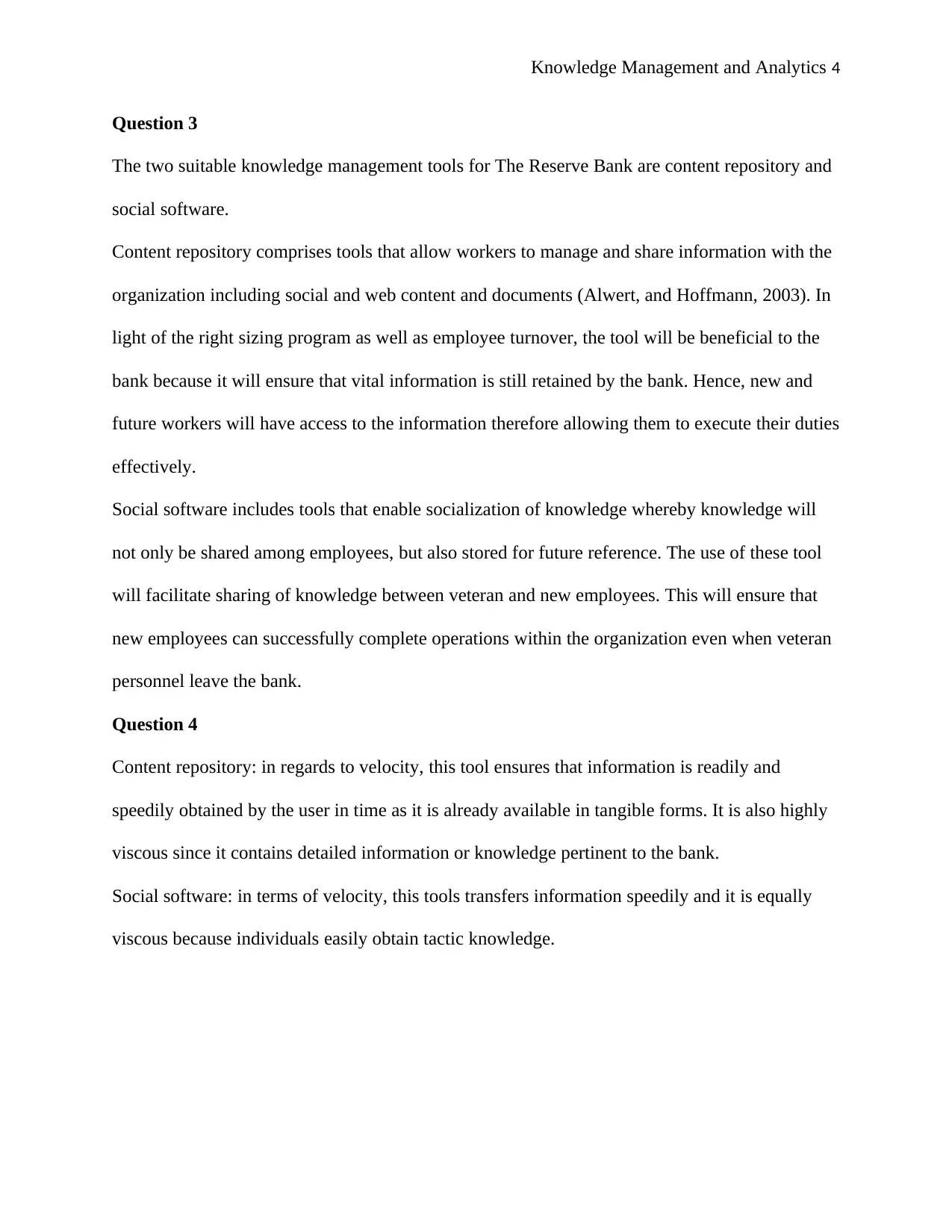
Question 3
The two suitable knowledge management tools for The Reserve Bank are content repository and
social software.
Content repository comprises tools that allow workers to manage and share information with the
organization including social and web content and documents (Alwert, and Hoffmann, 2003). In
light of the right sizing program as well as employee turnover, the tool will be beneficial to the
bank because it will ensure that vital information is still retained by the bank. Hence, new and
future workers will have access to the information therefore allowing them to execute their duties
effectively.
Social software includes tools that enable socialization of knowledge whereby knowledge will
not only be shared among employees, but also stored for future reference. The use of these tool
will facilitate sharing of knowledge between veteran and new employees. This will ensure that
new employees can successfully complete operations within the organization even when veteran
personnel leave the bank.
Question 4
Content repository: in regards to velocity, this tool ensures that information is readily and
speedily obtained by the user in time as it is already available in tangible forms. It is also highly
viscous since it contains detailed information or knowledge pertinent to the bank.
Social software: in terms of velocity, this tools transfers information speedily and it is equally
viscous because individuals easily obtain tactic knowledge.
Question 3
The two suitable knowledge management tools for The Reserve Bank are content repository and
social software.
Content repository comprises tools that allow workers to manage and share information with the
organization including social and web content and documents (Alwert, and Hoffmann, 2003). In
light of the right sizing program as well as employee turnover, the tool will be beneficial to the
bank because it will ensure that vital information is still retained by the bank. Hence, new and
future workers will have access to the information therefore allowing them to execute their duties
effectively.
Social software includes tools that enable socialization of knowledge whereby knowledge will
not only be shared among employees, but also stored for future reference. The use of these tool
will facilitate sharing of knowledge between veteran and new employees. This will ensure that
new employees can successfully complete operations within the organization even when veteran
personnel leave the bank.
Question 4
Content repository: in regards to velocity, this tool ensures that information is readily and
speedily obtained by the user in time as it is already available in tangible forms. It is also highly
viscous since it contains detailed information or knowledge pertinent to the bank.
Social software: in terms of velocity, this tools transfers information speedily and it is equally
viscous because individuals easily obtain tactic knowledge.
Paraphrase This Document
Need a fresh take? Get an instant paraphrase of this document with our AI Paraphraser

Knowledge Management and Analytics 5
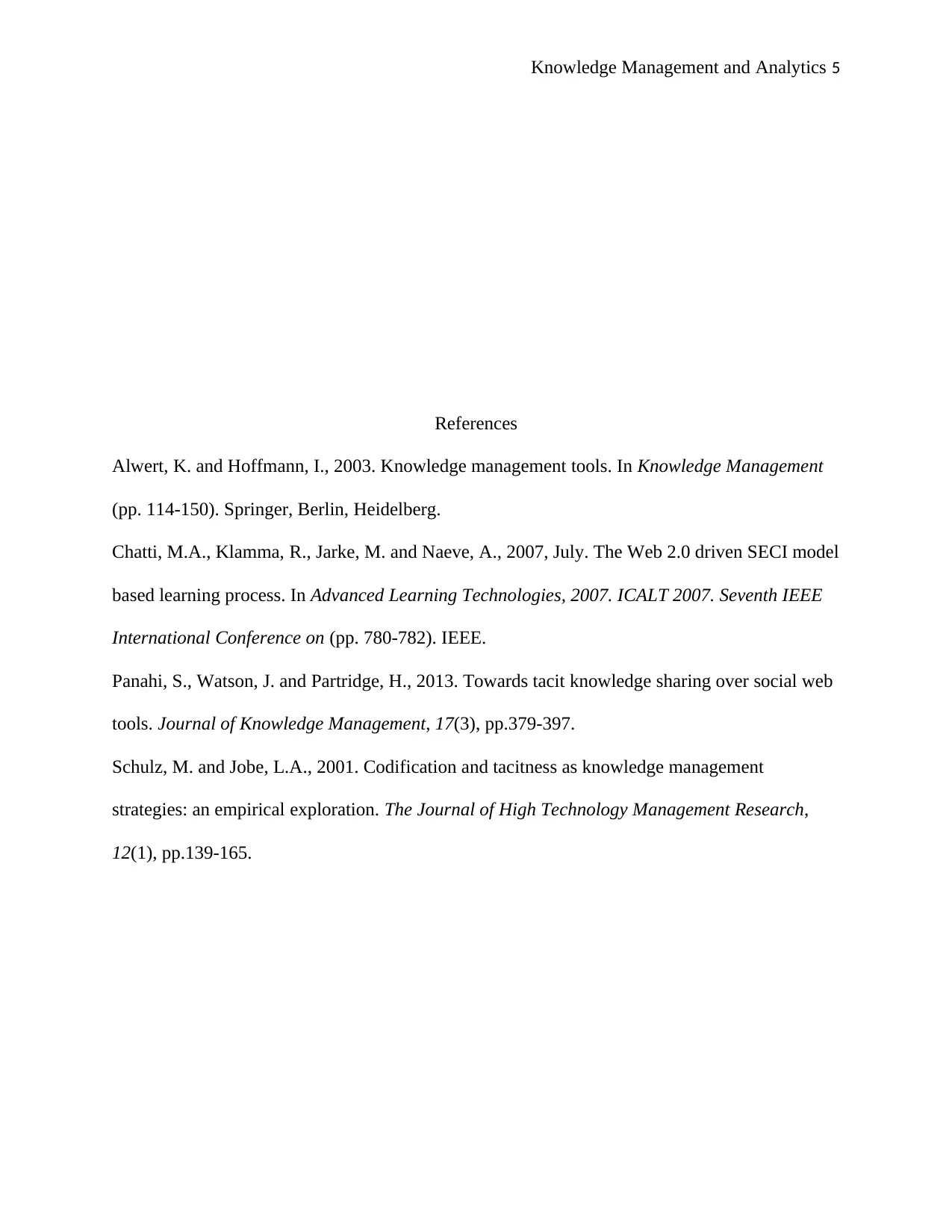
References
Alwert, K. and Hoffmann, I., 2003. Knowledge management tools. In Knowledge Management
(pp. 114-150). Springer, Berlin, Heidelberg.
Chatti, M.A., Klamma, R., Jarke, M. and Naeve, A., 2007, July. The Web 2.0 driven SECI model
based learning process. In Advanced Learning Technologies, 2007. ICALT 2007. Seventh IEEE
International Conference on (pp. 780-782). IEEE.
Panahi, S., Watson, J. and Partridge, H., 2013. Towards tacit knowledge sharing over social web
tools. Journal of Knowledge Management, 17(3), pp.379-397.
Schulz, M. and Jobe, L.A., 2001. Codification and tacitness as knowledge management
strategies: an empirical exploration. The Journal of High Technology Management Research,
12(1), pp.139-165.
References
Alwert, K. and Hoffmann, I., 2003. Knowledge management tools. In Knowledge Management
(pp. 114-150). Springer, Berlin, Heidelberg.
Chatti, M.A., Klamma, R., Jarke, M. and Naeve, A., 2007, July. The Web 2.0 driven SECI model
based learning process. In Advanced Learning Technologies, 2007. ICALT 2007. Seventh IEEE
International Conference on (pp. 780-782). IEEE.
Panahi, S., Watson, J. and Partridge, H., 2013. Towards tacit knowledge sharing over social web
tools. Journal of Knowledge Management, 17(3), pp.379-397.
Schulz, M. and Jobe, L.A., 2001. Codification and tacitness as knowledge management
strategies: an empirical exploration. The Journal of High Technology Management Research,
12(1), pp.139-165.
1 out of 5
Your All-in-One AI-Powered Toolkit for Academic Success.
 +13062052269
info@desklib.com
Available 24*7 on WhatsApp / Email
Unlock your academic potential
Copyright © 2020–2025 A2Z Services. All Rights Reserved. Developed and managed by ZUCOL.