Structural Design: Application of Knowledge-based Systems Analysis
VerifiedAdded on 2023/01/13
|11
|3737
|49
Report
AI Summary
This report delves into the application of Knowledge-based systems (KBS) within structural design processes, focusing on an Intelligent Structural Design and Cost Estimating model. It explores the potential of KBS to establish a connection between cost-estimating and structural design computer programs, aiming for quicker and more cost-efficient design processes. The literature review covers various aspects, including knowledge-based architectures for integrated structural engineering applications, KADBASE, DICE, and an integrated software environment for building design and construction. The report highlights the importance of KBS in addressing the creative and ill-structured aspects of structural design, emphasizing integrated design environments and the potential for automation. The findings underscore the need for integrated systems and offer recommendations for future development in structural design computer programs.
Running head: Application of Knowledge-based systems on Engineering (Structural Design
Processes)Application of Knowledge-based systems on Engineering (Structural Design Processes)
Application of Knowledge-based systems on Engineering (Structural
Design Processes)
Name of the Student:
Name of the University:
Author Note
Date of Production:
Table of Content
Processes)Application of Knowledge-based systems on Engineering (Structural Design Processes)
Application of Knowledge-based systems on Engineering (Structural
Design Processes)
Name of the Student:
Name of the University:
Author Note
Date of Production:
Table of Content

Paraphrase This Document
Need a fresh take? Get an instant paraphrase of this document with our AI Paraphraser

1
Application of Knowledge-based systems on Engineering (Structural Design
Processes)Application of Knowledge-based systems on Engineering (Structural Design
Processes)
s
Introduction................................................................................................................................2
Literature Review.......................................................................................................................2
i) Knowledge-based architecture for integrated structural engineering applications.........3
ii) KADBASE—interfacing expert systems with databases............................................5
iii) DICE—Distributed and integrated environment for computer-aided engineering.....7
iv) An integrated software environment for building design and construction................9
Summary of the Literature Review..........................................................................................11
Conclusion & Recommendation..............................................................................................13
Application of Knowledge-based systems on Engineering (Structural Design
Processes)Application of Knowledge-based systems on Engineering (Structural Design
Processes)
s
Introduction................................................................................................................................2
Literature Review.......................................................................................................................2
i) Knowledge-based architecture for integrated structural engineering applications.........3
ii) KADBASE—interfacing expert systems with databases............................................5
iii) DICE—Distributed and integrated environment for computer-aided engineering.....7
iv) An integrated software environment for building design and construction................9
Summary of the Literature Review..........................................................................................11
Conclusion & Recommendation..............................................................................................13
2
Application of Knowledge-based systems on Engineering (Structural Design
Processes)Application of Knowledge-based systems on Engineering (Structural Design
Processes)
Introduction
In this paper, an Intelligent Structural Design and Cost Estimating model, to the
military direct project’s part has been researched in this study. The object of the project is to
create a computer program while builds a generic connection between MCACES
(Microcomputer Construction and Cost Engineering System) expenses predicting computer
program and structural designed computer program. Importance has been transmitted to
explore the potential link of Knowledge-based system and how it institutes the generic
connection. The potential program is approximated to give access for designing and
performing preliminary costs to engineer’s design, in a much quicker and cost-efficient way
than that of the currently used methods.
The following report has two objectives: To encapsulate the results of literature
review research, to demonstrate the Knowledge Based System’s applications to the processes
of structural design, and further, presentation of recommendations for appropriate integrated
structurally designed computer has also been discussed. The limitation of this research is
confined to only include the research materials, according to ISDCE project’s relevancy.
Literature Review
The aim of the literature review is to conduct an investigation on Knowledge-based
system’s (KBS) applications in the environment of cost-estimation and structural
engineering. During the collection of information, numerous amount of previously conducted
researches were found, which were aimed at efficiency improvement in the process of
structural design through the utilization of the KBS’s programs. (Due to the purpose of the
following paper, the terms “construction engineering” and “structural design” will add every
processes from planning (architectural) to final construction).
The construction industry includes coordination and cooperation between numerous
diverse officials, like engineers (planning, structural and civil), architects, structural detailers
and other government officials. The respective types of project structure is considered to be
distributed, as the respective individuals signal multiple organizations. The present method of
data transfer between the individuals in a distributed project community is conducted,
through specifications and plans.
Massive amounts of computer programs are observed to be present for the structure
designer’s support, yet many construction-based aspects of a project structure are not
computerized. The following literature review provides efforts from computer program
integration to entire structural design automation process.
The following segments provides brief introduction of the relevant researches to the
comprehensive development of the structural design systems. Further, the research
implications to the computer program’s future development is also discussed.
i) Knowledge-based architecture for integrated structural engineering
applications
Rehak et al. (2014) i stated an indigenous work on integrated design
environment production for the two decades-structural engineering environment.
Different systems such as GENESYSii, ICESiii, and POLOiv were referred as
examples.
Rehak, Howard and Sriram proposed the algorithmic approach, in the late
eighties were inadequate for the actual development of an integrated structural
Application of Knowledge-based systems on Engineering (Structural Design
Processes)Application of Knowledge-based systems on Engineering (Structural Design
Processes)
Introduction
In this paper, an Intelligent Structural Design and Cost Estimating model, to the
military direct project’s part has been researched in this study. The object of the project is to
create a computer program while builds a generic connection between MCACES
(Microcomputer Construction and Cost Engineering System) expenses predicting computer
program and structural designed computer program. Importance has been transmitted to
explore the potential link of Knowledge-based system and how it institutes the generic
connection. The potential program is approximated to give access for designing and
performing preliminary costs to engineer’s design, in a much quicker and cost-efficient way
than that of the currently used methods.
The following report has two objectives: To encapsulate the results of literature
review research, to demonstrate the Knowledge Based System’s applications to the processes
of structural design, and further, presentation of recommendations for appropriate integrated
structurally designed computer has also been discussed. The limitation of this research is
confined to only include the research materials, according to ISDCE project’s relevancy.
Literature Review
The aim of the literature review is to conduct an investigation on Knowledge-based
system’s (KBS) applications in the environment of cost-estimation and structural
engineering. During the collection of information, numerous amount of previously conducted
researches were found, which were aimed at efficiency improvement in the process of
structural design through the utilization of the KBS’s programs. (Due to the purpose of the
following paper, the terms “construction engineering” and “structural design” will add every
processes from planning (architectural) to final construction).
The construction industry includes coordination and cooperation between numerous
diverse officials, like engineers (planning, structural and civil), architects, structural detailers
and other government officials. The respective types of project structure is considered to be
distributed, as the respective individuals signal multiple organizations. The present method of
data transfer between the individuals in a distributed project community is conducted,
through specifications and plans.
Massive amounts of computer programs are observed to be present for the structure
designer’s support, yet many construction-based aspects of a project structure are not
computerized. The following literature review provides efforts from computer program
integration to entire structural design automation process.
The following segments provides brief introduction of the relevant researches to the
comprehensive development of the structural design systems. Further, the research
implications to the computer program’s future development is also discussed.
i) Knowledge-based architecture for integrated structural engineering
applications
Rehak et al. (2014) i stated an indigenous work on integrated design
environment production for the two decades-structural engineering environment.
Different systems such as GENESYSii, ICESiii, and POLOiv were referred as
examples.
Rehak, Howard and Sriram proposed the algorithmic approach, in the late
eighties were inadequate for the actual development of an integrated structural
⊘ This is a preview!⊘
Do you want full access?
Subscribe today to unlock all pages.

Trusted by 1+ million students worldwide
3
Application of Knowledge-based systems on Engineering (Structural Design
Processes)Application of Knowledge-based systems on Engineering (Structural Design
Processes)
engineering design environment. Brown & Yao (2013)v stated the computer usage
has been extensive in structural engineering, yet confined to algorithmic-based
projects, which assists engineer in minor portion during the design phase. Weak-
structured problems, fragmentary nature and standard processing makes the
construction industry address the algorithmic programming methods, in an
incorrect way. Thus, the researchers noticed the Knowledge-based expert systems
to have the potentiality of useful addressing the creative aspects and, mitigating
the ill-structure. The potential tool was the Centralized database management,
while linked the multiple applications of design into the integrated system.
A paper evaluated an architecture for an integrated civil engineering design
environment (CAESE).vi According to the researchers, the continuation of the
work shall progressively enhance and revise the concepts, with overall
construction of the knowledge-based componential prototype.
Rehak, Howard and Sriram reviewed the respective prototype-based
components, and demonstrated a basic plan for componential integration for
initiating the work of the design system. The reference material would provide
much more information to the following program’s idea.
The interest of the researchers were due to the following reasons:
Discussion of the long-term interest in integrated structural design
system’s development.
Illustration of the required development plan, data storage plan,
and component’s control, which is to be used at or in any proposed
structural system of design.
Demonstration of the prior realization which computer-program-
based algorithms and concepts could not creatively address. Also,
addressing the ill-structured aspects of the construction and
structural design process is added.
ii) KADBASE—interfacing expert systems with databases
Howard and Rehak (2016)vii developed a statement for systems to integrated
computer engineering environment that has transformed into algorithmic program
sets, rotating around centrally placed DBMS.
Howard and Rehak has stated their prototype to be the Knowledge-aided
database management system (KADBASE). The working principle was observed
to be network database interfaced and flexible, where multiple KBS and databases
could communicate freely. The features of the KADBASE were as follows:
A particular database or expert system is connected only to its interface.
Separation of descriptive knowledge storage while data request processing
for a particular component in the system.
Confidentiality of the KADBASE architecture from the application and
user.
Various DBMS networks evaluate information from a significant database
to each global semantic model (database).
The advantages of the respective management system (KADBASE) are:
Much flexible interface is created by descriptive knowledge’s (feature
a) storing against the pure algorithmic connectional-ages. The extra
Application of Knowledge-based systems on Engineering (Structural Design
Processes)Application of Knowledge-based systems on Engineering (Structural Design
Processes)
engineering design environment. Brown & Yao (2013)v stated the computer usage
has been extensive in structural engineering, yet confined to algorithmic-based
projects, which assists engineer in minor portion during the design phase. Weak-
structured problems, fragmentary nature and standard processing makes the
construction industry address the algorithmic programming methods, in an
incorrect way. Thus, the researchers noticed the Knowledge-based expert systems
to have the potentiality of useful addressing the creative aspects and, mitigating
the ill-structure. The potential tool was the Centralized database management,
while linked the multiple applications of design into the integrated system.
A paper evaluated an architecture for an integrated civil engineering design
environment (CAESE).vi According to the researchers, the continuation of the
work shall progressively enhance and revise the concepts, with overall
construction of the knowledge-based componential prototype.
Rehak, Howard and Sriram reviewed the respective prototype-based
components, and demonstrated a basic plan for componential integration for
initiating the work of the design system. The reference material would provide
much more information to the following program’s idea.
The interest of the researchers were due to the following reasons:
Discussion of the long-term interest in integrated structural design
system’s development.
Illustration of the required development plan, data storage plan,
and component’s control, which is to be used at or in any proposed
structural system of design.
Demonstration of the prior realization which computer-program-
based algorithms and concepts could not creatively address. Also,
addressing the ill-structured aspects of the construction and
structural design process is added.
ii) KADBASE—interfacing expert systems with databases
Howard and Rehak (2016)vii developed a statement for systems to integrated
computer engineering environment that has transformed into algorithmic program
sets, rotating around centrally placed DBMS.
Howard and Rehak has stated their prototype to be the Knowledge-aided
database management system (KADBASE). The working principle was observed
to be network database interfaced and flexible, where multiple KBS and databases
could communicate freely. The features of the KADBASE were as follows:
A particular database or expert system is connected only to its interface.
Separation of descriptive knowledge storage while data request processing
for a particular component in the system.
Confidentiality of the KADBASE architecture from the application and
user.
Various DBMS networks evaluate information from a significant database
to each global semantic model (database).
The advantages of the respective management system (KADBASE) are:
Much flexible interface is created by descriptive knowledge’s (feature
a) storing against the pure algorithmic connectional-ages. The extra
Paraphrase This Document
Need a fresh take? Get an instant paraphrase of this document with our AI Paraphraser
4
Application of Knowledge-based systems on Engineering (Structural Design
Processes)Application of Knowledge-based systems on Engineering (Structural Design
Processes)
flexibility is required to enhance the diversion of data to access the
engineering databases and the expert systems.
The connection between the interface (feature b) and components
initiate the DBMS and the new expert systems to become a part of the
system. Thus, each component is evaluated as a particularly different
process.
The flexibility of a component to the existent machine or multiply
distributed machines is allowed by features of c and d.
The paper demonstrated two applications of the knowledge-based structural
engineering and KADBASE as:
SPEXviii, a standard, independent, knowledge-based structural design
system.
HICOSTix, a cost-predictor (knowledge-based) for designing buildings.
Moreover, the research successfully integrated SPEX and HICOST to the
KADBASE environment. The validity of the current concepts was handled by SPEX
due to its independent and developed component. The above described applications
and KADBASE were set on the VAX 11/260 and also, multiple MicroVAX, which
were connected via LAN. The OS was Mach and Franz Lisp was used as the
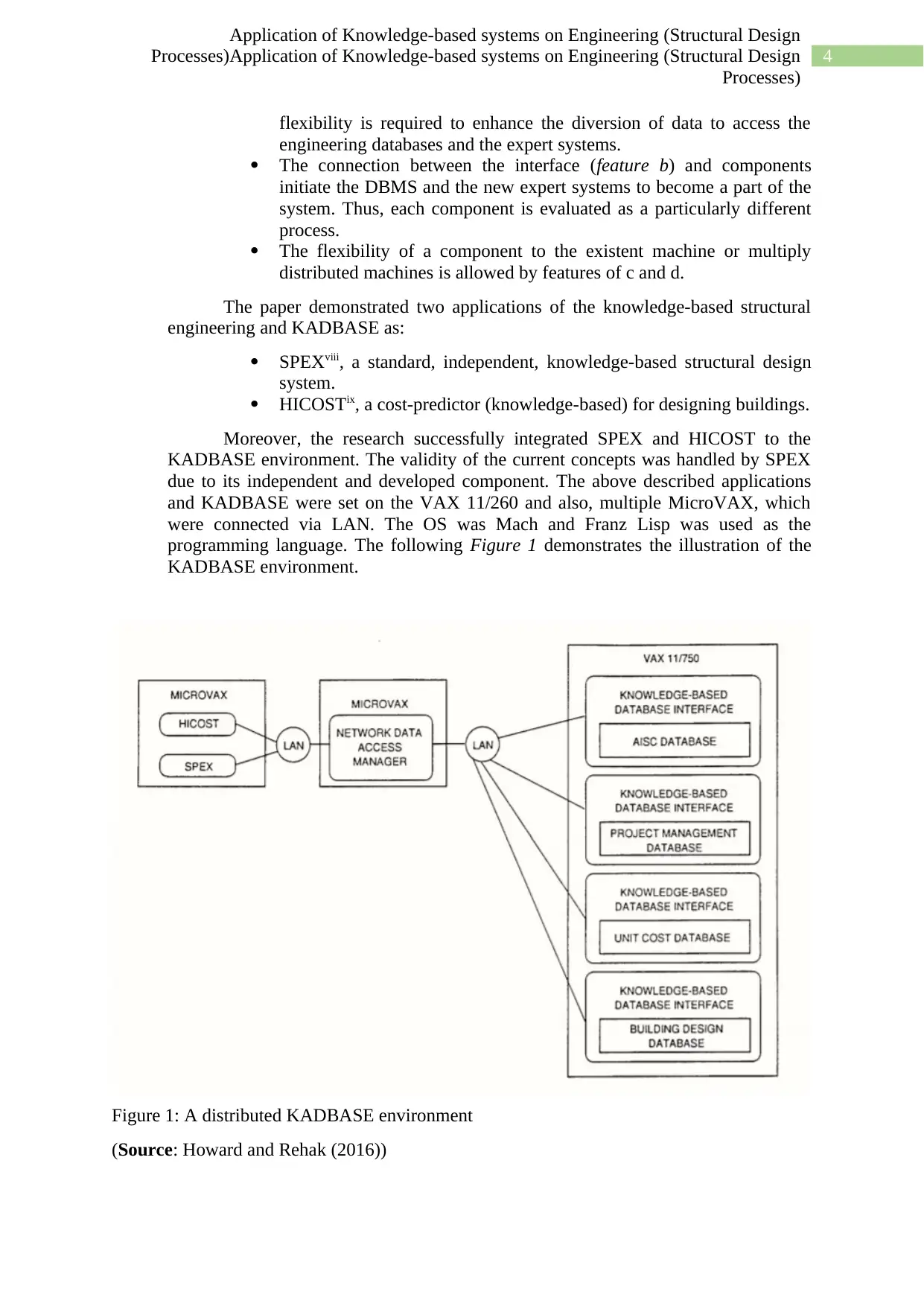
programming language. The following Figure 1 demonstrates the illustration of the
KADBASE environment.
Figure 1: A distributed KADBASE environment
(Source: Howard and Rehak (2016))
Application of Knowledge-based systems on Engineering (Structural Design
Processes)Application of Knowledge-based systems on Engineering (Structural Design
Processes)
flexibility is required to enhance the diversion of data to access the
engineering databases and the expert systems.
The connection between the interface (feature b) and components
initiate the DBMS and the new expert systems to become a part of the
system. Thus, each component is evaluated as a particularly different
process.
The flexibility of a component to the existent machine or multiply
distributed machines is allowed by features of c and d.
The paper demonstrated two applications of the knowledge-based structural
engineering and KADBASE as:
SPEXviii, a standard, independent, knowledge-based structural design
system.
HICOSTix, a cost-predictor (knowledge-based) for designing buildings.
Moreover, the research successfully integrated SPEX and HICOST to the
KADBASE environment. The validity of the current concepts was handled by SPEX
due to its independent and developed component. The above described applications
and KADBASE were set on the VAX 11/260 and also, multiple MicroVAX, which
were connected via LAN. The OS was Mach and Franz Lisp was used as the
programming language. The following Figure 1 demonstrates the illustration of the
KADBASE environment.
Figure 1: A distributed KADBASE environment
(Source: Howard and Rehak (2016))
5
Application of Knowledge-based systems on Engineering (Structural Design
Processes)Application of Knowledge-based systems on Engineering (Structural Design
Processes)
The researchers have presented a working KADVASE model for integrated
data space development. However, they ignore multiple KB design tools, user
interfaces, analysis routines on network processors.
iii) DICE—Distributed and integrated environment for computer-aided
engineering
Sriram et al. (2013)x featured a system architecture to support computer-aided
engineering (DICE) under a distributed and integrated environment. The respective
architecture provides coordination and integration to multiple levels and participants
in the products of the engineering. The objectives of the project are as follows:
Forecasting the design decision’s impact on construction and manufacturing.
Effective coordinative facilitation and communication in multiple involved
engineering disciplines.
Process capturing by each designer to make informative decision and its
process of usage.
Designer interactivity with extended manufacturing process and planning
(construction).
Development of automation’s intelligent interfaces.
Five computer-based software development tools were utilized during the DICE
development process: KBS, Object-oriented programming, DBMS, LAN and visual
computing. DICE is moreover, a computer and users linked network, for control and
coordination through global database control mechanism. The basic components of
DICE are:
A Control mechanism to communicate, coordinate and initiate functions of
data transfer.
Backboard, through which the communication is transmitted and occurs as an
intelligent functioning database.
Knowledge modules, which is either a CAD tool or an algorithmic program of
knowledge-based expert system.
For the study’s evaluation and validity, the Hyatt Regency disaster was taken as a
test case. The development environment was illustrated to show the successful
modelling of the design process and the validation of the simulation program. The
simulation identified the structural fabricator and the connection designer’s design
were incompatible. The development of simulator was conducted on a couple of SUN
computers.
During the research, Sriram and his accomplices also stated the incomplete state
of the process, as modification and integration of the computer program BUILDERxi
was left to be initiated in the DICE environment. The program automatically creates
schedules of construction from architectural drawings. BUILDER was developed by
KEE, which is a hybrid knowledge-based programming interface which executes
LISP functions; see research materialxii for more details. The update version of
BUILDER would be called as DICEY-BUILDER, can will be demonstrate
communicative channel between LAN connected protocol mechanisms and the
heterogeneous modules of knowledge. The details to DICEY-BUILDER’s
implementation are described in the comprehensive journal material.xiii
Application of Knowledge-based systems on Engineering (Structural Design
Processes)Application of Knowledge-based systems on Engineering (Structural Design
Processes)
The researchers have presented a working KADVASE model for integrated
data space development. However, they ignore multiple KB design tools, user
interfaces, analysis routines on network processors.
iii) DICE—Distributed and integrated environment for computer-aided
engineering
Sriram et al. (2013)x featured a system architecture to support computer-aided
engineering (DICE) under a distributed and integrated environment. The respective
architecture provides coordination and integration to multiple levels and participants
in the products of the engineering. The objectives of the project are as follows:
Forecasting the design decision’s impact on construction and manufacturing.
Effective coordinative facilitation and communication in multiple involved
engineering disciplines.
Process capturing by each designer to make informative decision and its
process of usage.
Designer interactivity with extended manufacturing process and planning
(construction).
Development of automation’s intelligent interfaces.
Five computer-based software development tools were utilized during the DICE
development process: KBS, Object-oriented programming, DBMS, LAN and visual
computing. DICE is moreover, a computer and users linked network, for control and
coordination through global database control mechanism. The basic components of
DICE are:
A Control mechanism to communicate, coordinate and initiate functions of
data transfer.
Backboard, through which the communication is transmitted and occurs as an
intelligent functioning database.
Knowledge modules, which is either a CAD tool or an algorithmic program of
knowledge-based expert system.
For the study’s evaluation and validity, the Hyatt Regency disaster was taken as a
test case. The development environment was illustrated to show the successful
modelling of the design process and the validation of the simulation program. The
simulation identified the structural fabricator and the connection designer’s design
were incompatible. The development of simulator was conducted on a couple of SUN
computers.
During the research, Sriram and his accomplices also stated the incomplete state
of the process, as modification and integration of the computer program BUILDERxi
was left to be initiated in the DICE environment. The program automatically creates
schedules of construction from architectural drawings. BUILDER was developed by
KEE, which is a hybrid knowledge-based programming interface which executes
LISP functions; see research materialxii for more details. The update version of
BUILDER would be called as DICEY-BUILDER, can will be demonstrate
communicative channel between LAN connected protocol mechanisms and the
heterogeneous modules of knowledge. The details to DICEY-BUILDER’s
implementation are described in the comprehensive journal material.xiii
⊘ This is a preview!⊘
Do you want full access?
Subscribe today to unlock all pages.
Trusted by 1+ million students worldwide
6
Application of Knowledge-based systems on Engineering (Structural Design
Processes)Application of Knowledge-based systems on Engineering (Structural Design
Processes)
The implementation of DICE is under a hybrid programming environment, which
is also called FRULEKIT/PARMENIDES. This enhances programming in rules and
frames, and was developed by Shell and Carbonell on LISP.
Sriram’s paper demonstrates a consistent effort in the constraint negotiation area
for various design related resolvable conflicts (Example: Structural members and
mechanical equipment interferences). A communication protocol (layered) was
facilitated between dissimilar disciplines, secondary management storage and X-
window UI. A demonstration of industrial setting of DICE was also demonstrated.
iv) An integrated software environment for building design and
construction
An integrated software environment was introduced by Fenves et al. (2014) xiv for
creating construction of IBDE and designing. The developed prototype was created to
signal the inherent of the distributed project organization in the industry of
construction (Example: Architects, contractors, government official and others
cooperation and coordination). The improved communicative state between dissimilar
organizations in participative planning, construction and design of buildings had been
the prototype’s major deal.
The IBDE enables process and information flow among the structural design,
architectural design and analysis, and also planning to construction. Fenves and his
fellow researchers, have recommended a computer-based exchange for specifications
and drawings, for enhancing communicating design decisions to various
professionals. The paradigm gap of computer usage (from simple numeric
calculations to symbolic reasoning) is also portrayed by the IBDE.
The design process of IDBE was comprised of-
HI-RISE: An expert system performing preliminary structural design for
buildings.xv
ARCHPLAN: An expert system (architectural planning) assisting in
development of conceptual building designing.xvi
SPEX: A preliminary structural design’s component designer.xvii
CONSTRUCTION PLANEX: An expert system (knowledge-intensive)
assisting construction planner.xviii
FOOTER: An expert system performing preliminary foundation design of a
building.xix
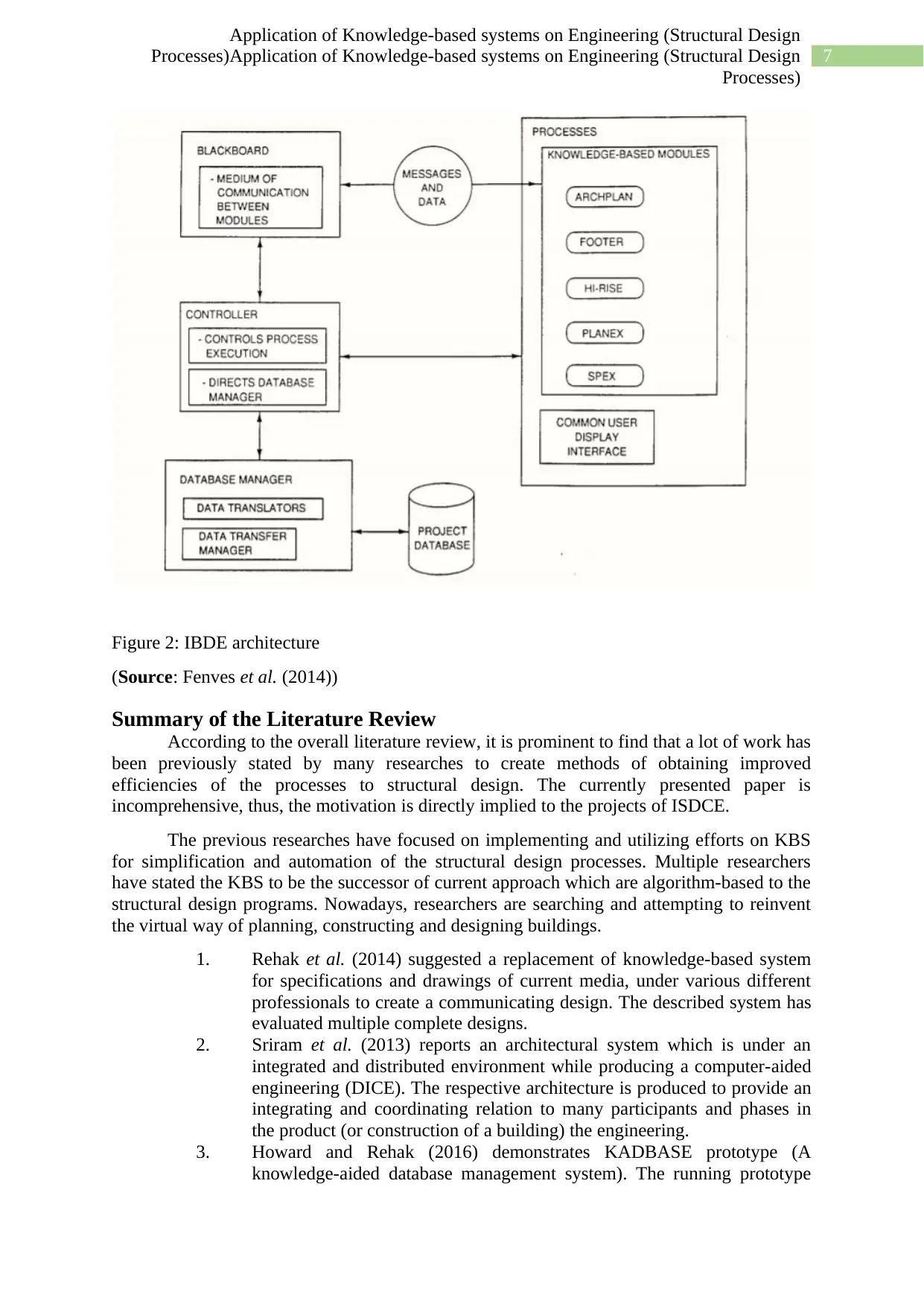
Message blackboard and database makes a communication channel between
the modules. An informative controller is situated on the blackboard for controlling
the process execution and, retrieval and storage of database manager is directed. The
structure of the program is shown in Figure 2.
Various machines may create residual knowledge-based modules, thus the
blackboard and database manager use a LAN network. A DPSK (distributed problem
solving kernel) initiates distribution of a problem via multiple involvement of
languages and computers in a program. Moreover, the respective study is considered
on the basis of integrated environment to feature new computer tools.
Application of Knowledge-based systems on Engineering (Structural Design
Processes)Application of Knowledge-based systems on Engineering (Structural Design
Processes)
The implementation of DICE is under a hybrid programming environment, which
is also called FRULEKIT/PARMENIDES. This enhances programming in rules and
frames, and was developed by Shell and Carbonell on LISP.
Sriram’s paper demonstrates a consistent effort in the constraint negotiation area
for various design related resolvable conflicts (Example: Structural members and
mechanical equipment interferences). A communication protocol (layered) was
facilitated between dissimilar disciplines, secondary management storage and X-
window UI. A demonstration of industrial setting of DICE was also demonstrated.
iv) An integrated software environment for building design and
construction
An integrated software environment was introduced by Fenves et al. (2014) xiv for
creating construction of IBDE and designing. The developed prototype was created to
signal the inherent of the distributed project organization in the industry of
construction (Example: Architects, contractors, government official and others
cooperation and coordination). The improved communicative state between dissimilar
organizations in participative planning, construction and design of buildings had been
the prototype’s major deal.
The IBDE enables process and information flow among the structural design,
architectural design and analysis, and also planning to construction. Fenves and his
fellow researchers, have recommended a computer-based exchange for specifications
and drawings, for enhancing communicating design decisions to various
professionals. The paradigm gap of computer usage (from simple numeric
calculations to symbolic reasoning) is also portrayed by the IBDE.
The design process of IDBE was comprised of-
HI-RISE: An expert system performing preliminary structural design for
buildings.xv
ARCHPLAN: An expert system (architectural planning) assisting in
development of conceptual building designing.xvi
SPEX: A preliminary structural design’s component designer.xvii
CONSTRUCTION PLANEX: An expert system (knowledge-intensive)
assisting construction planner.xviii
FOOTER: An expert system performing preliminary foundation design of a
building.xix
Message blackboard and database makes a communication channel between
the modules. An informative controller is situated on the blackboard for controlling
the process execution and, retrieval and storage of database manager is directed. The
structure of the program is shown in Figure 2.
Various machines may create residual knowledge-based modules, thus the
blackboard and database manager use a LAN network. A DPSK (distributed problem
solving kernel) initiates distribution of a problem via multiple involvement of
languages and computers in a program. Moreover, the respective study is considered
on the basis of integrated environment to feature new computer tools.
Paraphrase This Document
Need a fresh take? Get an instant paraphrase of this document with our AI Paraphraser
7
Application of Knowledge-based systems on Engineering (Structural Design
Processes)Application of Knowledge-based systems on Engineering (Structural Design
Processes)
Figure 2: IBDE architecture
(Source: Fenves et al. (2014))
Summary of the Literature Review
According to the overall literature review, it is prominent to find that a lot of work has
been previously stated by many researches to create methods of obtaining improved
efficiencies of the processes to structural design. The currently presented paper is
incomprehensive, thus, the motivation is directly implied to the projects of ISDCE.
The previous researches have focused on implementing and utilizing efforts on KBS
for simplification and automation of the structural design processes. Multiple researchers
have stated the KBS to be the successor of current approach which are algorithm-based to the
structural design programs. Nowadays, researchers are searching and attempting to reinvent
the virtual way of planning, constructing and designing buildings.
1. Rehak et al. (2014) suggested a replacement of knowledge-based system
for specifications and drawings of current media, under various different
professionals to create a communicating design. The described system has
evaluated multiple complete designs.
2. Sriram et al. (2013) reports an architectural system which is under an
integrated and distributed environment while producing a computer-aided
engineering (DICE). The respective architecture is produced to provide an
integrating and coordinating relation to many participants and phases in
the product (or construction of a building) the engineering.
3. Howard and Rehak (2016) demonstrates KADBASE prototype (A
knowledge-aided database management system). The running prototype
Application of Knowledge-based systems on Engineering (Structural Design
Processes)Application of Knowledge-based systems on Engineering (Structural Design
Processes)
Figure 2: IBDE architecture
(Source: Fenves et al. (2014))
Summary of the Literature Review
According to the overall literature review, it is prominent to find that a lot of work has
been previously stated by many researches to create methods of obtaining improved
efficiencies of the processes to structural design. The currently presented paper is
incomprehensive, thus, the motivation is directly implied to the projects of ISDCE.
The previous researches have focused on implementing and utilizing efforts on KBS
for simplification and automation of the structural design processes. Multiple researchers
have stated the KBS to be the successor of current approach which are algorithm-based to the
structural design programs. Nowadays, researchers are searching and attempting to reinvent
the virtual way of planning, constructing and designing buildings.
1. Rehak et al. (2014) suggested a replacement of knowledge-based system
for specifications and drawings of current media, under various different
professionals to create a communicating design. The described system has
evaluated multiple complete designs.
2. Sriram et al. (2013) reports an architectural system which is under an
integrated and distributed environment while producing a computer-aided
engineering (DICE). The respective architecture is produced to provide an
integrating and coordinating relation to many participants and phases in
the product (or construction of a building) the engineering.
3. Howard and Rehak (2016) demonstrates KADBASE prototype (A
knowledge-aided database management system). The running prototype
8
Application of Knowledge-based systems on Engineering (Structural Design
Processes)Application of Knowledge-based systems on Engineering (Structural Design
Processes)
was flexible and, supported networked database interface, where multiple
KBS’s and databases could create self-descriptive and independent
communicational components, all under an integrated computer-aided
engineering platform.
4. The paradigm gap with respect to construction industry’s computer usage
has been reported with various amount of research with respect to
knowledge-based approaches. Fenves et al. (2014) has predicted such
computer programs which are capable of shifting to knowledge and
symbol-based reasoning, from the purely number-based calculations.
Conclusion & Recommendation
The respective literature review has illustrated feasible integrated systems to structural
designing, in the engineering field applications. Detailed planning is essential for the
integrated design system’s development. Although the control and coordination of
mechanisms in the present generation are presently under developed; in response, KBS’s core
will provide the future for the integrated design systems.
Prominently, algorithmic techniques, on itself could become limited area for
improvement in computer usage and scopes in the industry of construction. Also, expansion
of presently stated algorithmic algorithms and connecting them, through explicit interface
programs would produce confined utility rate. Further, addition of existing algorithmic
programs to knowledge-based modules can foresee the limitations.
Implementing comprehensive integrated platforms would need perquisite top down
planning methods. The integrate system’s design is viable to be successful, while the
integration issues are resolved before creating the components. Present methods of
algorithmic application development and implementing connection to the programs and other
independent algorithmic programs would be degraded if development of the integrated
systems are evaluated. However, a study reported integration abilities for separation of
developed application with respect to the KBS.xx In the future researches, it is recommended
to collect appropriate funds on implementation plans of integrated design system. This would
clarify the state of the art of this field, and the value of the stated projects.
Application of Knowledge-based systems on Engineering (Structural Design
Processes)Application of Knowledge-based systems on Engineering (Structural Design
Processes)
was flexible and, supported networked database interface, where multiple
KBS’s and databases could create self-descriptive and independent
communicational components, all under an integrated computer-aided
engineering platform.
4. The paradigm gap with respect to construction industry’s computer usage
has been reported with various amount of research with respect to
knowledge-based approaches. Fenves et al. (2014) has predicted such
computer programs which are capable of shifting to knowledge and
symbol-based reasoning, from the purely number-based calculations.
Conclusion & Recommendation
The respective literature review has illustrated feasible integrated systems to structural
designing, in the engineering field applications. Detailed planning is essential for the
integrated design system’s development. Although the control and coordination of
mechanisms in the present generation are presently under developed; in response, KBS’s core
will provide the future for the integrated design systems.
Prominently, algorithmic techniques, on itself could become limited area for
improvement in computer usage and scopes in the industry of construction. Also, expansion
of presently stated algorithmic algorithms and connecting them, through explicit interface
programs would produce confined utility rate. Further, addition of existing algorithmic
programs to knowledge-based modules can foresee the limitations.
Implementing comprehensive integrated platforms would need perquisite top down
planning methods. The integrate system’s design is viable to be successful, while the
integration issues are resolved before creating the components. Present methods of
algorithmic application development and implementing connection to the programs and other
independent algorithmic programs would be degraded if development of the integrated
systems are evaluated. However, a study reported integration abilities for separation of
developed application with respect to the KBS.xx In the future researches, it is recommended
to collect appropriate funds on implementation plans of integrated design system. This would
clarify the state of the art of this field, and the value of the stated projects.
⊘ This is a preview!⊘
Do you want full access?
Subscribe today to unlock all pages.
Trusted by 1+ million students worldwide
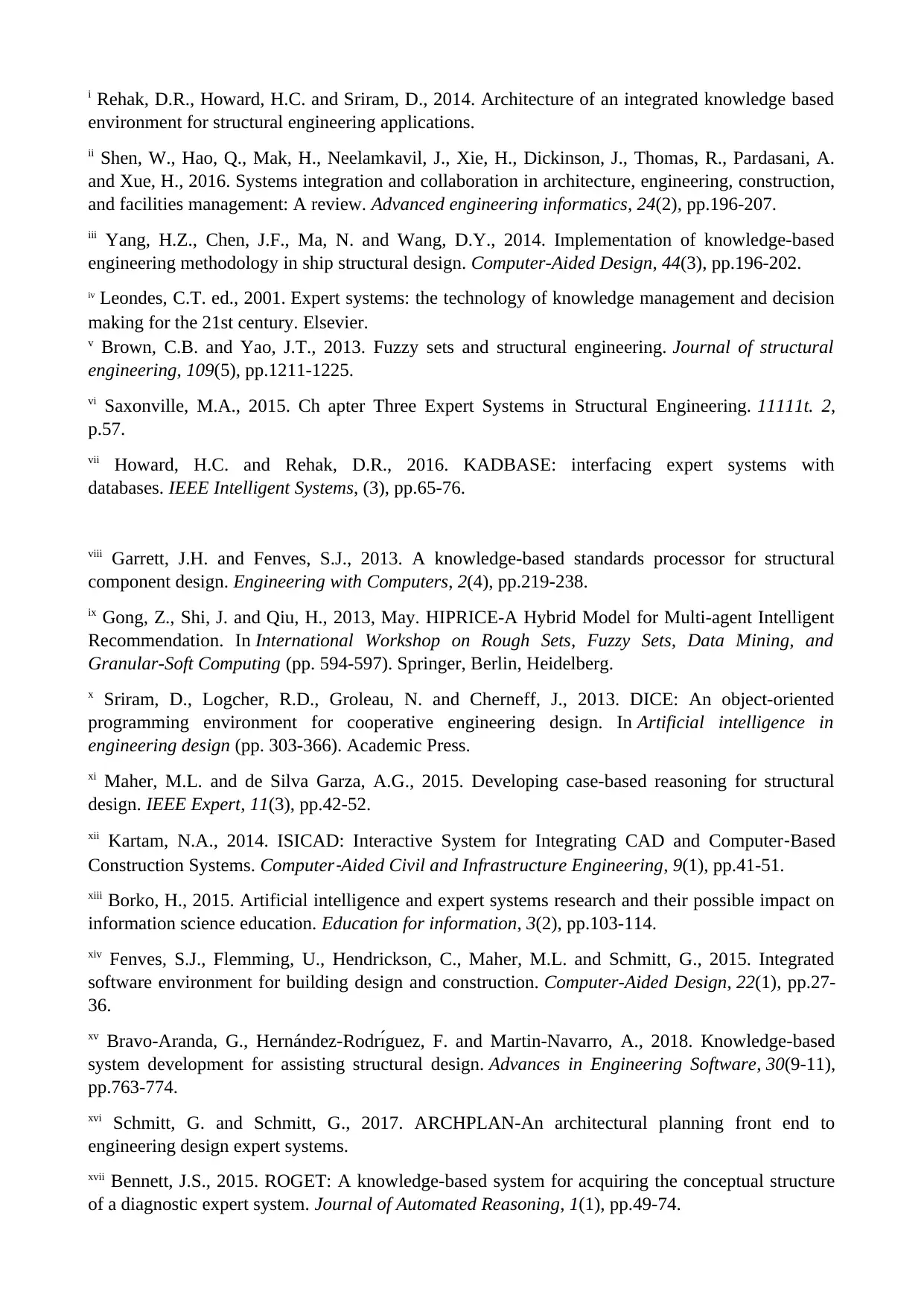
i Rehak, D.R., Howard, H.C. and Sriram, D., 2014. Architecture of an integrated knowledge based
environment for structural engineering applications.
ii Shen, W., Hao, Q., Mak, H., Neelamkavil, J., Xie, H., Dickinson, J., Thomas, R., Pardasani, A.
and Xue, H., 2016. Systems integration and collaboration in architecture, engineering, construction,
and facilities management: A review. Advanced engineering informatics, 24(2), pp.196-207.
iii Yang, H.Z., Chen, J.F., Ma, N. and Wang, D.Y., 2014. Implementation of knowledge-based
engineering methodology in ship structural design. Computer-Aided Design, 44(3), pp.196-202.
iv Leondes, C.T. ed., 2001. Expert systems: the technology of knowledge management and decision
making for the 21st century. Elsevier.
v Brown, C.B. and Yao, J.T., 2013. Fuzzy sets and structural engineering. Journal of structural
engineering, 109(5), pp.1211-1225.
vi Saxonville, M.A., 2015. Ch apter Three Expert Systems in Structural Engineering. 11111t. 2,
p.57.
vii Howard, H.C. and Rehak, D.R., 2016. KADBASE: interfacing expert systems with
databases. IEEE Intelligent Systems, (3), pp.65-76.
viii Garrett, J.H. and Fenves, S.J., 2013. A knowledge-based standards processor for structural
component design. Engineering with Computers, 2(4), pp.219-238.
ix Gong, Z., Shi, J. and Qiu, H., 2013, May. HIPRICE-A Hybrid Model for Multi-agent Intelligent
Recommendation. In International Workshop on Rough Sets, Fuzzy Sets, Data Mining, and
Granular-Soft Computing (pp. 594-597). Springer, Berlin, Heidelberg.
x Sriram, D., Logcher, R.D., Groleau, N. and Cherneff, J., 2013. DICE: An object-oriented
programming environment for cooperative engineering design. In Artificial intelligence in
engineering design (pp. 303-366). Academic Press.
xi Maher, M.L. and de Silva Garza, A.G., 2015. Developing case-based reasoning for structural
design. IEEE Expert, 11(3), pp.42-52.
xii Kartam, N.A., 2014. ISICAD: Interactive System for Integrating CAD and Computer‐Based
Construction Systems. Computer
‐Aided Civil and Infrastructure Engineering, 9(1), pp.41-51.
xiii Borko, H., 2015. Artificial intelligence and expert systems research and their possible impact on
information science education. Education for information, 3(2), pp.103-114.
xiv Fenves, S.J., Flemming, U., Hendrickson, C., Maher, M.L. and Schmitt, G., 2015. Integrated
software environment for building design and construction. Computer-Aided Design, 22(1), pp.27-
36.
xv Bravo-Aranda, G., Hernández-Rodrı́guez, F. and Martin-Navarro, A., 2018. Knowledge-based
system development for assisting structural design. Advances in Engineering Software, 30(9-11),
pp.763-774.
xvi Schmitt, G. and Schmitt, G., 2017. ARCHPLAN-An architectural planning front end to
engineering design expert systems.
xvii Bennett, J.S., 2015. ROGET: A knowledge-based system for acquiring the conceptual structure
of a diagnostic expert system. Journal of Automated Reasoning, 1(1), pp.49-74.
environment for structural engineering applications.
ii Shen, W., Hao, Q., Mak, H., Neelamkavil, J., Xie, H., Dickinson, J., Thomas, R., Pardasani, A.
and Xue, H., 2016. Systems integration and collaboration in architecture, engineering, construction,
and facilities management: A review. Advanced engineering informatics, 24(2), pp.196-207.
iii Yang, H.Z., Chen, J.F., Ma, N. and Wang, D.Y., 2014. Implementation of knowledge-based
engineering methodology in ship structural design. Computer-Aided Design, 44(3), pp.196-202.
iv Leondes, C.T. ed., 2001. Expert systems: the technology of knowledge management and decision
making for the 21st century. Elsevier.
v Brown, C.B. and Yao, J.T., 2013. Fuzzy sets and structural engineering. Journal of structural
engineering, 109(5), pp.1211-1225.
vi Saxonville, M.A., 2015. Ch apter Three Expert Systems in Structural Engineering. 11111t. 2,
p.57.
vii Howard, H.C. and Rehak, D.R., 2016. KADBASE: interfacing expert systems with
databases. IEEE Intelligent Systems, (3), pp.65-76.
viii Garrett, J.H. and Fenves, S.J., 2013. A knowledge-based standards processor for structural
component design. Engineering with Computers, 2(4), pp.219-238.
ix Gong, Z., Shi, J. and Qiu, H., 2013, May. HIPRICE-A Hybrid Model for Multi-agent Intelligent
Recommendation. In International Workshop on Rough Sets, Fuzzy Sets, Data Mining, and
Granular-Soft Computing (pp. 594-597). Springer, Berlin, Heidelberg.
x Sriram, D., Logcher, R.D., Groleau, N. and Cherneff, J., 2013. DICE: An object-oriented
programming environment for cooperative engineering design. In Artificial intelligence in
engineering design (pp. 303-366). Academic Press.
xi Maher, M.L. and de Silva Garza, A.G., 2015. Developing case-based reasoning for structural
design. IEEE Expert, 11(3), pp.42-52.
xii Kartam, N.A., 2014. ISICAD: Interactive System for Integrating CAD and Computer‐Based
Construction Systems. Computer
‐Aided Civil and Infrastructure Engineering, 9(1), pp.41-51.
xiii Borko, H., 2015. Artificial intelligence and expert systems research and their possible impact on
information science education. Education for information, 3(2), pp.103-114.
xiv Fenves, S.J., Flemming, U., Hendrickson, C., Maher, M.L. and Schmitt, G., 2015. Integrated
software environment for building design and construction. Computer-Aided Design, 22(1), pp.27-
36.
xv Bravo-Aranda, G., Hernández-Rodrı́guez, F. and Martin-Navarro, A., 2018. Knowledge-based
system development for assisting structural design. Advances in Engineering Software, 30(9-11),
pp.763-774.
xvi Schmitt, G. and Schmitt, G., 2017. ARCHPLAN-An architectural planning front end to
engineering design expert systems.
xvii Bennett, J.S., 2015. ROGET: A knowledge-based system for acquiring the conceptual structure
of a diagnostic expert system. Journal of Automated Reasoning, 1(1), pp.49-74.
Paraphrase This Document
Need a fresh take? Get an instant paraphrase of this document with our AI Paraphraser

xviii Hendrickson, C., Zozaya-Gorostiza, C., Rehak, D., Baracco-Miller, E. and Lim, P., 2017. Expert
system for construction planning. Journal of Computing in Civil Engineering, 1(4), pp.253-269.
xix Koenemann, J. and Robertson, S.P., 2013, April. Expert problem solving strategies for program
comprehension. In Proceedings of the SIGCHI Conference on Human Factors in Computing
Systems (pp. 125-130). ACM.
xx Kostem, C.N. and Maher, M.L., 2014. Expert systems in civil engineering (No. CONF-8604255-).
American Society of Civil Engineers, New York, NY.
system for construction planning. Journal of Computing in Civil Engineering, 1(4), pp.253-269.
xix Koenemann, J. and Robertson, S.P., 2013, April. Expert problem solving strategies for program
comprehension. In Proceedings of the SIGCHI Conference on Human Factors in Computing
Systems (pp. 125-130). ACM.
xx Kostem, C.N. and Maher, M.L., 2014. Expert systems in civil engineering (No. CONF-8604255-).
American Society of Civil Engineers, New York, NY.

1 out of 11


Related Documents


Your All-in-One AI-Powered Toolkit for Academic Success.
+13062052269
info@desklib.com
Available 24*7 on WhatsApp / Email
![[object Object]](/_next/static/media/star-bottom.7253800d.svg)
Unlock your academic potential
Copyright © 2020–2026 A2Z Services. All Rights Reserved. Developed and managed by ZUCOL.