Knowledge Exchange Project: HSBC Financial Software Development
VerifiedAdded on 2022/12/27
|23
|6710
|27
Project
AI Summary
This project report examines the feasibility and security aspects of developing new financial software for HSBC Holdings. It begins with an introduction outlining the identified issue of technological advancements in the financial sector, particularly in the UK, and the need for software to mitigate financial risks and enhance operational efficiency. A cost-benefit analysis is presented to justify the investment in the software, followed by a literature review exploring software innovations, feasibility, and challenges in the financial sector. The project sets objectives, including a research hypothesis assessing the software's viability. The methodology includes data requirements, research philosophy, and project deliverables. The report details the project's planning, resourcing, results, and findings, including evidence of activities, achievement of objectives, impact on the business, and a sustainability plan. The project concludes with a reflection and references, providing a comprehensive analysis of financial software development within the context of HSBC's operations.

KNOWLEDGE EXCHANGE
PROJECT
PROJECT

Paraphrase This Document
Need a fresh take? Get an instant paraphrase of this document with our AI Paraphraser
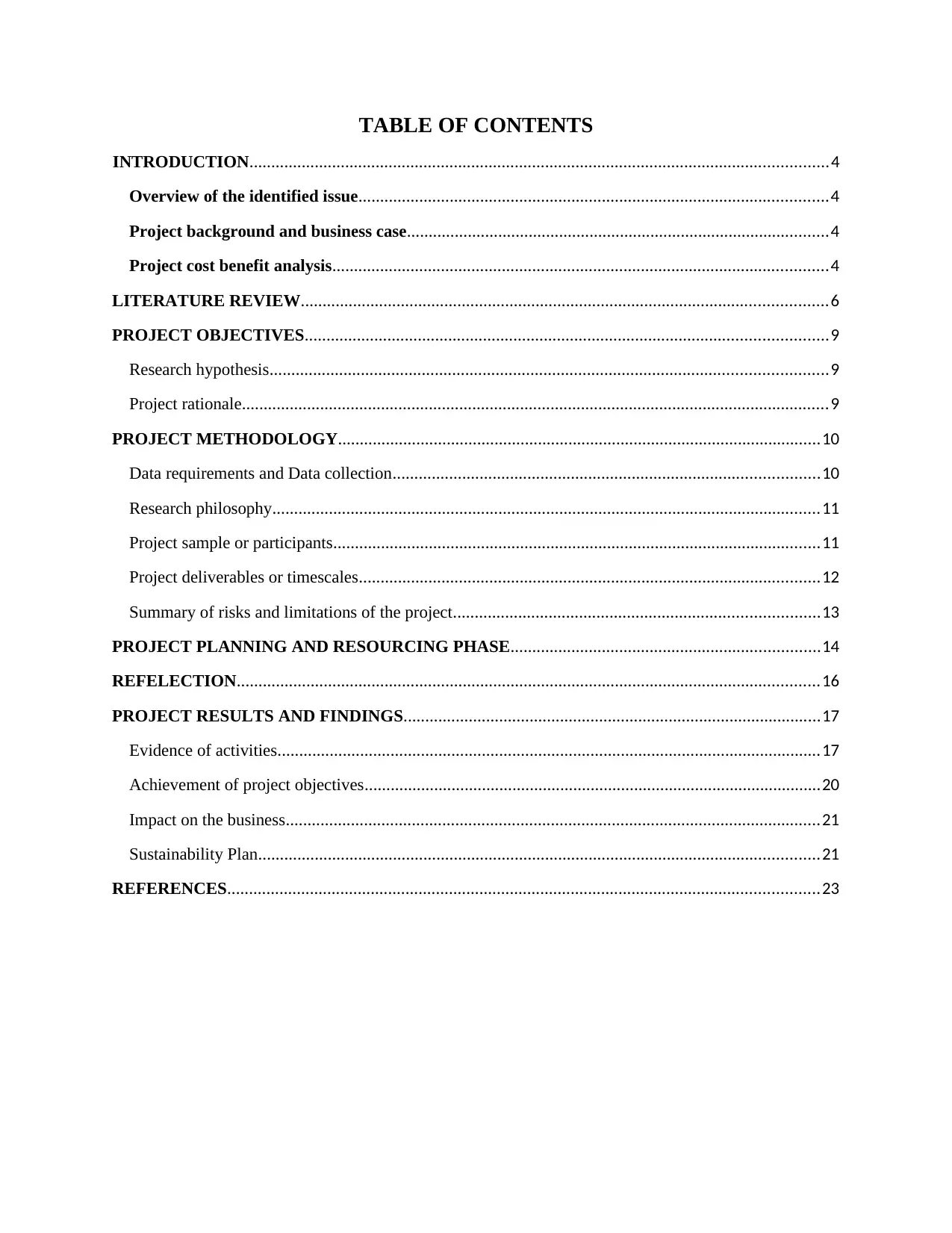
TABLE OF CONTENTS
INTRODUCTION.....................................................................................................................................4
Overview of the identified issue............................................................................................................4
Project background and business case.................................................................................................4
Project cost benefit analysis..................................................................................................................4
LITERATURE REVIEW.........................................................................................................................6
PROJECT OBJECTIVES........................................................................................................................9
Research hypothesis................................................................................................................................9
Project rationale.......................................................................................................................................9
PROJECT METHODOLOGY...............................................................................................................10
Data requirements and Data collection..................................................................................................10
Research philosophy..............................................................................................................................11
Project sample or participants................................................................................................................11
Project deliverables or timescales..........................................................................................................12
Summary of risks and limitations of the project....................................................................................13
PROJECT PLANNING AND RESOURCING PHASE.......................................................................14
REFELECTION......................................................................................................................................16
PROJECT RESULTS AND FINDINGS................................................................................................17
Evidence of activities.............................................................................................................................17
Achievement of project objectives.........................................................................................................20
Impact on the business...........................................................................................................................21
Sustainability Plan.................................................................................................................................21
REFERENCES........................................................................................................................................23
INTRODUCTION.....................................................................................................................................4
Overview of the identified issue............................................................................................................4
Project background and business case.................................................................................................4
Project cost benefit analysis..................................................................................................................4
LITERATURE REVIEW.........................................................................................................................6
PROJECT OBJECTIVES........................................................................................................................9
Research hypothesis................................................................................................................................9
Project rationale.......................................................................................................................................9
PROJECT METHODOLOGY...............................................................................................................10
Data requirements and Data collection..................................................................................................10
Research philosophy..............................................................................................................................11
Project sample or participants................................................................................................................11
Project deliverables or timescales..........................................................................................................12
Summary of risks and limitations of the project....................................................................................13
PROJECT PLANNING AND RESOURCING PHASE.......................................................................14
REFELECTION......................................................................................................................................16
PROJECT RESULTS AND FINDINGS................................................................................................17
Evidence of activities.............................................................................................................................17
Achievement of project objectives.........................................................................................................20
Impact on the business...........................................................................................................................21
Sustainability Plan.................................................................................................................................21
REFERENCES........................................................................................................................................23
INTRODUCTION
Overview of the identified issue
The present era is known for continuous advancement in technology. The technology is
changing every next day causing an impact on the operations of the companies in all sectors of
the economy. The present report will focus specifically on financial sector of the UK’s economy.
Actually financial sector is considered to be the most sensitive sector among all other sector of
the economy, as this sector handles and manages the financial aspect of the citizens of the
country including their savings, investments, loans and deposits. In this project report, the
researcher will take and explain the issues of various technological advancement into the
financial sector and the resulting development of financial software in order to minimize risk
associated with financial concern and detecting preventive and cautious controls needed for safe
and secure operations of the financial institutions.
Project background and business case
In the modern time, there seems high level of social dependence over software systems,
which has increase the development of products like software for making the operations easier
against the traditional methods. There is no denying of the fact that such software development
due to the technological advancement has improve customer’s experience and companies are
taking such development as source of enhancing customer satisfaction. In this project report we
will focus on development of software for financial institutions which helps them to reduce
fallacious acts from both their employees and hacker’s. In the report pertaining to the research
undertaken for the purpose of studying the viability of such software development within the
financial sector of UK, the main focus will be given on how HSBC holdings acting and operating
as a financial player can develop and implement such financial software to improvise their
operational efficiency and reduce the chances of financial losses. Financial services firm like
HSBC, can adopt such financial software keeping in mind that this will allow for improving
customer’s experience and should be customer handy too. The software will also allow for
providing guidance to financial executive in performing their roles and activities.
Overview of the identified issue
The present era is known for continuous advancement in technology. The technology is
changing every next day causing an impact on the operations of the companies in all sectors of
the economy. The present report will focus specifically on financial sector of the UK’s economy.
Actually financial sector is considered to be the most sensitive sector among all other sector of
the economy, as this sector handles and manages the financial aspect of the citizens of the
country including their savings, investments, loans and deposits. In this project report, the
researcher will take and explain the issues of various technological advancement into the
financial sector and the resulting development of financial software in order to minimize risk
associated with financial concern and detecting preventive and cautious controls needed for safe
and secure operations of the financial institutions.
Project background and business case
In the modern time, there seems high level of social dependence over software systems,
which has increase the development of products like software for making the operations easier
against the traditional methods. There is no denying of the fact that such software development
due to the technological advancement has improve customer’s experience and companies are
taking such development as source of enhancing customer satisfaction. In this project report we
will focus on development of software for financial institutions which helps them to reduce
fallacious acts from both their employees and hacker’s. In the report pertaining to the research
undertaken for the purpose of studying the viability of such software development within the
financial sector of UK, the main focus will be given on how HSBC holdings acting and operating
as a financial player can develop and implement such financial software to improvise their
operational efficiency and reduce the chances of financial losses. Financial services firm like
HSBC, can adopt such financial software keeping in mind that this will allow for improving
customer’s experience and should be customer handy too. The software will also allow for
providing guidance to financial executive in performing their roles and activities.
⊘ This is a preview!⊘
Do you want full access?
Subscribe today to unlock all pages.

Trusted by 1+ million students worldwide
Project cost benefit analysis
Cost – benefit analysis helps in identifying what would be the resulting benefits for the
concern after incurring various expenditure for any particular project. It is an evaluation of
whether the cost incurred for a project will release sufficient benefits in terms of profits to cover
up the cost of implementing a project. A project manager always strives for minimizing the risks
by ensuring that the project implementation will be having more certainty over uncertainty.
There always remains a matter of concern for a project manager that by combining all the
benefits of the project and comparing the same with the overall cost associated with it will lead
to profitability or not. The analysis begins with the collection of cost data, which would be seems
like as follows in the present project of financial software development.
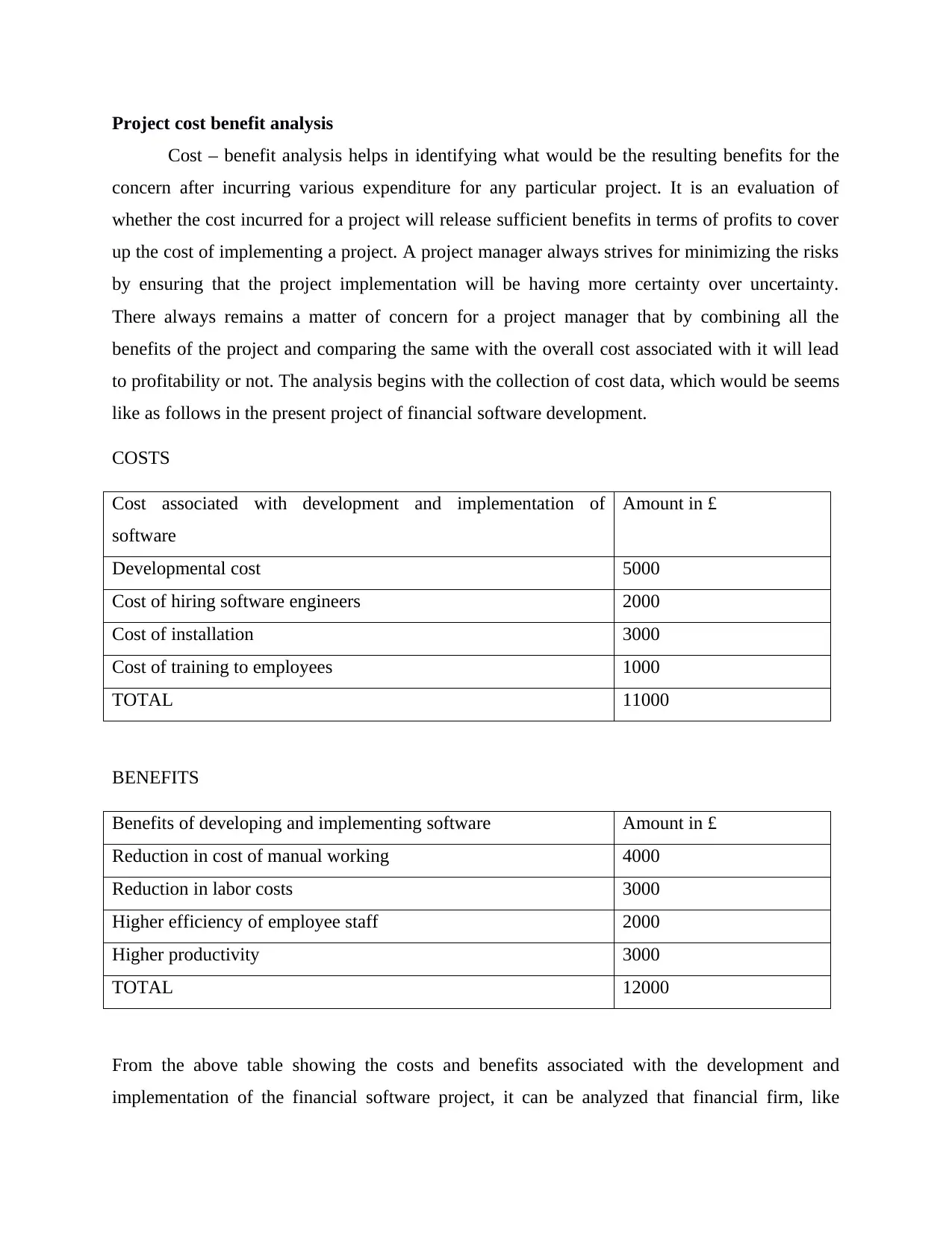
COSTS
Cost associated with development and implementation of
software
Amount in £
Developmental cost 5000
Cost of hiring software engineers 2000
Cost of installation 3000
Cost of training to employees 1000
TOTAL 11000
BENEFITS
Benefits of developing and implementing software Amount in £
Reduction in cost of manual working 4000
Reduction in labor costs 3000
Higher efficiency of employee staff 2000
Higher productivity 3000
TOTAL 12000
From the above table showing the costs and benefits associated with the development and
implementation of the financial software project, it can be analyzed that financial firm, like
Cost – benefit analysis helps in identifying what would be the resulting benefits for the
concern after incurring various expenditure for any particular project. It is an evaluation of
whether the cost incurred for a project will release sufficient benefits in terms of profits to cover
up the cost of implementing a project. A project manager always strives for minimizing the risks
by ensuring that the project implementation will be having more certainty over uncertainty.
There always remains a matter of concern for a project manager that by combining all the
benefits of the project and comparing the same with the overall cost associated with it will lead
to profitability or not. The analysis begins with the collection of cost data, which would be seems
like as follows in the present project of financial software development.
COSTS
Cost associated with development and implementation of
software
Amount in £
Developmental cost 5000
Cost of hiring software engineers 2000
Cost of installation 3000
Cost of training to employees 1000
TOTAL 11000
BENEFITS
Benefits of developing and implementing software Amount in £
Reduction in cost of manual working 4000
Reduction in labor costs 3000
Higher efficiency of employee staff 2000
Higher productivity 3000
TOTAL 12000
From the above table showing the costs and benefits associated with the development and
implementation of the financial software project, it can be analyzed that financial firm, like
Paraphrase This Document
Need a fresh take? Get an instant paraphrase of this document with our AI Paraphraser
HSBC here, will need to incur costs approximately 11000 for the new software as depicted above
for various arrangements. And along with the cost data, there is corresponding depiction of
benefits has been done to guide project manager in deciding upon whether to implement new
software or not. So, here the benefits are higher than the costs, that is 12000, so it is advisable for
project manager to proceed with software implementation, as there is enough scope for
recovering cost of the project within one year.
LITERATURE REVIEW
In this section of the project report, the researcher will present various existing literature by
surveying the same from books, journals, scholar’s articles and many sources of literature that
the researcher think relevant for the present issue, that is viability and security aspects associated
with the new software developed for the financial concern. Through this reviewing of literature,
the researcher aims to answer research questions in order to achieve the set objectives of the
research project.
Operational efficiency and software innovations in financial sector
With the technological advancement in every sectors, there seems a transformation in the
functional mechanism. The financial services industry is not an exception for such technological
and software innovations. The financial services industry is experiencing widespread
technological innovations where every next day there is an introduction of new applications and
software, which is making operations of related concerns quite easier and efficient.
Supe and et.al. (2019), The more use of technology in financial sector has made the
delivery of services easier compared to traditional working pattern. Many new software is being
introduced for financial institutions which are improving efficiency in terms of decreased costs
and higher profitability. The efficiency is improving as the innovations in the system software
allows for low labor costs due to more automated systems. Also, innovation has made the service
delivery process much faster compared to manual systems of the past times. This fastest service
delivery led to the higher productivity of the financial institutions and related concerns.
However, as per the views of Guerrero, Segura and Lucio (2020), the exploitation rate of
technological innovations like implementation of efficient system and application software is
much lower than the rate at which these are advancing. Also, in their research “Adopting
for various arrangements. And along with the cost data, there is corresponding depiction of
benefits has been done to guide project manager in deciding upon whether to implement new
software or not. So, here the benefits are higher than the costs, that is 12000, so it is advisable for
project manager to proceed with software implementation, as there is enough scope for
recovering cost of the project within one year.
LITERATURE REVIEW
In this section of the project report, the researcher will present various existing literature by
surveying the same from books, journals, scholar’s articles and many sources of literature that
the researcher think relevant for the present issue, that is viability and security aspects associated
with the new software developed for the financial concern. Through this reviewing of literature,
the researcher aims to answer research questions in order to achieve the set objectives of the
research project.
Operational efficiency and software innovations in financial sector
With the technological advancement in every sectors, there seems a transformation in the
functional mechanism. The financial services industry is not an exception for such technological
and software innovations. The financial services industry is experiencing widespread
technological innovations where every next day there is an introduction of new applications and
software, which is making operations of related concerns quite easier and efficient.
Supe and et.al. (2019), The more use of technology in financial sector has made the
delivery of services easier compared to traditional working pattern. Many new software is being
introduced for financial institutions which are improving efficiency in terms of decreased costs
and higher profitability. The efficiency is improving as the innovations in the system software
allows for low labor costs due to more automated systems. Also, innovation has made the service
delivery process much faster compared to manual systems of the past times. This fastest service
delivery led to the higher productivity of the financial institutions and related concerns.
However, as per the views of Guerrero, Segura and Lucio (2020), the exploitation rate of
technological innovations like implementation of efficient system and application software is
much lower than the rate at which these are advancing. Also, in their research “Adopting
innovative software in financial sector”, it has been found that banks and other financial
institutions do not even perform 10 % of their sales through such advance technology. The
underlying reason of such gap between innovations and its implementation in real sense is
nothing but the inability of financial concern to appropriately exploit such innovations towards
improving customer experiences.
Feasibility aspects and software development and implementation
Feasibility aspects determine the viability of the project in terms of technical, operational
and economic factors relevant to the project. Technical feasibility associated with the new
software can be explained as the companies in the financial sector to have technically sound
employee base to adjust according to the changing working pattern, this also include the
expertise, experience and efficiency of the technical team successfully implement and install
innovative software to reap the actual and maximum benefits of the innovations. An important
aspect considered while determining the viability of the new software is the resources available
for providing training to the employees to handle new software in the best possible manner.
Wójcik and Ioannou (2020), identified that technological advancement in financial sector
is at high pace, where all the procedures and processes associated with the financial concern is
done through innovative software allowing for greater ease in operations. The individual
employed in financial sector are comparatively technically sound and even there is enough scope
of providing training to the employees and staff.
Labbé and Robert (2020), finds that negative side of such innovative software can’t be
oversighted. Software development and installation requires huge cost in terms of designing,
developing and deploying a software solution. Also, there seems rising cases of hacking which
can’t be ignored. The reason behind such hacking and frauds are just due to fact that as much as
the operations gets easier, it has open many opportunities for hackers to secretly obtain
customers confidential details with the use of technology itself. And if this will happen in
financial sector, this would definitely result in financial loss to company and customers both.
Kleiner, Rybachuk and Karpinskaya (2020), investigated that one of the most important
study done before developing and implementing software is the economic feasibility study. It
includes obtaining information that whether innovations in system software will be beneficial or
institutions do not even perform 10 % of their sales through such advance technology. The
underlying reason of such gap between innovations and its implementation in real sense is
nothing but the inability of financial concern to appropriately exploit such innovations towards
improving customer experiences.
Feasibility aspects and software development and implementation
Feasibility aspects determine the viability of the project in terms of technical, operational
and economic factors relevant to the project. Technical feasibility associated with the new
software can be explained as the companies in the financial sector to have technically sound
employee base to adjust according to the changing working pattern, this also include the
expertise, experience and efficiency of the technical team successfully implement and install
innovative software to reap the actual and maximum benefits of the innovations. An important
aspect considered while determining the viability of the new software is the resources available
for providing training to the employees to handle new software in the best possible manner.
Wójcik and Ioannou (2020), identified that technological advancement in financial sector
is at high pace, where all the procedures and processes associated with the financial concern is
done through innovative software allowing for greater ease in operations. The individual
employed in financial sector are comparatively technically sound and even there is enough scope
of providing training to the employees and staff.
Labbé and Robert (2020), finds that negative side of such innovative software can’t be
oversighted. Software development and installation requires huge cost in terms of designing,
developing and deploying a software solution. Also, there seems rising cases of hacking which
can’t be ignored. The reason behind such hacking and frauds are just due to fact that as much as
the operations gets easier, it has open many opportunities for hackers to secretly obtain
customers confidential details with the use of technology itself. And if this will happen in
financial sector, this would definitely result in financial loss to company and customers both.
Kleiner, Rybachuk and Karpinskaya (2020), investigated that one of the most important
study done before developing and implementing software is the economic feasibility study. It
includes obtaining information that whether innovations in system software will be beneficial or
⊘ This is a preview!⊘
Do you want full access?
Subscribe today to unlock all pages.
Trusted by 1+ million students worldwide
not, and this can be done through cost – benefit analysis where the all the costs and benefits
expected to be derived from the project are placed together to decide upon whether the particular
course of action should be implement or not. In the same way when there is any innovation in
technology associated with financial sector, there are many cost which need to be incurred like,
developmental cost, installation and training costs. These costs are then compared with the
benefits that is expected to be availed by the company. And then finally, decisions are taken for
adopting software innovations.
Sare (2021), identified that many financial institutions fail to install and operate
innovative software, which leads to financial loss for the company rather than maximizing
benefits and improving customer experience. It has been noticed that the reason of such inability
to operate software are identified as improper training and the resulting frustration among
customers as they will not get their services delivered in a desired manner.
Challenges and issues with reference to new software development and implementation in
financial sector
Kuhrmann and et.al. (2018), in their study finds that there is no denying the fact that
software innovations have made functioning of the financial company quite easier, but there are
many challenges and issues that has been faced by many banks and financial institutions in
adopting innovative software. First of all, financial companies and banks are required to
complied with much regulations. Financial regulators are much concerned about the systems and
software that are developed and implemented. They require that such software must be tested
against policies and regulations pertaining to the financial sector. The second challenge is to
manage software in order to avoid bugs, as this can be caused due to not upgrading software on a
timely and regular basis. Another challenge in developing and implementing financial software is
to ensure quick release of the software and speedy operations which are sometime becomes
impossible to ensure.
Security aspects and new software development
Feltus (2019), studied that, the most challenging aspect associated with software
development is to ensure that the existing security should not be compromised at all. The
security is the base of any financial sector company. They are required by the regulatory body to
expected to be derived from the project are placed together to decide upon whether the particular
course of action should be implement or not. In the same way when there is any innovation in
technology associated with financial sector, there are many cost which need to be incurred like,
developmental cost, installation and training costs. These costs are then compared with the
benefits that is expected to be availed by the company. And then finally, decisions are taken for
adopting software innovations.
Sare (2021), identified that many financial institutions fail to install and operate
innovative software, which leads to financial loss for the company rather than maximizing
benefits and improving customer experience. It has been noticed that the reason of such inability
to operate software are identified as improper training and the resulting frustration among
customers as they will not get their services delivered in a desired manner.
Challenges and issues with reference to new software development and implementation in
financial sector
Kuhrmann and et.al. (2018), in their study finds that there is no denying the fact that
software innovations have made functioning of the financial company quite easier, but there are
many challenges and issues that has been faced by many banks and financial institutions in
adopting innovative software. First of all, financial companies and banks are required to
complied with much regulations. Financial regulators are much concerned about the systems and
software that are developed and implemented. They require that such software must be tested
against policies and regulations pertaining to the financial sector. The second challenge is to
manage software in order to avoid bugs, as this can be caused due to not upgrading software on a
timely and regular basis. Another challenge in developing and implementing financial software is
to ensure quick release of the software and speedy operations which are sometime becomes
impossible to ensure.
Security aspects and new software development
Feltus (2019), studied that, the most challenging aspect associated with software
development is to ensure that the existing security should not be compromised at all. The
security is the base of any financial sector company. They are required by the regulatory body to
Paraphrase This Document
Need a fresh take? Get an instant paraphrase of this document with our AI Paraphraser

make sure that their customer's wealth must be kept in a safe and secured manner. Many times it
has been noticed that software innovation causes problems like encouragement of fraudulent act
like hacking and this create problems of losing their customer's trust and other financial
institutions.
Tsaurai (2018), identified that many a times company with a motive of detecting faulty
acts installed new and innovative software which is meant for ensuring cyber security. Such
measure towards ensuring security helps financial concern in increasing customer base and acts
as a marketing tool for the banks and financial institutions in minimizing risks and losses
associated with the assets of the customers.
PROJECT OBJECTIVES
Research hypothesis
H0: The new software will be proved to be viable and secured for HSBC holdings and will
improvise their efficiency and performance.
H1: The new software will not prove to be viable and secured for HSBC holdings and may affect
their performance negatively.
Project rationale
The first and the foremost reason behind undertaking this research project is to study the viability
of the new software that the HSBC holdings is going to implement in their operations. In order to
study the viability of this new software project, the researcher will undertake feasibility study to
identify the project's effectiveness and efficiency in terms of technical, operational and economic
sense. The various aspects associated with these factors will be studied to ensure that the overall
performance of HSBC holdings will not be affected due to the implementation of new software
in terms of technical, operational and economic factors.
The another reason for which this research project has been undertaken is to identify
whether the security standards fixed by the company will be affected in any sense like positively
or negatively. Positive impact could be take place if the new software implementation will lead
to the higher security of the banks confidential information and on the other hand this could be
proved to be negative also if the bank loses its confidential information in the hands of hackers
has been noticed that software innovation causes problems like encouragement of fraudulent act
like hacking and this create problems of losing their customer's trust and other financial
institutions.
Tsaurai (2018), identified that many a times company with a motive of detecting faulty
acts installed new and innovative software which is meant for ensuring cyber security. Such
measure towards ensuring security helps financial concern in increasing customer base and acts
as a marketing tool for the banks and financial institutions in minimizing risks and losses
associated with the assets of the customers.
PROJECT OBJECTIVES
Research hypothesis
H0: The new software will be proved to be viable and secured for HSBC holdings and will
improvise their efficiency and performance.
H1: The new software will not prove to be viable and secured for HSBC holdings and may affect
their performance negatively.
Project rationale
The first and the foremost reason behind undertaking this research project is to study the viability
of the new software that the HSBC holdings is going to implement in their operations. In order to
study the viability of this new software project, the researcher will undertake feasibility study to
identify the project's effectiveness and efficiency in terms of technical, operational and economic
sense. The various aspects associated with these factors will be studied to ensure that the overall
performance of HSBC holdings will not be affected due to the implementation of new software
in terms of technical, operational and economic factors.
The another reason for which this research project has been undertaken is to identify
whether the security standards fixed by the company will be affected in any sense like positively
or negatively. Positive impact could be take place if the new software implementation will lead
to the higher security of the banks confidential information and on the other hand this could be
proved to be negative also if the bank loses its confidential information in the hands of hackers
and fraudsters. So the research will identify the security aspects and emerging challenges
associated with the implementation of new software.
Also, the reason of implementing such software will be identified through this research
project, where the researcher will identify how the new software will lead to higher performance
and operational efficiency of HSBC holdings. The researcher to answer the question like what
could be the resulting efficiency would be, how the performance of the software will be
measured, did the overall performance would be improved or not of HSBC holdings, if YES,
then how the management should carry on with the implementation stage in order to attain its
objectives of installing new software with great efficiency, safety, security and effectiveness. And
if the new software has any deficiency in terms of effectiveness, security, safety and efficiency,
then what successive steps should be advised to the management to cope up with such successive
challenges.
There are many other reasons for undertaking this project, like studying and conducting
financial analysis and scheduling the activities for the successful implementation of the new
software in HSBC holdings. By doing financial analysis, the researcher aims to ensure that the
company like HSBC holdings will not be affected by any sort of losses succeeding the
implementation of new software. So, the researcher by doing cost and benefit analysis ensure
that whatever the cost incurred by HSBC holdings would be neutralized by the benefits derived
by the company from the installation of new software in its operations.
PROJECT METHODOLOGY
Data requirements and Data collection
For carrying out the research associated with the aim to study the viability and security aspects
with reference to the implementation and installation of new software in the financial services
company like HSBC holdings here, the researcher will need to gather qualitative information to
answer the research question and accordingly achieve the research objectives. Through the
utilization of qualitative data, the researcher will find out various challenges, success factors,
opinions, viewpoints and attitude of the society and businesses towards the technological
advancement and their resulting implementation in the real world and more specifically into the
financial sector. Qualitative data type is selected in order to gain useful and in-depth insight of
the market attitude towards the technological advancement and its resulting positive and negative
associated with the implementation of new software.
Also, the reason of implementing such software will be identified through this research
project, where the researcher will identify how the new software will lead to higher performance
and operational efficiency of HSBC holdings. The researcher to answer the question like what
could be the resulting efficiency would be, how the performance of the software will be
measured, did the overall performance would be improved or not of HSBC holdings, if YES,
then how the management should carry on with the implementation stage in order to attain its
objectives of installing new software with great efficiency, safety, security and effectiveness. And
if the new software has any deficiency in terms of effectiveness, security, safety and efficiency,
then what successive steps should be advised to the management to cope up with such successive
challenges.
There are many other reasons for undertaking this project, like studying and conducting
financial analysis and scheduling the activities for the successful implementation of the new
software in HSBC holdings. By doing financial analysis, the researcher aims to ensure that the
company like HSBC holdings will not be affected by any sort of losses succeeding the
implementation of new software. So, the researcher by doing cost and benefit analysis ensure
that whatever the cost incurred by HSBC holdings would be neutralized by the benefits derived
by the company from the installation of new software in its operations.
PROJECT METHODOLOGY
Data requirements and Data collection
For carrying out the research associated with the aim to study the viability and security aspects
with reference to the implementation and installation of new software in the financial services
company like HSBC holdings here, the researcher will need to gather qualitative information to
answer the research question and accordingly achieve the research objectives. Through the
utilization of qualitative data, the researcher will find out various challenges, success factors,
opinions, viewpoints and attitude of the society and businesses towards the technological
advancement and their resulting implementation in the real world and more specifically into the
financial sector. Qualitative data type is selected in order to gain useful and in-depth insight of
the market attitude towards the technological advancement and its resulting positive and negative
⊘ This is a preview!⊘
Do you want full access?
Subscribe today to unlock all pages.
Trusted by 1+ million students worldwide
impacts.
In order to collect data for this research pertaining to study the viability and security aspects
associated aspects of the new software installation, the researcher would here undertake both
primary and secondary research in order to collect in depth information. This is done to advise
the management over the proposal on new software and their implementation in the operations of
HSBC holdings. So, the management could decide upon this proposal of new software and
accordingly ensure that the technological advancement in their business operations would lead to
higher operational efficiency, improvements in the overall business performance and the
management need not to regret upon the installation of new software at any of the successive
stage. The primary research will be conducted here to gather information related to the individual
perception, attitude and viewpoints by approaching technical and security personnel in the
financial sector. And by doing secondary research, various success factors and challenges that
could be emerged with the technological advancement in the financial sector would be studied.
The data and information so gathered by the researcher would be interpreted through the
adoption and application of thematic analysis. Thematic analysis has been chosen here due to the
nature of data that is, the data here is of qualitative nature and in order to interpreted qualitative
information, thematic analysis is the best technique to be adopted and applied accordingly in
order to ensure that the gathered data is relevant and reliable.
Research philosophy
In order to gather, analyse and utilize the information so collected by incorporating both primary
and secondary research, the researcher will adopt the interpretivism philosophy. As the
researcher has collected qualitative data, so this philosophy would be best and suitable for
analysing and interpreting. As the information of human interests such as an opinion, attitude and
perception of the individual forms part of the research under consideration, so the interpretivism
philosophy is suitable as it helps in integrating human interest into the study. Also, this
philosophy is helpful in employing multiple methods towards reflecting multiple aspects of the
research issue.
Project sample or participants
Here in this research project, the researcher will adopt the random sampling method to select the
sample for this study. Here the sample would be the technical and security personnel working in
In order to collect data for this research pertaining to study the viability and security aspects
associated aspects of the new software installation, the researcher would here undertake both
primary and secondary research in order to collect in depth information. This is done to advise
the management over the proposal on new software and their implementation in the operations of
HSBC holdings. So, the management could decide upon this proposal of new software and
accordingly ensure that the technological advancement in their business operations would lead to
higher operational efficiency, improvements in the overall business performance and the
management need not to regret upon the installation of new software at any of the successive
stage. The primary research will be conducted here to gather information related to the individual
perception, attitude and viewpoints by approaching technical and security personnel in the
financial sector. And by doing secondary research, various success factors and challenges that
could be emerged with the technological advancement in the financial sector would be studied.
The data and information so gathered by the researcher would be interpreted through the
adoption and application of thematic analysis. Thematic analysis has been chosen here due to the
nature of data that is, the data here is of qualitative nature and in order to interpreted qualitative
information, thematic analysis is the best technique to be adopted and applied accordingly in
order to ensure that the gathered data is relevant and reliable.
Research philosophy
In order to gather, analyse and utilize the information so collected by incorporating both primary
and secondary research, the researcher will adopt the interpretivism philosophy. As the
researcher has collected qualitative data, so this philosophy would be best and suitable for
analysing and interpreting. As the information of human interests such as an opinion, attitude and
perception of the individual forms part of the research under consideration, so the interpretivism
philosophy is suitable as it helps in integrating human interest into the study. Also, this
philosophy is helpful in employing multiple methods towards reflecting multiple aspects of the
research issue.
Project sample or participants
Here in this research project, the researcher will adopt the random sampling method to select the
sample for this study. Here the sample would be the technical and security personnel working in
Paraphrase This Document
Need a fresh take? Get an instant paraphrase of this document with our AI Paraphraser
the financial along with some management experts who have enough experience of earlier
software installations. The random sampling would select randomly 50 number of participants in
order to gather required information for the research undertaken.
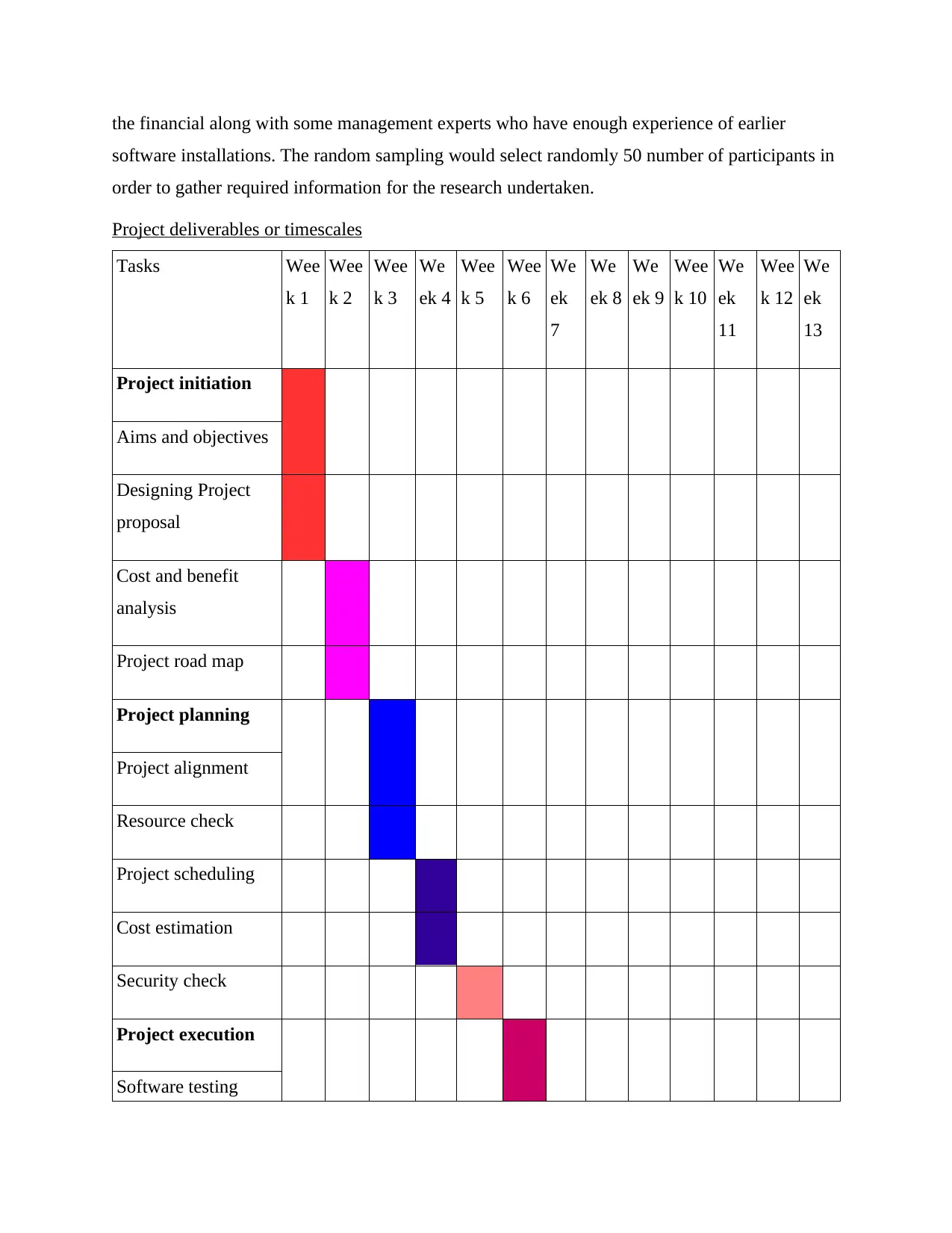
Project deliverables or timescales
Tasks Wee
k 1
Wee
k 2
Wee
k 3
We
ek 4
Wee
k 5
Wee
k 6
We
ek
7
We
ek 8
We
ek 9
Wee
k 10
We
ek
11
Wee
k 12
We
ek
13
Project initiation
Aims and objectives
Designing Project
proposal
Cost and benefit
analysis
Project road map
Project planning
Project alignment
Resource check
Project scheduling
Cost estimation
Security check
Project execution
Software testing
software installations. The random sampling would select randomly 50 number of participants in
order to gather required information for the research undertaken.
Project deliverables or timescales
Tasks Wee
k 1
Wee
k 2
Wee
k 3
We
ek 4
Wee
k 5
Wee
k 6
We
ek
7
We
ek 8
We
ek 9
Wee
k 10
We
ek
11
Wee
k 12
We
ek
13
Project initiation
Aims and objectives
Designing Project
proposal
Cost and benefit
analysis
Project road map
Project planning
Project alignment
Resource check
Project scheduling
Cost estimation
Security check
Project execution
Software testing
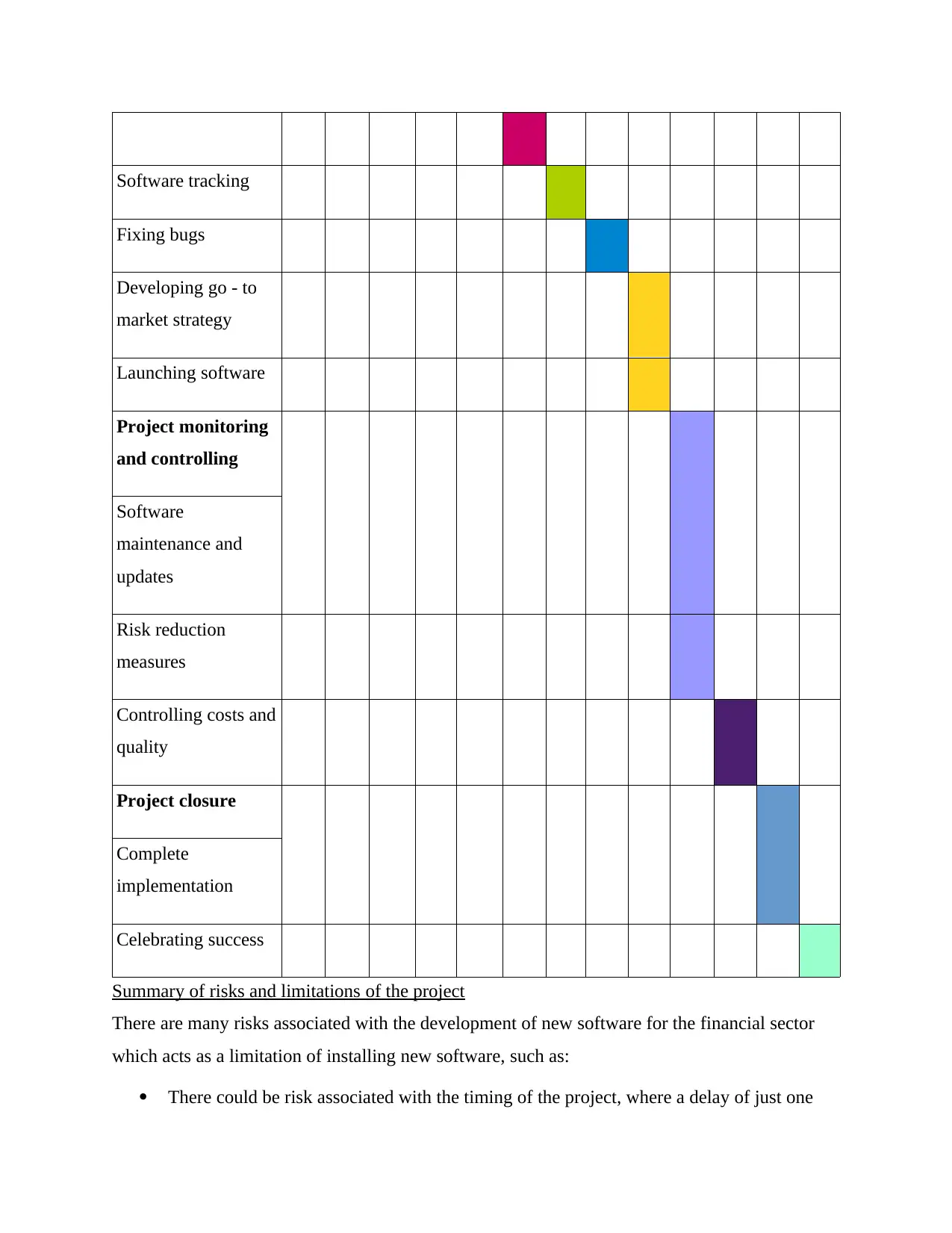
Software tracking
Fixing bugs
Developing go - to
market strategy
Launching software
Project monitoring
and controlling
Software
maintenance and
updates
Risk reduction
measures
Controlling costs and
quality
Project closure
Complete
implementation
Celebrating success
Summary of risks and limitations of the project
There are many risks associated with the development of new software for the financial sector
which acts as a limitation of installing new software, such as:
There could be risk associated with the timing of the project, where a delay of just one
Fixing bugs
Developing go - to
market strategy
Launching software
Project monitoring
and controlling
Software
maintenance and
updates
Risk reduction
measures
Controlling costs and
quality
Project closure
Complete
implementation
Celebrating success
Summary of risks and limitations of the project
There are many risks associated with the development of new software for the financial sector
which acts as a limitation of installing new software, such as:
There could be risk associated with the timing of the project, where a delay of just one
⊘ This is a preview!⊘
Do you want full access?
Subscribe today to unlock all pages.
Trusted by 1+ million students worldwide

1 out of 23


Related Documents


Your All-in-One AI-Powered Toolkit for Academic Success.
+13062052269
info@desklib.com
Available 24*7 on WhatsApp / Email
![[object Object]](/_next/static/media/star-bottom.7253800d.svg)
Unlock your academic potential
Copyright © 2020–2026 A2Z Services. All Rights Reserved. Developed and managed by ZUCOL.