Knowledge & Information Management Skills for the Workplace Report
VerifiedAdded on 2024/07/12
|21
|5290
|303
Report
AI Summary
This report provides a comprehensive overview of knowledge and information management skills essential for workplace success. It elucidates the relationship between data, information, and knowledge, highlighting how data transforms into meaningful information and subsequently into applicable knowledge. The report also explores the interplay between individual and organizational knowledge, emphasizing how both contribute to a company's competitive advantage. Furthermore, it discusses techniques for identifying and evaluating knowledge assets, including the use of KM models. The report further explains the processes involved in creating, storing, applying, and integrating knowledge within an organization, using Sainsbury's as an example. Finally, the importance of intellectual property and knowledge sharing is addressed, with recommendations for improving organizational frameworks to facilitate effective knowledge transfer and utilization.
Knowledge and Information Management Skills for the
Workplace
1
Workplace
1

Paraphrase This Document
Need a fresh take? Get an instant paraphrase of this document with our AI Paraphraser
Table of Contents
Introduction......................................................................................................................................3
Learning Outcome 1........................................................................................................................4
Learning Outcome 2......................................................................................................................10
Learning Outcome 3......................................................................................................................13
Conclusion..................................................................................................................................... 19
Reference List................................................................................................................................ 20
2
Introduction......................................................................................................................................3
Learning Outcome 1........................................................................................................................4
Learning Outcome 2......................................................................................................................10
Learning Outcome 3......................................................................................................................13
Conclusion..................................................................................................................................... 19
Reference List................................................................................................................................ 20
2
Introduction
Knowledge as well as information management skills are considered as very crucial in order to
continue the work flow in an effective manner. In addition, it assists to accomplish all the
business goals and objectives. Employees of a business organization can enhance their
performance level through proper knowledge and information management skills. Problem
solving, conceptual thinking, mentoring, ability of dealing and communication as well as
interpersonal skills all are included in knowledge and information management skills. Most of
the successful business organization such as Sainsbury’s focuses on enhancing their knowledge
and information management skills for accomplishing their business objectives in a more
significant way. This assignment will outline the relationship between data, information and
knowledge. In addition, relationship between organizational knowledge and individual
knowledge along with analysing and modelling techniques will also be included in this
assignment. The importance of intellectual property, contribution of knowledge assets and the
framework of the organization for enabling knowledge sharing with a recommendation for
improving the framework will also be provided in this assignment in order to offer a clear idea
about the topic.
3
Knowledge as well as information management skills are considered as very crucial in order to
continue the work flow in an effective manner. In addition, it assists to accomplish all the
business goals and objectives. Employees of a business organization can enhance their
performance level through proper knowledge and information management skills. Problem
solving, conceptual thinking, mentoring, ability of dealing and communication as well as
interpersonal skills all are included in knowledge and information management skills. Most of
the successful business organization such as Sainsbury’s focuses on enhancing their knowledge
and information management skills for accomplishing their business objectives in a more
significant way. This assignment will outline the relationship between data, information and
knowledge. In addition, relationship between organizational knowledge and individual
knowledge along with analysing and modelling techniques will also be included in this
assignment. The importance of intellectual property, contribution of knowledge assets and the
framework of the organization for enabling knowledge sharing with a recommendation for
improving the framework will also be provided in this assignment in order to offer a clear idea
about the topic.
3
⊘ This is a preview!⊘
Do you want full access?
Subscribe today to unlock all pages.

Trusted by 1+ million students worldwide
Learning Outcome 1
a) Explain the relationship between data, information and knowledge
In order to understand the relationship between data, information and knowledge, it is very
important to understand the definition of these three elements.
Data
Data is observation or raw fact that is considered for having no value or little value until this has
been processed as well as transformed into the information.
Examples:
1. Record of a fact
2. A series of several facts that are obtained through research or observation and recorded.
Information
Data, which has been processed and transformed in meaningful is considered as information.
Data and information are inter-related with each other.
Examples:
1. Data, which has been processed for a purpose such as a bank statement, a bus timetable
or a balance sheet
Knowledge
Knowledge can be considered as the combined result of the experiences of a person as well as
the information they have possessed. As per the researchers, knowledge is the application of
information and data.
In addition, from the above definitions; it can be observed that data and information are inter-
linked with each other. Actually, data are considered as the raw facts or observation that contains
the most effective values in it (Rowley and Hartley, 2017). Data can also be considered as the
collection of the non-random facts. On the opposite side, information is something that carries
effective meaning as well as evidence of the past incidents. Data is scientifically processed and
4
a) Explain the relationship between data, information and knowledge
In order to understand the relationship between data, information and knowledge, it is very
important to understand the definition of these three elements.
Data
Data is observation or raw fact that is considered for having no value or little value until this has
been processed as well as transformed into the information.
Examples:
1. Record of a fact
2. A series of several facts that are obtained through research or observation and recorded.
Information
Data, which has been processed and transformed in meaningful is considered as information.
Data and information are inter-related with each other.
Examples:
1. Data, which has been processed for a purpose such as a bank statement, a bus timetable
or a balance sheet
Knowledge
Knowledge can be considered as the combined result of the experiences of a person as well as
the information they have possessed. As per the researchers, knowledge is the application of
information and data.
In addition, from the above definitions; it can be observed that data and information are inter-
linked with each other. Actually, data are considered as the raw facts or observation that contains
the most effective values in it (Rowley and Hartley, 2017). Data can also be considered as the
collection of the non-random facts. On the opposite side, information is something that carries
effective meaning as well as evidence of the past incidents. Data is scientifically processed and
4
Paraphrase This Document
Need a fresh take? Get an instant paraphrase of this document with our AI Paraphraser
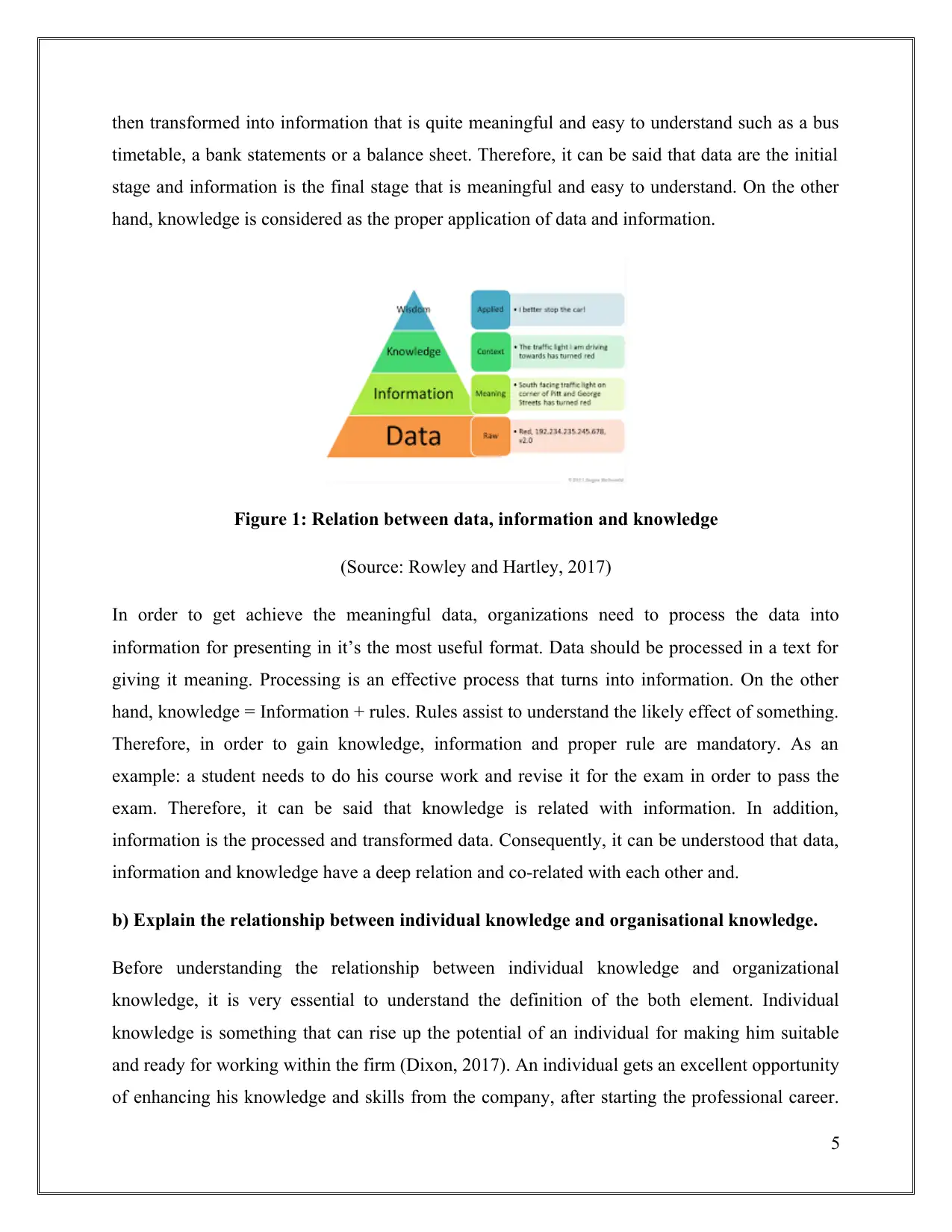
then transformed into information that is quite meaningful and easy to understand such as a bus
timetable, a bank statements or a balance sheet. Therefore, it can be said that data are the initial
stage and information is the final stage that is meaningful and easy to understand. On the other
hand, knowledge is considered as the proper application of data and information.
Figure 1: Relation between data, information and knowledge
(Source: Rowley and Hartley, 2017)
In order to get achieve the meaningful data, organizations need to process the data into
information for presenting in it’s the most useful format. Data should be processed in a text for
giving it meaning. Processing is an effective process that turns into information. On the other
hand, knowledge = Information + rules. Rules assist to understand the likely effect of something.
Therefore, in order to gain knowledge, information and proper rule are mandatory. As an
example: a student needs to do his course work and revise it for the exam in order to pass the
exam. Therefore, it can be said that knowledge is related with information. In addition,
information is the processed and transformed data. Consequently, it can be understood that data,
information and knowledge have a deep relation and co-related with each other and.
b) Explain the relationship between individual knowledge and organisational knowledge.
Before understanding the relationship between individual knowledge and organizational
knowledge, it is very essential to understand the definition of the both element. Individual
knowledge is something that can rise up the potential of an individual for making him suitable
and ready for working within the firm (Dixon, 2017). An individual gets an excellent opportunity
of enhancing his knowledge and skills from the company, after starting the professional career.
5
timetable, a bank statements or a balance sheet. Therefore, it can be said that data are the initial
stage and information is the final stage that is meaningful and easy to understand. On the other
hand, knowledge is considered as the proper application of data and information.
Figure 1: Relation between data, information and knowledge
(Source: Rowley and Hartley, 2017)
In order to get achieve the meaningful data, organizations need to process the data into
information for presenting in it’s the most useful format. Data should be processed in a text for
giving it meaning. Processing is an effective process that turns into information. On the other
hand, knowledge = Information + rules. Rules assist to understand the likely effect of something.
Therefore, in order to gain knowledge, information and proper rule are mandatory. As an
example: a student needs to do his course work and revise it for the exam in order to pass the
exam. Therefore, it can be said that knowledge is related with information. In addition,
information is the processed and transformed data. Consequently, it can be understood that data,
information and knowledge have a deep relation and co-related with each other and.
b) Explain the relationship between individual knowledge and organisational knowledge.
Before understanding the relationship between individual knowledge and organizational
knowledge, it is very essential to understand the definition of the both element. Individual
knowledge is something that can rise up the potential of an individual for making him suitable
and ready for working within the firm (Dixon, 2017). An individual gets an excellent opportunity
of enhancing his knowledge and skills from the company, after starting the professional career.
5
Consequently, it assists an organization to improve the performance level. Thus, offering training
to employees is helpful as it allows increasing the knowledge and performance level. On the
other hand, organizational knowledge is considered as the type of organization asset to that no
value can be named. Organizational knowledge refers to the knowledge that an employee
gathered during working within an organization. Organizational knowledge consists of all the
skills and knowledge that employees need to continue all the organizational operations within an
organization. in addition, employees can enhance their organizational performance level by
increasing their organizational knowledge and skills effectively. Thus, company get achieve
competitive market advantages in the market place (Omotayo, 2015). In addition, most of the
successful business organization such as Sainsbury’s always focuses to improve both of the
individual and organizational knowledge of the employees for improving the overall
performance level of the organization. In addition, an employee can focus on increasing both of
individual and organizational knowledge at the same time as these two types of knowledge are
co-related with each other and influences each other.
c) Apply analysis and modelling techniques to identify knowledge assets.
Identifying the knowledge assets is crucial for any organization in order to improve their
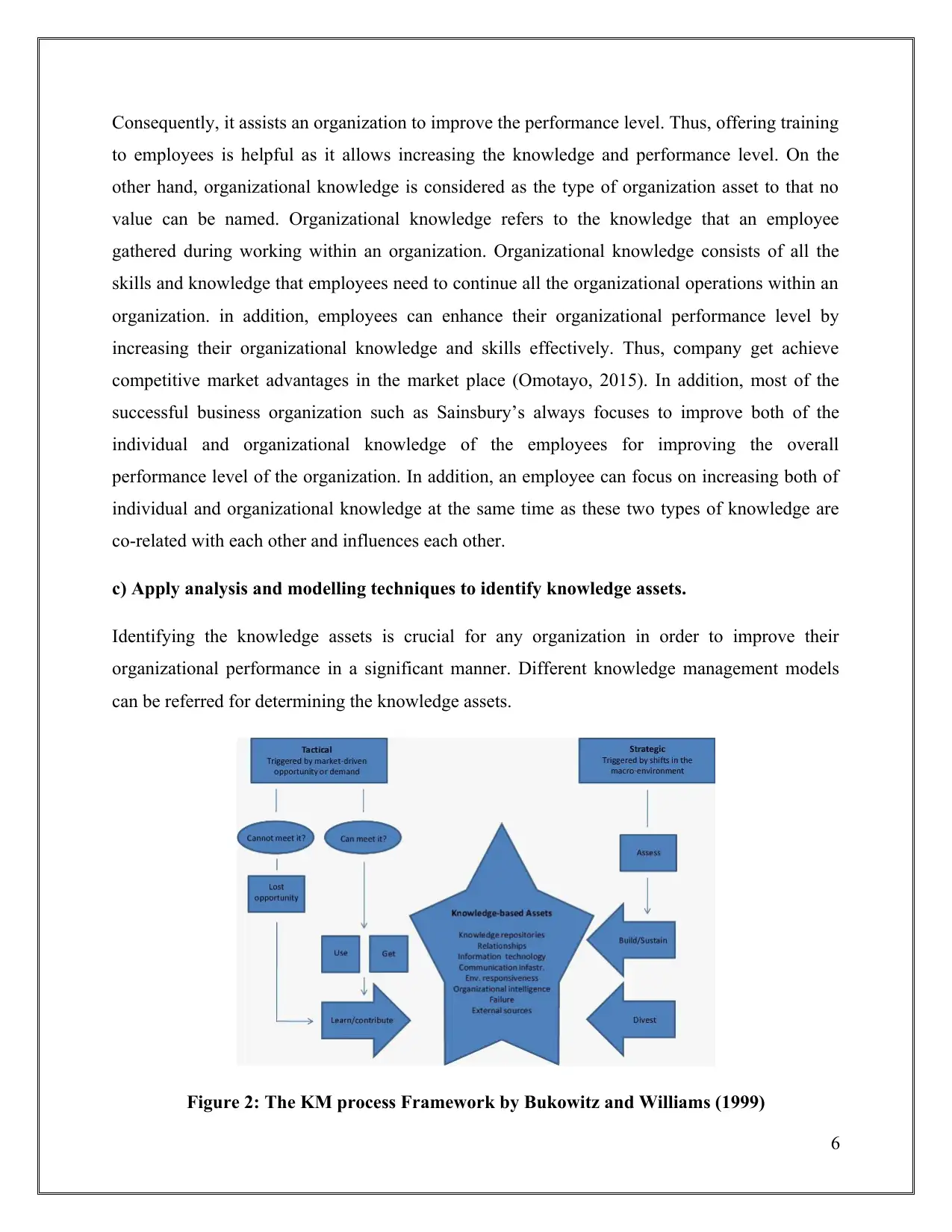
organizational performance in a significant manner. Different knowledge management models
can be referred for determining the knowledge assets.
Figure 2: The KM process Framework by Bukowitz and Williams (1999)
6
to employees is helpful as it allows increasing the knowledge and performance level. On the
other hand, organizational knowledge is considered as the type of organization asset to that no
value can be named. Organizational knowledge refers to the knowledge that an employee
gathered during working within an organization. Organizational knowledge consists of all the
skills and knowledge that employees need to continue all the organizational operations within an
organization. in addition, employees can enhance their organizational performance level by
increasing their organizational knowledge and skills effectively. Thus, company get achieve
competitive market advantages in the market place (Omotayo, 2015). In addition, most of the
successful business organization such as Sainsbury’s always focuses to improve both of the
individual and organizational knowledge of the employees for improving the overall
performance level of the organization. In addition, an employee can focus on increasing both of
individual and organizational knowledge at the same time as these two types of knowledge are
co-related with each other and influences each other.
c) Apply analysis and modelling techniques to identify knowledge assets.
Identifying the knowledge assets is crucial for any organization in order to improve their
organizational performance in a significant manner. Different knowledge management models
can be referred for determining the knowledge assets.
Figure 2: The KM process Framework by Bukowitz and Williams (1999)
6
⊘ This is a preview!⊘
Do you want full access?
Subscribe today to unlock all pages.
Trusted by 1+ million students worldwide
(Source: Doval, 2015)
The KM model states the process, which refers the management strategy for building, divesting
and enhancing knowledge assets. It is possible to emphasize the “when” and “why” aspects
through this effective model. Strategic focus is the strength of this model that puts KM actions
into context (Shongwe, 2016). Knowledge management initiatives are considered as are the
result of response to strategic and tactical needs and changes. A greater overview of the strategy
behind Knowledge management is provided by this model. Nevertheless, any deeper insight is
not included by this KM model, which is considered as one of the major disadvantages of this
model.
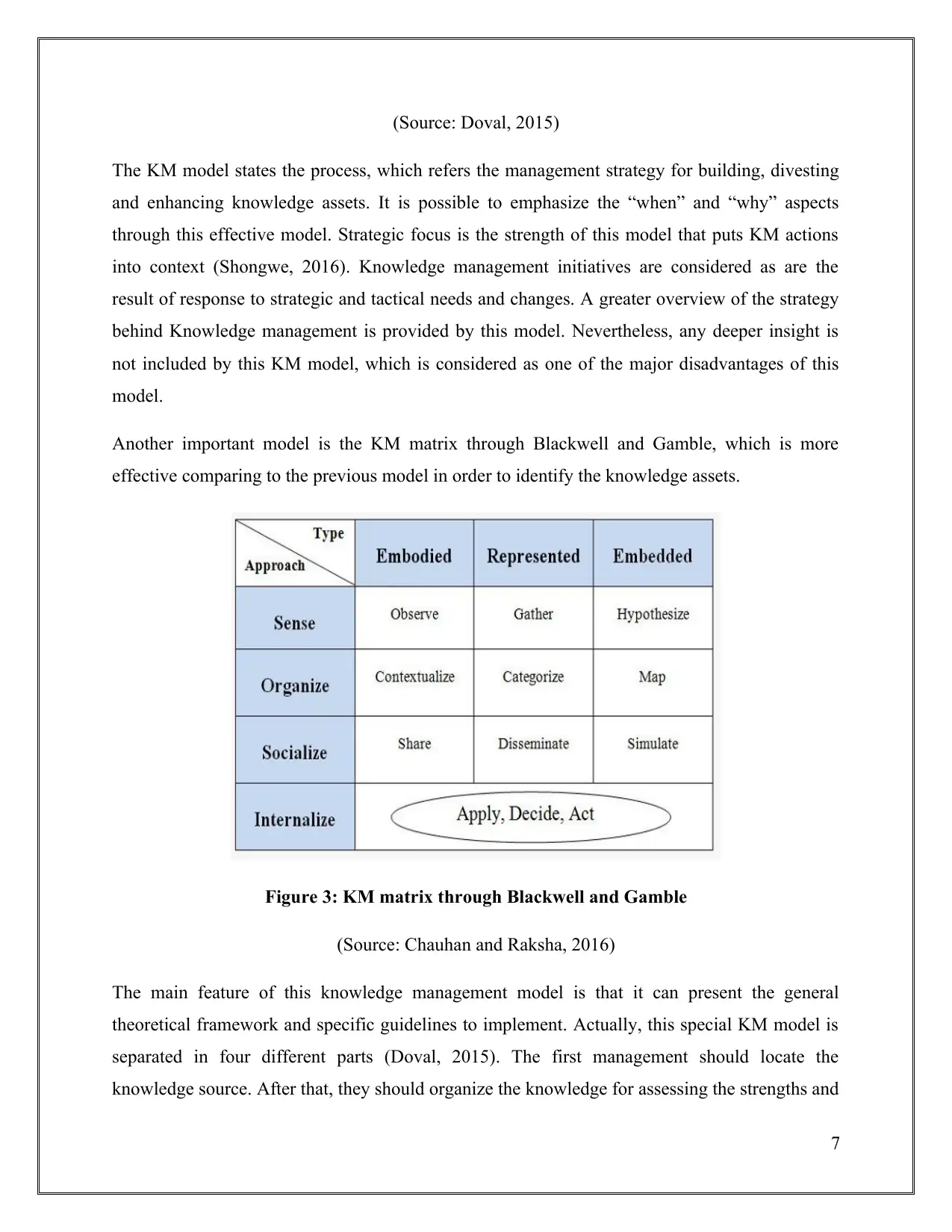
Another important model is the KM matrix through Blackwell and Gamble, which is more
effective comparing to the previous model in order to identify the knowledge assets.
Figure 3: KM matrix through Blackwell and Gamble
(Source: Chauhan and Raksha, 2016)
The main feature of this knowledge management model is that it can present the general
theoretical framework and specific guidelines to implement. Actually, this special KM model is
separated in four different parts (Doval, 2015). The first management should locate the
knowledge source. After that, they should organize the knowledge for assessing the strengths and
7
The KM model states the process, which refers the management strategy for building, divesting
and enhancing knowledge assets. It is possible to emphasize the “when” and “why” aspects
through this effective model. Strategic focus is the strength of this model that puts KM actions
into context (Shongwe, 2016). Knowledge management initiatives are considered as are the
result of response to strategic and tactical needs and changes. A greater overview of the strategy
behind Knowledge management is provided by this model. Nevertheless, any deeper insight is
not included by this KM model, which is considered as one of the major disadvantages of this
model.
Another important model is the KM matrix through Blackwell and Gamble, which is more
effective comparing to the previous model in order to identify the knowledge assets.
Figure 3: KM matrix through Blackwell and Gamble
(Source: Chauhan and Raksha, 2016)
The main feature of this knowledge management model is that it can present the general
theoretical framework and specific guidelines to implement. Actually, this special KM model is
separated in four different parts (Doval, 2015). The first management should locate the
knowledge source. After that, they should organize the knowledge for assessing the strengths and
7
Paraphrase This Document
Need a fresh take? Get an instant paraphrase of this document with our AI Paraphraser
weaknesses of a company and determining its reusability as well as relevance. Socialization
follows this, where different techniques are used for assisting, sharing and disseminating it to
whoever requires it within the firm. Ultimately, knowledge is internalized by use. This model is
effective because it can provide an excellent overview of the KM manager’s role in a more
significant manner comparing to other KM model. One of the major difficulties of this model is
its focus. First of all, the role of KM is limited to knowledge sharing. Secondly, the overall
strategic role that is outlined through Williams and Bukowitz is not included. This can be
considered as an effective approach to knowledge management, where it focuses on sharing as
well as retrieval of existing knowledge.
Most of the successful business organizations use different effective KM models for indentifying
their knowledge assets. Being one of the leading retail chain industries Sainsbury’s also needs to
use effective KM model. Hence, both of the KM models that are discussed above can be adopted
through Sainsbury’s in order to identify the knowledge assets.
d) Evaluate actual and potential knowledge assets.
Knowledge assets can be considered as the source of knowledge that can be used for different
organizational purposes. Several factors including the collective ideas, experiences, memories
and the overall knowledge are crucial for determining the decision making process (Evans et al.,
2015). In a business organization, individuals with specified roles act as source as well as
knowledge asset. Regional managers, employees and other staff those who are directly linked
with organization present an array of strategies and ideas for enhancing the business performance
in a significant way. In addition, all of the employees of an organization are considered as the
most active and necessary knowledge source as they have the responsibility of presenting the
most realistic and improved strategies and ideas. Process and technology is another important
factor in this process that might be considered as potential knowledge. Process refers to the
business process that is done within the organization for accomplishing all the business goals.
Construction, trending, pre-trending, design process with quality management is the functions of
overall business procedure as well as considered as an asset and active source for a company. On
the other hand, technology is defined as another part of the potential knowledge asset. In this
modern era, several advanced technology along with digital facilities has already arrived in the
market place for assisting all business organizations (Dayan et al., 2017). Therefore, digital and
8
follows this, where different techniques are used for assisting, sharing and disseminating it to
whoever requires it within the firm. Ultimately, knowledge is internalized by use. This model is
effective because it can provide an excellent overview of the KM manager’s role in a more
significant manner comparing to other KM model. One of the major difficulties of this model is
its focus. First of all, the role of KM is limited to knowledge sharing. Secondly, the overall
strategic role that is outlined through Williams and Bukowitz is not included. This can be
considered as an effective approach to knowledge management, where it focuses on sharing as
well as retrieval of existing knowledge.
Most of the successful business organizations use different effective KM models for indentifying
their knowledge assets. Being one of the leading retail chain industries Sainsbury’s also needs to
use effective KM model. Hence, both of the KM models that are discussed above can be adopted
through Sainsbury’s in order to identify the knowledge assets.
d) Evaluate actual and potential knowledge assets.
Knowledge assets can be considered as the source of knowledge that can be used for different
organizational purposes. Several factors including the collective ideas, experiences, memories
and the overall knowledge are crucial for determining the decision making process (Evans et al.,
2015). In a business organization, individuals with specified roles act as source as well as
knowledge asset. Regional managers, employees and other staff those who are directly linked
with organization present an array of strategies and ideas for enhancing the business performance
in a significant way. In addition, all of the employees of an organization are considered as the
most active and necessary knowledge source as they have the responsibility of presenting the
most realistic and improved strategies and ideas. Process and technology is another important
factor in this process that might be considered as potential knowledge. Process refers to the
business process that is done within the organization for accomplishing all the business goals.
Construction, trending, pre-trending, design process with quality management is the functions of
overall business procedure as well as considered as an asset and active source for a company. On
the other hand, technology is defined as another part of the potential knowledge asset. In this
modern era, several advanced technology along with digital facilities has already arrived in the
market place for assisting all business organizations (Dayan et al., 2017). Therefore, digital and
8
technological advancement along with different effective software and application can be
considered as an active knowledge source. Most of the successful business organization such as
Sainsbury’s focuses on their knowledge assets. Being one of the leading retail chain
supermarkets across the UK, the principle knowledge asset considers as the organization’s
member. In addition, advancement of technology and digital media are also considered as an
active participant as well as knowledge source. The strategies and knowledge are presented
through the management, executives and the entire employees those are also one of the most
significant sources of knowledge. Hence, the procedure and process of Sainsbury’s is defined as
an effective knowledge source for decision making process.
9
considered as an active knowledge source. Most of the successful business organization such as
Sainsbury’s focuses on their knowledge assets. Being one of the leading retail chain
supermarkets across the UK, the principle knowledge asset considers as the organization’s
member. In addition, advancement of technology and digital media are also considered as an
active participant as well as knowledge source. The strategies and knowledge are presented
through the management, executives and the entire employees those are also one of the most
significant sources of knowledge. Hence, the procedure and process of Sainsbury’s is defined as
an effective knowledge source for decision making process.
9
⊘ This is a preview!⊘
Do you want full access?
Subscribe today to unlock all pages.
Trusted by 1+ million students worldwide
Learning Outcome 2
a) Explain what is required to create, store, apply and integrate knowledge.
Knowledge integration is considered as the process of blending different knowledge models into
an effective general model. Knowledge integration process depends on the numerous information
and incorporating new ideas. This approach is effective in determining the exact idea for
completing a specific task and interacting the new information.
Creating and storing integrated knowledge
In knowledge management system, capturing, storing and sharing knowledge are considered as
most crucial factors (Girard and Girard, 2015). The proper location in order to store appropriate
knowledge needs to be located. The integrated knowledge depends on the factors of how the
organizational knowledge experts are achieving an opportunity for synthesizing knowledge from
various business environment sources. As per the concern of the researcher as well as knowledge
experts, the managers have the prime responsibility of putting skilful and experienced workers
within the organization in order to improve the performance level of the overall organization in
an effective way. Other key persons for this purpose are engineers, designers, writers and other
important professionals. In addition, this whole process is also known as knowledge mapping
process (Hislop et al., 2018). For developing the whole knowledge map for the company, the
managers of Sainsbury’s require to judge all the aspects of company’s internal as well as external
business environment. Business records and experience of the managers of the company are
assisting in developing the entire knowledge map for the firm. Knowledge from the external
factors such as social and political condition of the market place in that the company is
functioning and several important factors that are directly influencing the overall business in the
market place is also very important. In case of Sainsbury’s, the manager requires for justifying
the company’s exact condition in the market place and for indicating the accurate strategy to be
followed by the firm. In addition, managers know well the wealth of knowledge and the
importance of implementing the ideas and exact strategy for the betterment of the company.
Applying and integrating knowledge
In an organization applying and integrating knowledge is very crucial to accomplish all the
business goals in an effective manner. In order to apply knowledge, all of the business
10
a) Explain what is required to create, store, apply and integrate knowledge.
Knowledge integration is considered as the process of blending different knowledge models into
an effective general model. Knowledge integration process depends on the numerous information
and incorporating new ideas. This approach is effective in determining the exact idea for
completing a specific task and interacting the new information.
Creating and storing integrated knowledge
In knowledge management system, capturing, storing and sharing knowledge are considered as
most crucial factors (Girard and Girard, 2015). The proper location in order to store appropriate
knowledge needs to be located. The integrated knowledge depends on the factors of how the
organizational knowledge experts are achieving an opportunity for synthesizing knowledge from
various business environment sources. As per the concern of the researcher as well as knowledge
experts, the managers have the prime responsibility of putting skilful and experienced workers
within the organization in order to improve the performance level of the overall organization in
an effective way. Other key persons for this purpose are engineers, designers, writers and other
important professionals. In addition, this whole process is also known as knowledge mapping
process (Hislop et al., 2018). For developing the whole knowledge map for the company, the
managers of Sainsbury’s require to judge all the aspects of company’s internal as well as external
business environment. Business records and experience of the managers of the company are
assisting in developing the entire knowledge map for the firm. Knowledge from the external
factors such as social and political condition of the market place in that the company is
functioning and several important factors that are directly influencing the overall business in the
market place is also very important. In case of Sainsbury’s, the manager requires for justifying
the company’s exact condition in the market place and for indicating the accurate strategy to be
followed by the firm. In addition, managers know well the wealth of knowledge and the
importance of implementing the ideas and exact strategy for the betterment of the company.
Applying and integrating knowledge
In an organization applying and integrating knowledge is very crucial to accomplish all the
business goals in an effective manner. In order to apply knowledge, all of the business
10
Paraphrase This Document
Need a fresh take? Get an instant paraphrase of this document with our AI Paraphraser
organizations need to arrange training and development program that can assist the employees to
be more familiar with the new advanced digital technologies and software (Chang et al., 2015).
By the training and development program, employees will get the excellent opportunity of
acquiring more knowledge and skills. In addition, they will be more familiar with the software
that is used within the firm. Alternatively, it allows improving the performance level of the
employees as well as the whole business organization in a more significant manner. Stored data
and information also influences decision making process. Additionally, trained employees can
handle the software effectively to continue all the business function smoothly within the firm.
Thus, company such as Sainsbury’s will be able to offer better product or services to their
valuable customers.
b) Consider the importance of Intellectual Property rights.
The Intellectual Property Rights also termed as IP Rights plays a major role within the
organisational boundary of Sainsbury, UK. The IP rights protect the contents of the websites and
the retail sites through copyrights, trademarks, databases and others (Drahos, 2016). According
the particular rights, the organisation has the liberty to retrieve and display the contents of their
website as well as their retail sites on the computer display screens and can store those contents
into the disks, considered to be the only electronic form for storage. These operations mat also
include printing up of those contents for the organisational purpose along with keeping all the
copyrights and patents intact (Help.sainsburys.co.uk, 2018). These data and information
collected from the contents of the Sainsbury’s website and retail websites shall be used only for
educational purpose and the individuals shall strictly follow that they are not allowed to use
those for any commercial means against the written permission from Sainsbury’s, as mentioned
in the Intellectual Property Rights.
The particular Intellectual Property rights imposed upon the Sainsbury’s are significant for the
organisation as a whole and following are the important reasons:
Sainsbury’s are allowed to set their retail business apart from the way their competitors
operates.
The IP rights are important for the organisation to sell or license in order to attain the
organisational revenue stream.
11
be more familiar with the new advanced digital technologies and software (Chang et al., 2015).
By the training and development program, employees will get the excellent opportunity of
acquiring more knowledge and skills. In addition, they will be more familiar with the software
that is used within the firm. Alternatively, it allows improving the performance level of the
employees as well as the whole business organization in a more significant manner. Stored data
and information also influences decision making process. Additionally, trained employees can
handle the software effectively to continue all the business function smoothly within the firm.
Thus, company such as Sainsbury’s will be able to offer better product or services to their
valuable customers.
b) Consider the importance of Intellectual Property rights.
The Intellectual Property Rights also termed as IP Rights plays a major role within the
organisational boundary of Sainsbury, UK. The IP rights protect the contents of the websites and
the retail sites through copyrights, trademarks, databases and others (Drahos, 2016). According
the particular rights, the organisation has the liberty to retrieve and display the contents of their
website as well as their retail sites on the computer display screens and can store those contents
into the disks, considered to be the only electronic form for storage. These operations mat also
include printing up of those contents for the organisational purpose along with keeping all the
copyrights and patents intact (Help.sainsburys.co.uk, 2018). These data and information
collected from the contents of the Sainsbury’s website and retail websites shall be used only for
educational purpose and the individuals shall strictly follow that they are not allowed to use
those for any commercial means against the written permission from Sainsbury’s, as mentioned
in the Intellectual Property Rights.
The particular Intellectual Property rights imposed upon the Sainsbury’s are significant for the
organisation as a whole and following are the important reasons:
Sainsbury’s are allowed to set their retail business apart from the way their competitors
operates.
The IP rights are important for the organisation to sell or license in order to attain the
organisational revenue stream.
11
Sainsbury’s with the use and operating strictly according to the IP rights will be able to
provide their targeted consumers every time with something new, different and improved
products and services.
The IP rights issued upon the organisational structure of Sainsbury’s, forms an important
part, so that their marketing and branding strategies becomes efficient and effective
towards the fulfilment of their organisational goals.
When the organisation has the need to start or launch a new product and services and they
are out of huge finances, the IP rights helps the organisation to securely apply for loans.
With the adoption and regulating the overall business in accordance to IP rights, Sainsbury’s has
able to contribute immensely to the nation as well as the population resending within UK. Some
of important features of IP rights that are significant for the nation and consumers are as follows:
Among the various significances of Intellectual Property Rights, the IP rights are
important for creating job opportunities with high-paying jobs in order to increase the
scope of employment within the national boundary. Sainsbury’s is an IP-intensive
organisation and they have able to employ hundreds of millions of people all across the
globe (Evers et al., 2015).
Intellectual Property Rights has extensively raised economic growth and competitiveness
in the international markets.
Sainsbury’s with the strong and enforced usage of IP rights has able to protect the
consumers and the families through educating them about safety, reliability, and
effectiveness of whatever the commodities the consumers are found to purchase.
Moreover, Sainsbury’s has able to encourage innovations within their organisational
boundaries and also reward the entrepreneurs who are seem to contribute towards the
organisational success.
12
provide their targeted consumers every time with something new, different and improved
products and services.
The IP rights issued upon the organisational structure of Sainsbury’s, forms an important
part, so that their marketing and branding strategies becomes efficient and effective
towards the fulfilment of their organisational goals.
When the organisation has the need to start or launch a new product and services and they
are out of huge finances, the IP rights helps the organisation to securely apply for loans.
With the adoption and regulating the overall business in accordance to IP rights, Sainsbury’s has
able to contribute immensely to the nation as well as the population resending within UK. Some
of important features of IP rights that are significant for the nation and consumers are as follows:
Among the various significances of Intellectual Property Rights, the IP rights are
important for creating job opportunities with high-paying jobs in order to increase the
scope of employment within the national boundary. Sainsbury’s is an IP-intensive
organisation and they have able to employ hundreds of millions of people all across the
globe (Evers et al., 2015).
Intellectual Property Rights has extensively raised economic growth and competitiveness
in the international markets.
Sainsbury’s with the strong and enforced usage of IP rights has able to protect the
consumers and the families through educating them about safety, reliability, and
effectiveness of whatever the commodities the consumers are found to purchase.
Moreover, Sainsbury’s has able to encourage innovations within their organisational
boundaries and also reward the entrepreneurs who are seem to contribute towards the
organisational success.
12
⊘ This is a preview!⊘
Do you want full access?
Subscribe today to unlock all pages.
Trusted by 1+ million students worldwide

1 out of 21


Related Documents


Your All-in-One AI-Powered Toolkit for Academic Success.
+13062052269
info@desklib.com
Available 24*7 on WhatsApp / Email
![[object Object]](/_next/static/media/star-bottom.7253800d.svg)
Unlock your academic potential
Copyright © 2020–2026 A2Z Services. All Rights Reserved. Developed and managed by ZUCOL.