Business Expansion and Knowledge/Information Management Report
VerifiedAdded on 2022/12/19
|18
|4359
|23
Report
AI Summary
This report provides a comprehensive overview of knowledge and information management, exploring the technologies and strategies used within organizations. It begins by defining knowledge management and its importance, then delves into existing technologies such as databases and decision support systems. The report also highlights emerging technologies like artificial intelligence and machine learning. The core of the report includes an analysis of key features of management information systems and decision support systems, and the role of risk management plans in business decision-making. The second part of the report is a business expansion report for the Kind Edward VII College, outlining financial policies, procedures, and data. It includes an analysis of expenses, profit and loss statements, staff survey results, customer feedback, and a proposed communication plan. The report concludes with a summary of findings and recommendations, providing valuable insights for effective knowledge management and business expansion strategies. The report showcases how the college can expand to new campuses in Brisbane and Adelaide by studying the market, and using innovative teaching methods and state of art facilities.
Manage knowledge
and Information
and Information

Paraphrase This Document
Need a fresh take? Get an instant paraphrase of this document with our AI Paraphraser
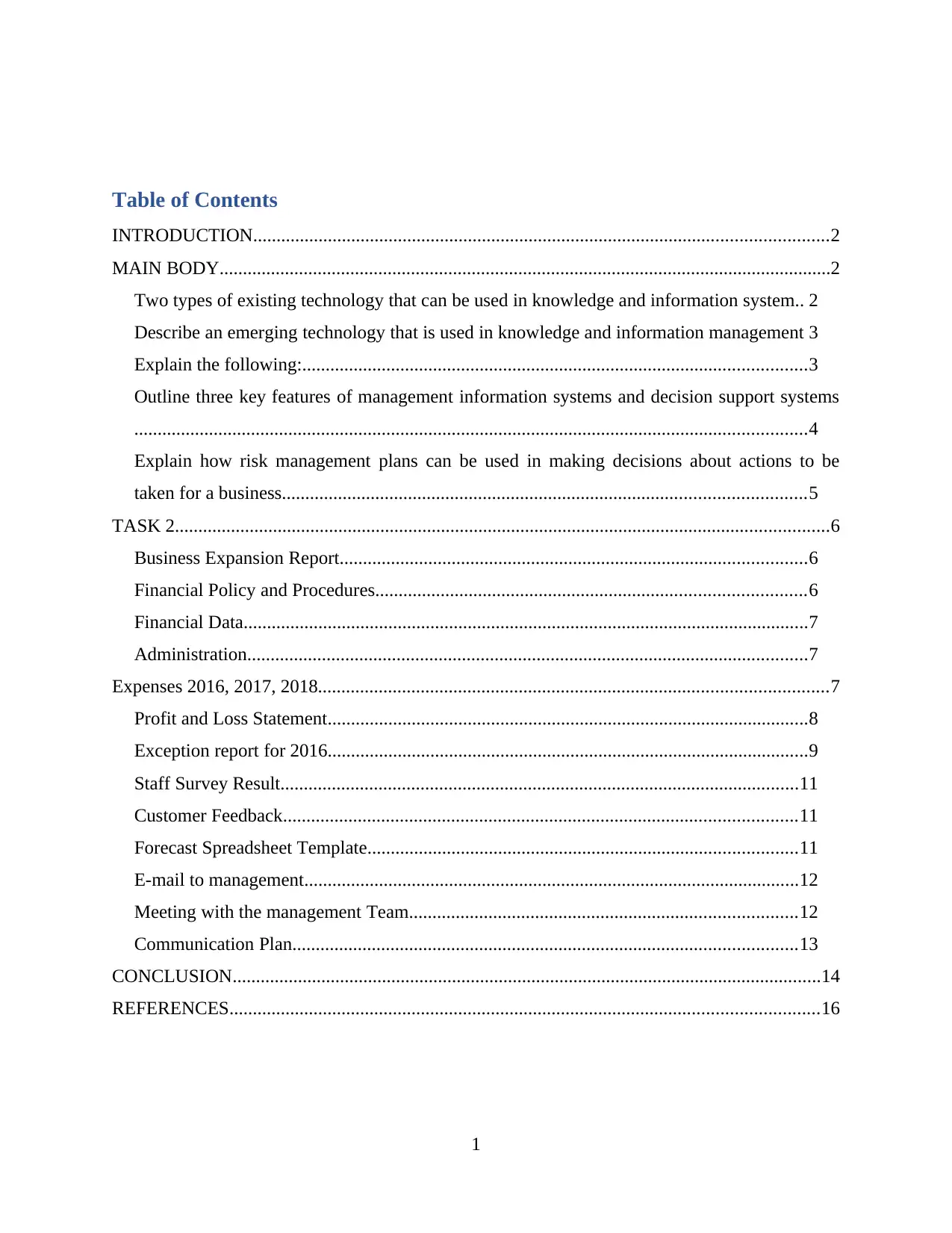
Table of Contents
INTRODUCTION...........................................................................................................................2
MAIN BODY...................................................................................................................................2
Two types of existing technology that can be used in knowledge and information system.. 2
Describe an emerging technology that is used in knowledge and information management 3
Explain the following:............................................................................................................3
Outline three key features of management information systems and decision support systems
................................................................................................................................................4
Explain how risk management plans can be used in making decisions about actions to be
taken for a business................................................................................................................5
TASK 2............................................................................................................................................6
Business Expansion Report....................................................................................................6
Financial Policy and Procedures............................................................................................6
Financial Data.........................................................................................................................7
Administration........................................................................................................................7
Expenses 2016, 2017, 2018.............................................................................................................7
Profit and Loss Statement.......................................................................................................8
Exception report for 2016.......................................................................................................9
Staff Survey Result...............................................................................................................11
Customer Feedback..............................................................................................................11
Forecast Spreadsheet Template............................................................................................11
E-mail to management..........................................................................................................12
Meeting with the management Team...................................................................................12
Communication Plan............................................................................................................13
CONCLUSION..............................................................................................................................14
REFERENCES..............................................................................................................................16
1
INTRODUCTION...........................................................................................................................2
MAIN BODY...................................................................................................................................2
Two types of existing technology that can be used in knowledge and information system.. 2
Describe an emerging technology that is used in knowledge and information management 3
Explain the following:............................................................................................................3
Outline three key features of management information systems and decision support systems
................................................................................................................................................4
Explain how risk management plans can be used in making decisions about actions to be
taken for a business................................................................................................................5
TASK 2............................................................................................................................................6
Business Expansion Report....................................................................................................6
Financial Policy and Procedures............................................................................................6
Financial Data.........................................................................................................................7
Administration........................................................................................................................7
Expenses 2016, 2017, 2018.............................................................................................................7
Profit and Loss Statement.......................................................................................................8
Exception report for 2016.......................................................................................................9
Staff Survey Result...............................................................................................................11
Customer Feedback..............................................................................................................11
Forecast Spreadsheet Template............................................................................................11
E-mail to management..........................................................................................................12
Meeting with the management Team...................................................................................12
Communication Plan............................................................................................................13
CONCLUSION..............................................................................................................................14
REFERENCES..............................................................................................................................16
1
INTRODUCTION
Knowledge is very essential in every field; it require appropriate relevant information that
is very beneficial in terms of enhance brilliancy. In the prospective of organization, it is very
important to encourage the efficiency of the company and decision making process. Knowledge
is glue as well as learning together(Araz and et. al., 2020). Both terms play very crucial role in
student’s life, especially in schools, colleges and universities. If they don’t have appropriate
knowledge, they will face many difficulties in understanding the text. Management of knowledge
including the process of generating, accumulating, sharing and using knowledge for changing
organizational performance. It is a creation of new skills and abilities as well as competencies
and sharing the utilize of knowledge through organizational behaviour. In the prospective
knowledge management is very comprehensive encompasses various elements from
identification of knowledge to developing available the appropriate knowledge at the right time
to the right users. It focused on various activities such as generating new knowledge, acquiring
valuable knowledge from outside sources, using accessible knowledge in decision making. This
report composes of two types of existing technology that can be used in knowledge and
information management. It can be included emerging technology that is also used in knowledge
information system.
MAIN BODY
Two types of existing technology that can be used in knowledge and information system.
In the prospective of technology that support knowledge management that involve the
artificial intelligence, AI technologies involving those used for knowledge acquisition and case
based reasoning systems, electronic discussion groups and computer based stimulation, data
bases, decision support systems, enterprise resource planning system, expert’s system and
administration (Chen, Leng and Labi, 2020). Information system using the information
technology that has improved efficiency and productivity in such areas as sales and product
delivery through changing work procedure. However, there is no evidence that has increased
knowledge work. They have various mode of communication such as e mail, cell phones and
spend more time managing this information rather than using it. Although the early thinking was
that improved communication would reduce the need of physical space that space may be more
2
Knowledge is very essential in every field; it require appropriate relevant information that
is very beneficial in terms of enhance brilliancy. In the prospective of organization, it is very
important to encourage the efficiency of the company and decision making process. Knowledge
is glue as well as learning together(Araz and et. al., 2020). Both terms play very crucial role in
student’s life, especially in schools, colleges and universities. If they don’t have appropriate
knowledge, they will face many difficulties in understanding the text. Management of knowledge
including the process of generating, accumulating, sharing and using knowledge for changing
organizational performance. It is a creation of new skills and abilities as well as competencies
and sharing the utilize of knowledge through organizational behaviour. In the prospective
knowledge management is very comprehensive encompasses various elements from
identification of knowledge to developing available the appropriate knowledge at the right time
to the right users. It focused on various activities such as generating new knowledge, acquiring
valuable knowledge from outside sources, using accessible knowledge in decision making. This
report composes of two types of existing technology that can be used in knowledge and
information management. It can be included emerging technology that is also used in knowledge
information system.
MAIN BODY
Two types of existing technology that can be used in knowledge and information system.
In the prospective of technology that support knowledge management that involve the
artificial intelligence, AI technologies involving those used for knowledge acquisition and case
based reasoning systems, electronic discussion groups and computer based stimulation, data
bases, decision support systems, enterprise resource planning system, expert’s system and
administration (Chen, Leng and Labi, 2020). Information system using the information
technology that has improved efficiency and productivity in such areas as sales and product
delivery through changing work procedure. However, there is no evidence that has increased
knowledge work. They have various mode of communication such as e mail, cell phones and
spend more time managing this information rather than using it. Although the early thinking was
that improved communication would reduce the need of physical space that space may be more
2
⊘ This is a preview!⊘
Do you want full access?
Subscribe today to unlock all pages.

Trusted by 1+ million students worldwide
important not less essential to knowledge work. In the prospective of information technology, it
involves the development, maintenance and the utilization of computer systems and software and
network for the processing and distribution of data. IT administration is the discipline in various
forms of how it is managed in term of priorities and requirement of the commercial enterprises
and organization. There are two types of knowledge management system first one is enterprise
wide knowledge management system that provide the key advantage of streamlining work and
maintaining company productivity.
Knowledge work system it gives business wide knowledge management that focuses on various
systems.
There are two types of technology that used KMS and IT management are given below:
Data base management system: it is a system software for developing and managing databases
that make it possible for users to create, protect, read, update and delete data in data base.
Describe an emerging technology that is used in knowledge and information management
Automated artificial intelligence and machine learning are one of the most advanced
emerging technologies affecting the information technology sector (Choi and et. al., 2020). There
are various types of emerging technologies such as artificial intelligence it is used for design the
mimic the human cognitive process, cloud computing, Nano medicine, 3 d bio printing and the
most important is robotics, it is the design, engineering and use of robotic machines to perform
partially or fully automated physical cognitive functions. Emerging technology is a term that
generally used to recognise or describe a new technology it may refer to the continuing
development of an existing technology. It can have a slightly various meaning that used in
several areas such as media, business, science and education.
Explain the following:
Correlation calculation: The term correlation refers to a statistical measurement that
every company applies in order to analyse the degree of movement for two or more
securities shaving relation with each other (de Azevedo and et. al., 2020). Such kind of
calculation is done in order to manage firm’s portfolio having range between -1.0 to +1.0.
This shows the relationship between all the variables that they are related or not.
Short term and long term analyses: The short term refers to a maximum period of up-
to one year or 12 months and long term comprises of time period more than three years
and lasts up-to thirty years. It includes the time period for assets held by the company.
3
involves the development, maintenance and the utilization of computer systems and software and
network for the processing and distribution of data. IT administration is the discipline in various
forms of how it is managed in term of priorities and requirement of the commercial enterprises
and organization. There are two types of knowledge management system first one is enterprise
wide knowledge management system that provide the key advantage of streamlining work and
maintaining company productivity.
Knowledge work system it gives business wide knowledge management that focuses on various
systems.
There are two types of technology that used KMS and IT management are given below:
Data base management system: it is a system software for developing and managing databases
that make it possible for users to create, protect, read, update and delete data in data base.
Describe an emerging technology that is used in knowledge and information management
Automated artificial intelligence and machine learning are one of the most advanced
emerging technologies affecting the information technology sector (Choi and et. al., 2020). There
are various types of emerging technologies such as artificial intelligence it is used for design the
mimic the human cognitive process, cloud computing, Nano medicine, 3 d bio printing and the
most important is robotics, it is the design, engineering and use of robotic machines to perform
partially or fully automated physical cognitive functions. Emerging technology is a term that
generally used to recognise or describe a new technology it may refer to the continuing
development of an existing technology. It can have a slightly various meaning that used in
several areas such as media, business, science and education.
Explain the following:
Correlation calculation: The term correlation refers to a statistical measurement that
every company applies in order to analyse the degree of movement for two or more
securities shaving relation with each other (de Azevedo and et. al., 2020). Such kind of
calculation is done in order to manage firm’s portfolio having range between -1.0 to +1.0.
This shows the relationship between all the variables that they are related or not.
Short term and long term analyses: The short term refers to a maximum period of up-
to one year or 12 months and long term comprises of time period more than three years
and lasts up-to thirty years. It includes the time period for assets held by the company.
3
Paraphrase This Document
Need a fresh take? Get an instant paraphrase of this document with our AI Paraphraser
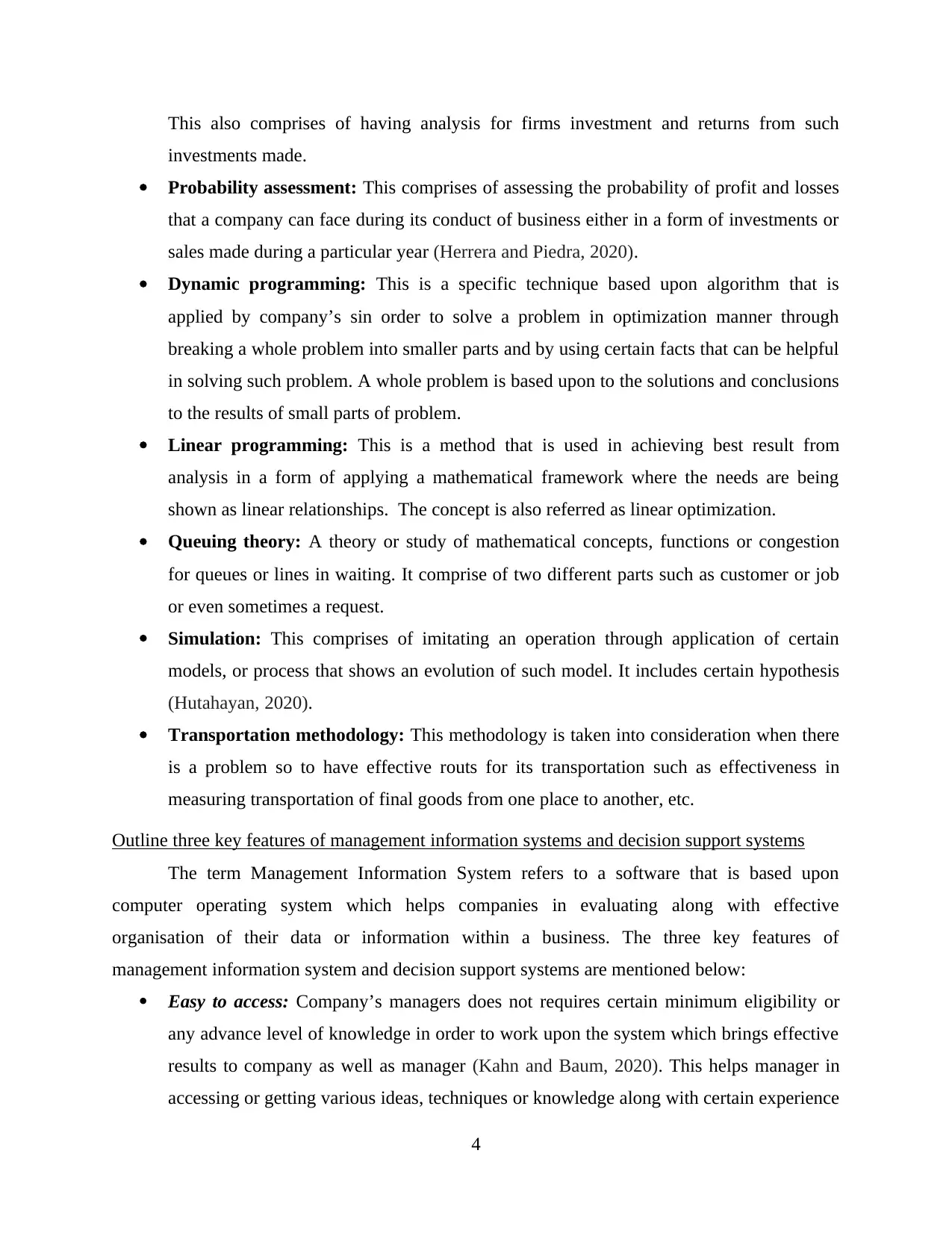
This also comprises of having analysis for firms investment and returns from such
investments made.
Probability assessment: This comprises of assessing the probability of profit and losses
that a company can face during its conduct of business either in a form of investments or
sales made during a particular year (Herrera and Piedra, 2020).
Dynamic programming: This is a specific technique based upon algorithm that is
applied by company’s sin order to solve a problem in optimization manner through
breaking a whole problem into smaller parts and by using certain facts that can be helpful
in solving such problem. A whole problem is based upon to the solutions and conclusions
to the results of small parts of problem.
Linear programming: This is a method that is used in achieving best result from
analysis in a form of applying a mathematical framework where the needs are being
shown as linear relationships. The concept is also referred as linear optimization.
Queuing theory: A theory or study of mathematical concepts, functions or congestion
for queues or lines in waiting. It comprise of two different parts such as customer or job
or even sometimes a request.
Simulation: This comprises of imitating an operation through application of certain
models, or process that shows an evolution of such model. It includes certain hypothesis
(Hutahayan, 2020).
Transportation methodology: This methodology is taken into consideration when there
is a problem so to have effective routs for its transportation such as effectiveness in
measuring transportation of final goods from one place to another, etc.
Outline three key features of management information systems and decision support systems
The term Management Information System refers to a software that is based upon
computer operating system which helps companies in evaluating along with effective
organisation of their data or information within a business. The three key features of
management information system and decision support systems are mentioned below:
Easy to access: Company’s managers does not requires certain minimum eligibility or
any advance level of knowledge in order to work upon the system which brings effective
results to company as well as manager (Kahn and Baum, 2020). This helps manager in
accessing or getting various ideas, techniques or knowledge along with certain experience
4
investments made.
Probability assessment: This comprises of assessing the probability of profit and losses
that a company can face during its conduct of business either in a form of investments or
sales made during a particular year (Herrera and Piedra, 2020).
Dynamic programming: This is a specific technique based upon algorithm that is
applied by company’s sin order to solve a problem in optimization manner through
breaking a whole problem into smaller parts and by using certain facts that can be helpful
in solving such problem. A whole problem is based upon to the solutions and conclusions
to the results of small parts of problem.
Linear programming: This is a method that is used in achieving best result from
analysis in a form of applying a mathematical framework where the needs are being
shown as linear relationships. The concept is also referred as linear optimization.
Queuing theory: A theory or study of mathematical concepts, functions or congestion
for queues or lines in waiting. It comprise of two different parts such as customer or job
or even sometimes a request.
Simulation: This comprises of imitating an operation through application of certain
models, or process that shows an evolution of such model. It includes certain hypothesis
(Hutahayan, 2020).
Transportation methodology: This methodology is taken into consideration when there
is a problem so to have effective routs for its transportation such as effectiveness in
measuring transportation of final goods from one place to another, etc.
Outline three key features of management information systems and decision support systems
The term Management Information System refers to a software that is based upon
computer operating system which helps companies in evaluating along with effective
organisation of their data or information within a business. The three key features of
management information system and decision support systems are mentioned below:
Easy to access: Company’s managers does not requires certain minimum eligibility or
any advance level of knowledge in order to work upon the system which brings effective
results to company as well as manager (Kahn and Baum, 2020). This helps manager in
accessing or getting various ideas, techniques or knowledge along with certain experience
4
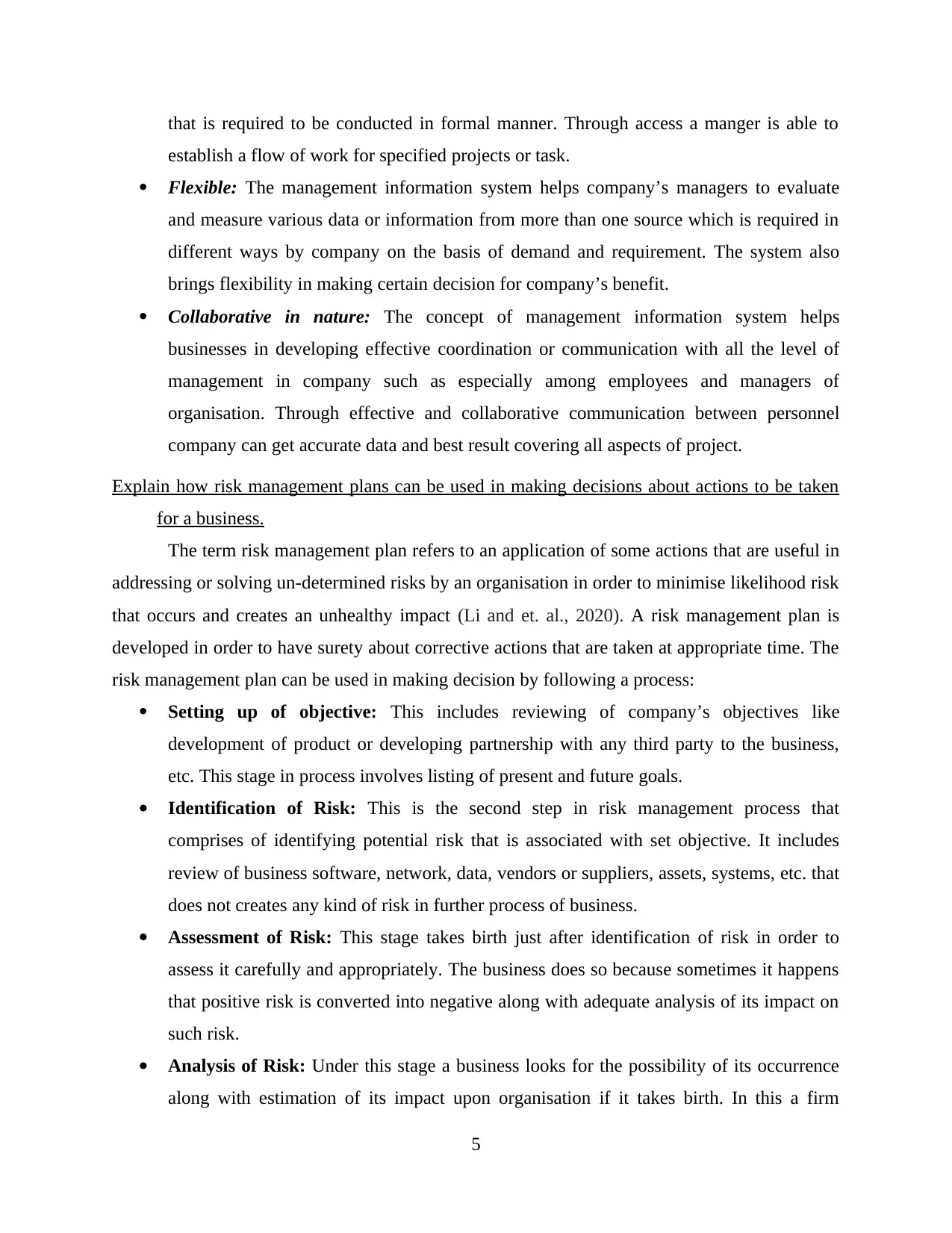
that is required to be conducted in formal manner. Through access a manger is able to
establish a flow of work for specified projects or task.
Flexible: The management information system helps company’s managers to evaluate
and measure various data or information from more than one source which is required in
different ways by company on the basis of demand and requirement. The system also
brings flexibility in making certain decision for company’s benefit.
Collaborative in nature: The concept of management information system helps
businesses in developing effective coordination or communication with all the level of
management in company such as especially among employees and managers of
organisation. Through effective and collaborative communication between personnel
company can get accurate data and best result covering all aspects of project.
Explain how risk management plans can be used in making decisions about actions to be taken
for a business.
The term risk management plan refers to an application of some actions that are useful in
addressing or solving un-determined risks by an organisation in order to minimise likelihood risk
that occurs and creates an unhealthy impact (Li and et. al., 2020). A risk management plan is
developed in order to have surety about corrective actions that are taken at appropriate time. The
risk management plan can be used in making decision by following a process:
Setting up of objective: This includes reviewing of company’s objectives like
development of product or developing partnership with any third party to the business,
etc. This stage in process involves listing of present and future goals.
Identification of Risk: This is the second step in risk management process that
comprises of identifying potential risk that is associated with set objective. It includes
review of business software, network, data, vendors or suppliers, assets, systems, etc. that
does not creates any kind of risk in further process of business.
Assessment of Risk: This stage takes birth just after identification of risk in order to
assess it carefully and appropriately. The business does so because sometimes it happens
that positive risk is converted into negative along with adequate analysis of its impact on
such risk.
Analysis of Risk: Under this stage a business looks for the possibility of its occurrence
along with estimation of its impact upon organisation if it takes birth. In this a firm
5
establish a flow of work for specified projects or task.
Flexible: The management information system helps company’s managers to evaluate
and measure various data or information from more than one source which is required in
different ways by company on the basis of demand and requirement. The system also
brings flexibility in making certain decision for company’s benefit.
Collaborative in nature: The concept of management information system helps
businesses in developing effective coordination or communication with all the level of
management in company such as especially among employees and managers of
organisation. Through effective and collaborative communication between personnel
company can get accurate data and best result covering all aspects of project.
Explain how risk management plans can be used in making decisions about actions to be taken
for a business.
The term risk management plan refers to an application of some actions that are useful in
addressing or solving un-determined risks by an organisation in order to minimise likelihood risk
that occurs and creates an unhealthy impact (Li and et. al., 2020). A risk management plan is
developed in order to have surety about corrective actions that are taken at appropriate time. The
risk management plan can be used in making decision by following a process:
Setting up of objective: This includes reviewing of company’s objectives like
development of product or developing partnership with any third party to the business,
etc. This stage in process involves listing of present and future goals.
Identification of Risk: This is the second step in risk management process that
comprises of identifying potential risk that is associated with set objective. It includes
review of business software, network, data, vendors or suppliers, assets, systems, etc. that
does not creates any kind of risk in further process of business.
Assessment of Risk: This stage takes birth just after identification of risk in order to
assess it carefully and appropriately. The business does so because sometimes it happens
that positive risk is converted into negative along with adequate analysis of its impact on
such risk.
Analysis of Risk: Under this stage a business looks for the possibility of its occurrence
along with estimation of its impact upon organisation if it takes birth. In this a firm
5
⊘ This is a preview!⊘
Do you want full access?
Subscribe today to unlock all pages.
Trusted by 1+ million students worldwide
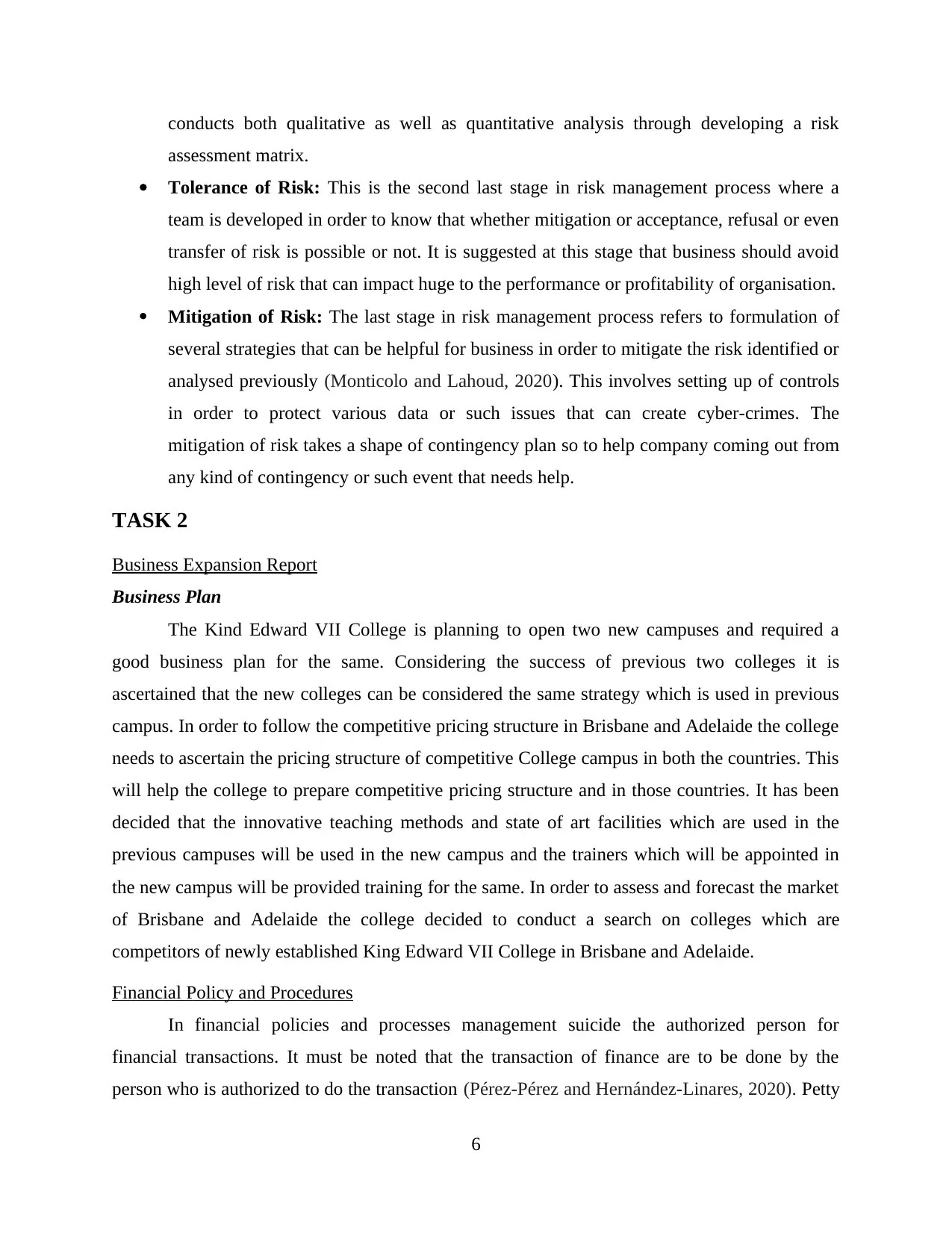
conducts both qualitative as well as quantitative analysis through developing a risk
assessment matrix.
Tolerance of Risk: This is the second last stage in risk management process where a
team is developed in order to know that whether mitigation or acceptance, refusal or even
transfer of risk is possible or not. It is suggested at this stage that business should avoid
high level of risk that can impact huge to the performance or profitability of organisation.
Mitigation of Risk: The last stage in risk management process refers to formulation of
several strategies that can be helpful for business in order to mitigate the risk identified or
analysed previously (Monticolo and Lahoud, 2020). This involves setting up of controls
in order to protect various data or such issues that can create cyber-crimes. The
mitigation of risk takes a shape of contingency plan so to help company coming out from
any kind of contingency or such event that needs help.
TASK 2
Business Expansion Report
Business Plan
The Kind Edward VII College is planning to open two new campuses and required a
good business plan for the same. Considering the success of previous two colleges it is
ascertained that the new colleges can be considered the same strategy which is used in previous
campus. In order to follow the competitive pricing structure in Brisbane and Adelaide the college
needs to ascertain the pricing structure of competitive College campus in both the countries. This
will help the college to prepare competitive pricing structure and in those countries. It has been
decided that the innovative teaching methods and state of art facilities which are used in the
previous campuses will be used in the new campus and the trainers which will be appointed in
the new campus will be provided training for the same. In order to assess and forecast the market
of Brisbane and Adelaide the college decided to conduct a search on colleges which are
competitors of newly established King Edward VII College in Brisbane and Adelaide.
Financial Policy and Procedures
In financial policies and processes management suicide the authorized person for
financial transactions. It must be noted that the transaction of finance are to be done by the
person who is authorized to do the transaction (Pérez-Pérez and Hernández-Linares, 2020). Petty
6
assessment matrix.
Tolerance of Risk: This is the second last stage in risk management process where a
team is developed in order to know that whether mitigation or acceptance, refusal or even
transfer of risk is possible or not. It is suggested at this stage that business should avoid
high level of risk that can impact huge to the performance or profitability of organisation.
Mitigation of Risk: The last stage in risk management process refers to formulation of
several strategies that can be helpful for business in order to mitigate the risk identified or
analysed previously (Monticolo and Lahoud, 2020). This involves setting up of controls
in order to protect various data or such issues that can create cyber-crimes. The
mitigation of risk takes a shape of contingency plan so to help company coming out from
any kind of contingency or such event that needs help.
TASK 2
Business Expansion Report
Business Plan
The Kind Edward VII College is planning to open two new campuses and required a
good business plan for the same. Considering the success of previous two colleges it is
ascertained that the new colleges can be considered the same strategy which is used in previous
campus. In order to follow the competitive pricing structure in Brisbane and Adelaide the college
needs to ascertain the pricing structure of competitive College campus in both the countries. This
will help the college to prepare competitive pricing structure and in those countries. It has been
decided that the innovative teaching methods and state of art facilities which are used in the
previous campuses will be used in the new campus and the trainers which will be appointed in
the new campus will be provided training for the same. In order to assess and forecast the market
of Brisbane and Adelaide the college decided to conduct a search on colleges which are
competitors of newly established King Edward VII College in Brisbane and Adelaide.
Financial Policy and Procedures
In financial policies and processes management suicide the authorized person for
financial transactions. It must be noted that the transaction of finance are to be done by the
person who is authorized to do the transaction (Pérez-Pérez and Hernández-Linares, 2020). Petty
6
Paraphrase This Document
Need a fresh take? Get an instant paraphrase of this document with our AI Paraphraser
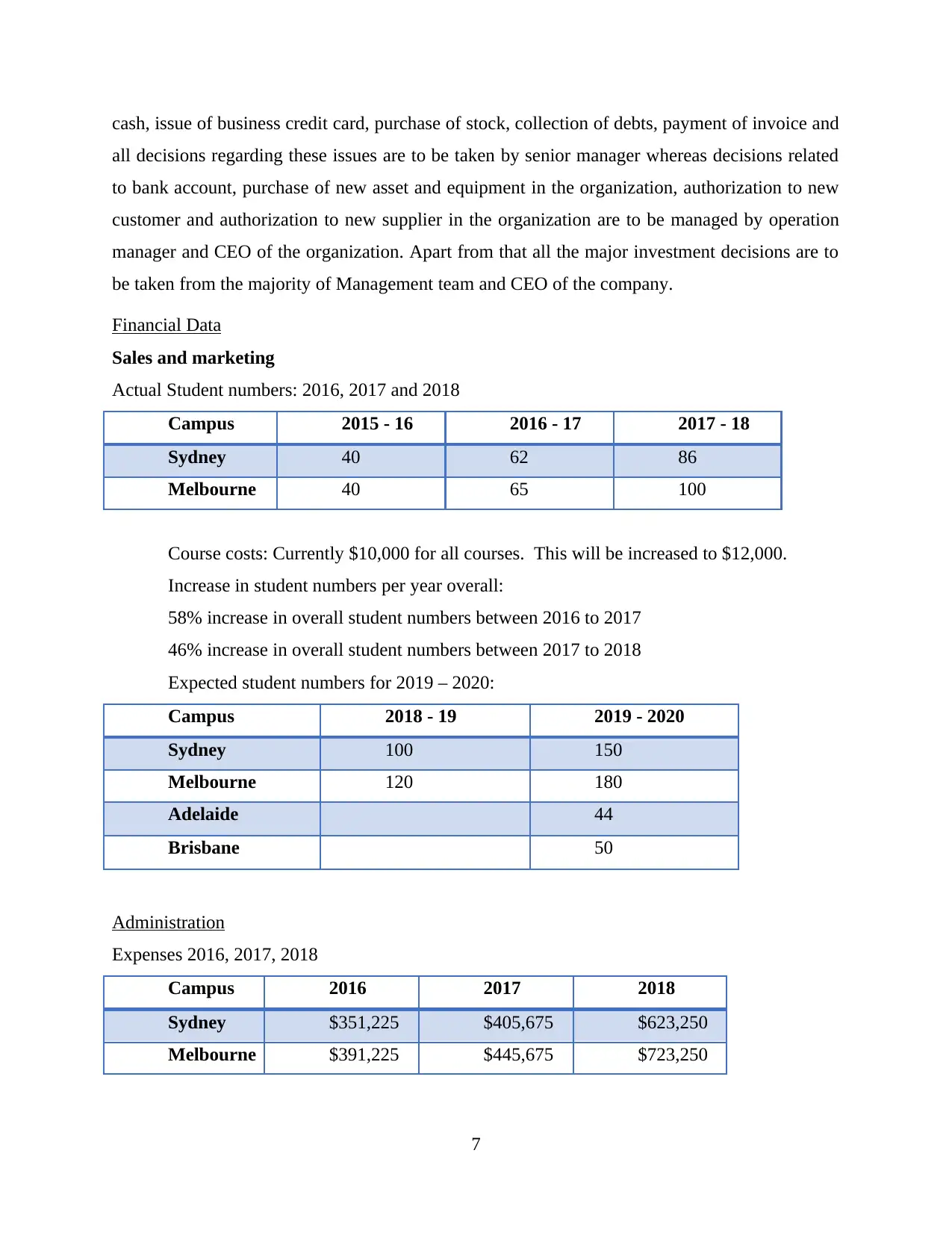
cash, issue of business credit card, purchase of stock, collection of debts, payment of invoice and
all decisions regarding these issues are to be taken by senior manager whereas decisions related
to bank account, purchase of new asset and equipment in the organization, authorization to new
customer and authorization to new supplier in the organization are to be managed by operation
manager and CEO of the organization. Apart from that all the major investment decisions are to
be taken from the majority of Management team and CEO of the company.
Financial Data
Sales and marketing
Actual Student numbers: 2016, 2017 and 2018
Campus 2015 - 16 2016 - 17 2017 - 18
Sydney 40 62 86
Melbourne 40 65 100
Course costs: Currently $10,000 for all courses. This will be increased to $12,000.
Increase in student numbers per year overall:
58% increase in overall student numbers between 2016 to 2017
46% increase in overall student numbers between 2017 to 2018
Expected student numbers for 2019 – 2020:
Campus 2018 - 19 2019 - 2020
Sydney 100 150
Melbourne 120 180
Adelaide 44
Brisbane 50
Administration
Expenses 2016, 2017, 2018
Campus 2016 2017 2018
Sydney $351,225 $405,675 $623,250
Melbourne $391,225 $445,675 $723,250
7
all decisions regarding these issues are to be taken by senior manager whereas decisions related
to bank account, purchase of new asset and equipment in the organization, authorization to new
customer and authorization to new supplier in the organization are to be managed by operation
manager and CEO of the organization. Apart from that all the major investment decisions are to
be taken from the majority of Management team and CEO of the company.
Financial Data
Sales and marketing
Actual Student numbers: 2016, 2017 and 2018
Campus 2015 - 16 2016 - 17 2017 - 18
Sydney 40 62 86
Melbourne 40 65 100
Course costs: Currently $10,000 for all courses. This will be increased to $12,000.
Increase in student numbers per year overall:
58% increase in overall student numbers between 2016 to 2017
46% increase in overall student numbers between 2017 to 2018
Expected student numbers for 2019 – 2020:
Campus 2018 - 19 2019 - 2020
Sydney 100 150
Melbourne 120 180
Adelaide 44
Brisbane 50
Administration
Expenses 2016, 2017, 2018
Campus 2016 2017 2018
Sydney $351,225 $405,675 $623,250
Melbourne $391,225 $445,675 $723,250
7
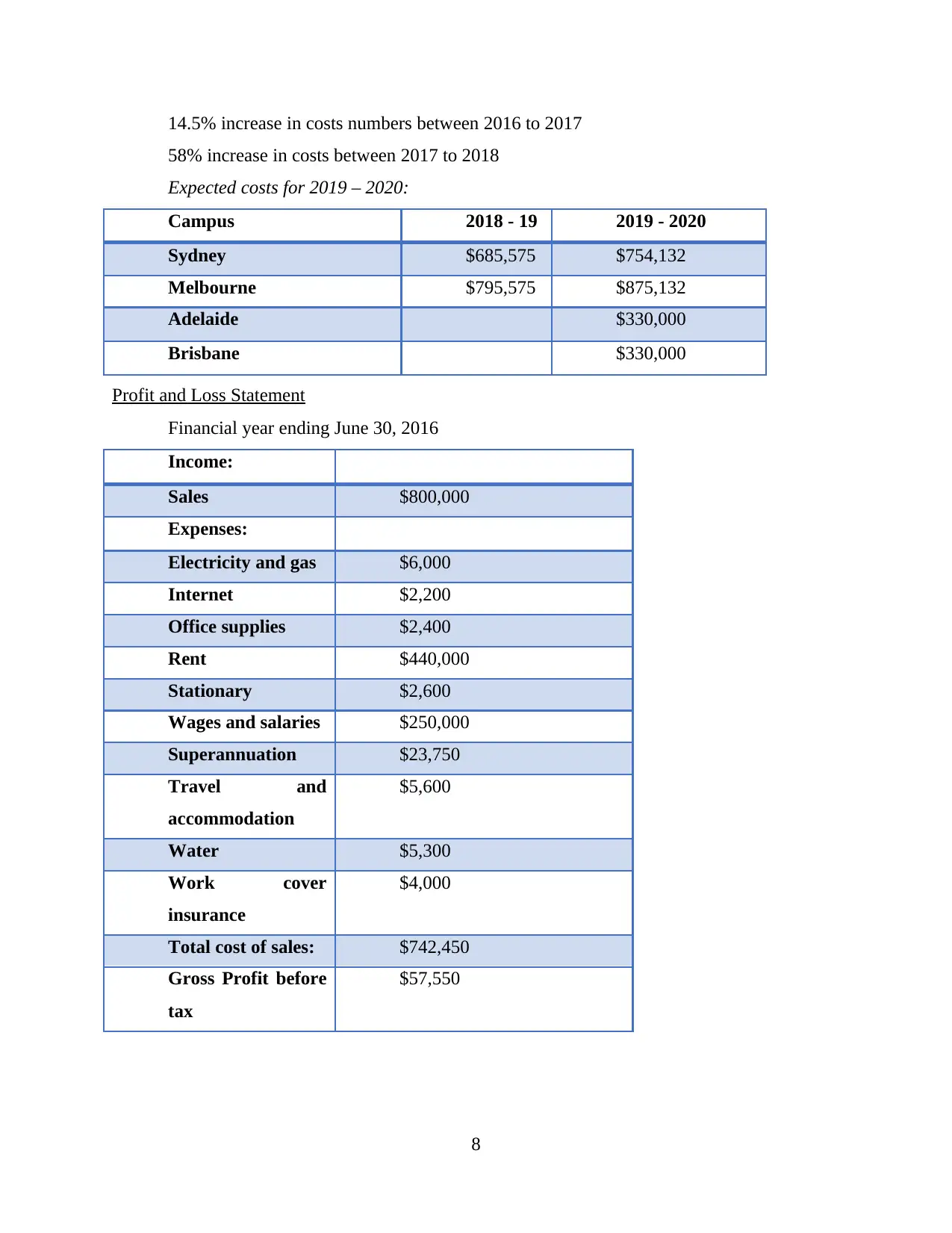
14.5% increase in costs numbers between 2016 to 2017
58% increase in costs between 2017 to 2018
Expected costs for 2019 – 2020:
Campus 2018 - 19 2019 - 2020
Sydney $685,575 $754,132
Melbourne $795,575 $875,132
Adelaide $330,000
Brisbane $330,000
Profit and Loss Statement
Financial year ending June 30, 2016
Income:
Sales $800,000
Expenses:
Electricity and gas $6,000
Internet $2,200
Office supplies $2,400
Rent $440,000
Stationary $2,600
Wages and salaries $250,000
Superannuation $23,750
Travel and
accommodation
$5,600
Water $5,300
Work cover
insurance
$4,000
Total cost of sales: $742,450
Gross Profit before
tax
$57,550
8
58% increase in costs between 2017 to 2018
Expected costs for 2019 – 2020:
Campus 2018 - 19 2019 - 2020
Sydney $685,575 $754,132
Melbourne $795,575 $875,132
Adelaide $330,000
Brisbane $330,000
Profit and Loss Statement
Financial year ending June 30, 2016
Income:
Sales $800,000
Expenses:
Electricity and gas $6,000
Internet $2,200
Office supplies $2,400
Rent $440,000
Stationary $2,600
Wages and salaries $250,000
Superannuation $23,750
Travel and
accommodation
$5,600
Water $5,300
Work cover
insurance
$4,000
Total cost of sales: $742,450
Gross Profit before
tax
$57,550
8
⊘ This is a preview!⊘
Do you want full access?
Subscribe today to unlock all pages.
Trusted by 1+ million students worldwide
Exception report for 2016
In 2016 there was a variation in expected profit to actual profit by 20%. This was due to
lower than expected student numbers in the first year of operation. In all other years, there were
no significant variations in profit and loss.
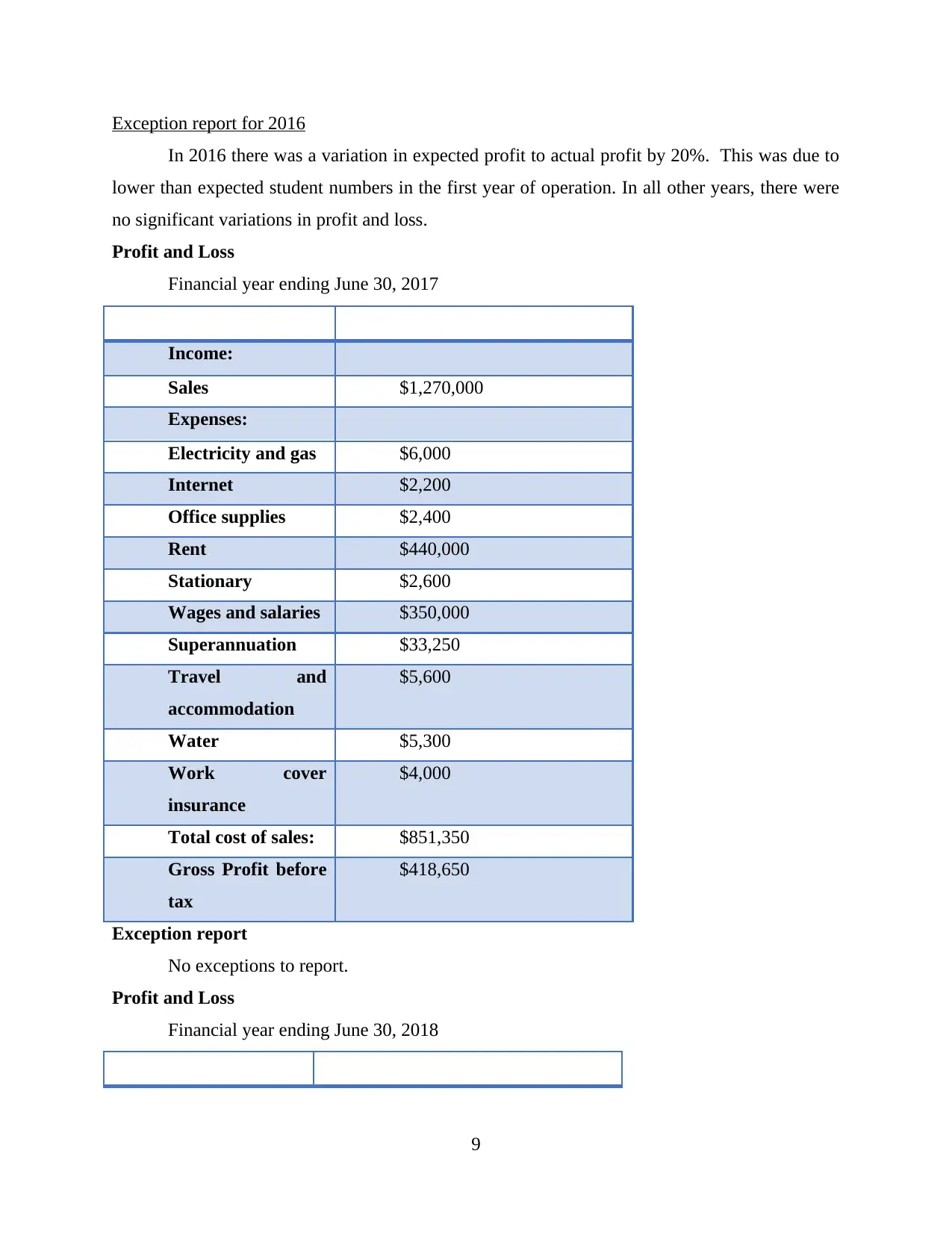
Profit and Loss
Financial year ending June 30, 2017
Income:
Sales $1,270,000
Expenses:
Electricity and gas $6,000
Internet $2,200
Office supplies $2,400
Rent $440,000
Stationary $2,600
Wages and salaries $350,000
Superannuation $33,250
Travel and
accommodation
$5,600
Water $5,300
Work cover
insurance
$4,000
Total cost of sales: $851,350
Gross Profit before
tax
$418,650
Exception report
No exceptions to report.
Profit and Loss
Financial year ending June 30, 2018
9
In 2016 there was a variation in expected profit to actual profit by 20%. This was due to
lower than expected student numbers in the first year of operation. In all other years, there were
no significant variations in profit and loss.
Profit and Loss
Financial year ending June 30, 2017
Income:
Sales $1,270,000
Expenses:
Electricity and gas $6,000
Internet $2,200
Office supplies $2,400
Rent $440,000
Stationary $2,600
Wages and salaries $350,000
Superannuation $33,250
Travel and
accommodation
$5,600
Water $5,300
Work cover
insurance
$4,000
Total cost of sales: $851,350
Gross Profit before
tax
$418,650
Exception report
No exceptions to report.
Profit and Loss
Financial year ending June 30, 2018
9
Paraphrase This Document
Need a fresh take? Get an instant paraphrase of this document with our AI Paraphraser
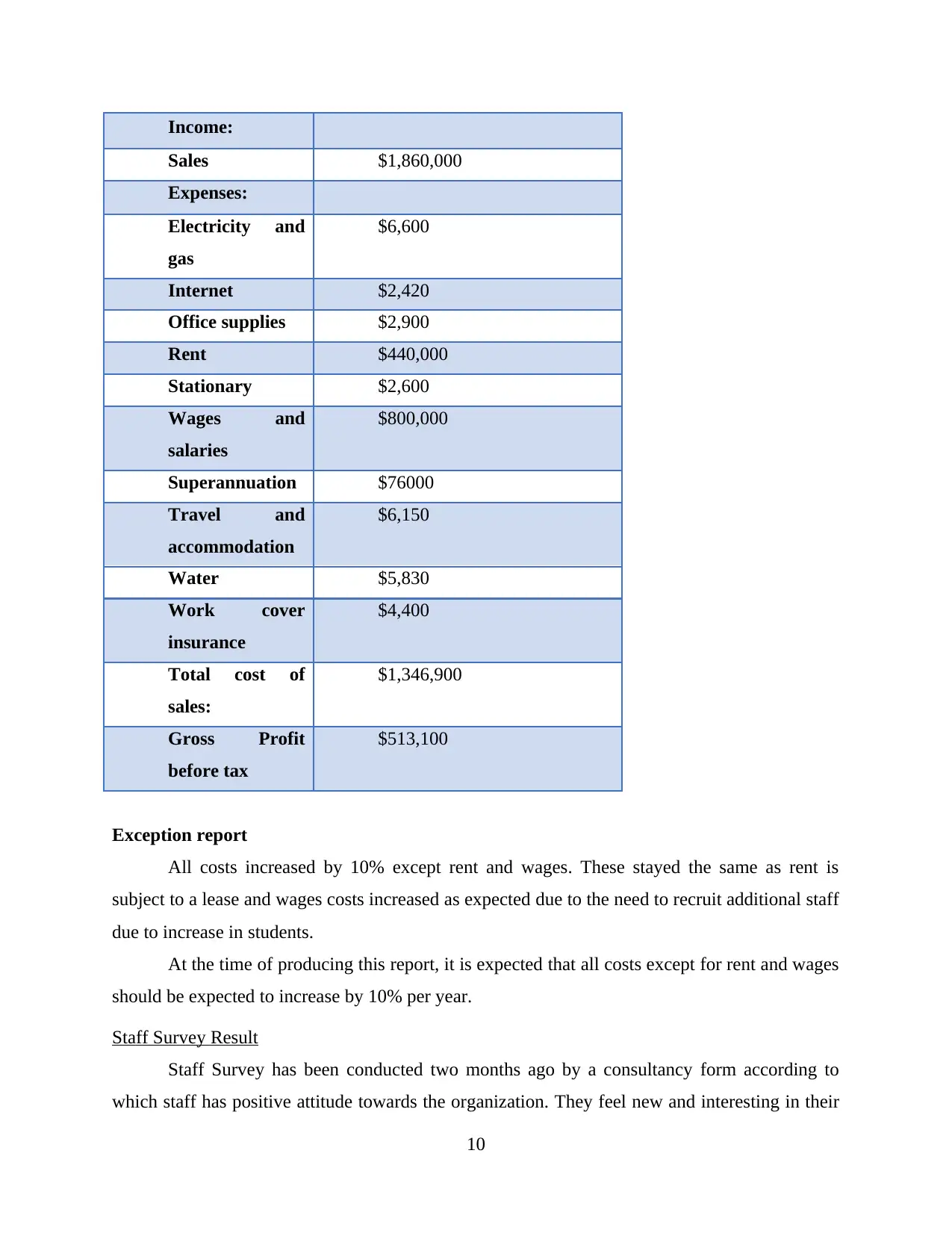
Income:
Sales $1,860,000
Expenses:
Electricity and
gas
$6,600
Internet $2,420
Office supplies $2,900
Rent $440,000
Stationary $2,600
Wages and
salaries
$800,000
Superannuation $76000
Travel and
accommodation
$6,150
Water $5,830
Work cover
insurance
$4,400
Total cost of
sales:
$1,346,900
Gross Profit
before tax
$513,100
Exception report
All costs increased by 10% except rent and wages. These stayed the same as rent is
subject to a lease and wages costs increased as expected due to the need to recruit additional staff
due to increase in students.
At the time of producing this report, it is expected that all costs except for rent and wages
should be expected to increase by 10% per year.
Staff Survey Result
Staff Survey has been conducted two months ago by a consultancy form according to
which staff has positive attitude towards the organization. They feel new and interesting in their
10
Sales $1,860,000
Expenses:
Electricity and
gas
$6,600
Internet $2,420
Office supplies $2,900
Rent $440,000
Stationary $2,600
Wages and
salaries
$800,000
Superannuation $76000
Travel and
accommodation
$6,150
Water $5,830
Work cover
insurance
$4,400
Total cost of
sales:
$1,346,900
Gross Profit
before tax
$513,100
Exception report
All costs increased by 10% except rent and wages. These stayed the same as rent is
subject to a lease and wages costs increased as expected due to the need to recruit additional staff
due to increase in students.
At the time of producing this report, it is expected that all costs except for rent and wages
should be expected to increase by 10% per year.
Staff Survey Result
Staff Survey has been conducted two months ago by a consultancy form according to
which staff has positive attitude towards the organization. They feel new and interesting in their
10
work because of the innovative teaching techniques used in the college (Robison, Hanson and
Black, 2020). They also feel some of the bad things in the college that are not enough
communication between staff and Management, disorganized process, not consistent with
managerial decisions, too much work and many more. In order to achieve success in the new
business Ventures of Edward College it has been decided to fulfill all the demand of staff
members which are assessed through the staff service.
Customer Feedback
According to the feedback of students the college is rated excellent by 29 students good
by 46 ok by 21 terrible by 1 and not good by 3. The comments which were addressed by student
and response of the college was good and they have good experience with the course and
teaching in the college. Some of the students found that there is not enough teaching staff. All
the changes can be addressed in the new organizations which are going to be established by
Edward college.
Forecast Spreadsheet Template
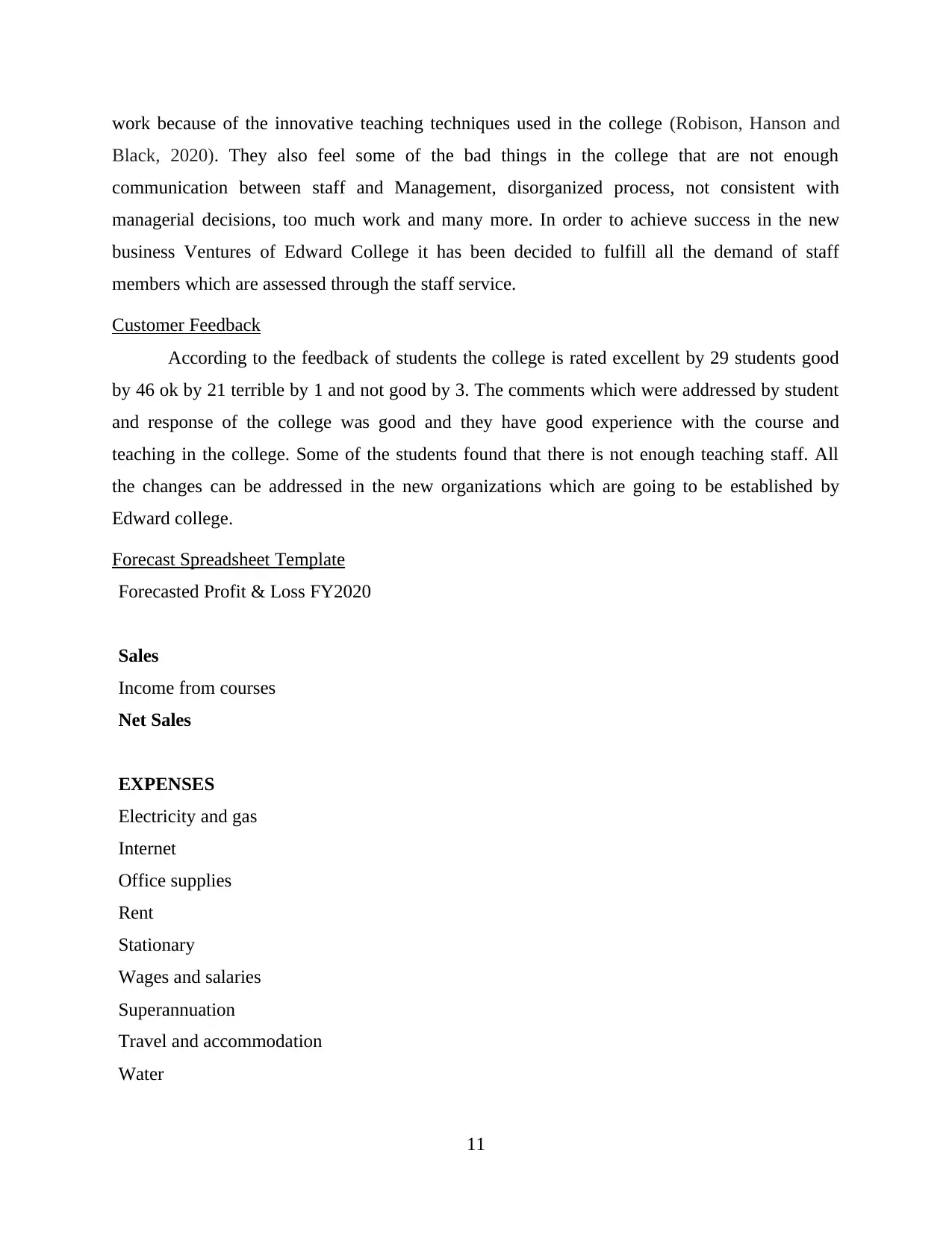
Forecasted Profit & Loss FY2020
Sales
Income from courses
Net Sales
EXPENSES
Electricity and gas
Internet
Office supplies
Rent
Stationary
Wages and salaries
Superannuation
Travel and accommodation
Water
11
Black, 2020). They also feel some of the bad things in the college that are not enough
communication between staff and Management, disorganized process, not consistent with
managerial decisions, too much work and many more. In order to achieve success in the new
business Ventures of Edward College it has been decided to fulfill all the demand of staff
members which are assessed through the staff service.
Customer Feedback
According to the feedback of students the college is rated excellent by 29 students good
by 46 ok by 21 terrible by 1 and not good by 3. The comments which were addressed by student
and response of the college was good and they have good experience with the course and
teaching in the college. Some of the students found that there is not enough teaching staff. All
the changes can be addressed in the new organizations which are going to be established by
Edward college.
Forecast Spreadsheet Template
Forecasted Profit & Loss FY2020
Sales
Income from courses
Net Sales
EXPENSES
Electricity and gas
Internet
Office supplies
Rent
Stationary
Wages and salaries
Superannuation
Travel and accommodation
Water
11
⊘ This is a preview!⊘
Do you want full access?
Subscribe today to unlock all pages.
Trusted by 1+ million students worldwide

1 out of 18


Related Documents


Your All-in-One AI-Powered Toolkit for Academic Success.
+13062052269
info@desklib.com
Available 24*7 on WhatsApp / Email
![[object Object]](/_next/static/media/star-bottom.7253800d.svg)
Unlock your academic potential
Copyright © 2020–2026 A2Z Services. All Rights Reserved. Developed and managed by ZUCOL.