Knowledge Management Assignment: Tacit vs. Explicit Knowledge
VerifiedAdded on 2021/12/22
|8
|1683
|31
Homework Assignment
AI Summary
This homework assignment delves into the core concepts of knowledge management, providing definitions and examples for data, information, and knowledge. It differentiates between tacit and explicit knowledge, exploring their characteristics and applications. The assignment further examines knowledge conversion, the benefits and drawbacks of knowledge sharing, and the relationship between tacit and explicit knowledge. It also discusses the management of knowledge, the impact of people, culture, and organizational structure on knowledge management, and the role of human resource management. The assignment concludes by exploring how knowledge management ensures customer satisfaction, knowledge creation, and the perspectives of key knowledge management thinkers such as David Gurteen, Vala Afshar, and Euan Semple.
Surname1
Name
Tutor
Course
Date
KNOWLEDGE MANAGEMENT
Question 1
Define and extensively explain each of the following, giving examples whenever possible
(preferably genuine examples):
1) Data, Information and knowledge.
Data represent the values of subject in regard to quantitative or qualitative variable. Both
information and data are mostly used interchangeably. Data refers to information converted to a
form that can be easily process in the organization (Donate, Mario, and Jesús 2015). Information
refers to data that is timely and accurate, organized and specific for a purpose, put within a
context that provides its relevance and meaning, and can decrease uncertainty and increase
understanding process.
Knowledge is awareness, familiarity, or understanding of something or someone, such as
information, facts, skills, or description, which is obtained through education or experience by
perceiving, learning, or discovering (Geisler, Eliezer, and Nilmini 2015).
2) Tacit and Explicit Knowledge.
Name
Tutor
Course
Date
KNOWLEDGE MANAGEMENT
Question 1
Define and extensively explain each of the following, giving examples whenever possible
(preferably genuine examples):
1) Data, Information and knowledge.
Data represent the values of subject in regard to quantitative or qualitative variable. Both
information and data are mostly used interchangeably. Data refers to information converted to a
form that can be easily process in the organization (Donate, Mario, and Jesús 2015). Information
refers to data that is timely and accurate, organized and specific for a purpose, put within a
context that provides its relevance and meaning, and can decrease uncertainty and increase
understanding process.
Knowledge is awareness, familiarity, or understanding of something or someone, such as
information, facts, skills, or description, which is obtained through education or experience by
perceiving, learning, or discovering (Geisler, Eliezer, and Nilmini 2015).
2) Tacit and Explicit Knowledge.
Paraphrase This Document
Need a fresh take? Get an instant paraphrase of this document with our AI Paraphraser

Surname2
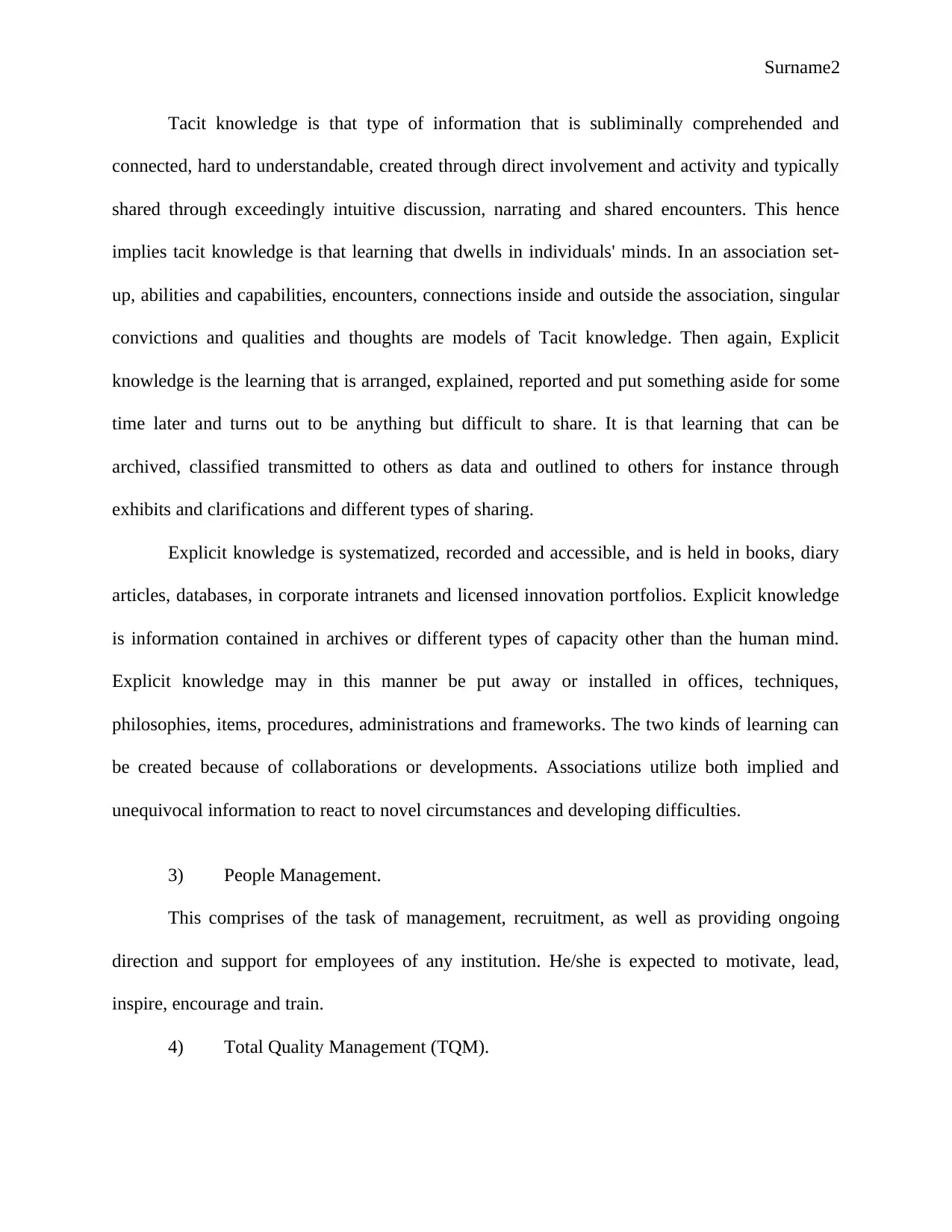
Tacit knowledge is that type of information that is subliminally comprehended and
connected, hard to understandable, created through direct involvement and activity and typically
shared through exceedingly intuitive discussion, narrating and shared encounters. This hence
implies tacit knowledge is that learning that dwells in individuals' minds. In an association set-
up, abilities and capabilities, encounters, connections inside and outside the association, singular
convictions and qualities and thoughts are models of Tacit knowledge. Then again, Explicit
knowledge is the learning that is arranged, explained, reported and put something aside for some
time later and turns out to be anything but difficult to share. It is that learning that can be
archived, classified transmitted to others as data and outlined to others for instance through
exhibits and clarifications and different types of sharing.
Explicit knowledge is systematized, recorded and accessible, and is held in books, diary
articles, databases, in corporate intranets and licensed innovation portfolios. Explicit knowledge
is information contained in archives or different types of capacity other than the human mind.
Explicit knowledge may in this manner be put away or installed in offices, techniques,
philosophies, items, procedures, administrations and frameworks. The two kinds of learning can
be created because of collaborations or developments. Associations utilize both implied and
unequivocal information to react to novel circumstances and developing difficulties.
3) People Management.
This comprises of the task of management, recruitment, as well as providing ongoing
direction and support for employees of any institution. He/she is expected to motivate, lead,
inspire, encourage and train.
4) Total Quality Management (TQM).
Tacit knowledge is that type of information that is subliminally comprehended and
connected, hard to understandable, created through direct involvement and activity and typically
shared through exceedingly intuitive discussion, narrating and shared encounters. This hence
implies tacit knowledge is that learning that dwells in individuals' minds. In an association set-
up, abilities and capabilities, encounters, connections inside and outside the association, singular
convictions and qualities and thoughts are models of Tacit knowledge. Then again, Explicit
knowledge is the learning that is arranged, explained, reported and put something aside for some
time later and turns out to be anything but difficult to share. It is that learning that can be
archived, classified transmitted to others as data and outlined to others for instance through
exhibits and clarifications and different types of sharing.
Explicit knowledge is systematized, recorded and accessible, and is held in books, diary
articles, databases, in corporate intranets and licensed innovation portfolios. Explicit knowledge
is information contained in archives or different types of capacity other than the human mind.
Explicit knowledge may in this manner be put away or installed in offices, techniques,
philosophies, items, procedures, administrations and frameworks. The two kinds of learning can
be created because of collaborations or developments. Associations utilize both implied and
unequivocal information to react to novel circumstances and developing difficulties.
3) People Management.
This comprises of the task of management, recruitment, as well as providing ongoing
direction and support for employees of any institution. He/she is expected to motivate, lead,
inspire, encourage and train.
4) Total Quality Management (TQM).

Surname3
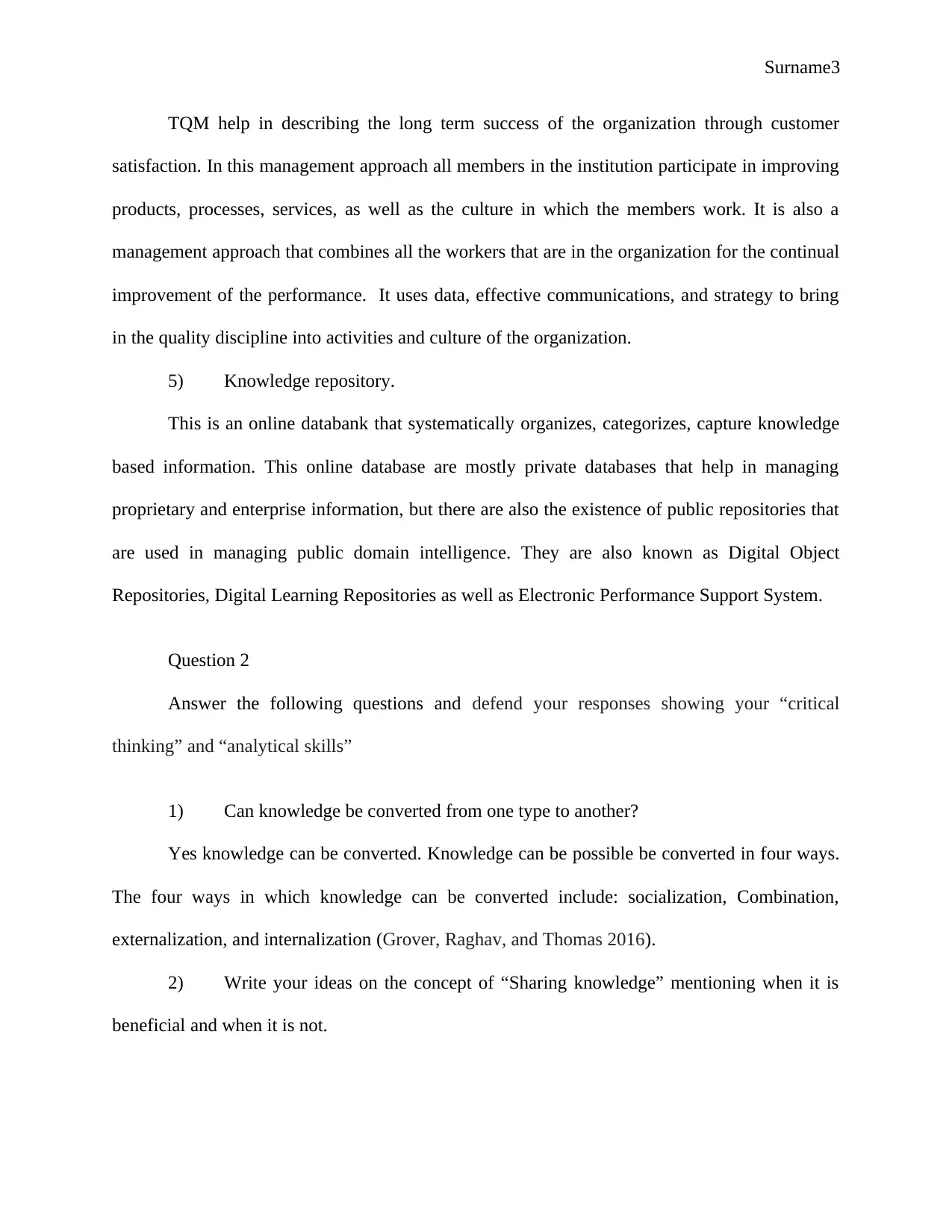
TQM help in describing the long term success of the organization through customer
satisfaction. In this management approach all members in the institution participate in improving
products, processes, services, as well as the culture in which the members work. It is also a
management approach that combines all the workers that are in the organization for the continual
improvement of the performance. It uses data, effective communications, and strategy to bring
in the quality discipline into activities and culture of the organization.
5) Knowledge repository.
This is an online databank that systematically organizes, categorizes, capture knowledge
based information. This online database are mostly private databases that help in managing
proprietary and enterprise information, but there are also the existence of public repositories that
are used in managing public domain intelligence. They are also known as Digital Object
Repositories, Digital Learning Repositories as well as Electronic Performance Support System.
Question 2
Answer the following questions and defend your responses showing your “critical
thinking” and “analytical skills”
1) Can knowledge be converted from one type to another?
Yes knowledge can be converted. Knowledge can be possible be converted in four ways.
The four ways in which knowledge can be converted include: socialization, Combination,
externalization, and internalization (Grover, Raghav, and Thomas 2016).
2) Write your ideas on the concept of “Sharing knowledge” mentioning when it is
beneficial and when it is not.
TQM help in describing the long term success of the organization through customer
satisfaction. In this management approach all members in the institution participate in improving
products, processes, services, as well as the culture in which the members work. It is also a
management approach that combines all the workers that are in the organization for the continual
improvement of the performance. It uses data, effective communications, and strategy to bring
in the quality discipline into activities and culture of the organization.
5) Knowledge repository.
This is an online databank that systematically organizes, categorizes, capture knowledge
based information. This online database are mostly private databases that help in managing
proprietary and enterprise information, but there are also the existence of public repositories that
are used in managing public domain intelligence. They are also known as Digital Object
Repositories, Digital Learning Repositories as well as Electronic Performance Support System.
Question 2
Answer the following questions and defend your responses showing your “critical
thinking” and “analytical skills”
1) Can knowledge be converted from one type to another?
Yes knowledge can be converted. Knowledge can be possible be converted in four ways.
The four ways in which knowledge can be converted include: socialization, Combination,
externalization, and internalization (Grover, Raghav, and Thomas 2016).
2) Write your ideas on the concept of “Sharing knowledge” mentioning when it is
beneficial and when it is not.
⊘ This is a preview!⊘
Do you want full access?
Subscribe today to unlock all pages.

Trusted by 1+ million students worldwide

Surname4
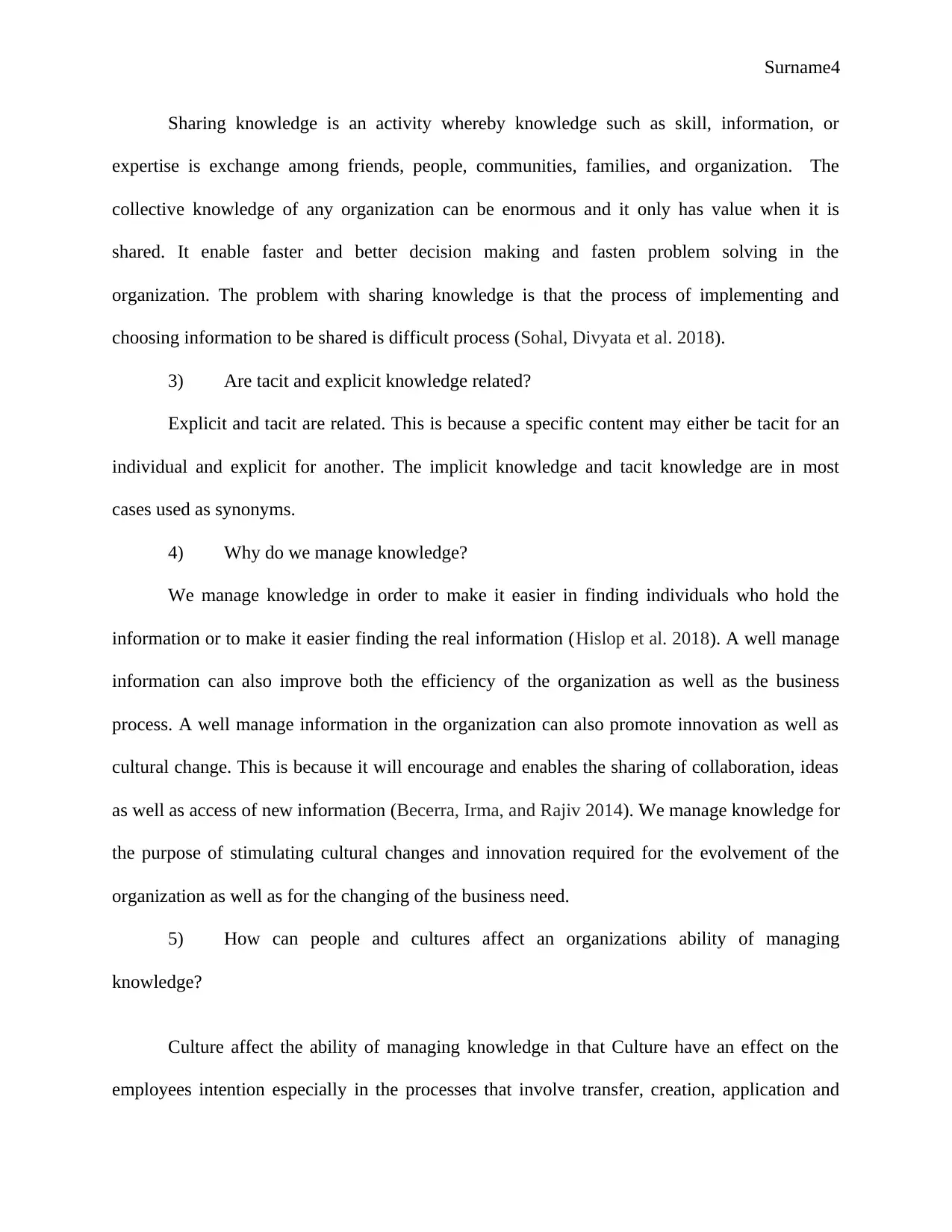
Sharing knowledge is an activity whereby knowledge such as skill, information, or
expertise is exchange among friends, people, communities, families, and organization. The
collective knowledge of any organization can be enormous and it only has value when it is
shared. It enable faster and better decision making and fasten problem solving in the
organization. The problem with sharing knowledge is that the process of implementing and
choosing information to be shared is difficult process (Sohal, Divyata et al. 2018).
3) Are tacit and explicit knowledge related?
Explicit and tacit are related. This is because a specific content may either be tacit for an
individual and explicit for another. The implicit knowledge and tacit knowledge are in most
cases used as synonyms.
4) Why do we manage knowledge?
We manage knowledge in order to make it easier in finding individuals who hold the
information or to make it easier finding the real information (Hislop et al. 2018). A well manage
information can also improve both the efficiency of the organization as well as the business
process. A well manage information in the organization can also promote innovation as well as
cultural change. This is because it will encourage and enables the sharing of collaboration, ideas
as well as access of new information (Becerra, Irma, and Rajiv 2014). We manage knowledge for
the purpose of stimulating cultural changes and innovation required for the evolvement of the
organization as well as for the changing of the business need.
5) How can people and cultures affect an organizations ability of managing
knowledge?
Culture affect the ability of managing knowledge in that Culture have an effect on the
employees intention especially in the processes that involve transfer, creation, application and
Sharing knowledge is an activity whereby knowledge such as skill, information, or
expertise is exchange among friends, people, communities, families, and organization. The
collective knowledge of any organization can be enormous and it only has value when it is
shared. It enable faster and better decision making and fasten problem solving in the
organization. The problem with sharing knowledge is that the process of implementing and
choosing information to be shared is difficult process (Sohal, Divyata et al. 2018).
3) Are tacit and explicit knowledge related?
Explicit and tacit are related. This is because a specific content may either be tacit for an
individual and explicit for another. The implicit knowledge and tacit knowledge are in most
cases used as synonyms.
4) Why do we manage knowledge?
We manage knowledge in order to make it easier in finding individuals who hold the
information or to make it easier finding the real information (Hislop et al. 2018). A well manage
information can also improve both the efficiency of the organization as well as the business
process. A well manage information in the organization can also promote innovation as well as
cultural change. This is because it will encourage and enables the sharing of collaboration, ideas
as well as access of new information (Becerra, Irma, and Rajiv 2014). We manage knowledge for
the purpose of stimulating cultural changes and innovation required for the evolvement of the
organization as well as for the changing of the business need.
5) How can people and cultures affect an organizations ability of managing
knowledge?
Culture affect the ability of managing knowledge in that Culture have an effect on the
employees intention especially in the processes that involve transfer, creation, application and
Paraphrase This Document
Need a fresh take? Get an instant paraphrase of this document with our AI Paraphraser

Surname5
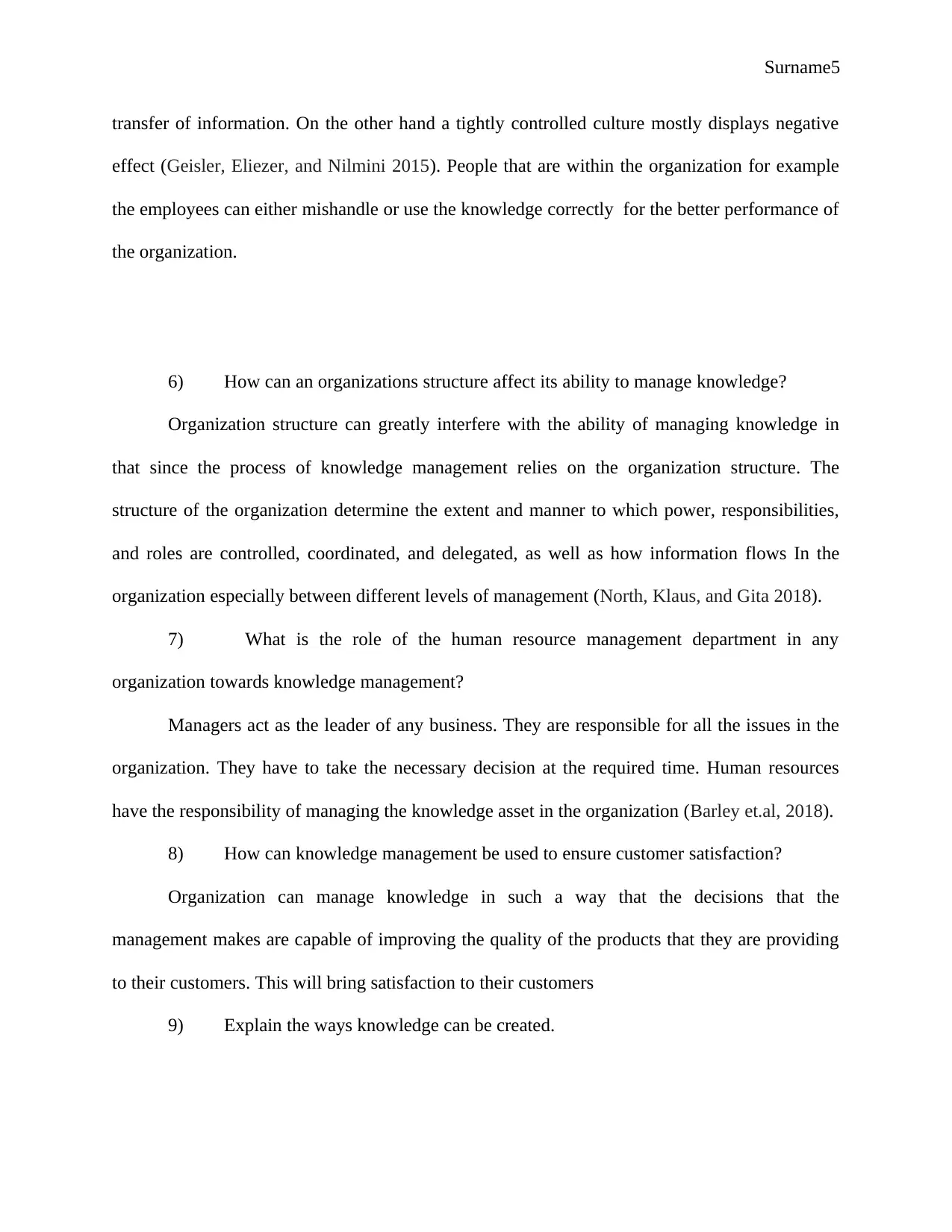
transfer of information. On the other hand a tightly controlled culture mostly displays negative
effect (Geisler, Eliezer, and Nilmini 2015). People that are within the organization for example
the employees can either mishandle or use the knowledge correctly for the better performance of
the organization.
6) How can an organizations structure affect its ability to manage knowledge?
Organization structure can greatly interfere with the ability of managing knowledge in
that since the process of knowledge management relies on the organization structure. The
structure of the organization determine the extent and manner to which power, responsibilities,
and roles are controlled, coordinated, and delegated, as well as how information flows In the
organization especially between different levels of management (North, Klaus, and Gita 2018).
7) What is the role of the human resource management department in any
organization towards knowledge management?
Managers act as the leader of any business. They are responsible for all the issues in the
organization. They have to take the necessary decision at the required time. Human resources
have the responsibility of managing the knowledge asset in the organization (Barley et.al, 2018).
8) How can knowledge management be used to ensure customer satisfaction?
Organization can manage knowledge in such a way that the decisions that the
management makes are capable of improving the quality of the products that they are providing
to their customers. This will bring satisfaction to their customers
9) Explain the ways knowledge can be created.
transfer of information. On the other hand a tightly controlled culture mostly displays negative
effect (Geisler, Eliezer, and Nilmini 2015). People that are within the organization for example
the employees can either mishandle or use the knowledge correctly for the better performance of
the organization.
6) How can an organizations structure affect its ability to manage knowledge?
Organization structure can greatly interfere with the ability of managing knowledge in
that since the process of knowledge management relies on the organization structure. The
structure of the organization determine the extent and manner to which power, responsibilities,
and roles are controlled, coordinated, and delegated, as well as how information flows In the
organization especially between different levels of management (North, Klaus, and Gita 2018).
7) What is the role of the human resource management department in any
organization towards knowledge management?
Managers act as the leader of any business. They are responsible for all the issues in the
organization. They have to take the necessary decision at the required time. Human resources
have the responsibility of managing the knowledge asset in the organization (Barley et.al, 2018).
8) How can knowledge management be used to ensure customer satisfaction?
Organization can manage knowledge in such a way that the decisions that the
management makes are capable of improving the quality of the products that they are providing
to their customers. This will bring satisfaction to their customers
9) Explain the ways knowledge can be created.

Surname6
Yes knowledge can be created. This is because if someone read another person sentence
for example if a person discover new thing, or connect different ideas into a concept, then
knowledge has been created. This is because the value of knowledge has actually allowed idea or
concept to be formed. We can also create knowledge through research example of such is the
knowledge of molecular basis of inheritance created by Watson and Crick.
10) There are many knowledge management thinkers, you have studies three of them
in class, and who are they? What are their different perspectives about knowledge management?
Example of knowledge management thinkers include: David Gurteen, Vala Afshar and
Euan Semple
Yes knowledge can be created. This is because if someone read another person sentence
for example if a person discover new thing, or connect different ideas into a concept, then
knowledge has been created. This is because the value of knowledge has actually allowed idea or
concept to be formed. We can also create knowledge through research example of such is the
knowledge of molecular basis of inheritance created by Watson and Crick.
10) There are many knowledge management thinkers, you have studies three of them
in class, and who are they? What are their different perspectives about knowledge management?
Example of knowledge management thinkers include: David Gurteen, Vala Afshar and
Euan Semple
⊘ This is a preview!⊘
Do you want full access?
Subscribe today to unlock all pages.

Trusted by 1+ million students worldwide

Surname7
Works citied
Barley, William C., Jeffrey W. Treem, and Timothy Kuhn. "Valuing multiple trajectories of
knowledge: A critical review and agenda for knowledge management research." Academy
of Management Annals 12.1 (2018): 278-317.
Becerra-Fernandez, Irma, and Rajiv Sabherwal. Knowledge management: Systems and
processes. Routledge, 2014.
Donate, Mario J., and Jesús D. Sánchez de Pablo. "The role of knowledge-oriented leadership in
knowledge management practices and innovation." Journal of Business Research 68.2
(2015): 360-370.
Geisler, Eliezer, and Nilmini Wickramasinghe. Principles of Knowledge Management: Theory,
Practice, and Cases: Theory, Practice, and Cases. Routledge, 2015.
Grover, Raghav, and Thomas M. Froese. "Knowledge management in construction using a
SocioBIM platform: A case study of AYO smart home project." Procedia
Engineering145 (2016): 1283-1290.
Hislop, Donald, Rachelle Bosua, and Remko Helms. Knowledge management in organizations:
A critical introduction. Oxford University Press, 2018.
North, Klaus, and Gita Kumta. Knowledge management: Value creation through organizational
learning. Springer, 2018.
Sohal, Divyata, et al. "Sustainable Knowledge Management: The Role of Knowledge
Management Audits." Refer 34.1 (2018): 22-25.
Works citied
Barley, William C., Jeffrey W. Treem, and Timothy Kuhn. "Valuing multiple trajectories of
knowledge: A critical review and agenda for knowledge management research." Academy
of Management Annals 12.1 (2018): 278-317.
Becerra-Fernandez, Irma, and Rajiv Sabherwal. Knowledge management: Systems and
processes. Routledge, 2014.
Donate, Mario J., and Jesús D. Sánchez de Pablo. "The role of knowledge-oriented leadership in
knowledge management practices and innovation." Journal of Business Research 68.2
(2015): 360-370.
Geisler, Eliezer, and Nilmini Wickramasinghe. Principles of Knowledge Management: Theory,
Practice, and Cases: Theory, Practice, and Cases. Routledge, 2015.
Grover, Raghav, and Thomas M. Froese. "Knowledge management in construction using a
SocioBIM platform: A case study of AYO smart home project." Procedia
Engineering145 (2016): 1283-1290.
Hislop, Donald, Rachelle Bosua, and Remko Helms. Knowledge management in organizations:
A critical introduction. Oxford University Press, 2018.
North, Klaus, and Gita Kumta. Knowledge management: Value creation through organizational
learning. Springer, 2018.
Sohal, Divyata, et al. "Sustainable Knowledge Management: The Role of Knowledge
Management Audits." Refer 34.1 (2018): 22-25.
Paraphrase This Document
Need a fresh take? Get an instant paraphrase of this document with our AI Paraphraser

Surname8
1 out of 8
Related Documents
Your All-in-One AI-Powered Toolkit for Academic Success.
+13062052269
info@desklib.com
Available 24*7 on WhatsApp / Email
Unlock your academic potential
Copyright © 2020–2025 A2Z Services. All Rights Reserved. Developed and managed by ZUCOL.