Knowledge Management and E-commerce: A Detailed Analysis Report
VerifiedAdded on 2019/11/14
|11
|2203
|204
Report
AI Summary
This report examines the critical role of knowledge management in e-commerce, focusing on how businesses acquire, manage, and apply knowledge to enhance their operations. The study begins by defining knowledge management and its core functions, including knowledge criterion, transfer, and application. It then contrasts traditional commerce with e-commerce, highlighting differences in scope, product variety, and geographical reach. The report delves into the knowledge creation process, identifying key sources like system users, the environment, and expert analysis, along with techniques for knowledge acquisition. The analysis covers the evolution of knowledge adaptation to changing market conditions, both online and offline. The conclusion emphasizes the importance of integrating knowledge management functions within e-commerce systems for improved business outcomes.
Running head: MANAGEMENT AND BUSINESS CONTEXT
Knowledge management and e-commerce
Name of the student
Name of the university
Author Note:
Knowledge management and e-commerce
Name of the student
Name of the university
Author Note:

Paraphrase This Document
Need a fresh take? Get an instant paraphrase of this document with our AI Paraphraser
2
MANAGEMENT AND BUSINESS CONTEXT
Introduction
Knowledge management refers to the process of the establishment, sharing, management
and the usage of the different kinds of knowledge and data that are received from the
organization. The following refers to a multidisciplinary approach which helps the organization
to effectively manage and achieve the different objectives of the organization. In this following
essay the researcher has taken into consideration the knowledge management aspects of an
organization. The main aim of undertaking the research is to determine the amount of knowledge
management that Everest Treks need to have.
The last decade has seen an immense rise in the importance of knowledge management in
and around the different parts of the world. Compared to other managed resources such as assets,
capital and people knowledge is based upon perpetual regeneration. The more knowledge is used
the more is the knowledge produced. Knowledge Management usually comprises of three main
functions;
a. Knowledge Criterion- It consists of processes and sub processes of acquisition process.
Processing new knowledge, validation of the information and integrating the new
knowledge with the existing system (Laudon & Traver, 2013).
b. Knowledge Transfer- The transfer of knowledge refers to the question of how, what,
when and in which form the knowledge the purpose is delivered to the business
organization.
c. Knowledge Application- The application of knowledge refers to the methodology by
which knowledge is employed and integrated into the organization (Mazzarol, 2015).
MANAGEMENT AND BUSINESS CONTEXT
Introduction
Knowledge management refers to the process of the establishment, sharing, management
and the usage of the different kinds of knowledge and data that are received from the
organization. The following refers to a multidisciplinary approach which helps the organization
to effectively manage and achieve the different objectives of the organization. In this following
essay the researcher has taken into consideration the knowledge management aspects of an
organization. The main aim of undertaking the research is to determine the amount of knowledge
management that Everest Treks need to have.
The last decade has seen an immense rise in the importance of knowledge management in
and around the different parts of the world. Compared to other managed resources such as assets,
capital and people knowledge is based upon perpetual regeneration. The more knowledge is used
the more is the knowledge produced. Knowledge Management usually comprises of three main
functions;
a. Knowledge Criterion- It consists of processes and sub processes of acquisition process.
Processing new knowledge, validation of the information and integrating the new
knowledge with the existing system (Laudon & Traver, 2013).
b. Knowledge Transfer- The transfer of knowledge refers to the question of how, what,
when and in which form the knowledge the purpose is delivered to the business
organization.
c. Knowledge Application- The application of knowledge refers to the methodology by
which knowledge is employed and integrated into the organization (Mazzarol, 2015).
3
MANAGEMENT AND BUSINESS CONTEXT
The knowledge management functions create a continuous knowledge feedback problem, the
application of the existing knowledge, a set of new possibilities for the creation of new
knowledge (Palacios, Soto & Merigó, 2015).
Internal Analysis
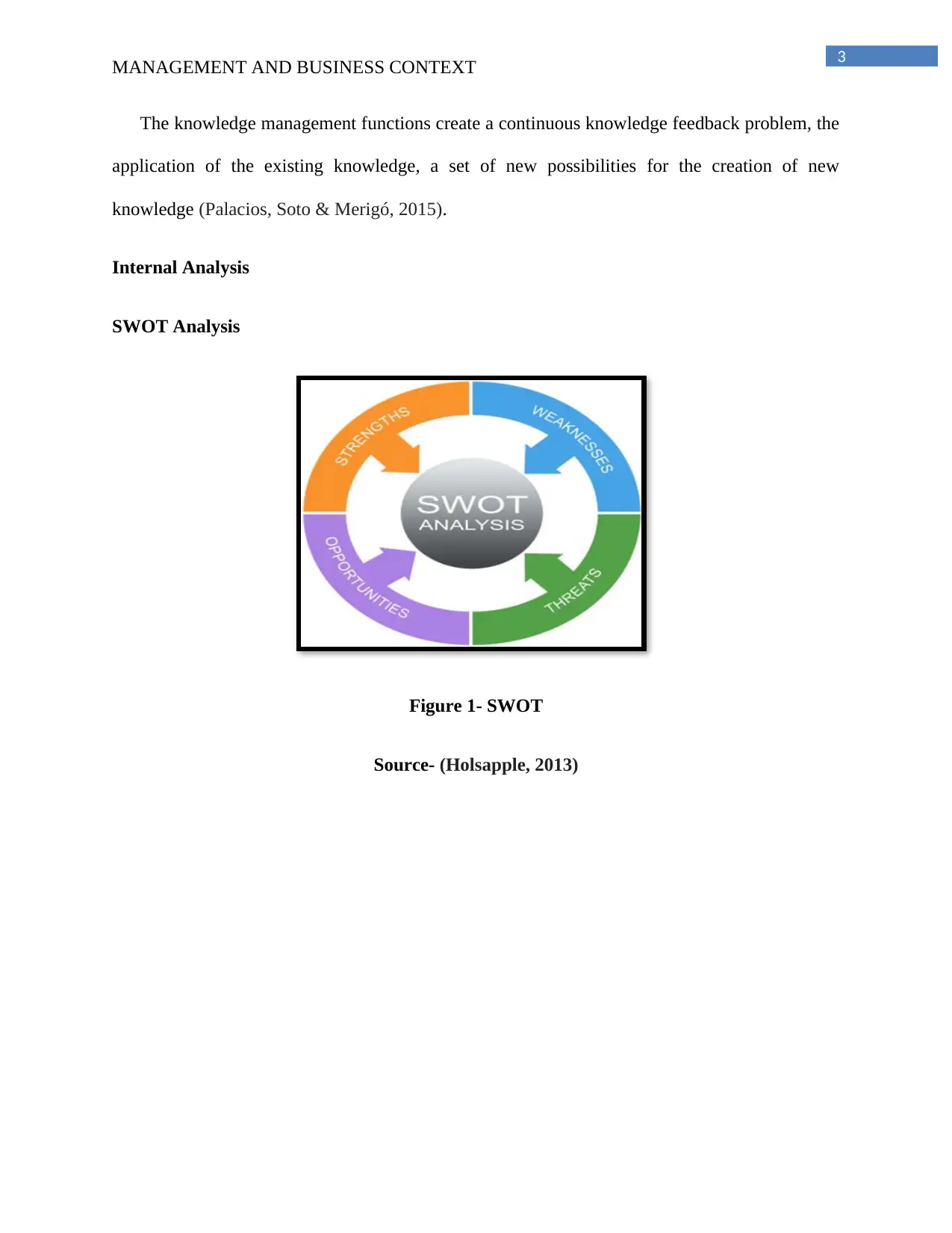
SWOT Analysis
Figure 1- SWOT
Source- (Holsapple, 2013)
MANAGEMENT AND BUSINESS CONTEXT
The knowledge management functions create a continuous knowledge feedback problem, the
application of the existing knowledge, a set of new possibilities for the creation of new
knowledge (Palacios, Soto & Merigó, 2015).
Internal Analysis
SWOT Analysis
Figure 1- SWOT
Source- (Holsapple, 2013)
⊘ This is a preview!⊘
Do you want full access?
Subscribe today to unlock all pages.

Trusted by 1+ million students worldwide

4
MANAGEMENT AND BUSINESS CONTEXT
Figure No 2- External Analyses
Source- (Geisler & Wickramasinghe, 2015)
Figure No 3- Internal Analyses
Source- (Geisler & Wickramasinghe, 2015)
MANAGEMENT AND BUSINESS CONTEXT
Figure No 2- External Analyses
Source- (Geisler & Wickramasinghe, 2015)
Figure No 3- Internal Analyses
Source- (Geisler & Wickramasinghe, 2015)
Paraphrase This Document
Need a fresh take? Get an instant paraphrase of this document with our AI Paraphraser
5
MANAGEMENT AND BUSINESS CONTEXT
Commerce and E Commerce the Knowledge Process
The transformation of the knowledge process functions from the domain of commerce to
that of e commerce (Teo & Bhattacherjee, 2014). The following process helps the organization to
comprehensively formalize the knowledge of the humans and the knowledge processes to
replicate human intelligence. The perfect starting point for the broad comparison between the
electronic and the traditional commerce system would be the best one to describe (Chong et al.
2013).
Differences of Scope
There is a vast difference between the electronic and traditional commerce system. The
researcher has provided some of the common and critical differences between the two parts of
business which have a huge impact on the knowledge management of the organization (Gholami
et al. 2013). The main contrasting factors are the scope of time, scope of the products and the
geographical scope.
a. The traditional stores have a limited or a maximum or minimum supply of items whereas
online stores has a huge collections of products as because market size is much bigger
than the traditional stores and the unlimited number of products these online stores have
in their disposal (Laudon & Traver, 2013).
b. Secondly the conventional stores have a limited variety of products under their fold (Chiu
et al. 2014). For example a shoe store deals exclusively with the shoes whereas an e
commerce system has a wide range of different products starting from a blade, clothes to
fashionable items, shoes etc.
MANAGEMENT AND BUSINESS CONTEXT
Commerce and E Commerce the Knowledge Process
The transformation of the knowledge process functions from the domain of commerce to
that of e commerce (Teo & Bhattacherjee, 2014). The following process helps the organization to
comprehensively formalize the knowledge of the humans and the knowledge processes to
replicate human intelligence. The perfect starting point for the broad comparison between the
electronic and the traditional commerce system would be the best one to describe (Chong et al.
2013).
Differences of Scope
There is a vast difference between the electronic and traditional commerce system. The
researcher has provided some of the common and critical differences between the two parts of
business which have a huge impact on the knowledge management of the organization (Gholami
et al. 2013). The main contrasting factors are the scope of time, scope of the products and the
geographical scope.
a. The traditional stores have a limited or a maximum or minimum supply of items whereas
online stores has a huge collections of products as because market size is much bigger
than the traditional stores and the unlimited number of products these online stores have
in their disposal (Laudon & Traver, 2013).
b. Secondly the conventional stores have a limited variety of products under their fold (Chiu
et al. 2014). For example a shoe store deals exclusively with the shoes whereas an e
commerce system has a wide range of different products starting from a blade, clothes to
fashionable items, shoes etc.
6
MANAGEMENT AND BUSINESS CONTEXT
c. It is very much difficult for a traditional store to keep open for 24 hours a day as it
involves a lot of problems. There will be no consumers available at night in a
conventional store (Fang et al. 2014). On the other hand an e commerce business is open
round the clock and customers can easily place their order at any time of the day or night.
The online system of the e commerce is way ahead and much more convenient for the
customers and the people who are busy all the time (Laudon & Traver, 2013).
d. Physical commerce is limited to the sale of the products locally and in regional markets.
The largest MNC’s established in a particular area are limited to the sales of their
products in just a small area (Wang, Wang & Liu, 2016). The online stores on the other
hand may start locally but given a proper marketing and brand promotion will surely be
able to extend its reach globally. The global market will help the business to grow and
earn huge revenues. The global reach of the business will help to gather more and more
knowledge in the organizational system. the inflow of quality local, regional and global
knowledge will help Everest Trek to organize itself according to the demands of the
customers and arrange the system accordingly.
Creation of the Knowledge
The experts dealing in Knowledge management believes that the creation of the
knowledge involves a continuous transformation of tactical knowledge into explicit knowledge
which can be expressed with a formal representation. The following description usually refers to
the knowledge acquired from the human experts. The total information is stored in the local
databases and other forms of electronic repositories increases gradually. The use of the new
technologies requires very less human intervention as because all of the system is controlled via
MANAGEMENT AND BUSINESS CONTEXT
c. It is very much difficult for a traditional store to keep open for 24 hours a day as it
involves a lot of problems. There will be no consumers available at night in a
conventional store (Fang et al. 2014). On the other hand an e commerce business is open
round the clock and customers can easily place their order at any time of the day or night.
The online system of the e commerce is way ahead and much more convenient for the
customers and the people who are busy all the time (Laudon & Traver, 2013).
d. Physical commerce is limited to the sale of the products locally and in regional markets.
The largest MNC’s established in a particular area are limited to the sales of their
products in just a small area (Wang, Wang & Liu, 2016). The online stores on the other
hand may start locally but given a proper marketing and brand promotion will surely be
able to extend its reach globally. The global market will help the business to grow and
earn huge revenues. The global reach of the business will help to gather more and more
knowledge in the organizational system. the inflow of quality local, regional and global
knowledge will help Everest Trek to organize itself according to the demands of the
customers and arrange the system accordingly.
Creation of the Knowledge
The experts dealing in Knowledge management believes that the creation of the
knowledge involves a continuous transformation of tactical knowledge into explicit knowledge
which can be expressed with a formal representation. The following description usually refers to
the knowledge acquired from the human experts. The total information is stored in the local
databases and other forms of electronic repositories increases gradually. The use of the new
technologies requires very less human intervention as because all of the system is controlled via
⊘ This is a preview!⊘
Do you want full access?
Subscribe today to unlock all pages.
Trusted by 1+ million students worldwide
7
MANAGEMENT AND BUSINESS CONTEXT
the knowledge management software’s installed by the organizations to perform their daily
business. The researcher has addressed each of the sources in detail;
1. Users of the System- According to (Wang, Wang & Liu, 2016) The organizations depend
on the different electronic data to be the perfect in storing the different information of the
organization. The following includes the transparent sources of information that are
related to the customers such as originating IP logs, cookies, stored sessions and many
more as such. Apart from this there are many more direct methods to fetch out
information from the customers. The system used by the organizations to gather the
knowledge serves as a mediator between the customers and the organization. The
organization can conceptualize the information received from the customers in a similar
way like the information from the organization (Andam, 2014).
2. The Environment- The organization, customers and the suppliers are all involved in the
environment in which the system operates. In the business context environment can be
termed as the place or the area in which the suppliers, people and the customers operate.
The typical factors that determine the system are economic factors, new and latest
technologies, cultural events, fashion trends and many more as such (Hartono et al.
2014).
3. Experts- Knowledge acquisition from the human experts is a very difficult task thus the
organizations employ different other tactics to acquire knowledge. The foundation of the
human experience derived consumptions, in which the system’s knowledge grows and
evolves (Huang & Benyoucef, 2013).
MANAGEMENT AND BUSINESS CONTEXT
the knowledge management software’s installed by the organizations to perform their daily
business. The researcher has addressed each of the sources in detail;
1. Users of the System- According to (Wang, Wang & Liu, 2016) The organizations depend
on the different electronic data to be the perfect in storing the different information of the
organization. The following includes the transparent sources of information that are
related to the customers such as originating IP logs, cookies, stored sessions and many
more as such. Apart from this there are many more direct methods to fetch out
information from the customers. The system used by the organizations to gather the
knowledge serves as a mediator between the customers and the organization. The
organization can conceptualize the information received from the customers in a similar
way like the information from the organization (Andam, 2014).
2. The Environment- The organization, customers and the suppliers are all involved in the
environment in which the system operates. In the business context environment can be
termed as the place or the area in which the suppliers, people and the customers operate.
The typical factors that determine the system are economic factors, new and latest
technologies, cultural events, fashion trends and many more as such (Hartono et al.
2014).
3. Experts- Knowledge acquisition from the human experts is a very difficult task thus the
organizations employ different other tactics to acquire knowledge. The foundation of the
human experience derived consumptions, in which the system’s knowledge grows and
evolves (Huang & Benyoucef, 2013).
Paraphrase This Document
Need a fresh take? Get an instant paraphrase of this document with our AI Paraphraser
8
MANAGEMENT AND BUSINESS CONTEXT
Knowledge acquisition techniques
Knowledge acquisition from the information that is stored in the system applies to the
information collected about the customers from the customers themselves and the environment in
which the business operates (Da Costa, 2016). As mentioned earlier environment is the particular
sector where the business, the people and the suppliers are based. The knowledge acquisition
involves the addition of new knowledge on the existing knowledge, the depreciation of the
existing knowledge and removing the unnecessary knowledge that is of no use for the
organization (Hartono et al. 2014). The organizations usually take no risks and concentrates both
on the knowledge acquisition and the evolution of the knowledge. Evolution of the knowledge
by the organizations is done to keep a regular update and to adapt to the changing conditions of
the market both locally and globally (Hartono et al. 2014).
The adaption of knowledge involves the addition of new knowledge as well as the
creation of new databases with the new and latest knowledge (Hartono et al. 2014). The
organizations ensure that all these knowledge are evaluated and correlated so that no irrelevant
knowledge is present in the system. There are generally two types of adaption involved in the
acquisition of knowledge namely on-line and offline. Online adaption of knowledge is done
when the customer is online or he is surfing the internet and the system is supporting him while
in the second case the customer is supported by the employees of the organization in real time.
MANAGEMENT AND BUSINESS CONTEXT
Knowledge acquisition techniques
Knowledge acquisition from the information that is stored in the system applies to the
information collected about the customers from the customers themselves and the environment in
which the business operates (Da Costa, 2016). As mentioned earlier environment is the particular
sector where the business, the people and the suppliers are based. The knowledge acquisition
involves the addition of new knowledge on the existing knowledge, the depreciation of the
existing knowledge and removing the unnecessary knowledge that is of no use for the
organization (Hartono et al. 2014). The organizations usually take no risks and concentrates both
on the knowledge acquisition and the evolution of the knowledge. Evolution of the knowledge
by the organizations is done to keep a regular update and to adapt to the changing conditions of
the market both locally and globally (Hartono et al. 2014).
The adaption of knowledge involves the addition of new knowledge as well as the
creation of new databases with the new and latest knowledge (Hartono et al. 2014). The
organizations ensure that all these knowledge are evaluated and correlated so that no irrelevant
knowledge is present in the system. There are generally two types of adaption involved in the
acquisition of knowledge namely on-line and offline. Online adaption of knowledge is done
when the customer is online or he is surfing the internet and the system is supporting him while
in the second case the customer is supported by the employees of the organization in real time.
9
MANAGEMENT AND BUSINESS CONTEXT
Conclusion
In this following paper the researcher has analyzed the different knowledge management
aspect of the e-commerce systems, through the integration of the functions of the knowledge
acquired by an e-commerce system. A thorough scrutiny of the following report will help the
readers to gain a crucial knowledge about the knowledge management system of an organization.
The different perspectives of the research have highlighted different knowledge about e
commerce and the level of human analysis and the process by which the latest systems are
implemented across the organization.
MANAGEMENT AND BUSINESS CONTEXT
Conclusion
In this following paper the researcher has analyzed the different knowledge management
aspect of the e-commerce systems, through the integration of the functions of the knowledge
acquired by an e-commerce system. A thorough scrutiny of the following report will help the
readers to gain a crucial knowledge about the knowledge management system of an organization.
The different perspectives of the research have highlighted different knowledge about e
commerce and the level of human analysis and the process by which the latest systems are
implemented across the organization.
⊘ This is a preview!⊘
Do you want full access?
Subscribe today to unlock all pages.
Trusted by 1+ million students worldwide
10
MANAGEMENT AND BUSINESS CONTEXT
References
Andam, Z. R. (2014). e-Commerce and e-Business.
Chiu, C. M., Wang, E. T., Fang, Y. H., & Huang, H. Y. (2014). Understanding customers' repeat
purchase intentions in B2C e‐commerce: the roles of utilitarian value, hedonic value and
perceived risk. Information Systems Journal, 24(1), 85-114.
Chong, A. Y. L., Chan, F. T., Goh, M., & Tiwari, M. K. (2013). Do interorganisational
relationships and knowledge-management practices enhance collaborative commerce
adoption?. International Journal of Production Research, 51(7), 2006-2018.
Da Costa, E. (2016). Global e-commerce strategies for small businesses. Mit Press.
Fang, Y., Qureshi, I., Sun, H., McCole, P., Ramsey, E., & Lim, K. H. (2014). Trust, Satisfaction,
and Online Repurchase Intention: The Moderating Role of Perceived Effectiveness of E-
Commerce Institutional Mechanisms. Mis Quarterly, 38(2).
Geisler, E., & Wickramasinghe, N. (2015). Principles of knowledge management: Theory,
practice, and cases. Routledge.
Gholami, M. H., Asli, M. N., Nazari-Shirkouhi, S., & Noruzy, A. (2013). Investigating the
influence of knowledge management practices on organizational performance: an
empirical study. Acta Polytechnica Hungarica, 10(2), 205-216.
Hartono, E., Holsapple, C. W., Kim, K. Y., Na, K. S., & Simpson, J. T. (2014). Measuring
perceived security in B2C electronic commerce website usage: A respecification and
validation. Decision Support Systems, 62, 11-21.
MANAGEMENT AND BUSINESS CONTEXT
References
Andam, Z. R. (2014). e-Commerce and e-Business.
Chiu, C. M., Wang, E. T., Fang, Y. H., & Huang, H. Y. (2014). Understanding customers' repeat
purchase intentions in B2C e‐commerce: the roles of utilitarian value, hedonic value and
perceived risk. Information Systems Journal, 24(1), 85-114.
Chong, A. Y. L., Chan, F. T., Goh, M., & Tiwari, M. K. (2013). Do interorganisational
relationships and knowledge-management practices enhance collaborative commerce
adoption?. International Journal of Production Research, 51(7), 2006-2018.
Da Costa, E. (2016). Global e-commerce strategies for small businesses. Mit Press.
Fang, Y., Qureshi, I., Sun, H., McCole, P., Ramsey, E., & Lim, K. H. (2014). Trust, Satisfaction,
and Online Repurchase Intention: The Moderating Role of Perceived Effectiveness of E-
Commerce Institutional Mechanisms. Mis Quarterly, 38(2).
Geisler, E., & Wickramasinghe, N. (2015). Principles of knowledge management: Theory,
practice, and cases. Routledge.
Gholami, M. H., Asli, M. N., Nazari-Shirkouhi, S., & Noruzy, A. (2013). Investigating the
influence of knowledge management practices on organizational performance: an
empirical study. Acta Polytechnica Hungarica, 10(2), 205-216.
Hartono, E., Holsapple, C. W., Kim, K. Y., Na, K. S., & Simpson, J. T. (2014). Measuring
perceived security in B2C electronic commerce website usage: A respecification and
validation. Decision Support Systems, 62, 11-21.
Paraphrase This Document
Need a fresh take? Get an instant paraphrase of this document with our AI Paraphraser
11
MANAGEMENT AND BUSINESS CONTEXT
Holsapple, C. (Ed.). (2013). Handbook on knowledge management 1: Knowledge matters (Vol.
1). Springer Science & Business Media.
Huang, Z., & Benyoucef, M. (2013). From e-commerce to social commerce: A close look at
design features. Electronic Commerce Research and Applications, 12(4), 246-259.
Laudon, K. C., & Traver, C. G. (2013). E-commerce. Pearson.
Laudon, K. C., & Traver, C. G. (2013). E-commerce. Pearson.
Mazzarol, T. (2015). SMEs engagement with e-commerce, e-business and e-marketing. Small
enterprise research, 22(1), 79-90.
Palacios-Marqués, D., Soto-Acosta, P., & Merigó, J. M. (2015). Analyzing the effects of
technological, organizational and competition factors on Web knowledge exchange in
SMEs. Telematics and Informatics, 32(1), 23-32.
Teo, T. S., & Bhattacherjee, A. (2014). Knowledge transfer and utilization in IT outsourcing
partnerships: A preliminary model of antecedents and outcomes. Information &
Management, 51(2), 177-186.
Wang, W. T., Wang, Y. S., & Liu, E. R. (2016). The stickiness intention of group-buying
websites: The integration of the commitment–trust theory and e-commerce success
model. Information & Management, 53(5), 625-642.
MANAGEMENT AND BUSINESS CONTEXT
Holsapple, C. (Ed.). (2013). Handbook on knowledge management 1: Knowledge matters (Vol.
1). Springer Science & Business Media.
Huang, Z., & Benyoucef, M. (2013). From e-commerce to social commerce: A close look at
design features. Electronic Commerce Research and Applications, 12(4), 246-259.
Laudon, K. C., & Traver, C. G. (2013). E-commerce. Pearson.
Laudon, K. C., & Traver, C. G. (2013). E-commerce. Pearson.
Mazzarol, T. (2015). SMEs engagement with e-commerce, e-business and e-marketing. Small
enterprise research, 22(1), 79-90.
Palacios-Marqués, D., Soto-Acosta, P., & Merigó, J. M. (2015). Analyzing the effects of
technological, organizational and competition factors on Web knowledge exchange in
SMEs. Telematics and Informatics, 32(1), 23-32.
Teo, T. S., & Bhattacherjee, A. (2014). Knowledge transfer and utilization in IT outsourcing
partnerships: A preliminary model of antecedents and outcomes. Information &
Management, 51(2), 177-186.
Wang, W. T., Wang, Y. S., & Liu, E. R. (2016). The stickiness intention of group-buying
websites: The integration of the commitment–trust theory and e-commerce success
model. Information & Management, 53(5), 625-642.

1 out of 11


Related Documents


Your All-in-One AI-Powered Toolkit for Academic Success.
+13062052269
info@desklib.com
Available 24*7 on WhatsApp / Email
![[object Object]](/_next/static/media/star-bottom.7253800d.svg)
Unlock your academic potential
Copyright © 2020–2026 A2Z Services. All Rights Reserved. Developed and managed by ZUCOL.